brake CHEVROLET SUBURBAN 1994 User Guide
[x] Cancel search | Manufacturer: CHEVROLET, Model Year: 1994, Model line: SUBURBAN, Model: CHEVROLET SUBURBAN 1994Pages: 385, PDF Size: 19.88 MB
Page 87 of 385
If you have four-wheel drive and your transfer case is in “N” (Neutral),
your vehicle will be free to roll, even if your shift lever is in
“P” (Park). So,
be sure the transfer case is in a drive gear - not in “N” (Neutral). Follow
the proper steps
to be sure your vehicle won’t move. See “Shifting Into ‘P’
(Park)” in the Index.
If you’re pulling a trailer, see “Towing a Trailer” in the Index.
Four Wheel Drive
If your vehicle has four-wheel drive, you can send your engine’s driving
power
to all four wheels for extra traction. To get the most satisfaction out
of four-wheel drive, you must be familiar with it’s operation. Read the part
that follows before using four-wheel drive.
You should use 2H for most
normal driving conditions.
Rear-wheel antilock brakes do
not work when you shift into four-wheel
drive. Your regular brakes will
still work. When you shift back into
two-wheel drive, your rear-wheel antilock brakes will take over again.
2-32
ProCarManuals.com
Page 91 of 385
Hectric Tailgate Glass Release
Before operating your electric tailgate glass release, see the caution under
“Tailgate Glass, Tailgate and Rear Doors” in this section.
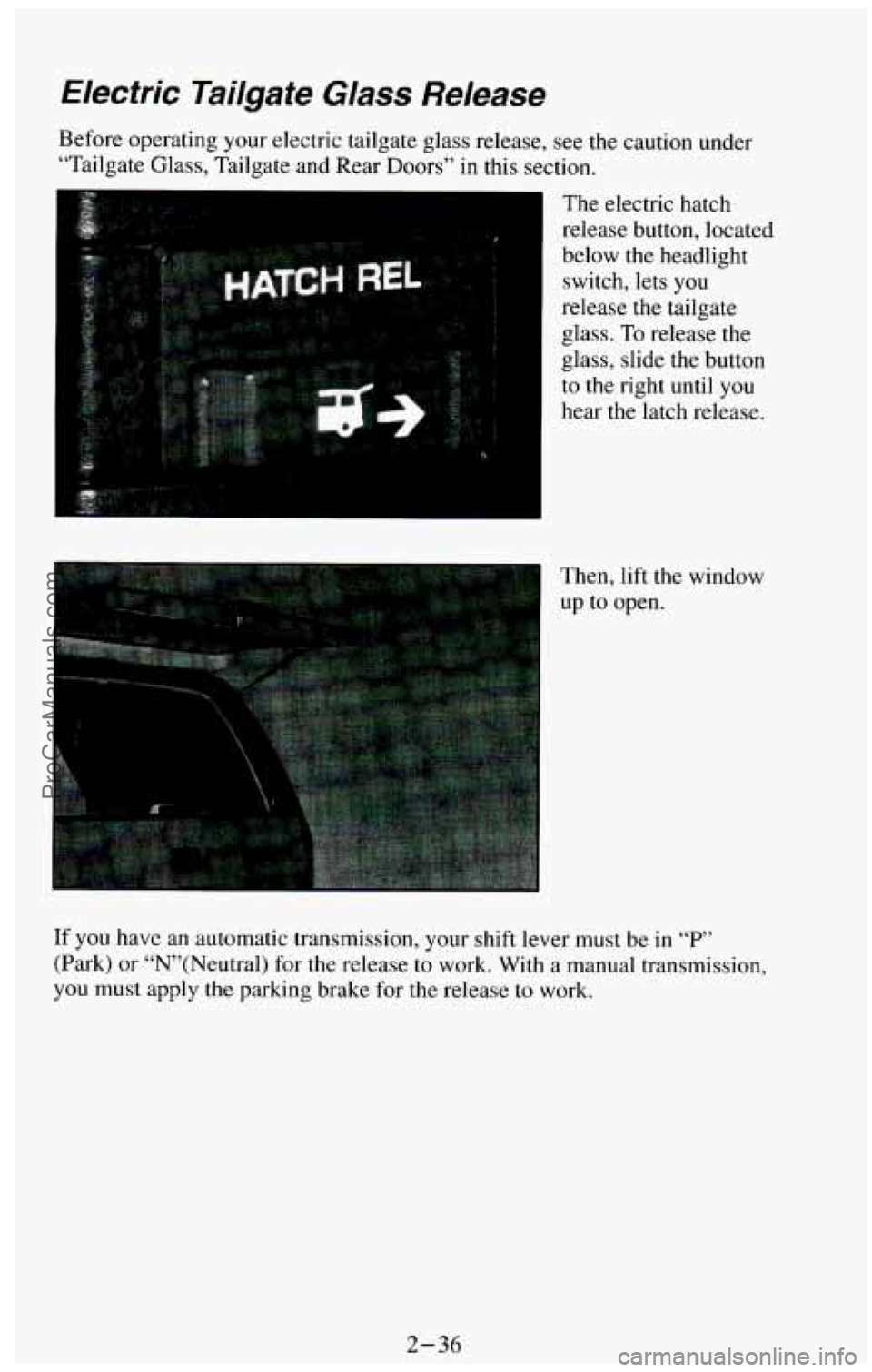
The electric hatch
release button, located
below the headlight switch, lets you
release the tailgate
glass.
To release the
glass, slide the button
to the right until
you
hear the latch release.
Then, lift
the window
up
to open.
If you have an automatic transmission, your shift lever must be in “P’
(Park) or “N”(Neutra1) for the release to work. With a manual transmission,
you
must apply the parking brake for the release to work.
2-36
ProCarManuals.com
Page 98 of 385
When you apply your brakes, the Cruise Control shuts off.
To Set Cruise Control
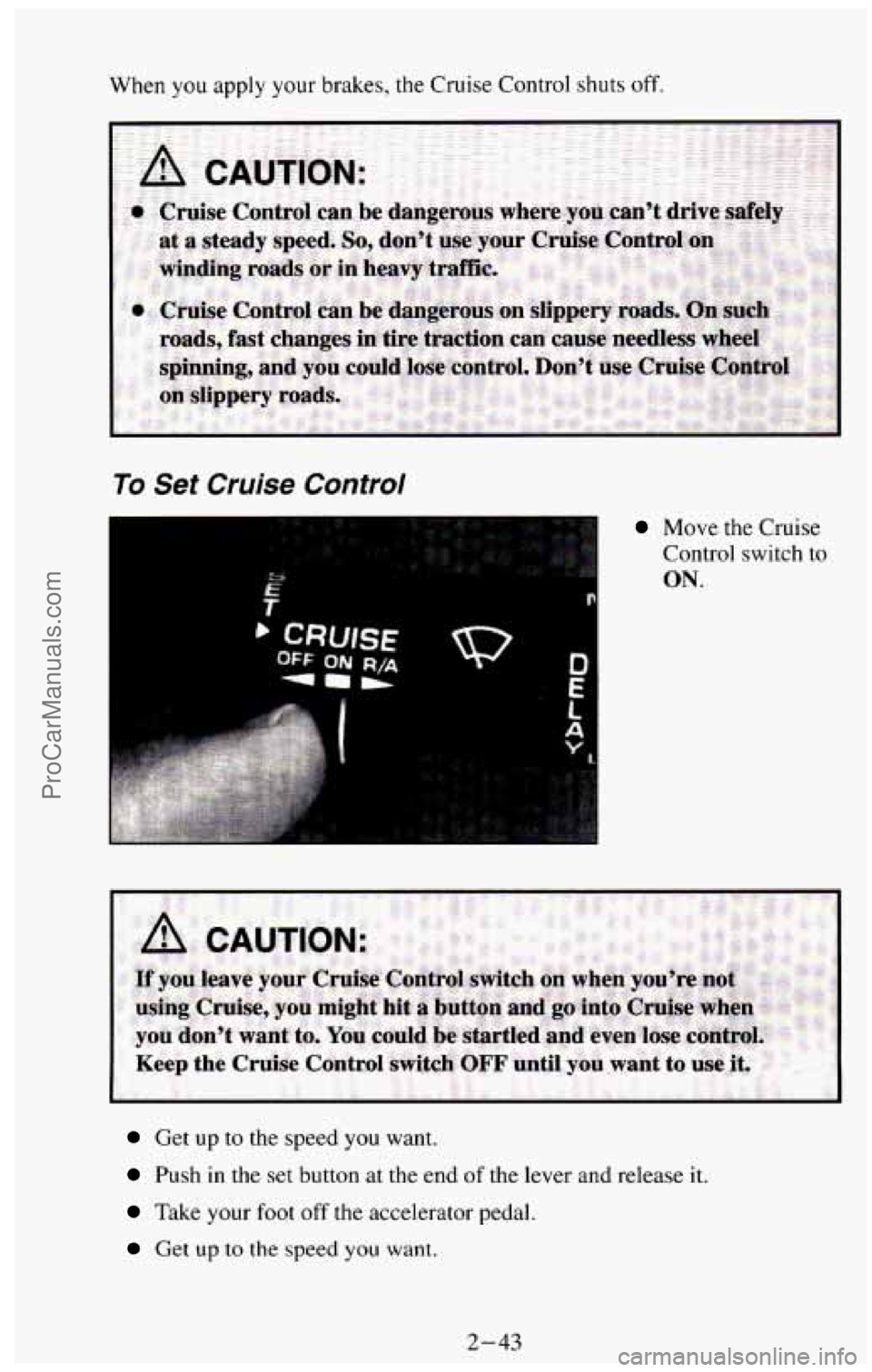
Move the Cruise
Control
switch to
ON.
Get up to the speed you want.
Push in the set button at the end of the lever and release it.
Take your foot off the accelerator pedal.
Get up to the speed you want.
2-43
ProCarManuals.com
Page 99 of 385
To Resume a Sef Speed
Suppose you set your Cruise Control at a desired speed and then you apply
the brake. This,
of course, shuts off the Cruise Control. But you don’t need
to reset
it.
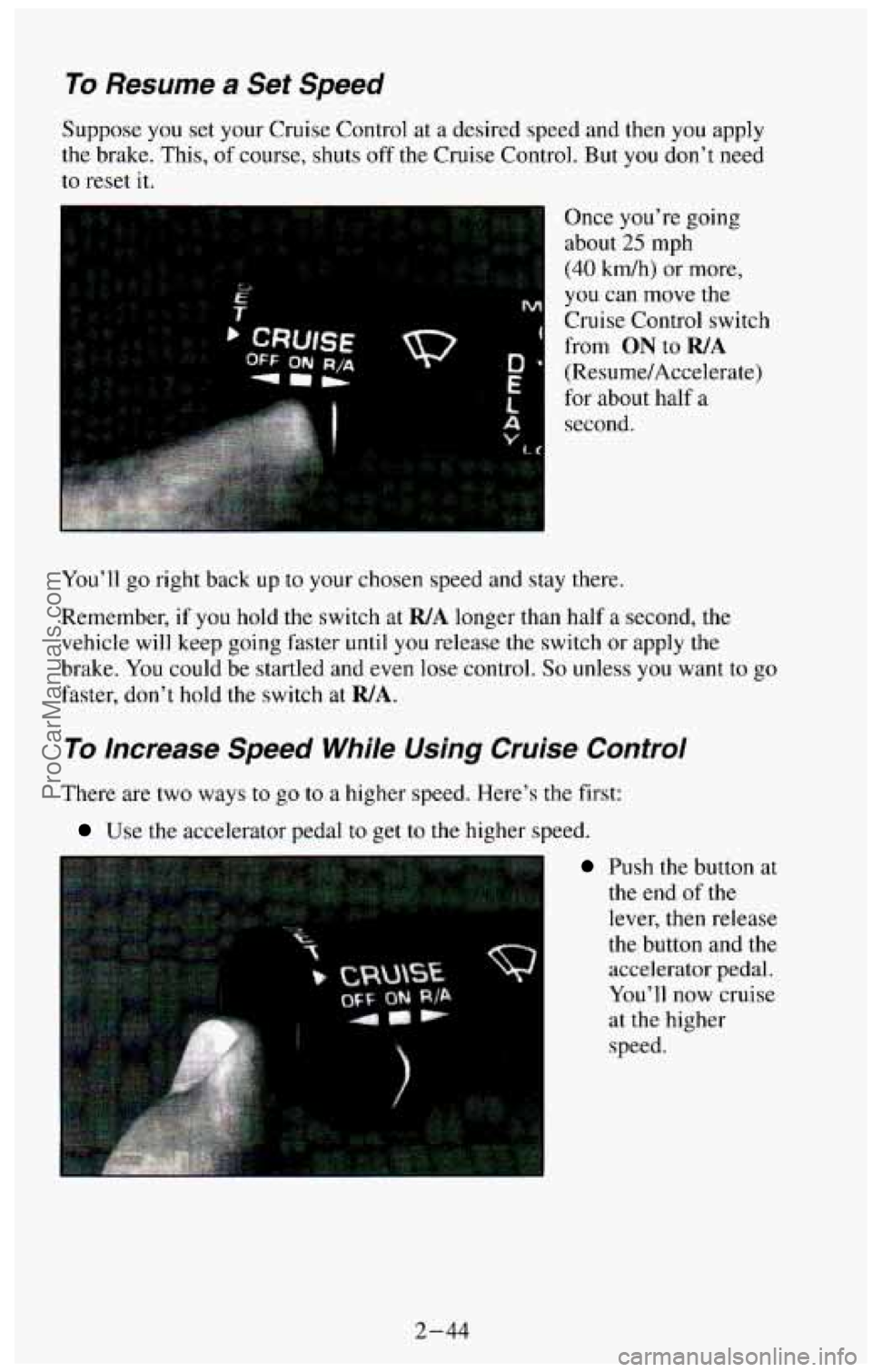
Once you’re going
about
25 mph
(40 km/h) or more,
you can move the
Cruise Control switch
from
ON to WA
(Resume/Accelerate)
for about half a
second.
You’ll go right back
up to your chosen speed and stay there.
Remember, if you hold the switch at
R/A longer than half a second, the
vehicle
will keep going faster until you release the switch or apply the
brake.
You could be startled and even lose control. So unless you want to go
faster, don’t hold the switch at
WA.
To lncrease Speed While Using Cruise Control
There are two ways to go to a higher speed. Here’s the first:
Use the accelerator pedal to get to the higher speed.
Push the button at
the end of
the
lever, then release
the button and the
accelerator pedal.
You’ll
now cruise
at the higher
speed.
2-44
ProCarManuals.com
Page 101 of 385
Using Cruise Control on Hills
How well your Cruise Control will work on hills depends upon your speed,
load, and the steepness of the hills. When going up steep hills, you may
have to step on the accelerator pedal to maintain your speed. When going
downhill, you may have to brake or shift to a lower gear to keep your speed
down. Of course, applying the brake takes you out
of Cruise Control. Many
drivers find this to be too much trouble and don't use Cruise Control on
steep hills.
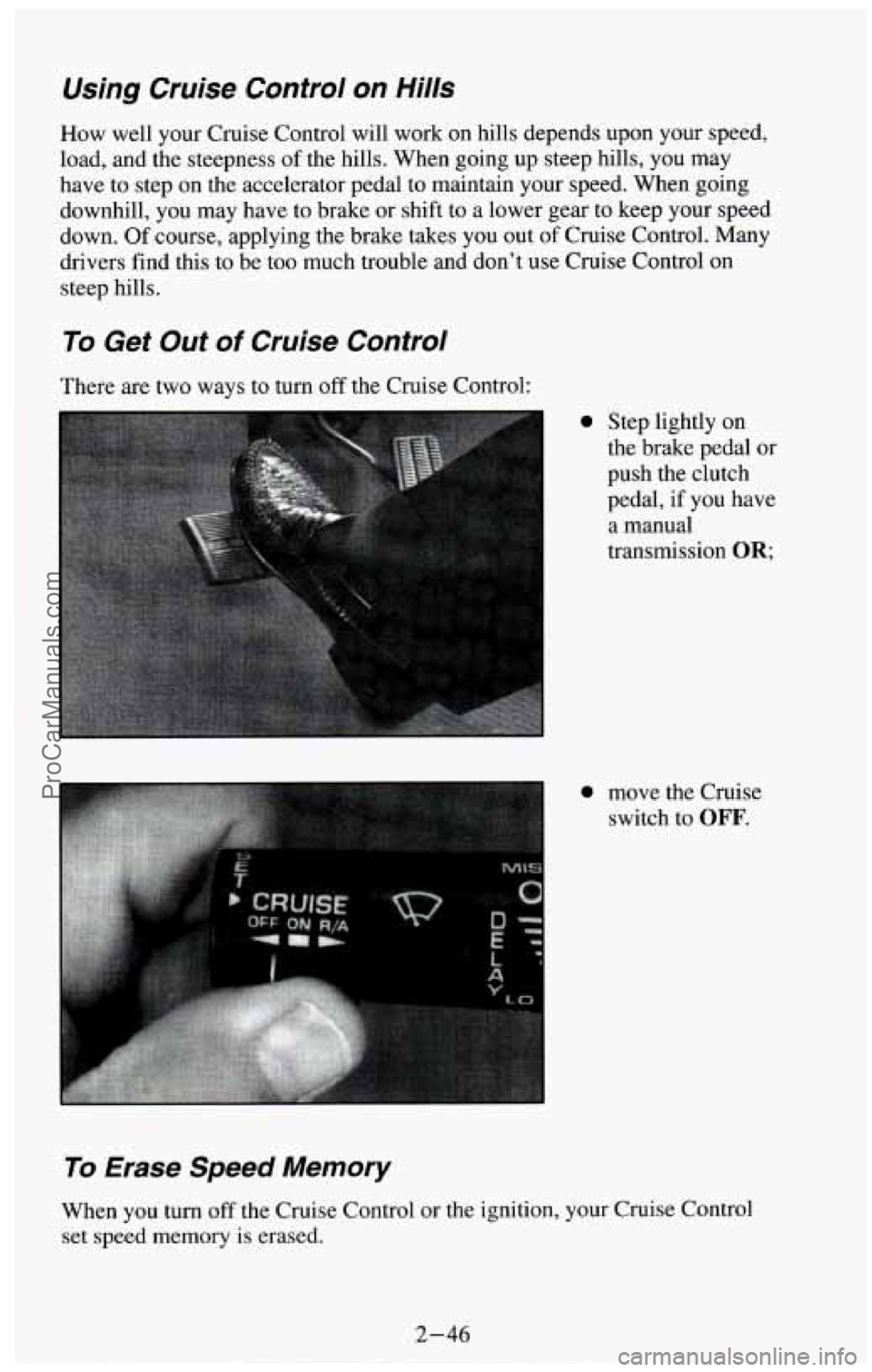
To Get Out of Cruise Control
There are two ways to turn off the Cruise Control:
0 Step lightly on
the brake pedal or
push the clutch
pedal, if you have
a manual
transmission
OR;
0 move the Cruise switch to
OFF.
To Erase 5peed Memory
When you turn off the Cruise Control or the ignition, your Cruise Control
set speed memory
is erased.
2-46
ProCarManuals.com
Page 103 of 385
Headlights-On Reminder
A buzzer will sound when your headlights are turned on and your ignition is
in
OFF, LOCK or ACC. If you need to use your headlights when the
ignition switch is in
OFF, LOCK or ACC, the buzzer can be turned off by
turning the interior light switch dial all the way off.
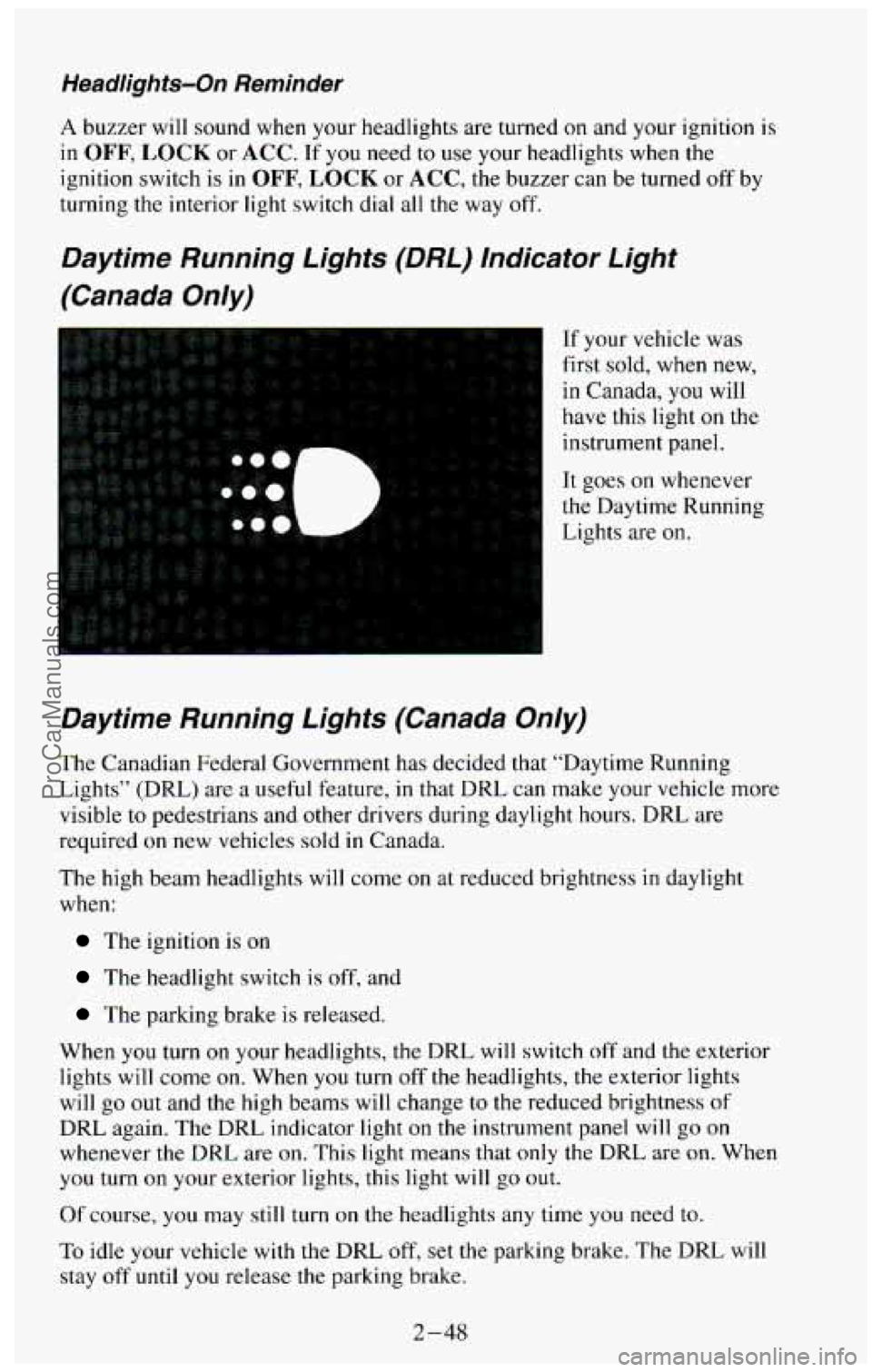
Daytime Running Lights (DRL) Indicator Light
(Canada
Only)
If your vehicle was
first sold, when new,
~ in Canada, you will
have this light on the instrument panel.
It goes on whenever
the Daytime Running
Lights are
on.
Daytime Running Lights (Canada Only)
The Canadian Federal Government has decided that “Daytime Running \
Lights” (DRL) are a useful feature, in that DRL can make your vehicle more
visible
to pedestrians and other drivers during daylight hours. DRL are
required
on new vehicles sold in Canada.
The high beam headlights will come
on at reduced brightness in daylight
when:
The ignition is on
The headlight switch is off, and
The parking brake is released.
When
you turn on your headlights, the DRL will switch off and the exterior
lights will come on. When
you turn off the headlights, the exterior lights
will go out and
the high beams will change to the reduced brightness of
DRL again. The DRL indicator light on the instrument panel will go on
whenever the DRL are
on. This light means that only the DRL are on. When
you turn on your exterior lights, this light will go out.
Of course, you may still turn on the headlights any time you need to.
To idle your vehicle with the DRL off, set the parking brake. The DRL will
stay
off until you release the parking brake.
2-48
ProCarManuals.com
Page 119 of 385
Instrument Panel
13 1’2
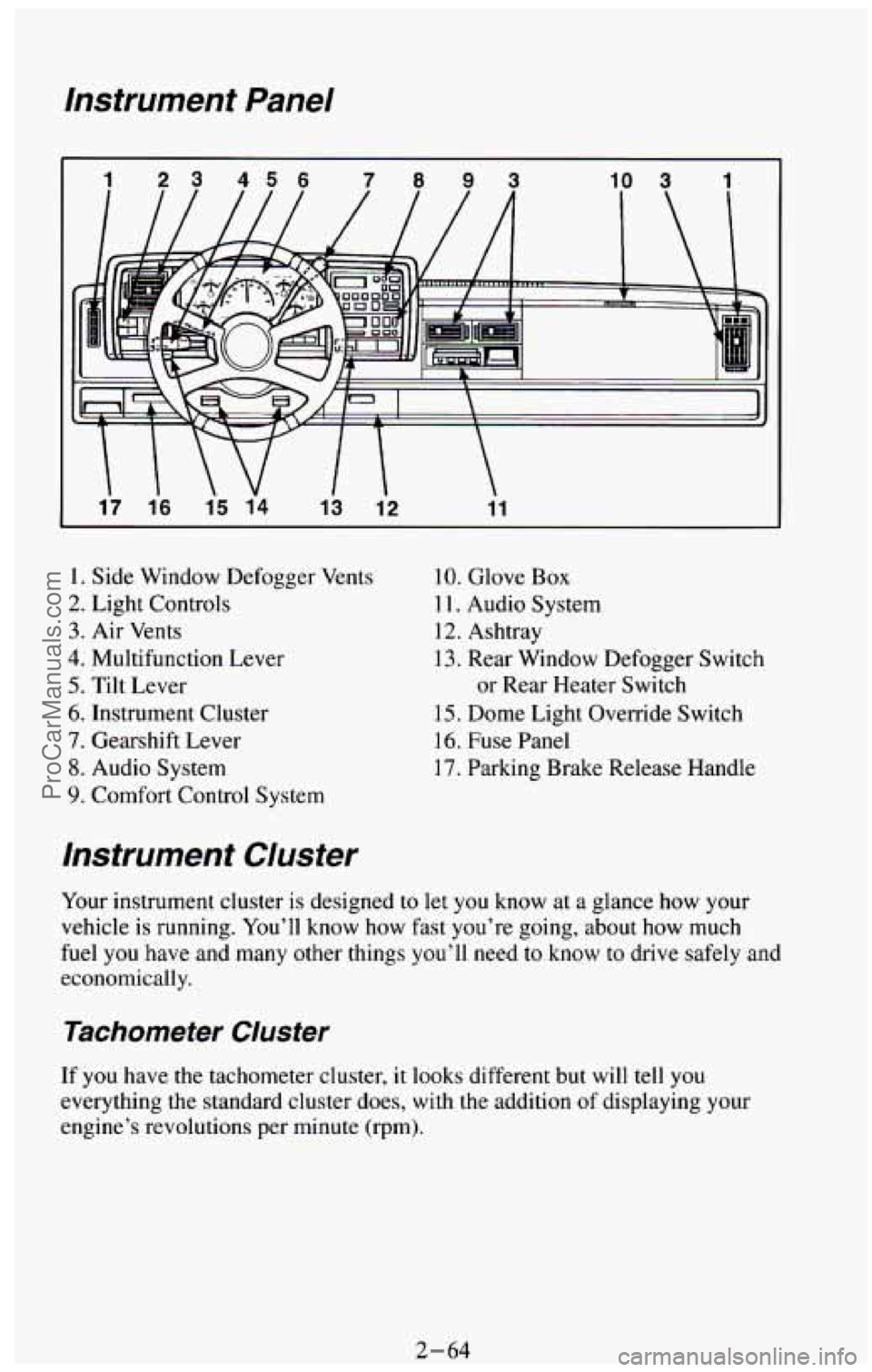
1. Side Window Defogger Vents
2. Light Controls
3. Air Vents
4. Multifunction Lever
5. Tilt Lever
6. Instrument Cluster
7. Gearshift Lever
8. Audio System
9. Comfort Control System
10. Glove Box
1 1. Audio System
12. Ashtray
13. Rear Window Defogger Switch
or Rear Heater Switch
15. Dome Light Override Switch
16. Fuse Panel
17. Parking Brake Release Handle
Instrument Cluster
Your instrument cluster is designed to let you know at a glance how your
vehicle is running.
You’ll know how fast you’re going, about how much
fuel you have
and many other things you’ll need to know to drive safely and
economically.
Tachometer Cluster
If you have the tachometer cluster, it looks different but will tell you
everything the standard cluster does, with the addition of displaying your
engine’s revolutions per minute (rpm).
2-64 ProCarManuals.com
Page 122 of 385
Waiting to do repairs can be costly - and even dangerous. So please get to
know your warning lights and gages. They’re a big help.
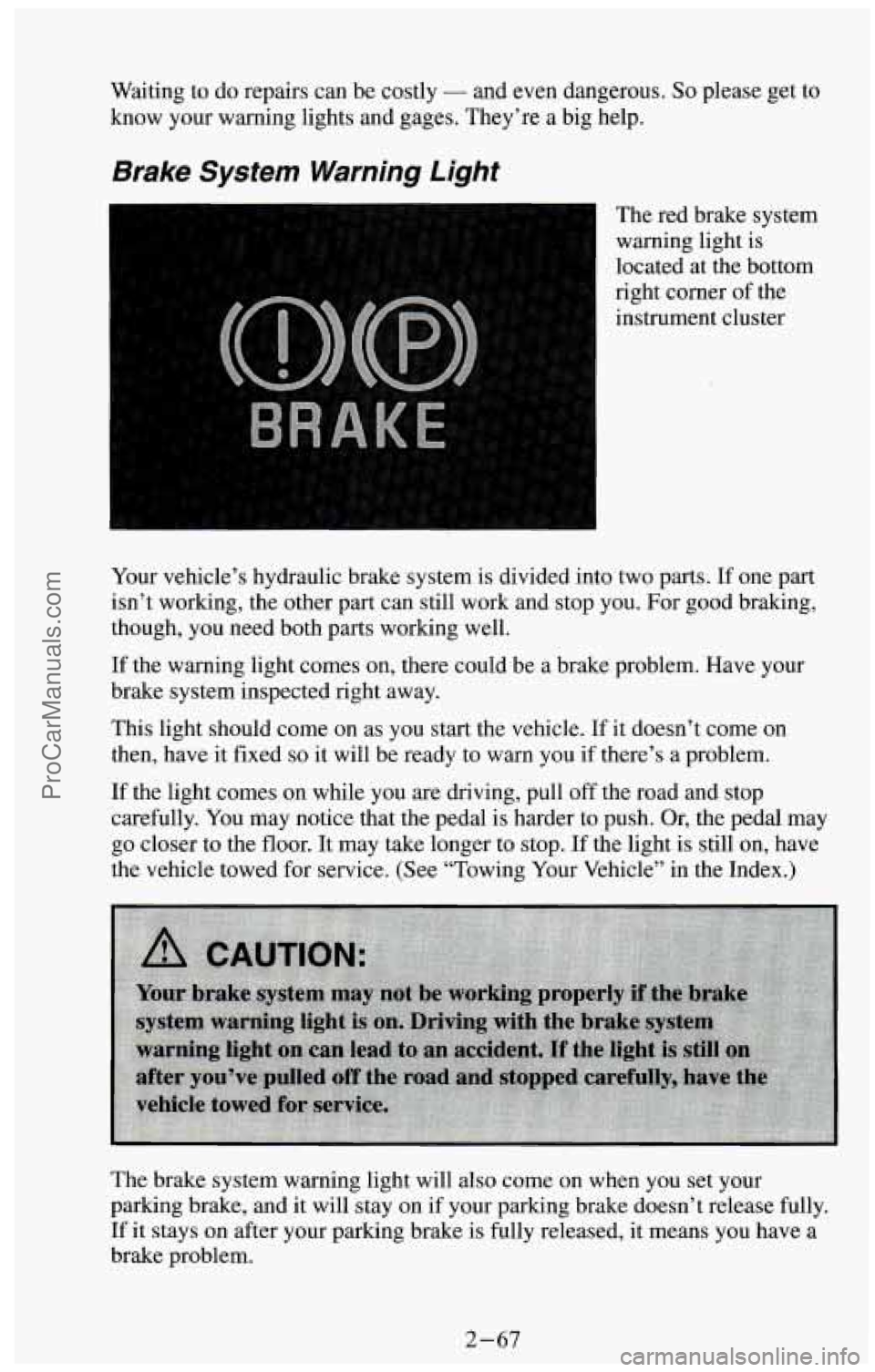
Brake System Warning Light
The red brake system
warning light is
located at the bottom
right corner of the
instrument cluster
Your vehicle’s hydraulic brake system is divided into two parts. If one part
isn’t working, the other part can still work and stop you. For
good braking,
though, you need both parts working well.
If the warning light comes on, there could be a brake problem. Have your
brake system inspected right away.
This light should come on as you start the vehicle. If it doesn’t come on
then, have it fixed
so it will be ready to warn you if there’s a problem.
If the light comes on while you are driving, pull off the road and stop
carefully. You may notice that the pedal is harder to push. Or, the pedal may
go closer to the floor. It may take longer to stop. If the light is still on, have
the vehicle towed for service. (See “Towing Your Vehicle” in the Index.)
The brake system warning light will also come on when you set your
parking brake, and it will stay on if your parking brake doesn’t release fully.
If it stays on after your parking brake is fully released, it means you have a
brake problem.
2-67
ProCarManuals.com
Page 123 of 385
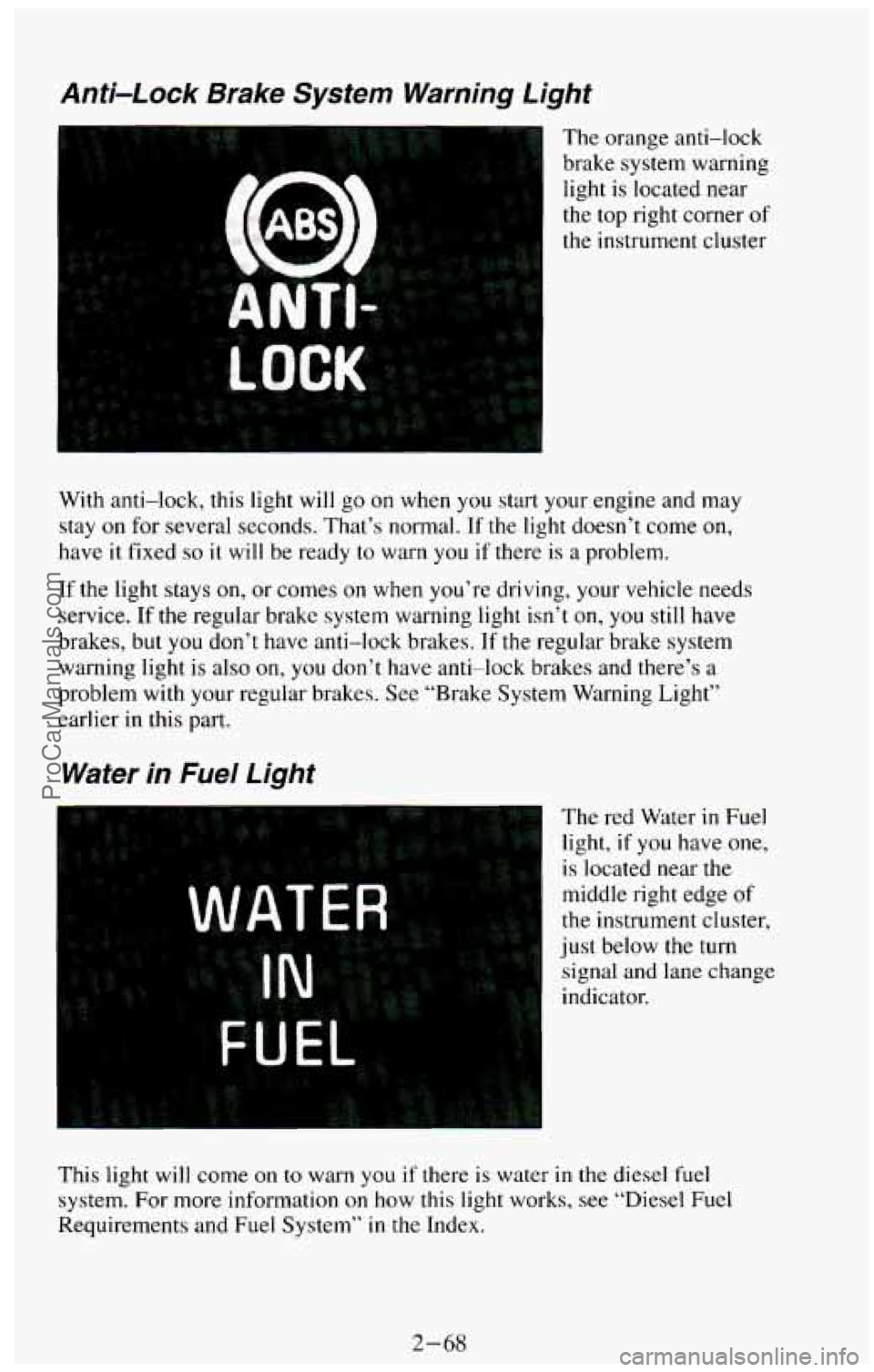
Anti-Lock Brake System Warning Light
The orange anti-lock
brake system warning light is located near
the top right corner
of
the instrument cluster
mi
With anti-lock, this light will go on when you start your engine and may
stay
on for several seconds. That’s normal. If the light doesn’t come on,
have it fixed
so it will be ready to warn you if there is a problem.
If the light stays on, or comes on when you’re driving, your vehicle needs
service.
If the regular brake system warning light isn’t on, you still have
brakes, but you don’t have anti-lock brakes. If the regular brake system
warning light is also
on, you don’t have anti-lock brakes and there’s a
problem with your regular brakes. See “Brake System Warning Light’’
earlier in this part.
Water in Fuel Light
The red Water in Fuel
light, if
you have one,
is located near the
middle right edge of
the instrument cluster,
just below the turn
signal and lane change
indicator.
This light will come on
to warn you if there is water in the diesel fuel
system.
For more information on how this light works, see “Diesel Fuel
Requirements and Fuel System”
in the Index.
2-68
ProCarManuals.com
Page 161 of 385
Defensive Driving
The best advice anyone can give about driving is: Drive defensively.
Please start with a very important safety device
in your vehicle: Buckle up.
(See “Safety Belts”
in the Index.)
Defensive driving really means “be ready for anything.” On city streets,
rural roads, or freeways, it means “always expect the unexpected.”
Assume that pedestrians or other drivers are going to be careless and make
mistakes. Anticipate what
they might do. Be ready for their mistakes.
Rear-end collisions are about the most preventable
of accidents. Yet they
are common. Allow enough following distance. It’s the best defensive
driving maneuver, in both city and rural driving. You never know when the
vehicle in front of you is going to brake or turn suddenly.
Drunken Driving
Death and injury associated with drinking and driving is a national tragedy.
It’s the number
one contributor to the highway death toll, claiming
thousands
of victims every year. Alcohol takes away three things that
anyone needs to drive a vehicle:
Judgment
Muscular Coordination
Vision
Police records show that almost half
of all motor vehicle-related deaths
involve alcohol
- a driver, a passenger or someone else, such as a
pedestrian, had been drinking. In most cases, these deaths are the result of
someone who was drinking and driving. About
20,000 motor
vehicle-related deaths occur
each year because of alcohol, and thousands of
people are injured.
Just how much alcohol is too much if a person plans to drive? Ideally, no
one should drink alcohol and then drive. But if one does, then what’s “too
much”? It can be a
lot less than many might think. Although it depends on
each person and situation, here is some general information on the problem.
The Blood Alcohol Content (BAC) of someone who
is drinking depends
upon four things:
0 How much alcohol is in the drink.
0 The drinker’s body weight.
The amount of food that is consumed before and during drinking.
The length of time it has taken the drinker to consume the alcohol.
4-2
ProCarManuals.com