tow CHEVROLET SUBURBAN 1994 Owner's Manual
[x] Cancel search | Manufacturer: CHEVROLET, Model Year: 1994, Model line: SUBURBAN, Model: CHEVROLET SUBURBAN 1994Pages: 385, PDF Size: 19.88 MB
Page 92 of 385
Horn
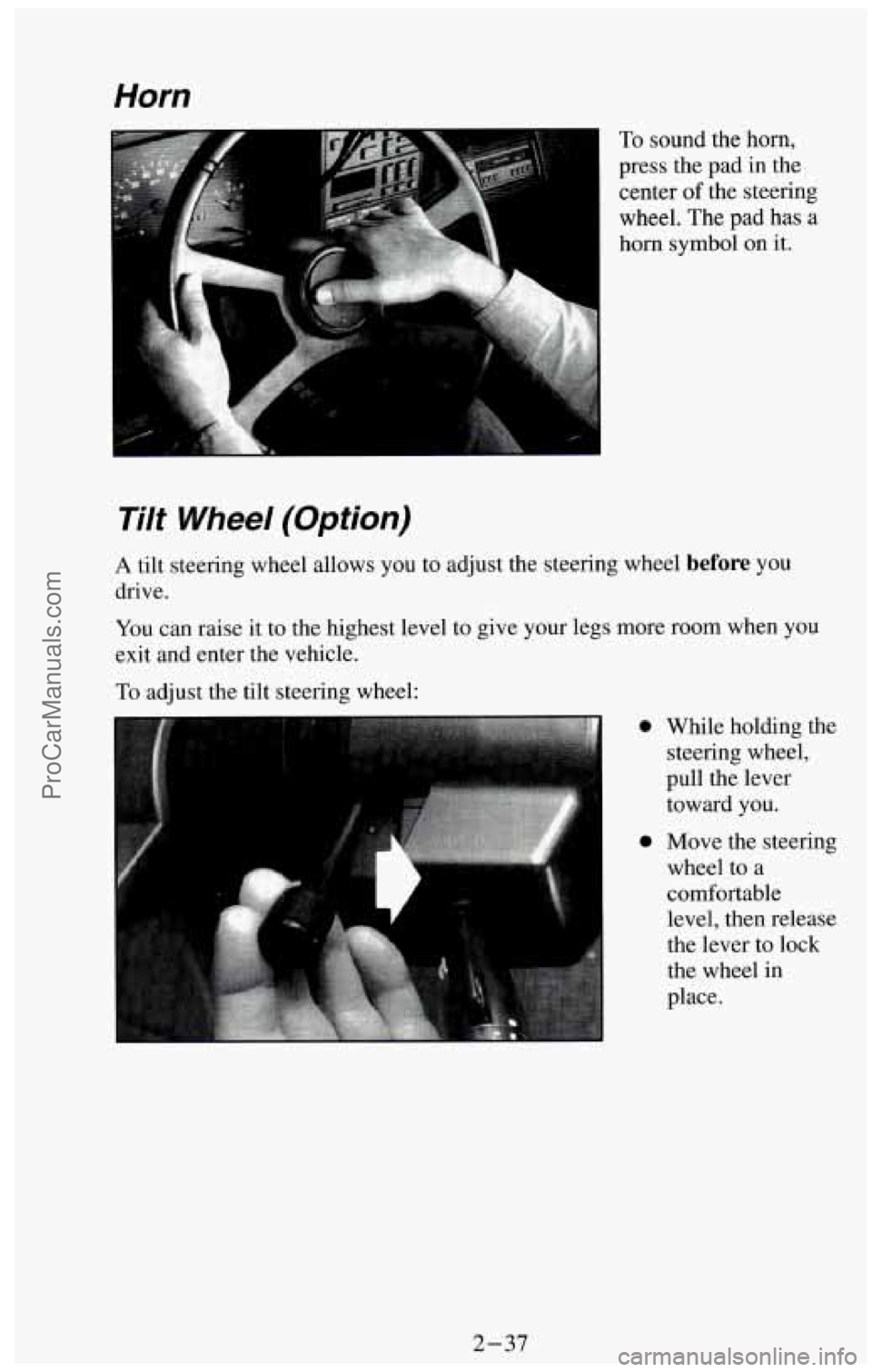
To sound the horn,
press the pad in the
center of the steering
wheel. The pad has a
Tilt Wheel (Option)
A tilt steering wheel allows you to adjust the steering wheel before you
drive.
You can raise it to the highest level to give your legs more room when you
exit and enter the vehicle.
To adjust the tilt steering wheel:
0 While holding the
steering wheel,
pull the lever
toward you.
0 Move the steering
wheel to a
comfortable
level, then release
the lever to lock
the wheel in
place.
2-37
ProCarManuals.com
Page 95 of 385
Headlight High-Low Beam
Windshield Wipers
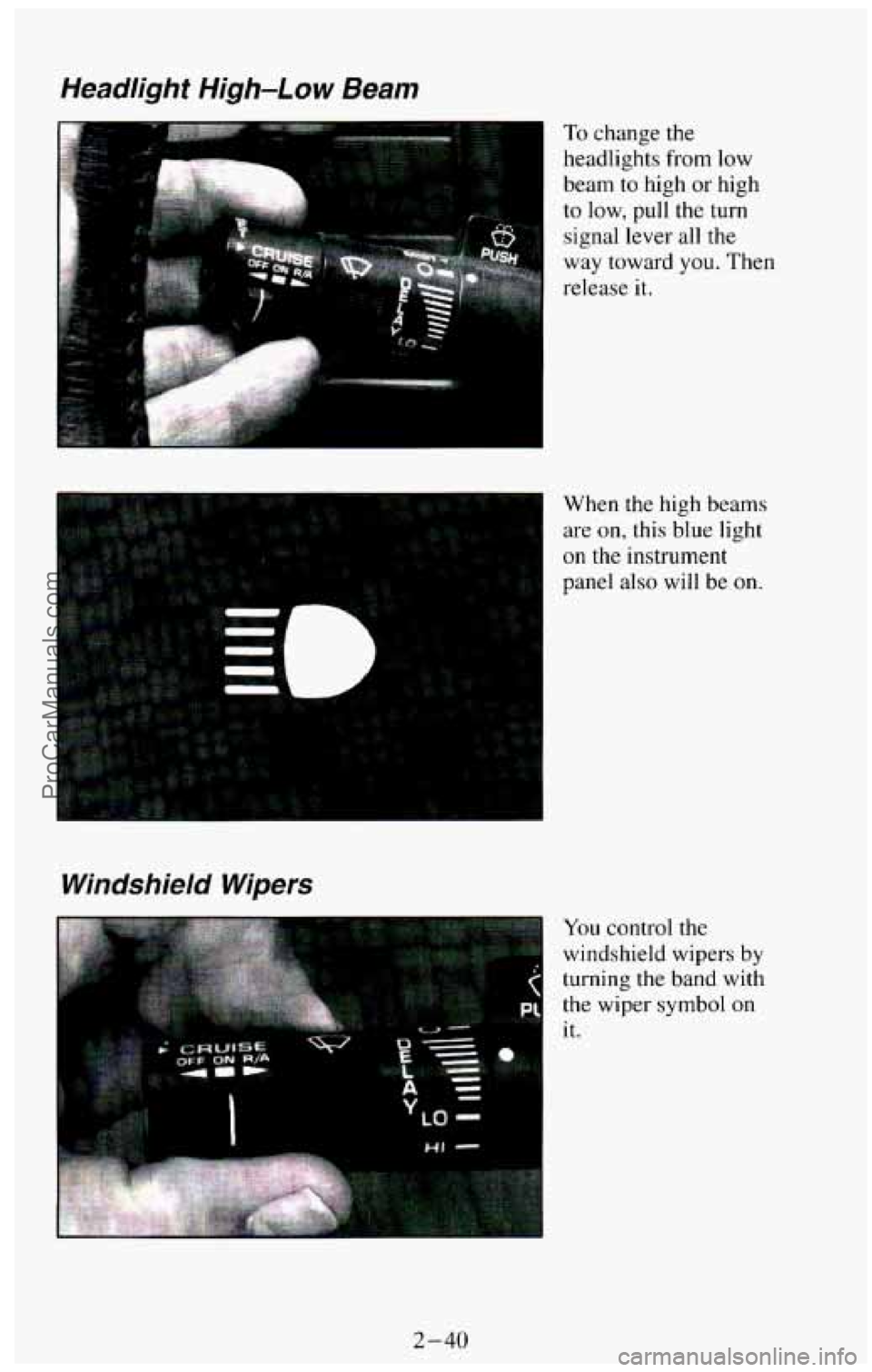
To change the
headlights from low
beam to high
or high
to low, pull the turn
signal lever
all the
way toward
you. Then
release it.
When
the high beams
are on, this blue light
on the instrument
panel also will be on.
You control the
windshield wipers
by
turning the band with
the wiper symbol on
it.
2-40
ProCarManuals.com
Page 122 of 385
Waiting to do repairs can be costly - and even dangerous. So please get to
know your warning lights and gages. They’re a big help.
Brake System Warning Light
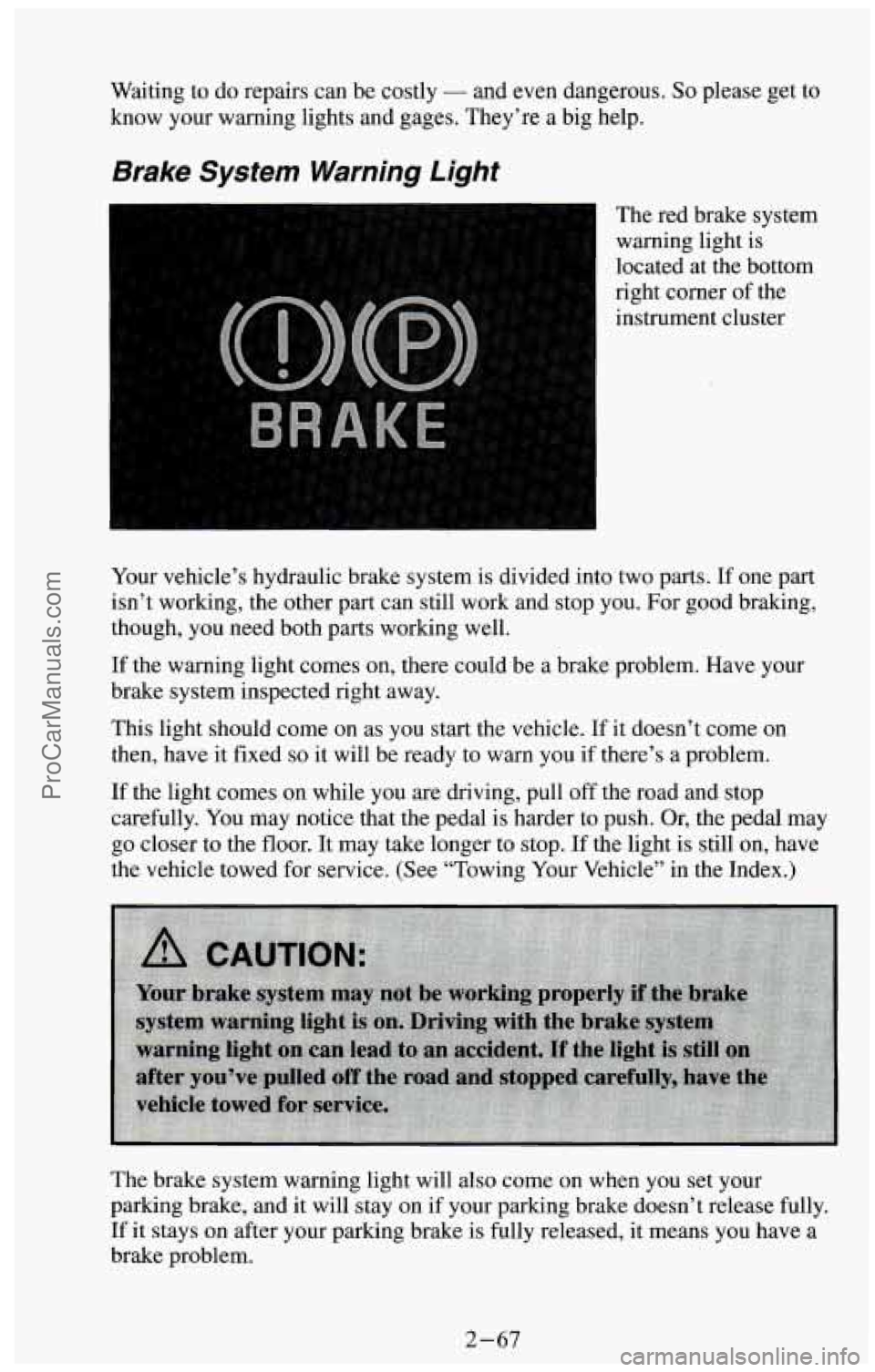
The red brake system
warning light is
located at the bottom
right corner of the
instrument cluster
Your vehicle’s hydraulic brake system is divided into two parts. If one part
isn’t working, the other part can still work and stop you. For
good braking,
though, you need both parts working well.
If the warning light comes on, there could be a brake problem. Have your
brake system inspected right away.
This light should come on as you start the vehicle. If it doesn’t come on
then, have it fixed
so it will be ready to warn you if there’s a problem.
If the light comes on while you are driving, pull off the road and stop
carefully. You may notice that the pedal is harder to push. Or, the pedal may
go closer to the floor. It may take longer to stop. If the light is still on, have
the vehicle towed for service. (See “Towing Your Vehicle” in the Index.)
The brake system warning light will also come on when you set your
parking brake, and it will stay on if your parking brake doesn’t release fully.
If it stays on after your parking brake is fully released, it means you have a
brake problem.
2-67
ProCarManuals.com
Page 136 of 385
Step-Bumper Pad
If your vehicle has a rear step bumper, it may be equipped with a rear step
pad at the center
of the bumper. Use this pad to improve footing when you
are stepping
on the bumper step.
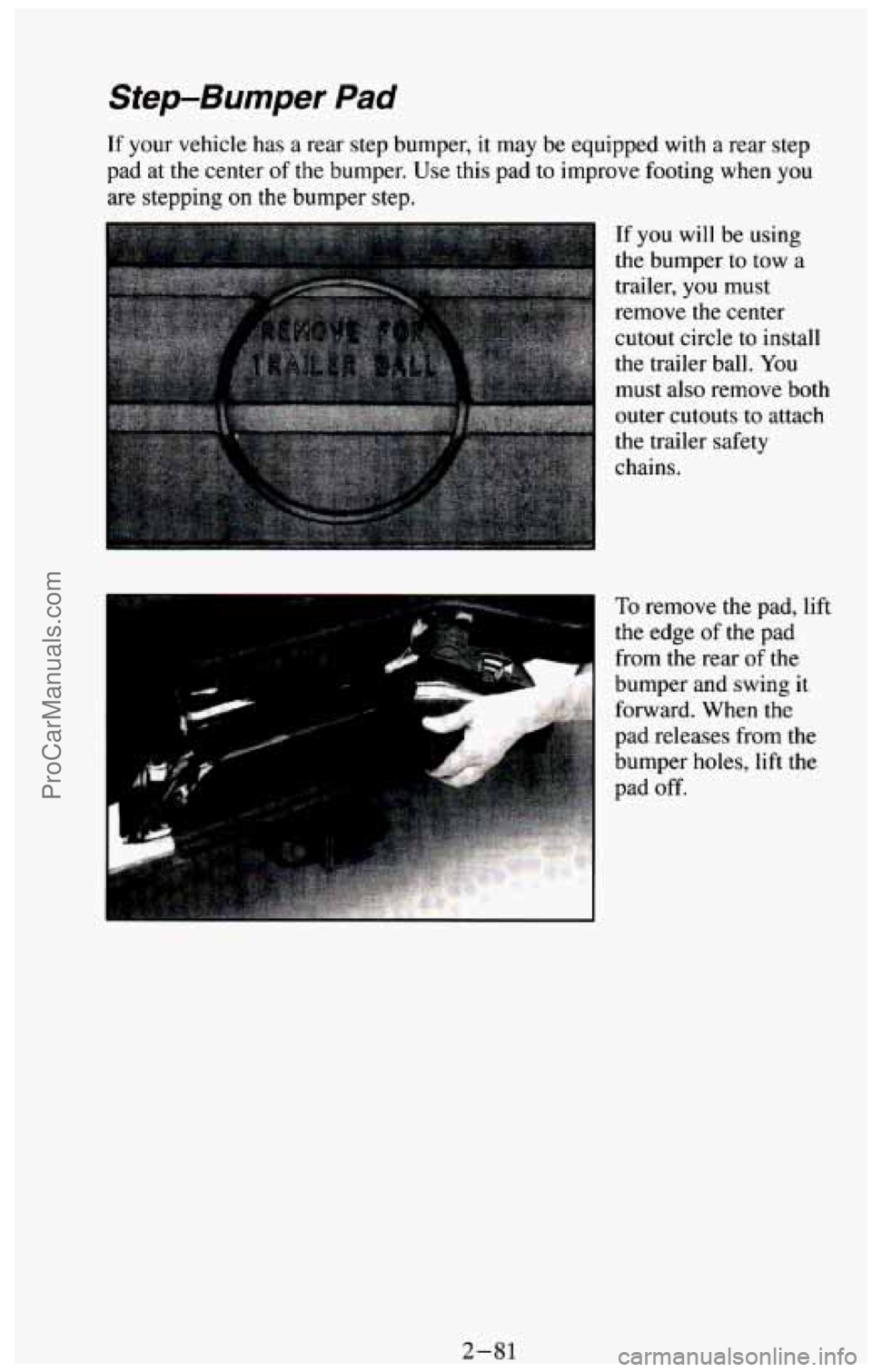
If you will be using
the bumper to tow a
trailer, you must
remove the center
cutout circle to install
the trailer ball.
You
must also remove both
outer cutouts to attach
the trailer safety
chains.
To remove the pad, lift
the edge
of the pad
from the rear
of the
bumper and swing it
forward. When
the
pad releases from the
pad off.
)c
@"
p.'; 2&& bumper holes, lift the
2-81 ProCarManuals.com
Page 142 of 385
Function Lever
The upper lever on the control panel can be moved to three different heating
functions.
0 Vent (Left): Air comes out at the vents on your instrument panel and at
your front side windows.
a heat setting, is best for cold weather.
0 Defrost (Right): This setting operates the defroster. Air comes out near
the bottom of the windshield and at your front side windows. Use this
setting, along with
a heat setting, when you get fog or ice on the
windshield.
0 Heater (Center): Air comes out near the floor. This setting, along with
Placing the lever between positions sends air out both vents.
Temperature Lever
The lower lever on the control panel lets you select the temperature of the
air flowing into the passenger area
of your vehicle. Move the lever right
toward
(+) for warmer air. Move the lever left toward (-) for cooler air.
Fan Control Knob
The knob on the right side of the heating system control panel controls the
fan speed. The knob has four speed positions. To increase the air flow, turn
the knob toward (+). To decrease the air flow, turn it toward (-).
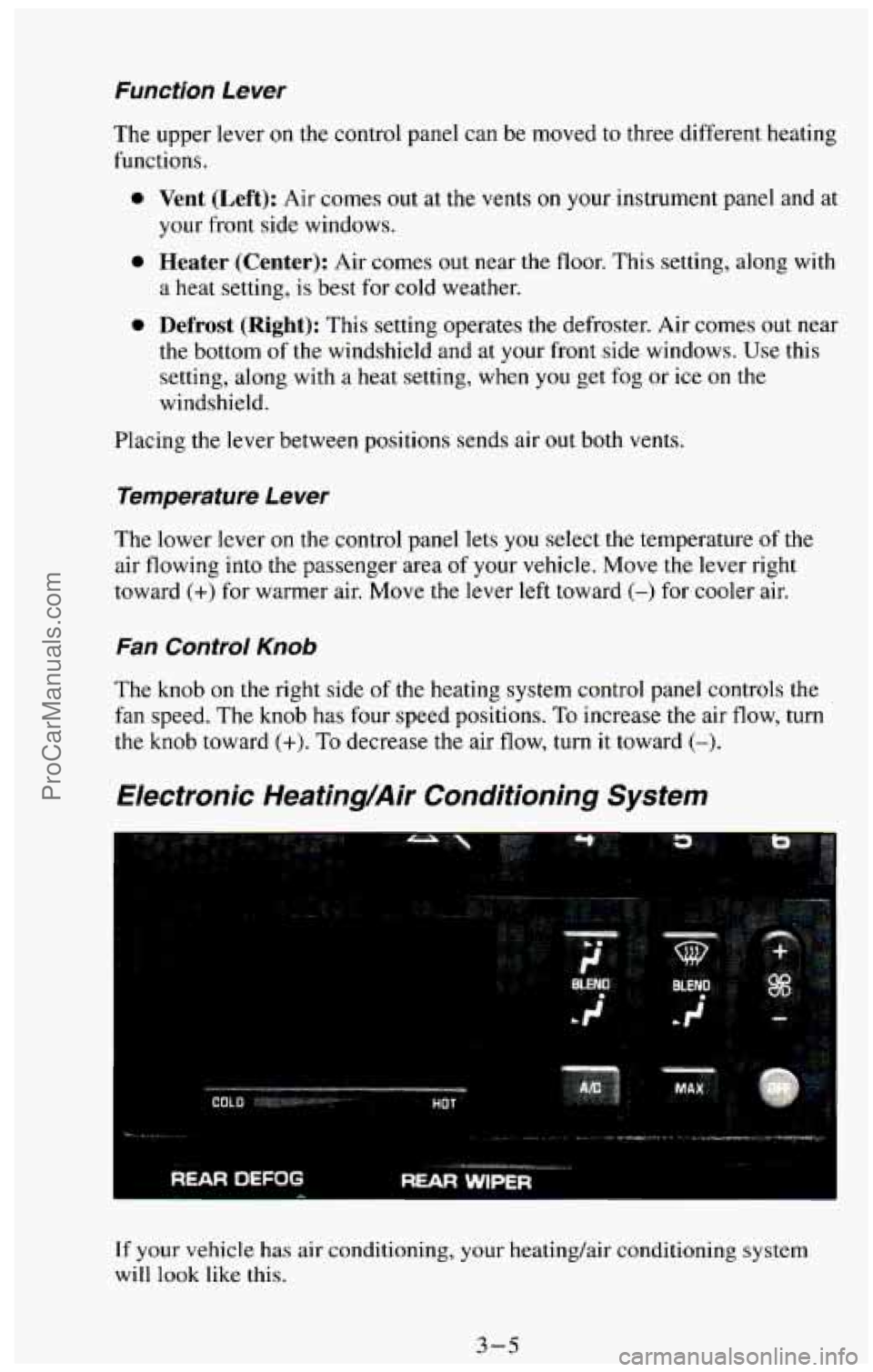
Electronic Heating/Air Conditioning System
If your vehicle has air conditioning, your heating/air conditioning system
will
look like this.
3-5
ProCarManuals.com
Page 144 of 385
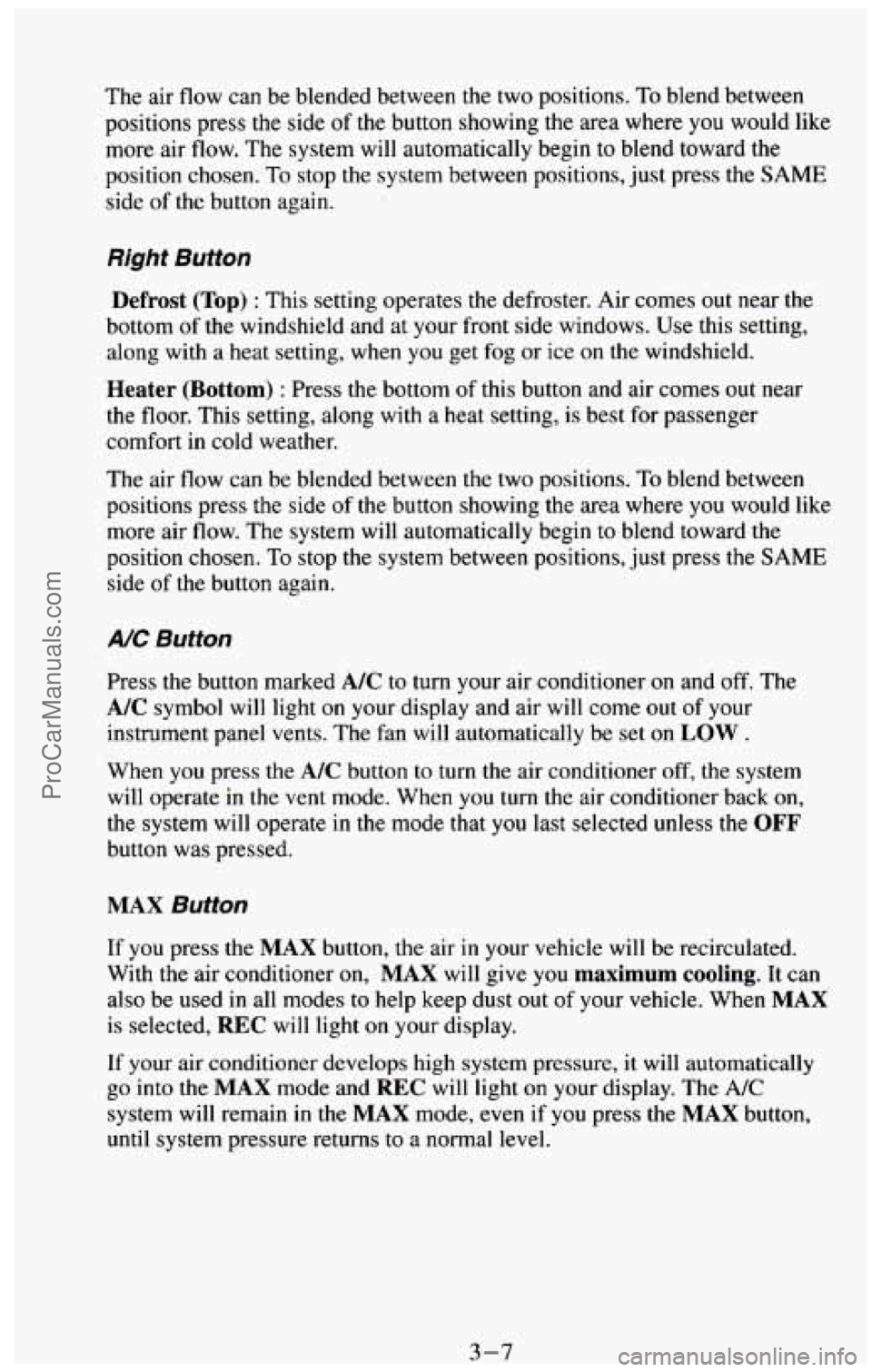
The air flow can be blended between the two positions. To blend between
positions press the side
of the button showing the area where you would like
more air flow. The system will automatically begin to blend toward the
position chosen.
To stop the system between positions, just press the SAME
side of the button again.
Right Button
Defrost (Top) : This setting operates the defroster. Air comes out near the
bottom of the windshield and at your front side windows. Use this setting,
along with a heat setting, when you get fog or ice on the windshield.
Heater (Bottom) : Press the bottom of this button and air comes out near
the floor. This setting, along
with a heat setting, is best for passenger
comfort in cold weather.
The air flow can be blended between the two positions.
To blend between
positions press the side of the button showing the area where
you would like
more air
flow. The system will automatically begin to blend toward the
position chosen. To stop the system between positions, just press
the SAME
side of the button again.
A/C Button
Press the button marked A/C to turn your air conditioner on and off. The
A/C symbol will light on your display and air will come out of your
instrument panel vents. The fan will automatically be set on
LOW .
When you press the A/C button to turn the air conditioner off, the system
will operate in the vent mode. When you turn the air conditioner back
on,
the system will operate in the mode that you last selected unless the OFF
button was pressed.
MAX Button
If you press the MAX button, the air in your vehicle will be recirculated.
With the air conditioner on,
MAX will give you maximum cooling. It can
also be used
in all modes to help keep dust out of your vehicle. When MAX
is selected, REC will light on your display.
If your air conditioner develops high system pressure, it will automatically
go into the
MAX mode and REC will light on your display. The A/C
system will remain in the MAX mode, even if you press the MAX button,
until system pressure returns to a normal level.
3-7 ProCarManuals.com
Page 147 of 385
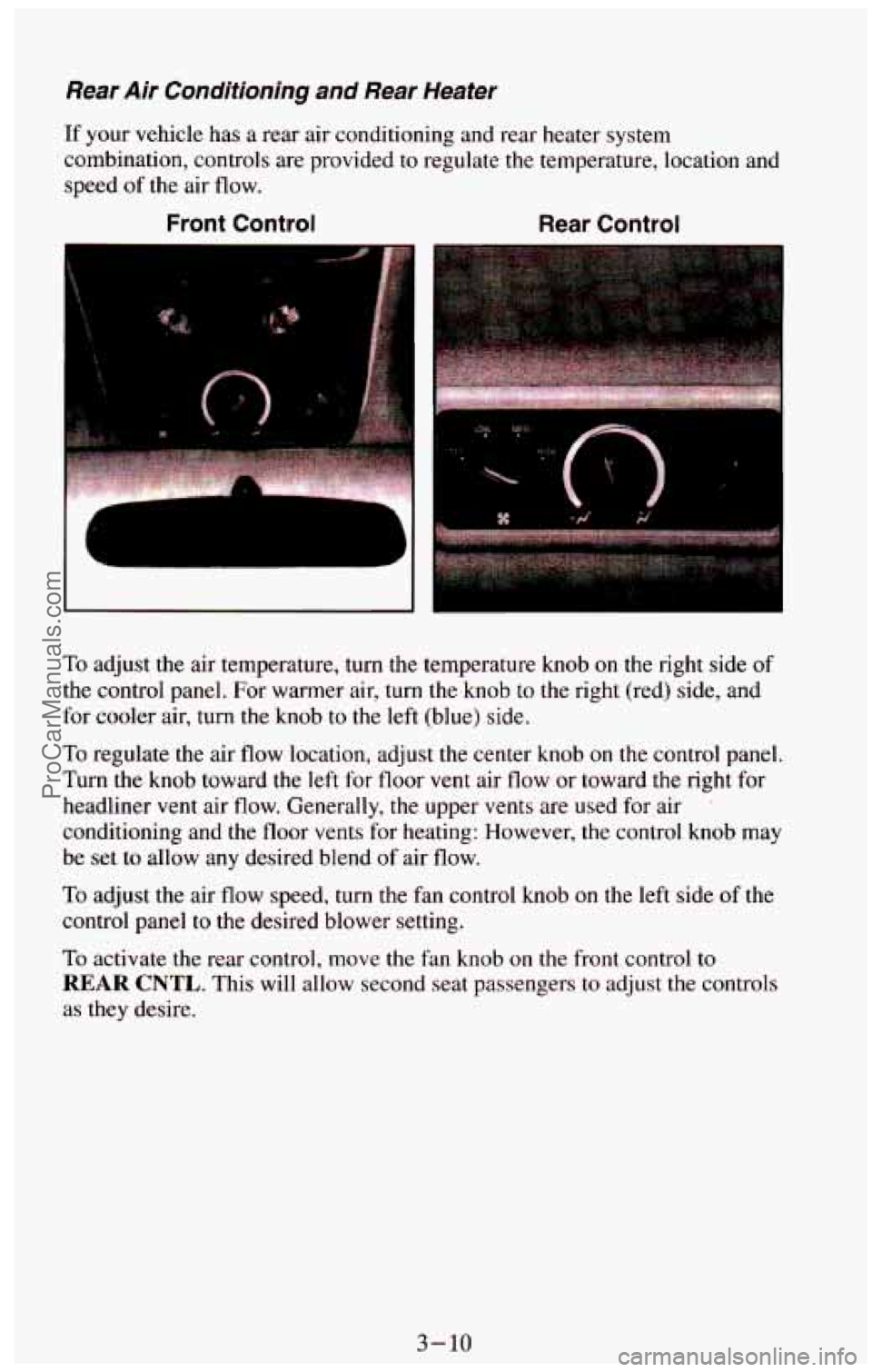
Rear Air Conditioning and Rear Heater
If your vehicle has a rear air conditioning and rear heater system
combination, controls are provided to regulate the temperature, location and
speed
of the air flow.
Front Control Rear Control
1
To adjust the air temperature, turn the temperature knob on the right side of
the control panel. For warmer air, turn the knob to the right (red) side, and
for cooler air, turn the knob to the left (blue) side.
To regulate the air flow location, adjust the center knob on the control panel.
Turn the knob toward the left for tloor vent air flow or toward the right for
headliner
vent air flow. Generally, the upper vents are used for air '
conditioning and the floor vents for heating: However, the control knob may
be set
to allow any desired blend of air flow.
To adjust the air flow speed, turn the fan control knob on the left side of the
control panel to the desired blower setting.
To activate the rear control, move the fan knob on the front control to
REAR CNTL. This will allow second seat passengers to adjust the controls
as they desire.
3- 10
ProCarManuals.com
Page 160 of 385
Your Driving and the Road
Section
1
Here you’ll find information about driving on different kinds of roads and in
varying weather conditions
. We’ve also included many other useful tips on
driving .
.............................. 4-2
Defensive Driving ..........
DrunkenDriving ........................................... 4-2
Control
of a Vehicle
Braking
... ........................................... 4-5
Steering
................................................ 4-7
Steering Tips
............................................ 4-7
Off-Road Recovery
...................................... 4-9
Passing
................................................ 4-9
LossofControl
......................................... 4-10
Off-Road Driving With Your Four-wheel Drive Vehicle
.......... 4-12
DrivingatNight
........................................... 4-23
Driving
in the Rain ........................................ 4-24
CityDriving
.............................................. 4-26
Freeway Driving
.......................................... 4-27
Hill and Mountain Roads
.................................... 4-29
Winter Driving
............................................ 4-30
Powerwinches
........................................... 4-34
PowerTake-Off(PT0)
..................................... 4-34
Towing a Trailer
........................................... 4-36
4-1
ProCarManuals.com
Page 195 of 385
4. Engage the power take-off.
If you are going to drive the vehicle, shift the transmission into the gear
you want. Then shift the transfer case into the range you want, apply
the regular brakes and release the parking brake.
When
you release the clutch, the power take-off will start.
5. Release the clutch (and the regular brakes) as you normally would.
Using a Transfer Case Mounted Power Take-Off
(Automatic Transmission)
1. Set the parking brake.
2. Shift the transfer case into “N” (Neutral).
3. Shift the transmission into “N’ (Neutral).
4. Engage the power take-off.
If you are going to drive the vehicle, shift the transfer case into the
range you want. Then apply the regular brakes and release the parkin\
g
brake.
5. Shift the transmission to “D” (Drive) to start the power take-off.
6. Release the regular brakes to drive the vehicle.
Towing a Trailer
4-36
ProCarManuals.com
Page 196 of 385

I NOTICE:
Pulling a trailer improperly can damage your vehicle and result\
in costly repairs not covered
by your warranty. To pull a trailer
correctly,
follow the advice in this section, and see your GM
dealer for important information about towing a trailer with
your vehicle.
Every vehicle is ready for some trailer towing. If it was built with trailering
options, as many are, it’s ready for heavier trailers. But trailering is different
than just driving your vehicle
by itself. Trailering means changes in
handling, durability, and fuel economy. Successful, safe trailering takes
correct equipment, and
it has to be used properly.
That’s the reason for this section. In it are many time-tested, important
trailering tips and safety rules. Many of these are important for your safety
and that of your passengers.
So please read this section carefully before you
pull a trailer.
rf You Do Decide To Pull A Trailer
If you do, here are some important points.
There are many different laws having to do with trailering. Make sure
your rig will be legal, not only where you live but also where you’ll
be
driving. A good source for this information can be state or provincial
police.
Consider using a sway control with a utility model if your trailer will
weigh 3,000 pounds (1 36 1 kg) or less, or with a wagon model if your
trailer
will weigh 4,000 pounds (1 800 kg) or less. You should always
use a sway control
with a utility model if your trailer will weigh more
than
3,000 pounds (I 361 kg), or with a wagon model if your trailer
will weigh more than 4,000 pounds (1 800 kg).
You can ask
a hitch dealer about sway controls.
Don’t tow a trailer at all during the first 500 miles (800 km) your new
vehicle is driven. Your engine, axle or other parts could be damaged.
Then, during the first 500 miles (800 km) that you tow a trailer, don’t
drive over
50 mph (80 km/h) and don’t make starts at full throttle. This
helps your engine and other parts of your vehicle wear
in at the heavier
loads.
4-37
ProCarManuals.com