trailer CHEVROLET SUBURBAN 1994 Owner's Manual
[x] Cancel search | Manufacturer: CHEVROLET, Model Year: 1994, Model line: SUBURBAN, Model: CHEVROLET SUBURBAN 1994Pages: 385, PDF Size: 19.88 MB
Page 271 of 385
This doughnut-shaped logo (symbol) is used on most oil containers to help
you select the correct oil.
You should look for this on the oil container, and use only those oils that
display the logo.
GM Goodwrench@ oil (in Canada, GM Engine Oil) meets all the
requirements for your vehicle.
Engine Oil Additives
Don’t add anything to your oil. Your GM dealer is ready to advise if you
think something should be added.
When to Change Engine Oil
See if any one of these is true for you:
Most trips are less than 4 miles (6 km).
0 It’s below freezing outside and most trips are less than 10 miles
0 The engine is at low speed most of the time (as in door-to-door
(16 km).
delivery,
or in stop-and-go traffic).
You tow a trailer often.
0 Most trips are through dusty places.
The vehicle is frequently operated off-road.
If any
of these is true for your vehicle, then you need to change your oil and
filter
every 2,500 miles (4 000 km) or 3 months - whichever comes first.
If none of them is true, change the oil and filter every 5,000 miles
(8 000 km) or 12 months - whichever comes first.
What to Do with Used Oil
Did you know that used engine oil contains certain elements that may be
unhealthy for your skin and could even cause cancer? Don’t let used oil stay
on your
skin for very long. Clean your skin and nails with soap and water,
or
a good hand cleaner. Wash or properly throw away clothing or rags
containing used engine
oil. (See the manufacturer’s warnings about the use
and disposal
of oil products.)
Used oil can be a real threat to the environment.
If you change your own oil.
be sure to drain all free-flowing oil from the filter before disposal. Don’t
ever dispose of oil by putting
it in the trash, pouring it on the ground, into
sewers, or into streams
or bodies of water. Instead, recycle it by taking it to
a place that collects used oil. If you have a problem properly disposing of
your used oil,
ask your dealer, a service station or a local recycling center
for help.
6-26
ProCarManuals.com
Page 274 of 385
NOTICE:
Too much or too little fluid can damage your transmission. Too
much can mean that some of the fluid could come out and fall on
hot engine parts or exhaust system, starting a fire. Be sure to get
an accurate reading if you check your transmission fluid.
Wait at least 30 minutes before checking the transmission fluid level if you
have been driving:
0 When outside temperatures are above 90°F (32°C).
0 At high speed for quite a while.
In heavy traffic - especially in hot weather.
0 While pulling a trailer.
To get the right reading, the fluid should be at normal operating
temperature,
which is 180°F to 200°F (82°C to 93°C).
To check transmissionfluid hot: Get the vehicle warmed up by driving
about 15 miles
(24 km) when outside temperatures are above 50°F (IOOC).
If it’s colder than 50°F (IOOC), drive the vehicle in “D” (3rd Gear) until the
engine temperature gage moves and then remains steady for
ten minutes.
Then follow
the hot check procedures.
To check transmissionfluid cold: A cold check is made after the vehicle has
been sitting for eight hours or more with the engine off and
is used only as a
reference. Let the engine run at idle for five minutes if outside temperatures
are
50°F (10°C) or more. If it’s colder than 50°F (IOOC), you may have to
idle the engine longer. Should
the fluid level be low during a cold check,
you
must perform a hot check before adding fluid. This will give you a more
accurate reading of the fluid level.
To check the fluid hot or cold
Park your vehicle on a level place.
e With the parking brake applied, place the shift lever in “P’ (Park).
With your foot on the brake pedal, move the shift lever through each
gear range, pausing for about three seconds in each range. Then,
position the shift lever in
“P” (Park).
Let the engine run at idle for three minutes or more.
Then, without shutting off the engine, follow these steps:
6-29 ProCarManuals.com
Page 302 of 385
Power Windows and Other Power Options
Circuit breakers in the fuse panel protect the power windows and other
power accessories. When the current load is too heavy, the circuit breaker
opens and closes. This protects the circuit until the current load returns to
normal or the problem is fixed
.
Trailer Wiring Harness
The optional seven-wire trailer wiring harness is protected by an in-line
fuse in the battery feed wire. This fuse is near the junction block. See
“Trailer Wiring Harness” in the Index for more information.
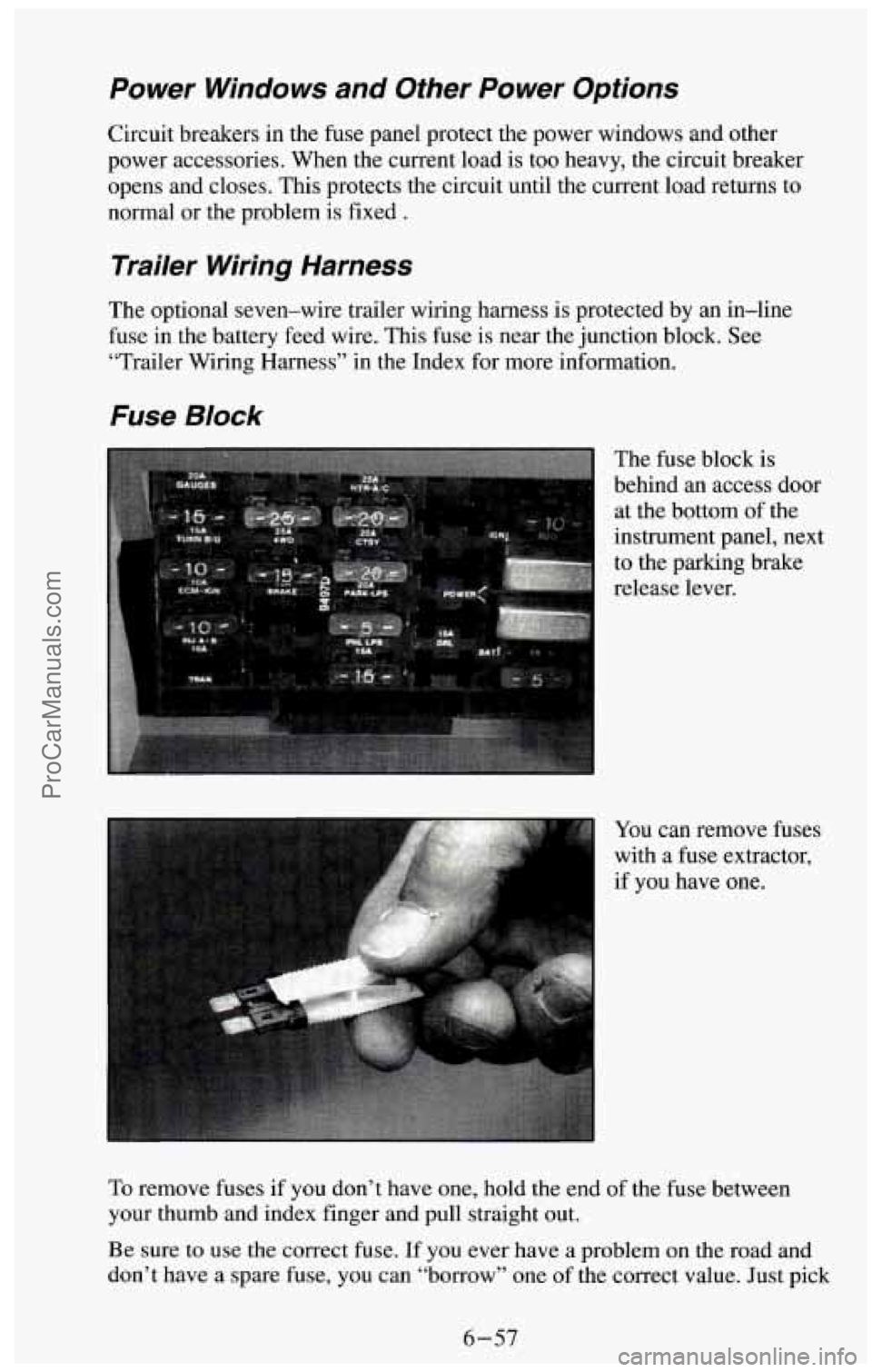
Fuse Block
The fuse block is
behind an access door
at the bottom
of the
instrument panel, next
to the parking brake
release lever.
You can remove fuses
with a fuse extractor,
if you have one.
To remove fuses if you don’t have one, hold the end of the fuse between
your thumb and index finger and pull straight out.
Be sure to use the correct fuse. If
you ever have a problem on the road and
don’t have a spare fuse, you can “borrow” one of the correct value. Just pick
6-57
ProCarManuals.com
Page 306 of 385
Trailering Package
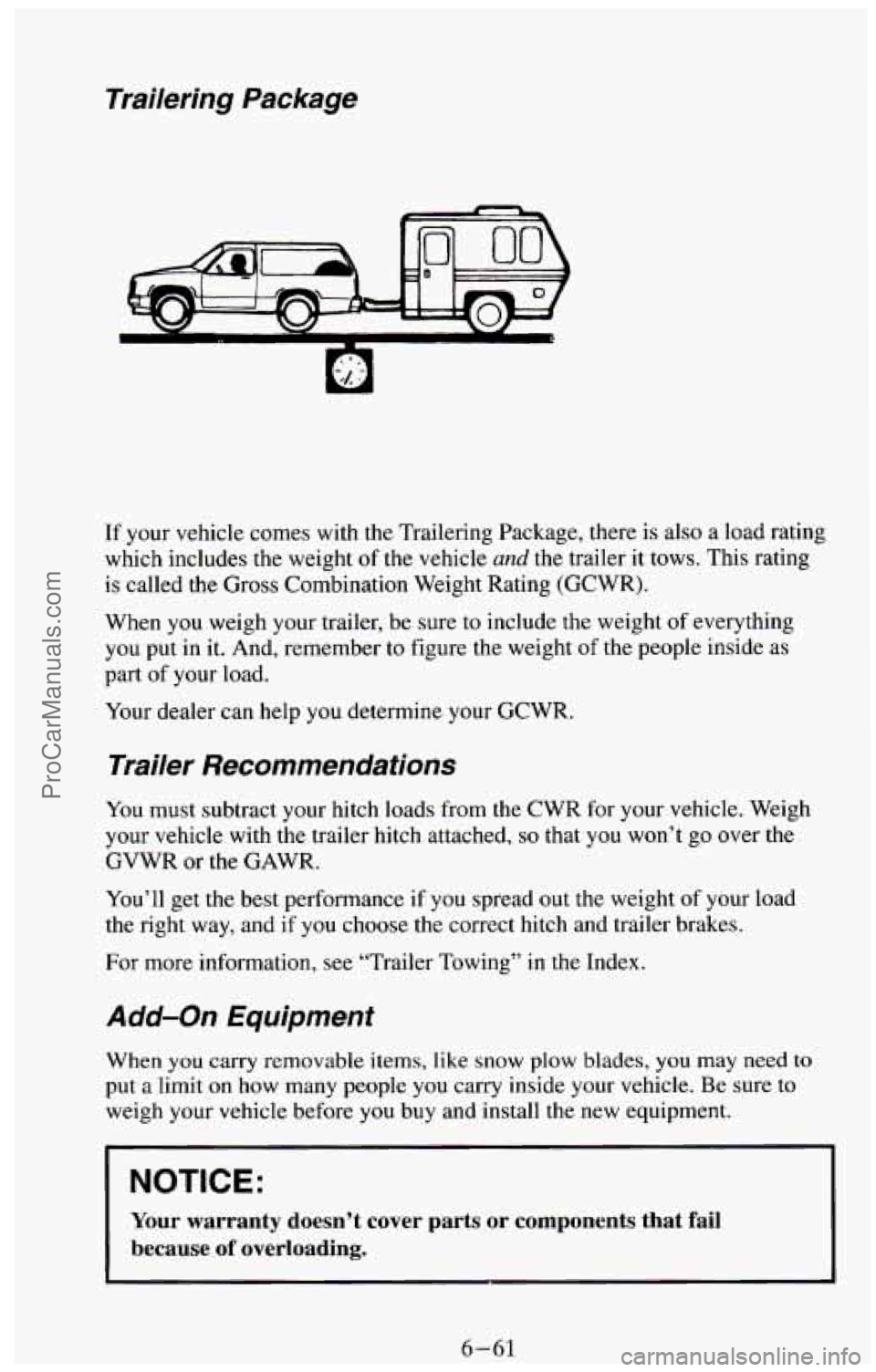
If your vehicle comes with the Trailering Package, there is also a load rating
which includes the weight
of the vehicle and the trailer it tows. This rating
is called the Gross Combination Weight Rating (GCWR).
When you weigh your trailer, be sure to include the weight
of everything
you put in it. And, remember
to figure the weight of the people inside as
part of your
load.
Your dealer can help you determine your GCWR.
Trailer Recommendations
You must subtract your hitch loads from the CWR for your vehicle. Weigh
your vehicle with the trailer hitch attached,
so that you won’t go over the
GVWR
or the GAWR.
You’ll get the best performance
if you spread out the weight of your load
the right way, and if you choose the correct hitch and trailer brakes.
For more information, see “Trailer Towing’’
in the Index.
Add-on Equipment
When you carry removable items, like snow plow blades, you may need to
put a limit on how many people you carry inside your vehicle. Be sure to
weigh your vehicle before you buy and install the new equipment.
~
NOTICE:
Your warranty doesn’t cover parts or components that fail
because
of overloading.
6-61 ProCarManuals.com
Page 338 of 385
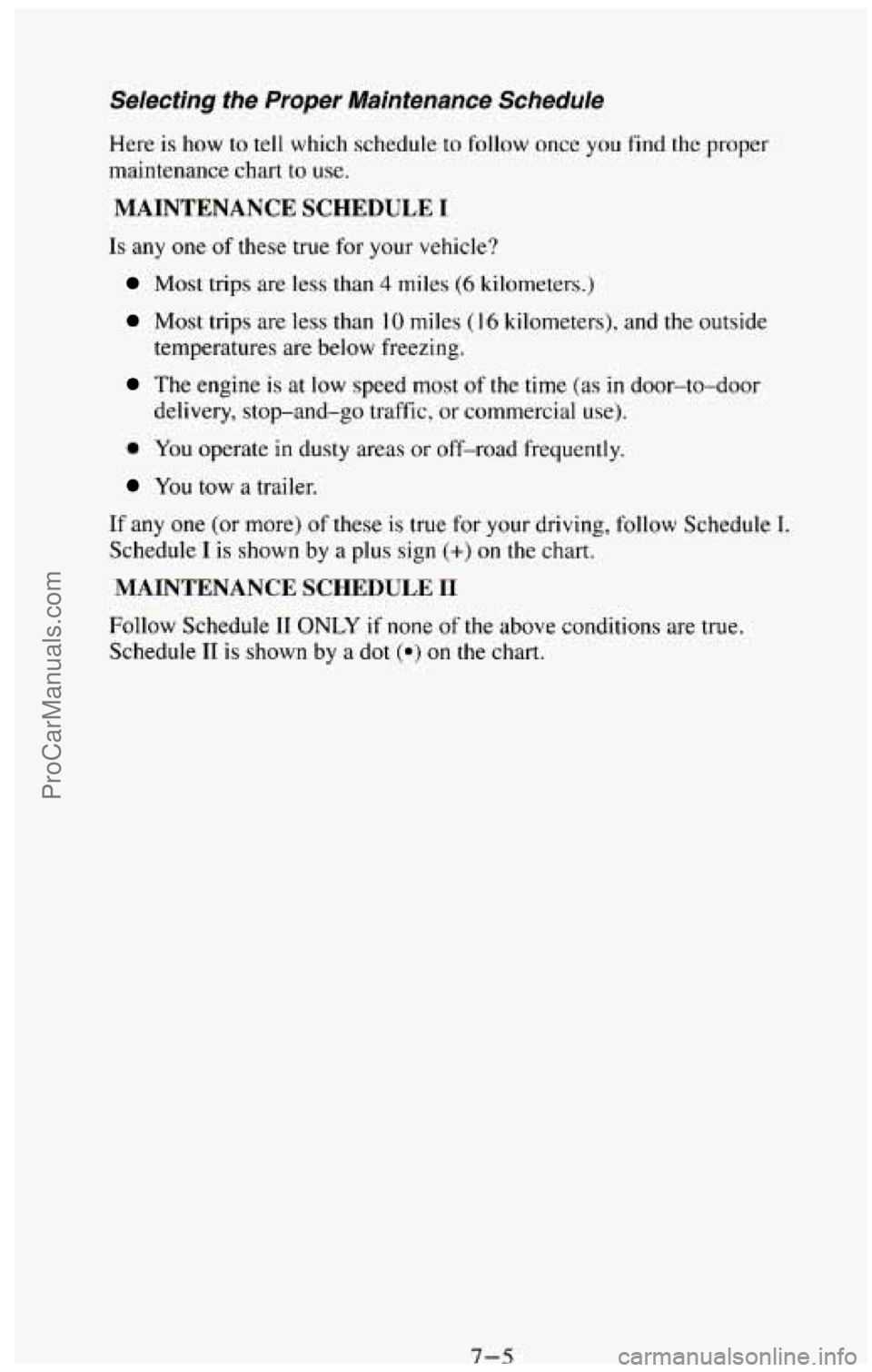
Selecting the Proper Maintenance Schedule
Here is how to tell which schedule to follow once you find the proper
maintenance chart to
use.
MAINTENANCE SCHEDULE I
Is any one of these true for your vehicle?
Most trips are less than 4 miles (6 kilometers.)
Most trips are less than 10 miles (16 kilometers), and the outside
temperatures are below freezing.
The engine is at low speed most of the time (as in door-to-door
delivery, stop-and-go traffic, or commercial use).
0 You operate in dusty areas or off-road frequently.
You tow a trailer.
If
any one (or more) of these is true for your driving, follow Schedule I.
Schedule I is shown by a plus sign (+) on the chart.
MAINTENANCE SCHEDULE II
Follow Schedule I1 ONLY if none of the above conditions are true.
Schedule
I1 is shown by a dot (0) on the chart.
7-5 ProCarManuals.com
Page 352 of 385
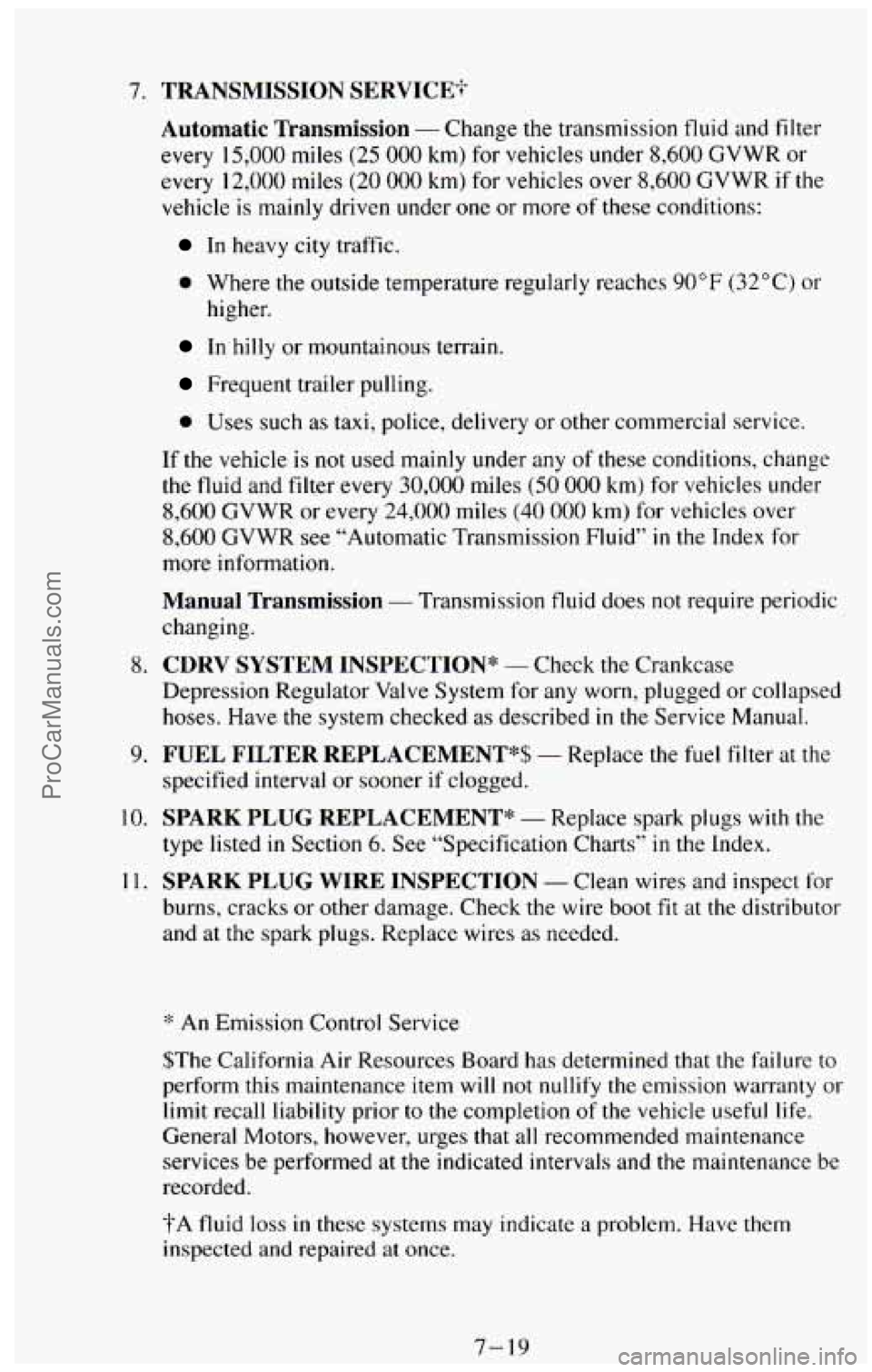
7. TRANSMISSION SERVICE;-
Automatic Transmission
- Change the transmission fluid and filter
every 15,000 miles
(25 000 km) for vehicles under 8,600 GVWR or
every 12,000 miles
(20 000 km) for vehicles over 8,600 GVWR if the
vehicle
is mainly driven under one or more of these conditions:
In heavy city traffic.
0 Where the outside temperature regularly reaches 90°F (32°C) or
higher.
In hilly or mountainous terrain.
Frequent trailer pulling.
0 Uses such as taxi, police, delivery or other commercial service.
If the vehicle is not used mainly under any
of these conditions, change
the fluid and filter every
30,000 miles (50 000 km) for vehicles under
8,600 GVWR or every 24,000 miles (40 000 km) for vehicles over
8,600 GVWR see “Automatic Transmission Fluid” in the Index for
more information.
Manual Transmission - Transmission fluid does not require periodic
changing.
8. CDRV SYSTEM INSPECTION* - Check the Crankcase
Depression Regulator Valve System for
any worn, plugged or collapsed
hoses. Have the system checked as described in the Service Manual.
9. FUEL FILTER REPLACEMENT*$ - Replace the fuel filter at the
specified interval or sooner if clogged.
10. SPARK PLUG REPLACEMENT* - Replace spark plugs with the
type listed in Section
6. See “Specification Charts” in the Index.
1 1. SPARK PLUG WIRE INSPECTION - Clean wires and inspect for
burns, cracks or other damage. Check the wire boot fit at the distributor
and at the
spark plugs. Replace wires as needed.
‘% An Emission Control Service
$The California Air Resources Board has determined that the failure to
perform this maintenance item will
not nullify the emission warranty or
limit recall liability prior to the completion of the vehicle useful life.
General Motors, however, urges that all recommended maintenance
services be performed at the indicated intervals and the maintenance be
recorded.
?A fluid loss in
these systems may indicate a problem. Have them
inspected and repaired at once.
7-19 ProCarManuals.com
Page 354 of 385
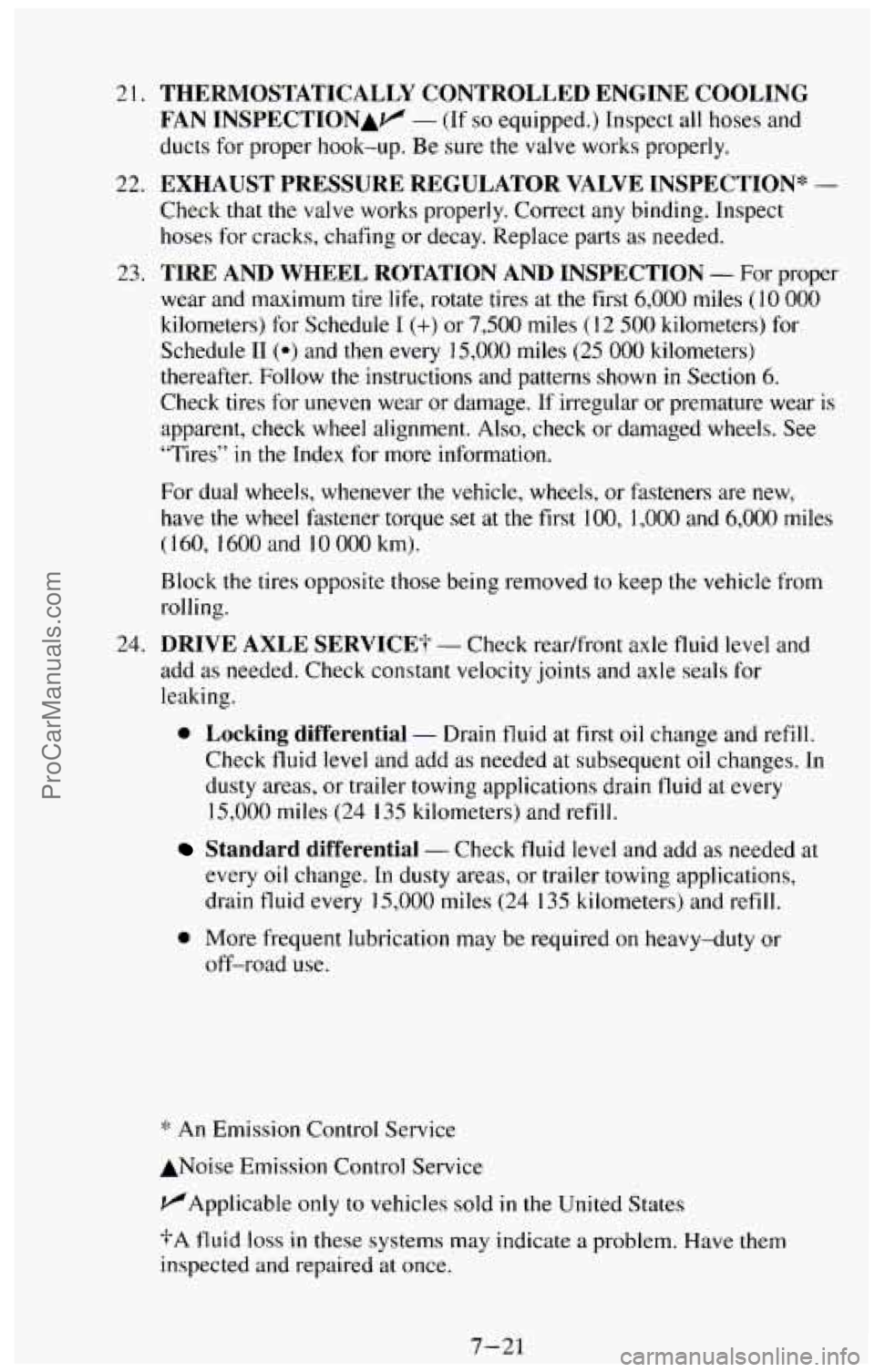
2 I. THERMOSTATICALLY CONTROLLED ENGINE COOLING FAN INSPECTIONAI/
- (If so equipped.) Inspect all hoses and
ducts for proper hook-up. Be sure the valve works properly.
22. EXHAUST PRESSURE REGULATOR VALVE INSPECTION” -
Check that the valve works properly, Correct any binding. Inspect
hoses for cracks, chafing or decay. Replace parts as needed.
23. TIRE AND WHEEL ROTATION AND INSPECTION - For proper
wear and maximum tire life, rotate tires at the first 6,000 miles
(10 000
kilometers) for Schedule
I (+) or 7,500 miles (12 500 kilometers) for
Schedule
I1 (0) and then every 15,000 miles (25 000 kilometers)
thereafter. Follow the instructions and patterns shown
in Section 6.
Check tires for uneven wear or damage. If irregular or premature wear is
apparent, check wheel alignment. Also, check or damaged wheels. See
“Tires”
in the Index for more information.
For dual wheels, whenever the vehicle, wheels, or fasteners are new,
have the wheel fastener torque
set at the first 100, 1,000 and 6,000 miles
( 160, 1600 and 10 000 km).
Block the tires opposite
those being removed to keep the vehicle from
rolling.
24.
DRIVE AXLE SERVICE? - Check readfront axle fluid level and
add
as needed. Check constant velocity joints and axle seals for
leaking.
0 Locking differential - Drain fluid at first oil change and refill.
Check fluid
level and add as needed at subsequent oil changes. In
dusty areas, or trailer towing applications drain fluid at every
15,000 miles (24 135 kilometers) and refill.
Standard differential - Check fluid level and add as needed at
every oil change. In dusty areas, or trailer towing applications,
drain fluid every
15,000 miles (24 135 kilometers) and refill.
0 More frequent lubrication may be required on heavy-duty or
off-road
use.
:i: An Emission Control Service
ANoise Emission Control Service
VApplicable
only to vehicles sold in the United States
+A fluid
loss in these systems may indicate a problem. Have them
inspected and repaired
at once.
7-21 ProCarManuals.com
Page 375 of 385
Index
A
Aircleaner ................................................... 6-27
Air Conditioning ............................................ 3.5, 6.83
Rear (Wagon Models)
........................................... 3-8
Refrigerant Capacity
........................................... 6-83
SystemControls
............................................... 3-8
Antenna, Fixed Mast
............................................. 3-22
Alternative Dispute Resolution Program
............................... 8-3
Antilock Brakes (See “Brakes”) System Warning Light 2-68
Appearancecare
................................................ 6-69
Materials
.................................................... 6-77
Audiosystems
.................................................. 3-12
AMRadio
................................................... 3-12
AM-FM Stereo Audio System with Cassette Deck
................... 3-14
AM-FM Stereo Audio System with Cassette Deck and Equalizer
........ 3-18
CassetteDeck
................................................... 3-20
Cassette Tape Player Care
......................................... 3-22
Automatic Transmission
.......................................... 2-21
Fluid
....................................................... 6-28
Axle ..................................................... 2-32, 6-33
Front
....................................................... 6-35
Rear
........................................................ 6-33
RearLockin
e; ................................................. 6-33
B
Battery ........................................................ 6-49
Belts (See “Safety Belts”)
Better Business Bureau
............................................ 8-3
Blizzard
....................................................... 4-33
Brakes
Adjustment
.................................................. 6-45
Antilock
..................................................... 4-6
Antilock Warning Light
........................................ 2-68
Fluid
....................................................... 6-44
Four-wheel Antilock
........................................... 4-7
Hydro-Boost System (Hydraulic Pump) ........................... 642
Master Cylinder
.............................................. 643
Parking
..................................................... 2-26
PedalTravel
................................................. 6-45
Replacing Parts ............................................... 6-46
System Warning Light
......................................... 2-69
Trailer
................................................. 4-36, 440
Wear Indicators
............................................... 645
Braking
......................................................... 4-5
In Emergencies
................................................ 4-7
Break-In, New Vehicle
........................................... 2-11
Bulb Replacement ............................................... 6-50
Replacement Chart
............................................ 6-86
1 ProCarManuals.com
Page 377 of 385
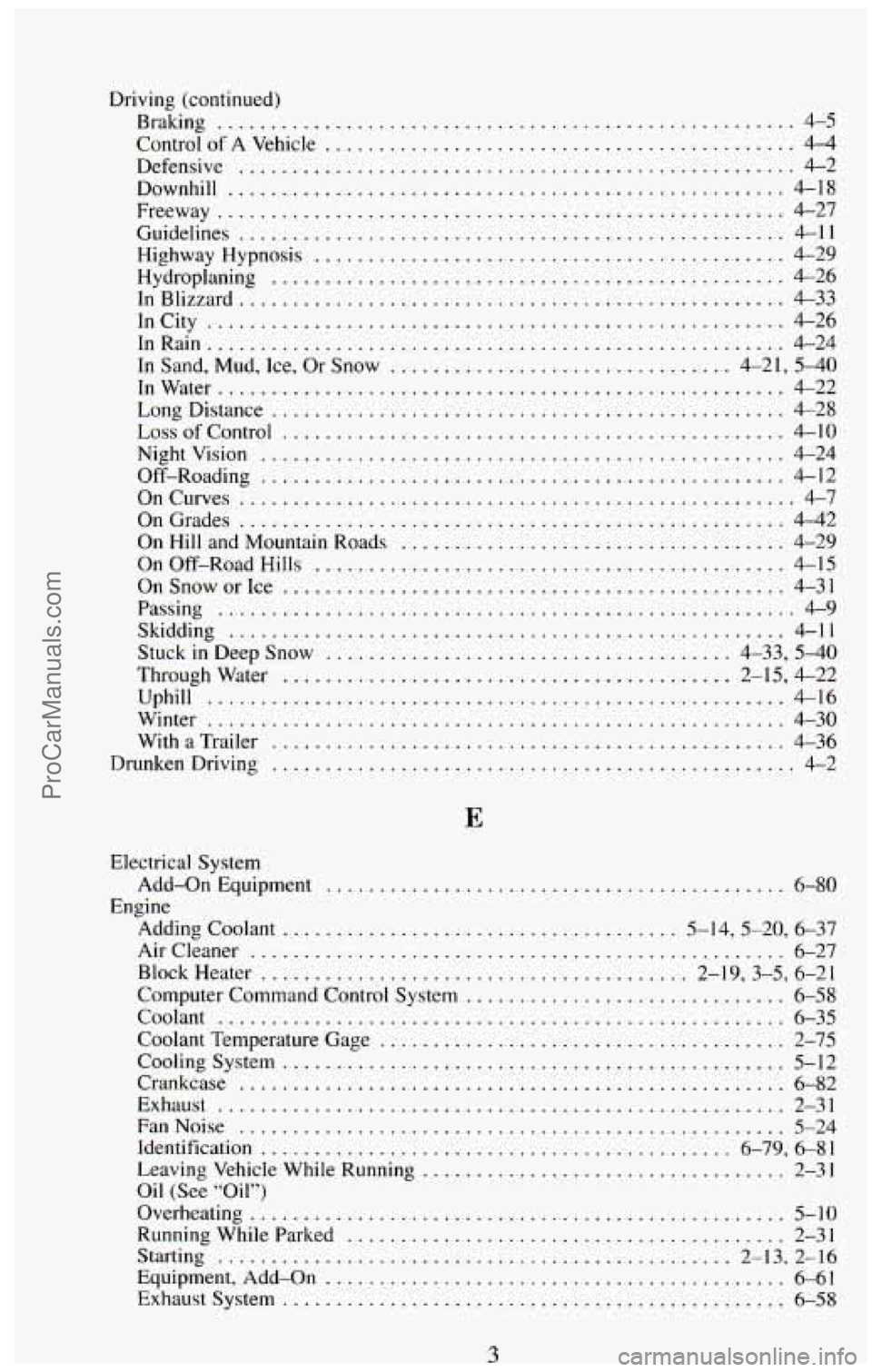
Driving (continued)
Braking
...................................................... 4-5
Control
of A Vehicle ............................................ 4-4
Defensive
.................................................... 4-2
Downhill
.................................................... 4-18
Guidelines
................................................... 4-11
Highway Hypnosis
............................................ 4-29
Hydroplaning
................................................ 4-26
In Blizzard ................................................... 4-33
InCity
...................................................... 4-26
InRain
...................................................... 4-24
In Sand, Mud, Ice, Or Snow ................................ 4-21, 5-40
InWater ..................................................... 4-22
LongDistance
................................................ 4-28
LossofControl
............................................... 4-10
Nightvision
................................................. 4-24
Off-Roading
................................................. 4-12
OnCurves
.................................................... 4-7
OnGrades
................................................... 4-42
On Hill and Mountain Roads .................................... 4-29
On Off-Road
Hills ............................................ 4-15
OnSnoworIce
............................................... 4-31
Passing
...................................................... 4-9
Skidding
.................................................... 4-11
Stuck in Deep
Snow ...................................... 4-33, 5-40
Throughwater .......................................... 2-15, 4-22
Uphill
...................................................... 4-16
Winter
...................................................... 4-30
WithaTrailer ................................................ 4-36
DrunkenDriving
................................................. 4-2
Freeway
..................................................... 4-27
E
Electrical System
Engine Add-on
Equipment
...........................................
Adding Coolant ..................................... 5-14,5-20.
Aircleaner
..................................................
Block Heater ........................................ 2-1 9,3-5,
Computer Command Control System
..............................
Coolant ...................
Coolant Temperature Gage ....
Cooling System .............
Crankcase .................
Exhaust ...................
Fan Noise .................
Identification ...............
Leaving Vehicle While Running
Oil (See “Oil”)
Overheating
................
Running While Parked .......
Starting ...................
Equipment. Add-on .........
Exhaust System .............
..................................
..................................
..................................
..................................
..................................
..................................
............................. 6-79,
..................................
..................................
..................................
............................. 2-13,
..................................
..................................
6-80
6-37
6-27
6-21
6-58
6-35
2-75
5-12
6-82
5-24 2-31
6-81
2-31
5-10
2-31
2-16
6-61
6-58
3 ProCarManuals.com
Page 378 of 385
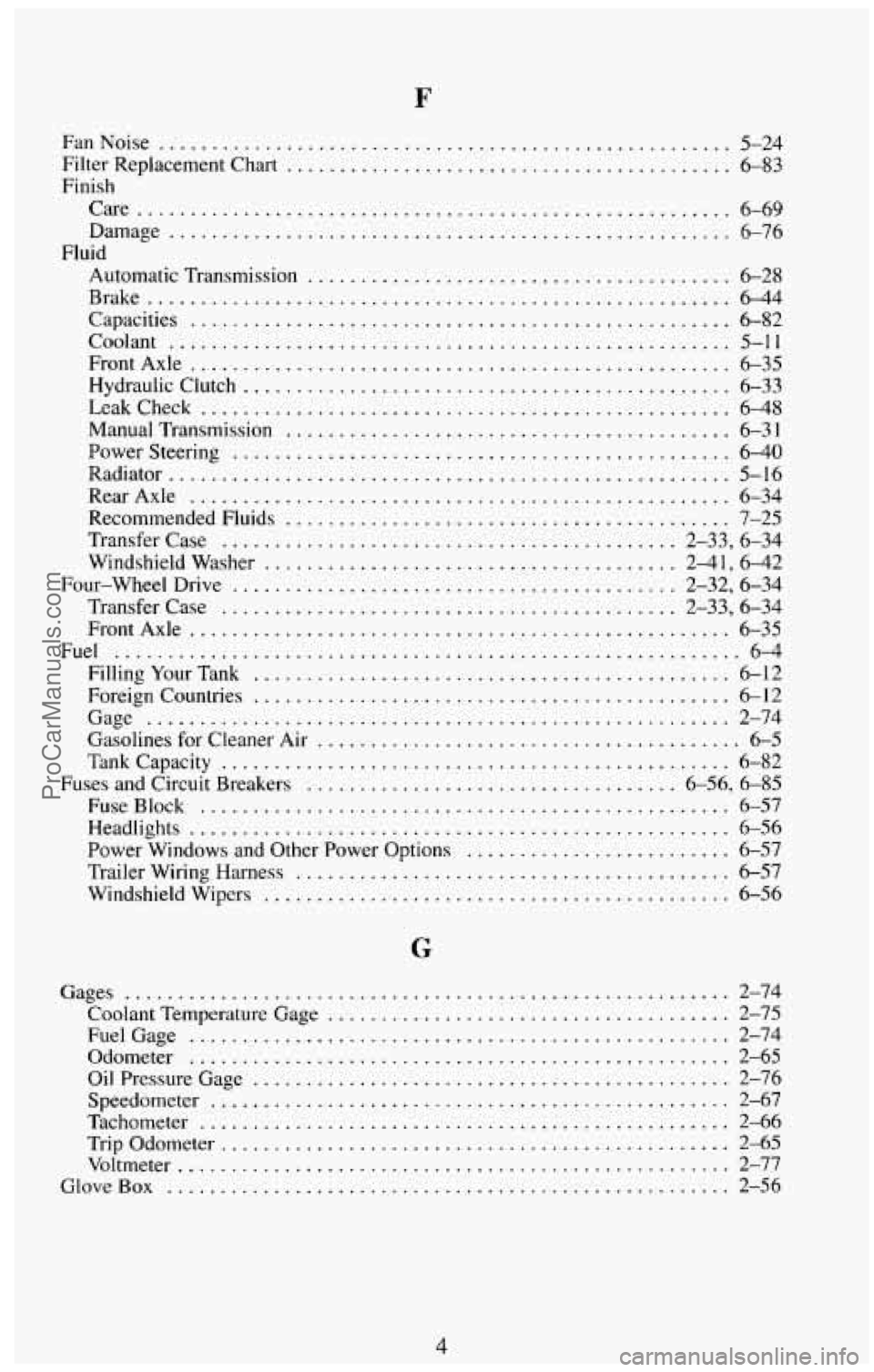
FanNoise ...................................................... 5-24
Filter Replacement Chart .......................................... 6-83
Finish Care
........................................................ 6-69
Damage
..................................................... 6-76
Automatic Transmission
........................................ 6-28
Brake
....................................................... 6-44
Capacities ................................................... 6-82
Coolant
..................................................... 5-11
FrontAxle ................................................... 6-35
Hydraulicclutch
.............................................. 6-33
Leakcheck .................................................. 6-48
ManualTransmission
.......................................... 6-31
Power Steering
............................................... 6-40
Radiator
..................................................... 5-16
Rear Axle ................................................... 6-34
Recommended Fluids
.......................................... 7-25
Transfer Case
........................................... 2-33, 6-34
Windshield Washer
....................................... 2-41, 6-42
Four-wheel Drive
.......................................... 2-32, 6-34
Transfer Case
........................................... 2-33, 6-34
FrontAxle
................................................... 6-35
Fuel
........................................................... 6-4
FillingYourTank ............................................. 6-12
Foreign Countries
............................................. 6-12
Gage
....................................................... 2-74
Gasolines for Cleaner
Air ........................................ 6-5
Tankcapacity
................................................ 6-82
Fuses and Circuit Breakers
................................... 6-56, 6-85
FuseBlock
.................................................. 6-57
Headlights
................................................... 6-56
Power Windows
and Other Power Options ......................... 6-57
Trailer Wiring Harness
......................................... 6-57
Windshield Wipers
............................................ 6-56
Fluid
G
Gages ......................................................... 2-74
Coolant Temperature Gage
...................................... 2-75
FuelGage
................................................... 2-74
Odometer
................................................... 2-65
Oil Pressure Gage ............................................. 2-76
Speedometer
................................................. 2-67
Tachometer
.................................................. 2-66
Trip Odometer
................................................ 2-65
Voltmeter
.................................................... 2-77
GloveBox
..................................................... 2-56
4 ProCarManuals.com