wheel CHEVROLET SUBURBAN 1994 Repair Manual
[x] Cancel search | Manufacturer: CHEVROLET, Model Year: 1994, Model line: SUBURBAN, Model: CHEVROLET SUBURBAN 1994Pages: 385, PDF Size: 19.88 MB
Page 291 of 385
Replacing Brake System Parts
The braking system on a modern vehicle is complex. Its many parts have to
be of top quality and work well together if the vehicle is to have really good
braking. Vehicles we design and test have top-quality
GM brake parts in
them, as your vehicle does when it is new. When you replace parts of your
braking system
- for example, when your brake linings wear down and
you have to have new ones put
in - be sure you get new genuine GM
replacement parts. If you don’t, your brakes may no longer work properly.
For example, if someone puts
in brake linings that are wrong for your
vehicle, the balance between your front and rear brakes can change, for the
worse. The braking performance you’ve come to expect can change
in many
other ways
if someone puts in the wrong replacement brake parts.
Other Maintenance Items
Front Suspension and Steering Linkage
Your maintenance schedule will tell you how often to lubricate the fittings.
See “Recommended Fluids and Lubricants” in the Index for the proper
lubricant to use.
Front Wheel Bearing
Your vehicle has front wheel bearings that must be cleaned and repacked.
Your maintenance schedule will tell you how often this must be done.
Front Shock Absorbers
The front shock absorbers of your vehicle do many things. They help the
vehicle ride smoothly and also control the travel of the suspension system.
When the shock absorbers are serviced, any replacement shock absorbers
must be the same as the original equipment shock absorbers
in both
extended length
and strength.
I NOTICE:
If you use shock absorbers that are not the same as the original
shock absorbers, the shock absorbers or suspension system
could be damaged.
6-46
ProCarManuals.com
Page 292 of 385
Wheel Nut Torque
For vehicles with dual wheels, when the vehicle, wheel or fasteners are new,
have the torque set at
the first 100, 1,000 and 6,000 miles (160, 1600 and
9600 km). Use the torque specified in the appropriate Specification Chart
later
in this section.
Single Belt Accessory Drive
If your new vehicle uses a serpentine belt, it is lighter, and more durable
than systems with several belts.
The belt
ruIl 'li'vkf br iir6und the pulleys or^ the engine. A tensione'r'n'iay be
used to keep the belt tight at all times. The tensioner also makes replacing
the belt easier
if you need to replace the belt, be sure to get the correct
replacement belt. Your dealership
or parts supplier can help you with this.
The Accessory Drive Belt Routing label on your vehicle will show you how
to route the belt your vehicle uses.
Windshield Wiper Blade lnserts
To replace your
windshield wiper
blade inserts, lift the
wiper arm and rotate
the blade until
it is
facing
away from the
windshield.
Unlatch the end
of the insert from the holding clips. Remove the insert and
slide
a new one in place. Make sure the blade is secured in the clips.
Air Conditioning
Every now and then have your dealership check your air conditioning
system to be sure
it has not lost any cooling ability. If you think the system
is not working properly, have your dealership check it out as soon as
possible.
The air conditioning will not work when the temperature
is below 40°F
(4°C).
6-47
ProCarManuals.com
Page 309 of 385
Special Tire lnflation
If you have 16 inch tires on your vehicle, and:
- You’ll be driving for very long at speeds of 66 mph (105 kdh) to
75 mph (120 km/h) where legal, inflate tires to 10 psi (70 kPa)
more than the recommended cold inflation pressures.
- You’ll be driving for very long at speeds of 76 mph ( 120 kdh) to
85 mph (1 35 kdh) where legal, cold inflation pressures should be
increased by
10 psi (70 kPa) and you must also reduce axle load
capacity by 10%.
Do not drive over 85 mph (135 km/h) even if
it’s legal.
Inflation pressures should never exceed 10 psi (70 kPa) above the
inflation specified for the maximum load
of the tire.
Tire lnspection and Rotation
To make your tires last longer, have them inspected and rotated at the
mileages recommended
in the Maintenance Schedule. See “Scheduled
Maintenance Services” in the Index.
FRT FRT
Use this rotation
pattern.
If your vehicle has front tires with different load ratings or tread designs
(such
as all season vs. on/off road) than the rear tires, don’t rotate your tires
front
to rear.
After the tires have been rotated, adjust the front and rear inflation pressure
as shown on the Certificationmire label. Make certain that all wheel nuts are
properly tightened. See “Wheel Nut Torque” in the Index.
6-64
ProCarManuals.com
Page 312 of 385
Traction - A, B, C
The traction grades, from highest to lowest are: A, B, and C. They represent
the tire’s ability to stop on wet pavement
as measured under controlled
conditions on specified government test surfaces
of asphalt and concrete. A
tire marked C may have poor traction performance.
Warning: The traction grade assigned to this tire is based on braking
(straight-ahead) traction tests and does not include cornering (turning)
traction.
Temperature - A, By C
The temperature grades are A (the highest), B, and C, representing the tire’s
resistance
to the generation of heat and its ability to dissipate heat when tested
under controlled conditions
on a specified indoor laboratory test wheel.
Sustained high temperature can cause the material of the tire to degenerate
and reduce tire life, and excessive temperature can lead to sudden tire failure.
The grade
C corresponds to a level of performance which all passenger car
tires
must meet under the Federal Motor Vehicle Safety Standard No. 109.
Grades B and A represent higher levels of performance on the laboratory test
wheel
than the minimum required by law.
Warning: The temperature grade for this tire is established for a tire that is
properly inflated and not overloaded. Excessive speed, underinflation, or
excessive loading, either separately or in combination, can cause heat
buildup and possible tire failure.
These grades are molded on the sidewalls of passenger car tires.
While the tires available as standard or optional equipment on General
Motors vehicles may vary with respect to these grades, all such tires meet
General Motors performance standards and have been approved for use on
General Motors vehicles. All passenger type
(P Metric) tires must conform
to Federal safety requirements in addition to these grades.
Wheel Alignment and Tire Balance
The wheels on your vehicle were aligned and balanced carefully at the
factory to give you the longest tire life and best overall performance.
In most cases, you will not need to have your wheels aligned again.
However,
if you notice unusual tire wear or your vehicle pulling one way or
the other, the alignment may need to be reset. If you notice your vehicle
vibrating when driving on
a smooth road, your wheels may need to be
rebalanced.
6-67 ProCarManuals.com
Page 313 of 385
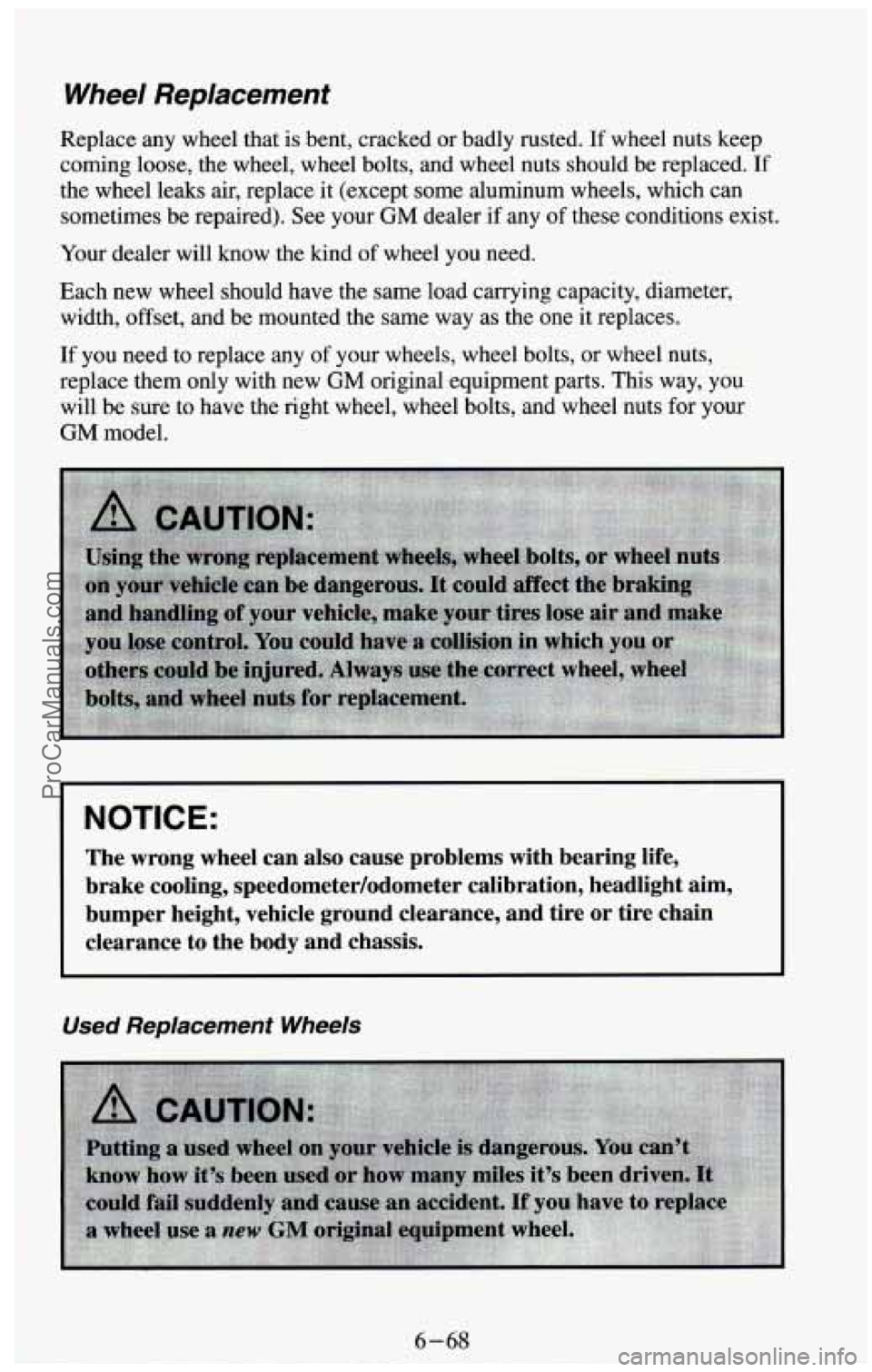
Wheel Replacement
Replace any wheel that is bent, cracked or badly rusted. If wheel nuts keep
coming loose, the wheel, wheel bolts, and wheel nuts should be replaced.
If
the wheel leaks air, replace it (except some aluminum wheels, which can
sometimes be repaired). See your GM dealer if any
of these conditions exist.
Your dealer will know the kind
of wheel you need.
Each new wheel should have the same load carrying capacity, diameter,
width, offset, and be mounted the same way as the one it replaces.
If you need to replace any of your wheels, wheel bolts, or wheel nuts,
replace them only with new GM original equipment parts. This way, you
will be sure to have the right wheel, wheel bolts, and wheel nuts
for your
GM model.
NOTICE:
The wrong wheel can also cause problems with bearing life,
brake cooling, speedometer/odometer calibration, headlight aim, bumper height, vehicle ground clearance, and tire or tire chain\
clearance to the body and chassis.
Used Replacement Wheels
ProCarManuals.com
Page 320 of 385
Finish Care
Occasional waxing or mild polishing of your vehicle may be necessary to
remove residue from
the paint finish. You can get GM approved cleaning
products from your dealer. (See “Appearance Care
and Materials” in the
Index.)
Your vehicle may have
a “ba~ec~at/clearc~at” paint finish. The clearcoat
gives more depth and gloss to the colored basecoat. Always use waxes and
polishes that are non-abrasive and made for a basecoatklearcoat paint
finish.
NOTICE:
Machine compounding or aggressive polishing on a
basecoatklearcoat paint finish may dull the finish or leave swirl
marks.
Protecting Exterior Bright Metal Parts
Bright metal parts should be cleaned regularly to keep their luster. Washing
with water is all that is usually needed. However, you may use GM Chrome
Polish on chrome or stainless steel trim,
if necessary.
Use special care with aluminum trim.
To avoid damaging protective trim,
never use auto or chrome polish, steam or caustic soap to clean aluminum.
A coating
of wax, rubbed to high polish, is recommended for all bright
metal parts.
Aluminum Wheels (If So Equipped)
Your aluminum wheels have a protective coating similar to the painted
surface
of your vehicle. Don’t use strong soaps, chemicals, chrome polish,
abrasive cleaners or abrasive cleaning brushes on them because you could
damage this coating. After rinsing thoroughly, a
wax may be applied.
NOTICE:
If you have aluminum wheels, don’t use an automatic vehicle
wash that has hard silicon carbide cleaning brushes. These
brushes can take
off the protective coating.
White Sidewall Tires
Your GM dealer has a GM White Sidewall Tire Cleaner. You can use a stiff
brush
with the cleaner.
6-75
ProCarManuals.com
Page 325 of 385
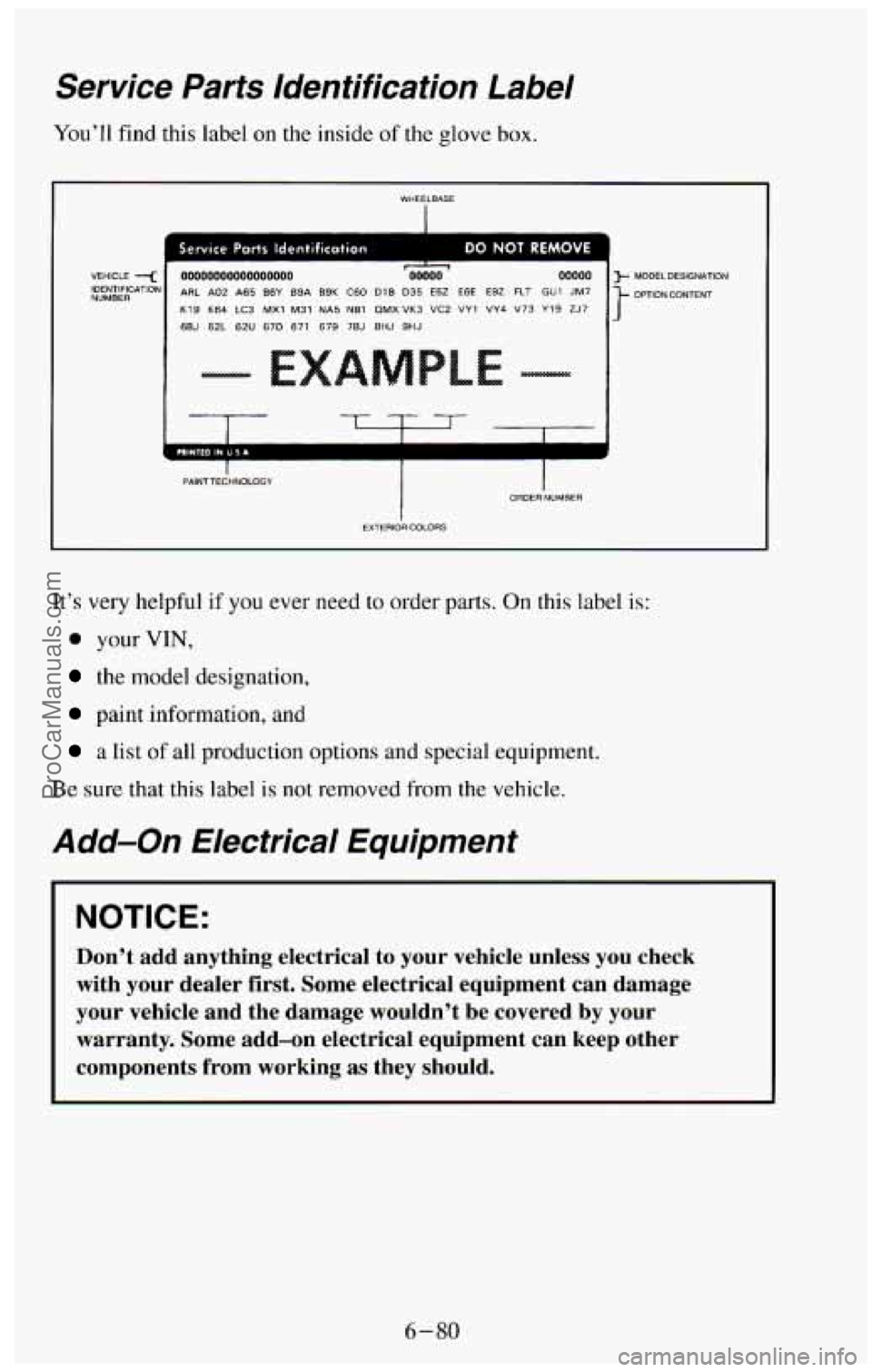
Service Parts Identification Label
You’ll find this label on the inside of the glove box.
WHEELBASE
I
MODEL DESIGNATION
OPTION CONTENT K19 K64 LC3 MXl M31 NA5 NB1 QMXVK3 VC2 VYl VY4 V73 Y19 ZJ7
6BJ 62L 62U 67D 671
679 7BJ 8HJ BHJ
I PAINT TECHNOLOGY I ORDER NUMBER
EXTERIOR COLORS
It’s very helpful if you ever need to order parts. On this label is:
0 your VIN,
the model designation,
paint information, and
a list of all production options and special equipment.
Be sure that this label is not removed from the vehicle.
Add-on E/ectrical Equipment
NOTICE:
Don’t add anything electrical to your vehicle unless you che\
ck
with
your dealer first. Some electrical equipment can damage
your vehicle and the damage wouldn’t be covered by your
warranty. Some add-on electrical equipment can keep other
components
from working as they should.
6-80
ProCarManuals.com
Page 326 of 385
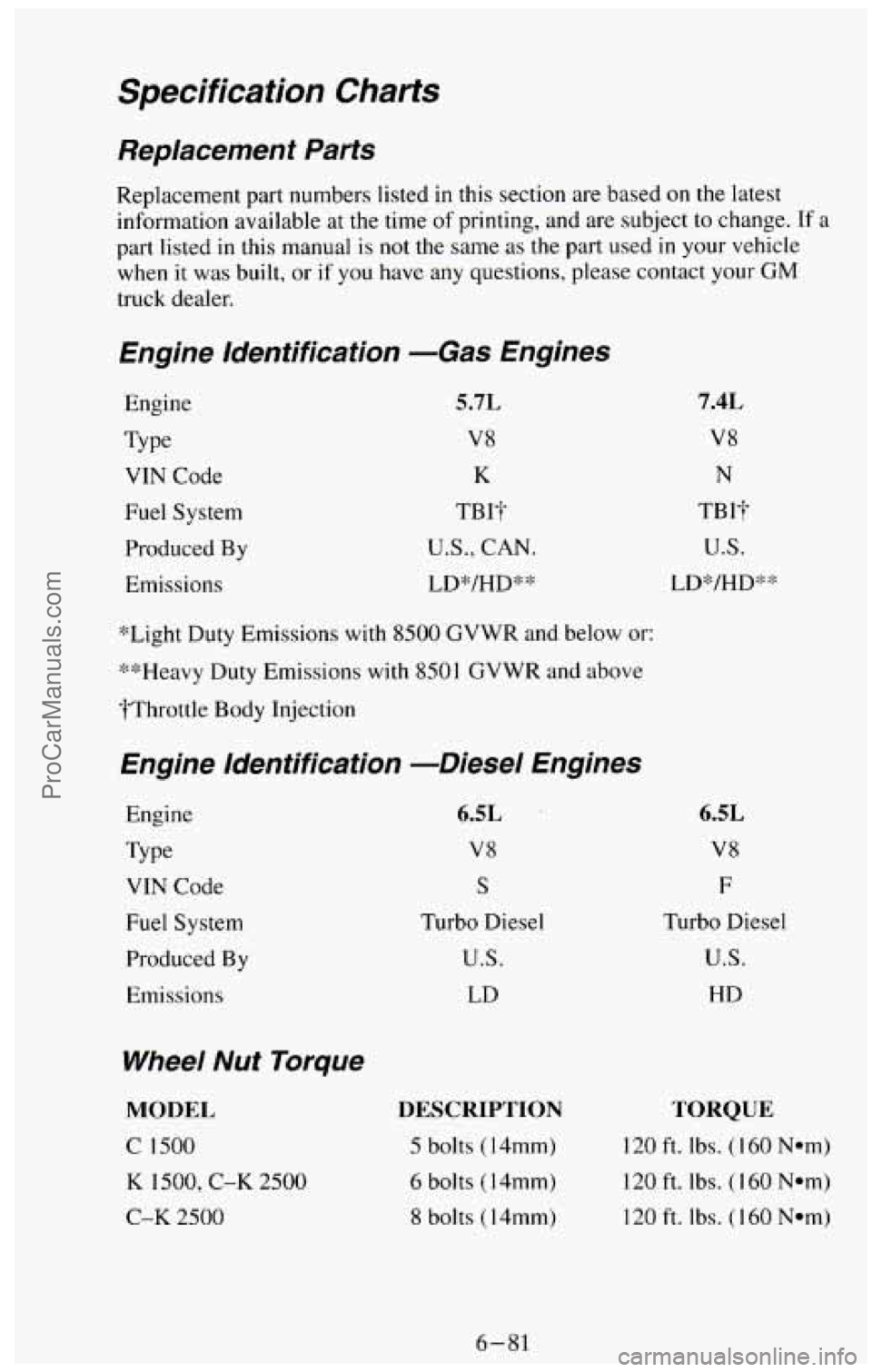
Specification Charts
Replacement Parts
Replacement part numbers listed in this section are based on the latest
information available
at the time of printing, and are subject to change. If a
part listed in this manual
is not the same as the part used in your vehicle
when
it was built, or if you have any questions, please contact your GM
truck dealer.
Engine Identification -Gas Engines
Engine
Type VIN Code
Fuel System
Produced By
Emissions
5.7L
V8
K
TBIT
U.S., CAN.
JJD*/HD**
“Light Duty Emissions with
8500 GVWR and below or:
**Heavy Duty Emissions with 8501 GVWR and above
?Throttle Body Injection
Engine Identification -Diesel Engines
Engine
Type VIN Code
Fuel System
Produced By
Emissions
Wheel Nut Torque
MODEL
C 1500
K 1500, C-K 2500
C-K 2500
6.5L
V8
S
Turbo Diesel
U.S.
LD
DESCRIPTION
5 bolts (14mm)
6 bolts (14mm)
8 bolts (14mm)
6.5L
V8
F
Turbo Diesel
U.S.
HD
TORQUE
120 ft. lbs. (1 60 Nom)
120 ft. lbs. ( 1 60 Nom)
I20 ft. Ibs. (I 60 Nom)
6-81
ProCarManuals.com
Page 328 of 385
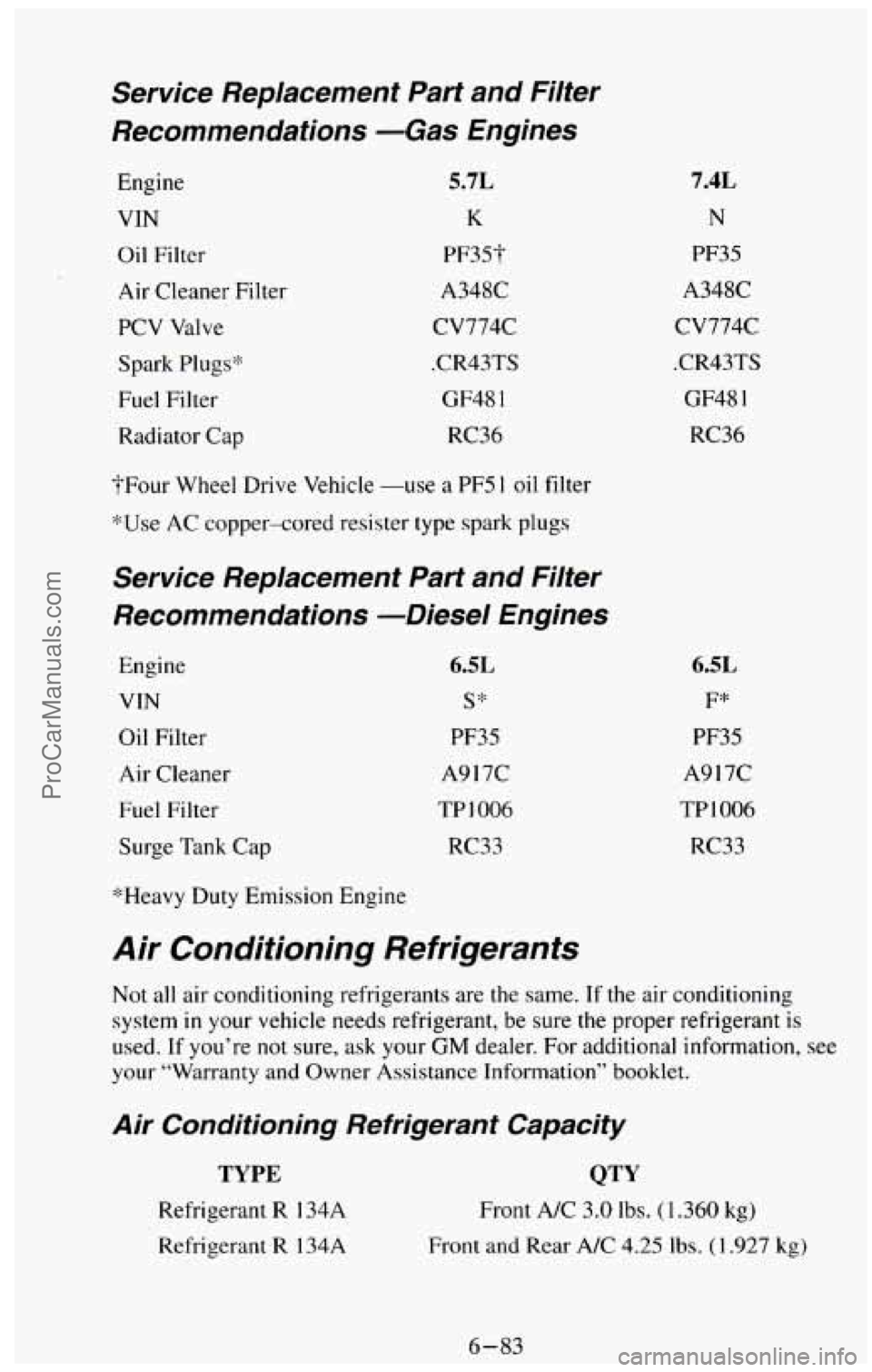
Service Replacement Part and Filter
Recommendations -Gas Engines
Engine
VIN
Oil Filter
Air Cleaner Filter
PCV Valve
Spark Plugs‘%
Fuel Filter
Radiator Cap
5.7L
K
PF353‘
A348C
cv774c
.CR43TS
GF48 1
RC36
$Four Wheel Drive Vehicle -use a
PFS 1 oil filter
*Use AC copper-cored resister type spark plugs
Service Replacement Part and Filter
Recommendations -Diesel Engines
Engine
VIN
Oil Filter
Air Cleaner
Fuel Filter
Surge Tank Cap 6.5L
S”
PF3S
A917C
TP
I 006
RC33
7.4L
N
PF35
A348C
cv774c
.CR43TS
GF48
I
RC36
6.5L
F”
PF35
A9 17C
TP
1006
RC33
*Heavy Duty Emission Engine
Air Conditioning Refrigerants
Not all air conditioning refrigerants are the same. If the air conditioning
system
in your vehicle needs refrigerant, be sure the proper refrigerant is
used. If you’re not sure, ask your GM dealer. For additional information, see
your “Warranty and Owner Assistance Information” booklet.
Air Conditioning Refrigerant Capacity
TYPE
Refrigerant R 134A
Refrigerant
R 134A
QTY
Front A/C 3.0 lbs. (1.360 kg)
Front and Rear A/C
4.25 Ibs. (I .927 kg)
6-83
ProCarManuals.com
Page 330 of 385
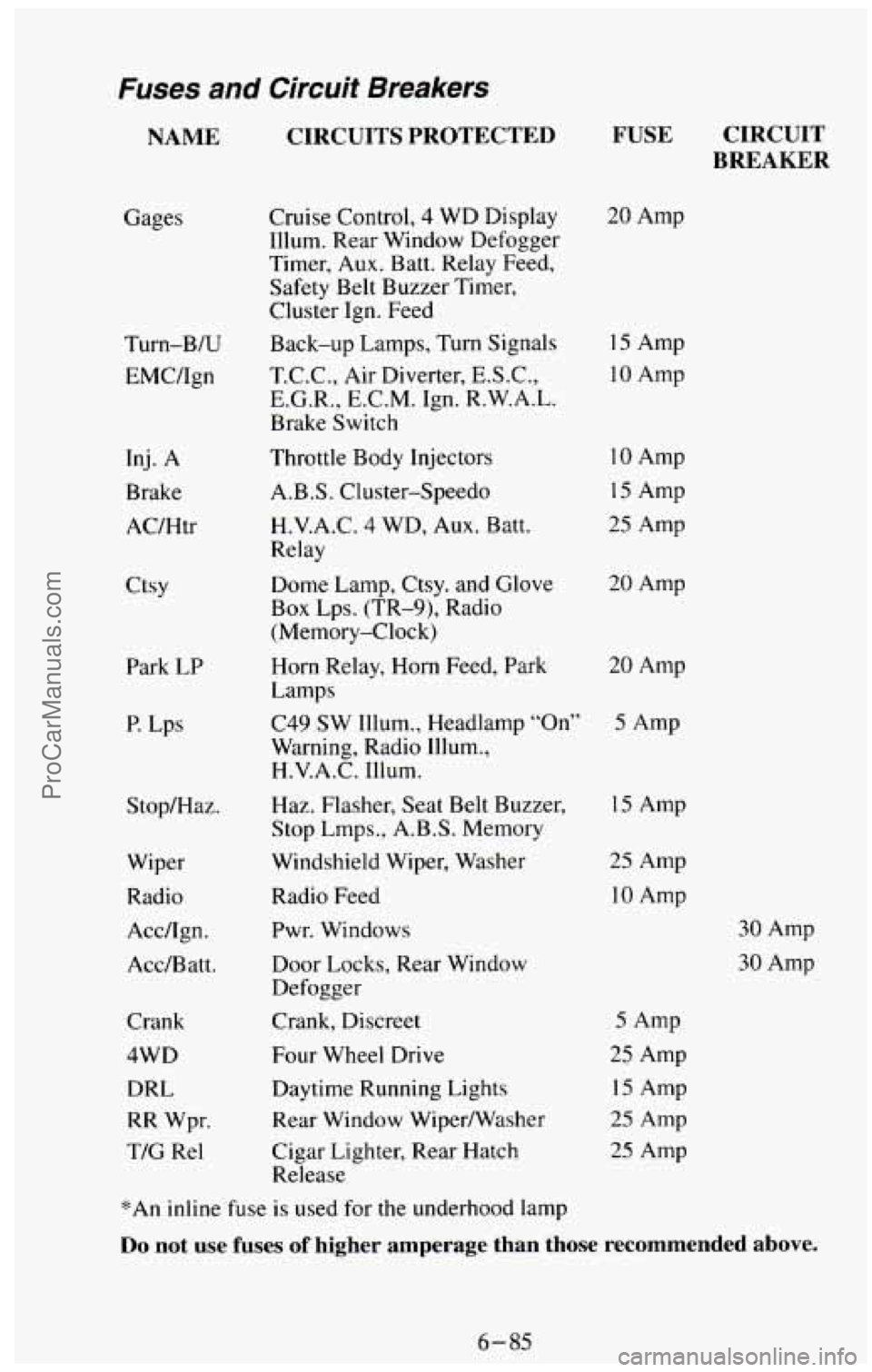
Fuses and Circuit Breakers
NAME CIRCUITS PROTECTED
Gages Turn-B/U
EMC/Ign
Inj. A
Brake
AC/Htr
Ctsy Park
LP
P. Lps
Stop/Haz.
Wiper
Radio Acc/Ign.
Acc/Batt.
Crank
4WD DRL
RR Wpr.
TIC Re1 Cruise Control,
4 WD Display
Illum. Rear Window Defogger
Timer, Aux. Batt. Relay Feed,
Safety Belt Buzzer Timer,
Cluster Ign. Feed
Back-up Lamps, Turn Signals
T.C.C., Air Diverter, E.S.C.,
E.G.R., E.C.M. Ign. R.W.A.L.
Brake Switch
Throttle Body Injectors
A.B.S. Cluster-Speed0
H.V.A.C.
4 WD, Aux. Batt.
Relay
Dome Lamp, Ctsy. and Glove
Box Lps. (TR-9), Radio
(Memory-Clock)
FUSE CIRCUIT
BREAKER
20 Amp
15 Amp
10 Amp
10 Amp
15 Amp
25 Amp
20 Amp
Horn Relay,
Horn Feed, Park 20 Amp
Lamps
C49 SW Illum., Headlamp
“On” 5 Amp
Warning, Radio Illum.,
H.V.A.C.
Illum.
Haz. Flasher, Seat Belt Buzzer,
Stop
Lmps., A.B.S. Memory
Windshield Wiper, Washer
Radio Feed Pwr. Windows
Door Locks, Rear Window
Defogger
Crank, Discreet
Four Wheel Drive
Daytime Running Lights
Rear Window Wipermasher
Cigar Lighter, Rear Hatch
Release
15 Amp
25 Amp
10 Amp
5 Amp
25 Amp
15 Amp
25 Amp
25 Amp
30 Amp
30 Amp
*An inline fuse is used for the underhood lamp
Do not use fuses of higher amperage than those recommended above.
6-85
ProCarManuals.com