brake light CHEVROLET SUBURBAN 1995 User Guide
[x] Cancel search | Manufacturer: CHEVROLET, Model Year: 1995, Model line: SUBURBAN, Model: CHEVROLET SUBURBAN 1995Pages: 486, PDF Size: 26.58 MB
Page 205 of 486
Driving ln Water
Light rain causes no special off-road driving problems. But heavy rain can
mean flash flooding, and flood waters demand extreme caution.
Find out how deep the water
is before you drive through it. If it’s deep
enough to cover your wheel hubs, axles,
or exhaust pipe, don’t try it - you
probably won’t get through. Also, water that deep can damage your axle and
other vehicle parts.
If the water isn’t
too deep, then drive through it slowly. At fast speeds, water
splashes
on your ignition system and your vehicle can stall. Stalling can also
occur
if you get your tailpipe under water. And, as long as your tailpipe is
under water, you’ll never be able
to start your engine. When you go through
water, remember that when your brakes get wet, it may take you longer to
stop.
If
you have a diesel engine, see “Driving Through Water (Diesel Engines)”
in the Index for more information on driving through water.
4-22
ProCarManuals.com
Page 206 of 486
After Off-Road Driving
Remove any biush or debris that has collected on the underbody, chassis or
under the hood. These accumulations
can be a fire hazard.
After operation
in mud or sand, have the brake linings cleaned and checked.
These substances
can cause glazing and uneven braking. Check the body
structure, steering, suspension, wheels, tires, and
exhaust system for
damage. Also, check the fuel lines and cooling system for any leakage.
Your vehicle will require more frequent service due to off-road use. Refer
to the Maintenance Schedule
for additional information.
Driving at Night
Night driving is more dangerous than day driving. One reason is that some
drivers are likely to be impaired
- by alcohol or drugs, with night vision
problems,
or by fatigue.
Here are some tips
on night driving.
0
0
0
0
e
0
0
Drive defensively.
Don’t drink and drive.
Adjust your inside rearview mirror to reduce the glare from headlamps
behind you.
Since you can’t see as well, you may need to slow down and
keep more
space between you and other vehicles.
Slow down, especially on higher speed roads. Your headlamps can light
up only
so much road ahead.
In remote areas, watch for animals.
If you’re tired, pull off the road
in a safe place and rest.
4-23
ProCarManuals.com
Page 217 of 486
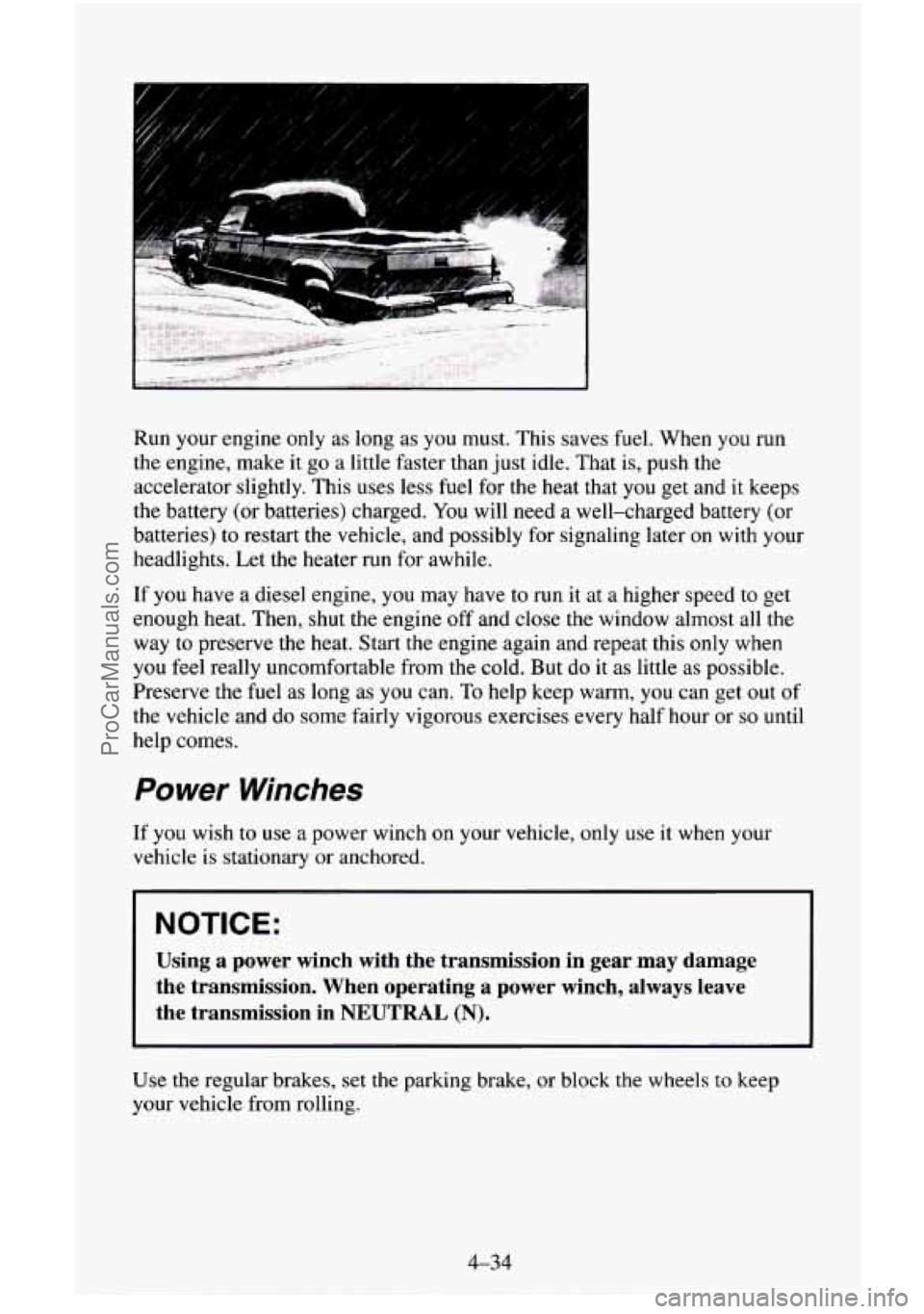
Run your engine only as long as you must. This saves fuel. When you run
the engine, make it
go a little faster than just idle. That is, push the
accelerator slightly. This uses less fuel for the heat
that you get and it keeps
the battery (or batteries) charged. You will need a well-charged battery
(or
batteries) to restart the vehicle, and possibly for signaling later on with your
headlights. Let the heater
run for awhile.
If you have a diesel engine, you may have
to run it at a higher speed to get
enough heat. Then, shut the engine off and close the window almost all the
way to preserve the heat. Start the engine again and repeat
this only when
you feel really uncomfortable from the cold. But do it as little as possible.
Preserve the fuel
as long as you can. To help keep warm, you can get out of
the vehicle and do some fairly vigorous exercises every half
hour or so until
help
comes.
Power Winches
If you wish to use a power winch on your vehicle, only use it when your
vehicle
is stationary or anchored.
I NOTICE:
Using a power winch with the transmission in gear may damage
the transmission. When operating a power winch, always leave
the transmission in NEUTRAL
(N).
Use the regular brakes, set the parking brake, or block the wheels to keep
your vehicle from rolling.
4-34
ProCarManuals.com
Page 230 of 486
Maintenance When Trailer Towing
Your vehicle will need service more often when you’re pulling a trailer. See
the Maintenance Schedule for more on this. Things that are especially
important
in trailer operation are automatic transmission fluid (don’t
overfill), engine oil, axle lubricant, belt, cooling system, an\
d brake
adjustment. Each
of these is covered in this manual, and the Index will help
you find them quickly. If you’re trailering, it’s a good idea to review these
sections before you start your trip.
Check periodically to see
that all hitch nuts and bolts are tight.
Trailer Lighting Systems Wiring
See “Trailer Wiring Harness” in the Index.
ProCarManuals.com
Page 284 of 486
Hesitation or “flat” performance at high speed or during hard acceleration
may be an indication of premature fuel filter plugging due
to dirty or
contaminated fuel. The filter element may need to be changed
if this
happens. See your dealer for assistance.
To drain water:
I. Stop and park the vehicle in a safe place. Turn off the engine and apply
the parking brake.
2. Remove the fuel tank cap.
3. Place a fuel-resistant container under the filter drain hose.
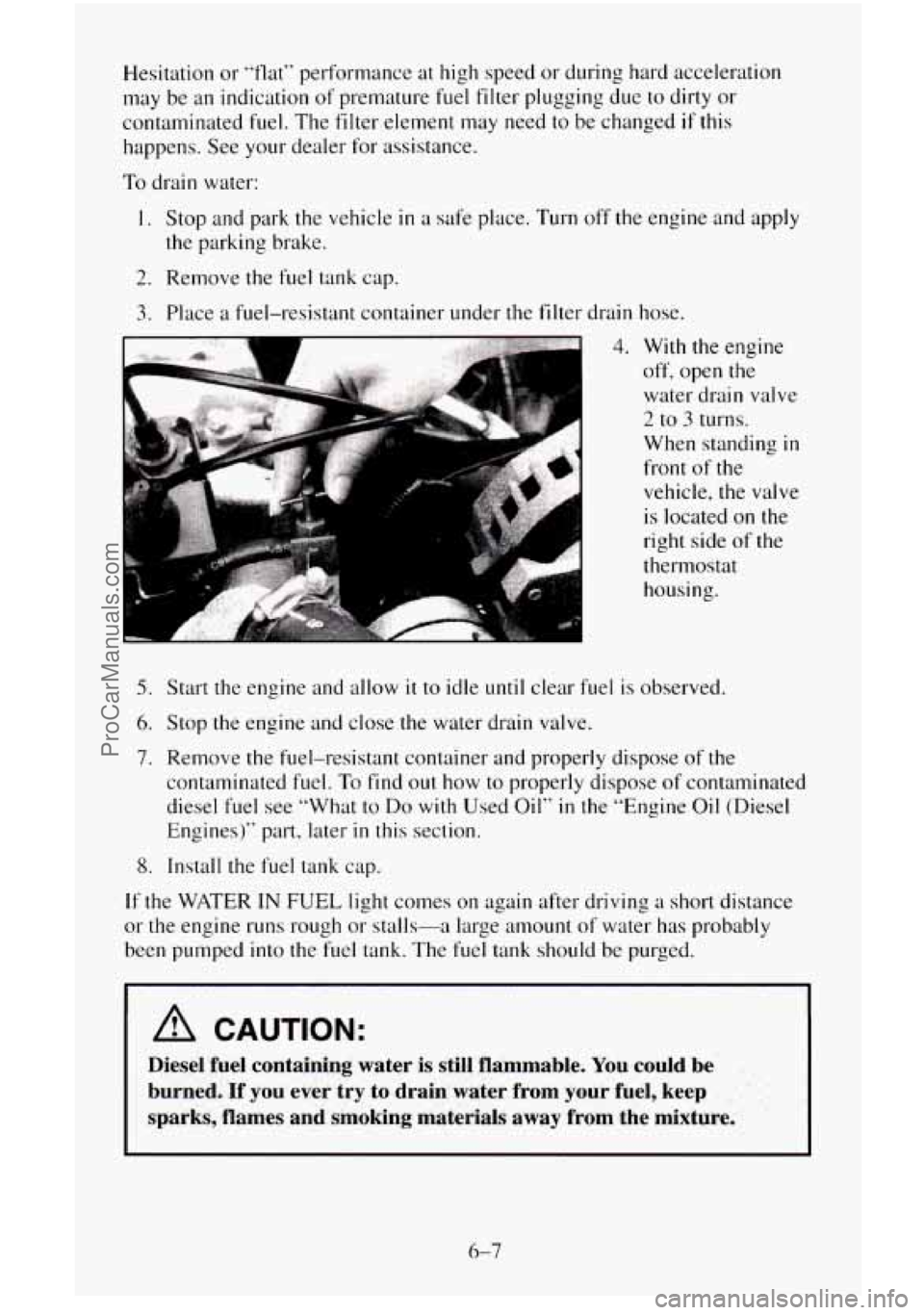
4. With the engine
off? open the
water drain valve
2 to 3 turns.
When standing
in
front of the
vehicle, the valve is located
on the
right side of the
thermostat housing.
5. Start the engine and allow it to idle until clear fuel is observed.
6. Stop the engine and close the water drain valve.
7. Remove the fuel-resistant container and properly dispose of the
contaminated fuel.
To find out how to properly dispose of contaminated
diesel fuel see “What to Do
with Used Oil” in the “Engine Oil (Diesel
Engines)” part, later
in this section.
8. Install the fuel tank cap.
If the WATER IN FUEL light comes on again after driving a short distance
or the engine runs rough or stalls-a large amount of water has probably
been pumped
into the fuel tank. The fuel tank should be purged.
6% CAUTION:
Diesel he1 containing water is still flammable. You could be
burned. If you ever try to drain water from
your fuel, keep
sparks, flames and smoking materials away
from the mixture.
6-7
ProCarManuals.com
Page 320 of 486
Brake Wear
Your vehicle has front disc brakes and rear drum brakes.
Disc brake pads
have built-in wear indicators that make a high-pitched
warning sound when the brake pads are worn and new pads are needed. The
sound may come and
go or be heard all the time your vehicle is moving
(except when you are pushing on the brake pedal firmly).
I NOTICE:
Continuing to drive with worn-out brake pads could result in
costly brake repair.
Some driving conditions or climates may cause a brake squeal when the
brakes are first applied or lightly applied. This does not mean something is
wrong with your brakes.
Your rear drum brakes don’t have wear indicators, but
if you ever hear a
rear brake rubbing noise, have the rear brake linings inspected. Also, the
rear brake drums should be removed and inspected each time the tires are
removed for rotation or changing. When
you have the front brakes replaced,
have
the rear brakes inspected, too.
Brake linings should always be replaced as complete axle sets.
Brake Pedal Travel
See your dealer if the brake pedal does not return to normal height, or if
there
is a rapid increase in pedal travel. This could be a sign of brake
trouble.
Brake Adjustment
Every time you make a brake stop, your disc brakes adjust for wear.
If your brake pedal goes down farther than normal, your rear drum brakes
may need adjustment. Adjust them by backing up and firmly applying the
brakes a few times.
6-43
ProCarManuals.com
Page 358 of 486
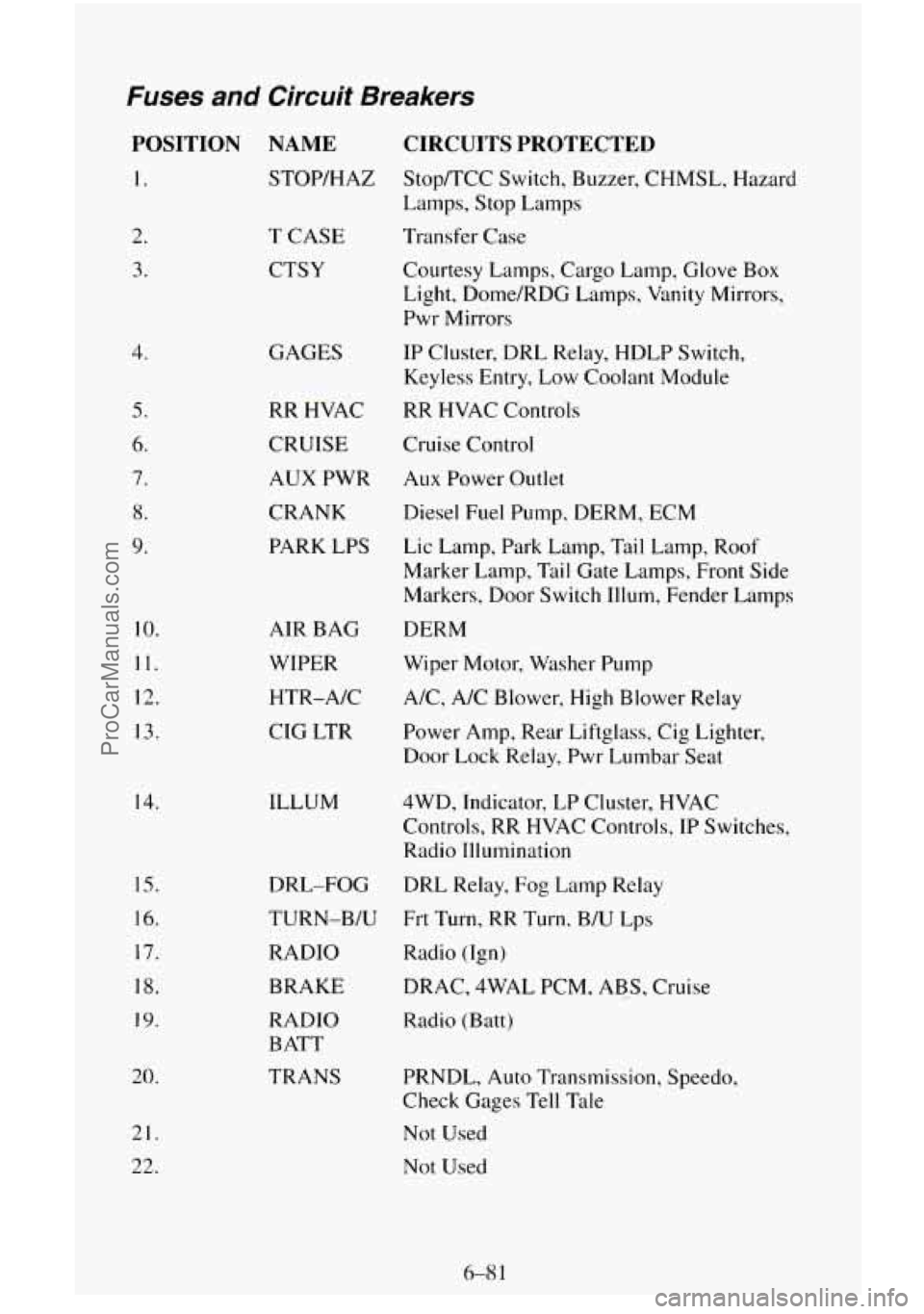
Fuses and Circuit Breakers
POSITION
1.
2.
3.
4.
5.
6.
7.
8.
9.
10.
11.
12.
13. 14.
15.
16.
17.
18.
19.
20.
21.
22.
NAME
STOP/HAZ
T CASE
CTSY
GAGES
RR WAC
CRUISE
AUX PWR CRANK
PARK LPS
AIR BAG
WIPER
HTR-A/C
CIG LTR
ILLUM
DRL-FOG
TURN-B/U
RADIO
BRAKE
RADIO
BATT
TRANS
CIRCUITS PROTECTED
Stop/TCC Switch, Buzzer, CHMSL, Hazard
Lamps, Stop Lamps
Transfer Case
Courtesy Lamps, Cargo Lamp, Glove Box
Light, Dome/RDG Lamps, Vanity Mirrors,
Pwr Mirrors
IP Cluster, DRL Relay, HDLP Switch,
Keyless Entry, Low Coolant Module
RR HVAC Controls
Cruise Control
Aux Power Outlet
Diesel Fuel Pump, DERM, ECM
Lic Lamp, Park Lamp, Tail Lamp, Roof
Marker Lamp, Tdi1 Gate Lamps, Front Side
Markers, Door Switch Illum, Fender Lamps
DERM
Wiper
Motor, Washer Pump
A/C, A/C Blower, High Blower Relay
Power Amp, Rear Liftglass, Cig Lighter,
Door Lock Relay, Pwr Lumbar Seat
4WD, Indicator, LP Cluster, HVAC
Controls,
RR HVAC Controls, IP Switches,
Radio Illumination
DRL Relay,
Fog Lamp Relay
Frt Turn, RR Turn, B/U Lps
Radio (Ign)
DRAC, 4WAL PCM. ABS,
... . Cruise
Radio (Batt)
PRNDL, Auto Transmission, Speedo,
Check Gages Tell Tde
Not Used Not Used
ProCarManuals.com
Page 367 of 486
If your engine has more than one emissions classification, the classification
is determined by the Gross Vehicle Weight Rating (GVWR) of your vehicle
as shown on the Certification Label. See “Loading Your Vehicle” in the
Index.
Once you’ve determined your engine type and,
if necessary, emissions
classification, you’ll need
to decide which of the two schedules is right for
your vehicle. See Definitions for Maintenance Schedule I and Maintenance
Schedule I1 following.
Schedule I Definition - Gasoline Engines With Light Duty
Emissions
Follow Maintenance Schedule I if any one of these is true for your vehicle:
0 Most trips are less than 5 to 10 miles (8 to 16 km). This is particularly
important when outside temperatures are below freezing.
stop-and-go traffic).
0 Most trips include extensive idling (such as frequent driving in
0 You operate your vehicle in dusty areas or off-road frequently.
You frequently tow a trailer or use a carrier on top of your vehicle.
Schedule
I should also be followed if the vehicle is used for delivery
service, police, taxi, or other commercial application.
Schedule I Intervals - Gasoline Engines With Light Duty
Emissions
Every
3,000 Miles (5 000 km) or 3 Months
Engine Oil and Filter Change
Chassis Lubrication
Drive Axle Service
At 6,000 Miles (10 000 km) - Then Every 12,000 Miles (25 000 km)
Tire Rotation
Every 15,000 Miles (25 000 km)
Air Cleaner Filter Inspection, if driving in dusty conditions
Front Wheel Bearing Repack (or at each brake relining)
(2WD Only)
7-4
ProCarManuals.com
Page 376 of 486
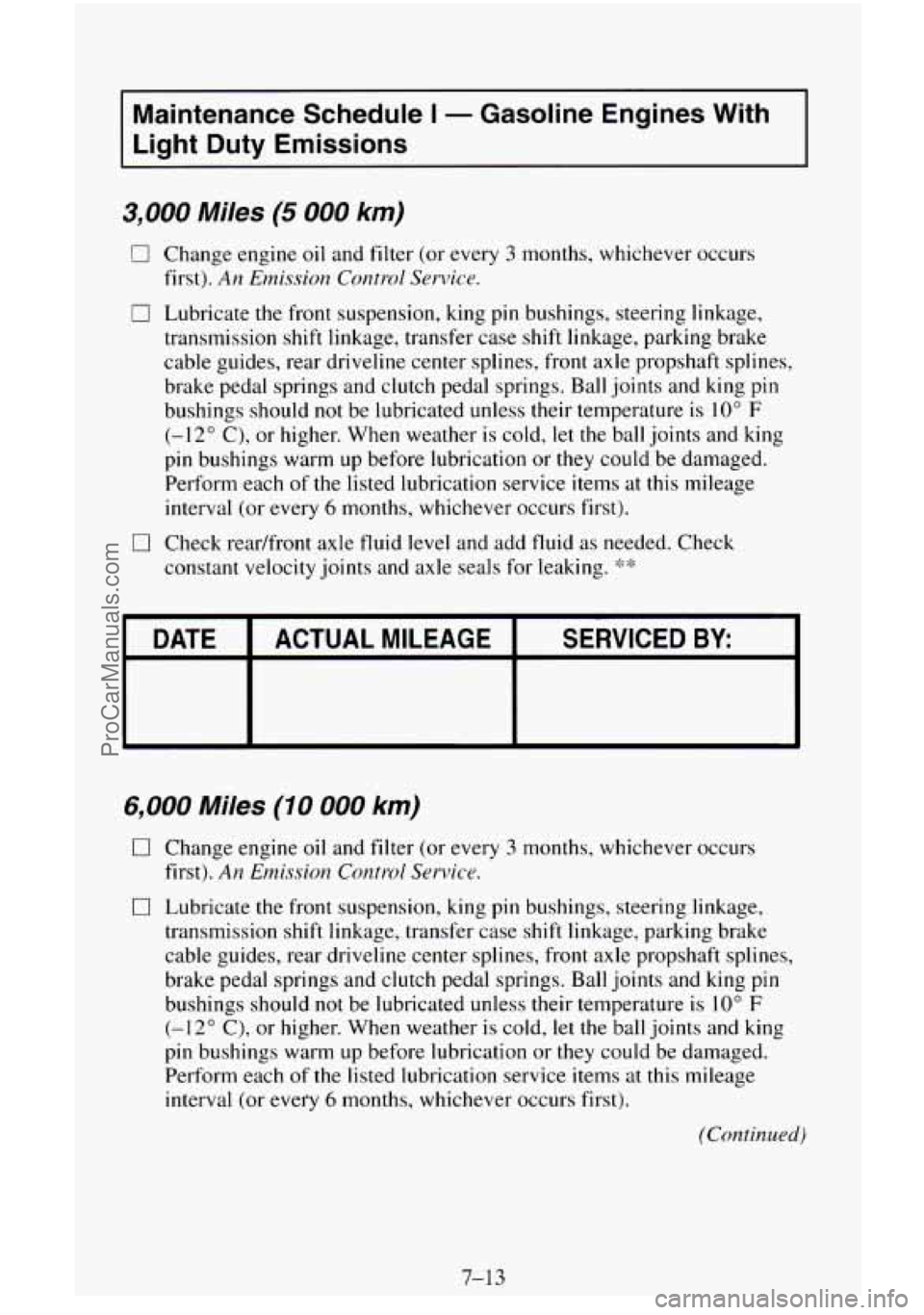
Maintenance Schedule I - Gasoline Engines With
Light Duty Emissions
3,000 Miles (5 000 km)
0 Change engine oil and filter (or every 3 months, whichever occurs
first).
An Emission Control Service.
0 Lubricate the front suspension, king pin bushings, steering linkage,
transmission shift linkage, transfer case shift linkage, parking brake
cable guides, rear driveline center splines, front axle propshaft splines,
brake pedal springs and clutch pedal springs. Ball joints and king pin
bushings should not be lubricated unless their temperature
is 10" F
(-1 2" C), or higher. When weather is cold, let the ball joints and king
pin bushings warm up before lubrication or
they could be damaged.
Perform each of the listed lubrication service items at this mileage
interval (or every
6 months, whichever occurs first).
0 Check readfront axle fluid level and add fluid as needed. Check
constant velocity joints and axle seals for leaking.
**
I DATE I ACTUALMILEAGE I SERVICED BY: I
6,000 Miles (10 000 km)
0 Change engine oil and filter (or every 3 months, whichever occurs
first).
An EInission Control Service.
0 Lubricate the front suspension, king pin bushings, steering linkage,
transmission shift linkage, transfer case shift linkage, parking brake
cable guides, rear driveline center splines, front axle propshaft splines,
brake pedal springs and clutch pedal springs. Ball joints and king pin
bushings should not be lubricated unless their temperature is
10" F
(-12" C), or higher. When weather is cold, let the ball joints and king
pin bushings warm up before lubrication or they could be damaged.
Perform each
of the listed lubrication service items at this mileage
interval (or every
6 months, whichever occurs first).
(Continued)
7-13
ProCarManuals.com
Page 377 of 486
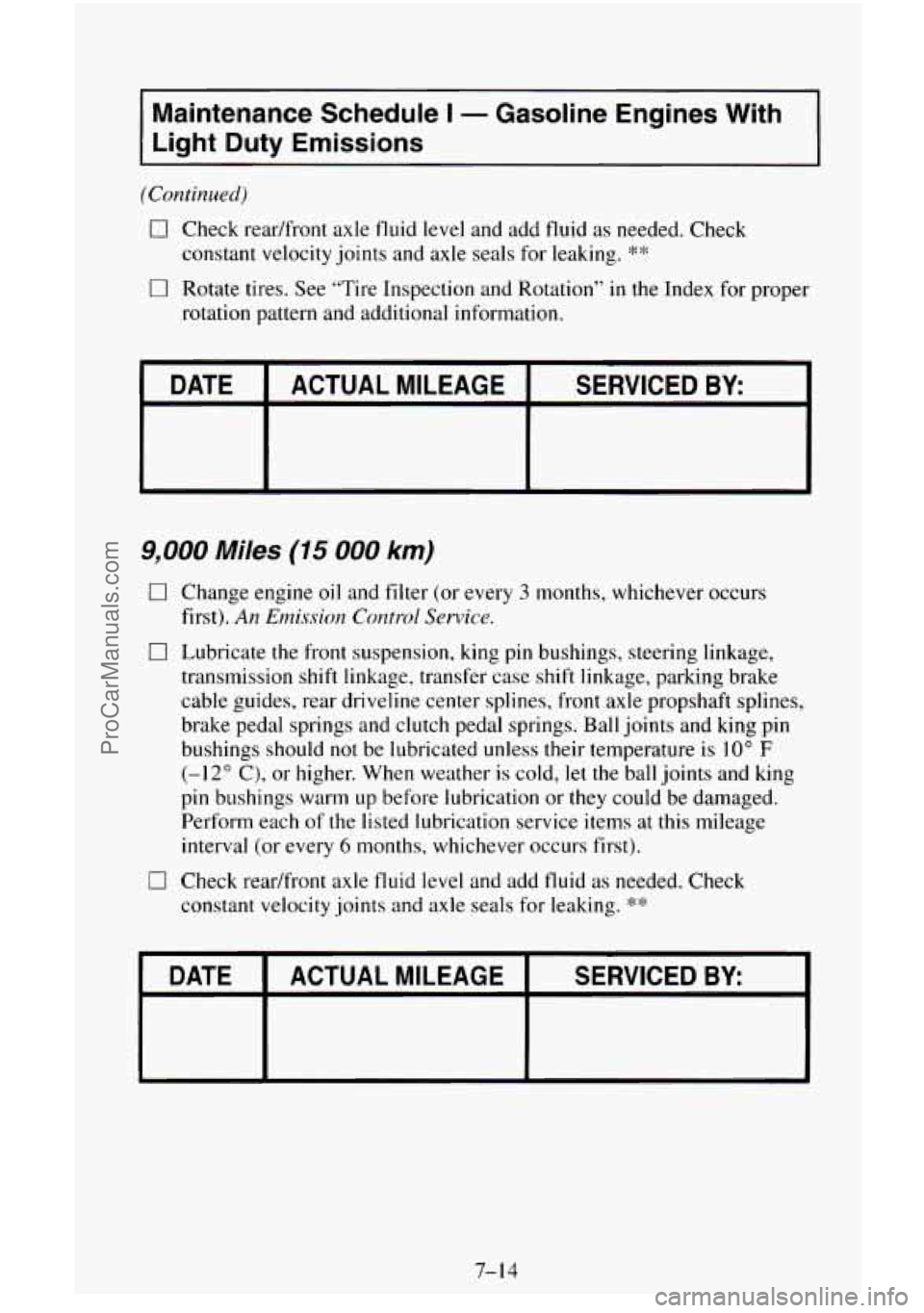
Maintenance Schedule I - Gasoline Engines With
Light Duty Emissions
(Continued)
0 Check readfront axle tluid level and add fluid as needed. Check
constant
velocity joints and axle seals for leaking. **
0 Rotate tires. See “Tire Inspection and Rotation’’ in the Index for proper
rotation pattern and additional information.
DATE SERVICED BY: ACTUAL MILEAGE
9,000 Miles (15 000 km)
0 Change engine oil and filter (or every 3 months, whichever occurs
first).
An Emission Control Service.
0 Lubricate the front suspension, king pin bushings, steering linkage,
transmission shift linkage, transfer case shift linkage, parking brake
cable guides, rear driveline center splines, front axle propshaft splines,
brake pedal springs and clutch pedal springs.
Ball joints and king pin
bushings should
not be lubricated unless their temperature is IO” F
(-1 2” C), or higher. When weather is cold, let the ball joints and king
pin bushings warm
up before lubrication or they could be damaged.
Perform each
of the listed lubrication service items at this mileage
interval (or every
6 months, whichever occurs first).
0 Check readfront axle fluid level and add tluid as needed. Check
constant velocity joints and axle seals for leaking.
**
DATE
SERVICED BY: ACTUAL MILEAGE
a
7-1 4
~~ ProCarManuals.com