engine coolant CHEVROLET SUBURBAN 1995 User Guide
[x] Cancel search | Manufacturer: CHEVROLET, Model Year: 1995, Model line: SUBURBAN, Model: CHEVROLET SUBURBAN 1995Pages: 486, PDF Size: 26.58 MB
Page 228 of 486
Turn Signals When Towing a Trailer
When you tow a trailer, your vehicle has to have extra wiring (included in
the optional trailering package). The green arrows
on your instrument panel
will flash whenever
you signal a turn or lane change. Properly hooked up,
the trailer lamps will
also flash, telling other drivers you’re about to turn,
change lanes or stop.
When towing a trailer, the green arrows on your instrument panel will flash
for turns even if the bulbs
on the trailer are burned out. Thus, you may think
drivers behind you are seeing your signal when they are not. It’s important
to check occasionally to be sure the trailer bulbs are still working.
Driving On Grades
Reduce speed and shift to a lower gear before you start down a long or steep
downgrade. If
you don’t shift down, you might have to use your brakes so
much that they would get hot and no longer work well.
On
a long uphill grade, shift down and reduce your speed to around 45 mph
(70 kdh) to reduce the possibility of engine and transmission overheating.
If
you have an automatic transmission you should use DRIVE (3) (or, as
you need to, a lower gear) when towing a trailer. Operating your vehicle in
DRIVE (3) when towing a trailer will minimize heat build-up and extend
the life
of your transmission.
If
you have a manual transmission and you are towing a trailer, it’s better
not to use FIFTH (5) gear. Just drive in FOURTH (4) gear (or, as you need
to,
a lower gear).
When towing at high altitude
on steep uphill grades, consider the following:
Engine coolant will boil at a lower temperature than at normal altitudes. If
you turn your engine off immediately after towing at high altitude on steep
uphill grades, your vehicle may show signs similar
to engine overheating.
To avoid this, let the engine run while parked (preferably on level ground)
with the automatic transmission
in PARK (P) (or the manual transmission
out of gear and the parking brake applied) for a few minutes before turning
the engine off.
If you do get the overheat warning, see “Engine
Overheating” in the Index.
Parking on Hills
You really should not park your vehicle, with a trailer attached, on a hill. If
something goes wrong, your rig could start to move. People can be injured,
and both your vehicle and
the trailer can be damaged.
But
if you ever have to park your rig on a hill, here’s how to do it:
1. Apply your regular brakes, but don’t shift into PARK (P) yet, or in gear
for a manual transmission.
ProCarManuals.com
Page 243 of 486
NOTICE:
If your engine catches fire because you keep driving with no
coolant, your vehicle can be badly damaged. The costly repairs
would not be covered by your warranty.
If No Steam Is Coming From Your Engine
If you get the overheat warning but see or hear no steam, the problem may
not be too serious. Sometimes the engine can get a little too hot when you:
Climb a long hill on a hot day.
Stop after high speed driving.
0 Idle for long periods in traffic.
Tow a trailer. See “Driving on Grades” in the Index.
If you get the overheat warning with
no sign of steam, try this for a minute
or
so:
I. If you have an air conditioner, turn it off.
2. Turn on your heater to full hot at the highest fan speed and open the
window as necessary.
3. If you’re in a traffic jam, shift to NEUTRAL (N); otherwise, shift to the
highest gear while driving
- AUTOMATIC OVERDRIVE (a) or
DRIVE (3) for automatic transmissions.
If you no longer have the overheat warning, you can drive. Just to be safe,
drive slower for about ten minutes. If the warning doesn’t come back on,
you can drive normally.
5-10
ProCarManuals.com
Page 244 of 486
If the warning continues, pull over, stop, and park your vehicle right away.
If there’s still no sign of steam, push the accelerator until the engine speed is
about twice as fast as normal idle speed. Bring the engine speed back
to
normal idle speed after two or three minutes. Now see if the warning stops.
But then, if you still have the warning,
turn ofthe engine and get everyone
out
of the vehicle until it cools down.
You may decide not to lift the hood but to get service help right away.
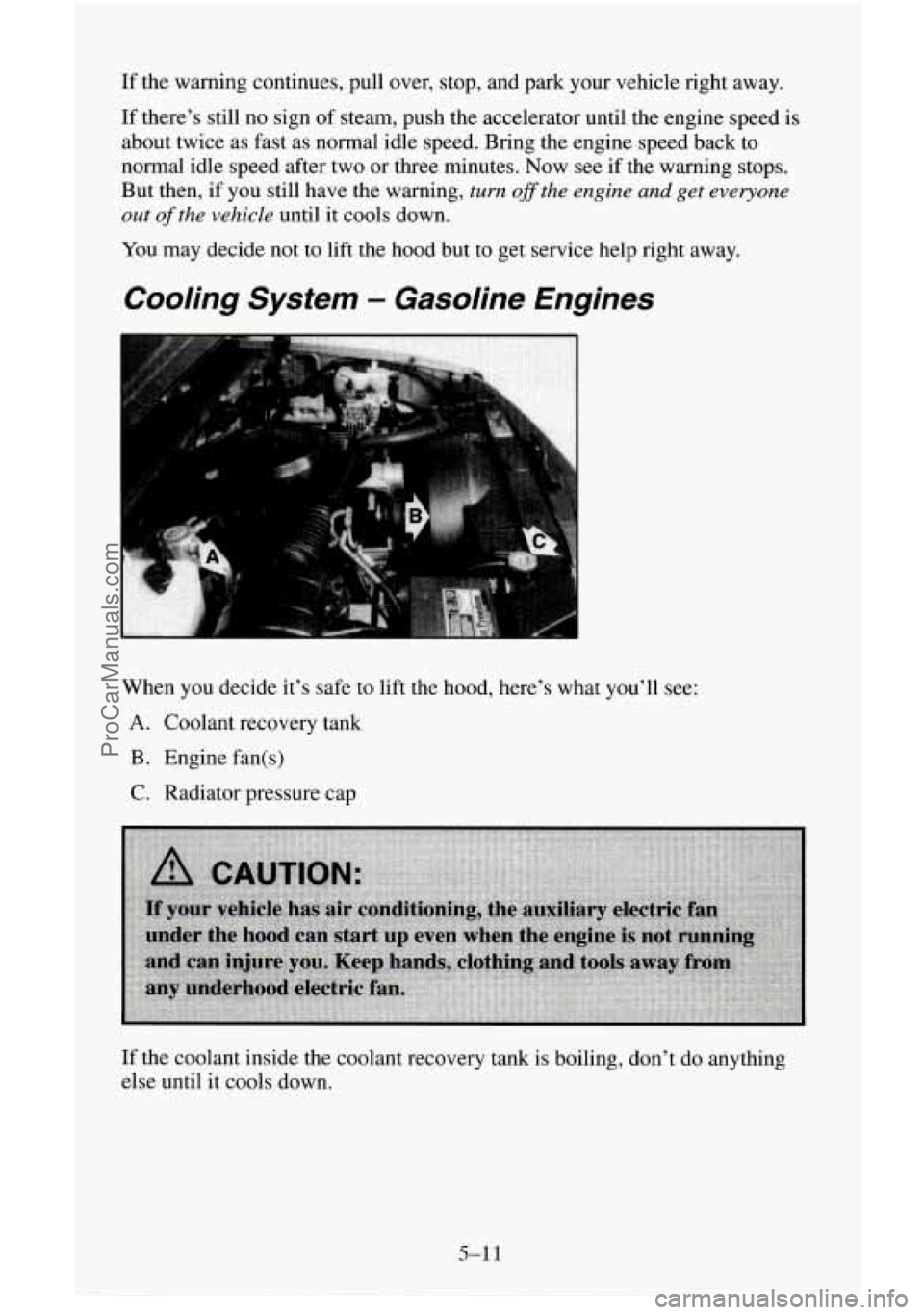
Cooling System - Gasoline Engines
When you decide it’s safe to lift the hood, here’s what you’ll see:
A. Coolant recovery tank
B . Engine fan( s)
C. Radiator pressure cap
If the coolant inside the coolant recovery tank is boiling, don’t do anything
else until
it cools down.
5-1 1
ProCarManuals.com
Page 245 of 486
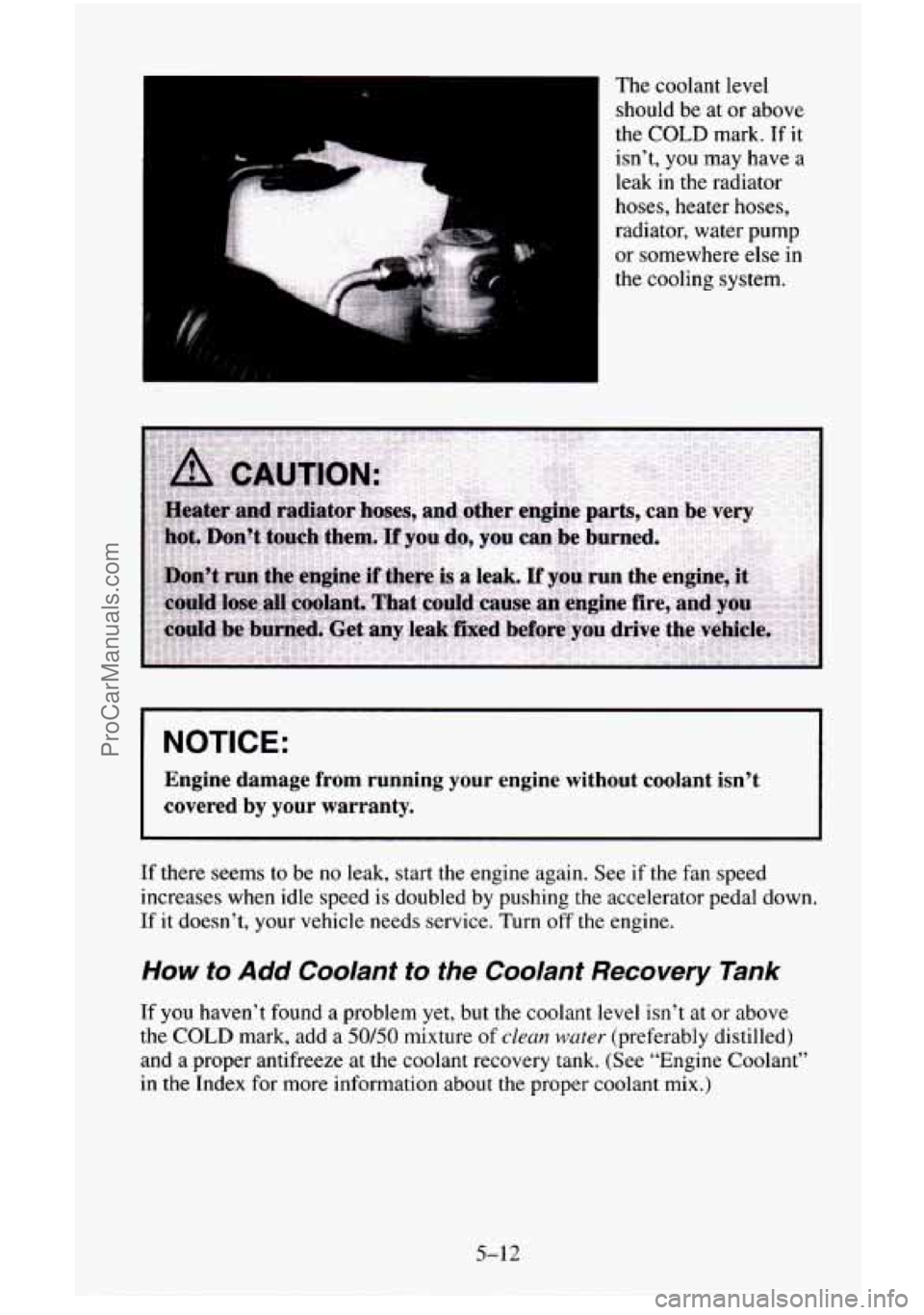
The coolant level
should be
at or above
the
COLD mark. If it
isn’t, you may have a
leak in the radiator
hoses, heater hoses,
radiator, water pump
or somewhere else in
the cooling system.
NOTICE:
Engine damage from running your engine without coolant isn’t \
covered
by your warranty.
If there seems to be no leak, start the engine again. See if the fan speed
increases when idle speed
is doubled by pushing the accelerator pedal down.
If it doesn’t, your vehicle needs service. Turn
off the engine.
How to Add Coolant to the Coolant Recovery Tank
If you haven’t found a problem yet, but the coolant level isn’t at or above
the
COLD mark, add a 50/50 mixture of clean water (preferably distilled)
and a proper antifreeze at the coolant recovery tank. (See “Engine Coolant”
in the Index for more information about the proper coolant mix.)
ProCarManuals.com
Page 246 of 486

NOTICE:
In cold weather, water can freeze and crack the engine, radiat\
or.
heater core and other parts. Use the recommended coolant.
E
When the coolant in the coolant recovery tank is at or above the COLD
mark, start your vehicle.
5-13
ProCarManuals.com
Page 250 of 486
I
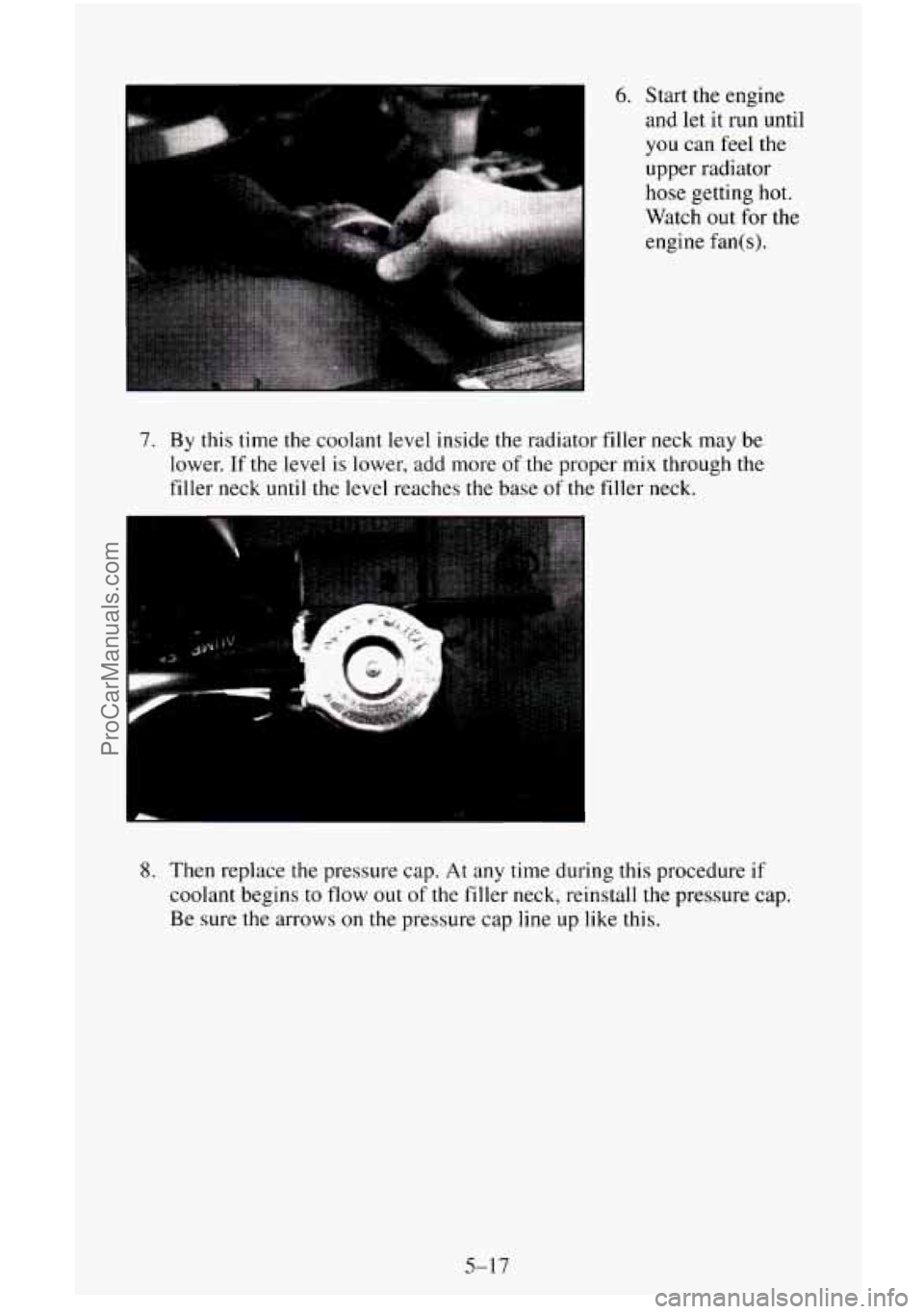
6. Start the engine
and let it run until
you can feel the
upper radiator
hose getting hot.
Watch
out for the
engine fan(s).
7. By this time the coolant level inside the radiator filler neck may be
lower. If the level
is lower, add more of the proper mix through the
filler neck until the level reaches the base of the filler neck.
8. Then replace the pressure cap. At any time during this procedure if
coolant begins to flow out of the filler neck, reinstall the pressure cap.
Be sure the arrows
on the pressure cap line up like this.
5-1 7
ProCarManuals.com
Page 251 of 486
Cooling System - Diesel Engines
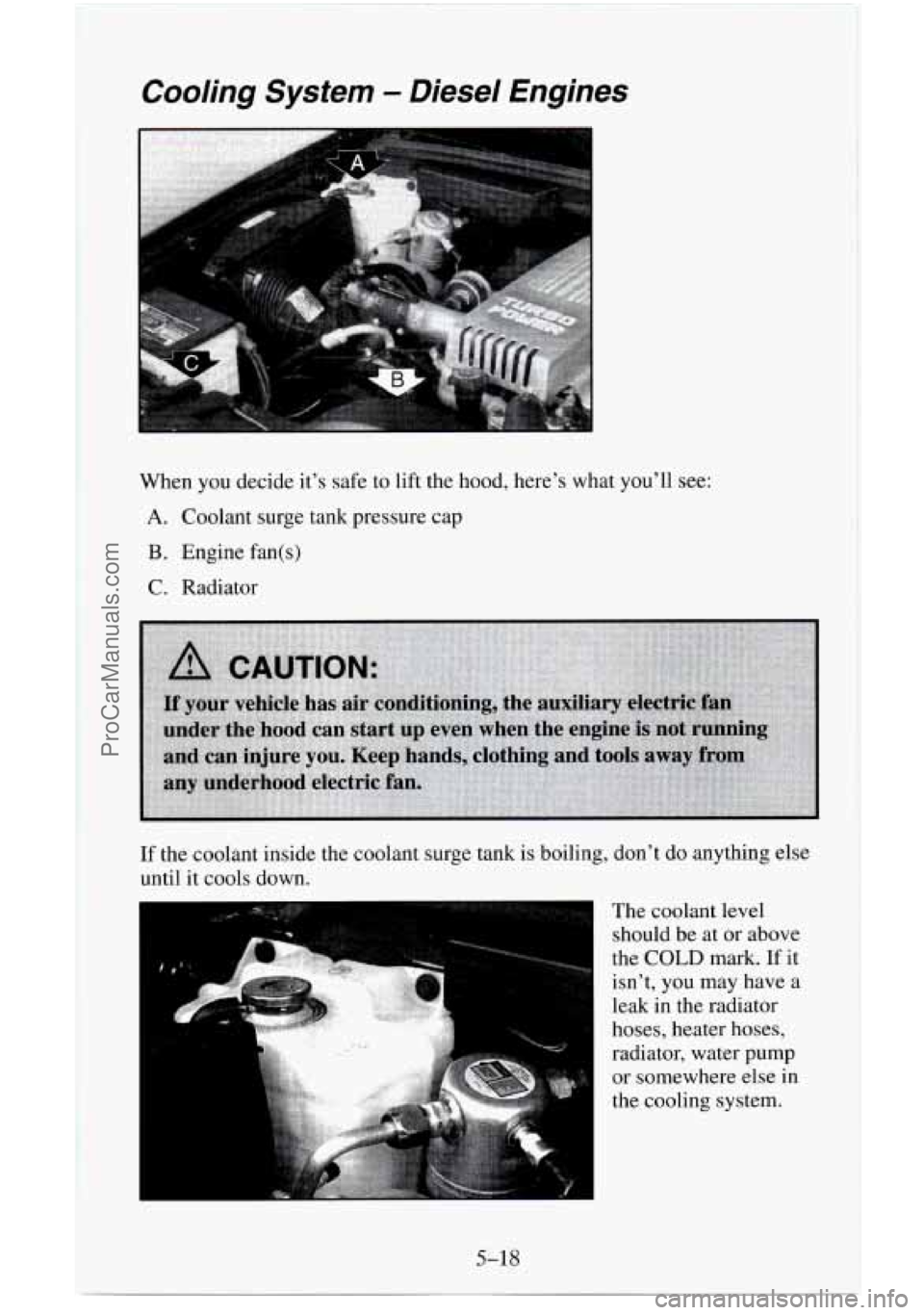
When you decide it’s safe to lift the hood, here’s what you’ll see:
A. Coolant surge tank pressure cap
B. Engine fan(s)
C. Radiator
If the coolant inside the coolant surge tank is boiling, don’t do anything else
until
it cools down.
The coolant level
should be at or above
the
COLD mark. If it
isn’t,
you may have a
leak in the radiator
hoses, heater hoses,
radiator, water pump
1 or somewhere else in
the cooling system.
5-18
ProCarManuals.com
Page 252 of 486

NOTICE:
Engine damage from running your engine without coolant isn’t \
covered by your warranty.
If there seems to be no leak, start the engine again. See if the fan speed
increases
when idle speed is doubled by pushing the accelerator pedal down.
If it doesn’t, your vehicle needs service. Turn
off the engine.
How to Add Coolant to the Coolant Surge Tank
NOTICE:
The diesel engine has a specific coolant fill procedure. Failur\
e to
follow this procedure could cause your engine to overheat and \
be
severely damaged.
If you haven’t found a problem yet, but the coolant level isn’t at the COLD
mark, add a 50/50 mixture of clean water (preferably distilled) and a proper
antifreeze at the coolant surge tank, but be sure the cooling system,
including the coolant surge tank pressure cap, is cool before you do it. (See
“Engine Coolant” in the Index for more information about the proper
coolant mix.)
5-19
ProCarManuals.com
Page 254 of 486

NOTICE:
In cold weather, water can freeze and crack the engine, radiat\
or,
heater core and other parts.
So use the recommended coolant.
1. You can remove the coolant surge tank pressure cap when the cooling
system, including the coolant surge tank pressure cap and upper
radiator hose, is no longer hot. Turn the pressure cap slowly to the left
until
it first stops. (Don’t press down while turning the pressure cap.)
If you hear a hiss, wait for that
to stop. A hiss means there is still some
pressure left.
5-21
ProCarManuals.com
Page 255 of 486
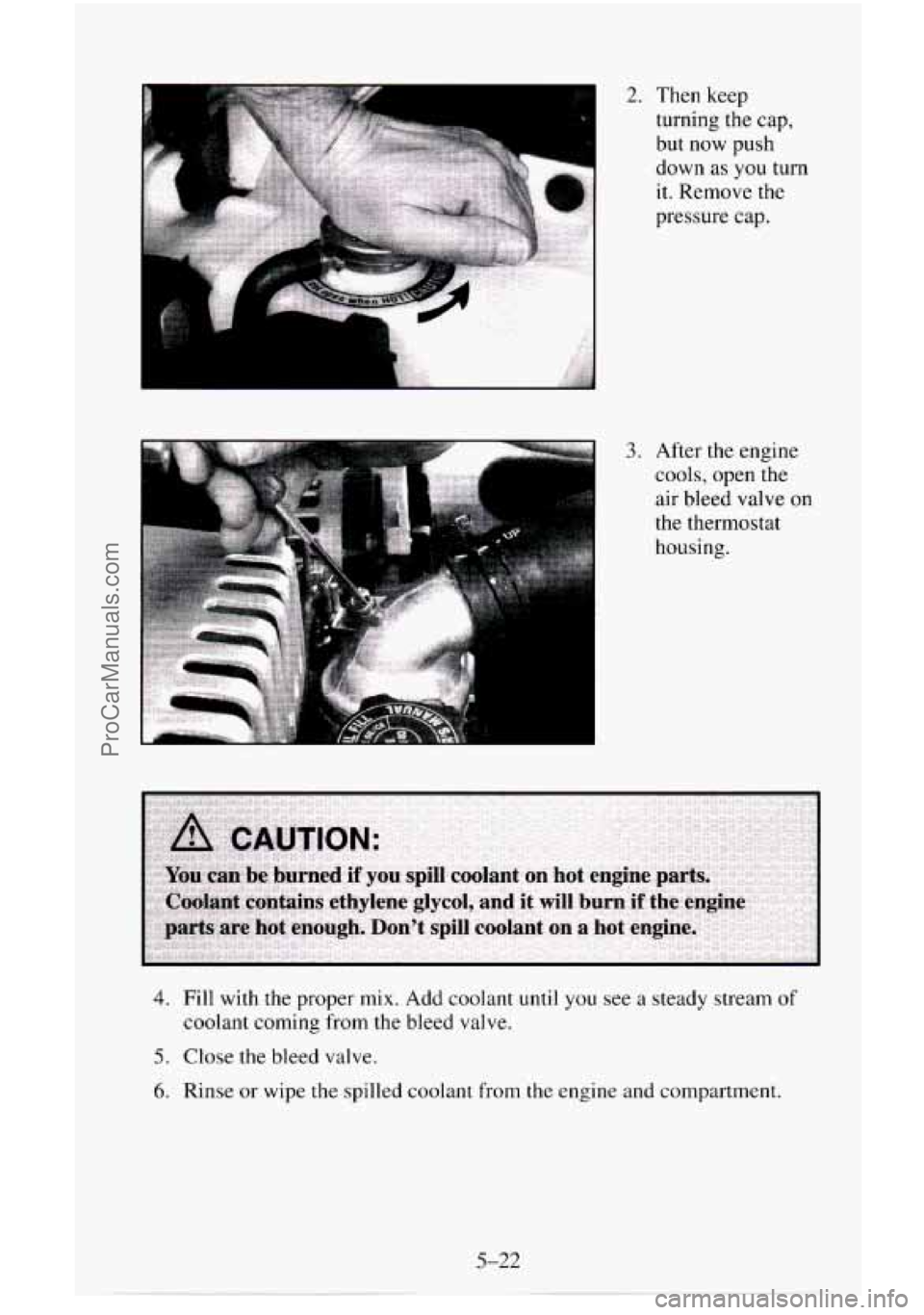
2. Then keep
turning the cap,
but now push
down
as you turn
it. Remove the
pressure cap.
3. After the engine
cools, open the
air bleed valve on
the thermostat
housing.
4. Fill with the proper mix. Add coolant until you see a steady stream of
5. Close the bleed valve. coolant coming
from the bleed valve.
6. Rinse or wipe the spilled coolant from the engine and compartment.
ProCarManuals.com