tow CHEVROLET SUBURBAN 1995 Owner's Manual
[x] Cancel search | Manufacturer: CHEVROLET, Model Year: 1995, Model line: SUBURBAN, Model: CHEVROLET SUBURBAN 1995Pages: 486, PDF Size: 26.58 MB
Page 89 of 486
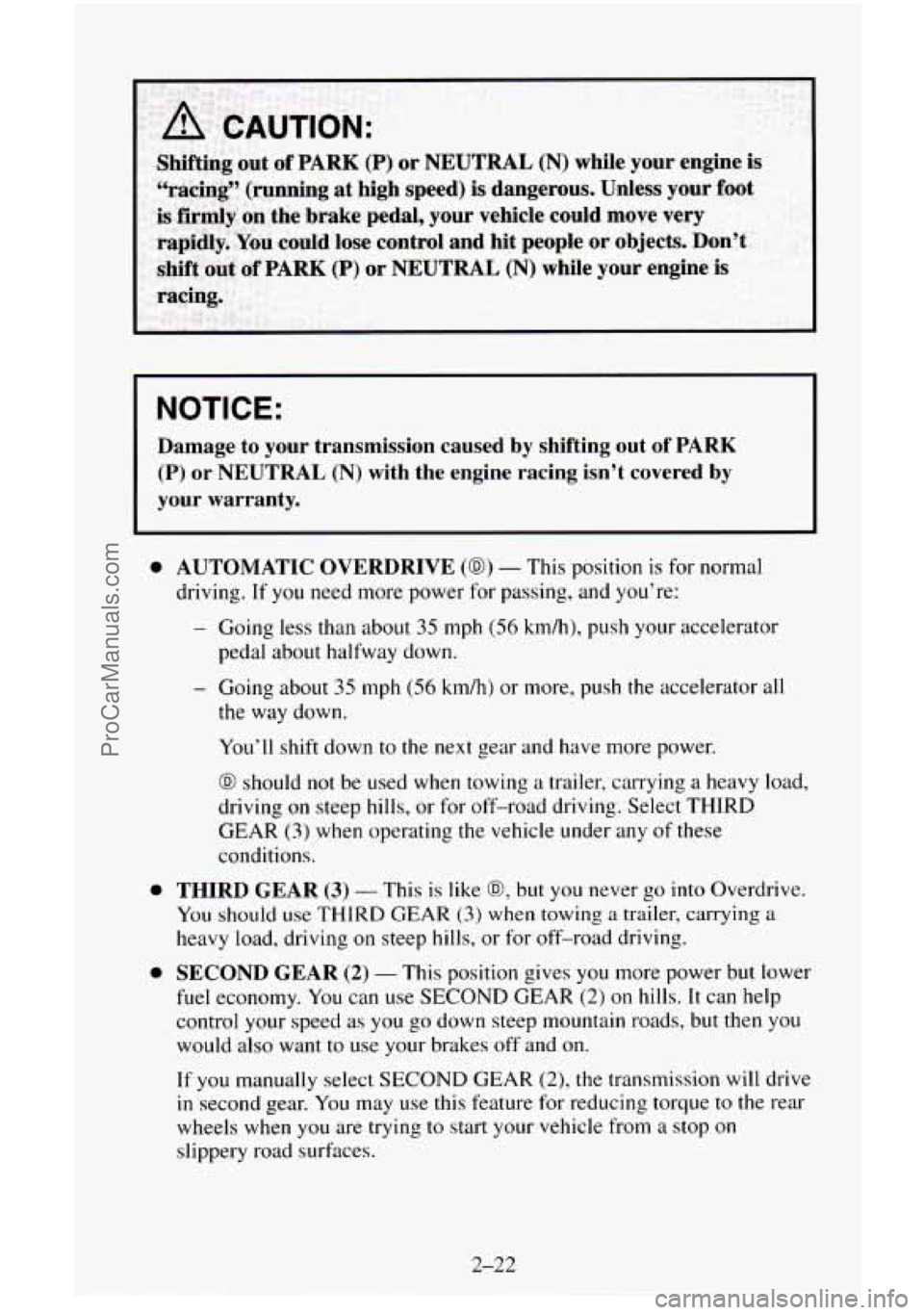
NOTICE:
Damage to your transmission caused by shifting out of PARK
(P) or NEUTRAL (N) with the engine racing isn’t covered by
your warranty.
0 AUTOMATIC OVERDRIVE (@) - This position is for normal
driving. If you need more power for passing, and you’re:
- Going less than about 35 mph (56 km/h), push your accelerator
pedal about halfway down.
- Going about 35 mph (56 km/h) or more, push the accelerator all
the way down.
You’ll shift down
to the next gear and have more power.
@ should not be used when towing a trailer, carrying a heavy load,
driving on steep hills, or for off-road driving. Select THIRD
GEAR
(3) when operating the vehicle under any of these
conditions.
0 THIRD GEAR (3) - This is like @, but you never go into Overdrive.
You should use THIRD GEAR (3) when towing a trailer, carrying a
heavy load, driving on steep hills, or for off-road driving.
0 SECOND GEAR (2) - This position gives you more power but lower
fuel economy. You can use SECOND GEAR (2) on hills. It can help
control your speed
as you go down steep mountain roads, but then you
would also want to use your brakes off and on.
If you manually select
SECOND GEAR (2), the transmission will drive
in second gear. You may use this feature for reducing torque to the rear
wheels when
you are trying to start your vehicle from a stop on
slippery road surfaces.
2-22
ProCarManuals.com
Page 93 of 486
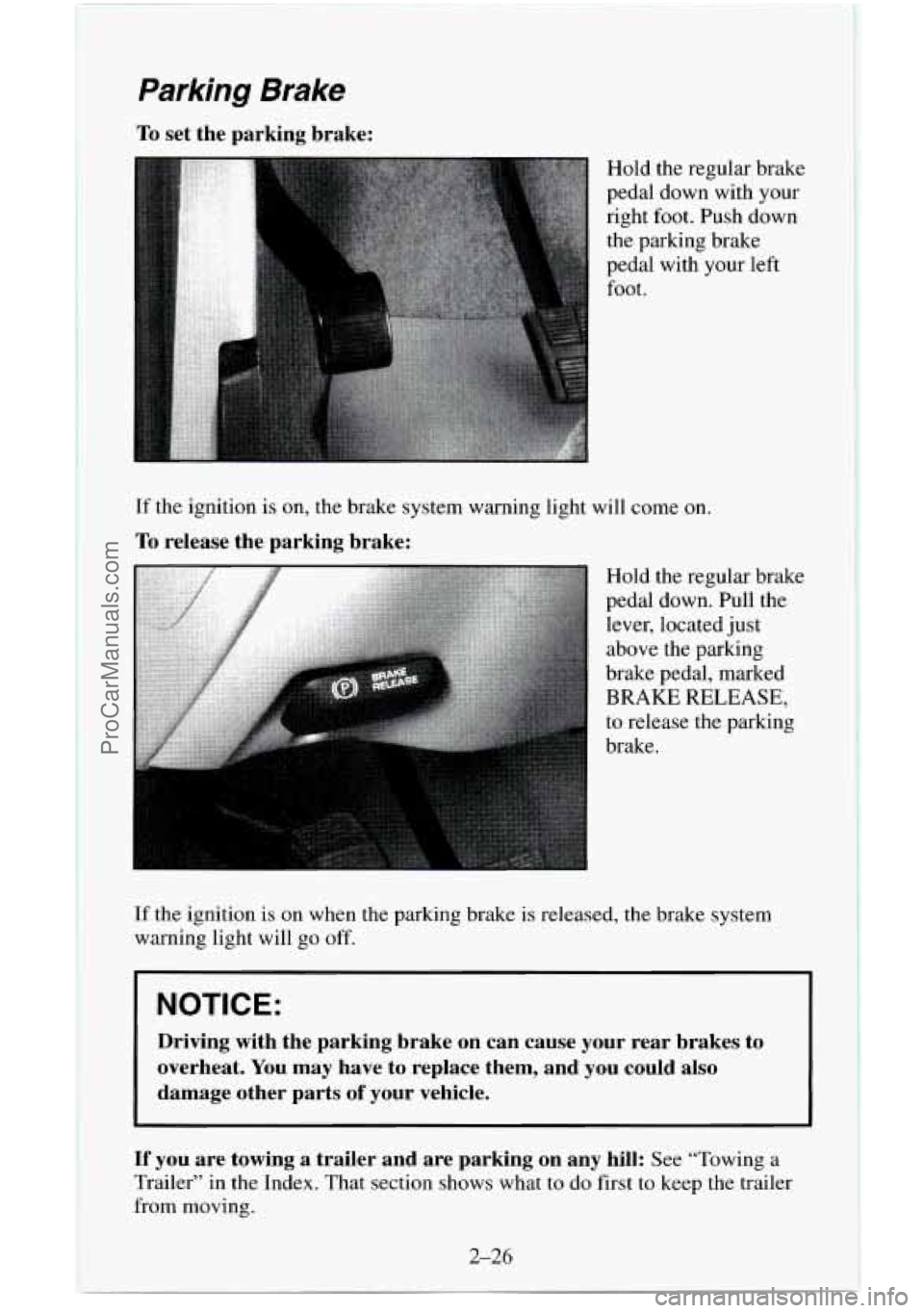
Parking Brake
To set the parking brake:
Hold the regular brake
pedal down with your
right foot. Push down
the parking brake
pedal with your left
foot.
If the ignition is on, the brake system warning light will come on.
To release the parking brake:
Hold the regular brake
pedal down. Pull the
lever, located just
above the parking
brake pedal, marked
BRAKE RELEASE,
to release the parking
brake.
If the ignition is on when the parking brake is released, the brake system
warning light will
go off.
I NOTICE:
Driving with the parking brake on can cause your rear brakes to
overheat. You may have to replace them, and you could also
damage other parts
of your vehicle.
If you are towing a trailer and are parking on any hill: See “Towing a
Trailer” in the Index. That section shows what to do first to keep the trailer
from moving.
2-26
I I
ProCarManuals.com
Page 94 of 486
Torque Lock
When parking, the weight of the vehicle may put too much force on the
parking pawl in the transmission. It may be difficult to pull the selector
lever out of
PARK (P). This is called “torque lock.” To find out how to
prevent torque lock,
see “Torque Lock” later in this section.
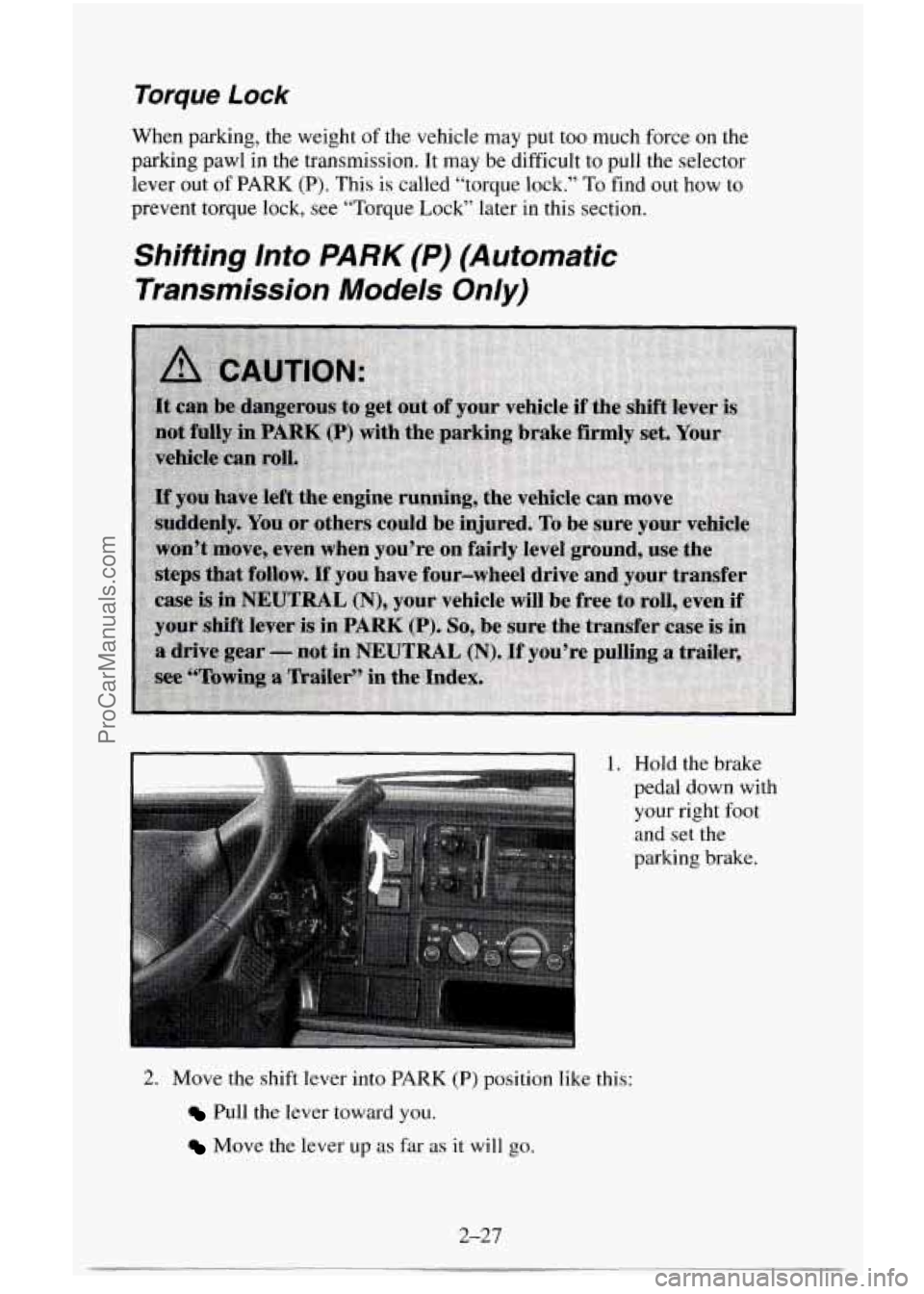
Shifting Into PARK (P) (Automatic
Transmission Models Only)
1. Hold the brake
pedal down with
your right foot
and set the
parking brake.
2. Move the shift lever into PARK (P) position like this:
Pull the lever toward you.
Move the lever up as far as it will go.
2-27
ProCarManuals.com
Page 97 of 486
Parking Your Vehicle (Manual Transmission
Models Only)
Before you get out of your vehicle, put your manual transmission in
REVERSE (R), turn off the engine, and firmly apply the parking brake.
If you have four-wheel drive, be sure your transfer case is in a drive gear.
Your vehicle could roll if it isn’t.
If you are parking on a hill, or if your pulling a trailer, see “Parking on
Hills” or “Towing a Trailer” in the Index.
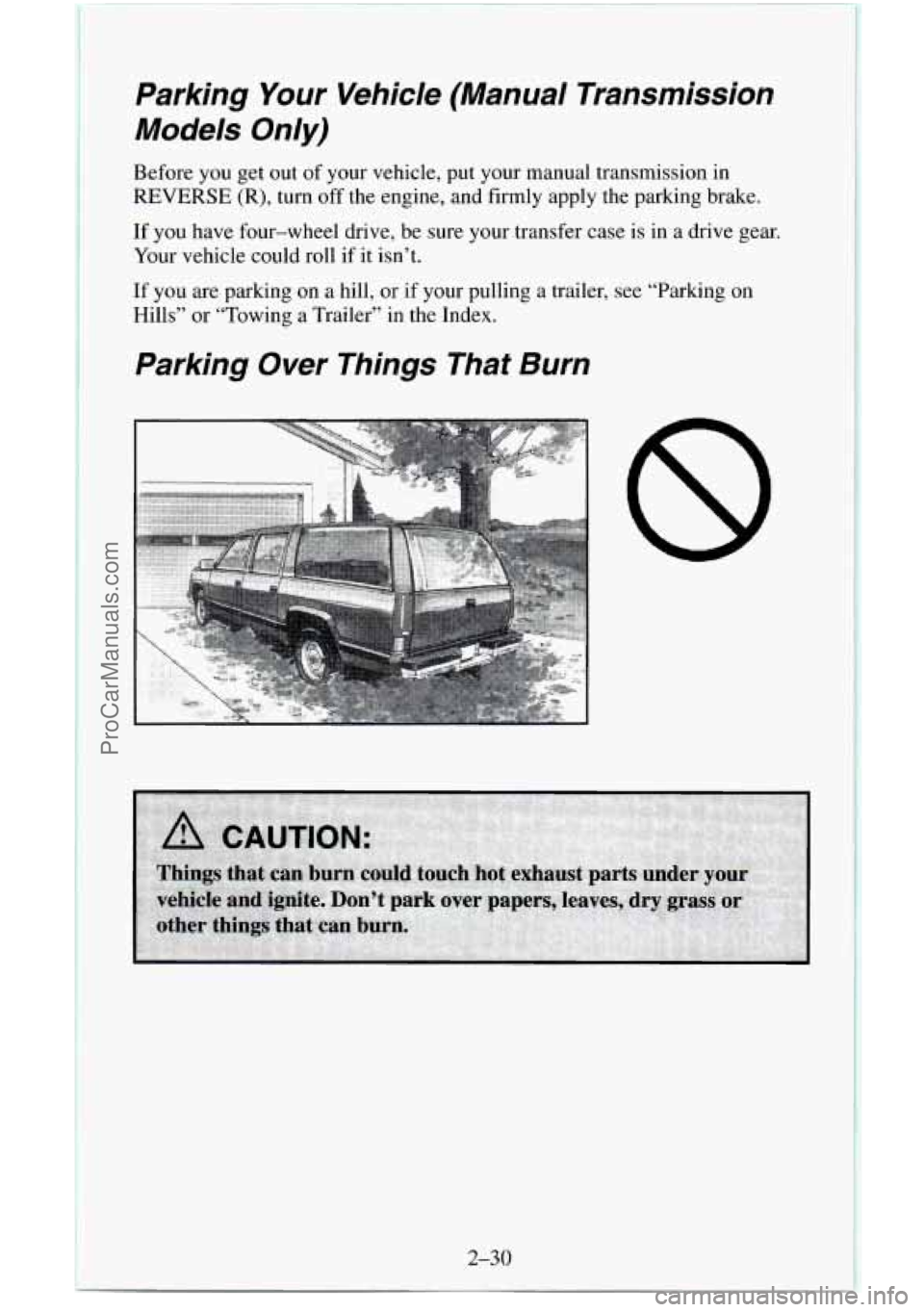
Parking Over Things That Burn
8
2-30
ProCarManuals.com
Page 99 of 486
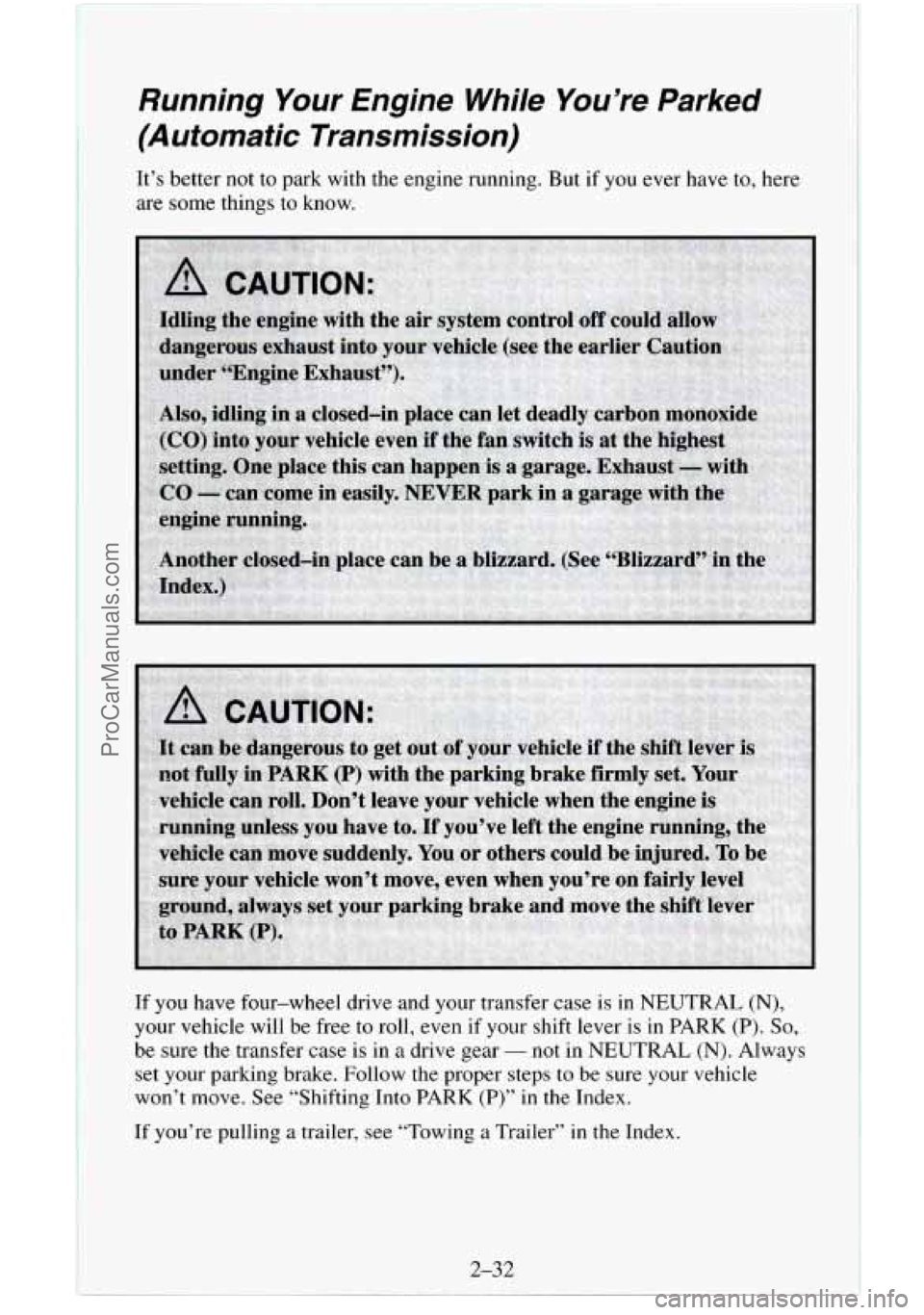
Running Your Engine While You’re Parked
(Automatic Transmission)
It’s better not to park with the engine running. But if you ever have to, here
are some things to know.
If you have four-wheel drive and your transfer case is
in NEUTRAL (N),
your vehicle will be free
to roll, even if your shift lever is in PARK (P). So,
be sure the transfer case is in a drive gear - not in NEUTRAL (N). Always
set your parking brake. Follow the proper steps
to be sure your vehicle
won’t move. See “Shifting Into
PARK (P)” in the Index.
If you’re pulling a trailer, see “Towing a Trailer” in the Index.
2-32 I
ProCarManuals.com
Page 101 of 486
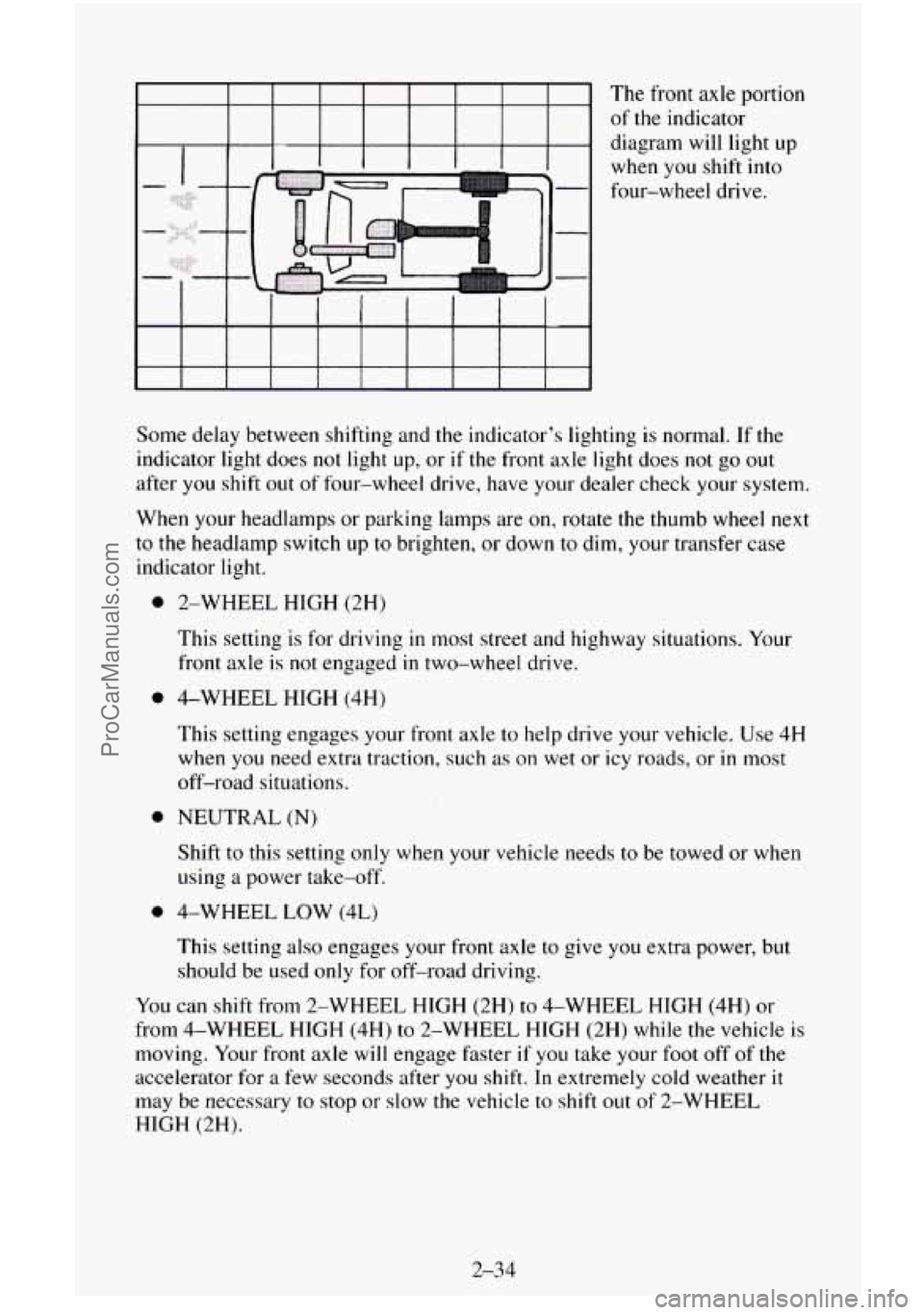
The front axle portion
of
the indicator
diagram will light up
when you shift into
four-wheel drive.
Some delay between shifting and the indicator's lighting is normal.
If the
indicator light does
not light up, or if the front axle light does not go out
after you shift out of four-wheel drive, have your dealer check your system.
When your headlamps or parking lamps are
on, rotate the thumb wheel next
to the headlamp switch up to brighten, or down to dim, your transfer case
indicator light.
0
0
0
0
2-WHEEL HIGH (2H)
This setting
is for driving in most street and highway situations. Your
front axle
is not engaged in two-wheel drive.
4-WHEEL HIGH (4H)
This setting engages your front axle to help drive your vehicle. Use 4H
when
you need extra traction, such as on wet or icy roads, or in most
off-road situations.
NEUTRAL
(N)
Shift to this setting only when your vehicle needs to be towed or when
using
a power take-off.
4-WHEEL LOW (4L)
This setting
also engages your front axle to give you extra power, but
should be used only for off-road driving.
You can shift from 2-WHEEL HIGH (2H) to 4-WHEEL HIGH (4H) or
from 4-WHEEL HIGH (4H) to 2-WHEEL HIGH (2H) while the vehicle
is
moving. Your front axle will engage faster if you take your foot off of the
accelerator for
a few seconds after you shift. In extremely cold weather it
may be necessary to stop or slow the vehicle to shift out of 2-WHEEL
HIGH (2H).
2-34
ProCarManuals.com
Page 108 of 486
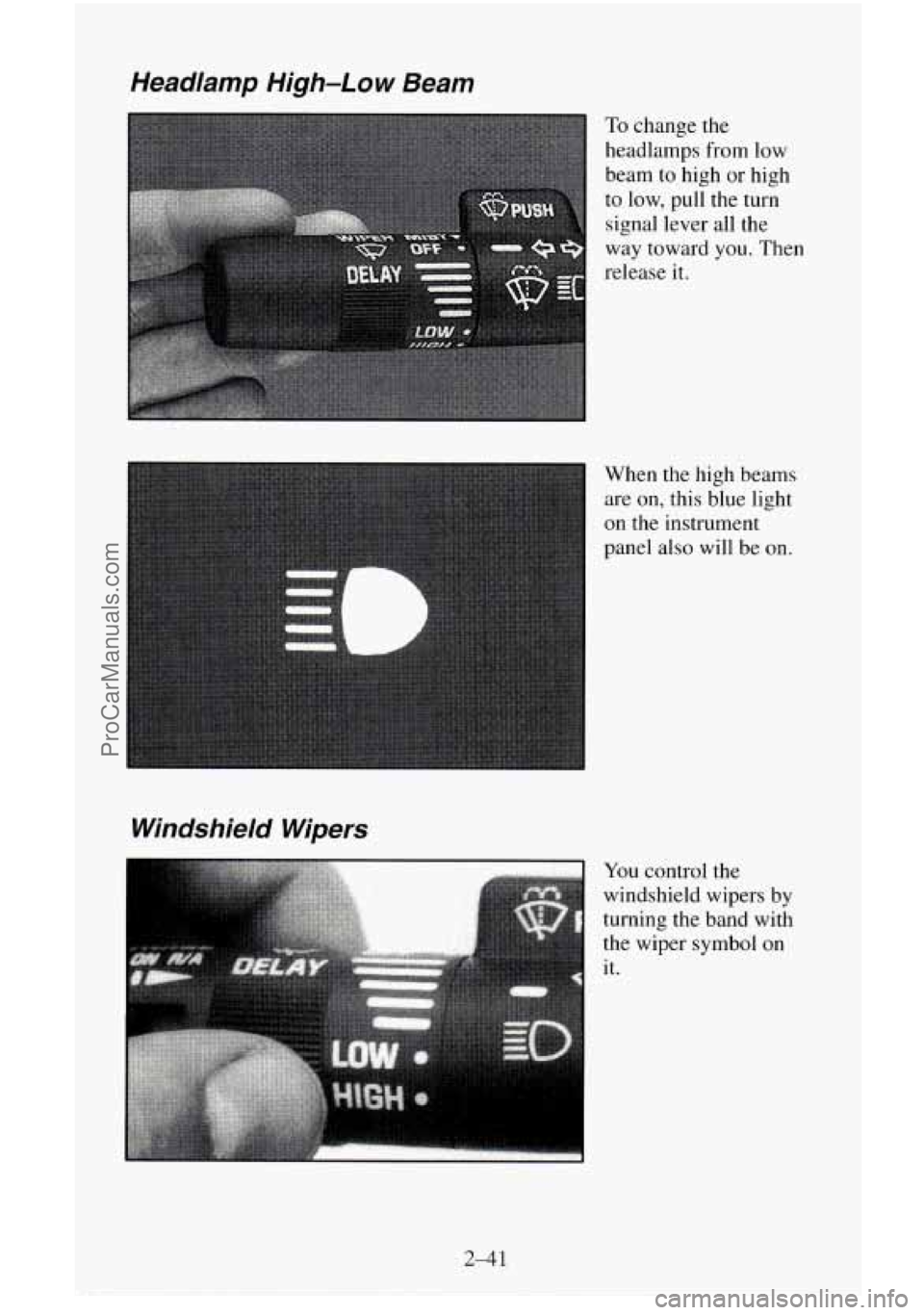
Headlamp High-Low Beam
... ..
Windshield Wipers
To change the
headlamps from low
beam to high or high
to
low, pull the turn
signal lever all the
way toward
you. Then
release it.
When the high beams
are
on, this blue light
on the instrument
panel also will be on.
You control the
windshield wipers by
turning
the band with
the wiper symbol on it.
2-41
ProCarManuals.com
Page 120 of 486
Compass Operation
When the ignition is on and the mirror switch is in the C/M position, the
compass display will show two character boxes for approximately two
seconds.
If, after two seconds, the display does not show a compass heading
(“N” for North, for example), there may be strong magnetic field interfering
with the compass. Such interference may include magnetic antenna mounts,
a magnetic note pad holder, or a similar magnetic item. If removing these
items does
not correct the condition, see your GM dealer for assistance.
When cleaning
the mirror, use a paper towel or similar material dampened
with glass cleaner.
Do not spray glass cleaner directly on the mirror as that
may cause liquid cleaner
to enter the mirror housing.
Compass Variance
Under certain circumstances, as during a long distance cross-country trip, it
will be necessary to adjust the compass to compensate for compass
variance. Compass variance
is the difference between earth’s magnetic
North and true geographic North.
If not adjusted to account for compass
variance, your compass could give false readings.
To adjust for compass variance:
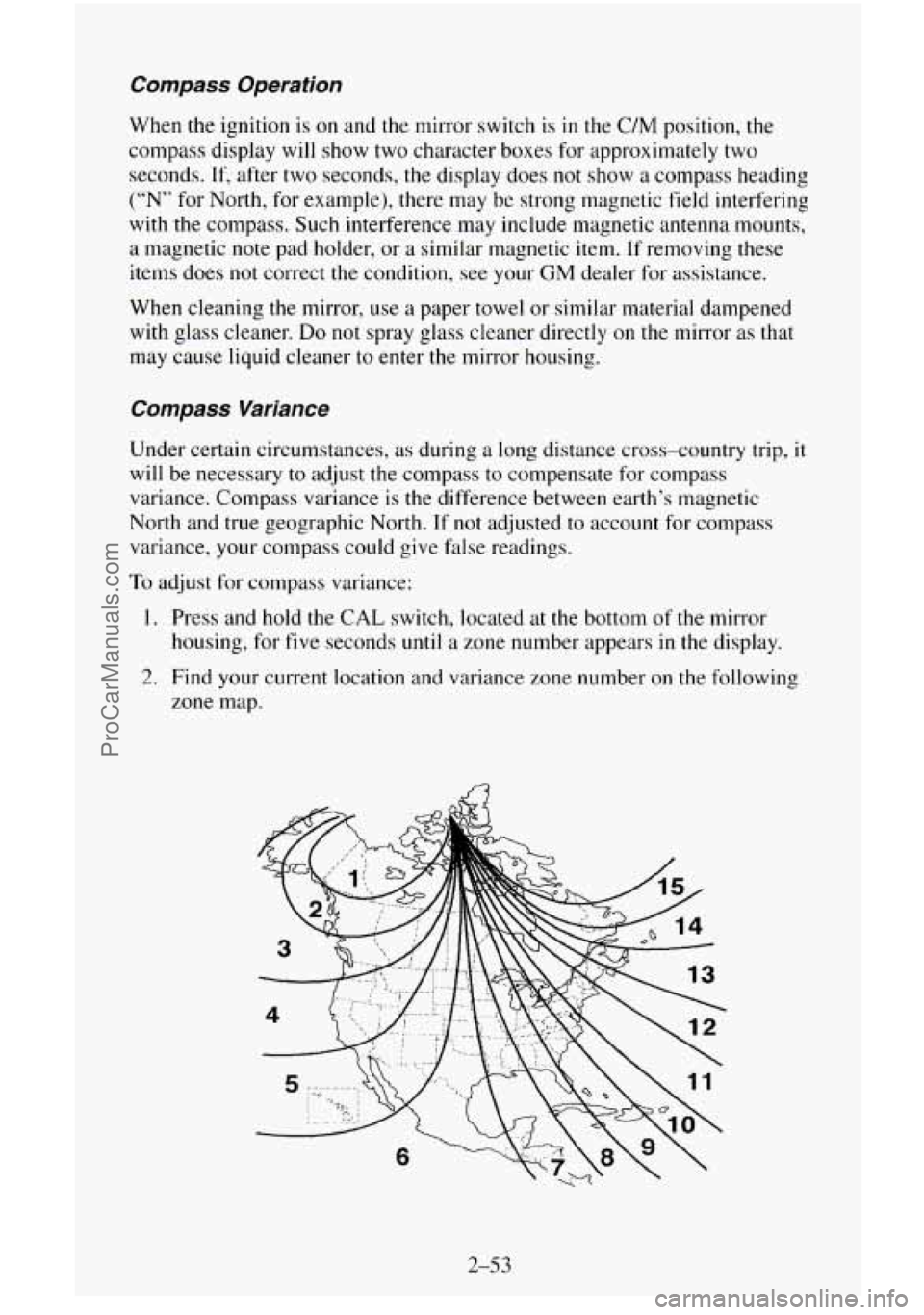
1. Press and hold the CAL switch, located at the bottom of the mirror
housing, for five seconds
until a zone number appears in the display.
2. Find your current location and variance zone number on the following
zone map.
2-53
ProCarManuals.com
Page 125 of 486
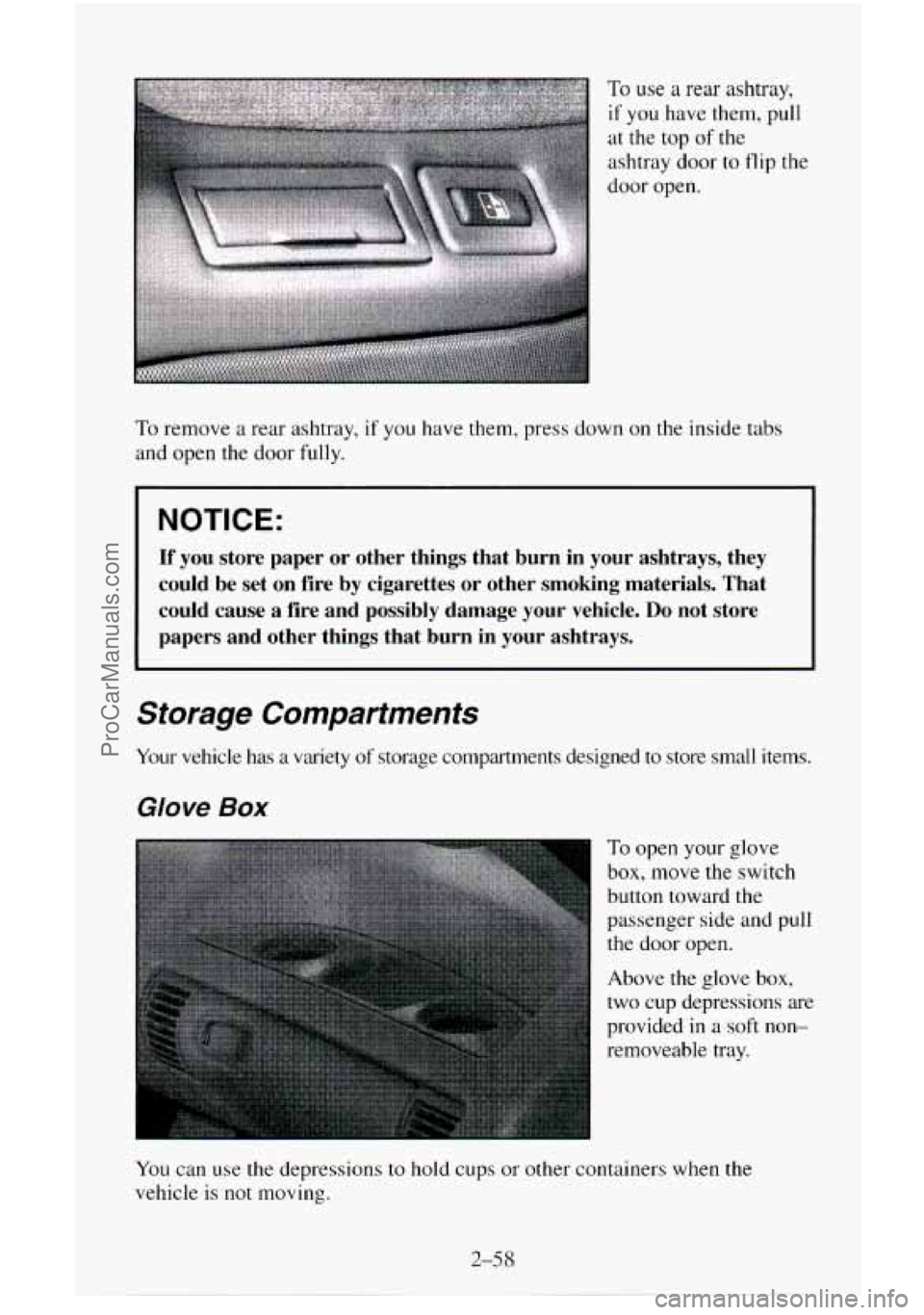
To use a rear ashtray,
if you have them, pull
at the top
of the
ashtray door to flip the
door open.
To remove a rear ashtray, if you have them, press down on the inside tabs
and open the door fully.
NOTICE:
If you store paper or other things that burn in your ashtrays, t\
hey
could be set on fire by cigarettes or other smoking materials.\
That
could cause
a fire and possibly damage your vehicle. Do not store
papers and other things that burn in your ashtrays.
Storage Compartments
Your vehicle has a variety of storage compartments designed to store small items.
Glove Box
To open your glove
box, move the switch
button toward the
passenger
side and pull
the door open.
Above the glove box,
two cup depressions are
provided in a
soft non-
removeable tray.
You can use the depressions to hold cups or other containers when the
vehicle is not moving.
2-5 8
ProCarManuals.com
Page 138 of 486
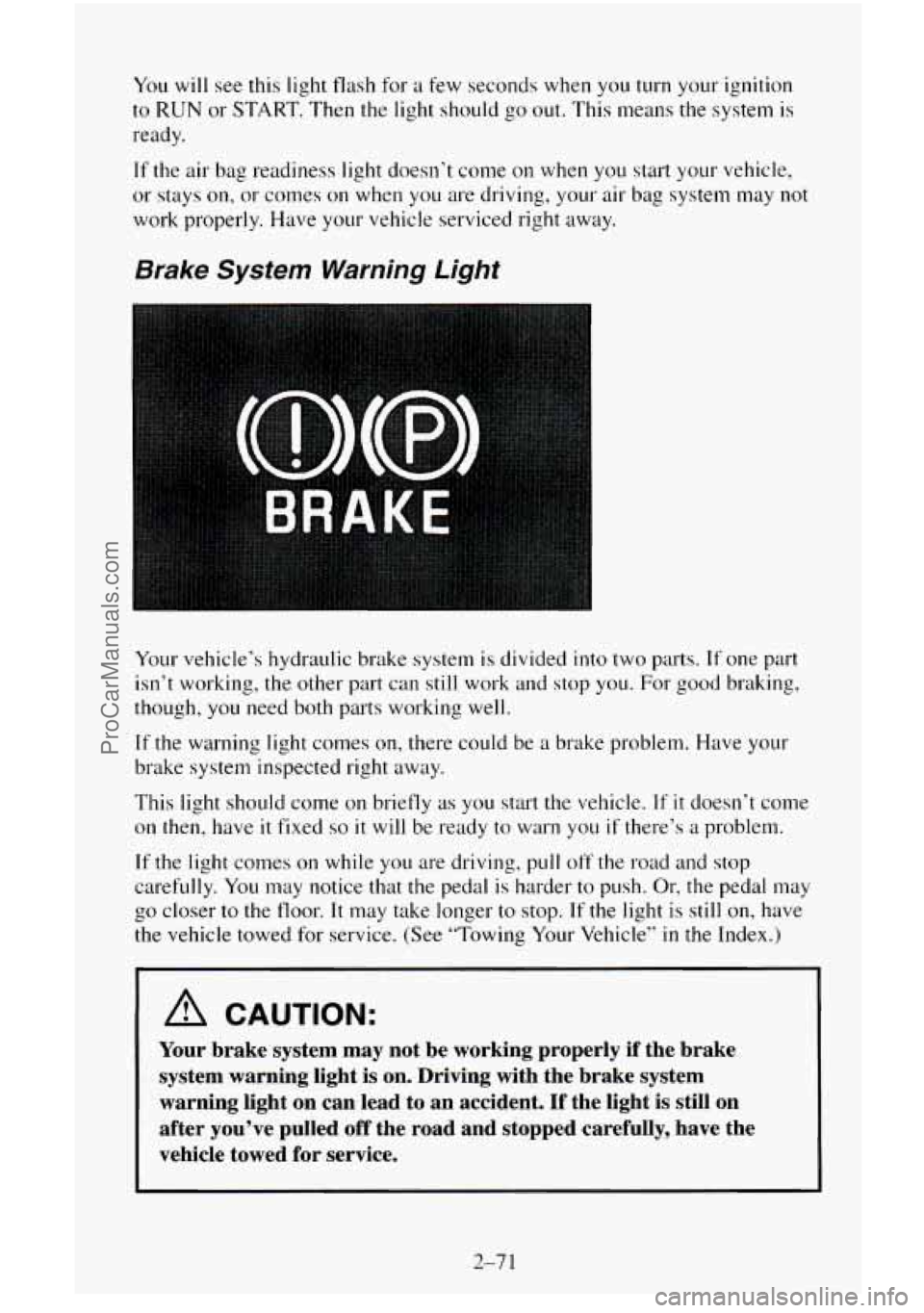
You will see this light flash for a few seconds when you turn your ignition
to RUN or START. Then the light should go out. This means the system is
ready.
If the air bag readiness light doesn’t come on when you start your vehicle,
or stays
on, or comes on when you are driving, your air bag system may not
work properly. Have your vehicle serviced right away.
Brake System Warning Light
Your vehicle’s hydraulic brake system is divided into two parts. If one part
isn’t working, the other part can still
work and stop you. For good braking,
though, you need both parts working well.
If the warning light comes on, there could be a brake problem. Have your
brake system inspected right away.
This light should come on briefly as
you start the vehicle. If it doesn’t come
on then, have it fixed so it will be ready to warn you if there’s a problem.
If the light comes on while you are driving, pull off the road and stop
carefully. You may notice that the pedal is harder
to push. Or, the pedal may
go closer
to the floor. It may take longer to stop. If the light is still on, have
the vehicle towed
for service. (See “Towing Your Vehicle” in the Index.)
~~
A CAUTION:
Your brake system may not be working properly if the brake
system warning light is
on. Driving with the brake system
warning light on can lead to an accident. If the light is still on
after you’ve pulled
off the road and stopped carefully, have the
vehicle towed for service.
2-7 1
ProCarManuals.com