fuel CHEVROLET SUBURBAN 1995 Owner's Guide
[x] Cancel search | Manufacturer: CHEVROLET, Model Year: 1995, Model line: SUBURBAN, Model: CHEVROLET SUBURBAN 1995Pages: 486, PDF Size: 26.58 MB
Page 283 of 486
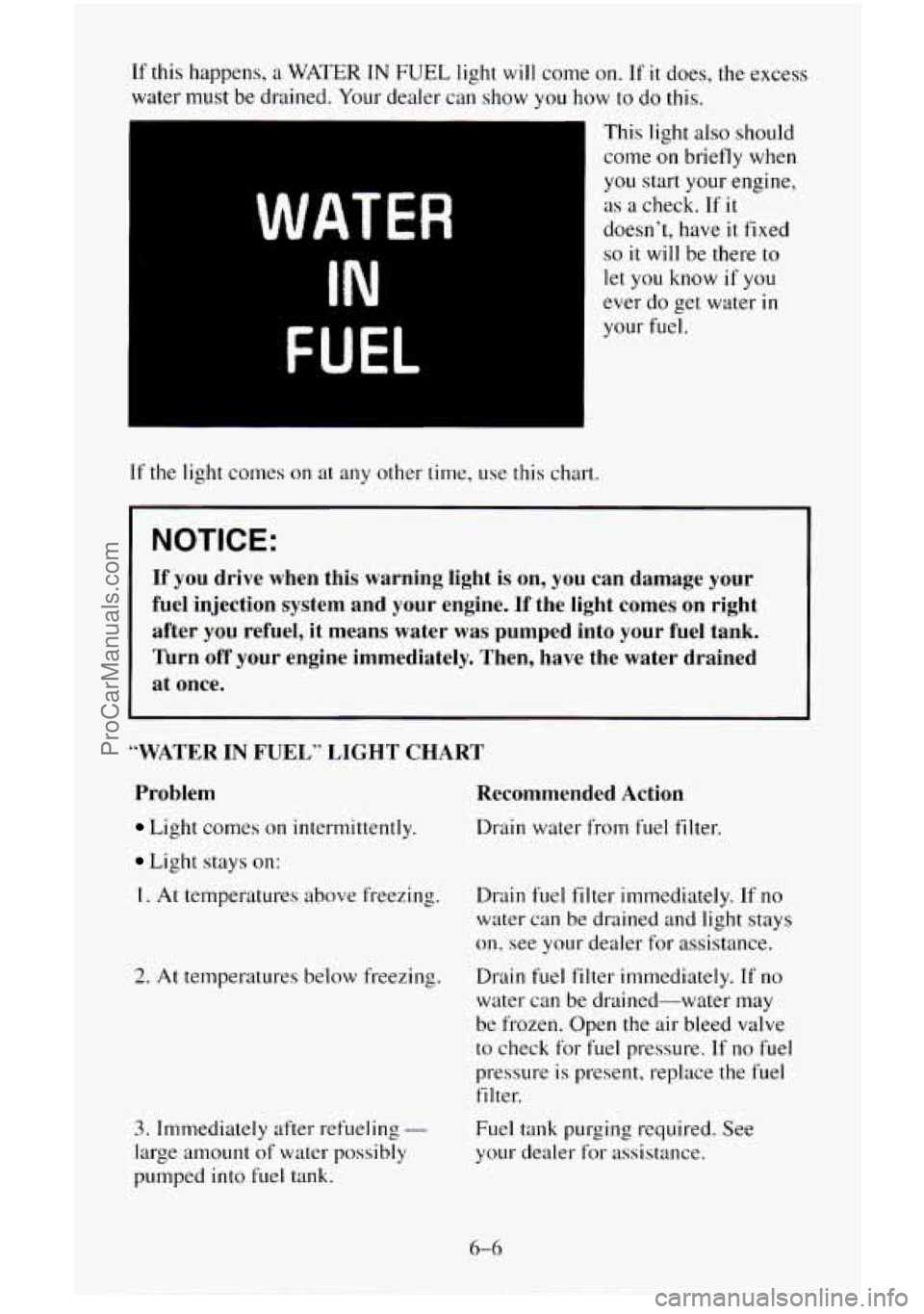
If this happens, a WATER IN FUEL light will come
water must be drained. Your Cfpder can show you
hc
I
WATER
IN
FUEL
If the light comes on at any other time, use this chart.
! on. If it does, the excess
3w to do this.
This light
also should
come
on briefly when
you start your engine,
as a check. If it
doesn’t, have it fixed
so it will be there to
let you know if you
ever do get water
in
your fuel.
NOTICE:
If you drive when this warning light is on, you can damage your \
fuel injection system and your engine. If the light comes on \
right
after you refuel,
it means water was pumped into your fuel tank.
Turn off your engine immediately. Then, have the water drained \
at once.
“WATER IN FUEL” LIGHT CHART Problem
Light comes on intermittently.
Light stays on:
Recommended Action
Drain water from fuel filter.
1. At temperatures above freezing. Drain fuel filter immediately. If no
water can be drained and light stays
on, see your dealer for assistance.
2. At temperatures below freezing. Drain fuel filter immediately. If no
water can be drained-water may
be frozen. Open the air bleed valve
to check for fuel pressure. If
no fuel
pressure is present, replace the fuel
filter.
3. Immediately after refueling -
large amount of water possibly
pumped into fuel tank. Fuel tank
purging required. See
your dealer for assistance.
6-4
ProCarManuals.com
Page 284 of 486
Hesitation or “flat” performance at high speed or during hard acceleration
may be an indication of premature fuel filter plugging due
to dirty or
contaminated fuel. The filter element may need to be changed
if this
happens. See your dealer for assistance.
To drain water:
I. Stop and park the vehicle in a safe place. Turn off the engine and apply
the parking brake.
2. Remove the fuel tank cap.
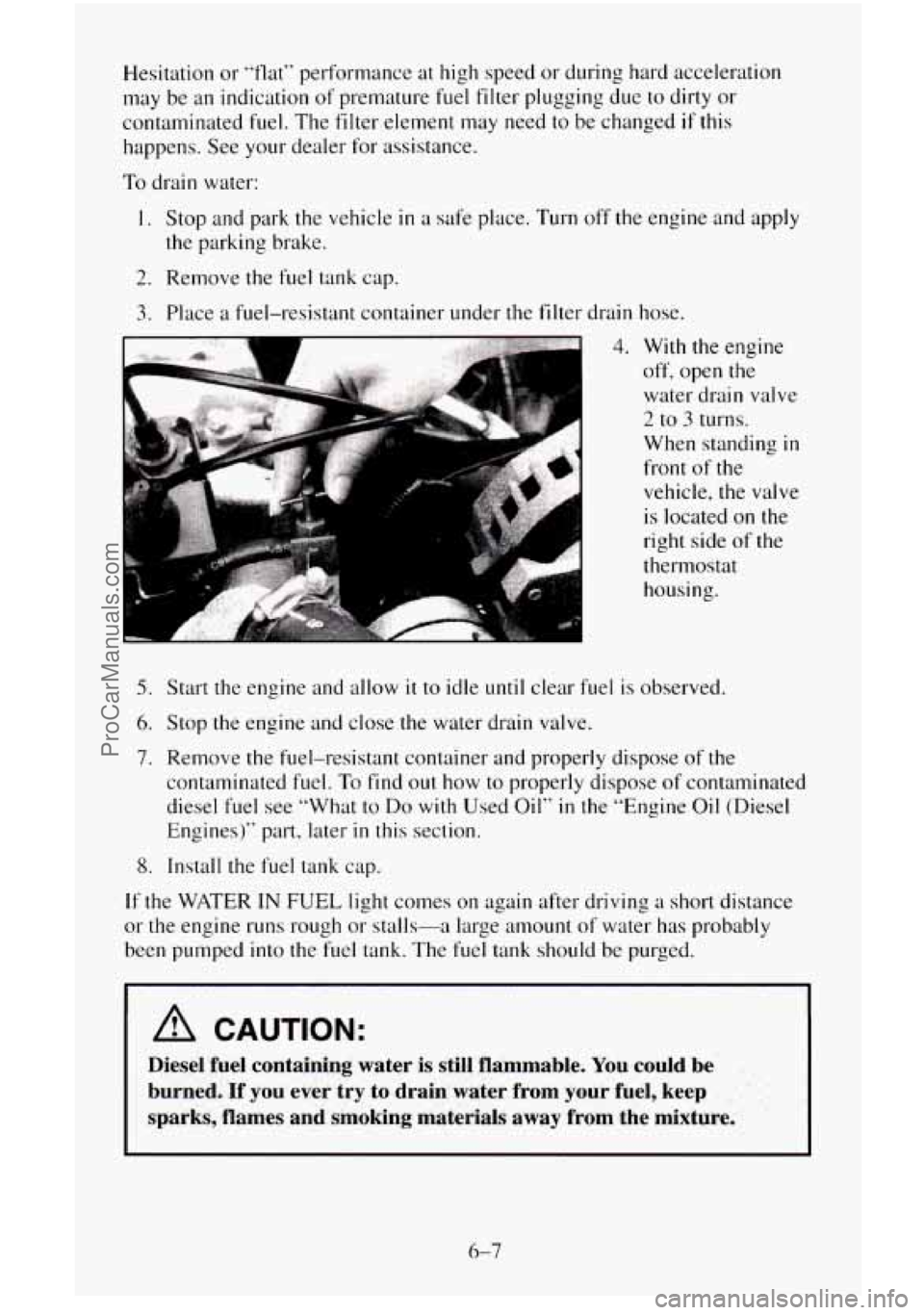
3. Place a fuel-resistant container under the filter drain hose.
4. With the engine
off? open the
water drain valve
2 to 3 turns.
When standing
in
front of the
vehicle, the valve is located
on the
right side of the
thermostat housing.
5. Start the engine and allow it to idle until clear fuel is observed.
6. Stop the engine and close the water drain valve.
7. Remove the fuel-resistant container and properly dispose of the
contaminated fuel.
To find out how to properly dispose of contaminated
diesel fuel see “What to Do
with Used Oil” in the “Engine Oil (Diesel
Engines)” part, later
in this section.
8. Install the fuel tank cap.
If the WATER IN FUEL light comes on again after driving a short distance
or the engine runs rough or stalls-a large amount of water has probably
been pumped
into the fuel tank. The fuel tank should be purged.
6% CAUTION:
Diesel he1 containing water is still flammable. You could be
burned. If you ever try to drain water from
your fuel, keep
sparks, flames and smoking materials away
from the mixture.
6-7
ProCarManuals.com
Page 285 of 486
NOTICE:
If there is water in your diesel fuel and the weather is warm or
humid, fungus and bacteria can grow in the fuel. They can
damage your fuel system. You’ll need
a diesel fuel biocide to
sterilize your fuel system. Your dealer can advise you if you ever
need this.
If your fuel tank needs to be purged to remove water,
see your
dealer or
a qualified technician. Improper purging can damage
your fuel system.
Running Out of Fuel (Diesel Engines)
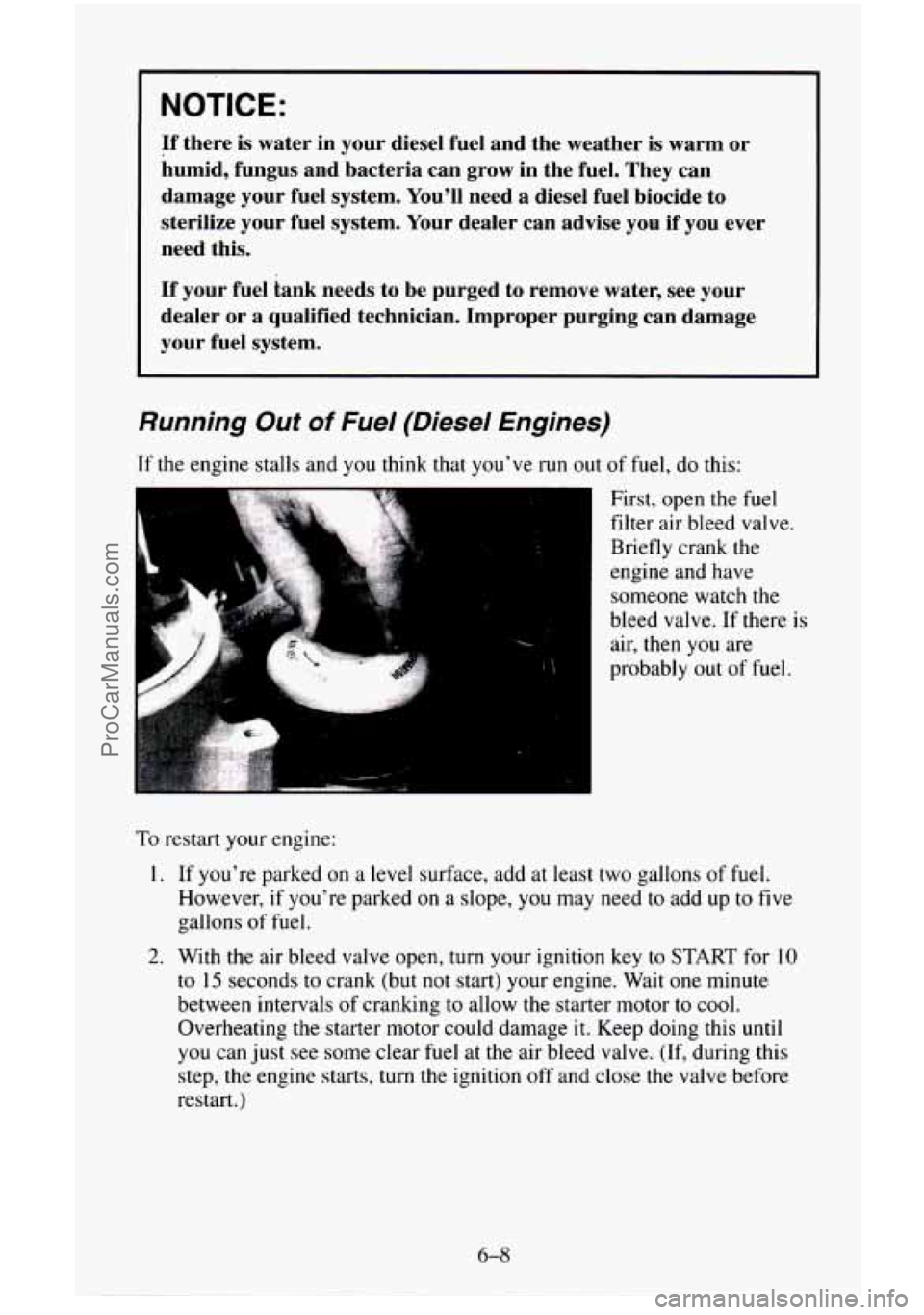
If the engine stalls and you think that you’ve run out of fuel, do this:
First, open the fuel
filter air bleed valve.
Briefly crank the
engine and have
someone watch
the
bleed valve. If there is
air,
then you are
probably
out of fuel.
To restart your engine:
1. If you’re parked on a level surface, add at least two gallons of fuel.
However, if you’re parked on a slope, you may need to add up to five
gallons of fuel.
2. With the air bleed valve open, turn your ignition key to START for 10
to 15 seconds to crank (but not start) your engine. Wait one minute
between intervals of cranking to allow the starter motor
to cool.
Overheating the starter motor could damage
it. Keep doing this until
you can just see some clear fuel at the air bleed valve. (If, during this
step, the engine starts, turn the ignition off and close the valve before
restart.)
ProCarManuals.com
Page 286 of 486
3. Close the air bleed valve.
4. Turn the ignition key to START for 10 to 15 seconds at a time until
your engine starts.
Fuel Filter Replacement (Diesel Engines)
If you want to change the fuel filter yourself, here's how to do it:
First, drain any water from the filter following the procedure for draining
water listed previously.
Your vehicle's engine should be off until the end of the following procedure.
r.
1. Apply the parking brake.
2. Take off the fuel tank cap. This releases vacuum in the tank.
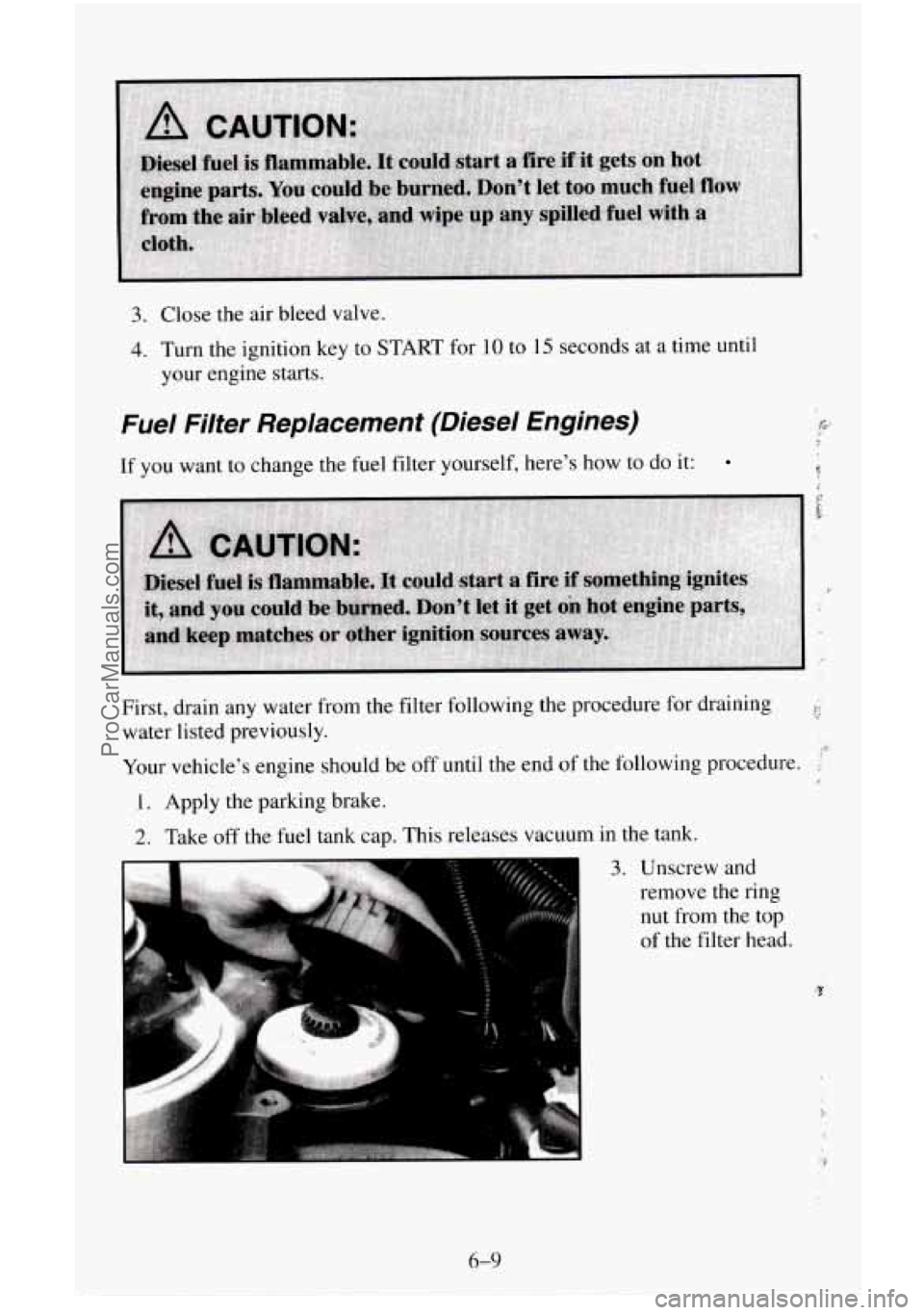
3. Unscrew and
remove the ring
nut from the top
of the filter head.
6-9
ProCarManuals.com
Page 287 of 486
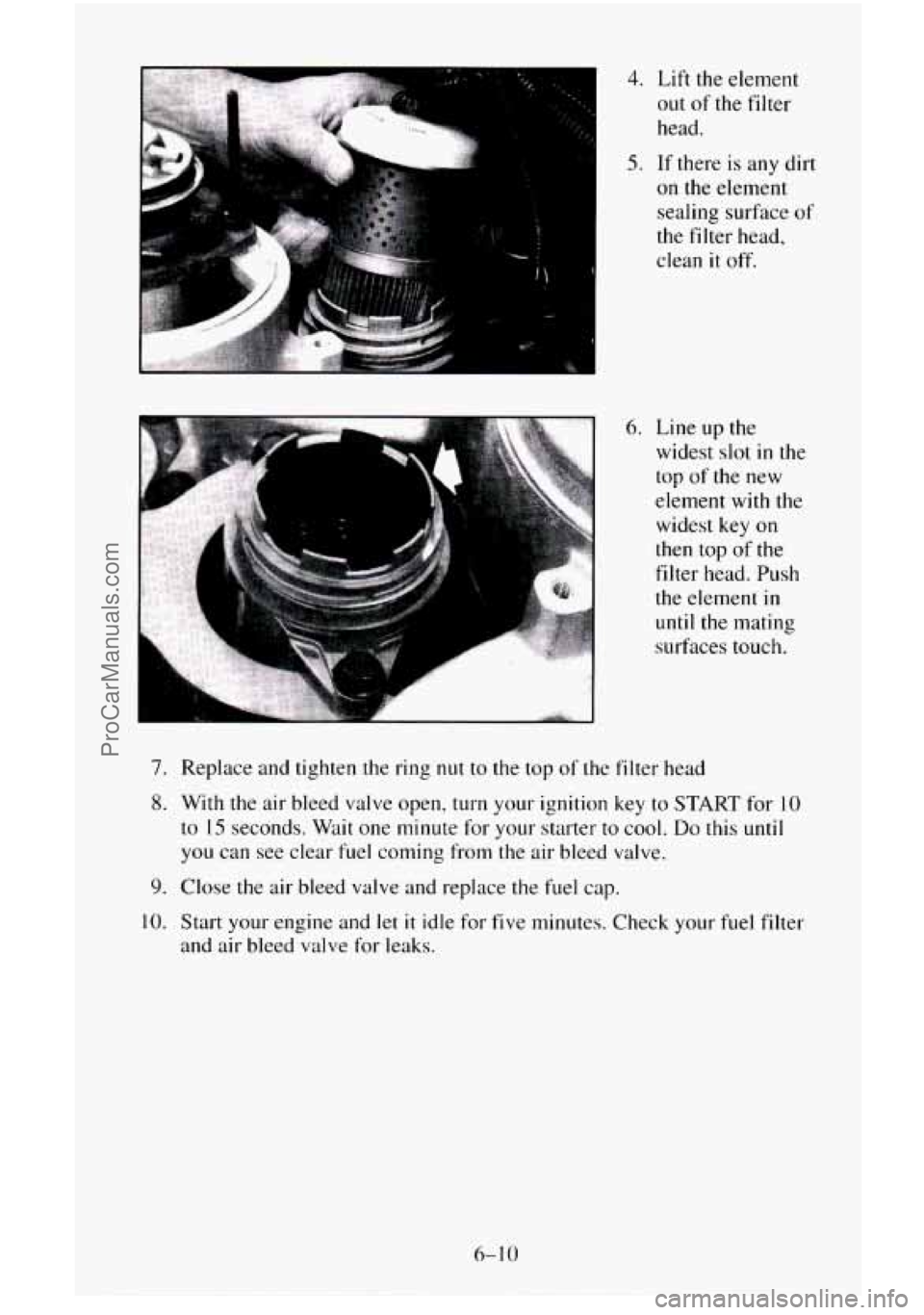
4. Lift the element
out
of the filter
head.
5. If there is any dirt
on the element
sealing surface
of
the filter head,
clean
it off.
6. Line up the
widest slot
in the
top
of the new
element with the
widest key on
then top of the
filter head. Push
the element
in
until the mating
surfaces touch.
7. Replace and tighten the ring nut to the top of'the filter head
8. With the air bleed valve open, turn your ignition key to START for 10
to 15 seconds, Wait one minute for your starter to cool. Do this until
you can see clear fuel coming from the air bleed valve.
9. Close the air bleed valve and replace the fuel cap.
10. Start your engine and let it idle for five minutes. Check your fuel filter
and air bleed valve for leaks.
6-10
ProCarManuals.com
Page 288 of 486
Fuels in Foreign Countries (Gasoline
Engines)
If you plan on driving in another country outside the U.S. or Canada,
unleaded
fuel may be hard to find. Do not use leaded gasoline. If you use
even one tankful, your emission controls won’t work well or at all. With
continuous use, spark plugs can get fouled, the exhaust system can corrode,
and your engine oil can deteriorate quickly. Your vehicle’s oxygen sensor
will be damaged. All of that means costly repairs that wouldn’t be covered
by your warranty.
To check on fuel availability, ask an auto club, or contact a major oil
company that does business
in the country where you’ll be driving.
You can
also write us at the following address for advice. Just tell us where
you’re going and give your Vehicle Identification Number
(VIN).
General Motors Overseas Distribution Corporation,
North American Export Sales
(NAES)
1908 Colonel Sam Drive
Oshawa, Ontario
LIH 8P7
Filling Your Tank
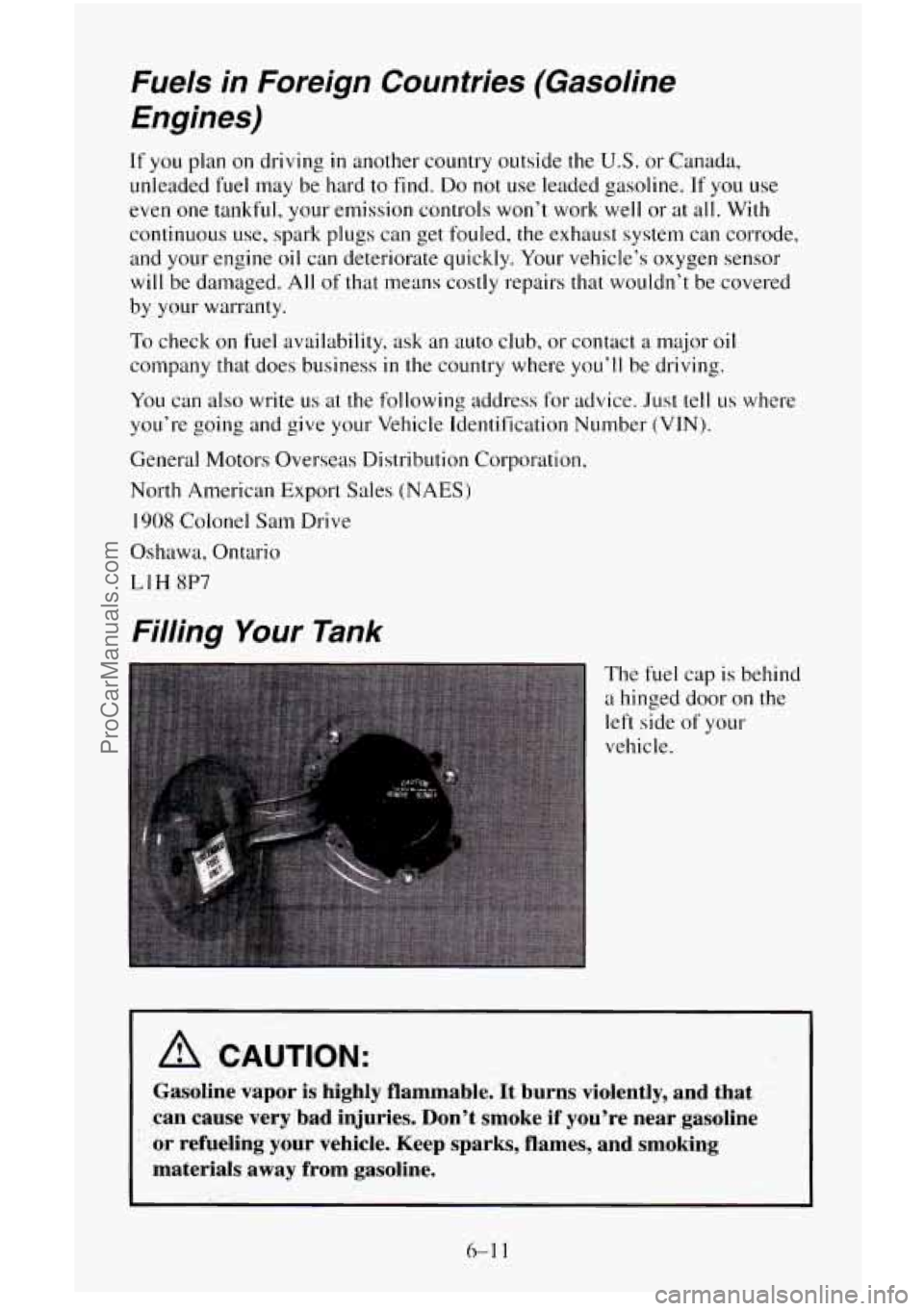
The fuel cap is behind
a hinged door on the
left side of your
vehicle.
A CAUTION:
Gasoline vapor is highly flammable. It burns violently, and that
can cause very bad injuries. Don’t smoke if you’re near gasol\
ine
or refueling your vehicle.
Keep sparks, flames, and smoking
materials away from gasoline.
6-1 1
ProCarManuals.com
Page 289 of 486
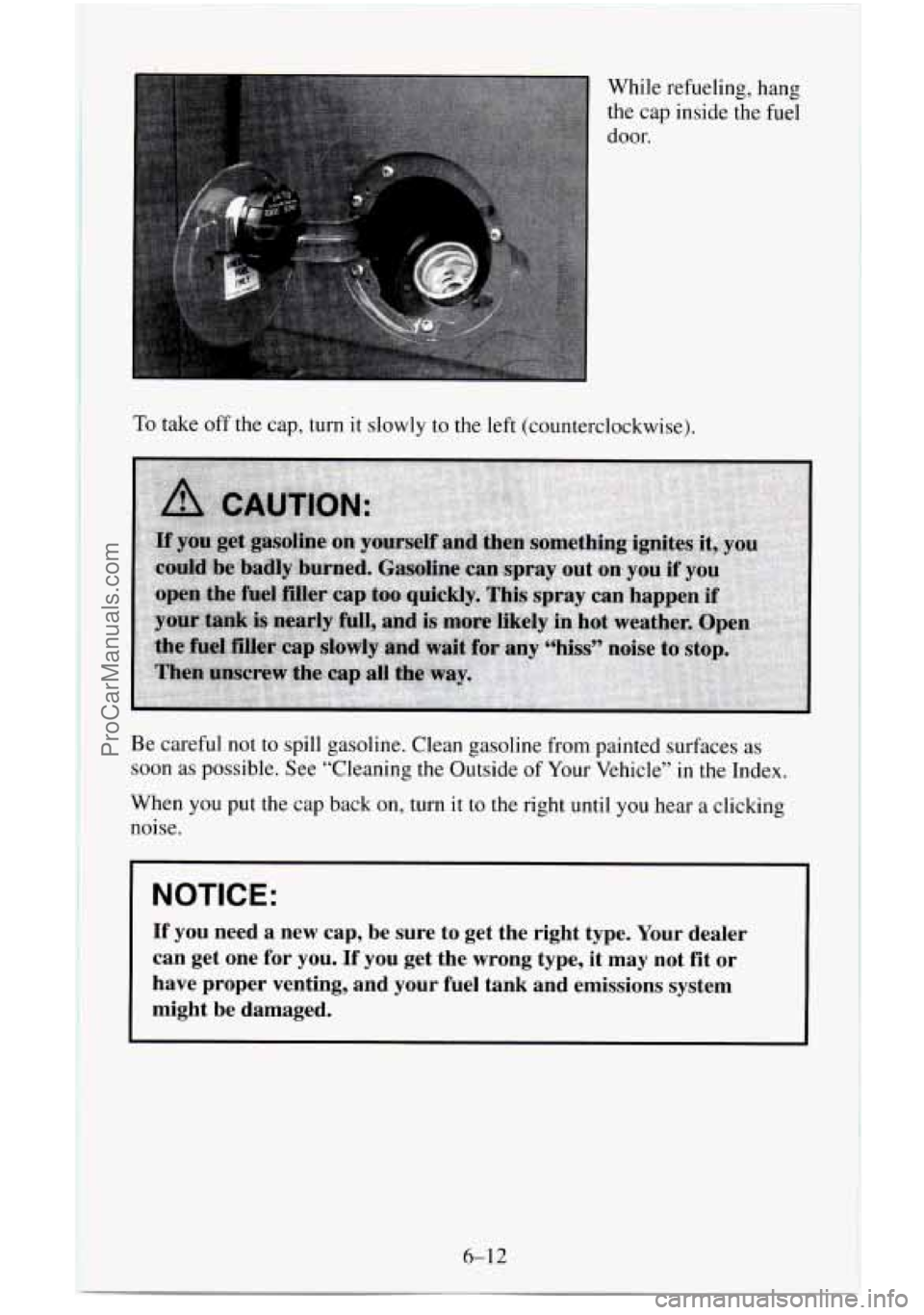
While refueling, hang the cap inside the fuel
door.
To take off the cap, turn it slowly to the left (counterclockwise).
Be careful not to spill gasoline. Clean gasoline from painted surfaces as
soon as possible. See “Cleaning the Outside of Your Vehicle” in the Index.
When you put the cap back on, turn it to the right until
you hear a clicking
noise.
1 NOTICE:
If you need a new cap, be sure to get the right type. Your dealer
can get one for you.
If you get the wrong type, it may not fit or
have proper venting, and your fuel tank and emissions system
might be damaged.
6-12
ProCarManuals.com
Page 291 of 486
Before closing the hood, be sure all filler caps are on properly. Pull down
the hood and close it firmly.
Cleaning Your Diesel Engine
NOTICE:
If you spray or pour water or any other liquid on your engine
when it is warm or hot, or when
it is running, you could cause
serious damage
to it. If you ever clean the engine, clean it only
when it
is cold.
Engine Oil (Gasoline Engines)
It’s a good idea to check your engine oil every time you get fuel. In order to
get an accurate reading, the oil must be warm and the vehicle must be on
level ground.
6-14
ProCarManuals.com
Page 294 of 486
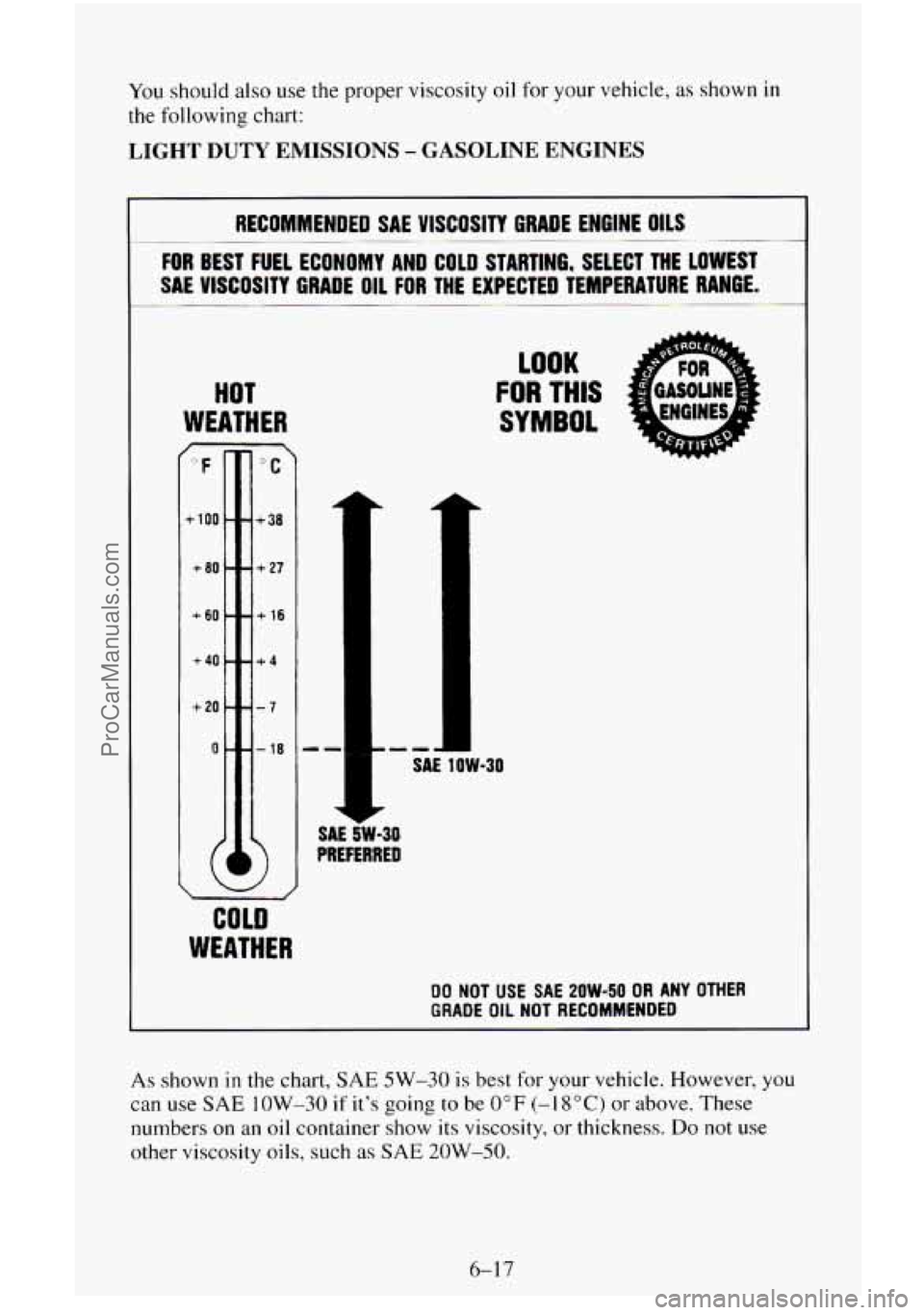
You should also use the proper viscosity oil for your vehicle, as shown in
the following chart:
LIGHT DUTY EMISSIONS - GASOLINE ENGINES
RECOMMENDED SAE VISCOSITY GRADE ENGINE OILS
FOR BEST FUEL ECONOMY AND COLD STARTING, SELECT THE LOWEST
SAE VISCOSITY GRADE
011 FOR THE EXPECTEO TEMPERATURE RANGE.
HOT
WEATHER
7
'F
t 100
+ 80
+ 60
+ 40
+ 20
0
7
c
+38
- +27
- +16
- +4
--7
--18
WEATHER
-- ....-
SAE 5W-30
PREFERRED
LOOK
FOR THIS
SYMBOL
-
SAE 1OW-30
As shown in the chart, SAE 5W-30 is best for your vehicle. However, you
can use SAE 1 OW-30 if it's going to be 0°F (- 1 SOC) or above. These
numbers on
an oil container show its viscosity, or thickness. Do not use
other viscosity oils, such as SAE 20W-50.
6-1 7
ProCarManuals.com
Page 295 of 486
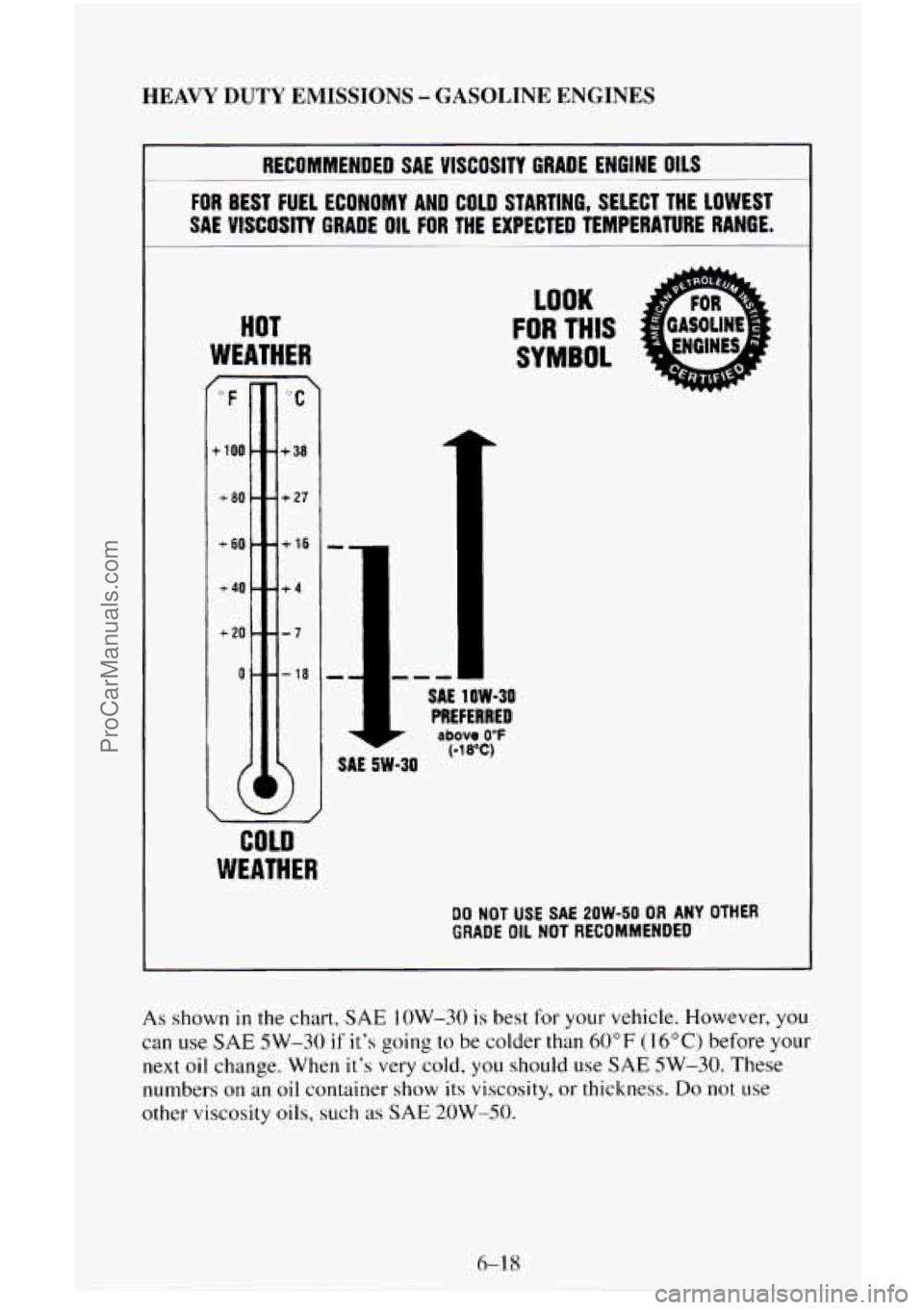
HEAVY DUTY EMISSIONS - GASOLINE ENGINES
- RECOMMENDED SAE VISCOSITY GRADE ENGINE OILS
FOR BEST FUEL ECONOMY AND COLD STARTING, SELECT THE LOWEST
SAL
VISCOSITY GRADE OIL FOR THE EXPECTED TEMPERATURE RANGE.
- ~~
HOT
WEATHER
/ v
"F
+lo0 c - +38
t8Q - - +27
+60 - +16
+4Q - - +4
+20 ---7
0 ---18
-
-
SAE 1OW-30
PREFERRED
SAE 5W-30
cola
WEATHER
LOOK
FOR THIS
SYMBOL
DO NOT USE SAE 2OW-50 OR ANY OTHER
GRADE OIL NOT RECOMMENDED
As shown in the chart, SAE IOW-30 is best for your vehicle. nowever, you
can use
SAE 5W-30 if it's going to be colder than 60°F (I 6°C) before your
next oil change. When
it's very cold, you should use SAE 5W-30. These
numbers
on an oil container show its viscosity, or thickness. Do not use
other viscosity
oils, such as SAE 20W-50.
6-1 8
ProCarManuals.com