fuel CHEVROLET SUBURBAN 1995 User Guide
[x] Cancel search | Manufacturer: CHEVROLET, Model Year: 1995, Model line: SUBURBAN, Model: CHEVROLET SUBURBAN 1995Pages: 486, PDF Size: 26.58 MB
Page 140 of 486
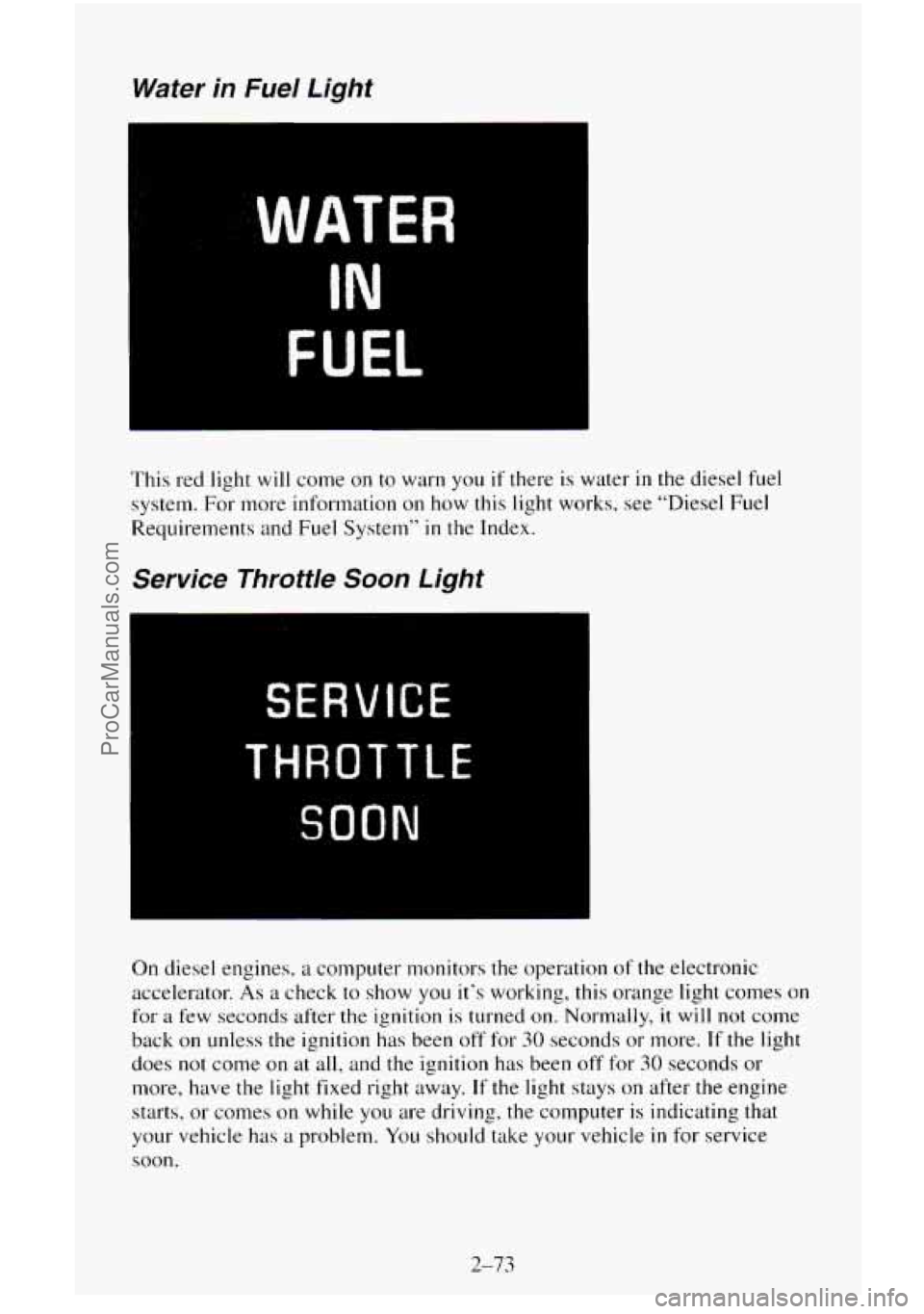
Water in Fuel Light
WATER
IN
FUEL
This red light will come on to warn you if there is water in the diesel fuel
system. For more information
on how this light works, see “Diesel Fuel
Requirements and Fuel System” in the Index.
Service Throttle Soon Light
SERVICE
THROTTLE
SOON
On diesel engines, a computer monitors the operation of the electronic
accelerator.
As a check to show you it’s working, this orange light comes on
for a few seconds after the ignition is turned on. Normally, it will not come
back on unless the ignition has been off for 30 seconds or more. If the light
does not come on at
all, and the ignition has been off for 30 seconds or
more, have the light fixed right away.
If the light stays on after the engine
starts, or comes on while
you are driving, the computer is indicating that
your vehicle
has a problem. You should take your vehicle in for service
soon.
2-73
ProCarManuals.com
Page 142 of 486
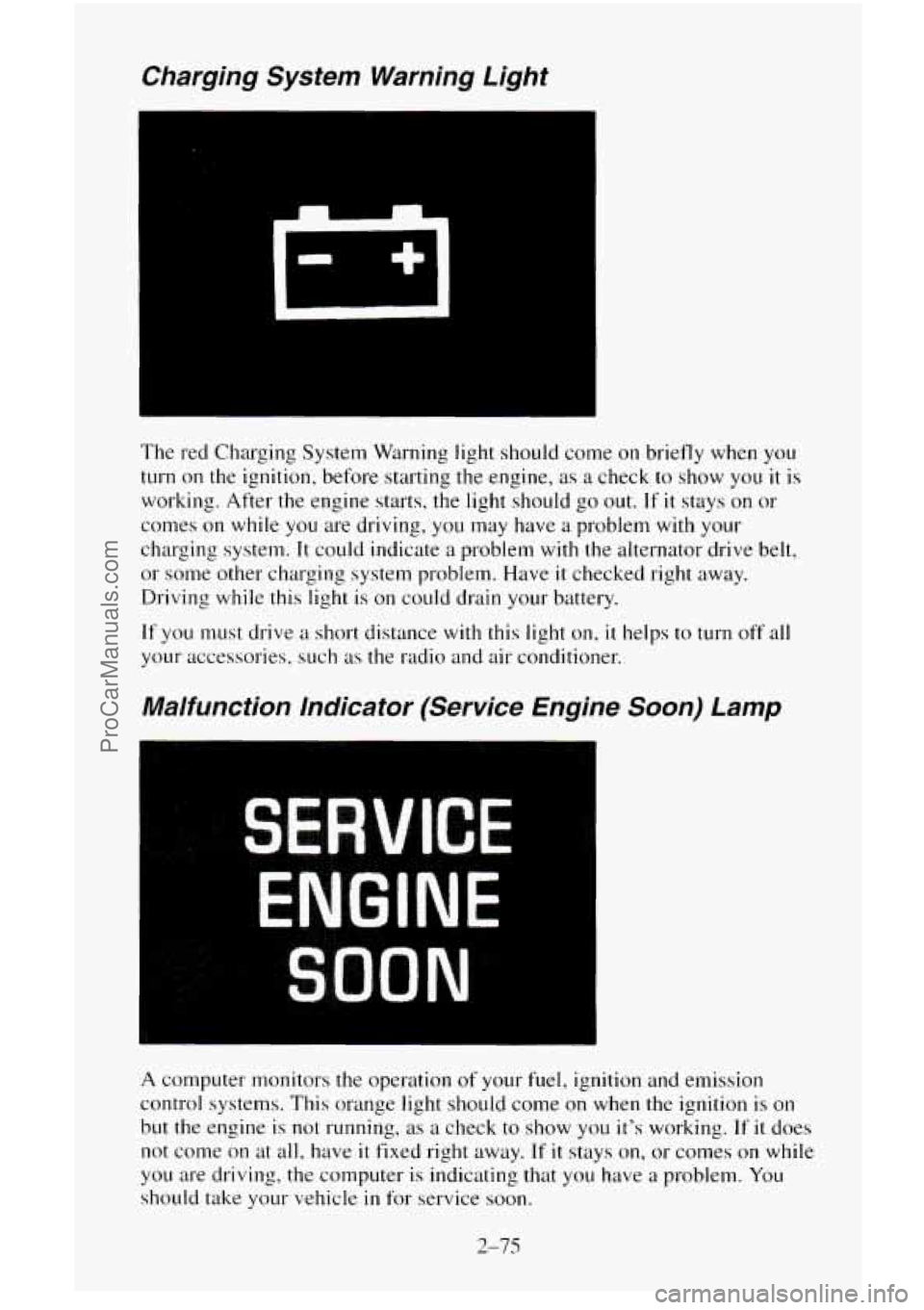
Charging System Warning Light
The red Charging System Warning light should come on briefly when you
turn on the ignition, before starting the engine, as a check to show you it is
working. After the engine starts, the light should go out. If it stays on or
conles on while you are driving, you may have a problem with your
charging system.
It could indicate a problem with the alternator drive belt,
or some other charging system problem. Have
it checked right away.
Driving while this light is on could drain your battery.
If you must drive a short distance with this light on, it helps to turn off all
your accessories, such
as the radio and air conditioner.
Malfunction indicator (Service Engine Soon) Lamp
A computer monitors the operation of your fuel, ignition and emission
control systems.
This orange light should come on when the ignition is on
but the engine is
not running, as a check to show you it’s working. If it does
not come on at all, have
it fixed right away. If it stays on, or comes on while
you are driving, the computer is indicating that you have a problem. You
should take your vehicle in for service soon.
2-75
ProCarManuals.com
Page 143 of 486

NOTICE:
If’ you keep driving your vehicle with this light on, after a whi\
le
the emission controls won’t work as well, your
fuel economy
won’t be as
good, and your engine may not run as smoothly.
This could lead to costly repairs not covered by your warranty\
.
Check Gages Light
This orange light will come on briefly when you are starting the engine. If
the light comes on and stays on while you are driving, it could indicate a
problem
with your vehicle. It could be a problem with your oil pressure,
coolant temperature, or some other problem. Check your various gages to
see
if they are in the warning zones. If they are, have your vehicle serviced
right away.
Daytime Running Lamps (DRL) Indicator Light
2-76
ProCarManuals.com
Page 144 of 486
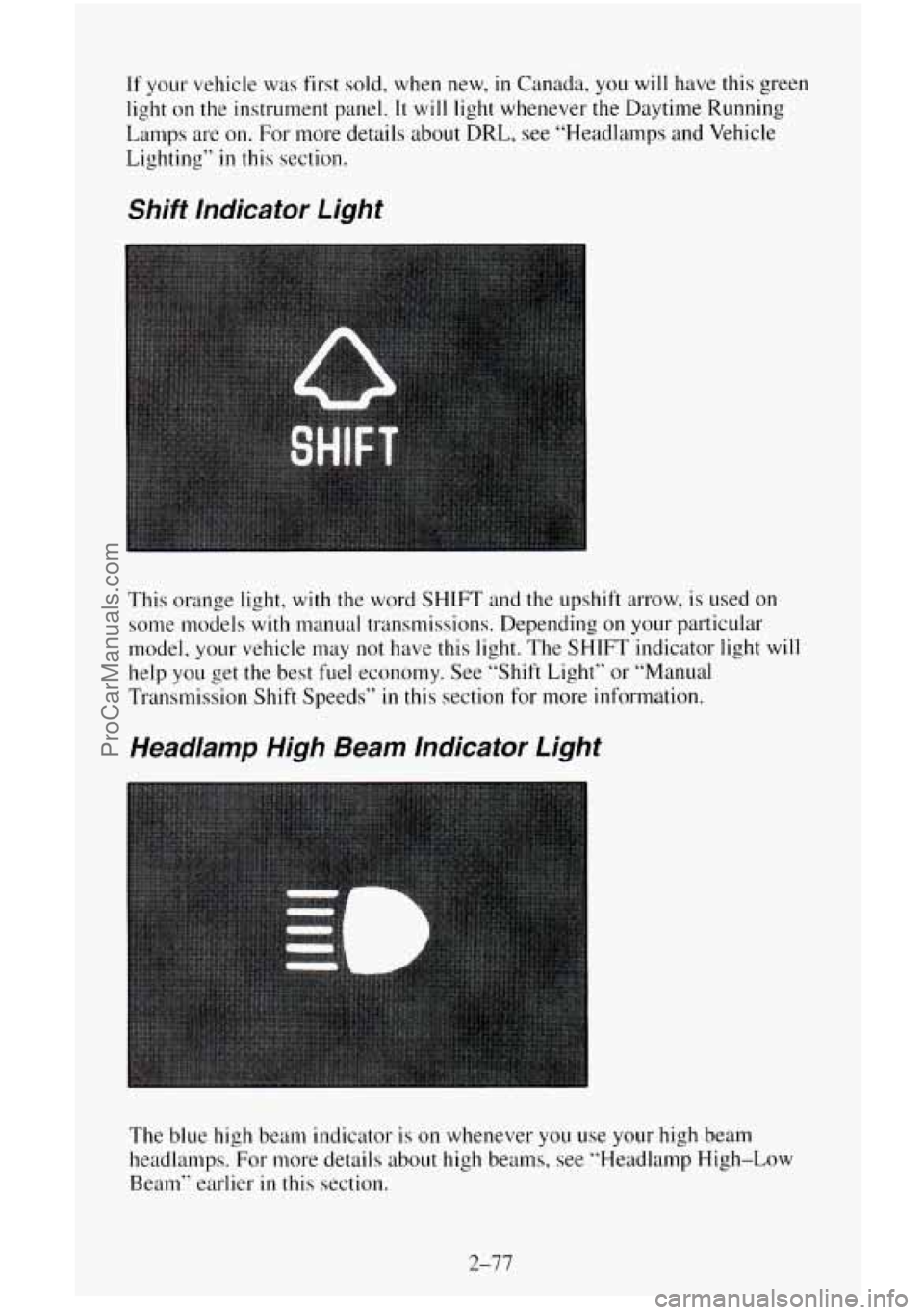
If your vehicle was first sold, when new, in Canada, you will have this green
light on
the instrument panel. It will light whenever the Daytime Running
Lamps
are on. For more details about DRL, see “Headlamps and Vehicle
Lighting’’
in this section.
Shift lndicator Light
This orange light, with the word SHIFT and the upshift arrow, is used on
some models with manual transmissions. Depending on your particular
model, your vehicle may
not have this light. The SHIFT indicator light will
help you get the best fuel economy. See “Shift Light” or “Manual
Transmission Shift Speeds”
in this section for more information.
Headlamp High Beam lndicator Light
The blue high beam indicator is on whenever you use your high beam
headlamps. For more details about high beams, see “Headlamp High-Low
Beam” earlier in this section.
2-77
ProCarManuals.com
Page 145 of 486
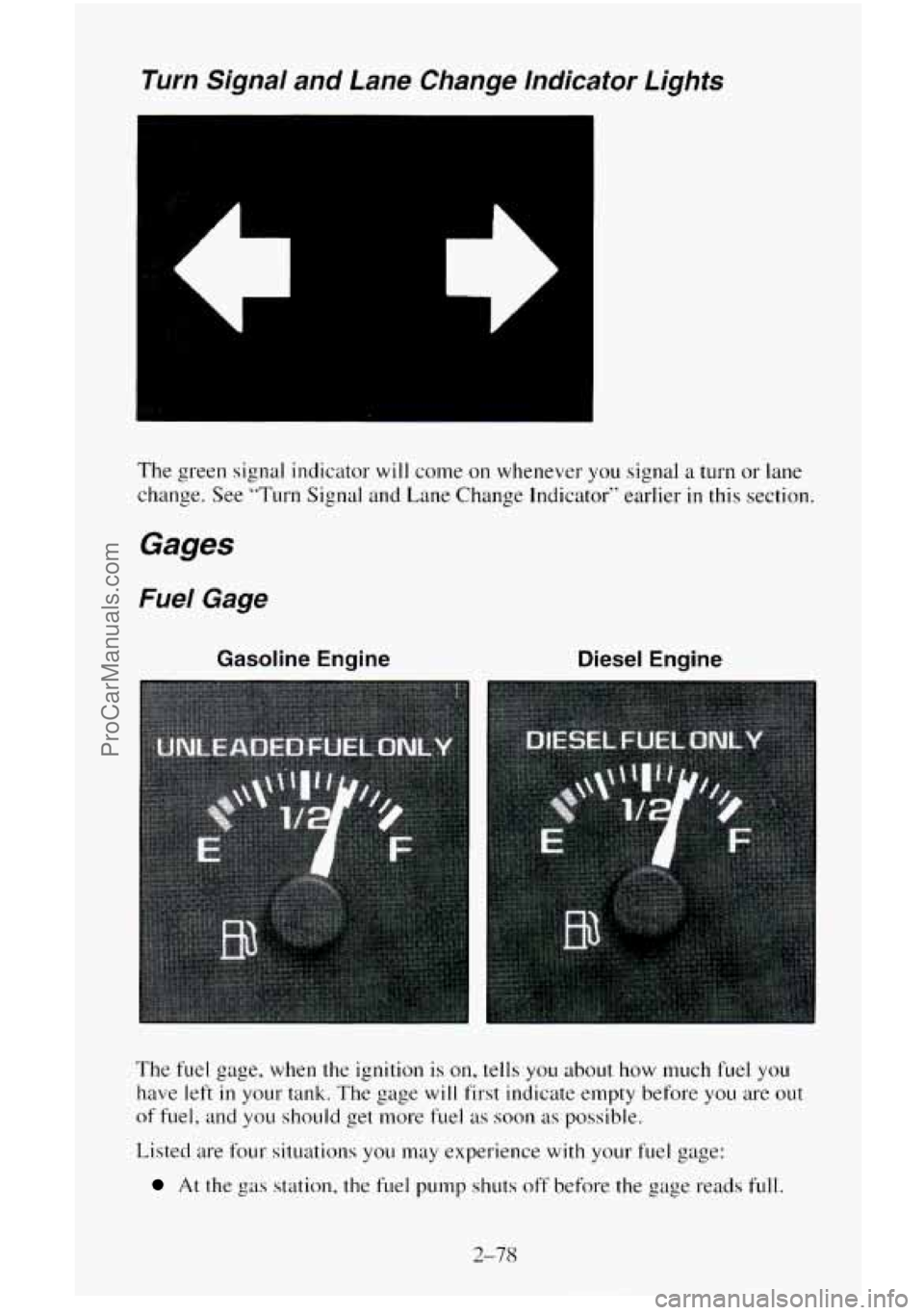
Turn Signal and Lane Change lndicator Lights
The green signal indicator will come on whenever you signal a turn or lane
change. See
“Turn Signal and Lane Change Indicator’‘ earlier in this section.
Gages
Fuel Gage
Gasoline Engine Diesel Engine
The fuel gage, when the ignition is on, tells you about how much fuel YOLI
have left in your tank. The gage will first indicate empty before you are out
of fuel,
and you should get more fuel as soon as possible.
Listed are
four situations you may experience with your fuel ea tracre:
At the gas station, the fuel pump shuts off before the gage reads ~LIII.
2-78
ProCarManuals.com
Page 146 of 486
It takes a little more or less fuel to fill up than the fuel gage indicated.
For example, the gage may have indicated the tank was half
full, but it
actually took a little more or less than half the tank’s capacity to fill the
tank.
The gage moves a little when you turn a corner or speed up.
0 The gage doesn’t go back to empty when you turn off the ignition.
None of these indicate a problem with the fuel gage.
For information on how to fill your fuel tank, see “Fuel
- Filling Your
Tank”
in the Index.
For your
fuel tank capacity, see “Fuel -Tank Capacity” in the Index.
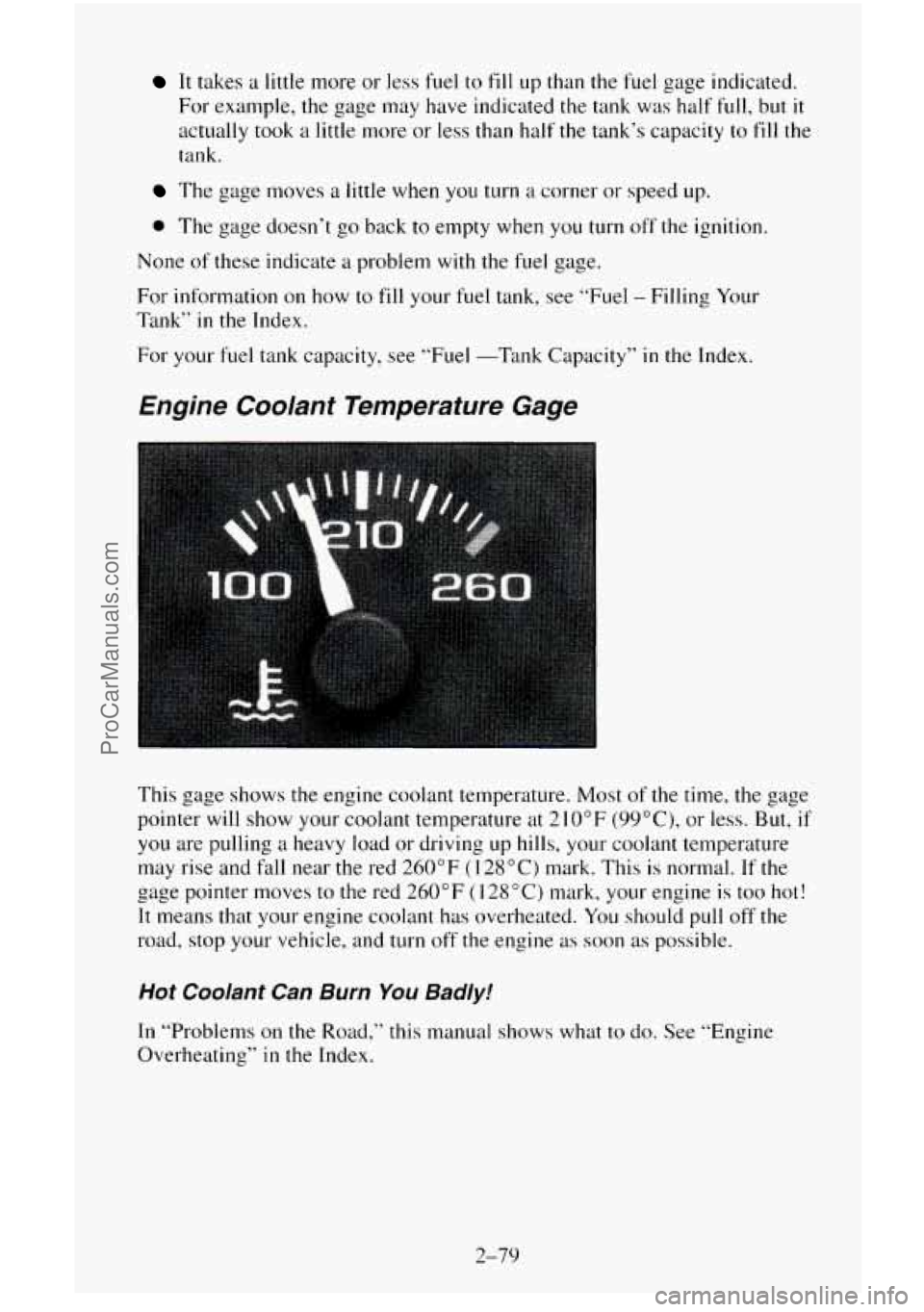
Engine Coolant Temperature Gage
This gage shows the engine coolant temperature. Most of the time, the gage
pointer will show your coolant temperature at 210°F (99”C), or less. But,
if
you are pulling a heavy load or driving up hills, your coolant temperature
may rise and fall near
the red 260°F (1 28°C) mark. This is normal. If the
gage pointer moves
to the red 260°F (1 28°C) mark, your engine is too hot!
It means that your engine coolant has overheated. You should pull off the
road, stop
your vehicle, and turn off the engine as soon as possible.
Hot Coolant Can Burn You Badly!
In “Problems on the Road,” this manual shows what to do. See “Engine
Overheating”
in the Index.
2-79
ProCarManuals.com
Page 158 of 486
Before using your vehicle’s air conditioning, open the windows to clear the
vehicle of
hot air.
Using the recirculation function can also help. See “Recirculation Button”
in this section for more information.
The knob on the left side of the heating system control panel controls the
fan speed. The knob has four speed positions. To increase the air flow, move
the knob toward HI.
To decrease the air flow, move it toward LO. To turn
the fan off, move the knob to
OFF. If you have the air conditioner on,
moving the fan knob to OFF also turns off the A/C compressor.
The middle knob
on the control panel lets you select the relative
temperature
of the air flowing into the passenger area of your vehicle. This
knob will allow
you to adjust the relative air temperature independently of
the function knob setting. Move the knob right toward the red area for
warmer air. Move the knob left toward the blue area for cooler air.
With
A/C on, move the knob to MAX for maximum cooling. This setting
puts the system in the recirculation mode and helps to maximize your air
conditioner’s performance and your vehicle’s fuel economy. This setting
also cools the air
the fastest. After the vehicle’s interior reaches a
comfortable temperature, move
the knob clockwise to place the air
conditioning system
in the normal mode.
The right knob on the control panel changes the heatedair conditioning
setting.
VENT
- This setting, with the arrow pointing at the figure’s head, directs
air through the instrument panel vents.
VENT/HEAT
- Use this setting, with the arrows pointing at the figure’s
feet and head, to divide airflow between the heater floor vents and
instrument panel vents.
HEAT
- This setting, with the arrow pointing at the figure’s feet, directs air
through the heater floor vents. This setting
is useful for cold weather.
HEAT/DEFROST
- Use this setting, with the arrow pointing at the figure’s
feet and the defroster symbol near
the figure’s head, to divide airflow
between the heater floor
vents and windshield.
DEFROST
- This setting with the defrost symbol directs air through the
windshield defroster vents. This setting is useful when
you have fog or ice
on the windshield.
The control knob can be placed in any position between two heatedair
conditioning settings to blend the flow of air. The closer the knob
is to a
setting symbol, the more
the air flow will represent that symbol’s air flow
arrows.
RECIRCULATION BUTTON
- This button, between the left and middle
knobs, allows the air inside your vehicle to be recirculated. This setting
helps to maximize your air conditioner’s performance and your vehicle’s
3-3
ProCarManuals.com
Page 159 of 486
fuel economy. This setting also cools the air the fastest and can be used to
keep “unwanted odors” and/or dust from entering the vehicle. When using
the air conditioner, turn off recirculation after the vehicle reaches
a
comfortable interior temperature.
When the right knob
on the control panel is between HEAT and DEFROST,
the recirculation feature will not function.
NC - This button, between the middle and right knobs, allows the air
coming into your vehicle
to be cooled and directed through the instrument
panel vents. This setting
is useful for normal cooling on hot days. When you
first
use A/C with the recirculation button pushed in, turn off recirculation
as soon as the vehicle reaches a comfortable interior temperature.
Engine Coolant Heater
If your vehicle has a diesel engine, it is equipped with an engine coolant
heater. An engine coolant heater is optional
on gas engine vehicles. If you
use the engine coolant heater before starting your engine (in cold weather
(20” F, (-8” C), or lower) your heating system will produce warmer air
faster, to heat
the passenger compartment in cold weather.
The use of an engine coolant heater also reduces
the time it takes for the
engine to reach normal operating temperature, and shortens the time it takes
the heater
to reach full output. For more information, See “Engine Coolant
Heater” in the Index.
Diesel Engine Heater Output
If you idle your diesel engine for a long time when it’s cold outside, your
heater may blow out cool air. This is normal. When you increase the engine
speed, your heater should blow
out warmer air. If it doesn’t, your coolant
level may be too low. See “Engine Coolant” in the Index to see how to
check your coolant level.
Rear Air Conditioning and Heating Systems (Suburban)
If your vehicle has either or both of these systems, you can increase and
decrease the air flow at the rear vents. Depending
on the system you have
and the setting selected, you can send cooled or heated air to the rear of the
vehicle.
Rear Air Conditioning (Without Rear Heater)
If your vehicle has rear air conditioning (without rear heater), the controls
are located above the front and second seats. The front and rear overhead
controls let
you increase and decrease the air flow at the rear vents.
3-4
ProCarManuals.com
Page 195 of 486
Off-Road Driving with Your Four-wheel Drive
Vehicle
This off-road guide is for vehicles that have four-wheel drive.
Also, see “Anti-Lock Brakes”
in the Index.
If your vehicle doesn’t have four-wheel drive, you shouldn’t drive off-road
unless you’re on a level, solid surface.
Off-road driving can be great
fun. But it does have some definite hazards.
The greatest
of these is the terrain itself.
“Off-roading” means you’ve left the great North American road system
behind. Traffic lanes aren’t marked. Curves aren’t banked. There are no
road signs. Surfaces can be slippery, rough, uphill or downhill. In short,
you’ve gone right back to nature.
Off-road driving involves some new
skills. And that’s why it’s very
important that you read this guide. You’ll find many driving tips and
suggestions. These will help make your off-road driving safer and more
enjoyable.
Before You Go Off-Roading
There are some things to do before you go out. For example, be sure to have
all necessary maintenance and service work done. Check to make sure all
underbody shields (if
so equipped) are properly attached. Be sure you read
all
the information about your four-wheel drive vehicle in this manual. Is
there enough fuel? Is the spare tire fully inflated? Are the fluid levels up
where they should be? What are
the local laws that apply to off-roading
where you’ll be driving? If you don’t know, you should check with law
enforcement people in the area. Will you be
on someone’s private land? If
so, be sure to get the necessary permission.
Loading Your Vehicle for Off-Road Driving
There are some important things to remember about how to load your
vehicle.
0 The heaviest things should be on the load floor and forward of your
0 Be sure the load is secured properly, so driving on the off-road terrain
rear axle. Put
heavier items as far forward as you can.
doesn’t toss things around.
ProCarManuals.com
Page 206 of 486
After Off-Road Driving
Remove any biush or debris that has collected on the underbody, chassis or
under the hood. These accumulations
can be a fire hazard.
After operation
in mud or sand, have the brake linings cleaned and checked.
These substances
can cause glazing and uneven braking. Check the body
structure, steering, suspension, wheels, tires, and
exhaust system for
damage. Also, check the fuel lines and cooling system for any leakage.
Your vehicle will require more frequent service due to off-road use. Refer
to the Maintenance Schedule
for additional information.
Driving at Night
Night driving is more dangerous than day driving. One reason is that some
drivers are likely to be impaired
- by alcohol or drugs, with night vision
problems,
or by fatigue.
Here are some tips
on night driving.
0
0
0
0
e
0
0
Drive defensively.
Don’t drink and drive.
Adjust your inside rearview mirror to reduce the glare from headlamps
behind you.
Since you can’t see as well, you may need to slow down and
keep more
space between you and other vehicles.
Slow down, especially on higher speed roads. Your headlamps can light
up only
so much road ahead.
In remote areas, watch for animals.
If you’re tired, pull off the road
in a safe place and rest.
4-23
ProCarManuals.com