light CHEVROLET SUBURBAN 1995 Owners Manual
[x] Cancel search | Manufacturer: CHEVROLET, Model Year: 1995, Model line: SUBURBAN, Model: CHEVROLET SUBURBAN 1995Pages: 486, PDF Size: 26.58 MB
Page 12 of 486
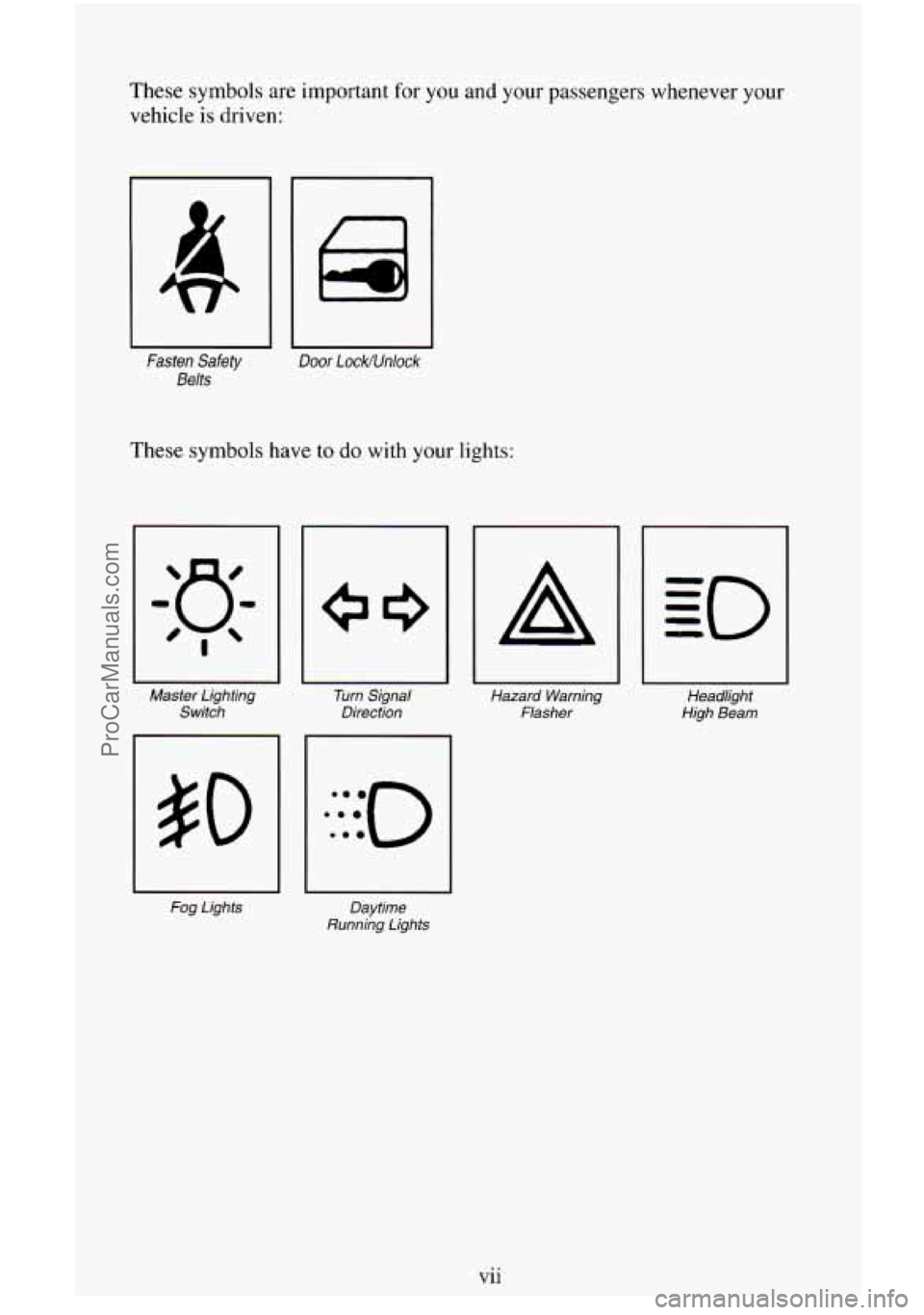
These symbols are important for you and your passengers whenever your
vehicle
is driven:
Fasten Safety Door LocWUnlock
Belts
These symbols have to do with your lights:
Master Lighting
Switch
-
Turn Signal Direction Hazard Warning
Flasher
Fog Lights Daytime
Running Lights
Vii
Headlight
High Beam
ProCarManuals.com
Page 13 of 486
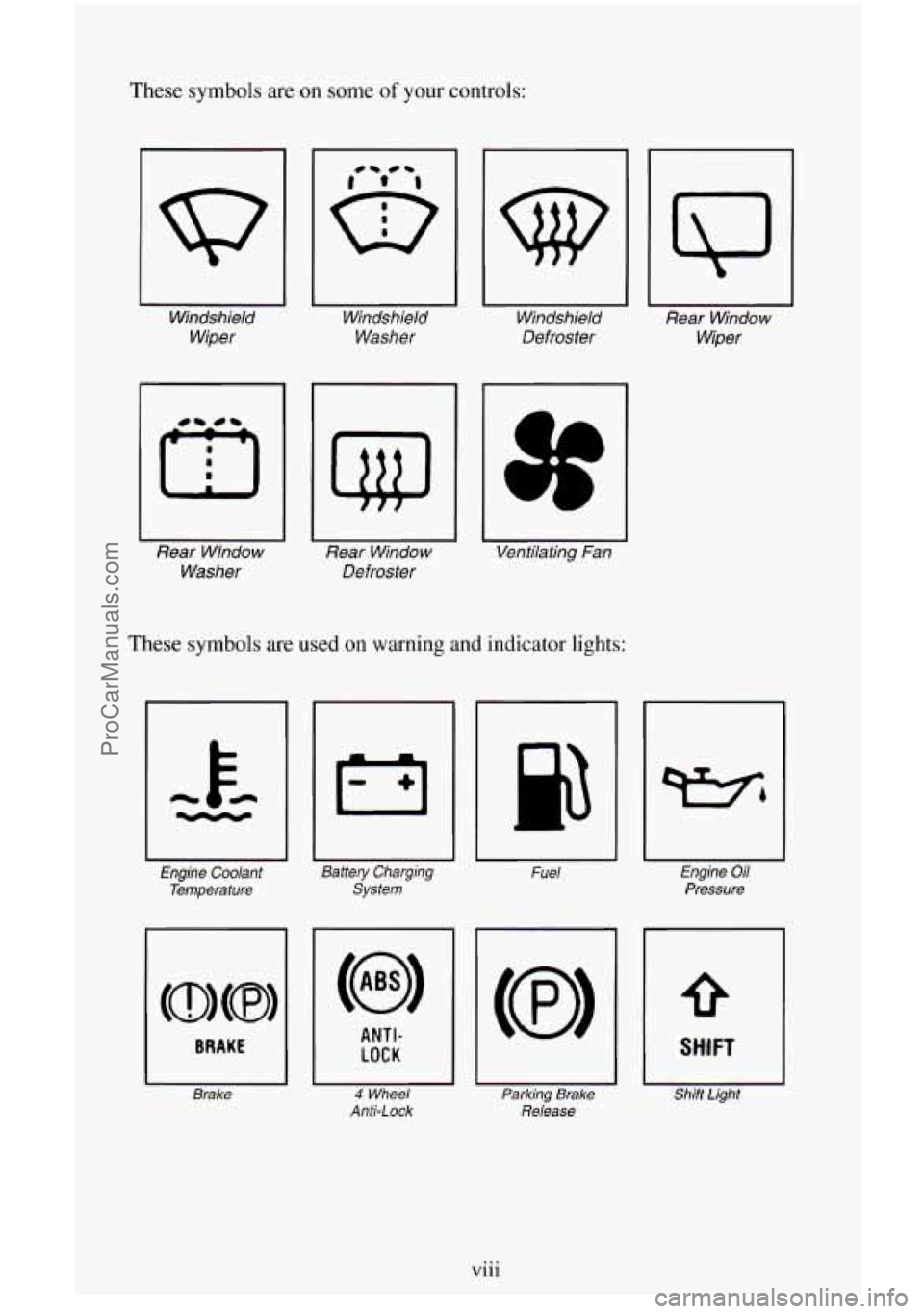
These symbols are on some of your controls:
I
Windshield
Wiper Windshield
Washer
Rear Wlndow Washer
I
Rear Window
Defroster
w
I
Windshield
Defroster
U
Ventilating Fan
These symbols are used on warning and indicator lights:
I -k 4cccy
Engine Coolant
Temperature
BRAKE
I Brake
I I
Battery Charging
System
ANTI-
I LOCK
I I 4 Wheel
Anti-Lock
Fuel
Parking Brake Release
I\J
Rear Window
Wiper
Engine Oil
Pressure
SHIFT
Shift Light
viii
. ~ .. ProCarManuals.com
Page 14 of 486
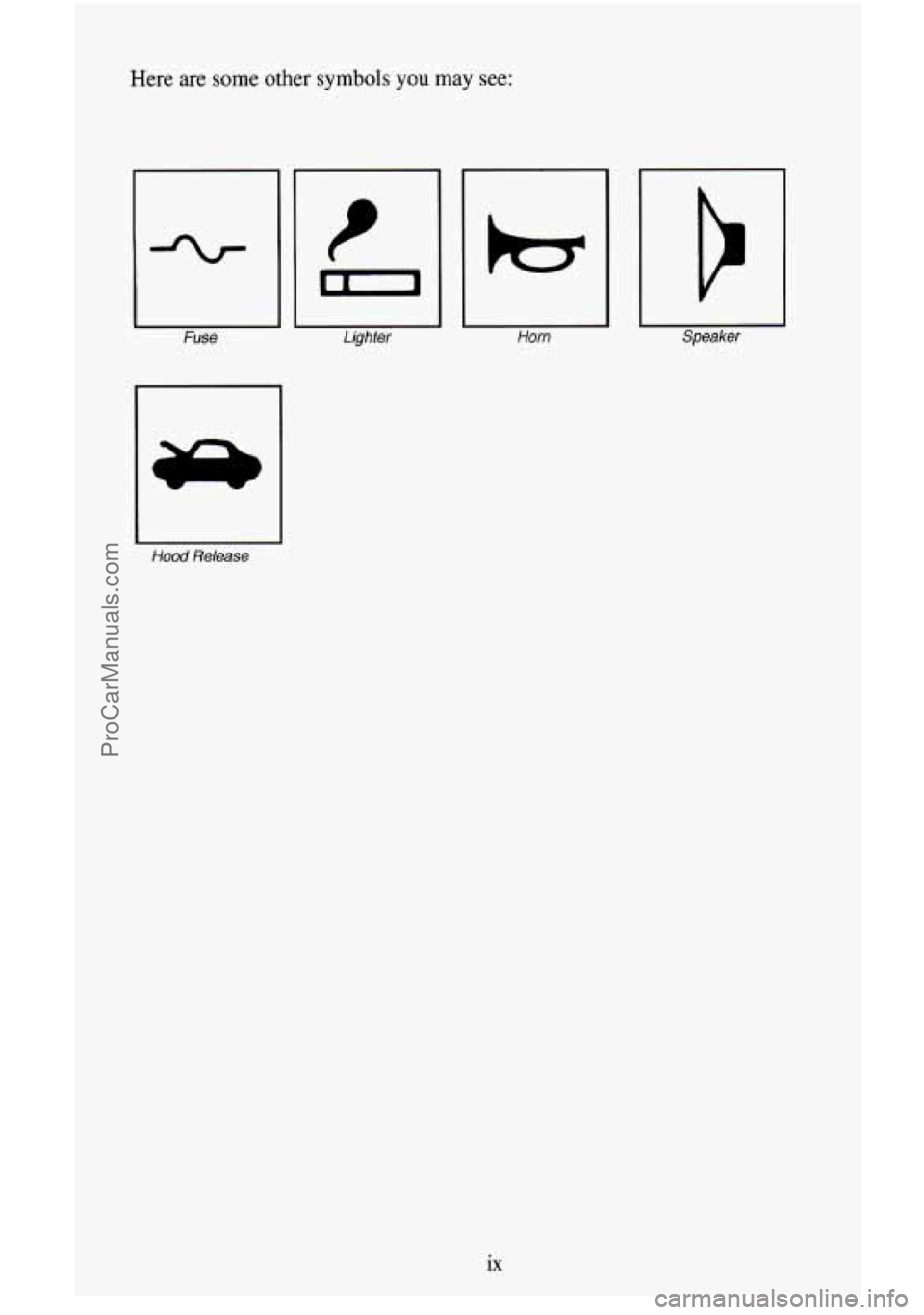
Here are some other symbols you may see:
H Fuse
El Hood Release Lighter
Horn Er Speaker
ix
ProCarManuals.com
Page 23 of 486
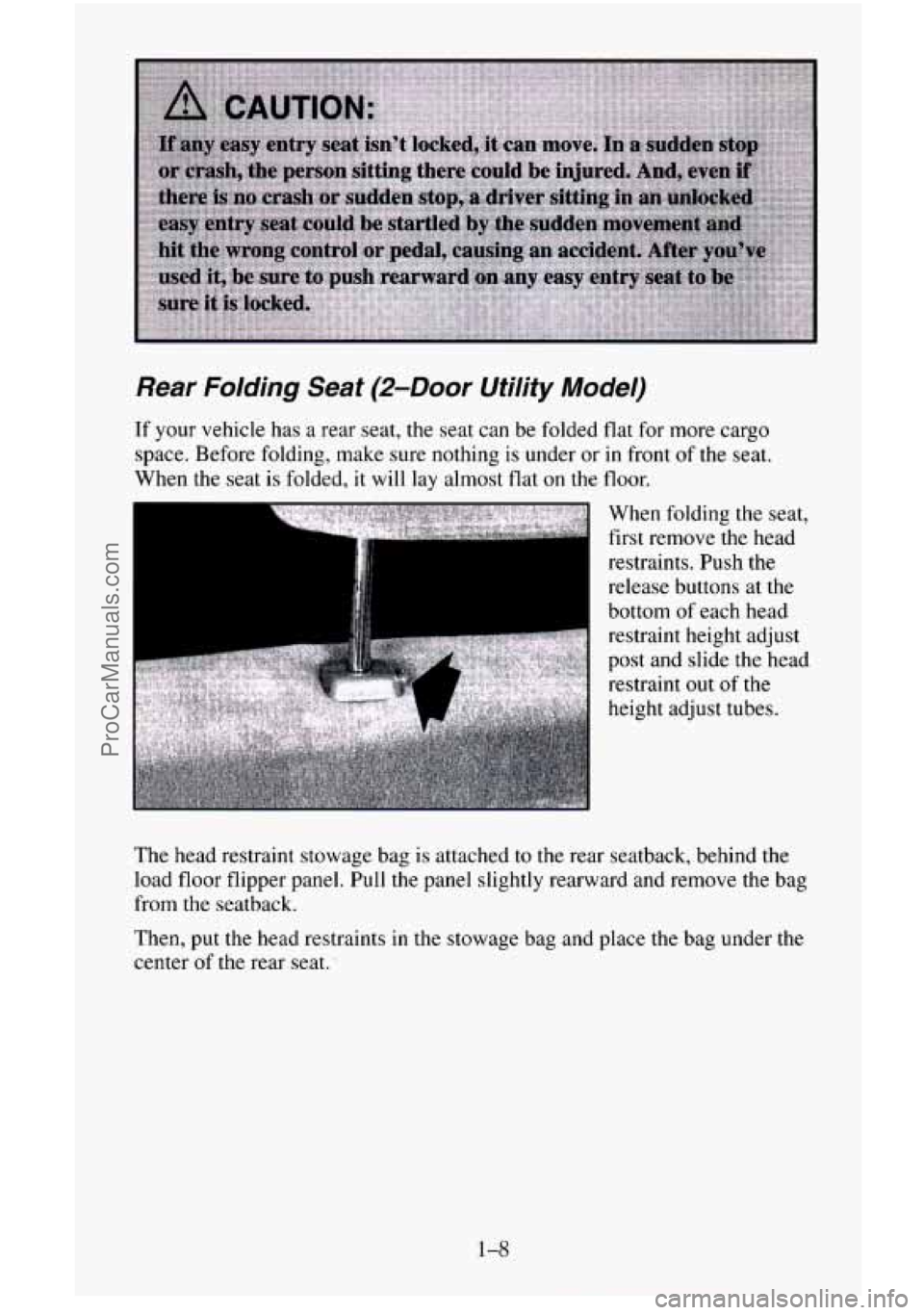
Rear Folding Seat (2-Door Utility Model)
If your vehicle has a rear seat, the seat can be folded flat for more cargo
space. Before folding, make sure nothing
is under or in front of the seat.
When the seat is folded, it will
lay almost flat on the floor.
i
When folding the seat,
first remove the head
restraints.
Push the
release buttons at the
bottom of each head
restraint height adjust
post and slide the head
restraint out
of the
height adjust tubes.
The head restraint stowage bag is attached to the rear seatback, behind the
load
floor flipper panel. Pull the panel slightly rearward and remove the bag
from the seatback.
Then, put the head restraints in
the stowage bag and place the bag under the
center of the rear seat.
1-8
ProCarManuals.com
Page 33 of 486
Safety Belts: They’re for Everyone
This part of the manual tells you how to use safety belts properly. It also
tells you some things you should not do with safety belts.
And it explains the Supplemental Inflatable Restraint, or “air bag” system.
t
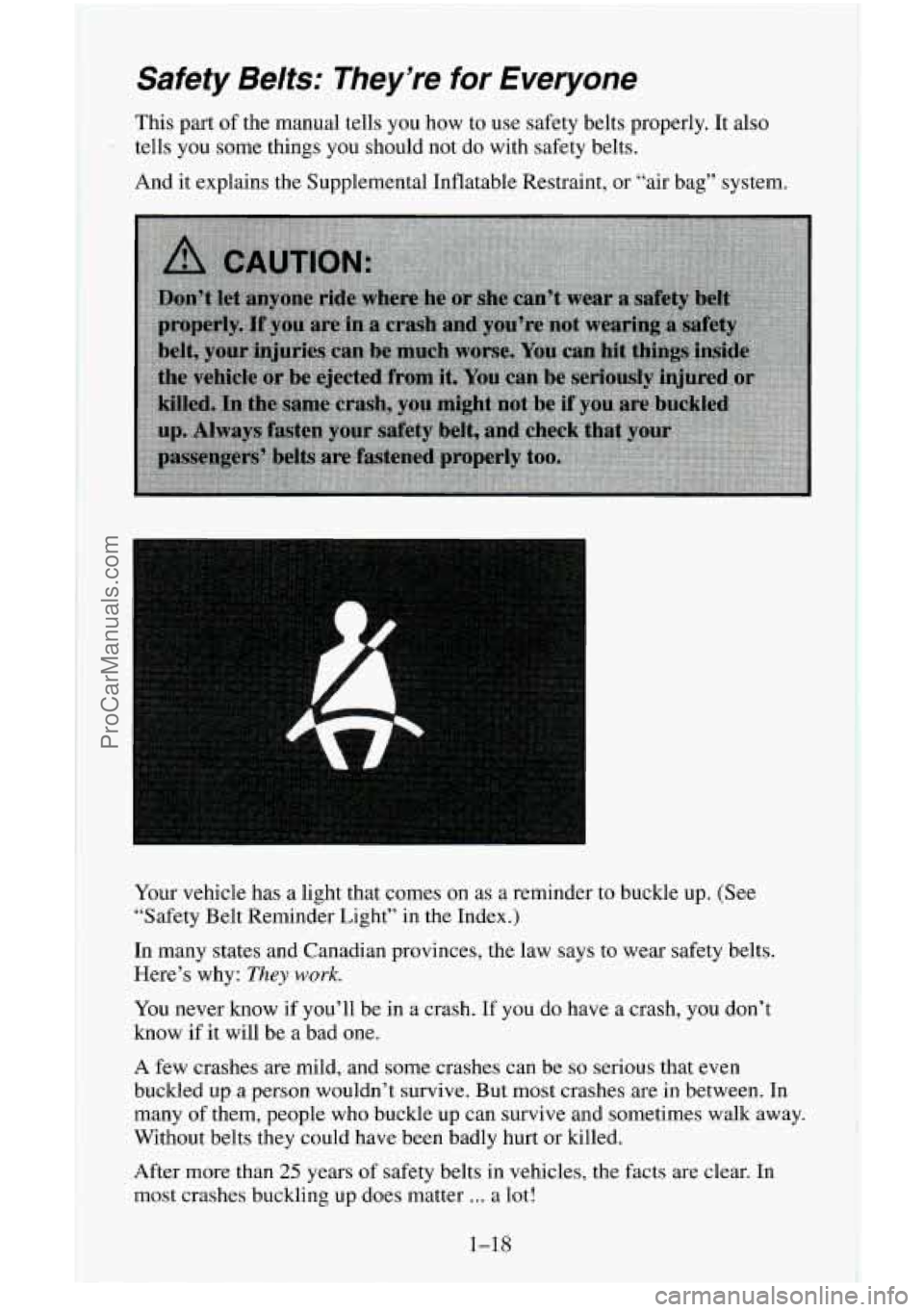
Your vehicle has a light that comes on as a reminder to buckle up. (See
“Safety Belt Reminder Light” in
the Index.)
In many states and Canadian provinces, the law says to wear safety belts.
Here’s why:
They work.
You never know if you’ll be in a crash. If you do have a crash, you don’t
know if it will be a bad one.
A few crashes
are mild, and some crashes can be so serious that even
buckled up
a person wouldn’t survive. But most crashes are in between. In
many of them, people who buckle up can survive and sometimes walk away.
Without belts they could have been badly hurt or killed.
After more than
25 years of safety belts in vehicles, the facts are clear. In
most crashes buckling up does matter
... a lot!
1-18
ProCarManuals.com
Page 45 of 486
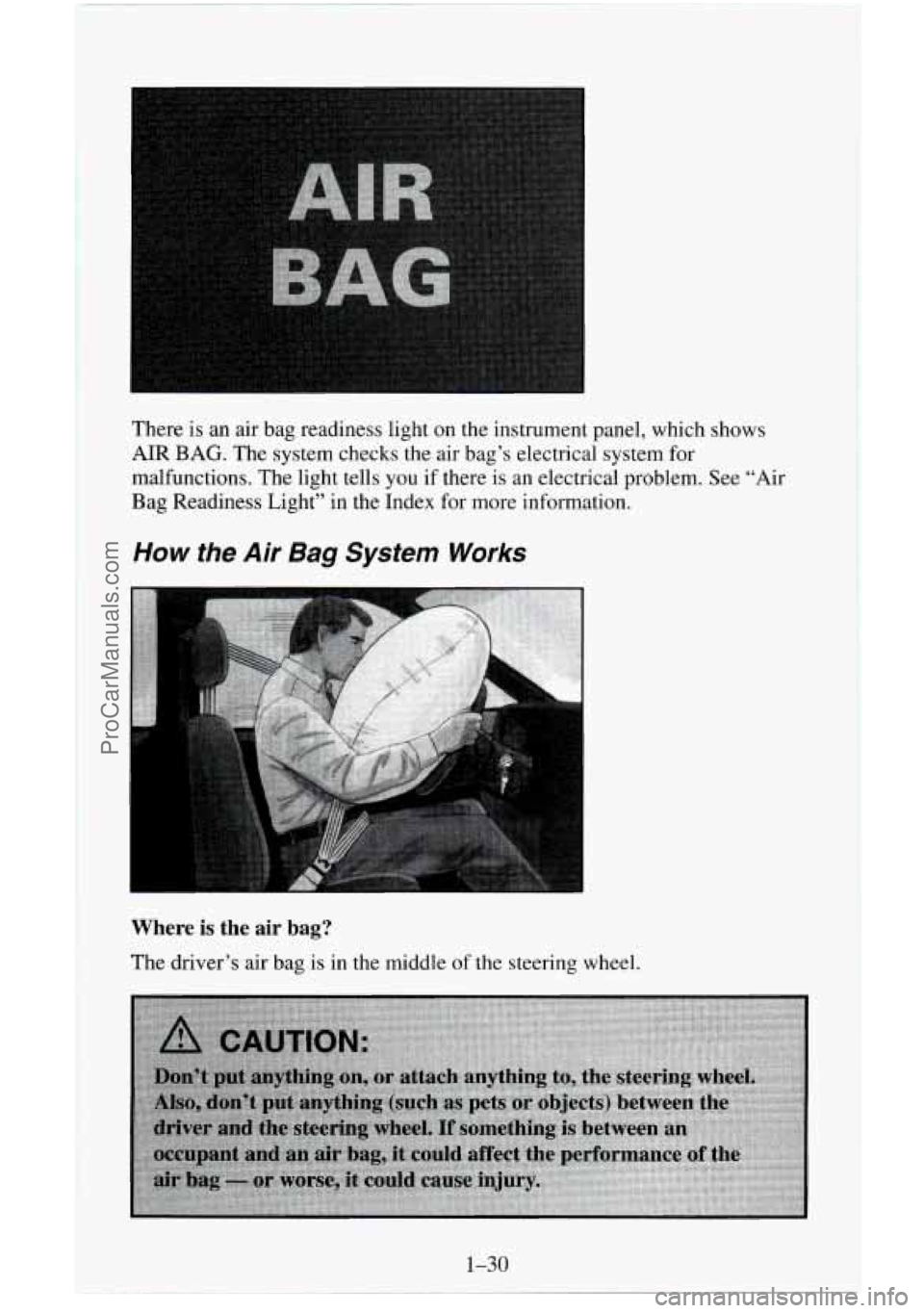
There is an air bag readiness light on the instrument panel, which shows
AIR
BAG. The system checks the air bag’s electrical system for
malfunctions. The light tells you if there is an electrical problem. See “Air
Bag Readiness Light” in the Index for more information.
How the Air Bag System Works
Where is the air bag?
The driver’s air bag is in the middle of the steering wheel.
1-30
ProCarManuals.com
Page 78 of 486
Parking at Night
Park in a lighted spot, close all windows and lock your vehicle. Remember
to keep your valuables out
of sight. Put them in a storage area, or take them
with
you.
Parking Lots
If you park in a lot where someone will be watching your vehicle, it’s best
to lock it up and take your keys. But what if you have to leave your ignition
key? What if you have
to leave something valuable in your vehicle‘?
0 Put your valuables in a storage area, like your glove box.
Lock all the doors except the driver’s.
New Vehicle “Break-ln”
NOTICE:
Your modern vehicle doesn’t need an elaborate “break-in.” But
it will perform better in the long run if you follow these
guidelines:
0 Keep your speed at 55 mph (88 km/h) or less for the first 500
miles (SO4 km).
Don’t drive at any one speed - fast or slow - for the first
500 miles (804 km). Don’t make full-throttle starts.
Avoid making hard stops for the first 200 miles (322 km) or
so. During this time your new brake linings aren’t yet broken
in. Hard stops with new linings can mean premature wear and
earlier replacement. Follow this “breaking-in” guideline
every time you get new brake linings.
Don’t tow a trailer during “break-in.” See “Towing a Trailer”
in the Index for more information.
2-1 3
ProCarManuals.com
Page 82 of 486
NOTICE:
Your engine is designed to work with the electronics in your
vehicle.
If you add electrical parts or accessories, you could
change the way the fuel injection system operates. Before addin\
g electrical equipment, check with your dealer.
If you don’t, your
engine might not perform properly.
If you ever have to have your vehicle towed, see the part of this
manual that tells how to do it without damaging your vehicle.
See “Towing Your Vehicle” in the Index.
Driving Through Deep Standing Water
NOTICE:
If you drive too quickly through deep puddles or standing water,
water can come in through your engine’s air intake and badl\
y
damage your engine. Never drive through water that is slightly \
lower than the underbody of your vehicle. If you can’t avoid
deep puddles
or standing water, drive through them very slowly.
Driving In Snow (Diesel Engines)
When driving in a heavy snowstorm or in swirling snow with a diesel
engine, snow can get into the air intake system.
If you keep driving in these
conditions the air cleaner may get plugged, causing black smoke and loss
of
power. In an emergency, if the air cleaner gets plugged with snow, you can
remove the air cleaner. Then, drive to
a place of safety as soon as possible
and put
the air cleaner back on.
Starting Your Diesel Engine
Your diesel engine starts differently than a gasoline engine.
1. Move your shift lever to PARK (P) or NEUTRAL (N). Your engine
won’t start
in any other position - that’s a safety feature. To restart
when you’re already moving, use NEUTRAL
(N) only.
2-1 5
ProCarManuals.com
Page 83 of 486
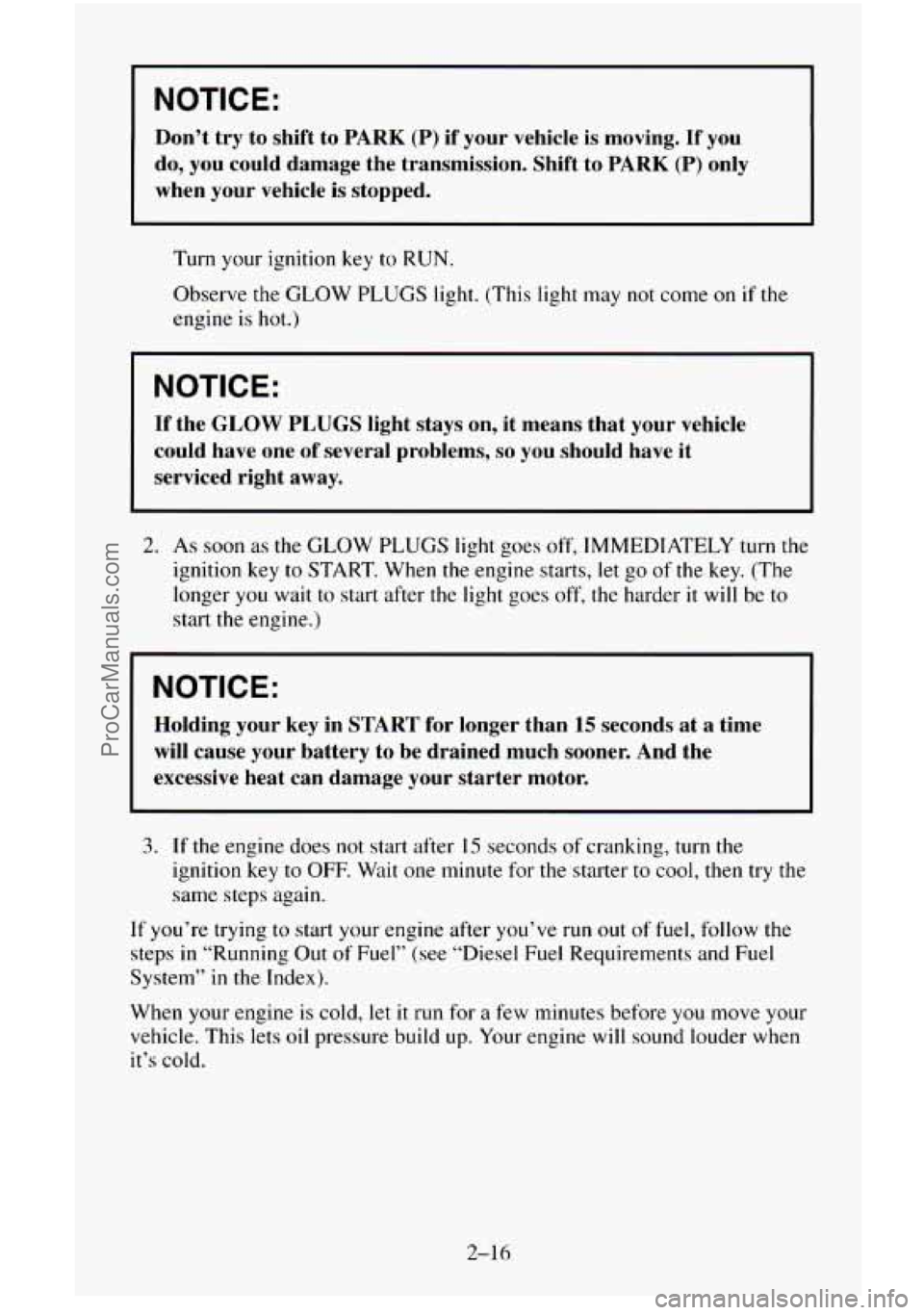
NOTICE:
Don’t try to shift to PARK (P) if your vehicle is moving. If you
do, you could damage the transmission. Shift to PARK
(P) only
when your vehicle is stopped.
Turn your ignition
key to RUN.
Observe the GLOW PLUGS light. (This light may not come on if the
engine is hot.)
NOTICE:
If the GLOW PLUGS light stays on, it means that your vehicle
could have one
of several problems, so you should have it
serviced right
away.
2. As soon as the GLOW PLUGS light goes off, IMMEDIATELY turn the
ignition key to START. When the engine starts, let go of the key. (The
longer you wait to start after the light goes off, the harder it will be to
start the engine.)
NOTICE:
Holding your key in START for longer than 15 seconds at a time
will cause your battery to be drained much sooner. And the
excessive heat can damage your starter motor.
3. If the engine does not start after 15 seconds of cranking, turn the
ignition key
to OFF. Wait one minute for the starter to cool, then try the
same steps again.
If you’re trying to start your engine after you’ve run out of fuel, follow the
steps
in “Running Out of Fuel” (see “Diesel Fuel Requirements and Fuel
System”
in the Index).
When your engine is cold, let it
run for a few minutes before you move your
vehicle. This lets oil pressure build up. Your engine will sound louder when
it’s cold.
2-16
ProCarManuals.com
Page 85 of 486
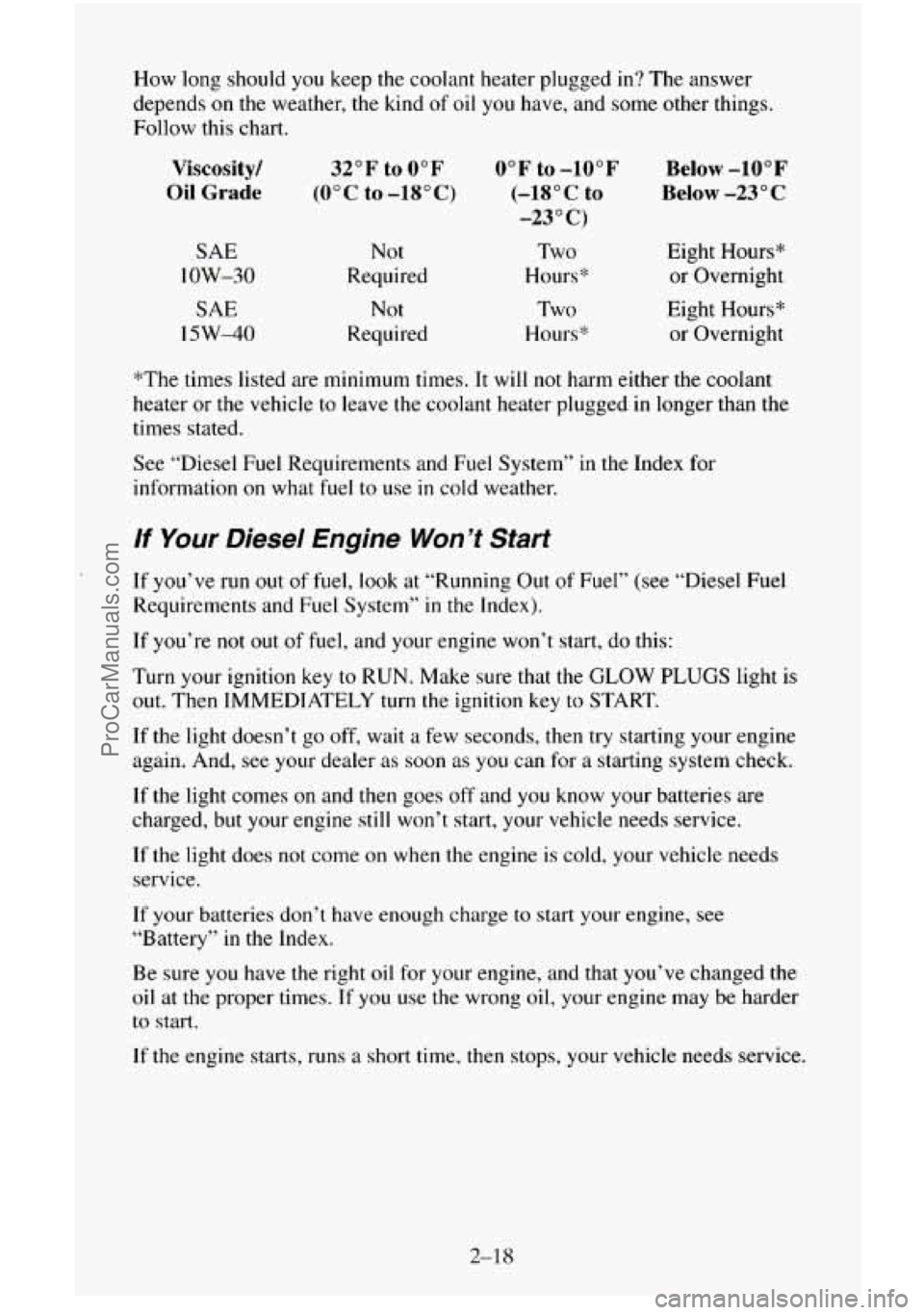
How long should you keep the coolant heater plugged in? The answer
depends
on the weather, the kind of oil you have, and some other things.
Follow this chart.
Viscosity/
Oil Grade
SAE
low-30
SAE
15W40
32°F to 0°F
(OOC to -18OC)
Not
Required
Not
Required
0°F to -10°F
(-18” c to
-23 O C)
Two
Hours*
Two
Hours*
Below -10°F
Below
-23 O C
Eight Hours*
or Overnight
Eight Hours*
or Overnight
*The times listed are minimum times.
It will not harm either the coolant
heater or
the vehicle to leave the coolant heater plugged in longer than the
times stated.
See “Diesel Fuel Requirements and
Fuel System” in the Index for
information
on what fuel to use in cold weather.
lf Your Diesel Engine Won’t Start
If you’ve run out of fuel, look at “Running Out of Fuel” (see “Diesel Fuel
Requirements and Fuel System” in the Index).
If you’re
not out of fuel, and your engine won’t start, do this:
Turn your ignition
key to RUN. Make sure that the GLOW PLUGS light is
out. Then IMMEDIATELY
turn the ignition key to START.
If the light doesn’t go off, wait a few seconds, then try starting your engine
again. And, see your dealer
as soon as you can for a starting system check.
If the light comes
on and then goes off and you know your batteries are
charged, but your engine still
won’t start, your vehicle needs service.
If the light does
not come on when the engine is cold, your vehicle needs
service.
If your batteries don’t have enough charge to start your engine, see
“Battery”
in the Index.
Be sure you have the right oil for your engine, and that you’ve changed
the
oil at the proper times. If you use the wrong oil, your engine may be harder
to start.
If the engine starts, runs a short time, then stops, your vehicle needs service.
2-18
ProCarManuals.com