steering CHEVROLET SUBURBAN 1996 Owner's Manual
[x] Cancel search | Manufacturer: CHEVROLET, Model Year: 1996, Model line: SUBURBAN, Model: CHEVROLET SUBURBAN 1996Pages: 486, PDF Size: 26.58 MB
Page 235 of 486
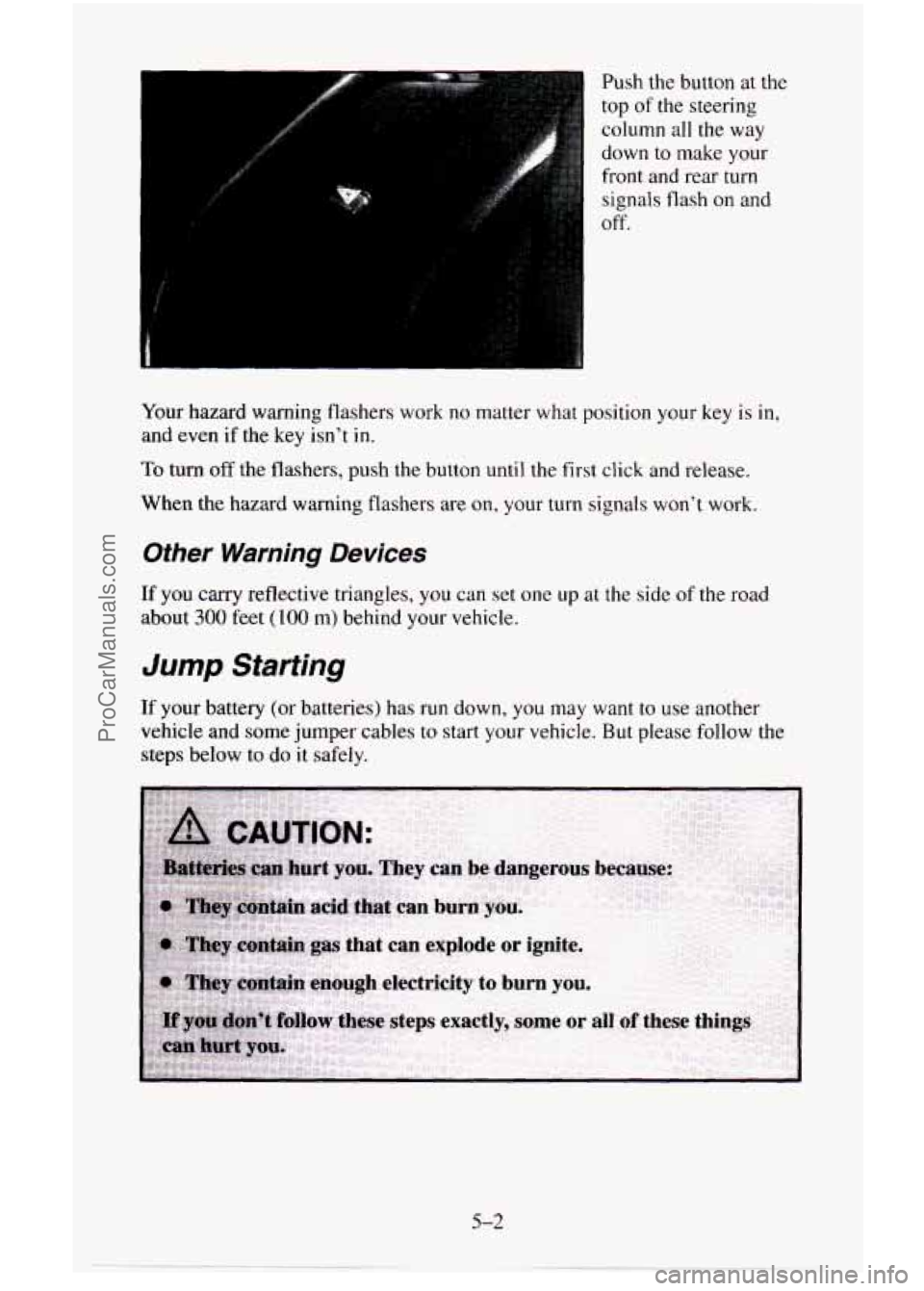
Push the button at the
top
of the steering
column all the way
down to make your
front and rear turn
signals flash on and
off.
Your hazard warning flashers work
no matter what position your key is in,
and even if the key isn’t
in.
To turn off the flashers, push the button until the first click and release.
When the hazard warning flashers are
on, your turn signals won’t work.
Other Warning Devices
If you carry reflective triangles, you can set one up at the side of the road
about 300 feet (100 m) behind your vehicle.
Jump Starting
If your battery (or batteries) has run down, you may want to use another
vehicle and some jumper cables
to start your vehicle. But please follow the
steps below to do it safely.
5-2
ProCarManuals.com
Page 240 of 486
To wing Your Vehicle
Try to have your GM dealer or a professional towing service tow your
vehicle. They can provide the right equipment and know how
to tow it
without damage.
If your vehicle has been changed since it was factory-new, by adding such
things like fog lamps, aero skirting, or special tires and wheels, these things
could be damaged during towing.
Before you do anything, turn on the hazard warning flashers.
When you call, tell the towing service:
0 That your vehicle has rear-wheel drive, or that it has the four-wheel
drive option.
The make, model, and year of your vehicle.
0 Whether you can move the shift lever for the transmission and transfer
case, if you have one.
0 If there was an accident, what was damaged.
When your vehicle is being towed, have
the ignition key off. The steering
wheel should be clamped
in a straight-ahead position, with a clamping
device designed for towing service.
Do not use the vehicle’s steering
column
lock for this. The transmission and transfer case, if you have one,
should be in NEUTRAL (N) and the parking brake released.
5-7
ProCarManuals.com
Page 257 of 486
h
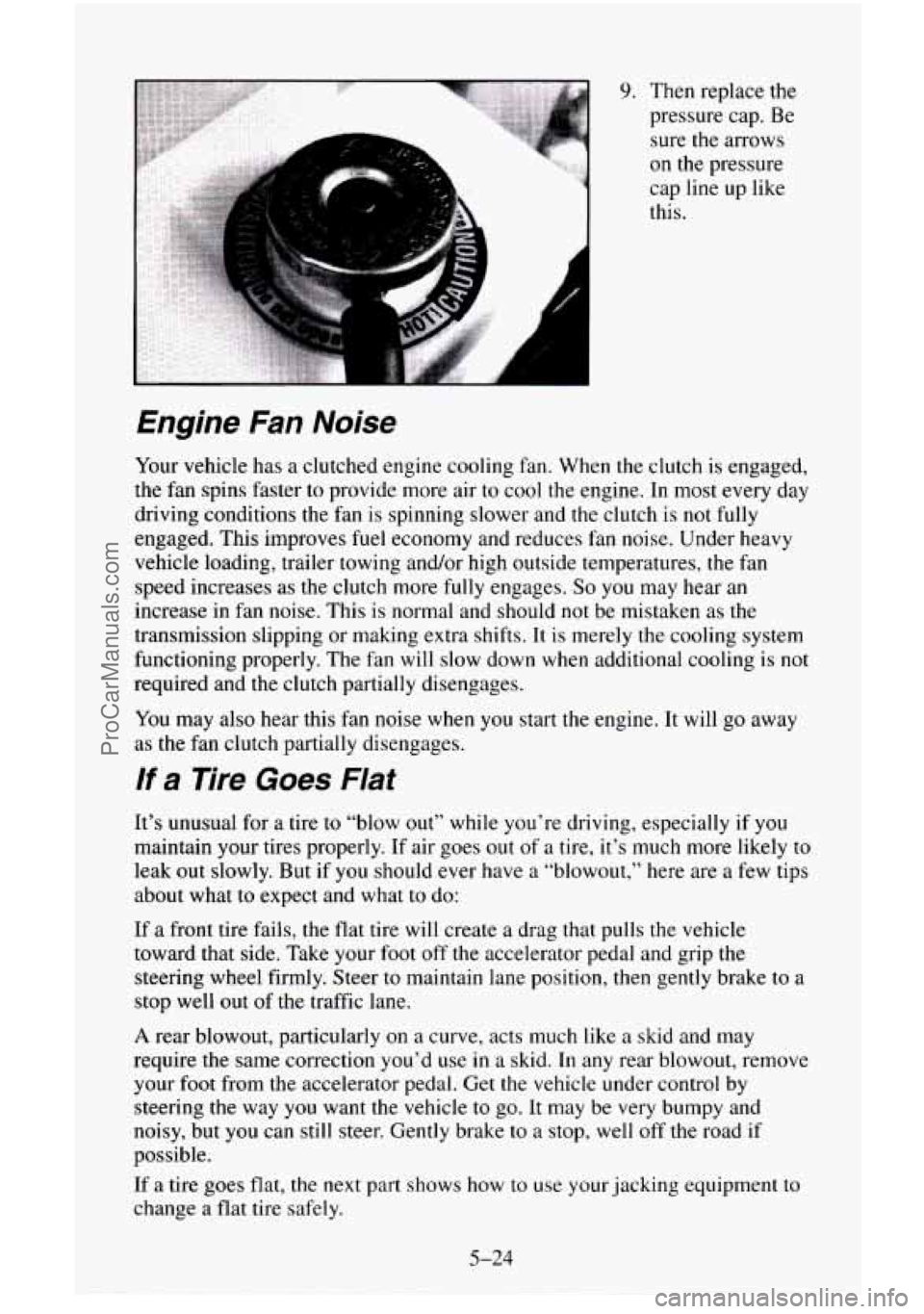
9. Then replace the
pressure cap. Be
sure the arrows
on the pressure
cap line up like
this.
Engine Fan Noise
Your vehicle has a clutched engine cooling fan. When the clutch is engaged,
the fan spins faster to provide more air to cool the engine. In most every day
driving conditions the fan
is spinning slower and the clutch is not fully
engaged. This improves fuel economy and reduces fan noise. Under heavy
vehicle loading, trailer towing and/or high outside temperatures,
the fan
speed increases as the clutch more
fully engages. So you may hear an
increase in fan noise. This is normal and should not be mistaken as the
transmission slipping
or making extra shifts. It is merely the cooling system
functioning properly. The fan will slow down when additional cooling is not
required and the clutch partially disengages.
You may also hear this fan noise when you start the engine. It will go away
as the fan clutch partially disengages.
If a Tire Goes Flat
It’s unusual for a tire to “blow out” while you’re driving, especially if you
maintain your tires properly. If air goes out of a tire, it’s much more likely to
leak out slowly. But if you should ever have a “blowout,” here are a few tips
about what
to expect and what to do:
If a front tire fails, the flat tire will create a drag that pulls the vehicle
toward that side. Take your foot off the accelerator pedal and grip the
steering wheel firmly. Steer
to maintain lane position, then gently brake to a
stop well out of the traffic lane.
A rear blowout, particularly on a curve, acts much like a skid and may
require the same correction you’d
use in a skid. In any rear blowout, remove
your foot from
the accelerator pedal. Get the vehicle under control by
steering the way
you want the vehicle to go. It may be very bumpy and
noisy, but you can still steer. Gently brake to a stop, well
off the road if
possible.
If a tire goes flat, the next part shows how to use your jacking equipment to
change a flat tire safely.
5-24
ProCarManuals.com
Page 274 of 486
If You’re Stuck: In Sand, Mud, /ce or Snow
What you don’t want to do when your vehicle is stuck is to spin your wheels
too fast. The method known as “rocking” can help you get out when you’re
stuck, but you must use caution.
I NOTICE:
Spinning your wheels can destroy parts of your vehicle as well as
the tires. If you spin the wheels too fast while shifting you\
r
transmission back and forth, you can destroy your transmission. \
For information about using tire chains on your vehicle, see “Tire Chains”
in the Index.
Rocking your vehicle to get it out:
First, turn your steering wheel left and right. That will clear the area around
your front wheels. Then shift back and forth between REVERSE (R) and a
forward gear (or with a manual transmission, between FIRST
(1) or
SECOND
(2) gear and REVERSE), spinning the wheels as little as possible.
Release the accelerator pedal while you shift, and press lightly on the
accelerator pedal when the transmission
is in gear. If that doesn’t get you
out after a few tries, you may need to be towed out. Or, you can use your
recovery hooks,
if your vehicle has them. If you do need to be towed out,
see “Towing Your Vehicle” in the Index.
5-41
ProCarManuals.com
Page 316 of 486
Power Steering Fluid
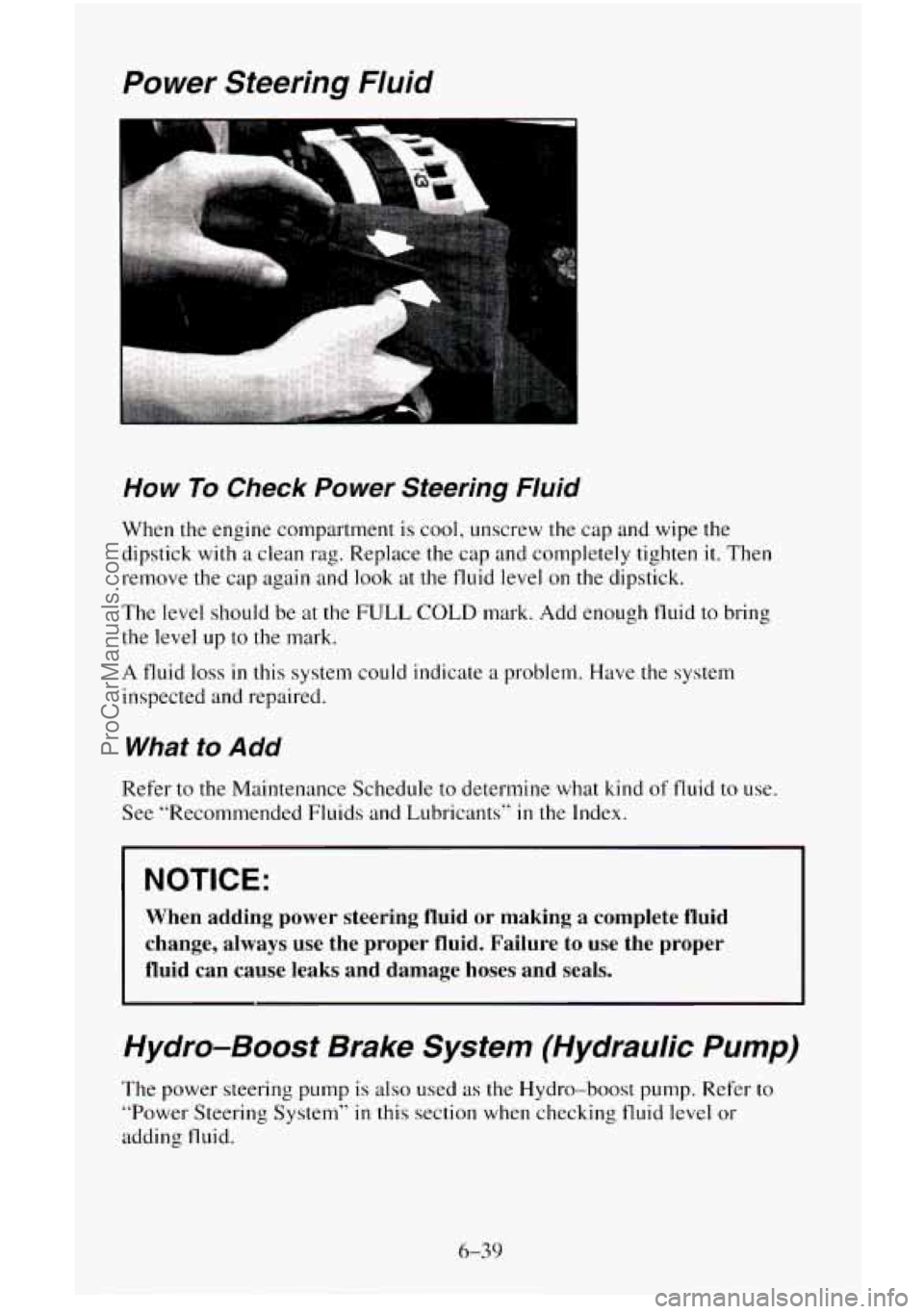
How To Check Power Steering Fluid
When the engine compartment is cool, unscrew the cap and wipe the
dipstick
with a clean rag. Replace the cap and completely tighten it. Then
remove the cap again
and look at the fluid level on the dipstick.
The level should be at the FULL COLD mark. Add enough fluid to bring
the level up
to the mark.
A fluid
loss in this system could indicate a problem. Have the system
inspected and repaired.
What to Add
Refer to the Maintenance Schedule to determine what kind of fluid to use.
See “Recommended Fluids and Lubricants”
in the Index.
I
I NOTICE:
When adding power steering fluid or making a complete fluid
change, always use the proper fluid. Failure to use the proper\
fluid can cause leaks and damage hoses and seals.
Hydro-Boost Brake System (Hydraulic Pump)
The power steering pump is also used as the Hydro-boost pump. Refer to
“Power Steering System” in this section when checking fluid level or
adding fluid.
6-39
ProCarManuals.com
Page 376 of 486
Maintenance Schedule I - Gasoline Engines With
Light Duty Emissions
3,000 Miles (5 000 km)
0 Change engine oil and filter (or every 3 months, whichever occurs
first).
An Emission Control Service.
0 Lubricate the front suspension, king pin bushings, steering linkage,
transmission shift linkage, transfer case shift linkage, parking brake
cable guides, rear driveline center splines, front axle propshaft splines,
brake pedal springs and clutch pedal springs. Ball joints and king pin
bushings should not be lubricated unless their temperature
is 10" F
(-1 2" C), or higher. When weather is cold, let the ball joints and king
pin bushings warm up before lubrication or
they could be damaged.
Perform each of the listed lubrication service items at this mileage
interval (or every
6 months, whichever occurs first).
0 Check readfront axle fluid level and add fluid as needed. Check
constant velocity joints and axle seals for leaking.
**
I DATE I ACTUALMILEAGE I SERVICED BY: I
6,000 Miles (10 000 km)
0 Change engine oil and filter (or every 3 months, whichever occurs
first).
An EInission Control Service.
0 Lubricate the front suspension, king pin bushings, steering linkage,
transmission shift linkage, transfer case shift linkage, parking brake
cable guides, rear driveline center splines, front axle propshaft splines,
brake pedal springs and clutch pedal springs. Ball joints and king pin
bushings should not be lubricated unless their temperature is
10" F
(-12" C), or higher. When weather is cold, let the ball joints and king
pin bushings warm up before lubrication or they could be damaged.
Perform each
of the listed lubrication service items at this mileage
interval (or every
6 months, whichever occurs first).
(Continued)
7-13
ProCarManuals.com
Page 377 of 486
Maintenance Schedule I - Gasoline Engines With
Light Duty Emissions
(Continued)
0 Check readfront axle tluid level and add fluid as needed. Check
constant
velocity joints and axle seals for leaking. **
0 Rotate tires. See “Tire Inspection and Rotation’’ in the Index for proper
rotation pattern and additional information.
DATE SERVICED BY: ACTUAL MILEAGE
9,000 Miles (15 000 km)
0 Change engine oil and filter (or every 3 months, whichever occurs
first).
An Emission Control Service.
0 Lubricate the front suspension, king pin bushings, steering linkage,
transmission shift linkage, transfer case shift linkage, parking brake
cable guides, rear driveline center splines, front axle propshaft splines,
brake pedal springs and clutch pedal springs.
Ball joints and king pin
bushings should
not be lubricated unless their temperature is IO” F
(-1 2” C), or higher. When weather is cold, let the ball joints and king
pin bushings warm
up before lubrication or they could be damaged.
Perform each
of the listed lubrication service items at this mileage
interval (or every
6 months, whichever occurs first).
0 Check readfront axle fluid level and add tluid as needed. Check
constant velocity joints and axle seals for leaking.
**
DATE
SERVICED BY: ACTUAL MILEAGE
a
7-1 4
~~ ProCarManuals.com
Page 378 of 486
I Maintenance Schedule I - Gasoline Engines With I
I Light Duty Emissions
12,000 Miles (20 000 km)
Change engine oil and filter (or every 3 months, whichever occurs
first).
An Emission Control Service.
0 Lubricate the front suspension, king pin bushings, steering linkage,
transmission shift linkage, transfer case shift linkage, parking brake
cable guides, rear driveline center splines, front axle propshaft splines,
brake pedal springs and clutch pedal springs. Ball joints and king pin
bushings should not be lubricated unless their temperature is
10" F
(-12" C), or higher. When weather is cold, let the ball joints and king
pin bushings warm
up before lubrication or they could be damaged.
Perform each of
the listed lubrication service items at this mileage
interval (or every
6 months, whichever occurs first).
0 Check readfront axle fluid level and add fluid as needed. Check
constant velocity joints and axle seals for leaking.
**
DATE SERVICED BY ACTUAL MILEAGE
15,000 Miles (25 000 km)
17 Change engine oil and filter (or every 3 months, whichever occurs
first).
An Emission Control Service.
0 Lubricate the front suspension, king pin bushings, steering linkage,
transmission shift linkage, transfer case shift linkage, parking brake
cable guides, rear driveline center splines, front axle propshaft splines,
brake pedal springs and clutch pedal springs. Ball joints and king pin
bushings should
not be lubricated unless their temperature is 10" F
(-1 2" C), or higher. When weather is cold, let the ball joints and king
pin bushings warm up before lubrication or
they could be damaged.
Perform each of the listed lubrication service items at this mileage
interval (or every
6 months, whichever occurs first).
0 Inspect air cleaner filter if you are driving in dusty conditions. Replace'
filter if necessary.
An Emission Control Service.
(Continued)
7-1 5
-_ ProCarManuals.com
Page 379 of 486
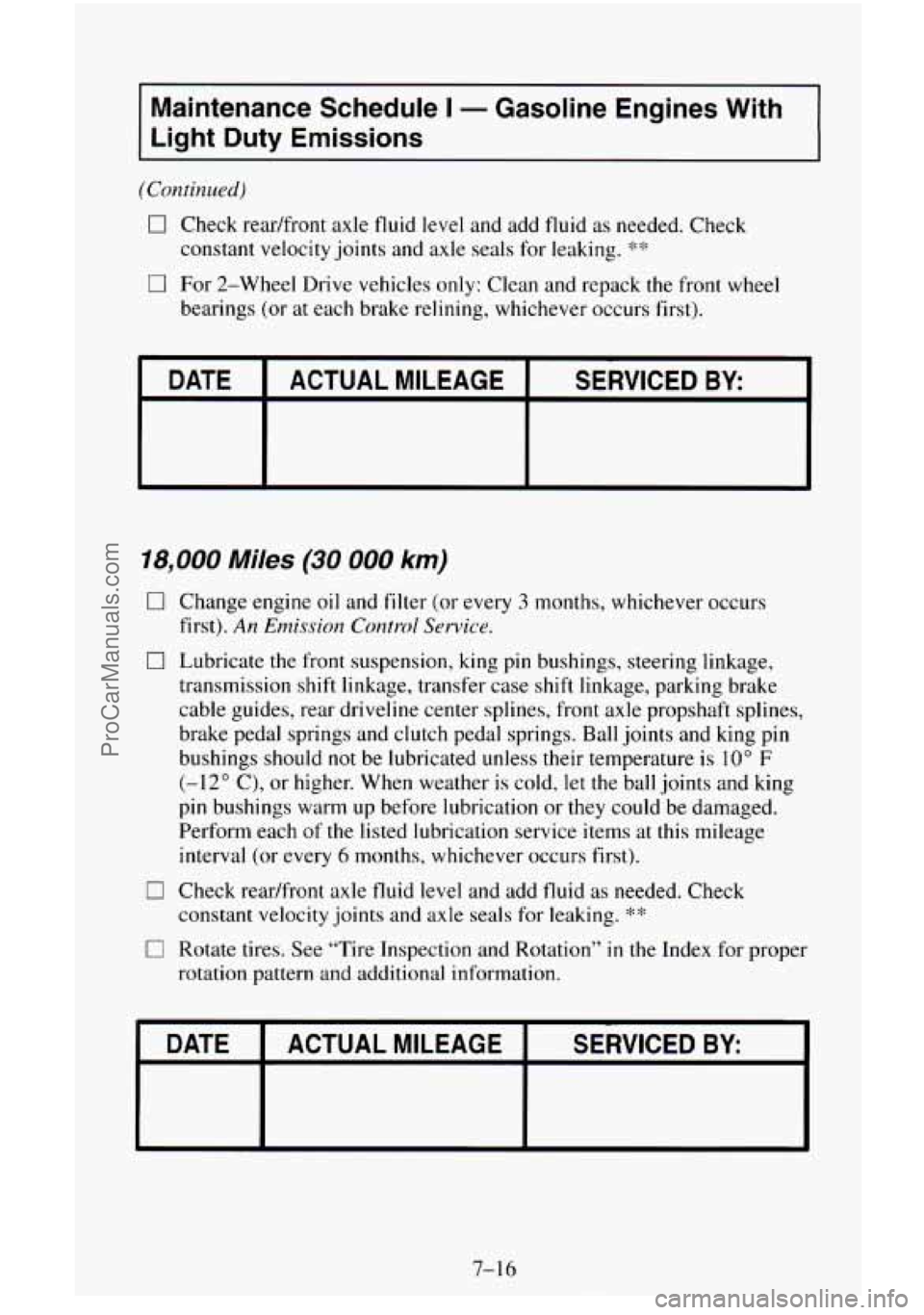
Maintenance Schedule I - Gasoline Engines With
Light Duty Emissions
(Continued)
0 Check readfront axle fluid level and add fluid as needed. Check
constant velocity joints and axle seals for leaking.
:w:
0 For 2-Wheel Drive vehicles only: Clean and repack the front wheel
bearings (or at each brake relining, whichever occurs first).
DATE ACTUAL MILEAGE
SERVICED BY: L
-
18,000 Mi/es (30 000 km)
0 Change engine oil and filter (or every 3 months, whichever occurs
first).
An Emission Control Service.
0 Lubricate the front suspension, king pin bushings, steering linkage,
transmission shift linkage, transfer case shift linkage, parking brake
cable guides, rear driveline center splines, front axle propshaft splines,
brake pedal springs and clutch pedal springs. Ball joints and king pin
bushings
should not be lubricated unless their temperature is 10” F
(-12” C), or higher. When weather is cold, let the ball joints and king
pin bushings warm up before lubrication or they could be damaged.
Perform each
of the listed lubrication service items at this mileage
interval (or every
6 months, whichever occurs first).
0 Check readfront axle fluid level and add fluid as needed. Check
constant velocity joints and axle seals for leaking.
**
0 Rotate tires. See “Tire Inspection and Rotation” in the Index for proper
rotation pattern and additional information.
DATE
SERVICED BY: ACTUAL MILEAGE
I
ProCarManuals.com
Page 380 of 486
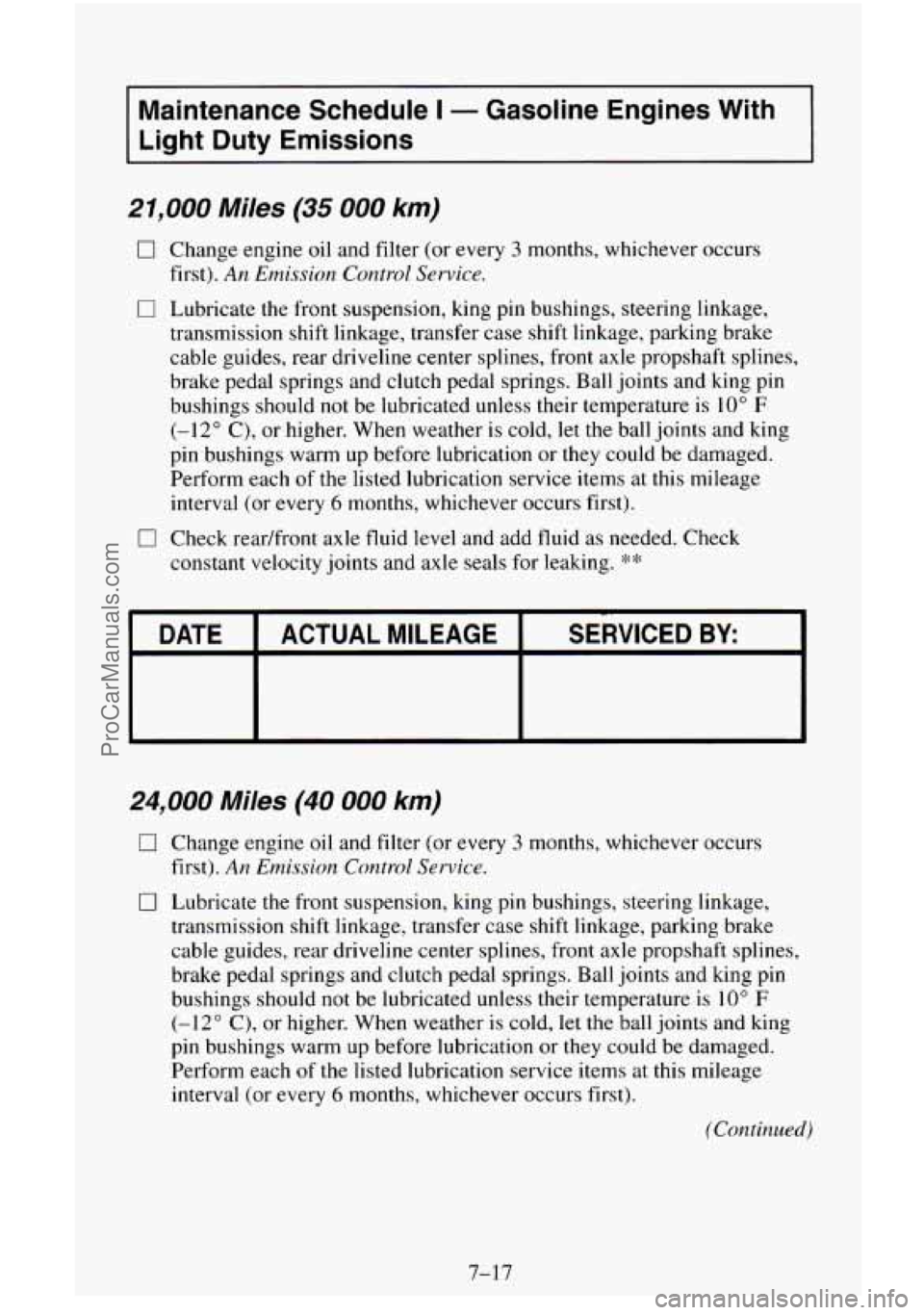
Maintenance Schedule I - Gasoline Engines With
Light Duty Emissions
21,000 Miles (35 000 km)
0 Change engine oil and filter (or every 3 months, whichever occurs
first).
An Emission Control Service.
0 Lubricate the front suspension, king pin bushings, steering linkage,
transmission
shift linkage, transfer case shift linkage, parking brake
cable guides, rear driveline center splines, front axle propshaft splines,
brake pedal springs and clutch pedal springs. Ball joints and king pin
bushings should not be lubricated unless their temperature is
10" F
(-12" C), or higher. When weather is cold, let the ball joints and king
pin bushings warm
up before lubrication or they could be damaged.
Perform each
of the listed lubrication service items at this mileage
interval (or every
6 months, whichever occurs first).
0 Check readfront axle fluid level and add fluid as needed. Check
constant velocity joints and axle seals for leaking.
*:ic
DATE I ACTUALMILEAGE I SERVICED BY: I
24,000 Miles (40 000 km)
0 Change engine oil and filter (or every 3 months, whichever occurs
first).
An Emission Control Service.
0 Lubricate the front suspension, king pin bushings, steering linkage,
transmission shift linkage, transfer case shift linkage, parking brake
cable guides, rear driveline center splines, front axle propshaft splines,
brake pedal springs and clutch pedal springs. Ball joints and king pin
bushings should not be lubricated unless their temperature
is 10" F
(-12" C), or higher. When weather is cold, let the ball joints and king
pin bushings warm up before lubrication or
they could be damaged.
Perform each
of the listed lubrication service items at this mileage
interval (or every
6 months, whichever occurs first).
(Continued)
7-17
ProCarManuals.com