lock CHEVROLET SUBURBAN 1997 Owners Manual
[x] Cancel search | Manufacturer: CHEVROLET, Model Year: 1997, Model line: SUBURBAN, Model: CHEVROLET SUBURBAN 1997Pages: 433, PDF Size: 21.49 MB
Page 344 of 433
15
16
Fuse/Circuit Breaker Usage
14 4WD Indicator, Cluster, Front and
Rear Comfort Controls, Instrument
Switches, Radio Illumination,
Chime Module
DRL Relay, Fog Lamp Relay
17
18
19
20
21
22
23
24
A
B Front and Rear Turn Signals,
Back-up
Lamps, BTSI Solenoid
Radio (Ignition)
4WALNCM, ABS, Cruise Control
Radio (Battery)
PRNDL, Automatic Transmission, Speedometer, Check Gages,
Warning Lights
Variable Effort Steering
Not Used
Rear Wiper, Rear Washer Pump
Front Axle, 4WD Indicator Lamp,
TP2 Relay (Gasoline Engine)
Power Door Lock, Six-Way Power
Seat, Keyless Entry Module
Power Windows
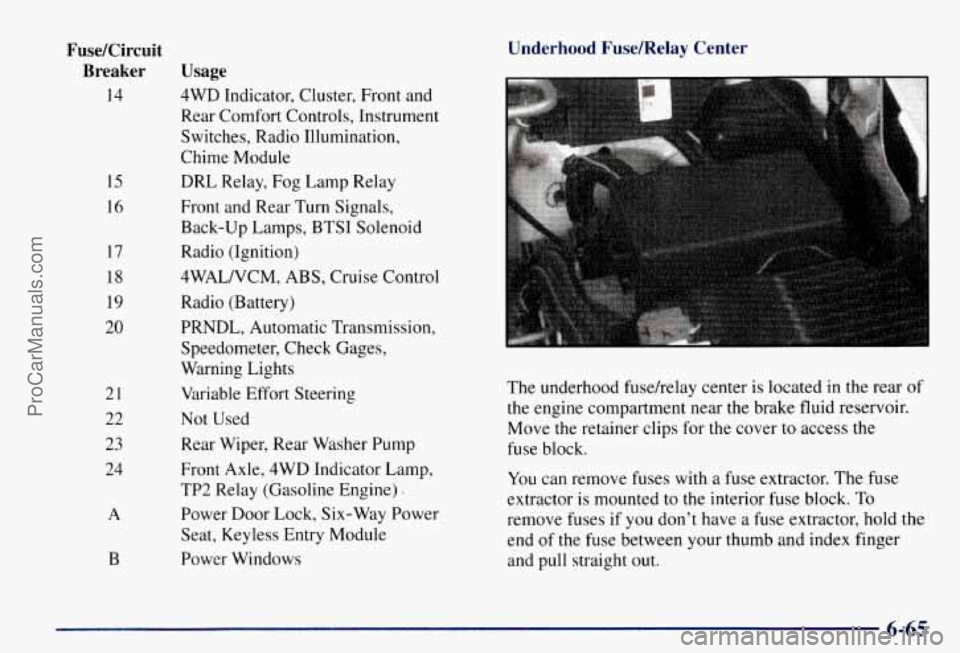
Underhood Fuse/Relay Center
The underhood fusehelay center is located in the rear of
the engine compartment near the brake fluid reservoir.
Move the retainer clips for the cover to access the
fuse block.
You can remove fuses with a fuse extractor. The fuse
extractor is mounted to the interior fuse block. To
remove fuses if you don't have a fuse extractor, hold the
end of the fuse between your thumb and index finger
and pull straight out.
6-65
ProCarManuals.com
Page 345 of 433
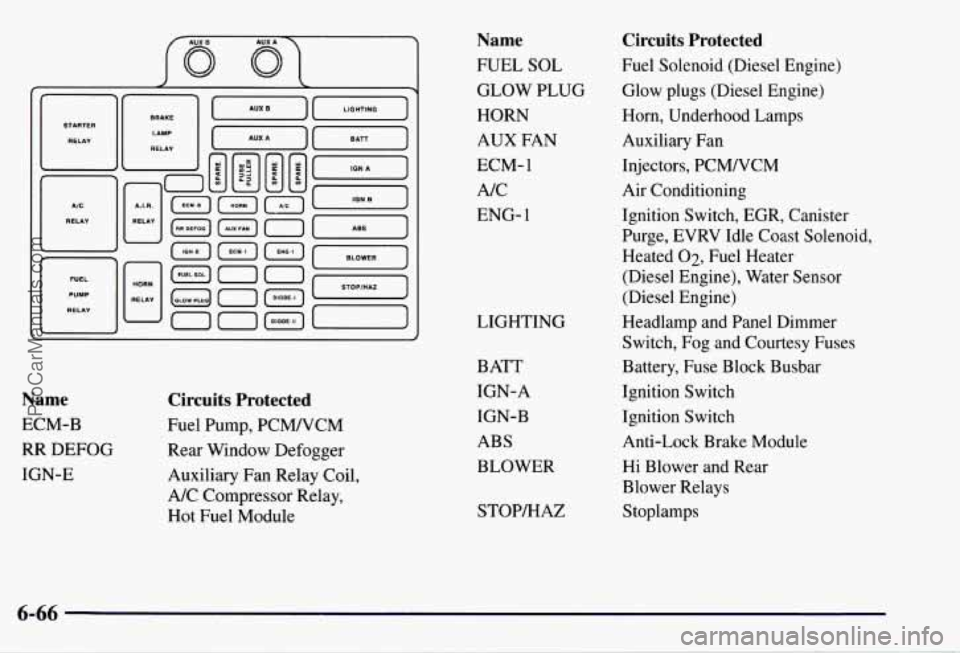
Name
ECM-B
RR DEFOG
IGN-E
Circuits Protected
Fuel Pump, PCMNCM
Rear Window Defogger
Auxiliary Fan Relay Coil,
A/C Compressor Relay,
Hot Fuel Module
Name
FUEL SOL
GLOW PLUG
HORN
AUX FAN
ECM-
1
AIC ENG-
1
LIGHTING
BATT
IGN-A IGN-B
ABS
BLOWER
STOP/HAZ
Circuits Protected
Fuel Solenoid (Diesel Engine)
Glow plugs (Diesel Engine)
Horn, Underhood Lamps
Auxiliary Fan
Injectors, PCMNCM
Air Conditioning
Ignition Switch, EGR, Canister
Purge, EVRV Idle Coast Solenoid,
Heated
02, Fuel Heater
(Diesel Engine), Water Sensor
(Diesel Engine)
Headlamp and Panel Dimmer
Switch, Fog and Courtesy Fuses
Battery, Fuse Block Busbar
Ignition Switch
Ignition Switch Anti-Lock Brake Module
Hi Blower and Rear
Blower Relays
Stoplamps
6-66
ProCarManuals.com
Page 360 of 433
Short Trip/City Maintenance Schedule -- Gasoline Engines I
The services shown in this schedule up to 100,000 miles
( 166 000 km) should be performed after 100,000 miles
(166
000 km) at the same intervals. The services shown
at
150,000 miles (240 000 km) should be performed at
the same interval after 150,000 miles (240
000 km).
See “Owner Checks and Services’’ and “Periodic
Maintenance Inspections” following.
Footnotes
The U.S. Environmental Protection Agency or the
California Air Resources Board has determined that the
failure to perform this maintenance item will not nullify
the emission warranty or limit recall liability prior to the
completion of the vehicle’s useful life. We, however,
urge that all recommended maintenance services be
performed at the indicated intervals and the maintenance
be recorded.
# Lubricate the front suspension, kingpin bushings,
steering linkage, transmission shift linkage, transfer case
shift linkage, parking brake cable guides, front axle
propshaft splines and brake pedal springs. Ball joints and kingpin bushings should not
be lubricated unless
their temperature
is 10” F (- 12” C) or higher, or they
could be damaged.
+ A good time to check your brakes is during tire
rotation. See “Brake System Inspection” under “Periodic
Maintenance Inspection” in Part
C of this schedule.
** Drive axle service (see “Recommended Fluids and
Lubricants” in the Index for proper lubricant to use):
Locking Differential -- Drain fluid and refill at first
engine oil change. At subsequent oil changes, check
fluid level and add fluid as needed.
If driving in
dusty areas or towing a trailer, drain fluid and refill
every
15,000 miles (25 000 km).
Standard Differential -- Check fluid level and add
fluid as needed at every oil change.
If driving in
dusty areas or towing a trailer, drain fluid and refill
every
15,000 miles (25 000 km).
heavy-duty or off-road use.
More frequent lubrication may be required for
ProCarManuals.com
Page 383 of 433
Long Tripmighway Maintenance Schedule -- Gasoline Engines
The services shown in this schedule up to 100,000 miles
(166
000 km) should be performed after 100,000 miles
(166
000 km) at the same intervals. The services shown
at
150,000 miles (240 000 km) should be performed at
the same interval after
150,000 miles (240 000 km).
See “Owner Checks and Services” and “Periodic
Maintenance Inspections” following.
Footnotes
3- The U.S. Environmental Protection Agency or the
California Air Resources Board has determined that the
failure
to perform this maintenance item will not nullify
the emission warranty or limit recall liability prior to the
completion of the vehicle’s useful life. We, however,
urge that all recommended maintenance services be
performed at the indicated intervals and the maintenance
be recorded.
# Lubricate the front suspension, kingpin bushings,
steering linkage, transmission shift linkage, transfer case
shift linkage, parking brake cable guides, front axle
propshaft splines and brake pedal springs. Ball joints and
kinetin bushings should
not be lubricated unless
their tegperature is”1O”F
(- 12°C) or higher, or they
could be damaged.
+ A good time to check your brakes is during tire
rotation. See “Brake System Inspection” under “Periodic
Maintenance Inspections” in
Part C of this schedule.
* * Drive axle service (see “Recommended Fluids and
Lubricants” in the Index for proper lubricant to use):
Locking Differential -- Drain fluid and refill at first
engine oil change. At subsequent oil changes, check
fluid level and add fluid as needed.
Standard Differential -- Check fluid level and add
fluid as needed at every engine oil change.
7-30 -
ProCarManuals.com
Page 397 of 433
At Least %ice a Year
Restraint System Check
Make sure the safety belt reminder light and all your
belts, buckles, latch plates, retractors and anchorages are
working properly. Look for any other loose or damaged
safety belt system parts. If you see anything that might
keep a safety belt system from doing its job, have it
repaired. Have any torn or frayed safety belts replaced.
Also look for any opened or broken air bag coverings,
and have them repaired or replaced. (The air bag system
does not need regular maintenance.)
Wiper Blade Check
Inspect wiper blades for wear or cracking. Replace blade
inserts that appear worn or damaged or that streak or
miss areas of the windshield. Also
see “Wiper Blades,
Cleaning” in the Index.
Air Cleaner Filter Restriction Indicator Check
Your vehicle has an indicator on the engine that lets you
know when the air cleaner filter is dirty and needs to be
changed. Check indicator at least twice a year or when your
oil is changed. See
“Air Cleaner’’ in the Index
for more information. Inspect your air cleaner filter
restriction indicator more often if the vehicle is used in
dusty areas or under
off road conditions.
Automatic Transmission Check
Check the transmission fluid level; add if needed. See
“Automatic Transmission” in the Index. A fluid loss
may indicate a problem. Check the system and repair
if needed.
At Least Once a Year
Key Lock Cylinders Service
Lubricate the key lock cylinders with the lubricant
specified in Part
D.
Body Lubrication Service
Lubricate all fuel door, body hood and body door
hinges, rear compartment hinges, tailgate handle pivot
points, latches, locks and folding seat hardware.
Part D
tells you what to use. More frequent lubrication may be
required when exposed to a corrosive environment.
ProCarManuals.com
Page 398 of 433
Starter Switch Check
I I
Brake-Transmission Shift Interlock (BTSI) Check
N:
When you are doing this check, the vehicle could
move suddenly. If
it does, you or others could be
injured. Follow the steps below.
1. Before you start, be sure you have enough room
around the vehicle.
2. Firmly apply both the parking brake (see “Parking
Brake” in the Index if necessary) and the
regular brake.
NOTE:
Do not use the accelerator pedal, and be
ready to turn off the engine immediately
if it starts.
3. Try to start the engine in each gear. The starter
should work only
in PARK (P) or NEUTRAL (N).
If the starter works in any other position, your
vehicle needs service.
move suddenly. If it does, you or others could be
injured. Follow the steps below.
I I
1. Before you start, be sure you have enough room
around the vehicle. It should be parked on a
level surface.
2. Firmly apply the parking brake (see “Parking Brake”
in the Index if necessary).
NOTE: Be ready to apply the regular brake
immediately if the vehicle begins to move.
3. With the engine off, turn the key to the RUN
position, but don’t start the engine. Without applying
the regular brake, try to move
the shift lever out
of PARK (P) with normal effort. If the shift lever
moves out of PARK (P), your vehicle’s BTSI
needs service.
7-45
ProCarManuals.com
Page 399 of 433
Ignition Transmission Lock Check
While parked, and with the parking brake set, try
to turn
the ignition key
to LOCK in each shift lever position.
The key should turn to LOCK only when the shift
The key should come out only in LOCK.
Parking Brake and Automatic Transmission
PARK (P) Mechanism Check lever
is in PARK
(P).
I 4 CAUTLN:
When you are doing this check, your vehicle
could begin to move. You or others could be
injured and property could be damaged. Make
sure there is room in front of your vehicle in case
it begins to roll. Be ready to apply the regular
brake at once should the vehicle begin to move.
-
Park on a fairly steep hill, with the vehicle facing
downhill. Keeping your foot on the regular brake, set the
parking brake.
To check the parking brake’s holding ability:
With the engine running and transmission in
NEUTRAL (N), slowly remove foot pressure from
the regular brake pedal.
Do this until the vehicle is
held by the parking brake only.
To check the PARK (P) mechanism’s holding ability:
With the engine running, shift to PARK (P). Then
release all brakes.
7-46
ProCarManuals.com
Page 402 of 433
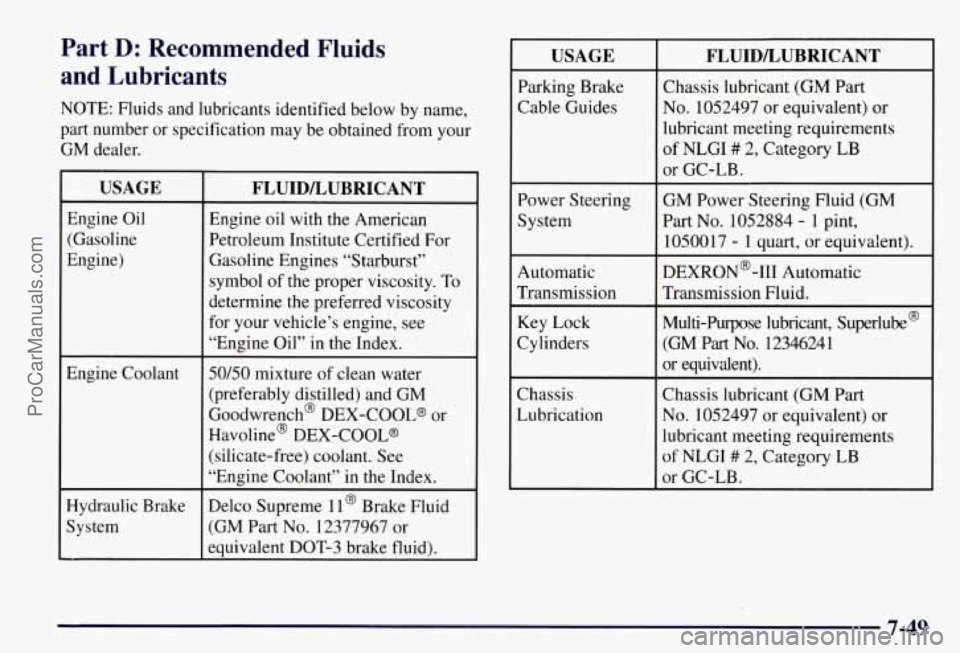
Part D: Recommended Fluids
and Lubricants
NOTE: Fluids and lubricants identified below by name,
part number or specification may be obtained from your
GM dealer.
USAGE
Engine Oil
(Gasoline
Engine)
Engine Coolant
Hydraulic Brake
System
FLUID/LUBRICANT
Engine oil with the American
Petroleum Institute Certified For Gasoline Engines “Starburst”
symbol of the proper viscosity.
To
determine the preferred viscosity
for your vehicle’s engine, see
“Engine Oil” in the Index.
50/50 mixture of clean water
(preferably distilled) and GM
Goodwrench@ DEX-COOLa or
Havoline@ DEX-COOL@
(silicate-free) coolant. See
“Engine Coolant” in the Index.
Delco Supreme 11
@ Brake Fluid
(GM Part No. 12377967 or
equivalent DOT-3 brake fluid).
USAGE
Parking Brake
Cable Guides
Power Steering
System
Automatic
Transmission
Key Lock
Cylinders
~~
Chassis
Lubrication
FLUIDLUBRICANT
Chassis lubricant (GM Part
No. 1052497 or equivalent) or
lubricant meeting requirements
of NLGI # 2, Category LB
or GC-LB.
GM Power Steering Fluid (GM
Part
No. 1052884 - 1 pint,
1050017
- 1 quart, or equivalent).
DEXRON@-111 Automatic
Transmission Fluid.
Multi-Purpose lubricant, Superlube@ (GM Part
No. 12346241
or equivalent).
Chassis lubricant (GM Part
No. 1052497 or equivalent) or
lubricant meeting requirements
of NLGI # 2, Category LB
or GC-LB.
7-49
ProCarManuals.com
Page 412 of 433
Chevrolet/Geo Roadside
Assistance Program
To enhance Chevrolet's strong commitment to customer
satisfaction, Chevrolet is excited to announce the
establishment of the Chevrolet/Geo Roadside Assistance
Center.
As the owner of a 1997 Chevrolet/Geo,
membership
in Roadside Assistance is free. Roadside Assistance
is available
24 hours a day,
365 days a year, by calling 1-800-CHEV-USA
(1-800-243-8872). This toll-free number will provide
you over-the-phone roadside assistance with minor
mechanical problems. If your problem cannot be
resolved over the phone, our advisors have access
to a
nationwide network
of dealer recommended service
providers. Roadside membership is free, however some
services may incur costs.
Roadside offers two levels of service to the customer,
Basic Care and Courtesy" Care:
0 Toll-free number, 1 -800-CHEV-USA
Free towing for warranty repairs
Basic over-the-phone technical advice
Available dealer services at reasonable costs (ie.,
wrecker services, locksmithkey service, glass
repair, etc.)
8-5
ProCarManuals.com
Page 413 of 433
ROADSIDE Courtesy" Care PROVIDES:
0 Roadside Basic Care services (as outlined above)
Plus:
FREE Non-Warranty Towing (to the closest dealer
from a legal roadway)
FREE LocksmithKey Service (when keys are lost
on the road or locked inside)
0 FREE Flat Tire Service (spare installed on the road)
0 FREE Jump Start (at home or on the road)
0 FREE Fuel Delivery ($5 of fuel delivered on
the road) Chevrolet/Geo offers Courtesy Transportation for
customers needing warranty service. Courtesy
Transportation will
be offered in conjunction with
the coverage provided by the Bumper to Bumper
New Vehicle Limited Warranty
to eligible purchasers
of
1997 Chevrolet/Geo passenger car and light duty
trucks. (Please see your selling dealer for details.)
Note:
Courtesy Care is available to Retail and Retail Lease
Customers operating
1997 and newer ChevroletlGeo
vehicles for a period
of 3 years/36,000 miles (60 O00 km),
whichever occurs first. All Courtesy Care services must
be pre-arranged by Chevrolet Roadside or dealer
Service Management.
Basic Care and Courtesy Care are not part of or
included in the coverage provided by the New Vehicle
Limited Warranty. Chevrolet reserves the right to
modify or discontinue
Basic Care and Courtesy Cure
at any time.
ProCarManuals.com