lock CHEVROLET SUBURBAN 1997 Manual Online
[x] Cancel search | Manufacturer: CHEVROLET, Model Year: 1997, Model line: SUBURBAN, Model: CHEVROLET SUBURBAN 1997Pages: 433, PDF Size: 21.49 MB
Page 269 of 433
7
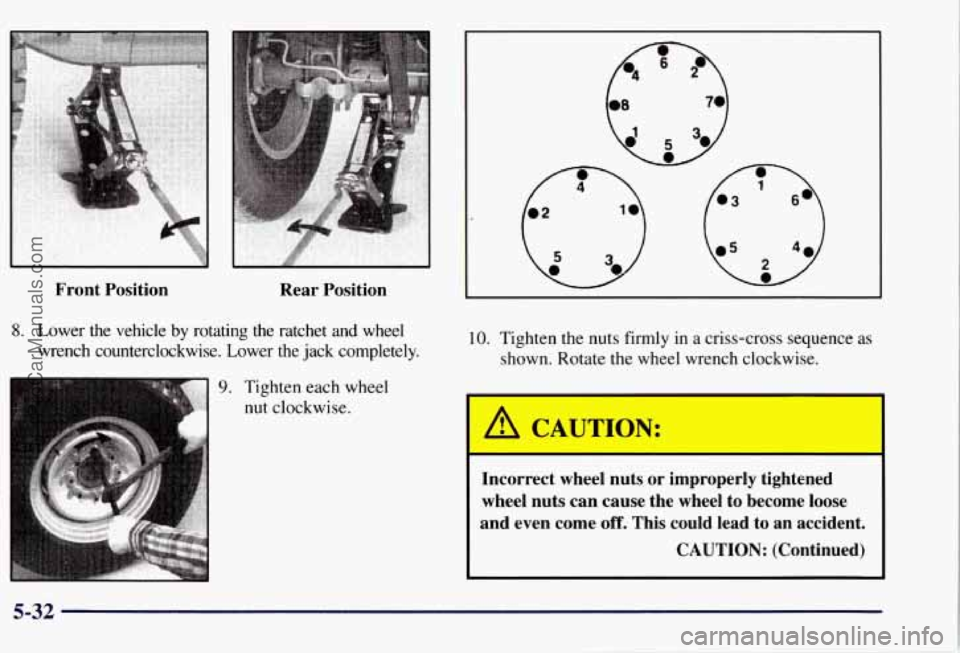
Front Position Rear Position
10. Tighten the nuts firmly in a criss-cross sequence as
shown. Rotate the wheel wrench clockwise.
Incorrect wheel nuts or improperly tightened
wheel nuts can cause the wheel to become loose
and even come
off. This could lead to an accident.
CAUTION: (Continued)
5-32
ProCarManuals.com
Page 270 of 433
I CAU‘IWN: (Continued)
Be sure to use the correct wheel nuts. If you have
to replace them, be sure to get new
GM original
equipment wheel nuts.
Stop somewhere as soon as you can and have the
nuts tightened with a torque wrench to the
proper torque. For proper torque, see
“Capacities and Specifications” in the Index.
L
NOTICE:
Improperly tightened wheel nuts can lead to
brake pulsation and rotor damage.
To avoid
expensive brake repairs, evenly tighten the wheel
nuts
in the proper sequence and to the proper
torque specification.
11. Put the wheel trim back on. For vehicles with
plastic wheel nut caps, tighten the caps until
they
are finger tight, then tighten them an additional
one-half turn with the ratchet and wheel wrench.
Storing a Flat or Spare Tire and Tools
I I
’
C TION:
-
Storing a jack, a tire or other equipment in the
passenger compartment
of the vehicle could
cause injury. In
a sudden stop or collision, loose
equipment could strike someone. Store all these
in the proper place.
Store the flat tire where the spare tire is stored.
Put the tools into the storage box and close it tightly. Fit
the storage box on the bracket with the bolt through the
box. Put the jack onto the box. Be sure the jack is stored
as shown in the following illustrations. The jack handle
attachment point is circled in the following illustrations
to show the direction the jack should face when it is
stored properly. Secure the emergency gloves, if your
vehicle has them,
to the jack using the provided strap.
Slide the retainer over the bolt onto the jack and put the
wing nut
on it. Turn the nut clockwise until it is tight
against the retainer.
5-33
ProCarManuals.com
Page 273 of 433
A B
n
C
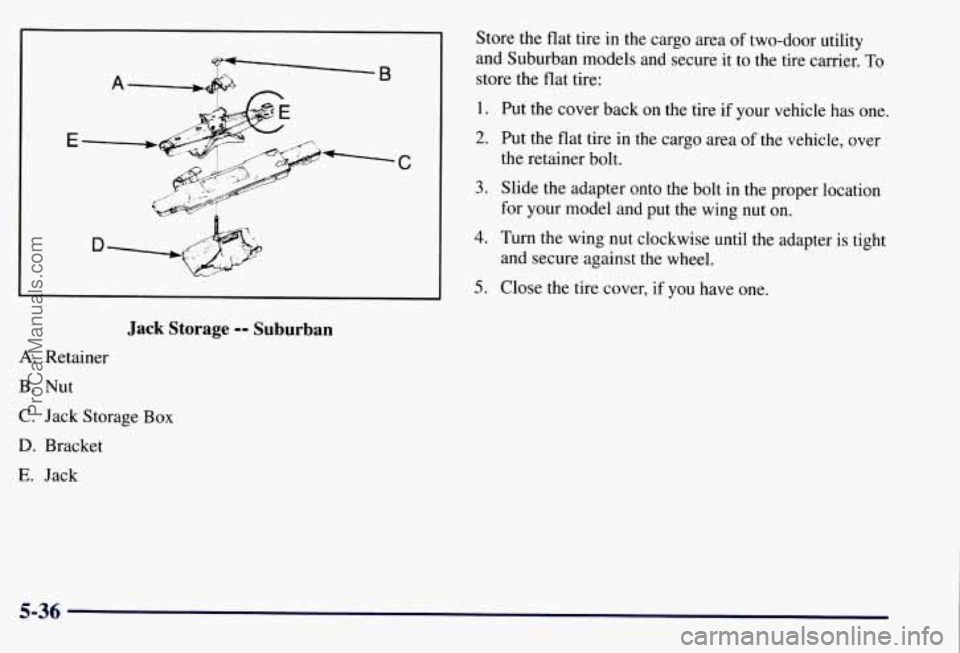
Jack Storage -- Suburban
A. Retainer
B. Nut
C. Jack Storage
Box
D. Bracket
E. Jack Store
the flat tire in the cargo area of two-door utility
and Suburban models and secure it to the tire carrier.
To
store the flat tire:
1.
2.
3.
4.
5.
Put the cover back on the tire if your vehicle has one.
Put the flat tire in the cargo area of the vehicle, over
the retainer bolt.
Slide
the adapter onto the bolt in the proper location
for your model and put
the wing nut on.
Turn the wing nut clockwise until the adapter is tight
and secure against the wheel.
Close the tire cover, if you have
one.
5-36
ProCarManuals.com
Page 286 of 433
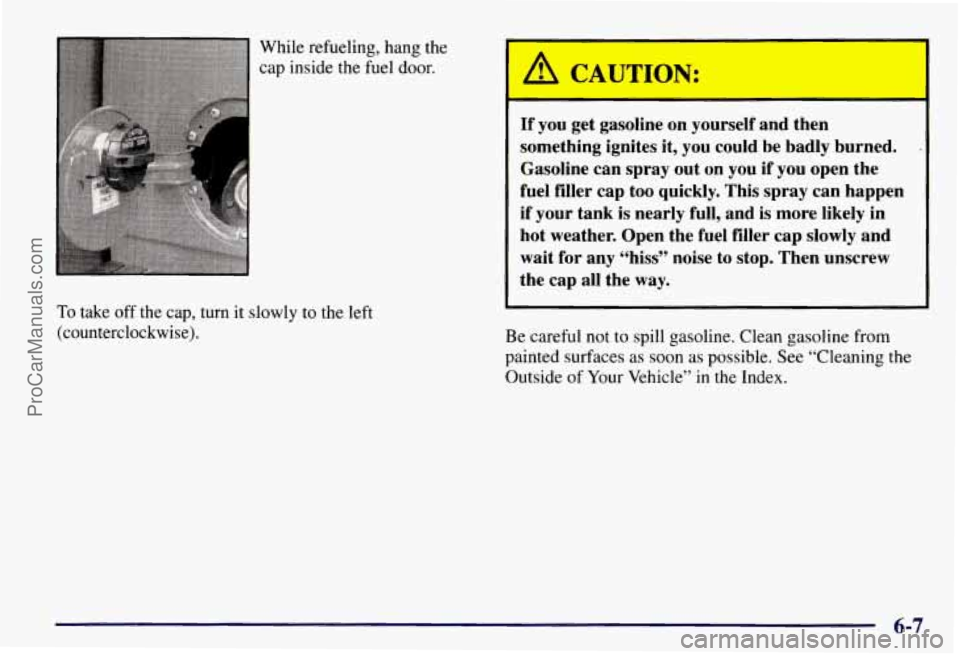
While refueling, hang the
cap inside the fuel door.
To take off the cap, turn it slowly to the left
(counterclockwise).
A CAUTION:
I
If you get gasoline on yourself and then
something ignites it, you could be badly burned.
.
Gasoline can spray out on you if you open the
fuel filler cap too quickly. This spray can happen
if your tank is nearly full, and is more likely in
hot weather. Open the fuel filler cap slowly and
wait for any “hiss” noise to stop. Then unscrew
the cap all the way.
,
Be careful not to spill gasoline. Clean gasoline from
painted surfaces as soon as possible. See “Cleaning the
Outside of Your Vehicle” in the Index.
6-7
ProCarManuals.com
Page 287 of 433
When you put the cap back on, turn it to the right
(clockwise) until you hear a clicking sound.
Make sure
you fully install the cap.
NOTICE:
If you need a new cap, be sure to get the right
type. Your dealer can get one for you.
If you get
the wrong type, it may not
fit or have proper
venting, and your fuel tank and emissions system
might be damaged.
Checking Things Under the Hood
'
A CAUTION:
If your vehicle has air conditioning, the auxiliary
engine fan under
the hood can start up and
injure you even when the engine is not running.
Keep hands, clothing and tools
away from any
underhood electric fan.
A CAUTION:
I I
Things that burn can get on hot engine parts and
start a fire. These include liquids like gasoline or
diesel fuel, oil, coolant, brake fluid, windshield
washer and other fluids, and plastic or rubber.
You or others could be burned. Be careful not to
drop or spill things that will burn onto a hot
engine.
6-8
ProCarManuals.com
Page 302 of 433
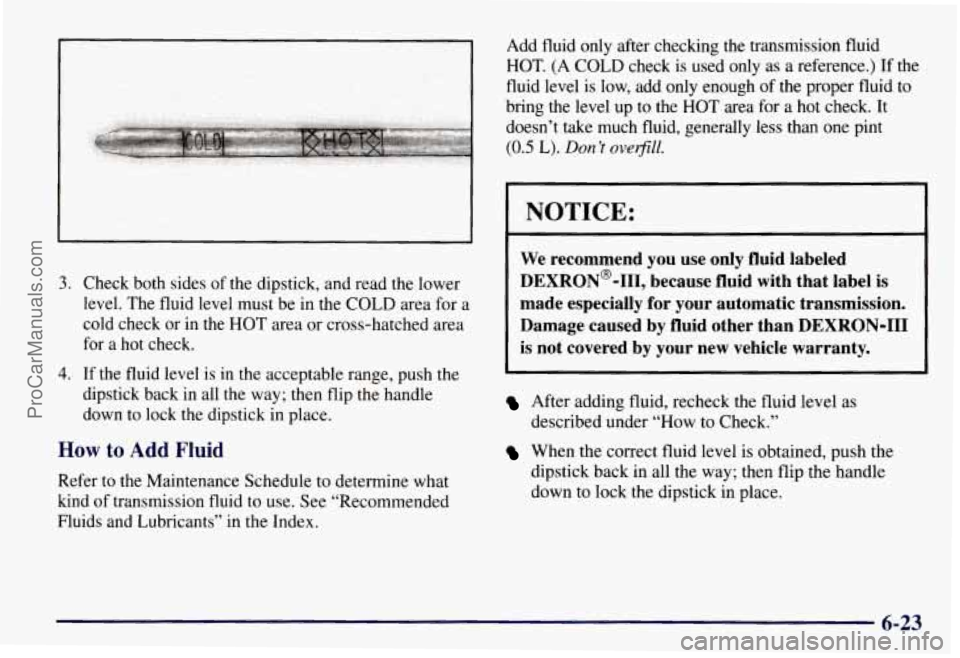
3. Check both sides of the dipstick, and read the lower
level. The fluid level must be in the COLD area for a
cold check or in the
HOT area or cross-hatched area
for a hot check.
4. If the fluid level is in the acceptable range, push the
dipstick back in all the way; then flip the handle
down to lock the dipstick in place.
How to Add Fluid
Refer to the Maintenance Schedule to determine what
kind
of transmission fluid to use. See “Recommended
Fluids and Lubricants” in the Index. Add
fluid only after checking the transmission fluid
HOT. (A COLD check is used only as a reference.) If the
fluid level is low, add only enough of the proper fluid to
bring the level up to the HOT area for
a hot check. It
doesn’t take much fluid, generally less
than one pint
(0.5 L). Don’t ove$ll.
NOTICE:
We recommend you use only fluid labeled
DEXRON@-111, because fluid with that label is
made especially for your automatic transmission.
Damage caused by fluid other than DEXRON-I11
is not covered by your new vehicle warranty.
After adding fluid, recheck the fluid level as
When the correct fluid level is obtained, push the
described under “How
to Check.”
dipstick back in all the way; then flip the handle
down to lock the dipstick in place.
6-23
ProCarManuals.com
Page 319 of 433
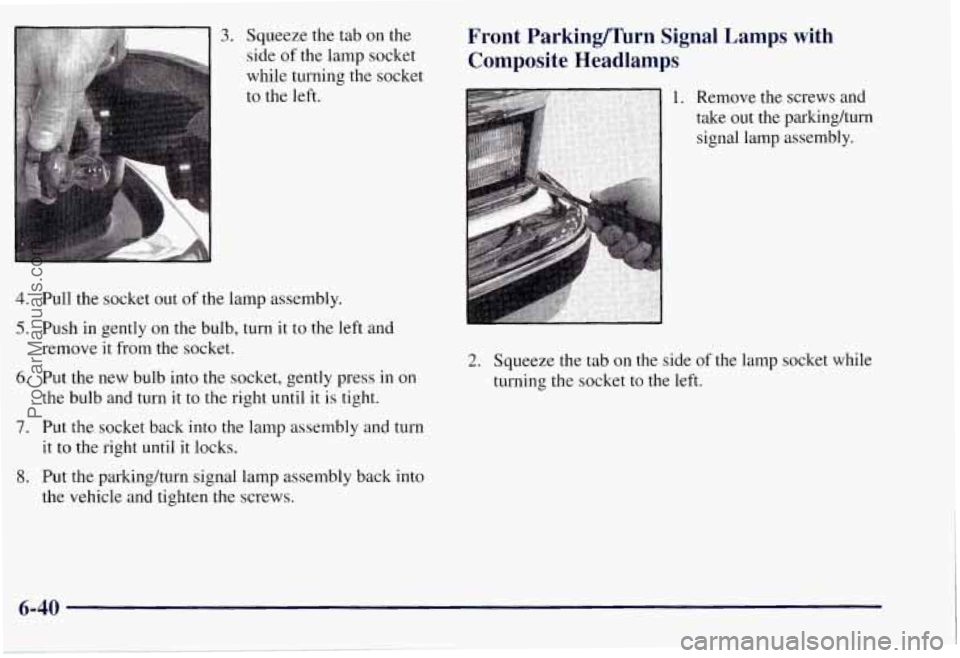
3. Squeeze the tab on the
side of the lamp socket
while turning the socket
to the left.
4. Pull the socket out of the lamp assembly.
5. Push in gently on the bulb, turn it to the left and
remove it from the socket.
6. Put the new bulb into the socket, gently press in on
the bulb and turn
it to the right until it is tight.
7. Put the socket back into the lamp assembly and turn
it
to the right until it locks.
8. Put the parkingkurn signal lamp assembly back into
the vehicle and tighten the screws.
Front Parkinnrn Signal Lamps with
Composite Headlamps
2. Squeeze the tab on the side of the lamp socket while
turning the socket to the left.
ProCarManuals.com
Page 320 of 433
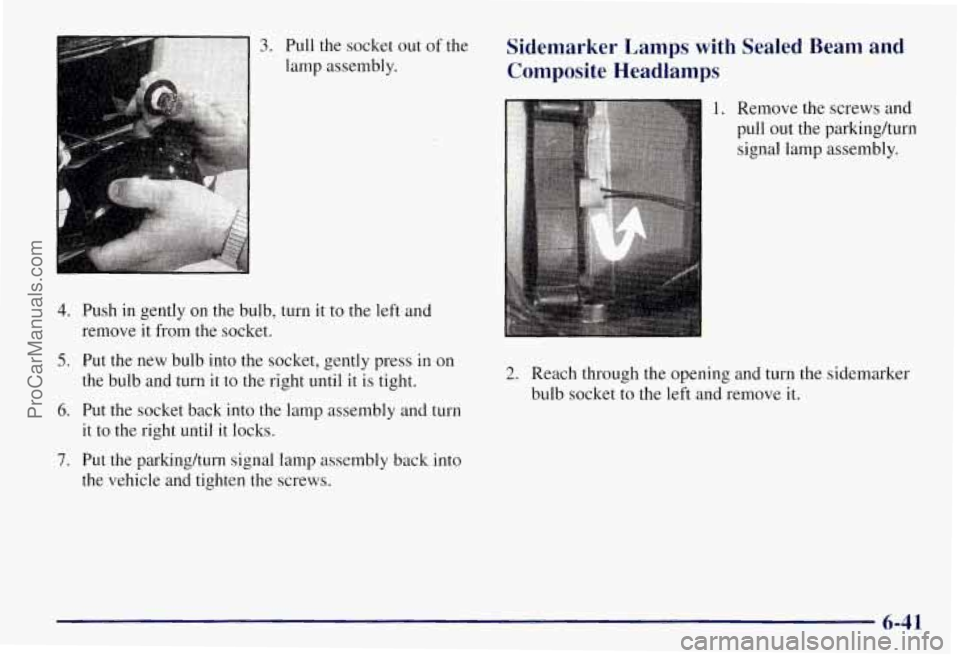
3. Pull the socket out of the
lamp assembly.
4. Push in gently on the bulb, turn it to the left and
remove it from the socket.
5. Put the new bulb into the socket, gently press in on
the bulb and turn it to the right until it is tight.
6. Put the socket back into the lamp assembly and turn
it to the right until it locks.
7. Put the parkinghurn signal lamp assembly back into
the vehicle and tighten the screws.
Sidemarker Lamps with Sealed Beam and
Composite Headlamps
1. Remove the screws and
pull out the parkinghurn
signal lamp assembly.
2. Reach through the opening and turn the sidemarker
bulb socket to the left and remove it.
6-41
ProCarManuals.com
Page 342 of 433
Power Windows and Other Power Options
Circuit breakers in the fuse panel protect the power
windows and other power accessories. When the current
load is too heavy, the circuit breaker opens and closes.
This protects the circuit until the current load returns
to
normal or the problem is fixed.
Fuses and Circuit Breakers
The wiring circuits in your vehicle are protected from
short circuits by a combination of fuses, circuit breakers
and fusible thermal links in the wiring itself. This
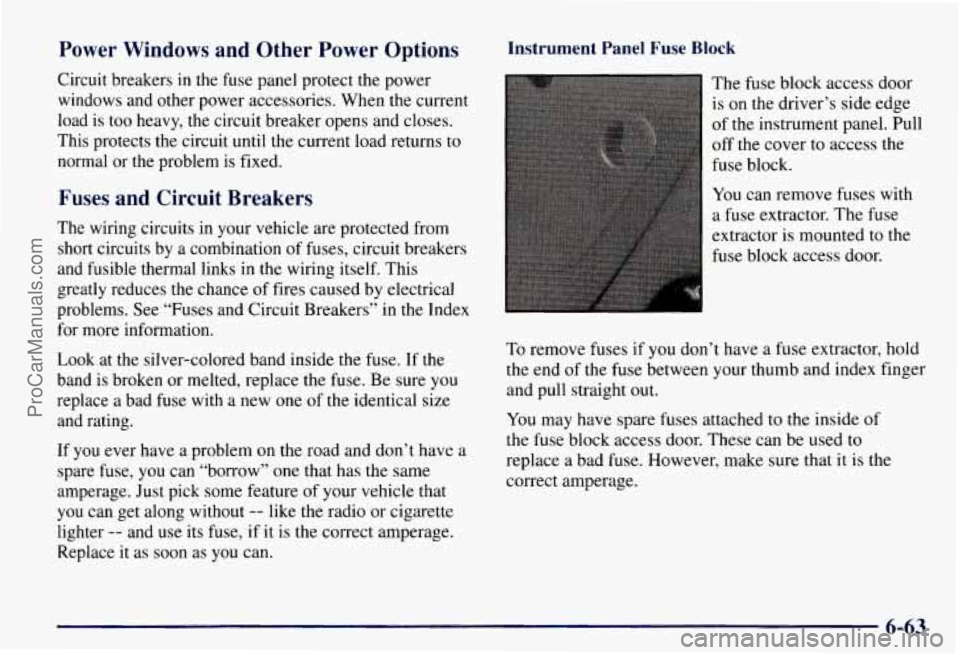
Instrument Panel Fuse Block
The fuse block access door
is on the driver’s side edge
of the instrument panel. Pull
off the cover to access the
fuse block.
You can remove fuses with
a fuse extractor. The fuse
extractor is mounted to the
fuse block access door.
greatly reduces the chance of fires caused by electrical
problems. See “Fuses and Circuit Breakers” in the Index
for more information.
Look at the silver-colored band inside the fuse. If the
band is broken or melted, replace the fuse. Be sure
you
replace a bad fuse with a new one of the identical size
and rating.
If you ever have a problem on the road and don’t have a
spare fuse, you can “borrow” one that has the same
amperage. Just pick some feature
of your vehicle that
you can get along without
-- like the radio or cigarette
lighter
-- and use its fuse, if it is the correct amperage.
Replace it as soon as you can.
To remove fuses if you don’t have a fuse extractor, hold
the end of the fuse between your thumb and index finger
and pull straight out.
You may have spare fuses attached to the inside of
the fuse block access door. These can be used to
replace a bad fuse. However, make sure that it is the
correct amperage.
6-63
ProCarManuals.com
Page 343 of 433
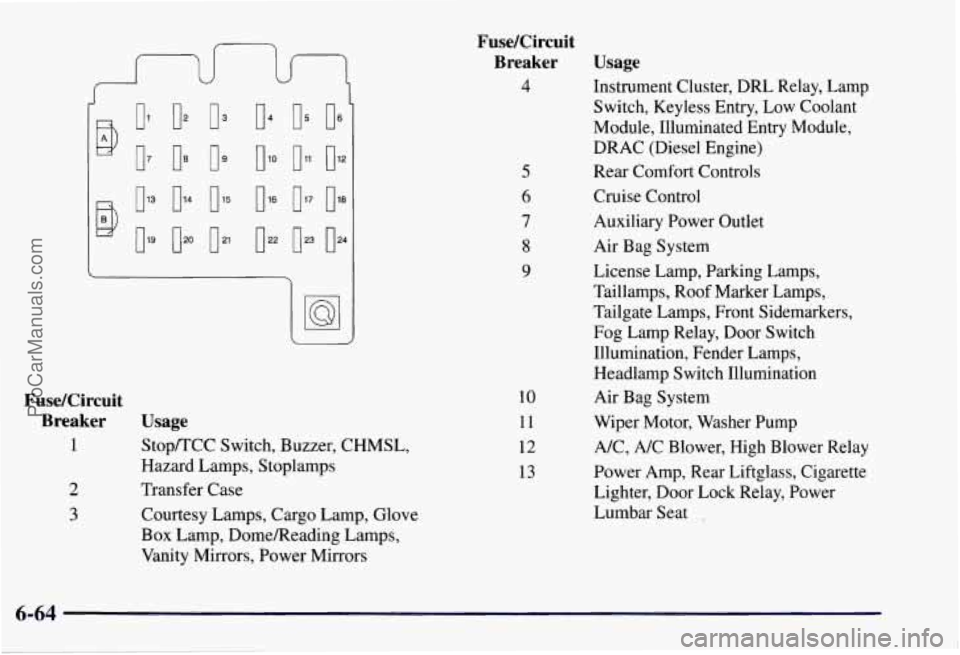
Fuse/Circuit Breaker Usage
4
Fuse/Circuit Breaker Usage
1 Stop/TCC Switch, Buzzer, CHMSL,
2 Transfer Case
Hazard Lamps, Stoplamps
3 Courtesy Lamps, Cargo Lamp, Glove
Box Lamp, DomeReading Lamps,
Vanity Mirrors, Power Mirrors 10
11
12
13 Instrument Cluster, DRL
Relay, Lamp
Switch, Keyless Entry, Low Coolant
Module, Illuminated Entry Module,
DRAC (Diesel Engine)
Rear Comfort Controls
Cruise Control
Auxiliary Power Outlet
Air Bag System
License Lamp, Parking Lamps,
Taillamps, Roof Marker Lamps,
Tailgate Lamps, Front Sidemarkers,
Fog Lamp Relay, Door Switch
Illumination, Fender Lamps,
Headlamp Switch Illumination
Air Bag System
Wiper Motor, Washer Pump
NC, A/C Blower, High Blower Relay
Power Amp, Rear Liftglass, Cigarette
Lighter, Door Lock Relay, Power
Lumbar Seat
,
ProCarManuals.com