warning CHEVROLET SUBURBAN 1997 User Guide
[x] Cancel search | Manufacturer: CHEVROLET, Model Year: 1997, Model line: SUBURBAN, Model: CHEVROLET SUBURBAN 1997Pages: 433, PDF Size: 21.49 MB
Page 144 of 433
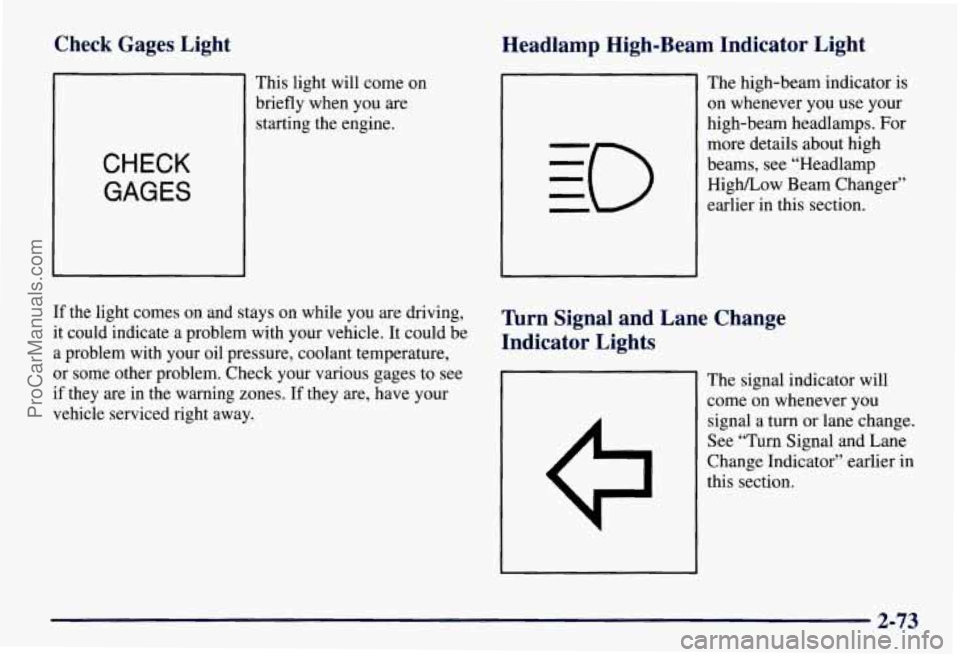
Check Gages Light Headlamp High-Beam Indicator Light
CHECK
GAGES
This light will come on
briefly when you are
starting the engine. The
high-beam indicator is
on whenever you use your
high-beam headlamps. For
more details about high
beams, see “Headlamp
HighLow Beam Changer”
earlier in this section.
If the light comes on and stays on while
YOU are driving, Turn Signal and Lane Change
it could indicate a problem with your vehicle. It could be
a problem with your oil pressure, coolant temperature,
or some other problem. Check your various gages
to see
signal a turn
or lane change.
vehicle serviced right
away. come on whenever
you
if they are in the warning zones. If they are, have your The signal indicator
will
See “Turn Signal and Lane
Change Indicator” earlier in
Indicator Lights
this section.
2-73
ProCarManuals.com
Page 186 of 433
Avoid needless heavy braking. Some people drive in
spurts
-- heavy acceleration followed by heavy
braking
-- rather than keeping pace with traffic. This is a
mistake. Your brakes may not have time to cool between
hard stops. Your brakes will wear out much faster if you
do a lot of heavy braking. If you keep pace with the
traffic and allow realistic following distances, you will
eliminate a lot
of unnecessary braking. That means
better braking and longer brake life.
If your engine ever stops while you’re driving, brake
normally but don’t pump your brakes. If you do, the
pedal may get harder to push down. If your engine
stops, you will still have some power brake assist. But
you will use it when you brake. Once the power assist is
used up, it may take longer to stop and the brake pedal
will be harder to push.
Anti-Lock Brakes (ABS)
Your vehicle has anti-lock brakes (ABS). ABS is an
advanced electronic braking system that will help
prevent a braking skid.
When you start your engine and begin to drive away,
your anti-lock brake system will check itself. You may
hear a momentary motor or clicking noise while this test
is going on. This is normal.
ANTI -
LOCK
If there’s a problem with the
anti-lock brake system, this
warning light will stay on.
See “Anti-Lock Brake
System Warning Light” in
the Index.
4-7
ProCarManuals.com
Page 193 of 433
While driving on a surface with reduced traction, try
your best to avoid sudden steering, acceleration
or
braking (including engine braking by shifting to a lower
gear). Any sudden changes could cause the tires to slide.
You may not realize the surface is slippery until your
vehicle is skidding. Learn to recognize warning
clues
-- such as enough water, ice or packed snow on
the road to make a “mirrored surface”
-- and slow down
when you have any doubt.
Remember:
Any anti-lock brake system (ABS) helps
avoid only the braking skid.
Driving Guidelines
This multipurpose passenger vehicle is defied as a utility
vehicle in Consumer Information Regulations issued by
the National Highway Trafpc Safety Administration
(NHTSA) of the United States Department of
Transportation. Utility vehicles have higher ground
clearance and a narrower track to make them capable of
performing in a wide variety of off-road applications.
Specific design characteristics give them a higher center of
gravity than ordinary cars.
An advantage of the higher
ground clearance is a better view of the road allowing you
to anticipate problems. They are not designed for
cornering at the same speeds as conventional
two-wheel-drive vehicles any more than low-slung
sports
cars are designed to perform satisfactorily under off-road conditions.
If at
all possible, avoid sharp turns or abrupt
maneuvers. As with other vehicles of this type, failure to
operate
this vehicle correctly may result in loss of control
or vehicle rollover.
Off-Road Driving with Your
Four-Wheel-Drive Vehicle
This off-road guide is for vehicles that have
four-wheel drive.
Also, see “Anti-Lock Brakes”
in the Index.
If your vehicle doesn’t have four-wheel drive, you
shouldn’t drive off-road unless you’re on
a level,
solid surface.
Off-road driving can
be great fun. But it does have some
definite hazards. The greatest of these is the terrain itself.
“Off-roading” means you’ve left the great North
American road system behind. Traffic lanes aren’t
marked. Curves aren’t banked. There are no road signs.
Surfaces can be slippery, rough, uphill or downhill. In
short, you’ve gone right back to nature.
Off-road driving involves some new skills.
And that’s
why it’s very important that you read this guide. You’ll
find many driving tips
and suggestions. These will help
make your off-road driving safer and more enjoyable.
4-14
ProCarManuals.com
Page 212 of 433
Here are ways to increase your safety in city driving:
0
0
0
Know the best way to get to where you are going.
Get a city map and plan your trip into an unknown
part of the city just as you would for a
cross-country trip.
Try to use the freeways that rim and crisscross most
large cities. You’ll save time and energy. (See the
next part, “Freeway Driving.”)
Treat a green light as a warning signal.
A traffk light is
there because the corner is busy enough to need it.
When a light
turns green, and just before you start to
move, check both ways for vehicles that have not
cleared the intersection or may
be running the red light.
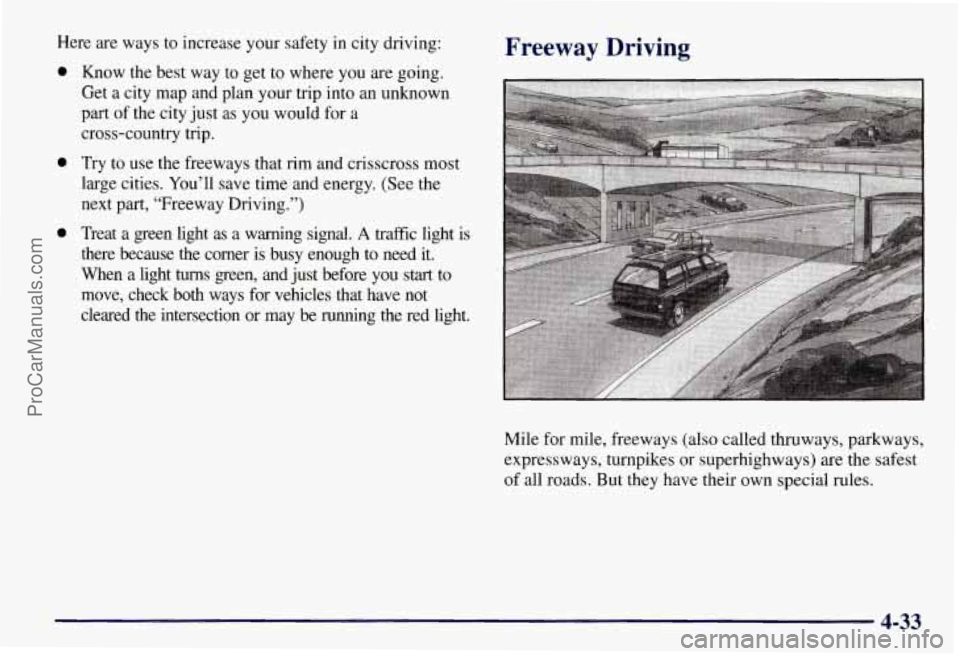
Freeway Driving
Mile for mile, freeways (also called thruways, parkways,
expressways, turnpikes
or superhighways) are the safest
of all roads. But they have their own special rules.
4-33
ProCarManuals.com
Page 217 of 433
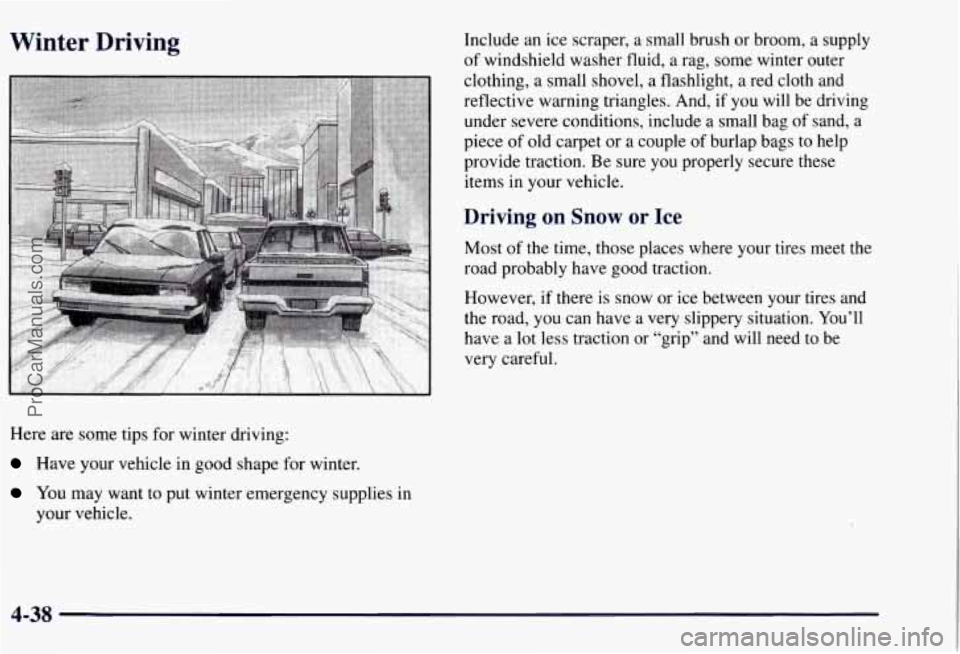
Winter Driving Include an ice scraper, a small brush or broom, a supply
of windshield washer fluid, a rag, some winter outer
clothing, a small shovel,
a flashlight, a red cloth and
reflective warning triangles. And, if you will be driving
under severe conditions, include a small bag of sand, a
piece of old carpet or a couple of burlap bags to help
provide traction. Be sure you properly secure these
items in your vehicle.
Driving on Snow or Ice
Most of the time, those places where your tires meet the
road probably have good traction.
However,
if there is snow or ice between your tires and
the road, you can have a very slippery situation. You’ll
have a lot less traction or “grip” and will need to be
very careful.
Here are some tips
for winter driving:
Have your vehicle in good shape for winter.
You may want to put winter emergency supplies in
your vehicle.
4-38
ProCarManuals.com
Page 231 of 433
Making ’hms
NOTICE:
Making very sharp turns while trailering could
cause the trailer to come in contact with the
vehicle. Your vehicle could be damaged. Avoid
making very sharp turns while trailering.
When you’re turning with a trailer, make wider turns than
normal.
Do this so your trailer won’t strike soft shoulders,
curbs, road signs, trees or other objects. Avoid jerky or
sudden maneuvers. Signal well
in advance.
Turn Signals When Towing a Trailer
The arrows on your instrument panel will flash
whenever you signal a turn or lane change. Properly
hooked up, the trailer lamps will also flash, telling other
drivers you’re about to turn, change lanes or stop.
When towing a trailer, the arrows on your instrument
panel will flash for turns even
if the bulbs on the trailer
are burned out. Thus, you may think drivers behind you
are seeing your signal when they are not. It’s important
to check occasionally to be sure the trailer bulbs are
still working.
Driving On Grades
Reduce speed and shift to a lower gear before you start
down a long or steep downgrade. If you don’t shift
down, you might have
to use your brakes so much that
they would get hot and no longer work well.
On a long uphill grade, shift down and reduce your
speed to around
45 mph (70 kmh) to reduce the
possibility of engine and transmission overheating.
If you have an automatic transmission, you can tow
in
AUTOMATIC OVERDRIVE (0). You may want to
shift the transmission to THIRD
(3) or, if necessary, a
lower gear selection if the transmission shifts too often
(e.g., under heavy loads and/or hilly conditions).
When towing at high altitude on steep uphill grades,
consider the following: Engine coolant will boil at a
lower temperature than at normal altitudes. If you turn
your engine off immediately after towing at high altitude
on steep uphill grades, your vehicle may show signs
similar
to engine overheating. To avoid this, let the
engine run while parked (preferably on level ground)
with the automatic transmission in PARK
(P) for a few
minutes before turning the engine off. If you do get the
overheat warning, see “Engine Overheating” in
the Index.
4-52
ProCarManuals.com
Page 238 of 433
Section 5 Problems On The Road
Here you’ll find what to do about some problems that can occur on the road.
5-2
5-3
5-3
5-8
5-11 Hazard
Warning Flashers
Other Warning Devices
Jump Starting
Towing Your Vehicle
Engine Overheating (Gasoline Engines) Cooling System
-- Gasoline Engines
Engine Fan Noise
If a Tire Goes Flat
Changing
a Flat Tire
If You’re Stuck: In Sand, Mud, Ice or
Snow
5-13
5-2 1
5-21
5-22
5-39
5-1
ProCarManuals.com
Page 239 of 433
Hazard Warning Flashers
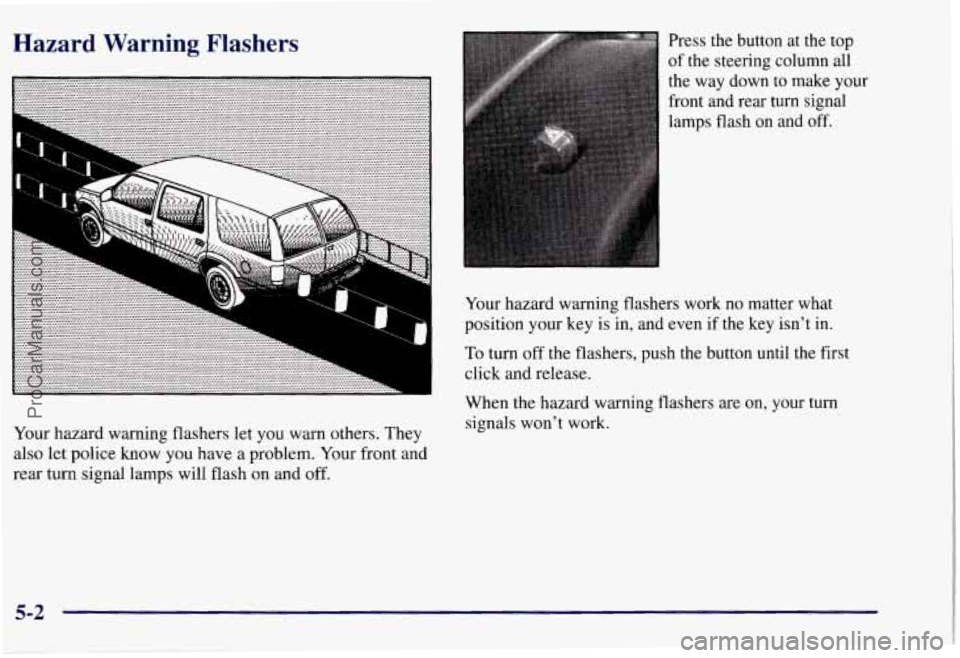
Your hazard warning flashers let you warn others. They
also let police know you have a problem. Your front and
rear turn signal lamps will flash on and off. Press the
button at the top
of the steering column all
the way down to make your
front and rear turn signal
lamps flash on and off.
Your hazard warning flashers work no matter what
position your key is in, and even if the key isn't in.
To turn off the flashers, push the button until the first
click and release.
When the hazard warning flashers are on, your turn
signals won't work.
5-2
ProCarManuals.com
Page 240 of 433
Other Warning Devices
If you carry reflective triangles, you can set one up at
the side of the road about
300 feet (100 m) behind
your vehicle.
Jump Starting
If your battery (or batteries) has run down, you may
want to
use another vehicle and some jumper cables to
start your vehicle. But please use the following steps to
do it safely.
Batteries can hurt you. They can be
dangerous because:
0 They contain acid that can burn you.
0 They contain gas that can explode or ignite.
0 They contain enough electricity to burn you.
If you don’t follow these steps exactly, some or all
of these things can hurt you.
NOTICE:
Ignoring these steps could result in costly damage
to your vehicle that wouldn’t be covered
by your
vehicle warranty.
Trying to start your vehicle by pushing
or pulling
it could damage your vehicle. With an automatic
transmission, it won’t start that
way.
1. Check the other vehicle. It must have a 12-volt
battery with a negative ground system.
2. Get the vehicles close enough
so the jumper cables
can reach, but be sure the vehicle’s aren’t touching
each other. If they are, it could cause a ground
connection you don’t want. You wouldn’t be able to
start your vehicle, and the bad grounding could
damage the electrical systems.
To avoid the possibility of the vehicles rolling, set the
parking brake
fiiy on both vehicles involved in the
jump
start procedure. Put an automatic transmission
in
PARK (P). If you have a four-wheel-drive vehicle,
be sure the transfer case is not
in NEUTRAL (N).
5-3
ProCarManuals.com
Page 245 of 433
Towing Your Vehicle
Try to have your GM dealer or a professional towing
service tow your vehicle. See “Roadside Assistance” in
the Index. They can provide the right equipment and
know-how to tow it without damage.
If
your vehicle has been changed since it was
factory-new, by adding such things as
fog lamps, aero
skirting,
or special tires and wheels, these things could
be damaged during towing.
Before you
do anythmg, turn on the hazard warning flashers.
When you call, tell the towing service:
That your vehicle has rear-wheel drive, or that it has
The make, model and year of your vehicle.
Whether you can move the shift lever for the
If there was an accident, what was damaged.
the
four-wheel-drive option.
transmission and transfer case,
if you have one. When
the towing service arrives, let the tow operator
know that this manual contains these towing
instructions. The operator may want to see them.
To help avoid injury to you or others:
0 Never let passengers ride in a vehicle that is
0 Never tow faster than safe or posted speeds.
being
towed.
~ 0 Never tow with damaged parts not
’ 0 Never get under your vehicle after it has
~ been lifted by the tow truck.
fully
secured.
0 Always use separate safety chains on each
side when towing a vehicle.
ProCarManuals.com