check engine CHEVROLET TAHOE 1996 1.G Repair Manual
[x] Cancel search | Manufacturer: CHEVROLET, Model Year: 1996, Model line: TAHOE, Model: CHEVROLET TAHOE 1996 1.GPages: 403, PDF Size: 20.63 MB
Page 287 of 403
Downloaded from www.Manualslib.com manuals search engine Some driving conditions or climates may cause a brake
squeal when the brakes are first applied or lightly
applied. This does not mean something is wrong with
your brakes.
Free movement
of brake calipers and properly torqued
wheel nuts are necessary
to help prevent brake
pulsation. When tires are rotated, inspect brake calipers
for movement, brake pads for wear, and evenly torque
wheel nuts in the proper sequence to
GM specifications.
Your rear drum brakes don’t have wear indicators, but if
you ever hear a rear brake rubbing noise, have the rear
brake linings inspected. Also, the rear brake drums should
be removed and inspected each time the tires are removed
for rotation or changing. When you have the front brakes
replaced, have the rear brakes inspected, too.
Brake linings should always be replaced as complete
axle sets.
Brake Pedal Travel
See your dealer if the brake pedal does not return to
normal height, or
if there is a rapid increase in pedal
travel. This could be a sign of brake trouble.
Brake Adjustment
Every time you make a brake stop, your disc brakes
adjust for wear. If
your brake pedal goes down farther than normal, your
rear drum brakes may need adjustment. Adjust them by
backing up and firmly applying the brakes a few times.
Replacing Brake System Parts
The braking system on a modern vehicle is complex. Its
many parts have to be of top quality and work well
together if the vehicle is to have really good braking.
Vehicles we design and test have top-quality
GM brake
parts in them, as your vehicle does when it is new. When
you replace parts of your braking system
-- for example,
when your brake linings wear down and you have to
have new ones put in
-- be sure you get new genuine
GM replacement parts. If you don’t, your brakes may
no longer work properly. For example, if someone
puts in brake linings that are wrong for your vehicle,
the balance between your front and rear brakes can
change
-- for the worse. The braking performance
you’ve come to expect can change in many other ways if
someone puts in the wrong replacement brake parts.
Fluid Leak Check
After the vehicle has been parked for a while, inspect the
surface under the vehicle for water, oil, fuel or other fluids\
.
Water dripping from the air conditioning system after
it
has been used is normal. If you notice fuel leaks or fumes,
the causes should
be found and corrected at once.
6-34
Page 296 of 403
Downloaded from www.Manualslib.com manuals search engine Tires
We don’t make tires. Your new vehicle comes with
high-quality tires made by a leading tire manufacturer.
If you ever have questions about your tire warranty and
where to obtain service, see your
GM Warranty booklet
for details.
A CAUTION:
Poorly maintained and improperly used tires
are dangerous.
0 Overloading your tires can cause
overheating as a result of too much friction.
You could have an air-out and a serious
accident. See “Loading Your Vehicle” in
the Index.
CAUTION: (Continued) CAUTION:
(Continued)
0
0
0
Underinflated tires pose the same danger as
overloaded tires. The resulting accident
could cause serious injury. Check all tires
frequently to maintain the recommended
pressure. Tire pressure should be checked
when your tires are cold.
Overinflated tires are more likely to be
cut, punctured or broken by
a sudden
impact
-- such as when you hit a pothole.
Keep tires at the recommended pressure.
Worn, old tires can cause accidents.
If your
tread is badly worn, or if your tires have
been damaged, replace them.
6-43
Page 298 of 403
Downloaded from www.Manualslib.com manuals search engine When to Check
Check your tires once a month or more. Also, check the
tire pressure of the spare tire.
How to Check
Use a good quality pocket-type gage to check tire
pressure.
You can’t tell.if your tires are properly inflated
simply by looking at them. Radial tires may look
properly inflated even when they’re underinflated.
Be sure to put the valve caps back on the valve
stems. They help prevent leaks by keeping out dirt
and moisture.
Tire Inspection and Rotation
Tires should be inspected every 6,000 to 8,000 miles
(10
000 to 13 000 km) for any signs of unusual wear.
If unusual wear is present, rotate your tires as soon as
possible and check wheel alignment. Also check for
damaged tires or wheels. See “When It’s Time for New
Tires” and “Wheel Replacement” later in this section for
more information.
I FRT FRT
The purpose of regular rotation is to achieve more
uniform wear for all tires on the vehicle. The first
rotation
is the most important. See “Scheduled
Maintenance Services” in the Index for scheduled
rotation intervals.
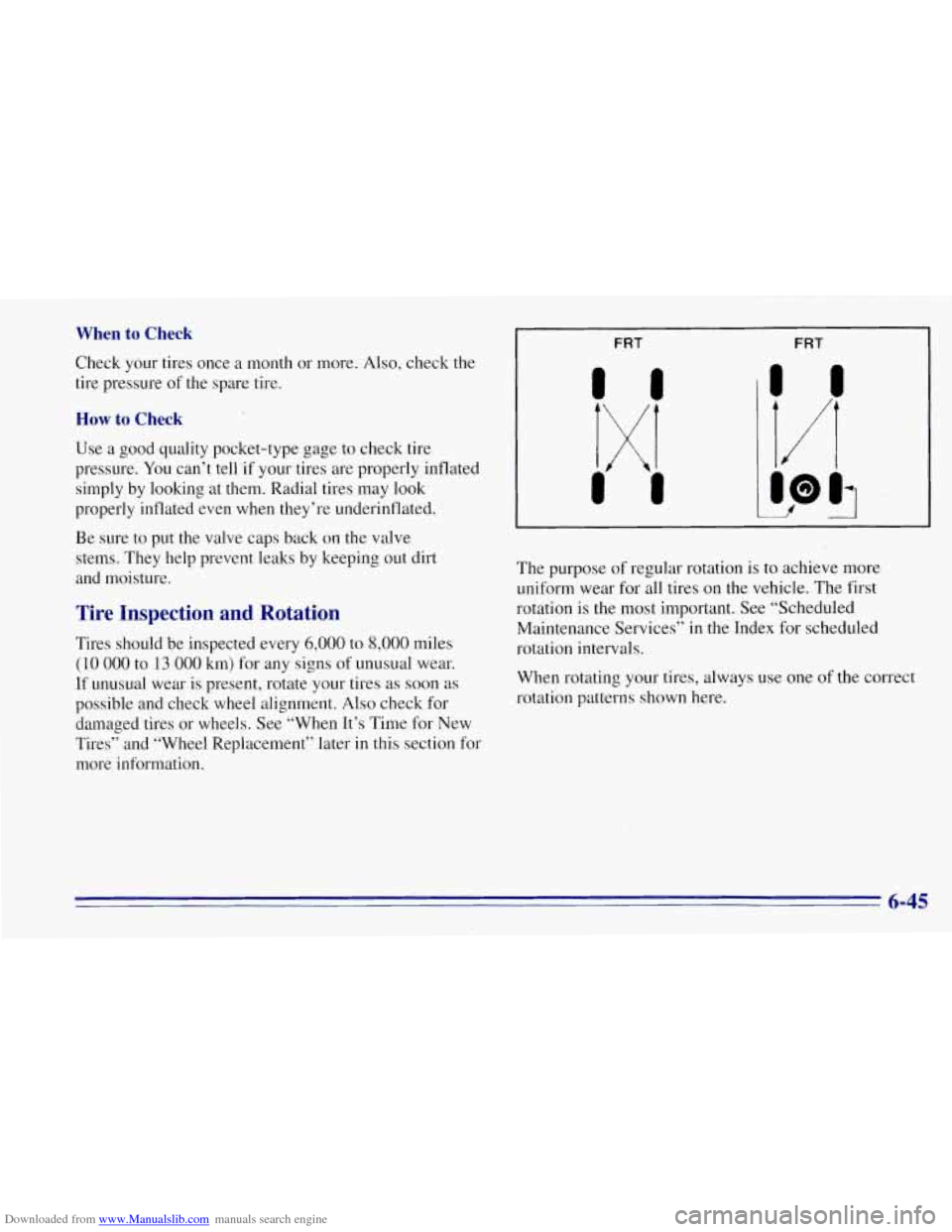
When rotating your tires, always use one
of the correct
rotation patterns shown here.
6-45
Page 299 of 403
Downloaded from www.Manualslib.com manuals search engine After the tires have been rotated, adjust the front and rear inflation pressures as shown on the Certificatioflire label.
Make certain that all. wheel nuts are properly tightened. See “Wheel
Nut Torque” in the Index.
A
/! CAUTION:
Rust or dirt on a wheel, or on the parts to which
it is fastened, can make wheel nuts become
loose
after a time. The wheel could come off and cause
an accident. When you change a wheel, remove
any rust or dirt from places where the wheel
attaches
to the vehicle. In an emergency, you can
use
a cloth or a paper towel to do this; but be
sure to
use a scraper or wire brush later, if you
need to, to get all the rust or dirt
off. (See
“Changing a Flat Tire” in the Index.) When
It’s Time for New Tires
You need a new tire if any o
are true: One
way to
tell when it’s
time for new tires is
to
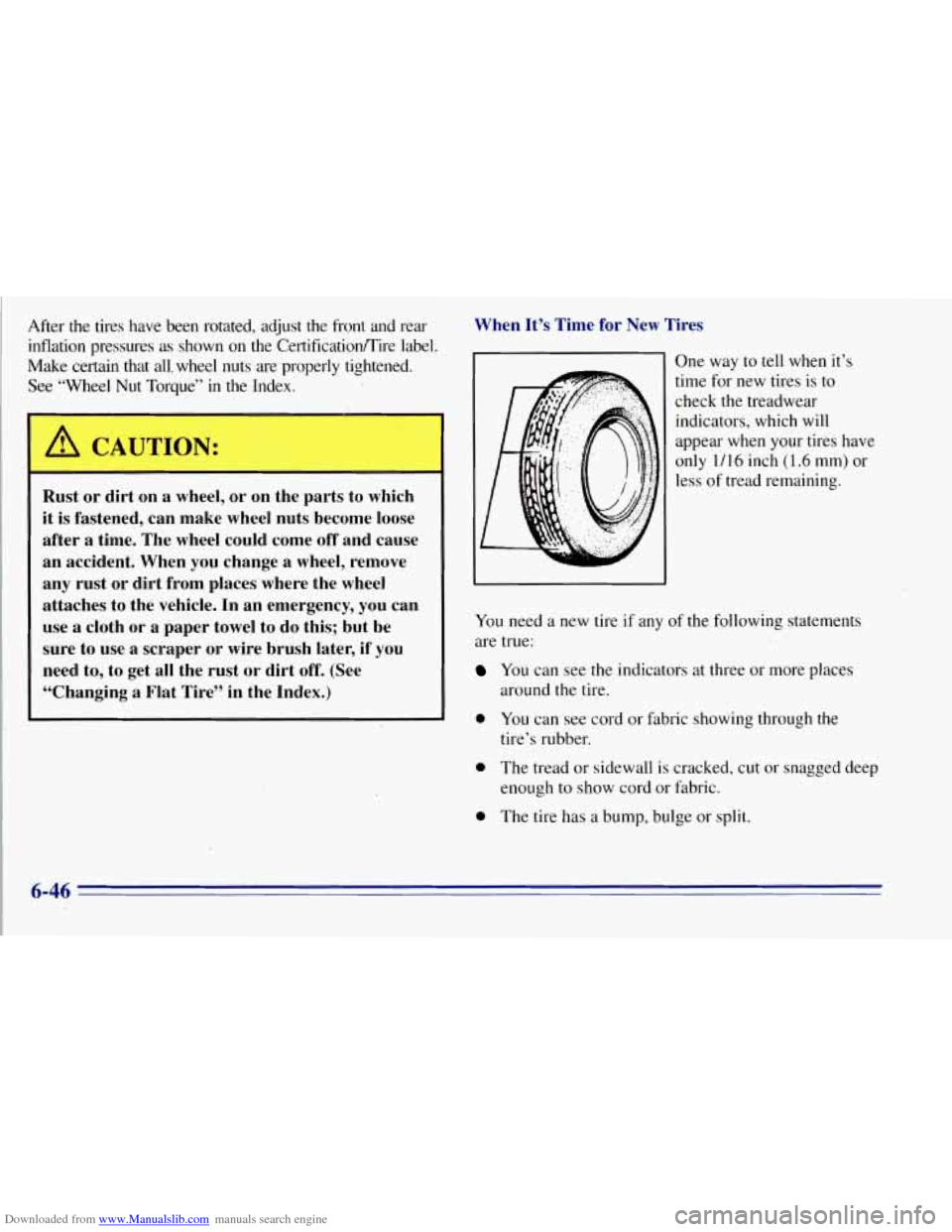
check the treadwear
indicators, which will
appear when your tires have
only
1/16 inch (1.6 mm) or
less of tread remaining.
f rh Ile following statements
You can see the indicators at three or more places
around the tire.
0 You can see cord or fabric showing through the
tire’s rubber.
0 The tread or sidewall is cracked, cut or snagged deep
enough to show cord or fabric.
0 The tire has a bump, bulge or split.
6-46
Page 308 of 403
Downloaded from www.Manualslib.com manuals search engine Care of Safety Belts
Keep belts clean and dry.
A CAUTIOl.,
Do not bleach or dye safety belts. If you do, it
may severely weaken them.
In a crash, they
might not be able to provide adequate protection. Clean safety belts only with mild soap and
lukewarm water.
Glass
Glass should be cleaned often. GM Glass Cleaner (GM
Part No. 1050427) or a liquid household glass cleaner
will remove normal tobacco smoke and dust films.
Don’t use abrasive cleaners on glass, because they may
cause scratches. Avoid placing decals on the inside rear
window, since they may have to be scraped off later.
If abrasive cleaners are used on the inside of the rear
window, an electric defogger element may be damaged.
Any temporary license should not be attached across the
defogger grid.
Cleaning the Outside of the Windshield,
Batklass and Wiper Blades
If the windshield is not clear after using the windshield
washer, or if the wiper blade chatters when running, wax
or other material may be on the blade or windshield.
Clean the outside
of the windshield with GM
Windshield Cleaner, Bon-Ami Powder@’ (GM Part
No. 105001 1). The windshield is-clean if beads do not
form when
you rinse it with water.
Clean the blade by wiping vigorously with a cloth
soaked in full-strength windshield washer solvent.
Then rinse the blade with water.
Wiper blades .should be checked
on a regular basis and
replaced when worn.
Weatherstrips
Silicone grease on weatherstrips will make them last
longer, seal better, and not stick or squeak. Apply
silicone grease with a clean cloth at least every six
months. During very cold, damp weather more frequent
application may
be required. (See “Recommended
Fluids and Lubricants” in the Index,)
6-55
Page 314 of 403
Downloaded from www.Manualslib.com manuals search engine Electrical System
Add-on Electrical Equipment
NOTICE:
Don’t add anyth’ing electrical to your vehicle
unless you check with your dealer first. Some
electrical equipment can damage your vehicle
and the damage wouldn’t be covered by your
warranty. Some add-on electrical equipment
can keep other components from working
as
they should.
Your vehicle has an air bag system. Before attempting to
add anything electrical to your vehicle, see “Servicing
Your Air Bag-Equipped Vehicle” in the Index.
Headlamps
The headlamp wiring is protected by a circuit breaker in
the lamp switch. An electrical overload will cause the
lamps
to flicker on and off, or in some cases to remain
off. If this happens, have your headlamp wiring checked
right away.
Windshield Wipers
The windshield wiper motor is protected by a circuit
breaker and a fuse. If the motor overheats due
to heavy
snow, etc,, the wiper will stop until the motor cools.
Although the’circuit is protected from electrical
overload, overload due to heavy snow, etc., may cause
wiper linkage damage. Always clear ice and heavy snow
from the
the windshield before using the windshield
wipers. If the overload is caused by some electrical
problem and not
snow, etc., be sure to get it fixed.
6-61
Page 318 of 403
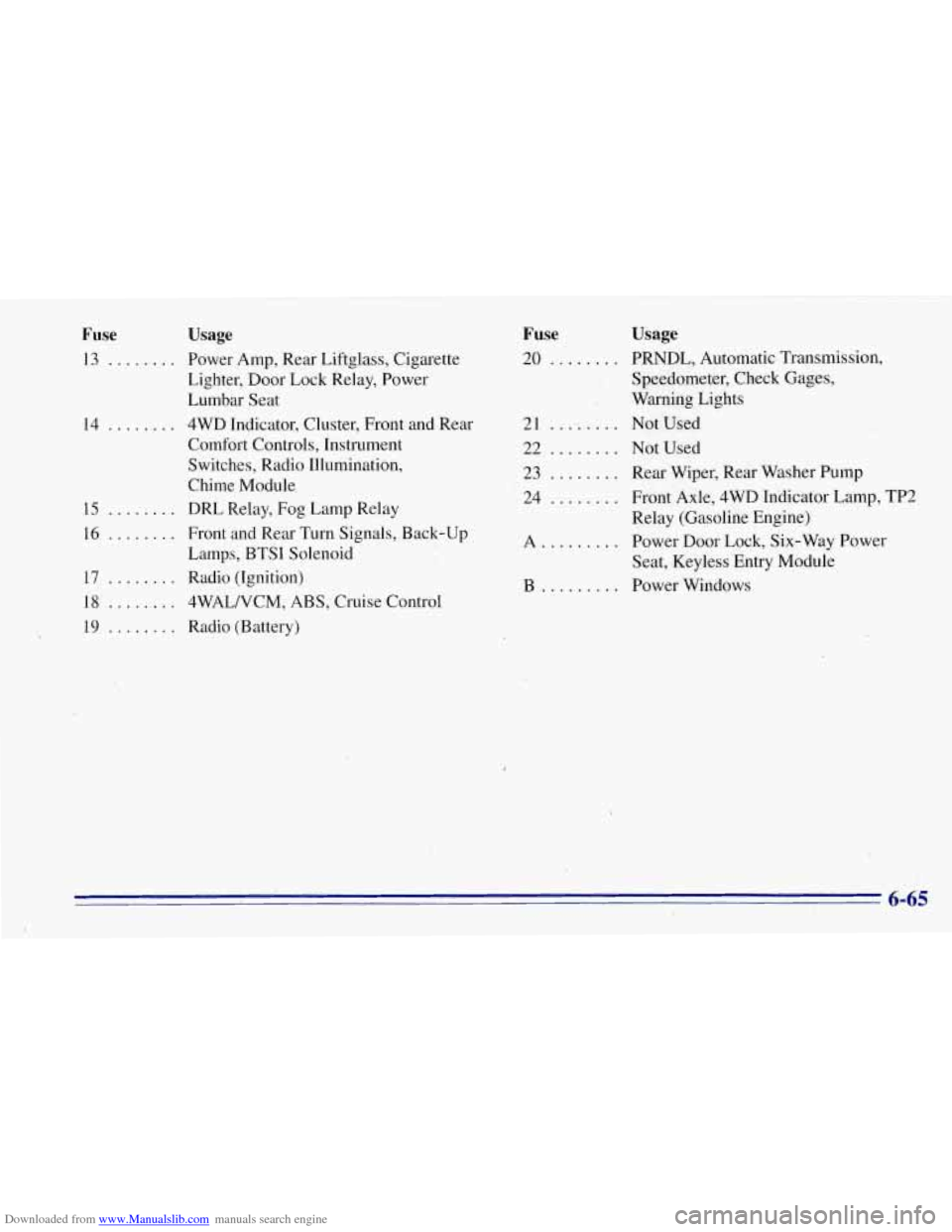
Downloaded from www.Manualslib.com manuals search engine Fuse Usage
13 ........ Power Amp, Rear Liftglass, Cigarette
Lighter, Door Lock Relay, Power
Lumbar Seat
Comfort Controls, instrument
Switches, Radio Illumination,
Chime Module
15
........ DRL Relay, Fog Lamp Relay
16
........ Front and Rear Turn Signals, Back-up
Lamps, BTSI Solenoid
17
........ Radio (Ignition)
18
........ 4WAL/VCM, ABS, Cruise Control
19
........ Radio (Battery)
14
........ 4WD Indicator, Cluster,
Front and Rear
Fuse Usage
20 ........ PRNDL, Automatic Transmission,
4. ,,/ J - ;c- ; Speedometer, Check Gages, .. '.. - *. 1'). 'I :,,:-: . .-.?Warning ,. Lights .- .
21 ........ Not Used
22
........ Not Used
23
........ Rear Wiper, Rear Washer Pump
24
........ Front Axle, 4WD Indicator Lamp, TP2
Relay (Gasoline Engine)
A ......... Power Door Lock, Six-Way Power
Seat, Keyless Entry Module
B ......... Power Windows
6-65
Page 325 of 403
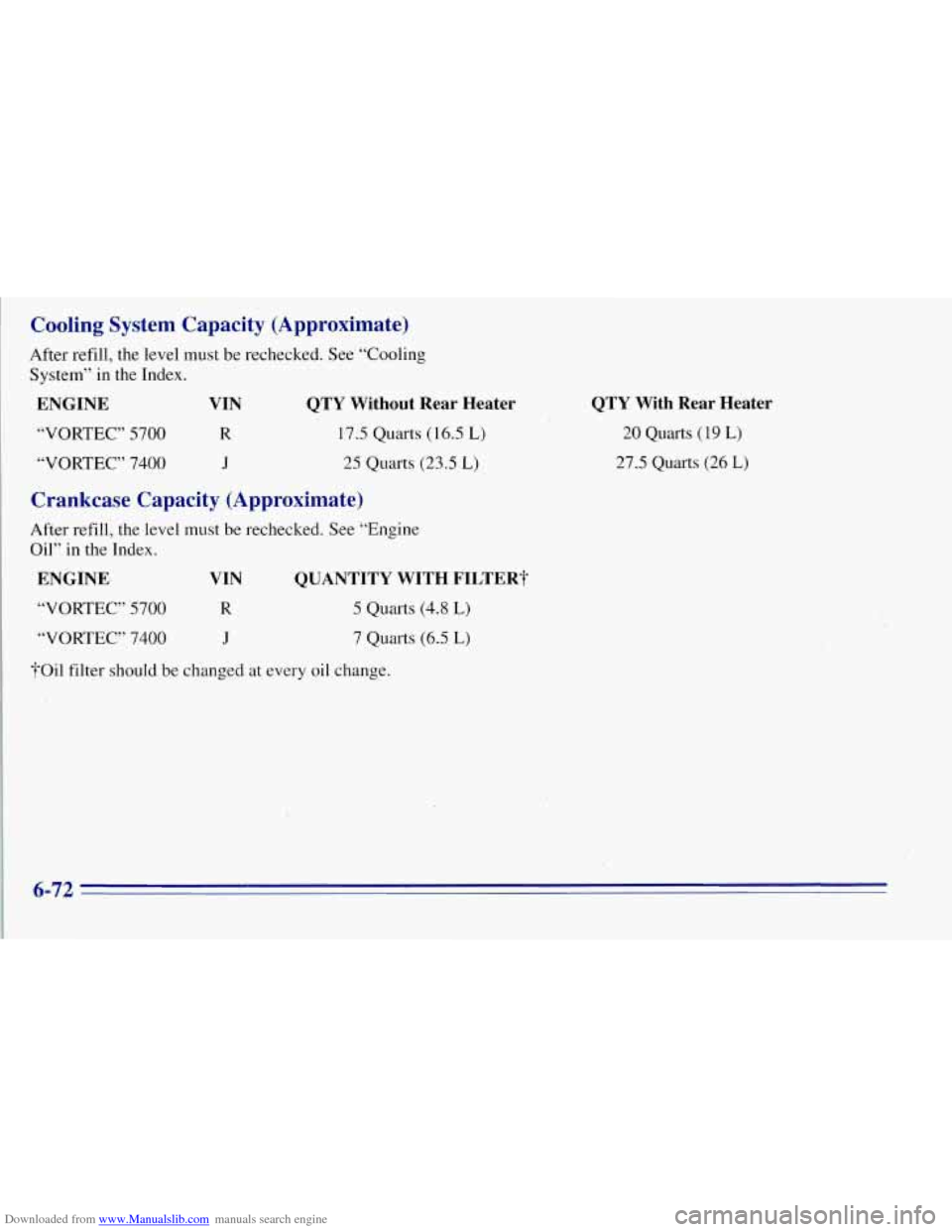
Downloaded from www.Manualslib.com manuals search engine Cooling System Capacity (Approximate)
After refill, the level must be rechecked. See “Cooling
System” in the Index.
ENGINE VIN QTY Without Rear Heater
“VORTEC” 5700
R 17.5 Quarts (1615 L)
“VORTEC” 7400 J 25 Quarts (23.5 L)
Crankcase Capacity (Approximate)
After refill, the level must be rechecked. See “Engine
Oil” in the Index.
ENGINE, VIN QUANTITY WITH FILTER?
“VORTEC” 5700 R 5 Quarts (4.8 L)
“VORTEC” 7400 J 7 Quarts (6.5 L)
?Oil filter should be changed at every oil change.
QTY With Rear Heater
20 Quarts (19 L)
27.5 Quarts (26 L)
6-72
Page 329 of 403
Downloaded from www.Manualslib.com manuals search engine How This Section is Organized
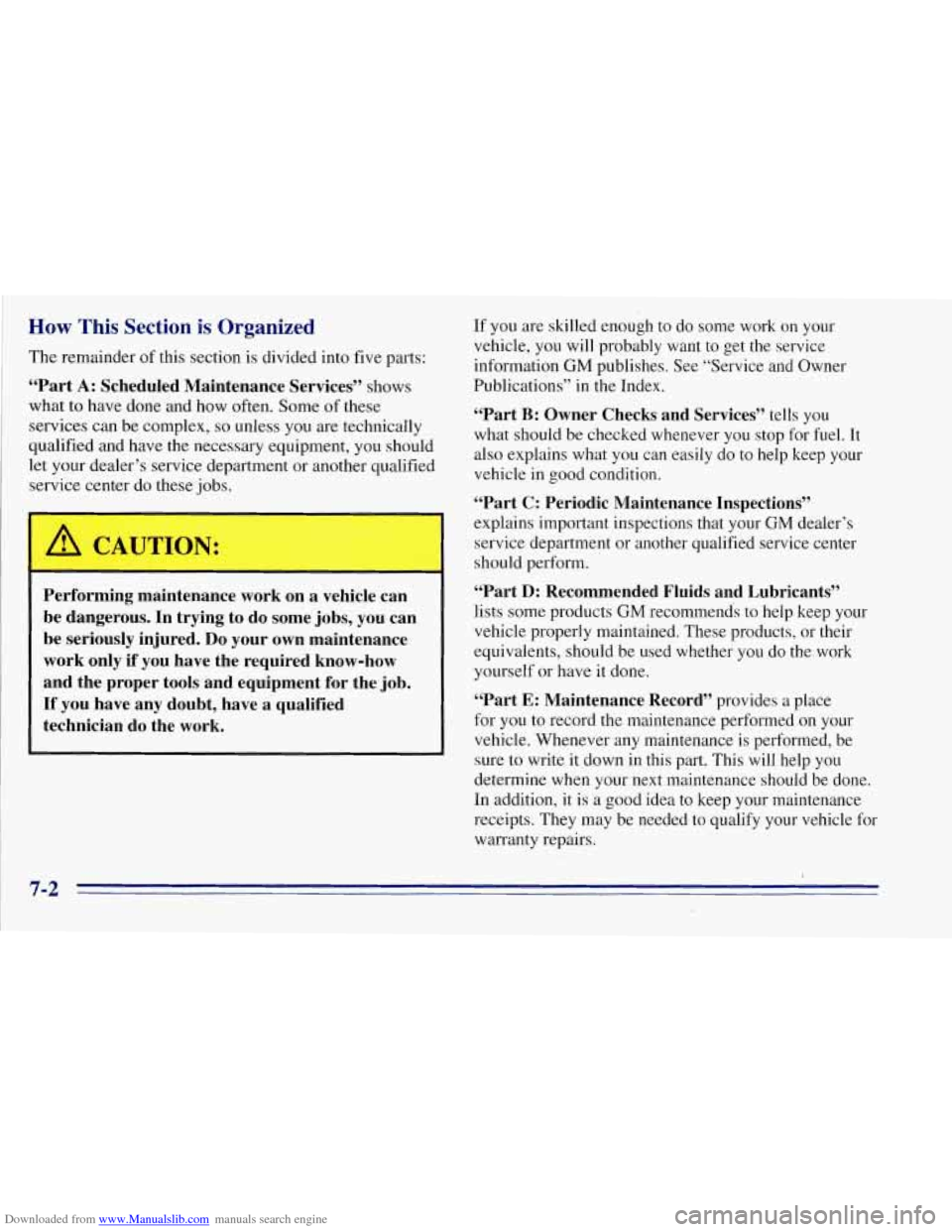
The remainder of this section is divided into five parts:
“Part A: Scheduled Maintenance Services” shows
what to h-ave done and how often. Some
of these
services can be complex,
so unless you are technically
qualified and have the necessary equipment,
you should
let your dealer’s service department or another qualified
service center
do these jobs.
A CAUTION:
I
If you are skilled enough to do some work on your
vehicle, you will probably want to get
the service
information
GM publishes. See “Service and Owner
Publications”
in the Index.
“Part B: Owner Checks and Services” tells you
what should be checked whenever you stop for fuel. It
also explains what you can easily do to help keep your
vehicle in good condition.
“Part C: Periodic Maintenance Inspections”
explains important inspections that your GM dealer’s
service department or another qualified service center
should perform.
Performing maintenance work on a vehicle can “Part D: Recommended Fluids and Lubricants”
be dangerous. In trying to do some jobs, you can
be seriously injured.
Do your own maintenance
work only
if you have the required know-how
’ and the proper tools and equipment for the job.
If.you have any doubt, have a qualified “Part
E: Maintenance Record” provides a place
technician do the work.
lists some products GM recommends to help keep your
vehicle properly maintained. These products, or their
equivalents, should be used whether you do the.work
yourself or have
it done.
for
you to record the maintenance performed on your
vehicle. Whenever any maintenance is performed, be
I I sure to write it down in this part. This will help you
determine when your next maintenance should be done.
In addition, it is a good idea to keep your maintenance
receipts. They may be needed to qualify your vehicle for
warranty repairs.
Page 330 of 403
Downloaded from www.Manualslib.com manuals search engine Part A:’ Scheduled-Maintenance
Services
Using Your Maintenance Schedule
We at General Motors want to help you keep your vehicle
in good working condition. But we don’t know exactly
how you’ll drive it. You may drive very
short distances
only a few times a week. Or you may drive long
distances all the time in very hot, dusty weather. You may
use your vehicle in making deliveries. Or you may drive
it to work, to do en-ands or in many other ways.
Because
of all the different ways people use their GM
vehicles, maintenance needs vary.
You may even need
more frequent checks and replacements than you’ll find
in the schedules
in this section. So please read this
section and note how you drive.
If you have any
questions on how to keep your vehicle in good
condition, see your GM dealer.
This part tells you the maintenance services you should
have done and when
you should schedule them. If you
go to your dealer for your service needs, you’ll know
that GM-trained and supported service people will
perform the work using genuine GM parts.
The proper fluids and lubricants to use are listed in Part
D. Make sure whoever services your vehicle uses these. All
parts should be replaced and all necessary repairs
done before you or anyone else drives the vehicle.
These schedules are for vehicles that:
0
0
0
0
carry passengers and cargo within recommended
limits. You will find these limits
on your vehicle’s
CertificatiodTire label. See “Loading Your Vehicle”
in the Index.
are driven on reasonable road surfaces within legal
driving limits.
are driven off-road in the recommended manner. See
“Off-Road Driving With Your Four-Wheel-Drive
Vehicle” in the Index.
use the recommended fuel. See “Fuel” in the Index.
Selecting the Right Schedule
First you’ll need to decide which of the two schedules is
right for your vehicle. Here’s how to decide which
schedule to follow:
Gasoline engine vehicles and diesel engine vehicles
have different maintenance requirements.
If you have a
diesel engine, follow a schedule designated for diesel
engine vehicles only.
See the Diesel Engine Supplement for diesel engine
maintenance schedules.
7-3