check engine CHEVROLET TAHOE 1996 1.G Owners Manual
[x] Cancel search | Manufacturer: CHEVROLET, Model Year: 1996, Model line: TAHOE, Model: CHEVROLET TAHOE 1996 1.GPages: 403, PDF Size: 20.63 MB
Page 19 of 403
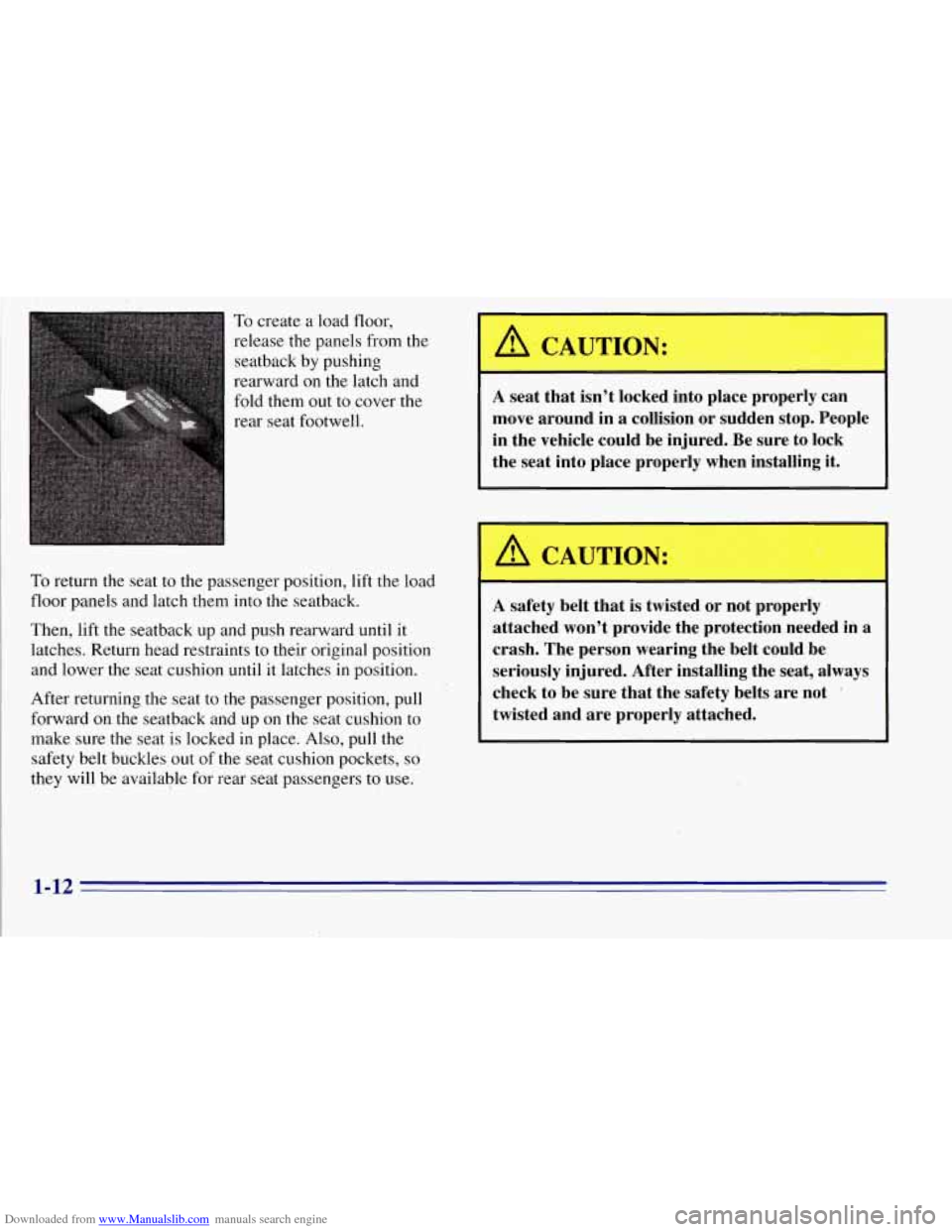
Downloaded from www.Manualslib.com manuals search engine To create a load floor,
release the panels from the
seatback by pushing
rearward on the latch and
fold them out to cover the
rear seat footwell.
To return the seat to the passenger position, lift the load
floor panels and latch them into the seatback.
Then, lift the seatback up and push rearward until it
latches. Return head restraints to their original position
and lower the seat cushion until it latches in position.
After returning the seat
to the passenger position, pull
forward on the seatback and up on the seat cushion to
make sure the seat is locked in place. Also, pull the
safety belt buckles out
of the seat cushion pockets, so
they will be available for rear seat passengers to use.
A CAUTION:
A seat that isq’t locked into place properly can
move around in
a collision or sudden stop. People
in the vehicle could be injured. Be sure to lock
the seat into place properly when installing it.
r
A safety belt that is twisted or not properly
attached won’t provide the protection needed in a
crash. The person wearing the belt could be
seriously injured. After installing the seat, always
check to be sure that the safety belts are not
‘
twisted and are properly attached.
1-12
Page 23 of 403
Downloaded from www.Manualslib.com manuals search engine Replacing the Rear Seat Safety Belts: They’re for Everyone
To put the seat back in, hold the seat sideways and put it This part of the manual tells you how to use safety belts
into the vehicle. Turn the seat to the forward position properly. It also tells you some things you should not do
and set it down, with the latches at the bottom of the seat with safety belts.
over the hooks in the floor. Pull up on the center ,release
handle and let the seat drop into place. Release the And it explains the Supplemental Inflatable Restraint
handle to let the seat latch close and make sure it locks
‘.(SIR), or air bag system.
into place. Then, move the seatback release lever at the
right rear of the seat toward the center of the vehicle and
raise the seatback.
After returning the seatback
to the upright position, push
the seatback forward to make sure it is locked in place.
Then, return the outside passenger position safety belts
to the seat frame buckles,
so they will be available for
rear seat passengers to use.
Don’t let anyone ride where he or she can’t wear
a safety belt properly. If you are in a crash and
you’re not wearing
a safety belt, your injuries
can be much worse. You can hit things inside the
vehicle or be ejected from it. You can be seriously
injured or killed. In the same crash, you might
not be if you are buckled up. Always fasten your
safety belt, and check that your passengers’ belts
are fastened properly too.
1-16
Page 37 of 403
Downloaded from www.Manualslib.com manuals search engine A CAUTION:
Air bags inflate with great force, faster than the
blink of an eye.
If you’re too close to an inflating
air bag, it could seriously injure you. Safety belts
help keep you in position for an air bag inflation
in a crash. Always wear your safety belt, even
with
an air bag, and sit as far back as you can
while still maintaining control
of your vehicle.
AIR
BAG
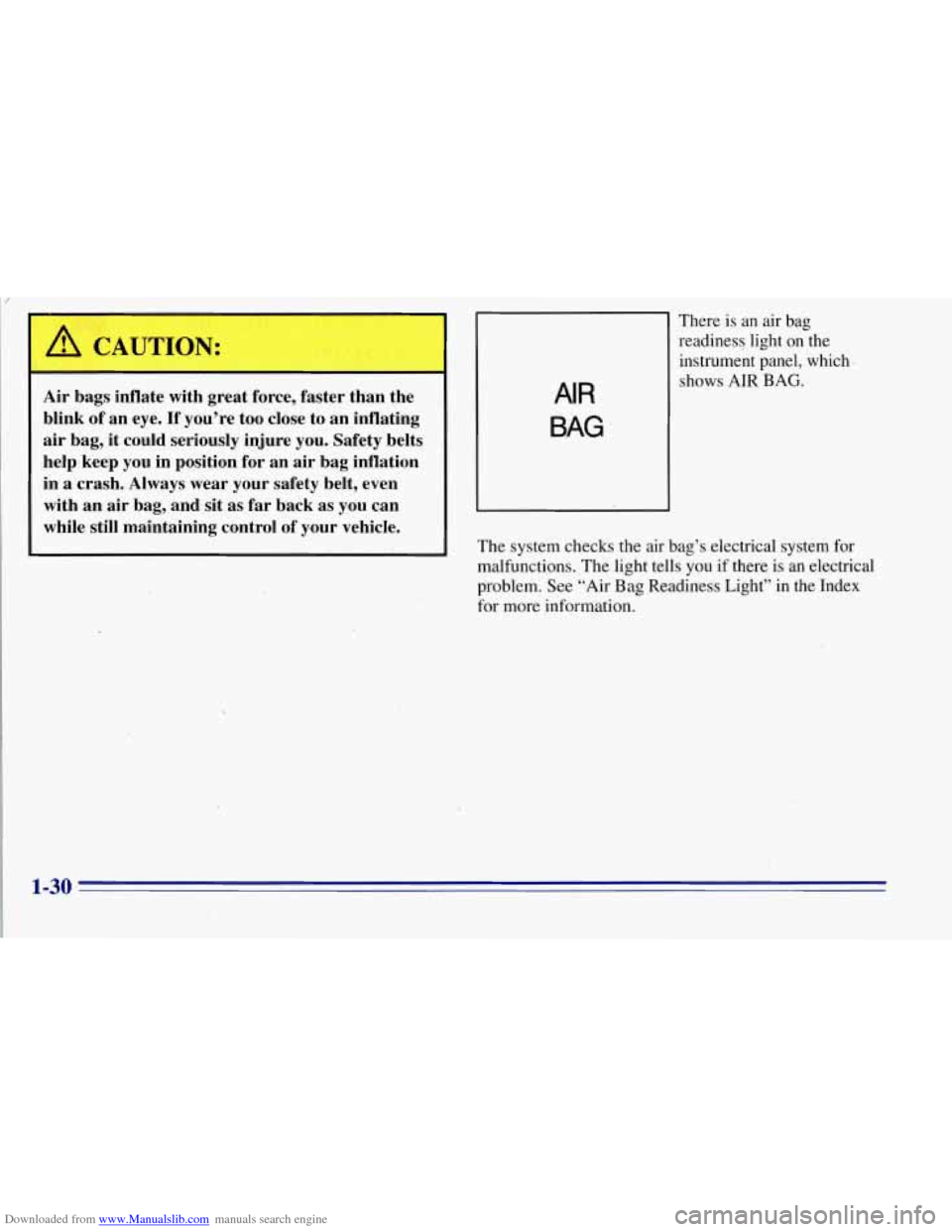
There is an air bag
readiness light on the
instrument panel, which
shows AIR BAG.
~
I The system checks the air bag’s electrical system for
malfunctions. The light tells you
if there is an electrical
problem. See “Air Bag Readiness Light” in the Index
for more information.
1-30
Page 62 of 403
Downloaded from www.Manualslib.com manuals search engine /i CAUTION:
Safety Belt Extender
If the vehicle’s safety belt will fasten around you, you
should use it.
Never do this.
Here a child is sitting in a seat that has a
lap-shoulder belt, but the shoulder part is behind the child. If the child wears the belt in this way, in
a crash the child might slide under the belt. The
belt’s force would then be applied right on the child’s abdomen. That could cause serious or
fatal injuries. ~ But if a safety belt isn’t long enough to fasten, your
’ dealer will order you an extender. It’s free. When you go
in
to order it, take the heaviest coat you will wear, so the
extender will be long enough for you. The extender will
be just for you, and just for the seat
in your vehicle that
you choose. Don’t let someone else use
it, and use it
only for the seat it is made to fit. To wear it, just attach it
to the regular safety belt.
I I Checking Your Restraint Systems
Wherever the child sits, the lap portion of the belt Now
and then, make sure the safety belt reminder light
should be worn low and snug on the hips, just touching and all your belts, buckles, latch plates, retractors and
the child’s thighs. This applies belt force
to the child’s anchorages
are working properly. Look for any other
pelvic bones in a crash. loose or damaged safety belt system parts. If you see
anything that might keep a safety belt system from
doing its job, have it repaired.
Torn or frayed safety belts may not protect
you in a
crash. They can rip apart under impact forces. If a belt is
torn or frayed, get a new one right away.
Also look for any opened or broken air bag covers, and
have them repaired or replaced. (The air bag system
does not need regular maintenance.)
1-55
Page 67 of 403
Downloaded from www.Manualslib.com manuals search engine Keyless Entry System (Option)
If your vehicle has this option, you can lock and unlock
your doors or your tailgate from up to
30 feet (9 m)
away using the key chain transmitter supplied with
your vehicle.
Your Keyless Entry System operates on a radio
frequency subject to Federal Communications
Commission (FCC) Rules.
This device complies with Part
15 of the FCC Rules.
Operation is subject to the following two conditions:
(1) This device may not cause harmful interference,
and
(2) This device must accept any interference
received, including interference that may cause
undesired operation.
Should interference to this system occur, try this:
Check to determine if battery replacement is
necessary. See the instructions
on battery replacement.
0 Check the distance. You may be too far from your
vehicle. This product has a maximum range.
Check the location. Other vehicles or objects may
be blocking the signal.
See your GM dealer or a qualified technician for service.
Changes or modifications to this system by other than an
authorized service facility could void authorization to
use this equipment.
Operation
To unlock the driver’s door, press the UNLOCK button.
If you press this button again within five seconds, all the
doors will unlock. Press the
REAR button to unlock the
rear door only, or to release the tailgate glass.
Press the LOCK button to lock all the doors.
When the UNLOCK button is pushed, the interior dome
lamps are turned on for
40 seconds or until the ignition
switch is activated.
When the LOCK button is pushed, the interior lamps
are turned on for two seconds
if the doors are closed.
If the LOCK button is pushed when a door is open, the
interior lamps will stay on for two seconds after the door
is closed.
Page 70 of 403
Downloaded from www.Manualslib.com manuals search engine Tailgate Glass and Tailgate
If your vehicle has a tailgate, you must raise the rear
glass before lowering the tailgate.
To open the glass from the outside, use your key. With
the key in the lock, turn the key clockwise to release the
glass, then lift
it up.
To release the glass from the inside, use the electric
tailgate glass release switch on the instrument panel. For
more information, see “Tailgate
-- Electric Glass
Release” in the Index.
Open the tailgate by lifting up on the handle while
pulling the tailgate toward you.
Close the tailgate before closing the rear glass. After
closing, make sure the tailgate is securely latched by
pulling it toward you. After closing the rear glass, pull
up on its handle to make sure it is locked.
Panel Doors
To open the rear panel doors, you must open the
passenger’s side door first. If the door is locked, insert
your door key in the lock and turn it counterclockwise to
unlock it.
To open the passenger’s side door, pull up on the handle
and pull the door open.
To open the driver’s side door, first open the passenger’s
side, door. Then, pull the handle on the left door edge out
and pull the door open.
The rear doors have a check assembly
to keep them
from fully opening during normal use. Tofully open
either rear door, you must release the check strap.
First, open the door partway until the white mark on the
check strap is fully outside the door edge. If the end of
the strap catches the pin on the door, the door
is open
too far.
2-7
Page 71 of 403
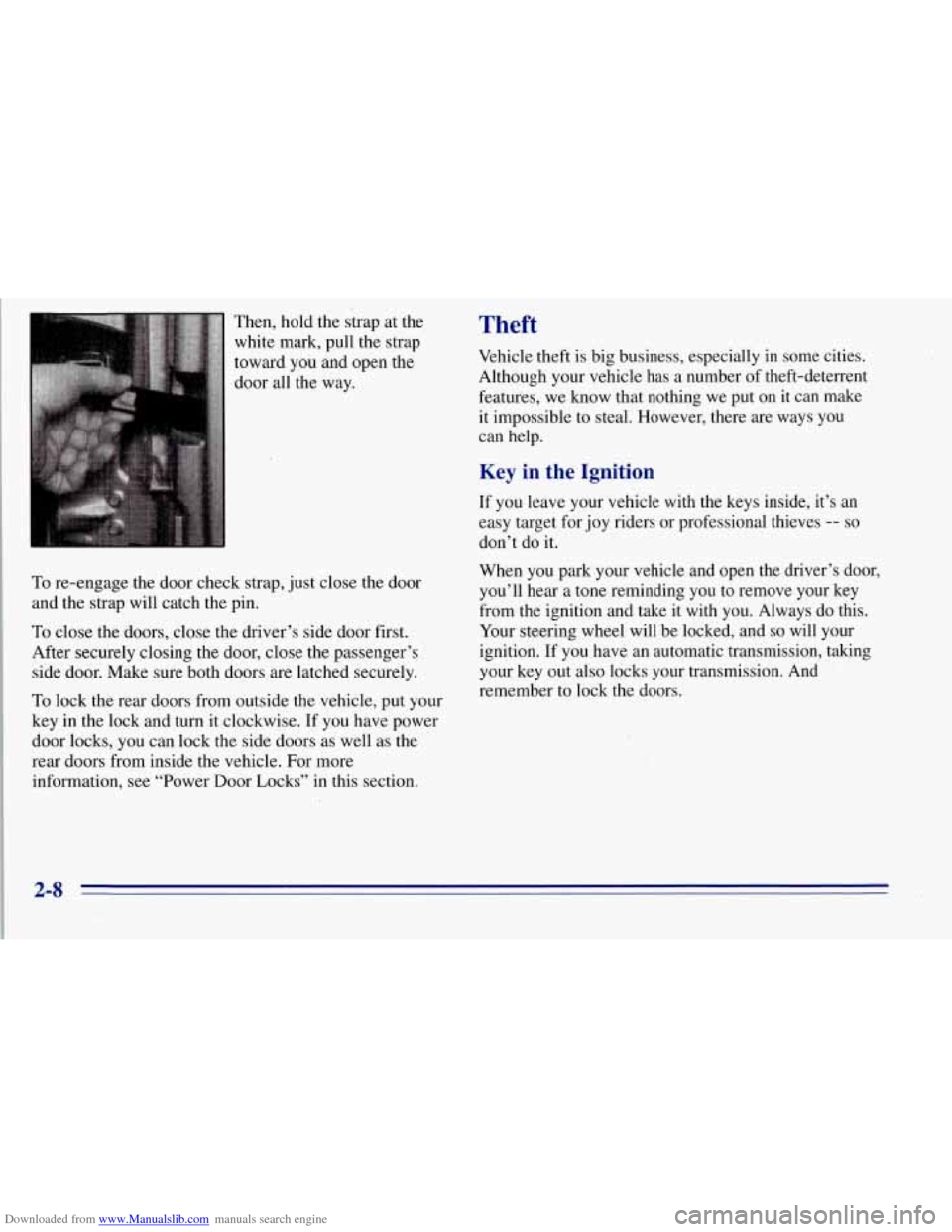
Downloaded from www.Manualslib.com manuals search engine Then, hold the strap at the
white mark, pull the strap
toward you and open the
door all the way.
To re-engage the door check strap, just close the door
and the strap will catch the pin.
To close the .doors, close the driver’s side door first.
After securely closing the door, close the passenger’s
side door. Make sure both doors
are latched securely.
To lock the rear doors from outside the vehicle, put your
key in the lock and turn it clockwise. If you have power
door locks, you can lock the side doors as well as the
rear doors from inside the vehicle. For more
information, see “Power Door Locks” in this section.
Theft
Vehicle theft is big business, especially in some cities.
Although your vehicle
has a number of theft-deterrent
features, we
know that nothing we put on it can make
it impossible
to steal. However, there are ways you
can help.
Key in the Ignition
If you leave your vehicle with the keys inside, it’s an
easy target for joy riders or professional thieves -- so
don”t do it.
When you park your vehicle and open the driver’s door,
you’ll hear a tone reminding you to remove your key
from the ignition and take it with you. Always do this.
Your steering wheel will be locked, and
so will your
ignition.
If you have an automatic transmission, taking
your key
out also locks your transmission. And
remember to lock the doors.
34
Page 75 of 403
Downloaded from www.Manualslib.com manuals search engine 3. If your enginestill won’t start (or starts but then
stops), wait
15 seconds and start over.
When
the engine starts, let go of the key and the
accelerator pedal.
NOTICE:
Your engine is designed to work with the
electronics in your vehicle.
If you add electrical
parts or accessories, you could change the way
the engine operates. Before adding electrical
equipment, check with your dealer.
If you don’t,
your engine might not perform properly.
If you ever have to have your vehicle towed, see
the part of this manual that tells how to do it
without damaging your vehicle. See “Towing
Your Vehicle’’ in the Index.
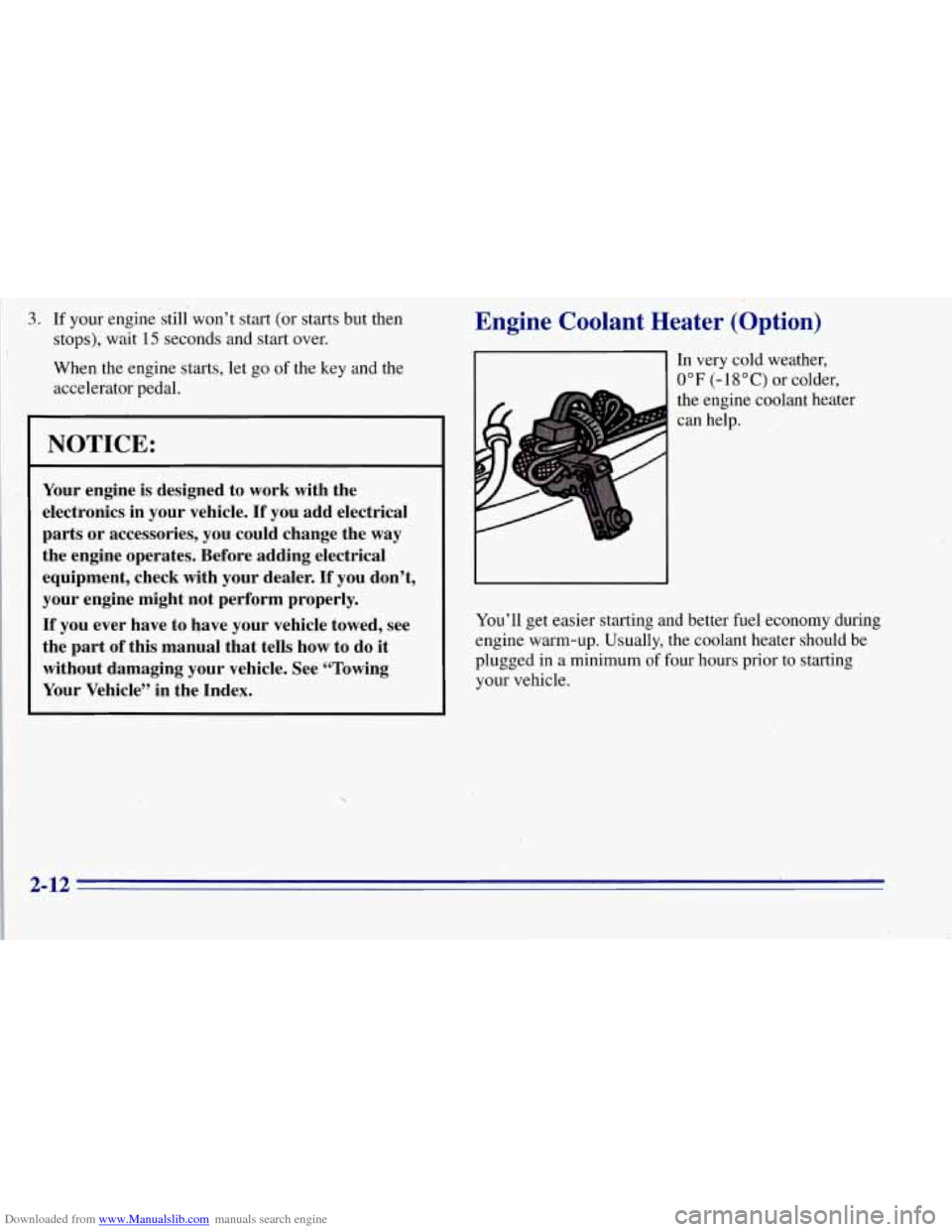
Engine Coolant Heater (Option)
c
In very cold weather,
0°F (-lS°C) or colder,
the engine coolant heater
can help.
You’ll get easier starting and better fuel economy during
engine warm-up. Usually, the coolant heater should be
plugged in a minimum of four hours prior to starting
your vehicle.
2-12
Page 81 of 403
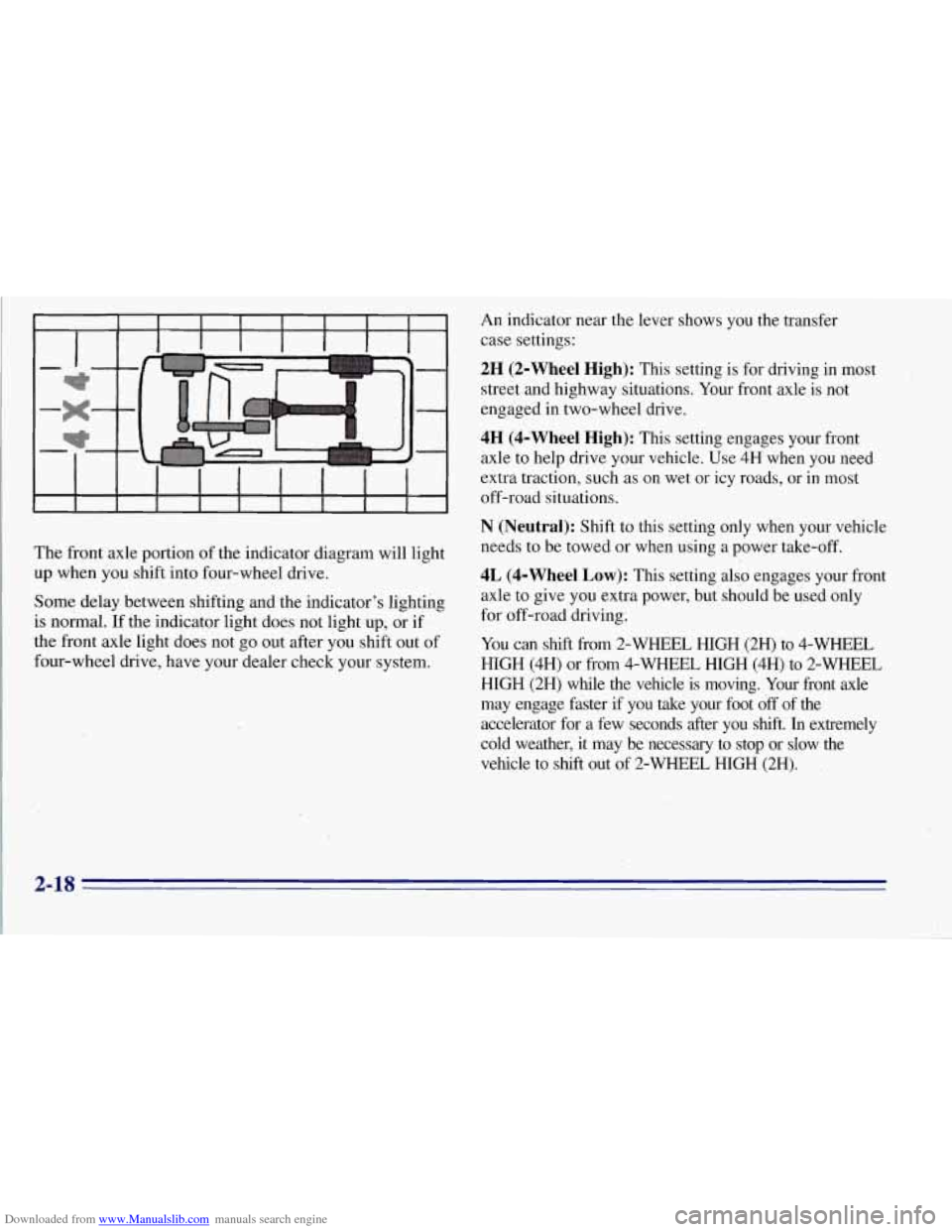
Downloaded from www.Manualslib.com manuals search engine The front axle portion of the indicator diagram will light
up when you shift into four-wheel drive.
Some delay between shifting and the indicator's lighting
is normal. If the indicator light does not light up, or if
the front axle light does not go out after you shift out of
four-wheel drive, have your dealer check your system.
An indicator near the lever shows you the transfer
case settings:
2H (2-Wheel High): This setting is for driving in most
street and highway situations. Your front axle is not
engaged in two-wheel drive.
4H (4-Wheel High): This setting engages your front
axle
to help drive your vehicle. Use 4H when you need
extra traction, such as on wet
or icy roads, or in most
off-road situations.
N '(Neutral): Shift to this setting only when your vehicle
needs to be towed or when using a power take-off.
4L (4-Wheel Low): This setting also engages your front
axle to give you extra power, but should be used- only
for off-road driving.
You can shift from 2-WHEEL HIGH (2H) to 4-WHEEL
HIGH (4H) or from 4-WHEEL HIGH (4H) to 2-WHEEL
HIGH
(2H) while the vehicle is moving. Your front axle
may engage faster if you take
your foot off of the
accelerator for a few seconds after you shift.
In extremely
cold weather, it may be necessary to stop or slow the
vehicle to
shift out of 2-WHEEL HIGH (2H). .
,
2-18
Page 93 of 403
Downloaded from www.Manualslib.com manuals search engine If you move the lever all the way up or down and
the arrow flashes at twice the normal rate, a signal
bulb may be burned out and other drivers may not see
your turn signal.
If a bulb is burned out, replace it to help avoid an
accident. If the arrows don’t go on at all when you
signal a turn, check for burned-out bulbs and a blown
fuse (see “Fuses” in the Index).
Headlamp HighLow Beam Changer
To change the headlamps from low beam to high or high
to low, pull the turn signal lever all the way toward you.
Then release it.
When the high beams
are
on, this light on the
instrument panel also
will be on.
Windshield Wipers
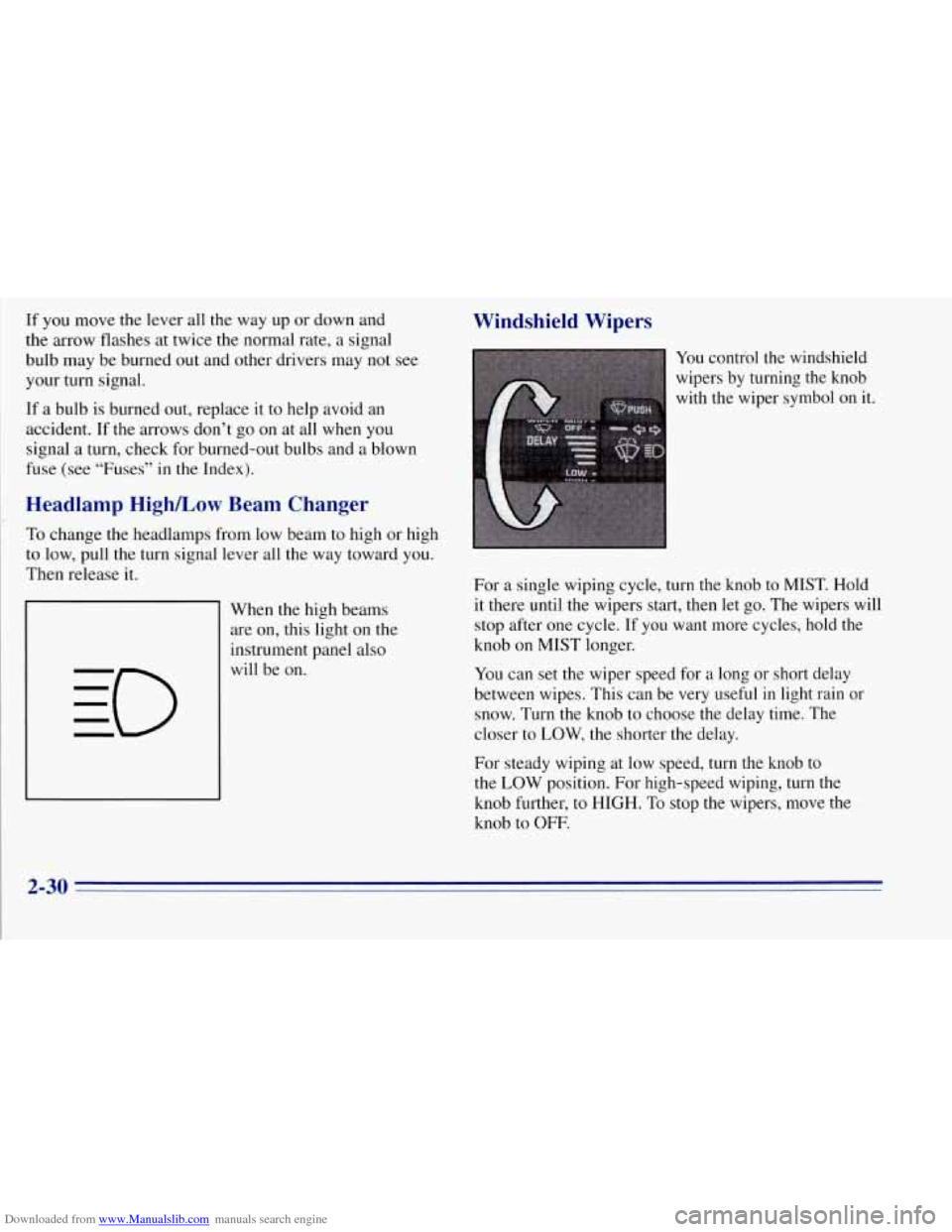
You control the windshield
wipers by turning the knob
with the wiper symbol on it.
For a single wiping cycle, turn the knob to MIST. Hold
it there until the wipers start, then let go. The wipers will
stop after
one cycle. If you want more cycles, hold the
knob on MIST longer.
You can set the wiper speed for a long
or short delay
between wipes. This can be very useful in light rain
or
snow. Turn the knob to choose the delay time. The
closer
to LOW, the shorter the delay.
For steady wiping at
low speed, turn the knob to
the
LOW position. For high-speed wiping, turn the
knob further, to
HIGH. To stop the wipers, move the.
knob to OFF.
2-30 -