cooling CHEVROLET TAHOE 2003 2.G Owner's Manual
[x] Cancel search | Manufacturer: CHEVROLET, Model Year: 2003, Model line: TAHOE, Model: CHEVROLET TAHOE 2003 2.GPages: 552, PDF Size: 3.44 MB
Page 415 of 552
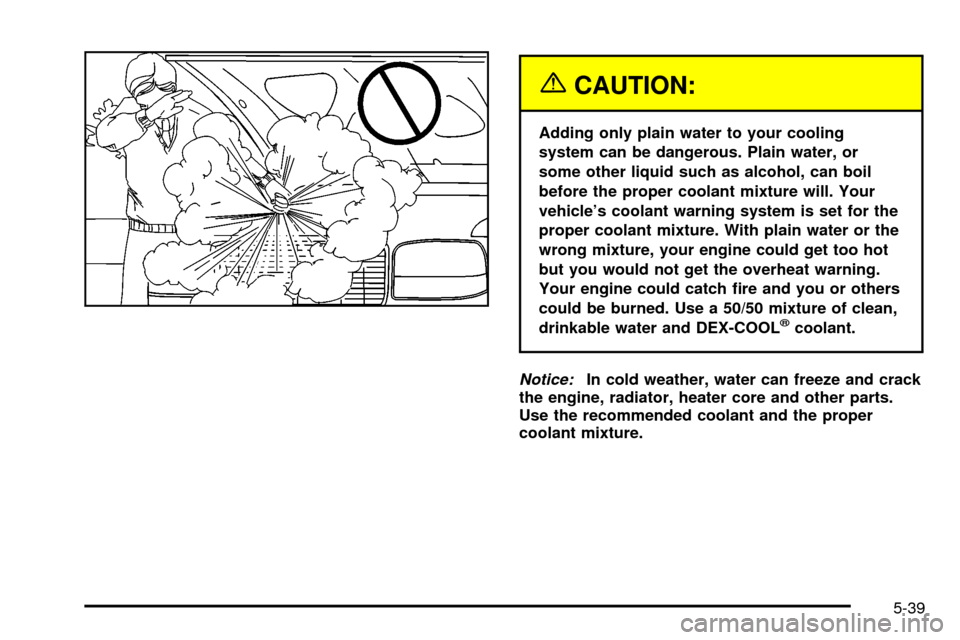
{CAUTION:
Adding only plain water to your cooling
system can be dangerous. Plain water, or
some other liquid such as alcohol, can boil
before the proper coolant mixture will. Your
vehicle's coolant warning system is set for the
proper coolant mixture. With plain water or the
wrong mixture, your engine could get too hot
but you would not get the overheat warning.
Your engine could catch ®re and you or others
could be burned. Use a 50/50 mixture of clean,
drinkable water and DEX-COOL
žcoolant.
Notice:In cold weather, water can freeze and crack
the engine, radiator, heater core and other parts.
Use the recommended coolant and the proper
coolant mixture.
5-39
Page 416 of 552
{CAUTION:
You can be burned if you spill coolant on hot
engine parts. Coolant contains ethylene glycol
and it will burn if the engine parts are hot
enough. Do not spill coolant on a hot engine.
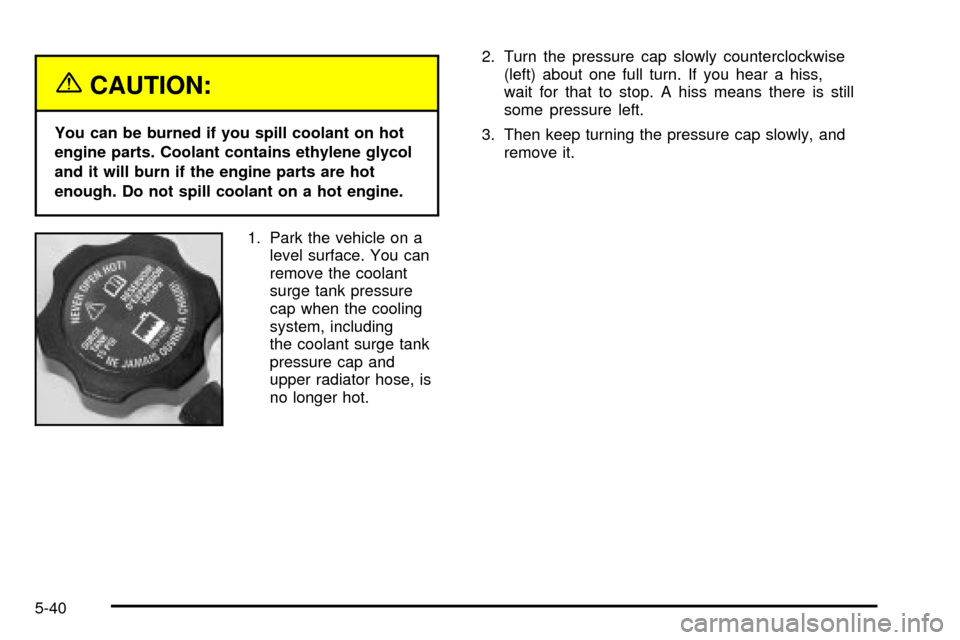
1. Park the vehicle on a
level surface. You can
remove the coolant
surge tank pressure
cap when the cooling
system, including
the coolant surge tank
pressure cap and
upper radiator hose, is
no longer hot.2. Turn the pressure cap slowly counterclockwise
(left) about one full turn. If you hear a hiss,
wait for that to stop. A hiss means there is still
some pressure left.
3. Then keep turning the pressure cap slowly, and
remove it.
5-40
Page 417 of 552
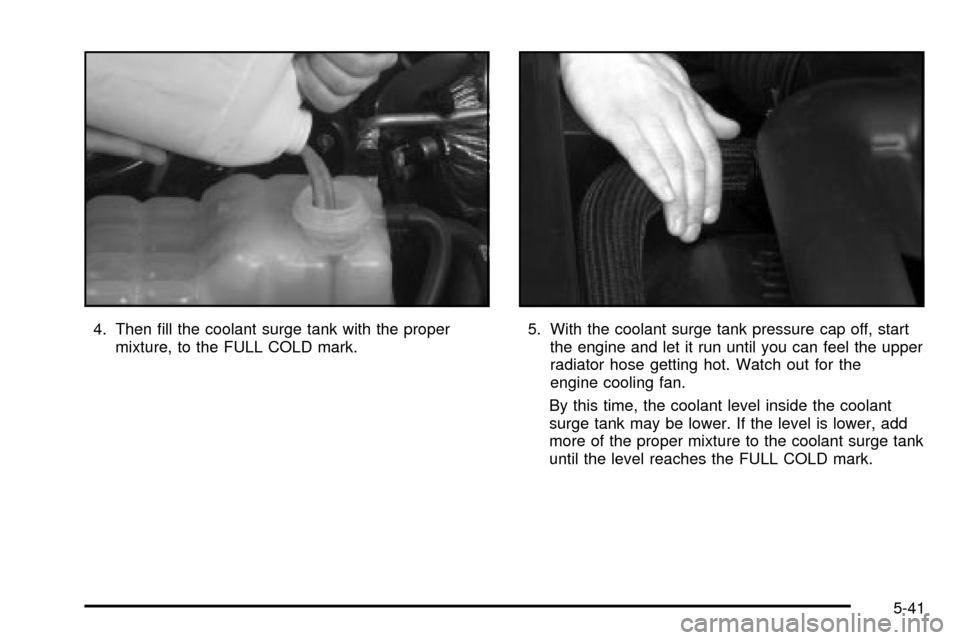
4. Then ®ll the coolant surge tank with the proper
mixture, to the FULL COLD mark.5. With the coolant surge tank pressure cap off, start
the engine and let it run until you can feel the upper
radiator hose getting hot. Watch out for the
engine cooling fan.
By this time, the coolant level inside the coolant
surge tank may be lower. If the level is lower, add
more of the proper mixture to the coolant surge tank
until the level reaches the FULL COLD mark.
5-41
Page 418 of 552
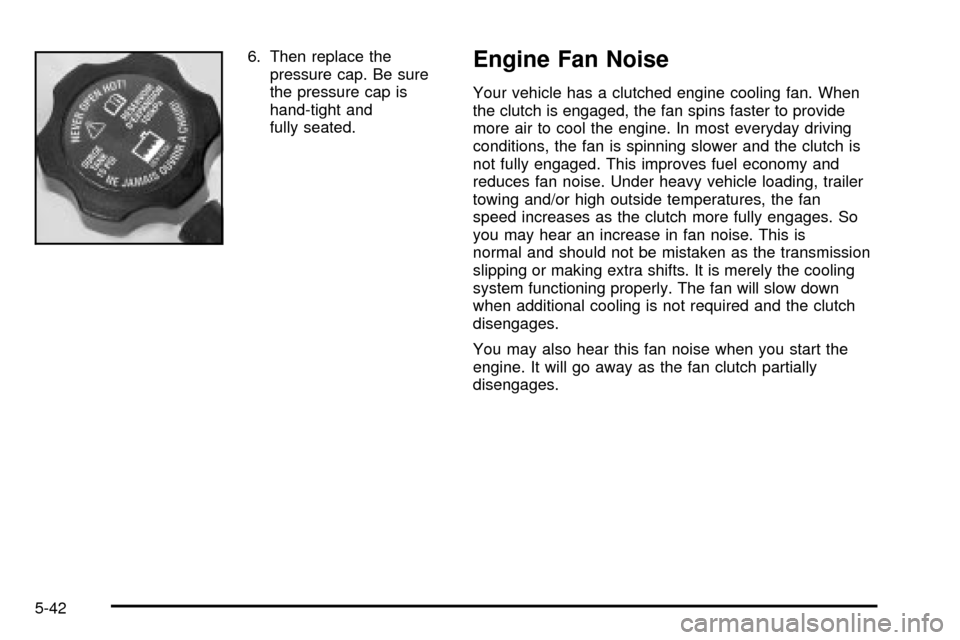
6. Then replace the
pressure cap. Be sure
the pressure cap is
hand-tight and
fully seated.Engine Fan Noise
Your vehicle has a clutched engine cooling fan. When
the clutch is engaged, the fan spins faster to provide
more air to cool the engine. In most everyday driving
conditions, the fan is spinning slower and the clutch is
not fully engaged. This improves fuel economy and
reduces fan noise. Under heavy vehicle loading, trailer
towing and/or high outside temperatures, the fan
speed increases as the clutch more fully engages. So
you may hear an increase in fan noise. This is
normal and should not be mistaken as the transmission
slipping or making extra shifts. It is merely the cooling
system functioning properly. The fan will slow down
when additional cooling is not required and the clutch
disengages.
You may also hear this fan noise when you start the
engine. It will go away as the fan clutch partially
disengages.
5-42
Page 451 of 552

{CAUTION:
Using the wrong replacement wheels, wheel
bolts or wheel nuts on your vehicle can be
dangerous. It could affect the braking and
handling of your vehicle, make your tires lose
air and make you lose control. You could have
a collision in which you or others could be
injured. Always use the correct wheel, wheel
bolts and wheel nuts for replacement.
Notice:The wrong wheel can also cause problems
with bearing life, brake cooling, speedometer or
odometer calibration, headlamp aim, bumper height,
vehicle ground clearance and tire or tire chain
clearance to the body and chassis.
See
Changing a Flat Tire on page 5-77for more
information.
Used Replacement Wheels
{CAUTION:
Putting a used wheel on your vehicle is
dangerous. You can't know how it's been used
or how far it's been driven. It could fail
suddenly and cause a crash. If you have to
replace a wheel, use a new GM original
equipment wheel.
5-75
Page 495 of 552
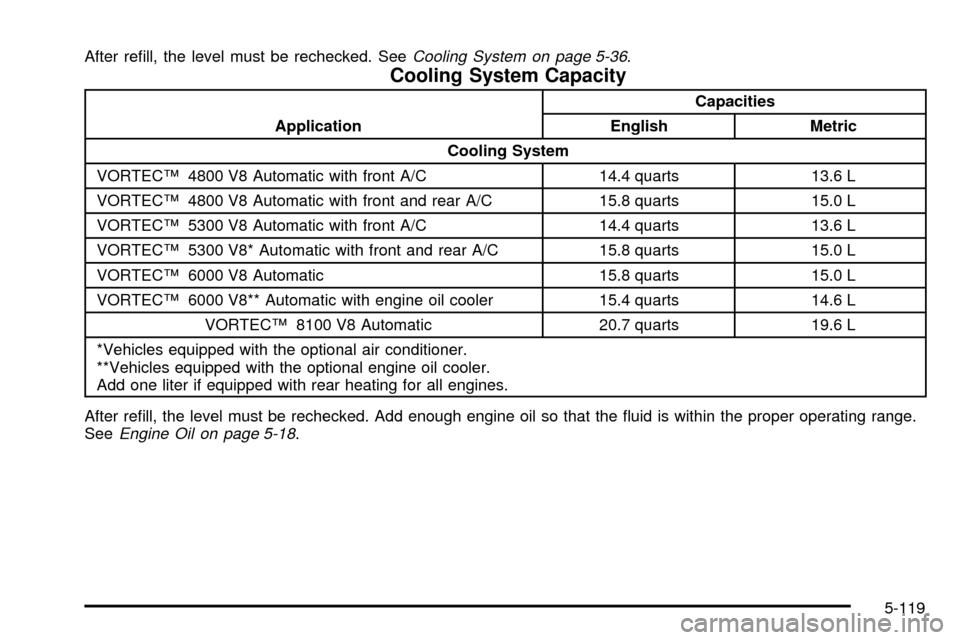
After re®ll, the level must be rechecked. SeeCooling System on page 5-36.
Cooling System Capacity
ApplicationCapacities
English Metric
Cooling System
VORTECŸ 4800 V8 Automatic with front A/C 14.4 quarts 13.6 L
VORTECŸ 4800 V8 Automatic with front and rear A/C 15.8 quarts 15.0 L
VORTECŸ 5300 V8 Automatic with front A/C 14.4 quarts 13.6 L
VORTECŸ 5300 V8* Automatic with front and rear A/C 15.8 quarts 15.0 L
VORTECŸ 6000 V8 Automatic 15.8 quarts 15.0 L
VORTECŸ 6000 V8** Automatic with engine oil cooler 15.4 quarts 14.6 L
VORTECŸ 8100 V8 Automatic 20.7 quarts 19.6 L
*Vehicles equipped with the optional air conditioner.
**Vehicles equipped with the optional engine oil cooler.
Add one liter if equipped with rear heating for all engines.
After re®ll, the level must be rechecked. Add enough engine oil so that the ¯uid is within the proper operating range.
See
Engine Oil on page 5-18.
5-119
Page 499 of 552

Maintenance Schedule......................................6-2
Introduction...................................................6-2
Your Vehicle and the Environment....................6-2
Maintenance Requirements..............................6-2
How This Section is Organized.........................6-3
Part A: Scheduled Maintenance Services...........6-4
Using Your Maintenance Schedule....................6-4
Scheduled Maintenance...................................6-5
Part B: Owner Checks and Services................6-11
At Each Fuel Fill..........................................6-11
At Least Once a Month.................................6-11
At Least Twice a Year...................................6-12
At Least Once a Year...................................6-13Part C: Periodic MaintenanceInspections.........6-16
Steering and Suspension Inspection................6-16
Exhaust System Inspection............................6-16
Fuel System Inspection..................................6-16
Engine Cooling System Inspection...................6-17
Transfer Case and Front Axle (Four-Wheel
Drive) Inspection.......................................6-17
Brake System Inspection................................6-17
Part D: Recommended Fluids and Lubricants. . . .6-18
Part E: Maintenance Record...........................6-20
Section 6 Maintenance Schedule
6-1
Page 508 of 552

97,500 Miles (162 500 km)
qCheck rear/front axle ¯uid level and add ¯uid as
needed. Check constant velocity joints and axle seals
for leaking.
qRotate tires. See
Tire Inspection and Rotation on
page 5-69for proper rotation pattern and additional
information.(See footnote +.)
100,000 Miles (166 000 km)
qInspect spark plug wires.An Emission Control
Service.
qReplace spark plugs.An Emission Control Service.
qChange automatic transmission ¯uid and ®lter if
the vehicle's GVWR is over 8,600 lbs or if the vehicle
is mainly driven under one or more of these
conditions:
þ In heavy city traffic where the outside
temperature regularly reaches 90ÉF (32ÉC) or
higher.
þ In hilly or mountainous terrain.
þ When doing frequent trailer towing.
þ Uses such as found in taxi, police or delivery
service.qIf you haven't used your vehicle under severe service
conditions listed previously and, therefore, haven't
changed your automatic transmission ¯uid, change
both the ¯uid and ®lter.
qChange transfer case ¯uid.
qExcept 8.1L V8 Engine: Inspect Positive Crankcase
Ventilation (PCV) valve.
An Emission Control
Service.
150,000 Miles (240 000 km)
qDrain, ¯ush and re®ll cooling system (or every
60 months since last service, whichever occurs ®rst).
See
Engine Coolant on page 5-29for what to use.
Inspect hoses. Clean radiator, condenser, pressure
cap and neck. Pressure test the cooling system
and pressure cap.
An Emission Control Service.
qInspect engine accessory drive belt.An Emission
Control Service.
6-10
Page 515 of 552

Engine Cooling System Inspection
Inspect the hoses and have them replaced if they
are cracked, swollen or deteriorated. Inspect all pipes,
®ttings and clamps; replace as needed. Clean the
outside of the radiator and air conditioning condenser.
To help ensure proper operation, a pressure test of
the cooling system and pressure cap is recommended
at least once a year.
Transfer Case and Front Axle
(Four-Wheel Drive) Inspection
Every 12 months or at engine oil change intervals,
check front axle and transfer case and add lubricant
when necessary. A ¯uid loss could indicate a problem;
check and have it repaired, if needed. On manual
shift transfer case, oil the control lever pivot point. Check
vent hose at transfer case for kinks and proper
installation. More frequent lubrication may be required
on off-road use.
Brake System Inspection
Inspect the complete system. Inspect brake lines and
hoses for proper hook-up, binding, leaks, cracks,
cha®ng, etc. Inspect disc brake pads for wear and rotors
for surface condition. Inspect other brake parts,
including calipers, parking brake, etc. You may need to
have your brakes inspected more often if your driving
habits or conditions result in frequent braking.
6-17
Page 537 of 552

Coolant.........................................................3-45
Engine Temperature Gage............................3-45
Heater, Engine............................................2-24
Surge Tank Pressure Cap.............................5-32
Cooling System..............................................5-36
Cruise Control Light........................................3-51
Cruise Control................................................3-10
Cupholder(s)..................................................2-61
Current and Past Model Order Forms................7-12
Customer Assistance Information........................ 7-8
Courtesy Transportation.................................. 7-8
Customer Assistance for Text Telephone (TTY)
Users....................................................... 7-4
Customer Assistance Offices........................... 7-4
Customer Satisfaction Procedure..................... 7-2
GM Mobility Program for Persons with
Disabilities................................................ 7-6
Reporting Safety Defects to General Motors....7-10
Reporting Safety Defects to the Canadian
Government............................................7-10
Reporting Safety Defects to the United States
Government............................................7-10
Roadside Assistance Program......................... 7-6
Service Publications Ordering Information........7-11D
Daytime Running Lamps..................................3-15
Defensive Driving............................................. 4-2
Defogging and Defrosting.........................3-23, 3-29
Delayed Locking.............................................2-10
Dinghy Towing................................................4-60
Doing Your Own Service Work........................... 5-3
Dolly Towing..................................................4-61
Dome Lamps.................................................3-18
Door.............................................................2-10
Delayed Locking..........................................2-10
Locks.......................................................... 2-8
Power Door Locks......................................... 2-9
Programmable Automatic Door Locks.............2-10
Rear Door Security Locks.............................2-13
DRIVER DOOR AJAR.....................................3-66
Driver Information Center (DIC).........................3-53
DIC Operation and Displays..........................3-54
DIC Warnings and Messages........................3-64
Driver............................................................1-30
Position, Safety Belt.....................................1-30
Driving Across an Incline..................................4-36
Driving Downhill..............................................4-34
5