engine coolant CHEVROLET TAHOE 2003 2.G Owner's Manual
[x] Cancel search | Manufacturer: CHEVROLET, Model Year: 2003, Model line: TAHOE, Model: CHEVROLET TAHOE 2003 2.GPages: 552, PDF Size: 3.44 MB
Page 411 of 552

If No Steam Is Coming From Your
Engine
An overheat warning, along with a low coolant condition,
can indicate a serious problem. SeeLow CoolantunderDIC Warnings and Messages on page 3-64.
If you get an engine overheat warning with and do not
have a low coolant condition, but see or hear no steam,
the problem may not be too serious. Sometimes the
engine can get a little too hot when you:
·Climb a long hill on a hot day.
·Stop after high-speed driving.
·Idle for long periods in traffic.
·Tow a trailer. SeeTowing a Trailer on page 4-65.
If you get the overheat warning with no sign of steam, try
this for a minute or so:
1. In heavy traffic, let the engine idle in neutral while
stopped. If it is safe to do so, pull off the road. Shift
to park or neutral and let the engine idle.
2. Turn on your heater to full hot at the highest fan
speed and open the window as necessary.If you no longer have the overheat warning, you can
drive. Just to be safe, drive slower for about 10 minutes.
If the warning doesn't come back on, you can drive
normally.
If the warning continues, pull over, stop, and park your
vehicle right away.
If there's still no sign of steam, you can push down the
accelerator until the engine speed is about twice as
fast as normal idle speed for at least three minutes while
you're parked. If you still have the warning,
turn off
the engine and get everyone out of the vehicleuntil it
cools down. Also, seeOverheated Engine Protection
Operating Modelisted previously in this section.
You may decide not to lift the hood but to get service
help right away.
5-35
Page 412 of 552
Cooling System
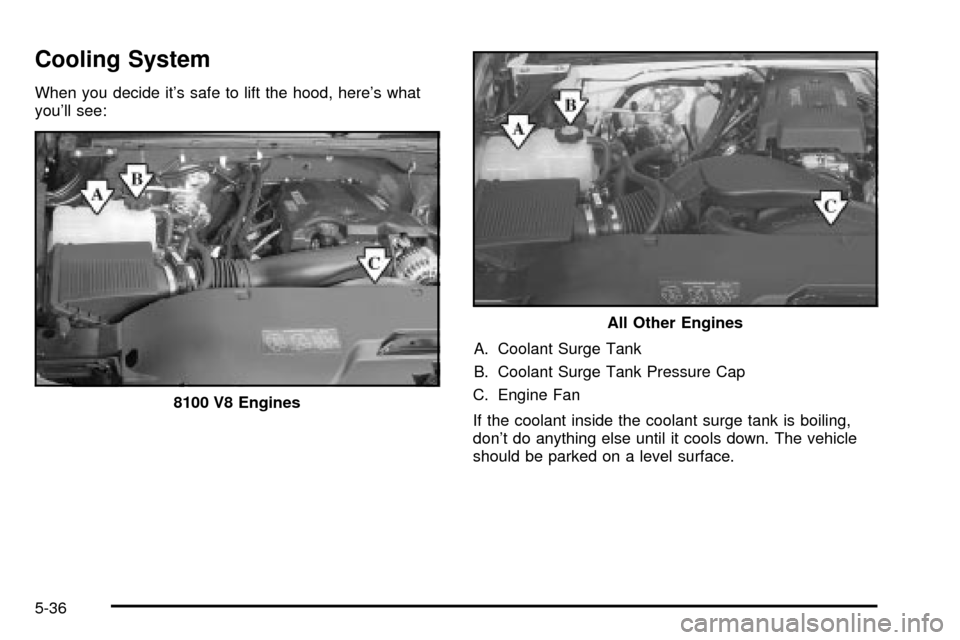
When you decide it's safe to lift the hood, here's what
you'll see:
A. Coolant Surge Tank
B. Coolant Surge Tank Pressure Cap
C. Engine Fan
If the coolant inside the coolant surge tank is boiling,
don't do anything else until it cools down. The vehicle
should be parked on a level surface. 8100 V8 Engines
All Other Engines
5-36
Page 413 of 552
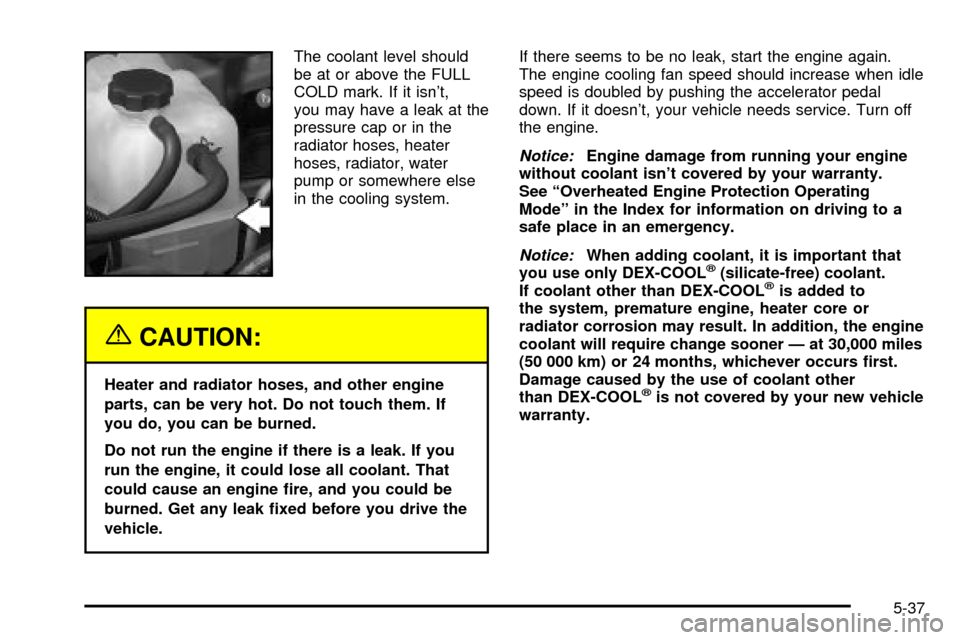
The coolant level should
be at or above the FULL
COLD mark. If it isn't,
you may have a leak at the
pressure cap or in the
radiator hoses, heater
hoses, radiator, water
pump or somewhere else
in the cooling system.
{CAUTION:
Heater and radiator hoses, and other engine
parts, can be very hot. Do not touch them. If
you do, you can be burned.
Do not run the engine if there is a leak. If you
run the engine, it could lose all coolant. That
could cause an engine ®re, and you could be
burned. Get any leak ®xed before you drive the
vehicle.If there seems to be no leak, start the engine again.
The engine cooling fan speed should increase when idle
speed is doubled by pushing the accelerator pedal
down. If it doesn't, your vehicle needs service. Turn off
the engine.
Notice:Engine damage from running your engine
without coolant isn't covered by your warranty.
See ªOverheated Engine Protection Operating
Modeº in the Index for information on driving to a
safe place in an emergency.
Notice:When adding coolant, it is important that
you use only DEX-COOLž(silicate-free) coolant.
If coolant other than DEX-COOLžis added to
the system, premature engine, heater core or
radiator corrosion may result. In addition, the engine
coolant will require change sooner Ð at 30,000 miles
(50 000 km) or 24 months, whichever occurs ®rst.
Damage caused by the use of coolant other
than DEX-COOL
žis not covered by your new vehicle
warranty.
5-37
Page 414 of 552
How to Add Coolant to the Coolant
Surge Tank
If you haven't found a problem yet, check to see if
coolant is visible in the surge tank. If coolant is visible
but the coolant level isn't at or above the FULL
COLD mark, add a 50/50 mixture of
clean, drinkable
waterand DEX-COOLžcoolant at the coolant
surge tank, but be sure the cooling system, including
the coolant surge tank pressure cap, is cool before you
do it. See
Engine Coolant on page 5-29for more
information.If no coolant is visible in the surge tank, add coolant as
follows:
{CAUTION:
Steam and scalding liquids from a hot cooling
system can blow out and burn you badly. They
are under pressure, and if you turn the coolant
surge tank pressure cap Ð even a little Ð they
can come out at high speed. Never turn the
cap when the cooling system, including the
coolant surge tank pressure cap, is hot. Wait
for the cooling system and coolant surge tank
pressure cap to cool if you ever have to turn
the pressure cap.
5-38
Page 415 of 552
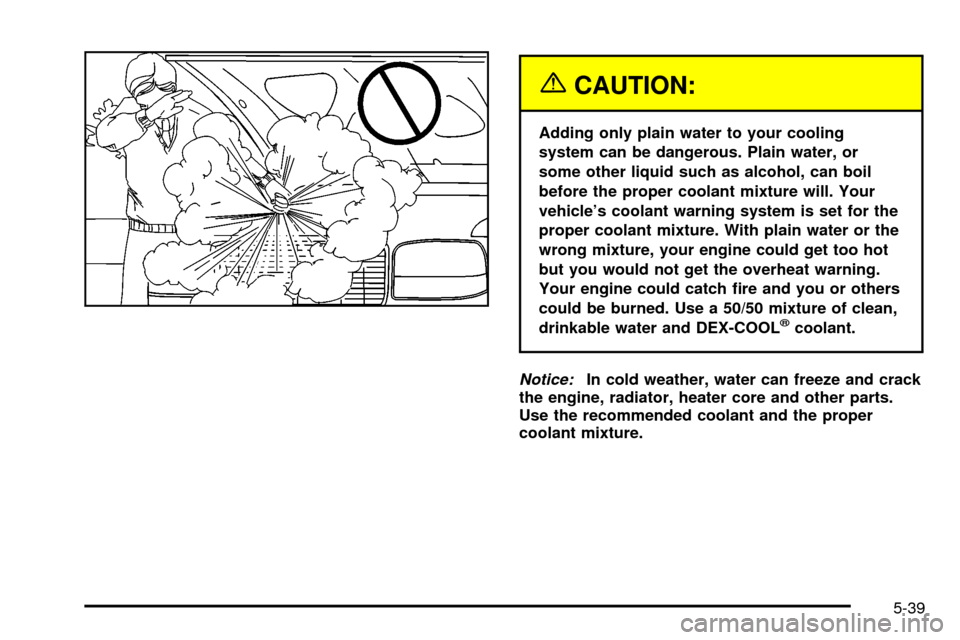
{CAUTION:
Adding only plain water to your cooling
system can be dangerous. Plain water, or
some other liquid such as alcohol, can boil
before the proper coolant mixture will. Your
vehicle's coolant warning system is set for the
proper coolant mixture. With plain water or the
wrong mixture, your engine could get too hot
but you would not get the overheat warning.
Your engine could catch ®re and you or others
could be burned. Use a 50/50 mixture of clean,
drinkable water and DEX-COOL
žcoolant.
Notice:In cold weather, water can freeze and crack
the engine, radiator, heater core and other parts.
Use the recommended coolant and the proper
coolant mixture.
5-39
Page 416 of 552
{CAUTION:
You can be burned if you spill coolant on hot
engine parts. Coolant contains ethylene glycol
and it will burn if the engine parts are hot
enough. Do not spill coolant on a hot engine.
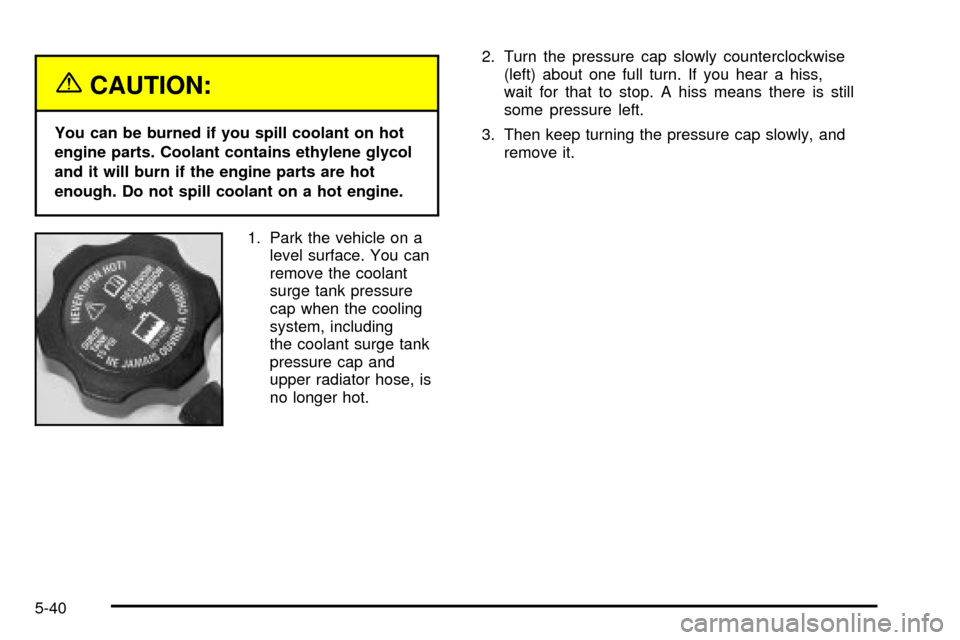
1. Park the vehicle on a
level surface. You can
remove the coolant
surge tank pressure
cap when the cooling
system, including
the coolant surge tank
pressure cap and
upper radiator hose, is
no longer hot.2. Turn the pressure cap slowly counterclockwise
(left) about one full turn. If you hear a hiss,
wait for that to stop. A hiss means there is still
some pressure left.
3. Then keep turning the pressure cap slowly, and
remove it.
5-40
Page 417 of 552
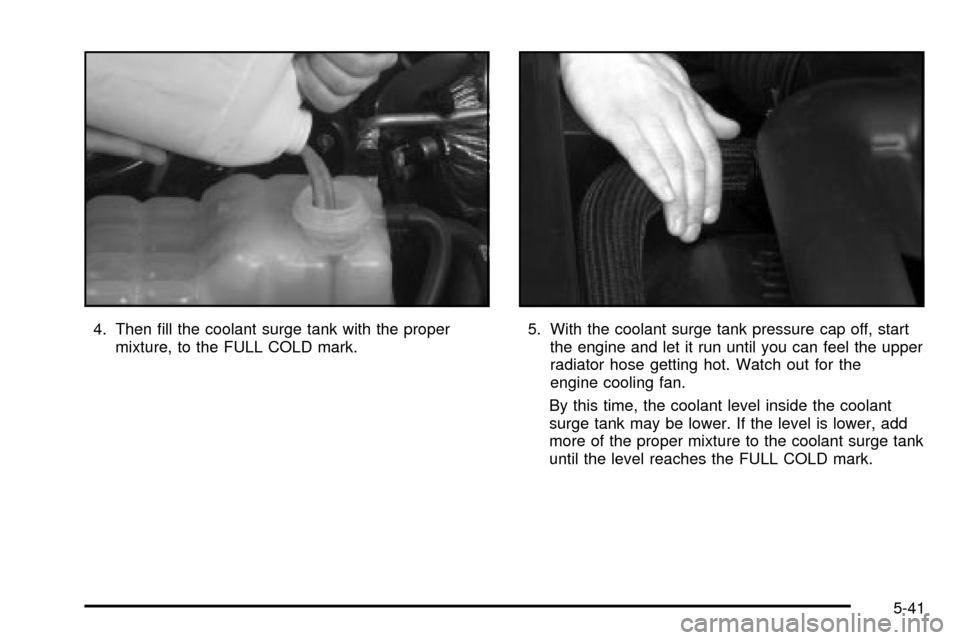
4. Then ®ll the coolant surge tank with the proper
mixture, to the FULL COLD mark.5. With the coolant surge tank pressure cap off, start
the engine and let it run until you can feel the upper
radiator hose getting hot. Watch out for the
engine cooling fan.
By this time, the coolant level inside the coolant
surge tank may be lower. If the level is lower, add
more of the proper mixture to the coolant surge tank
until the level reaches the FULL COLD mark.
5-41
Page 420 of 552

How to Check Power Steering Fluid
Turn the key off, let the engine compartment cool down,
wipe the cap and the top of the reservoir clean, then
unscrew the cap and wipe the dipstick with a clean rag.
Replace the cap and completely tighten it. Then remove
the cap again and look at the ¯uid level on the dipstick.
The level should be at the FULL COLD mark.
If necessary, add only enough ¯uid to bring the level up
to the mark.
What to Use
To determine what kind of ¯uid to use, seePart D:
Recommended Fluids and Lubricants on page 6-18.
Always use the proper ¯uid. Failure to use the proper
¯uid can cause leaks and damage hoses and seals.
Windshield Washer Fluid
What to Use
When you need windshield washer ¯uid, be sure to read
the manufacturer's instructions before use. If you will
be operating your vehicle in an area where the
temperature may fall below freezing, use a ¯uid that has
sufficient protection against freezing. See
Engine
Compartment Overview on page 5-14for reservoir
location.
Adding Washer Fluid
Open the cap with the
washer symbol on it. Add
washer ¯uid until the
tank is full.
Notice:
·When using concentrated washer ¯uid, follow
the manufacturer's instructions for adding
water.
·Don't mix water with ready-to-use washer ¯uid.
Water can cause the solution to freeze and
damage your washer ¯uid tank and other parts
of the washer system. Also, water doesn't
clean as well as washer ¯uid.
·Fill your washer ¯uid tank only three-quarters
full when it's very cold. This allows for
expansion if freezing occurs, which could
damage the tank if it is completely full.
·Don't use engine coolant (antifreeze) in your
windshield washer. It can damage your
washer system and paint.
5-44
Page 508 of 552

97,500 Miles (162 500 km)
qCheck rear/front axle ¯uid level and add ¯uid as
needed. Check constant velocity joints and axle seals
for leaking.
qRotate tires. See
Tire Inspection and Rotation on
page 5-69for proper rotation pattern and additional
information.(See footnote +.)
100,000 Miles (166 000 km)
qInspect spark plug wires.An Emission Control
Service.
qReplace spark plugs.An Emission Control Service.
qChange automatic transmission ¯uid and ®lter if
the vehicle's GVWR is over 8,600 lbs or if the vehicle
is mainly driven under one or more of these
conditions:
þ In heavy city traffic where the outside
temperature regularly reaches 90ÉF (32ÉC) or
higher.
þ In hilly or mountainous terrain.
þ When doing frequent trailer towing.
þ Uses such as found in taxi, police or delivery
service.qIf you haven't used your vehicle under severe service
conditions listed previously and, therefore, haven't
changed your automatic transmission ¯uid, change
both the ¯uid and ®lter.
qChange transfer case ¯uid.
qExcept 8.1L V8 Engine: Inspect Positive Crankcase
Ventilation (PCV) valve.
An Emission Control
Service.
150,000 Miles (240 000 km)
qDrain, ¯ush and re®ll cooling system (or every
60 months since last service, whichever occurs ®rst).
See
Engine Coolant on page 5-29for what to use.
Inspect hoses. Clean radiator, condenser, pressure
cap and neck. Pressure test the cooling system
and pressure cap.
An Emission Control Service.
qInspect engine accessory drive belt.An Emission
Control Service.
6-10
Page 509 of 552

Part B: Owner Checks and Services
Listed in this part are owner checks and services
which should be performed at the intervals speci®ed to
help ensure the safety, dependability and emission
control performance of your vehicle.
Be sure any necessary repairs are completed at once.
Whenever any ¯uids or lubricants are added to your
vehicle, make sure they are the proper ones, as shown
in Part D.
At Each Fuel Fill
It is important for you or a service station attendant to
perform these underhood checks at each fuel ®ll.
Engine Oil Level Check
Check the engine oil level and add the proper oil if
necessary. SeeEngine Oil on page 5-18for further
details.
Engine Coolant Level Check
Check the engine coolant level and add DEX-COOLž
coolant mixture if necessary. SeeEngine Coolant
on page 5-29for further details.
Windshield Washer Fluid Level Check
Check the windshield washer ¯uid level in the windshield
washer tank and add the proper ¯uid if necessary.
See
Windshield Washer Fluid on page 5-44for further
details.
At Least Once a Month
Tire In¯ation Check
Visually inspect your tires and make sure tires are
in¯ated to the correct pressures. Don't forget to check
your spare tire. See
Tires on page 5-67for further
details.
Cassette Tape Player Service
Clean cassette tape player. Cleaning should be done
every 50 hours of tape play. SeeAudio System(s)
on page 3-72for further details.
6-11