light CHEVROLET TAHOE 2007 3.G User Guide
[x] Cancel search | Manufacturer: CHEVROLET, Model Year: 2007, Model line: TAHOE, Model: CHEVROLET TAHOE 2007 3.GPages: 634, PDF Size: 3.18 MB
Page 54 of 634
Rear Seat Passengers
It is very important for rear seat passengers to
buckle up! Accident statistics show that unbelted
people in the rear seat are hurt more often in
crashes than those who are wearing safety belts.
Rear passengers who are not safety belted
can be thrown out of the vehicle in a crash. And
they can strike others in the vehicle who are
wearing safety belts.
Lap-Shoulder Belt
All rear seat positions have lap-shoulder belts.
Here is how to wear one properly.
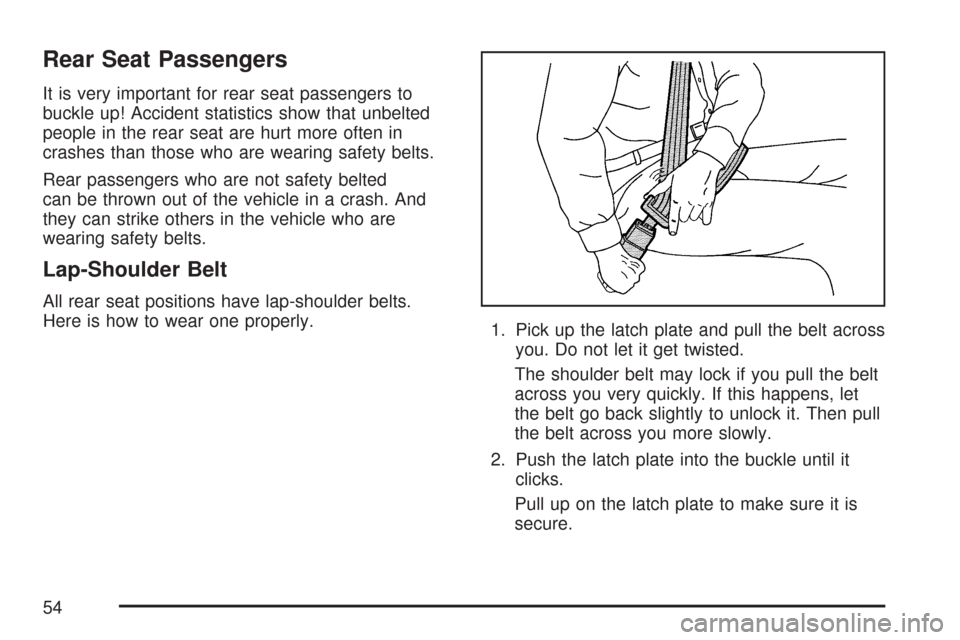
1. Pick up the latch plate and pull the belt across
you. Do not let it get twisted.
The shoulder belt may lock if you pull the belt
across you very quickly. If this happens, let
the belt go back slightly to unlock it. Then pull
the belt across you more slowly.
2. Push the latch plate into the buckle until it
clicks.
Pull up on the latch plate to make sure it is
secure.
54
Page 87 of 634

There is no top tether anchor at the right front
seating position. Do not secure a child seat in this
position if a national or local law requires that
the top tether be anchored or if the instructions
that come with the child restraint say that the top
tether must be anchored. SeeLower Anchors
and Tethers for Children (LATCH) on page 74if
the child restraint has a top tether.
You will be using the lap-shoulder belt to secure
the child restraint in this position. Be sure to follow
the instructions that came with the child restraint.
Secure the child in the child restraint when and as
the instructions say.
1. Your vehicle has a right front passenger’s
frontal airbag. SeePassenger Sensing
System on page 101. We recommend that
rear-facing child restraints be secured in a rear
seat, even if the airbag is off. If your child
restraint is forward-facing, move the seat as
far back as it will go before securing the
child restraint in this seat. SeeManual Seats
on page 9orPower Seats on page 10.When the passenger sensing system has
turned off the right front passenger’s frontal
airbag, the off indicator in the passenger
airbag status indicator should light and stay lit
when you turn the ignition to RUN or
START. SeePassenger Airbag Status
Indicator on page 246.
2. Put the child restraint on the seat.
3. Pick up the latch plate, and run the lap and
shoulder portions of the vehicle’s safety belt
through or around the restraint. The child
restraint instructions will show you how.
87
Page 89 of 634

6. To tighten the belt, push down on the child
restraint, pull the shoulder portion of the belt
to tighten the lap portion of the belt and
feed the shoulder belt back into the retractor.
If you are using a forward-facing child
restraint, you may nd it helpful to use your
knee to push down on the child restraint
as you tighten the belt. You should not be able
to pull more of the belt from the retractor
once the lock has been set.
7. Push and pull the child restraint in different
directions to be sure it is secure.8. If the airbag is off, the off indicator will be lit
and stay lit when the key is turned to RUN or
START.
If a child restraint has been installed and the on
indicator is lit, turn the vehicle off. Remove
the child restraint from the vehicle and reinstall the
child restraint.
If, after reinstalling the child restraint and restarting
the vehicle, the on indicator is still lit, check to
make sure that the vehicle’s seatback is not
pressing the child restraint into the seat cushion. If
this happens, slightly recline the vehicle’s
seatback and adjust the seat cushion if possible.
Also make sure the child restraint is not trapped
under the vehicle head restraint. If this happens,
adjust the head restraint.
If the on indicator is still lit, secure the child in the
child restraint in a rear seat position in the
vehicle and check with your dealer.
To remove the child restraint, just unbuckle the
vehicle’s safety belt and let it go back all the way.
The safety belt will move freely again and be
ready to work for an adult or larger child
passenger.
89
Page 92 of 634
{CAUTION:
Anyone who is up against, or very close
to, any airbag when it inates can be
seriously injured or killed. Airbags plus
lap-shoulder belts offer the best
protection for adults, but not for young
children and infants. Neither the vehicle’s
safety belt system nor its airbag system is
designed for them. Young children and
infants need the protection that a child
restraint system can provide. Always
secure children properly in your vehicle.
To read how, seeOlder Children on
page 61orInfants and Young Children on
page 64.
Occupants should not lean on or sleep
against the door in the rst or second row
seats, or the rear windows in the third row
seat, if your vehicle has roof-mounted
rollover airbags.There is an airbag
readiness light on the
instrument panel cluster,
which shows the
airbag symbol.
The system checks the airbag electrical system for
malfunctions. The light tells you if there is an
electrical problem. SeeAirbag Readiness Light on
page 245for more information.
92
Page 103 of 634
The right front passenger seat is occupied by
a smaller person, such as a child who has
outgrown child restraints
Or, if there is a critical problem with the airbag
system or the passenger sensing system.
When the passenger sensing system has turned
off the passenger’s airbag, the off indicator will light
and stay lit to remind you that the airbag is off.
If a child restraint has been installed and the
on indicator is lit, turn the vehicle off. Remove the
child restraint from the vehicle and reinstall the
child restraint following the child restraint
manufacturer’s directions and refer toSecuring a
Child Restraint in the Right Front Seat Position
on page 85.
If, after reinstalling the child restraint and restarting
the vehicle, the on indicator is still lit, check to
make sure that the vehicle’s seatback is not
pressing the child restraint into the seat cushion. If
this happens, slightly recline the vehicle’s
seatback and adjust the seat cushion if possible.
Also make sure the child restraint is not trapped
under the vehicle head restraint. If this happens,
adjust the head restraint.If the on indicator is still lit, secure the child in the
child restraint in a rear seat position in the
vehicle and check with your dealer.
The passenger sensing system is designed to
enable (may inate) the right front passenger’s
airbag anytime the system senses that a person of
adult size is sitting properly in the right front
passenger’s seat. When the passenger sensing
system has allowed the airbag to be enabled, the
on indicator will light and stay lit to remind you
that the airbag is active.
For some children who have outgrown child
restraints and for very small adults, the passenger
sensing system may or may not turn off the right
front passenger’s airbag, depending upon the
person’s seating posture and body build. Everyone
in your vehicle who has outgrown child restraints
should wear a safety belt properly — whether or not
there is an airbag for that person.
103
Page 105 of 634
{CAUTION:
If the airbag readiness light in the
instrument panel cluster ever comes on
and stays on, it means that something
may be wrong with the airbag system. If
this ever happens, have the vehicle
serviced promptly, because an adult-size
person sitting in the right front
passenger’s seat may not have the
protection of the airbag(s). SeeAirbag
Readiness Light on page 245for more on
this, including important safety
information.Aftermarket equipment, such as seat covers, can
affect how well the passenger sensing system
operates. You may want to consider not using seat
covers or other aftermarket equipment. See
Adding Equipment to Your Airbag-Equipped
Vehicle on page 107for more information about
modications that can affect how the system
operates.
{CAUTION:
Stowing of articles under the passenger’s
seat or between the passenger’s seat
cushion and seatback may interfere with
the proper operation of the passenger
sensing system.
105
Page 108 of 634
Restraint System Check
Checking the Restraint Systems
Now and then, make sure the safety belt reminder
light and all your belts, buckles, latch plates,
retractors and anchorages are working properly.
Look for any other loose or damaged safety
belt system parts. If you see anything that might
keep a safety belt system from doing its job, have
it repaired. Keep safety belts clean and dry.
SeeCare of Safety Belts on page 556for more
information.
Torn or frayed safety belts may not protect you in
a crash. They can rip apart under impact forces.
If a belt is torn or frayed, get a new one right away.
Also look for any opened or broken airbag
covers, and have them repaired or replaced. The
airbag system does not need regular maintenance.Notice:If you damage the covering for the
driver’s or the right front passenger’s airbag,
or the side impact airbag covering on the
ceiling near the side windows, the airbag may
not work properly. You may have to replace
the airbag module in the steering wheel, both
the airbag module and the instrument panel
for the right front passenger’s airbag, or
side impact airbag module and ceiling covering
for roof-mounted rollover airbags (if equipped).
Do not open or break the airbag coverings.
108
Page 109 of 634
Replacing Restraint System Parts
After a Crash
{CAUTION:
A crash can damage the restraint systems
in your vehicle. A damaged restraint
system may not properly protect the
person using it, resulting in serious injury
or even death in a crash. To help make sure
your restraint systems are working
properly after a crash, have them inspected
and any necessary replacements made as
soon as possible.
If you have had a crash, do you need new belts or
LATCH system parts?
After a very minor collision, nothing may be
necessary. But if the belts were stretched, as they
would be if worn during a more severe crash, then
you need new parts.
If the LATCH system was being used during a more
severe crash, you may need new LATCH system
parts.If belts are cut or damaged, replace them. Collision
damage also may mean you will need to have
LATCH system, safety belt or seat parts repaired or
replaced. New parts and repairs may be necessary
even if the belt or LATCH system was not being
used at the time of the collision.
If an airbag inates, you will need to replace airbag
system parts. See the part on the airbag system
earlier in this section.
If the frontal airbags inate you will also need to
replace the driver and front passenger’s safety belt
retractor assembly. Be sure to do so. Then the new
retractor assembly will be there to help protect you
in a collision.
After a crash you may need to replace the driver
and front passenger’s safety belt retractor
assemblies, even if the frontal airbags have not
deployed. The driver and front passenger’s safety
belt retractor assemblies contain the safety belt
pretensioners. Have your safety belt pretensioners
checked if your vehicle has been in a collision, or if
your airbag readiness light stays on after you start
your vehicle or while you are driving. SeeAirbag
Readiness Light on page 245.
109
Page 120 of 634
/(Remote Start):Press and release the lock
button and then press and hold the remote
start button to start the vehicle.
To start the vehicle using the remote start feature,
do the following:
1. Aim the transmitter at the vehicle.
2. Press and release the transmitter’s lock
button, then immediately press and hold
the transmitter’s remote start button until the
turn signal lights ash. If you cannot see
the vehicle’s lights, press and hold the remote
start button for at least four seconds. The
vehicle’s doors will lock. Pressing the remote
start button again after the vehicle has
started will turn off the ignition.
When the vehicle starts, the parking lamps will
turn on and remain on while the vehicle is
running.
3. If it is the rst remote start since the vehicle
has been driven, repeat these steps, while
the engine is still running, to extend the engine
running time by 10 minutes. Remote start
can be extended one time.
After entering the vehicle during a remote start,
insert and turn the key to RUN to drive the vehicle.If the vehicle is left running it will automatically
shut off after 10 minutes unless a time extension
has been done.
To manually shut off a remote start, do any of the
following:
Aim the RKE transmitter at the vehicle and
press the remote start button until the
parking lamps turn off.
Turn on the hazard warning ashers.
Turn the ignition switch on and then off.
The vehicle can be remote started two separate
times between driving sequences. The engine will
run for 10 minutes after each remote start.
Or, you can extend the engine run time by another
10 minutes within the rst 10 minute remote
start time frame, and before the engine stops.
For example, if the lock button and then the remote
start buttons are pressed again after the vehicle has
been running for ve minutes, 10 minutes are
added, allowing the engine to run for 15 minutes.
The additional ten minutes are considered a
second remote vehicle start.
120
Page 128 of 634
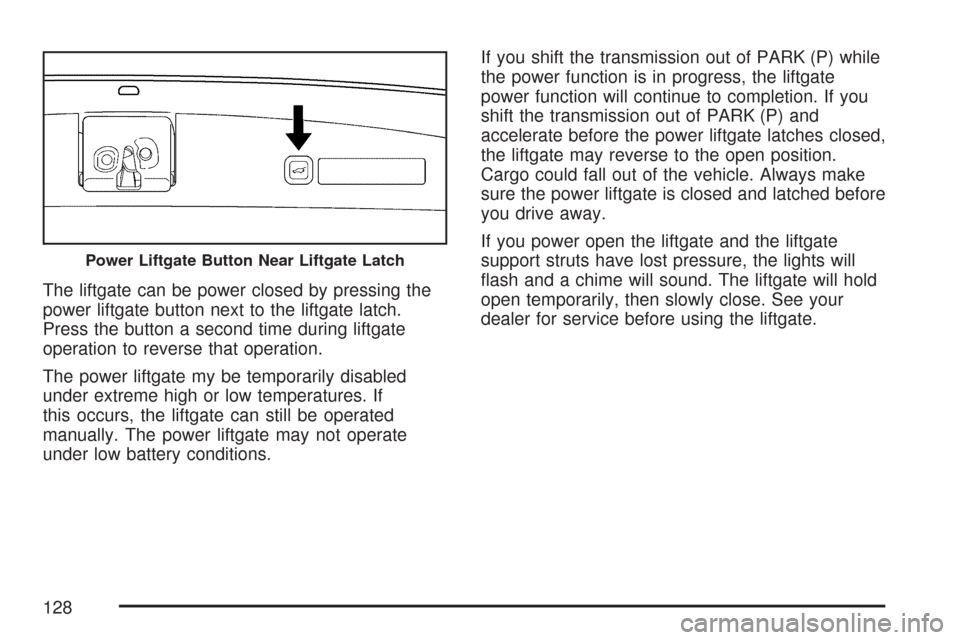
The liftgate can be power closed by pressing the
power liftgate button next to the liftgate latch.
Press the button a second time during liftgate
operation to reverse that operation.
The power liftgate my be temporarily disabled
under extreme high or low temperatures. If
this occurs, the liftgate can still be operated
manually. The power liftgate may not operate
under low battery conditions.If you shift the transmission out of PARK (P) while
the power function is in progress, the liftgate
power function will continue to completion. If you
shift the transmission out of PARK (P) and
accelerate before the power liftgate latches closed,
the liftgate may reverse to the open position.
Cargo could fall out of the vehicle. Always make
sure the power liftgate is closed and latched before
you drive away.
If you power open the liftgate and the liftgate
support struts have lost pressure, the lights will
ash and a chime will sound. The liftgate will hold
open temporarily, then slowly close. See your
dealer for service before using the liftgate.
Power Liftgate Button Near Liftgate Latch
128