light CHEVROLET TAHOE 2011 3.G User Guide
[x] Cancel search | Manufacturer: CHEVROLET, Model Year: 2011, Model line: TAHOE, Model: CHEVROLET TAHOE 2011 3.GPages: 98, PDF Size: 1.55 MB
Page 24 of 98
Black plate (12,1)Chevrolet Tahoe and GMC Yukon/Yukon Denali Hybrid - 2011
5-12 Instruments and Controls
the DIC will display a message. See
Battery Voltage and Charging
Messages on page 5‑12.
INST ECON (Instantaneous
Economy)
This display normally shows
instantaneous fuel economy. When
the vehicle is in Auto Stop mode
AUTO STOP or IFE = 0 L/100km or
IFE = 99 MPG will be displayed.
SeeStarting the Vehicle on
page 9‑2 for more information.Vehicle Messages
Messages displayed on the DIC
indicate the status of the vehicle or
some action may be needed to
correct a condition. Multiple
messages may appear one after
another.
The messages that do not require
immediate action can be
acknowledged and cleared by
pressing
V(Set/Reset).
The messages that require
immediate action cannot be cleared
until that action is performed.
All messages should be taken
seriously. Clearing the message
does not correct the problem.
The following are the possible
messages for the Hybrid and some
information about them. For
information on other DIC messages,
see “Vehicle Messages” in the
owner manual.
Battery Voltage and
Charging Messages
SERVICE BATTERY
CHARGING SYSTEM
If the 12V battery system faults or
fails this message will appear on the
DIC. The battery/charging system
light will appear in the instrument
panel cluster. See “Battery Warning
Light” in the owner manual. Driving
with this message on could drain
the battery. Have the electrical
system checked as soon as
possible.
Brake System Messages
SERVICE BRAKE SYSTEM
This message may be displayed if
there is a problem with the brake
system. You will still be able to
brake, but it will be noticeably more
difficult. Pull off the road to a safe
location and have your vehicle
towed to the nearest dealer for
service. See “Brakes,” “Brake
Page 25 of 98
Black plate (13,1)Chevrolet Tahoe and GMC Yukon/Yukon Denali Hybrid - 2011
Instruments and Controls 5-13
System Warning Light,”and“ABS
Brake System Warning Light” in the
owner manual.
This message may also come on
when you are towing a trailer. See
“Trailer Brakes” underTrailer Towing
on page 9‑16 for more information.
Door Ajar Messages
HOOD OPEN
If the hood is not fully closed or
there is a problem with the hood
switch, this message will be
displayed. Close the hood to clear
the message. If the HOOD OPEN
message continues to be displayed
after verifying the hood is closed,
you should have the hood switch
serviced. Failure to service the hood
switch properly can result in an Auto
Start condition.
Auto Stops will be disabled when
this message is displayed. If the
vehicle is in auto stop mode when
this message appears, the engine
will instantly start.
Engine Oil Messages
OIL PRESSURE LOW STOP
ENGINE
If engine oil pressure is low, this
message will be displayed on the
DIC. Stop the vehicle as soon as
safely possible and do not operate it
until the cause of the low oil
pressure has been corrected. Check
your oil level as soon as possible
and have your vehicle serviced. See
“Engine Oil”in the owner manual.
Service Vehicle Messages
SERVICE HYBRID SYSTEM
If this message is displayed on the
DIC, the vehicle may continue to
operate, but you need to have it
serviced as soon as possible.
SERVICE POWER STEERING
This message displays if a problem
has been detected with the electric
power steering. Have your vehicle
serviced by your dealer immediately.
Transmission Messages
SERVICE 4 WHEEL DRIVE
This message may display if a
problem occurs with the
four-wheel-drive system. If this
message appears, stop as soon as
possible and turn off the vehicle.
Make sure the key is in the LOCK/
OFF position for at least one minute
and then restart the vehicle and
check for the message on the DIC
display. If the message is still
displayed or appears again
when you begin driving, the
four-wheel-drive system needs
service. See your dealer.
Page 33 of 98
Black plate (3,1)Chevrolet Tahoe and GMC Yukon/Yukon Denali Hybrid - 2011
Driving and Operating 9-3
When the tachometer needle
indicates AUTO STOP, the hybrid
system is on, the engine is not
running, but may Auto Start at any
time without notice. SeeTachometer
on page 5‑4 for more information.
A chime will sound if the driver door
is opened while in Auto Stop as a
reminder that the ignition switch is
not in the LOCK/OFF position.
Always turn the ignition switch to
LOCK/OFF and remove the key
from the ignition switch when exiting
the vehicle.
Auto Start
The vehicle also has an Auto Start
feature. The engine will remain off
while in Auto Stop mode until
vehicle conditions require the
engine to run. The near-instant
starting of the engine from Auto
Stop mode is called Auto Start. Some of the vehicle conditions that
may cause the engine to Auto
Start are:
.The hood is opened.
.The gear selector is in
M (Manual Mode).
.The hybrid battery state of
charge is too low.
.The hybrid battery voltage,
temperature or power limits are
exceeded.
.A remote vehicle start has been
requested.
.The engine is not at operating
temperature.
.Acceleration demands require
the use of the engine.
EV Mode
The vehicle also has an Electric
Vehicle (EV) mode which uses only
the electric motor to move the
vehicle. With light acceleration, the
vehicle will drive in EV mode. EV
mode is unavailable when the
vehicle is out of fuel.
If increased acceleration is
required, or the vehicle reaches
approximately 40 km/h (30 mph), the
engine will start automatically. The
engine shuts off at speeds below
40 km/h (25 mph) unless the
transmission is in M (Manual Mode)
or Auto Stop is disabled.
During heavy acceleration, both the
engine and hybrid electric motors
supply power. A sensation similar to
a transmission gear change can be
felt as the transmission changes
modes. Engine RPM may remain
above 4,000 RPM for a longer
period during hard acceleration.
Page 41 of 98
Black plate (11,1)Chevrolet Tahoe and GMC Yukon/Yukon Denali Hybrid - 2011
Driving and Operating 9-11
Automatic Transfer Case
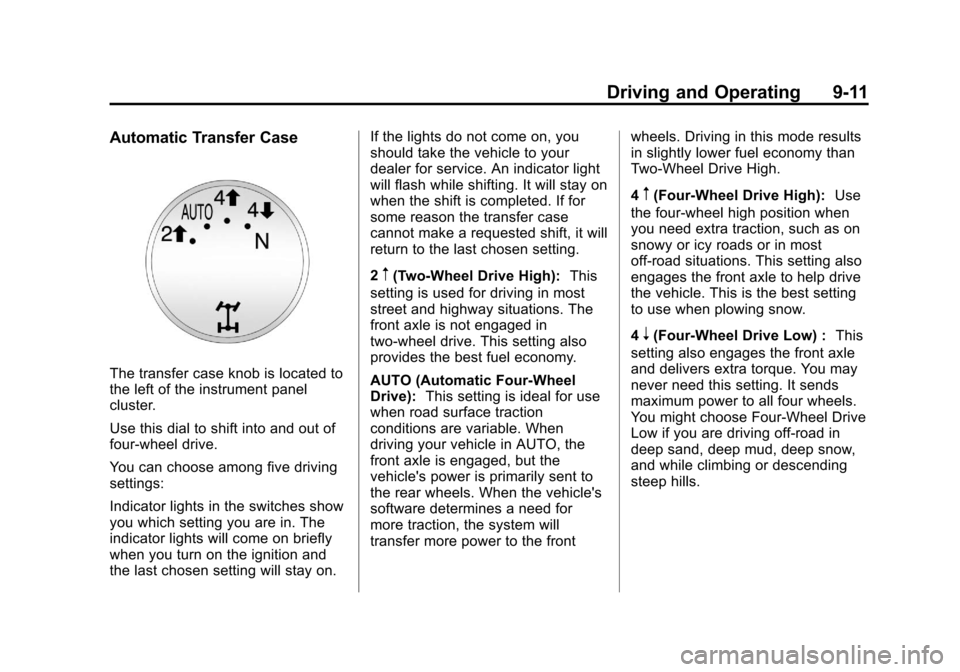
The transfer case knob is located to
the left of the instrument panel
cluster.
Use this dial to shift into and out of
four-wheel drive.
You can choose among five driving
settings:
Indicator lights in the switches show
you which setting you are in. The
indicator lights will come on briefly
when you turn on the ignition and
the last chosen setting will stay on.If the lights do not come on, you
should take the vehicle to your
dealer for service. An indicator light
will flash while shifting. It will stay on
when the shift is completed. If for
some reason the transfer case
cannot make a requested shift, it will
return to the last chosen setting.
2
m(Two-Wheel Drive High):
This
setting is used for driving in most
street and highway situations. The
front axle is not engaged in
two-wheel drive. This setting also
provides the best fuel economy.
AUTO (Automatic Four-Wheel
Drive): This setting is ideal for use
when road surface traction
conditions are variable. When
driving your vehicle in AUTO, the
front axle is engaged, but the
vehicle's power is primarily sent to
the rear wheels. When the vehicle's
software determines a need for
more traction, the system will
transfer more power to the front wheels. Driving in this mode results
in slightly lower fuel economy than
Two-Wheel Drive High.
4
m(Four-Wheel Drive High):
Use
the four-wheel high position when
you need extra traction, such as on
snowy or icy roads or in most
off-road situations. This setting also
engages the front axle to help drive
the vehicle. This is the best setting
to use when plowing snow.
4
n(Four-Wheel Drive Low) : This
setting also engages the front axle
and delivers extra torque. You may
never need this setting. It sends
maximum power to all four wheels.
You might choose Four-Wheel Drive
Low if you are driving off-road in
deep sand, deep mud, deep snow,
and while climbing or descending
steep hills.
Page 42 of 98
Black plate (12,1)Chevrolet Tahoe and GMC Yukon/Yukon Denali Hybrid - 2011
9-12 Driving and Operating
The vehicle has StabiliTrak. Shifting
into Four-Wheel-Drive Low will turn
Traction Control and StabiliTrak off.
See“StabiliTrak System” in the
owner manual.
{WARNING
Shifting the transfer case to
N (Neutral) can cause the vehicle
to roll even if the transmission is
in P (Park). You or someone else
could be seriously injured. Be
sure to set the parking brake
before placing the transfer case in
N (Neutral). See “Parking Brake”
in the owner manual for more
information.
N (Neutral): Shift the vehicle's
transfer case to N (Neutral) only
when towing the vehicle. See
“Recreational Vehicle Towing” or
“Towing Your Vehicle” in the owner
manual. If the SERVICE 4 WHEEL DRIVE
message stays on, you should take
the vehicle to your dealer for
service. See
Transmission
Messages on page 5‑13.
Shifting Into Four-Wheel Drive
High or AUTO (Automatic
Four-Wheel Drive)
Turn the knob to the Four-Wheel
High or AUTO position. This can be
done at any speed, except when
shifting from Four-Wheel Drive Low.
The indicator light will flash while
shifting. It will remain on when the
shift is completed.
Shifting Into Two-Wheel
Drive High
Turn the knob to the Two-Wheel
High position. This can be done at
any speed, except when shifting
from Four-Wheel Drive Low.
See “Shifting Out of Four-Wheel
Drive Low” in this section for more
information. Shifting Into Four-Wheel
Drive Low
When Four-Wheel Low is engaged,
vehicle speed should be kept below
64 km/h (40 mph). Extended
high-speed operation in 4L may
damage or shorten the life of the
drivetrain.
To shift to the Four-Wheel Drive
Low position, the ignition must be in
ON/RUN and the vehicle must be
stopped or moving less than 5 km/h
(3 mph) with the transmission in
N (Neutral). The preferred method
for shifting into Four-Wheel Drive
Low is to have the vehicle moving
1.6 to 3.2 km/h (1 to 2 mph). Turn
the knob to the Four-Wheel Drive
Low position. You must wait for the
Four-Wheel Drive Low indicator light
to stop flashing and remain on
before shifting the transmission
into gear.
Page 43 of 98
Black plate (13,1)Chevrolet Tahoe and GMC Yukon/Yukon Denali Hybrid - 2011
Driving and Operating 9-13
Notice:Shifting the transmission
into gear before the Four-Wheel
Drive Low indicator light has
stopped flashing could damage
the transfer case. To help avoid
damaging the vehicle, always wait
for the Four-Wheel Drive Low
indicator light to stop flashing
before shifting the transmission
into gear.
The vehicle may have significant
engagement noise and bump when
shifting between Four-Wheel Drive
Low and Four-Wheel Drive High
ranges or from N (Neutral) while the
engine is running.
If the knob is turned to the
Four-Wheel Drive Low position
when the vehicle is in gear and/or
moving, the Four-Wheel Drive Low
indicator light will flash for
30 seconds and not complete the
shift unless the vehicle is moving
less than 5 km/h (3 mph) and the
transmission is in N (Neutral). After
30 seconds the transfer case will
shift to Four-Wheel Drive
High mode. Shifting Out of Four-Wheel
Drive Low
To shift from Four-Wheel Drive Low
to Four-Wheel Drive High, AUTO,
or Two-Wheel Drive High, the
vehicle must be stopped or moving
less than 5 km/h (3 mph) with the
transmission in N (Neutral) and the
ignition in ON/RUN. The preferred
method for shifting out of
Four-Wheel Drive Low is to have
your vehicle moving 1.6 to 3.2 km/h
(1 to 2 mph). Turn the knob to the
Four-Wheel Drive High, AUTO,
or Two-Wheel Drive High position.
You must wait for the Four-Wheel
Drive High, AUTO, or Two-Wheel
Drive High indicator light to stop
flashing and remain on before
shifting the transmission into gear.
Notice:
Shifting the transmission
into gear before the Four-Wheel
Drive Low indicator light has
stopped flashing could damage
the transfer case. To help avoid damaging the vehicle, always wait
for the Four-Wheel Drive Low
indicator light to stop flashing
before shifting the transmission
into gear.
The vehicle may have significant
engagement noise and bump when
shifting between Four-Wheel Drive
Low and Four-Wheel Drive High
ranges or from N (Neutral) while the
engine is running.
If the knob is turned to the
Four-Wheel Drive High, AUTO,
or Two-Wheel Drive High switch
position when the vehicle is in gear
and/or moving, the Four-Wheel
Drive High, AUTO or Two-Wheel
Drive High indicator light will flash
for 30 seconds but will not complete
the shift unless the vehicle is
moving less than 5 km/h (3 mph)
and the transmission is in
N (Neutral).
Page 44 of 98
Black plate (14,1)Chevrolet Tahoe and GMC Yukon/Yukon Denali Hybrid - 2011
9-14 Driving and Operating
Shifting into Neutral
To shift the transfer case into
N (Neutral):
1. Make sure the vehicle is parkedso that it will not roll.
2. Set the parking brake and apply the regular brake pedal. See
“Parking Brake” in the owner
manual.
3. Start the vehicle or turn the ignition to ON/RUN.
4. Put the transmission in N (Neutral).
5. Shift the transfer case to Two-Wheel Drive High.
6. Turn the transfer case dial clockwise to N (Neutral) until it
stops and hold it there until the
N (Neutral) light starts blinking.
This will take at least
10 seconds. Then slowly release
the dial to the Four‐Wheel Drive
Low position. The N (Neutral)
light will come on when the
transfer case shift to N (Neutral)
is complete. 7. If the engine is running, verify
that the transfer case is in
N (Neutral) by shifting the
transmission to R (Reverse) for
one second, then shift the
transmission to D (Drive) for
one second.
8. Turn the ignition to ACC/ ACCESSORY, which will turn the
engine off.
9. Place the transmission shift lever in P (Park).
10. Release the parking brake prior to moving the vehicle.
11. Turn the ignition to LOCK/OFF.
Shifting Out of Neutral
To shift the transfer case out of
N (Neutral):
1. Set the parking brake and apply the regular brake pedal.
2. Turn the ignition to ON/RUN with the engine off, and shift the
transmission to N (Neutral). 3. Turn the transfer case dial to the
desired transfer case shift
position (Two-Wheel Drive High,
Four-Wheel Drive High, AUTO).
After the transfer case has
shifted out of N (Neutral), the
N (Neutral) light will go out.
4. Release the parking brake prior to moving the vehicle.
Notice: Shifting the transmission
into gear before the Four-Wheel
Drive Low indicator light has
stopped flashing could damage
the transfer case. To help avoid
damaging the vehicle, always wait
for the Four-Wheel Drive Low
indicator light to stop flashing
before shifting the transmission
into gear.
5. Start the engine and shift the transmission to the desired
position.
Page 63 of 98
Black plate (15,1)Chevrolet Tahoe and GMC Yukon/Yukon Denali Hybrid - 2011
Vehicle Care 10-15
Fuses and Circuit
Breakers
The wiring circuits in the vehicle are
protected from short circuits by a
combination of fuses, circuit
breakers and fusible thermal links.
This greatly reduces the chance of
fires caused by electrical problems.
Be sure you replace a bad fuse with
a new one of the identical size and
rating.If you ever have a problem on the
road and do not have a spare fuse,
you can borrow one that has the
same amperage. Just pick some
feature of the vehicle that you can
get along without, like the radio or
cigarette lighter, and use its fuse,
if it is the correct amperage.
Replace it as soon as you can.
The vehicle also has a special fuse
in the battery box for the 300-volt
batteries. If this fuse has failed and
needs to be replaced, the vehicle
will be disabled and you will need to
have the vehicle repaired by your
dealer. Do not attempt to
self-service this fuse.
Engine Compartment
Fuse Block
Hybrid Auxiliary Engine
Compartment Fuse Block
The hybrid auxiliary engine
compartment fuse block is located
in the engine compartment near the
front of the vehicle. Lift the cover for
access to the fuse/relay block. See
Engine Compartment Overview on
page 10‑4
for more information on
its location. For more information on
the main underhood fuse block, see
“Engine Compartment Fuse Block”
in the owner manual.
Page 66 of 98
Black plate (18,1)Chevrolet Tahoe and GMC Yukon/Yukon Denali Hybrid - 2011
10-18 Vehicle Care
affects vehicle handling and ride
comfort. Never load your vehicle
with more weight than it was
designed to carry.
When to Check
Check your tires once a month
or more.
How to Check
Use a good quality pocket-type
gauge to check tire pressure. You
cannot tell if your tires are properly
inflated simply by looking at them.
Radial tires may look properly
inflated even when they're
underinflated. Check the tire's
inflation pressure when the tires are
cold. Cold means your vehicle has
been sitting for at least three hours
or driven no more than 1.6 km
(1 mile).
Remove the valve cap from the tire
valve stem. Press the tire gauge
firmly onto the valve to get a
pressure measurement. If the cold
tire inflation pressure matches the
recommended pressure on the tireand loading information label, no
further adjustment is necessary.
If the pressure is low, add air until
you reach the recommended
amount.
If you overfill the tire, release air by
pushing on the metal stem in the
center of the tire valve. Recheck the
tire pressure with the tire gauge.
Be sure to put the valve caps back
on the valve stems. They help
prevent leaks by keeping out dirt
and moisture.
Tire Pressure Monitor
Operation
This vehicle may have a Tire
Pressure Monitor System (TPMS).
The TPMS is designed to warn the
driver when a low tire pressure
condition exists. TPMS sensors are
mounted onto each tire and wheel
assembly. The TPMS sensors
monitor the air pressure in the
vehicle's tires and transmit the tire
pressure readings to a receiver
located in the vehicle.
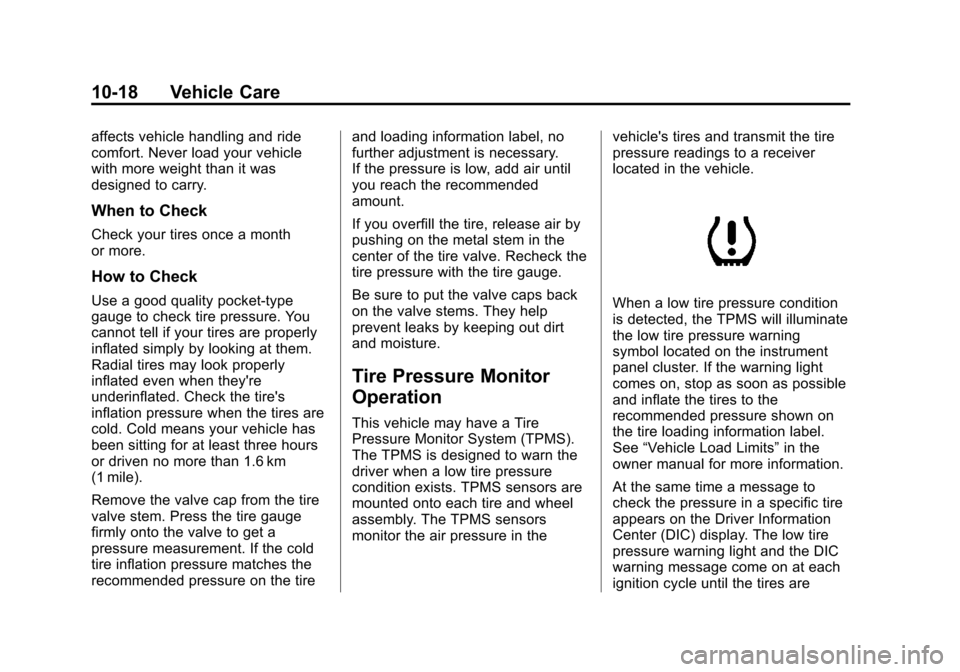
When a low tire pressure condition
is detected, the TPMS will illuminate
the low tire pressure warning
symbol located on the instrument
panel cluster. If the warning light
comes on, stop as soon as possible
and inflate the tires to the
recommended pressure shown on
the tire loading information label.
See
“Vehicle Load Limits” in the
owner manual for more information.
At the same time a message to
check the pressure in a specific tire
appears on the Driver Information
Center (DIC) display. The low tire
pressure warning light and the DIC
warning message come on at each
ignition cycle until the tires are
Page 67 of 98
Black plate (19,1)Chevrolet Tahoe and GMC Yukon/Yukon Denali Hybrid - 2011
Vehicle Care 10-19
inflated to the correct inflation
pressure. Using the DIC, tire
pressure levels can be viewed by
the driver. For additional information
and details about the DIC operation
and displays seeDriver Information
Center (DIC) on page 5‑11.
The low tire pressure warning light
may come on in cool weather when
the vehicle is first started, and then
turn off as you start to drive. This
could be an early indicator that the
air pressure in the tire(s) are getting
low and need to be inflated to the
proper pressure.
A Tire and Loading Information
label, attached to your vehicle,
shows the size of your vehicle's
original equipment tires and the
correct inflation pressure for your
vehicle's tires when they are cold.
See “Vehicle Load Limits” for an
example of the Tire and Loading
Information label and its location on
your vehicle. Also see Tire Pressure
on page 10‑17. Your vehicle's TPMS can warn you
about a low tire pressure condition
but it does not replace normal tire
maintenance. See
“Tire Inspection,”
“Tire Rotation” and“Tires” in the
owner manual for more information.
Notice: Tire sealant materials are
not all the same. A non-approved
tire sealant could damage the Tire
Pressure Monitor System (TPMS)
sensors. TPMS sensor damage
caused by using an incorrect tire
sealant is not covered by the
vehicle warranty. Always use only
the GM approved tire sealant
available through your dealer or
included in the vehicle.
Your vehicle, when new, included a
factory‐installed Tire Sealant and
Compressor Kit. This kit uses a GM
approved liquid tire sealant. See
Tire Sealant and Compressor Kit on
page 10‑24.TPMS Malfunction Light and
Message
The TPMS will not function properly
if one or more of the TPMS sensors
are missing or inoperable. When the
system detects a malfunction, the
low tire warning light flashes for
about one minute and then stays on
for the remainder of the ignition
cycle. A DIC warning message is
also displayed. The low tire warning
light and DIC warning message
come on at each ignition cycle until
the problem is corrected. Some of
the conditions that can cause the
malfunction light and DIC message
to come on are:
.The TPMS sensor matching
process was started but not
completed or not completed
successfully after rotating the
vehicle's tires. The DIC message
and TPMS malfunction light
should go off once the TPMS
sensor matching process is
performed successfully. See
“TPMS Sensor Matching
Process” later in this section.