warning CHEVROLET TAHOE 2011 3.G User Guide
[x] Cancel search | Manufacturer: CHEVROLET, Model Year: 2011, Model line: TAHOE, Model: CHEVROLET TAHOE 2011 3.GPages: 98, PDF Size: 1.55 MB
Page 32 of 98
Black plate (2,1)Chevrolet Tahoe and GMC Yukon/Yukon Denali Hybrid - 2011
9-2 Driving and Operating
Starting and
Operating
Starting the Vehicle
{WARNING
Exiting the vehicle, without first
shifting into P (Park), may cause
the vehicle to move, and you or
others can be seriously injured.
Because the vehicle has the
Automatic Engine Start/Stop
feature, the vehicle’s engine
might seem to be shut off when
you come to a complete stop.
However, once the brake pedal is
released, the vehicle can move.
The vehicle’s engine can also
restart at any time.
Shift to P (Park) and turn the
ignition to LOCK/OFF, before
exiting the vehicle.Start the engine as you would any
other engine. See
“Starting the
Engine” in the owner manual for
more information on starting.
If pulling a trailer with trailer brakes,
see Towing Equipment on
page 9‑17 for more information.Auto Stop
The vehicle has an Auto Stop
feature. After a successful engine
start, the engine may turn off and
operate in the Auto Stop mode.
Some of the vehicle conditions that
allow the engine to stop running and
enter the Auto Stop mode are:
.Ignition switch is in the ON/RUN
position.
.The hood is closed.
.The gear selector is in P (Park),
R (Reverse), N (Neutral) or
D (Drive).
.The hybrid battery is at an
acceptable state of charge.
.The hybrid battery voltage,
temperature or power limits are
not exceeded. In very hot
conditions, Auto Stop may be
unavailable until the hybrid
battery has cooled.
.The engine is at operating
temperature.
.The vehicle may enter Auto Stop
after a remote vehicle start.
With your foot off the brake and the
vehicle on level ground, the hybrid
drive motor may cause the vehicle
to roll slowly forward, even when the
engine is in Auto Stop.
Keep your foot firmly on the brake
pedal until you are ready for the
vehicle to move.
Engine OFF and AUTO STOP
modes are indicated on the
tachometer display. When the
tachometer needle indicates OFF,
the engine is not running and will
remain off until the ignition key is
placed in the START position or a
remote vehicle start is performed.
Page 34 of 98
Black plate (4,1)Chevrolet Tahoe and GMC Yukon/Yukon Denali Hybrid - 2011
9-4 Driving and Operating
Engine Coolant Heater
The engine coolant heater can
provide easier starting and better
fuel economy during engine
warm-up in cold weather conditions
at or below−18°C (0°F). Vehicles
with an engine heater should be
plugged in at least four hours before
starting. An internal thermostat in
the plug-end of the cord may exist
which will prevent engine coolant
heater operation at temperatures
above −18°C (0°F).
Using the Engine Coolant
Heater
1. Turn off the engine.
2. Open the hood and unwrap the
electrical cord. The cord is
secured to a wiring harness
between the engine and the
Hybrid Auxiliary Underhood
Fuse Block with a clip. Carefully
remove the wire tie which
secures the electrical cord. Do
not cut the electrical cord. 3. Plug the cord into a normal,
grounded 110-volt AC outlet.
{WARNING
Plugging the cord into an
ungrounded outlet could cause an
electrical shock. Also, the wrong
kind of extension cord could
overheat and cause a fire. You
could be seriously injured. Plug
the cord into a properly grounded
three-prong 110-volt AC outlet.
If the cord will not reach, use a
heavy-duty three-prong extension
cord rated for at least 15 amps.
4. Before starting the engine, be sure to unplug and store the
cord as it was before to keep it
away from moving engine parts.
If you do not, it could be
damaged. The length of time the heater should
remain plugged in depends on
several factors. Ask a dealer in the
area where you will be parking the
vehicle for the best advice on this.
Shifting Into Park
{WARNING
It can be dangerous to get out of
the vehicle if the shift lever is not
fully in P (Park) with the parking
brake firmly set. The vehicle can
roll. If you have left the engine
running, the vehicle can move
suddenly. You or others could be
injured. To be sure the vehicle will
not move, even when you are on
fairly level ground, use the steps
that follow. With four-wheel drive,
if the transfer case is in
N (Neutral), the vehicle will be
free to roll, even if the shift lever
is in P (Park). So, be sure the
transfer case is in a drive
(Continued)
Page 35 of 98
Black plate (5,1)Chevrolet Tahoe and GMC Yukon/Yukon Denali Hybrid - 2011
Driving and Operating 9-5
WARNING (Continued)
gear—not in N (Neutral). If you
are pulling a trailer, see “Driving
Characteristics and Towing Tips”
in the owner manual.
1. Hold the brake pedal down, then set the parking brake.
See “Parking Brake” in the
owner manual.
2. Move the shift lever into the P (Park) position by pulling the
shift lever toward you and
moving it up as far as it will go.
3. Be sure the transfer case (if equipped) is in a drive
gear —not in N (Neutral).
4. Turn the ignition key to LOCK/OFF.
5. Remove the key and take it with you. If you can leave the vehicle
with the ignition key in your
hand, the vehicle is in P (Park).
Leaving the Vehicle with the
Engine Running
{WARNING
It can be dangerous to leave the
vehicle with the engine running.
The vehicle could move suddenly
if the shift lever is not fully in
P (Park) with the parking brake
firmly set.
If you have four-wheel drive and
the transfer case is in N (Neutral),
the vehicle will be free to roll,
even if the shift lever is in
P (Park). So be sure the transfer
case is in a drive gear —not in
N (Neutral).
And, if you leave the vehicle with
the engine running, it could
overheat and even catch fire. You
or others could be injured. Do not
leave the vehicle with the engine
running unless you have to. If you have to leave the vehicle with
the engine running, be sure your
vehicle is in P (Park) and the
parking brake is firmly set before
you leave it. After you move the shift
lever into P (Park), hold the regular
brake pedal down. Then, see if you
can move the shift lever away from
P (Park) without first pulling it toward
you. If you can, it means that the
shift lever was not fully locked into
P (Park).
Torque Lock
If parking on a hill and the
transmission not shifted into
P (Park) properly, the weight of
the vehicle may put too much
force on the parking pawl in the
transmission. You may find it difficult
to pull the shift lever out of P (Park).
This is called torque lock. To
prevent torque lock, set the parking
brake and then shift into P (Park)
properly before you leave the driver
seat. To find out how, see
Shifting
Into Park on page 9‑4.
Page 36 of 98
Black plate (6,1)Chevrolet Tahoe and GMC Yukon/Yukon Denali Hybrid - 2011
9-6 Driving and Operating
When you are ready to drive, move
the shift lever out of P (Park) before
you release the parking brake.
If torque lock does occur, you may
need to have another vehicle push
yours a little uphill to take some of
the pressure from the parking pawl
in the transmission, then you will be
able to pull the shift lever out of
P (Park).Engine Exhaust
Running the Vehicle
While Parked
It is better not to park with the
engine running. But if you ever have
to, here are some things to know.
{WARNING
Exiting the vehicle, without first
shifting into P (Park), may cause
the vehicle to move, and you or
others can be seriously injured.
Because the vehicle has the
Automatic Engine Start/Stop
feature, the vehicle’s engine
might seem to be shut off when
you come to a complete stop.(Continued)
WARNING (Continued)
However, once the brake pedal is
released, the vehicle can move.
The vehicle’s engine can also
restart at any time.
Shift to P (Park) and turn the
ignition to LOCK/OFF, before
exiting the vehicle.
Follow the proper steps to be sure
the vehicle will not move. See
Shifting Into Park on page 9‑4.
If pulling a trailer, see “Driving
Characteristics and Towing Tips” in
the owner manual.
Page 37 of 98
Black plate (7,1)Chevrolet Tahoe and GMC Yukon/Yukon Denali Hybrid - 2011
Driving and Operating 9-7
Automatic
Transmission
The vehicle has an electronic shift
position indicator within the
instrument panel cluster.
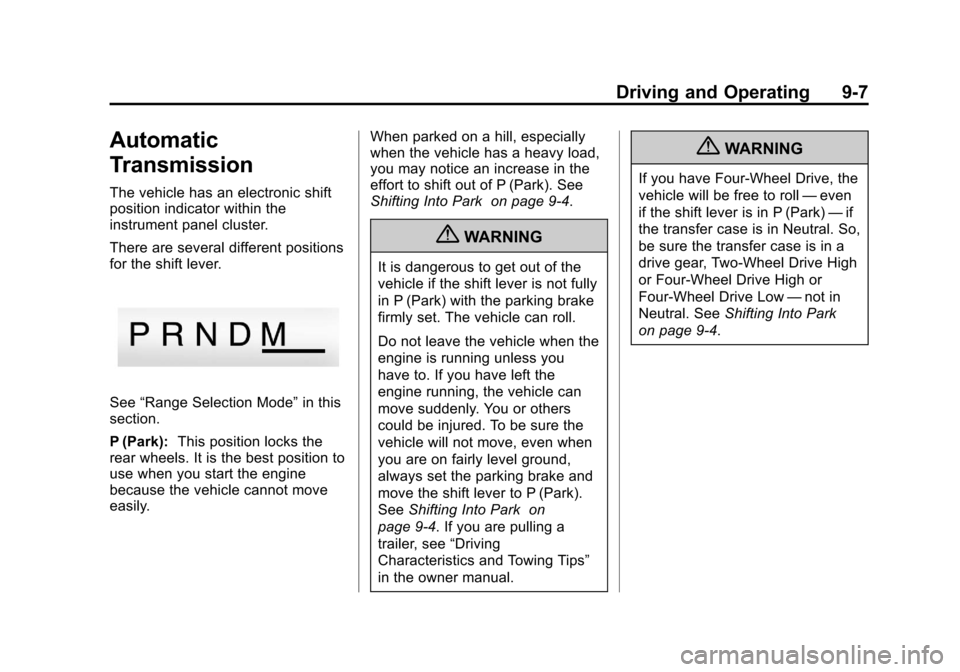
There are several different positions
for the shift lever.
See“Range Selection Mode” in this
section.
P (Park): This position locks the
rear wheels. It is the best position to
use when you start the engine
because the vehicle cannot move
easily. When parked on a hill, especially
when the vehicle has a heavy load,
you may notice an increase in the
effort to shift out of P (Park). See
Shifting Into Park on page 9‑4.
{WARNING
It is dangerous to get out of the
vehicle if the shift lever is not fully
in P (Park) with the parking brake
firmly set. The vehicle can roll.
Do not leave the vehicle when the
engine is running unless you
have to. If you have left the
engine running, the vehicle can
move suddenly. You or others
could be injured. To be sure the
vehicle will not move, even when
you are on fairly level ground,
always set the parking brake and
move the shift lever to P (Park).
See
Shifting Into Park on
page 9‑4. If you are pulling a
trailer, see “Driving
Characteristics and Towing Tips”
in the owner manual.
{WARNING
If you have Four-Wheel Drive, the
vehicle will be free to roll —even
if the shift lever is in P (Park) —if
the transfer case is in Neutral. So,
be sure the transfer case is in a
drive gear, Two-Wheel Drive High
or Four-Wheel Drive High or
Four-Wheel Drive Low —not in
Neutral. See Shifting Into Park
on page 9‑4.
Page 38 of 98
Black plate (8,1)Chevrolet Tahoe and GMC Yukon/Yukon Denali Hybrid - 2011
9-8 Driving and Operating
R (Reverse):Use this gear to
back up.
Notice: Shifting to R (Reverse)
while the vehicle is moving
forward could damage the
transmission. The repairs would
not be covered by the vehicle
warranty. Shift to R (Reverse) only
after the vehicle is stopped.
To rock the vehicle back and forth to
get out of snow, ice, or sand without
damaging the transmission, see “If
the Vehicle is Stuck” in the owner
manual.
N (Neutral): In this position, the
engine and transmission are not
connected with the wheels. To
restart the engine when the vehicle
is already moving, use
N (Neutral) only.{WARNING
Shifting into a drive gear while the
engine is running at high speed is
dangerous. Unless your foot is
firmly on the brake pedal, the
vehicle could move very rapidly.
You could lose control and hit
people or objects. Do not shift
into a drive gear while the engine
is running at high speed.
Notice: Shifting out of P (Park) or
N (Neutral) with the engine
running at high speed may
damage the transmission. The
repairs would not be covered by
the vehicle warranty. Be sure the
engine is not running at high
speed when shifting the vehicle. D (Drive):
This position is for
normal driving. It provides the best
fuel economy. If you need more
power for passing, and you are:
.Going less than about 55 km/h
(35 mph), push the accelerator
pedal about halfway down.
.Going about 55 km/h (35 mph) or
more, push the accelerator all
the way down.
D (Drive) or M (Manual Mode) can
be used when towing a trailer,
carrying a heavy load, driving on
steep hills, or for off-road driving.
You may want to shift the
transmission to a lower gear
selection if the transmission shifts
too often.
Downshifting the transmission in
slippery road conditions could result
in skidding. See “Loss of Control” in
the owner manual.
When temperatures are very cold,
the transmission's gear shifting may
be delayed, providing more stable
shifts until the engine warms up.
Page 42 of 98
Black plate (12,1)Chevrolet Tahoe and GMC Yukon/Yukon Denali Hybrid - 2011
9-12 Driving and Operating
The vehicle has StabiliTrak. Shifting
into Four-Wheel-Drive Low will turn
Traction Control and StabiliTrak off.
See“StabiliTrak System” in the
owner manual.
{WARNING
Shifting the transfer case to
N (Neutral) can cause the vehicle
to roll even if the transmission is
in P (Park). You or someone else
could be seriously injured. Be
sure to set the parking brake
before placing the transfer case in
N (Neutral). See “Parking Brake”
in the owner manual for more
information.
N (Neutral): Shift the vehicle's
transfer case to N (Neutral) only
when towing the vehicle. See
“Recreational Vehicle Towing” or
“Towing Your Vehicle” in the owner
manual. If the SERVICE 4 WHEEL DRIVE
message stays on, you should take
the vehicle to your dealer for
service. See
Transmission
Messages on page 5‑13.
Shifting Into Four-Wheel Drive
High or AUTO (Automatic
Four-Wheel Drive)
Turn the knob to the Four-Wheel
High or AUTO position. This can be
done at any speed, except when
shifting from Four-Wheel Drive Low.
The indicator light will flash while
shifting. It will remain on when the
shift is completed.
Shifting Into Two-Wheel
Drive High
Turn the knob to the Two-Wheel
High position. This can be done at
any speed, except when shifting
from Four-Wheel Drive Low.
See “Shifting Out of Four-Wheel
Drive Low” in this section for more
information. Shifting Into Four-Wheel
Drive Low
When Four-Wheel Low is engaged,
vehicle speed should be kept below
64 km/h (40 mph). Extended
high-speed operation in 4L may
damage or shorten the life of the
drivetrain.
To shift to the Four-Wheel Drive
Low position, the ignition must be in
ON/RUN and the vehicle must be
stopped or moving less than 5 km/h
(3 mph) with the transmission in
N (Neutral). The preferred method
for shifting into Four-Wheel Drive
Low is to have the vehicle moving
1.6 to 3.2 km/h (1 to 2 mph). Turn
the knob to the Four-Wheel Drive
Low position. You must wait for the
Four-Wheel Drive Low indicator light
to stop flashing and remain on
before shifting the transmission
into gear.
Page 50 of 98
Black plate (2,1)Chevrolet Tahoe and GMC Yukon/Yukon Denali Hybrid - 2011
10-2 Vehicle Care
Vehicle Checks
Doing Your Own
Service Work
{WARNING
Never try to do your own service
on hybrid components. You can
be injured and the vehicle can be
damaged if you try to do your own
service work. Service and repair
of these hybrid components
should only be performed by a
trained service technician with the
proper knowledge and tools.
{WARNING
You can be injured and the
vehicle could be damaged if you
try to do service work on a vehicle
without knowing enough about it.
.Be sure you have sufficient
knowledge, experience, the
proper replacement parts,
and tools before attempting
any vehicle
maintenance task.
.Be sure to use the proper
nuts, bolts, and other
fasteners. English and metric
fasteners can be easily
confused. If the wrong
fasteners are used, parts can
later break or fall off. You
could be hurt.If doing some of your own service
work, use the proper service
manual. It tells you much more
about how to service the vehicle
than this manual can. To order the
proper service manual, see
“Service
Publications Ordering Information”
in the owner manual.
This vehicle has an airbag system.
Before attempting to do your own
service work, see “Airbag System
Check” in the owner manual.
Keep a record with all parts receipts
and list the mileage and the date of
any service work performed. See
“Maintenance Records” in the owner
manual.
Page 58 of 98
Black plate (10,1)Chevrolet Tahoe and GMC Yukon/Yukon Denali Hybrid - 2011
10-10 Vehicle Care
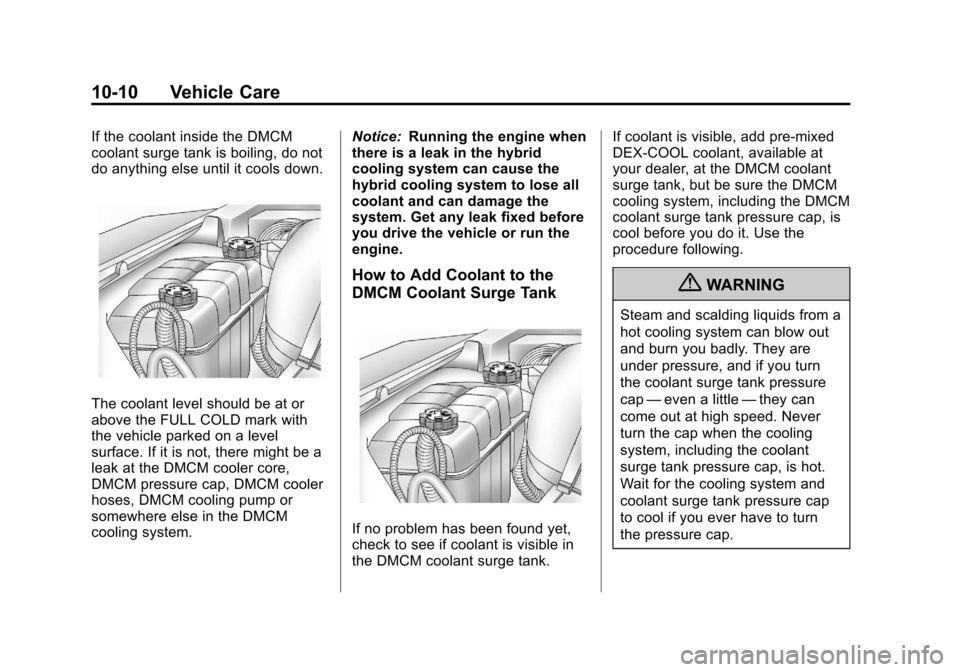
If the coolant inside the DMCM
coolant surge tank is boiling, do not
do anything else until it cools down.
The coolant level should be at or
above the FULL COLD mark with
the vehicle parked on a level
surface. If it is not, there might be a
leak at the DMCM cooler core,
DMCM pressure cap, DMCM cooler
hoses, DMCM cooling pump or
somewhere else in the DMCM
cooling system.Notice:
Running the engine when
there is a leak in the hybrid
cooling system can cause the
hybrid cooling system to lose all
coolant and can damage the
system. Get any leak fixed before
you drive the vehicle or run the
engine.
How to Add Coolant to the
DMCM Coolant Surge Tank
If no problem has been found yet,
check to see if coolant is visible in
the DMCM coolant surge tank. If coolant is visible, add pre‐mixed
DEX-COOL coolant, available at
your dealer, at the DMCM coolant
surge tank, but be sure the DMCM
cooling system, including the DMCM
coolant surge tank pressure cap, is
cool before you do it. Use the
procedure following.
{WARNING
Steam and scalding liquids from a
hot cooling system can blow out
and burn you badly. They are
under pressure, and if you turn
the coolant surge tank pressure
cap
—even a little —they can
come out at high speed. Never
turn the cap when the cooling
system, including the coolant
surge tank pressure cap, is hot.
Wait for the cooling system and
coolant surge tank pressure cap
to cool if you ever have to turn
the pressure cap.
Page 59 of 98
Black plate (11,1)Chevrolet Tahoe and GMC Yukon/Yukon Denali Hybrid - 2011
Vehicle Care 10-11
Notice:Using coolant other than
a pre‐mixed DEX-COOL, available
at your dealer, may damage your
vehicle. Any repairs would not be
covered by your warranty. Always
use a pre‐mixed DEX-COOL
(silicate-free) coolant in your
vehicle.
{WARNING
You can be burned if you spill
coolant on hot engine parts.
Coolant contains ethylene glycol
and it will burn if the engine parts
are hot enough. Do not spill
coolant on a hot engine.
If the DMCM coolant is empty, the
vehicle must be serviced by your
dealer and a special fill procedure
must be followed.
Notice: Attempting to fill the
DMCM cooling surge tank
yourself when the fluid level is
empty can damage your vehicle.
Your vehicle must be serviced.
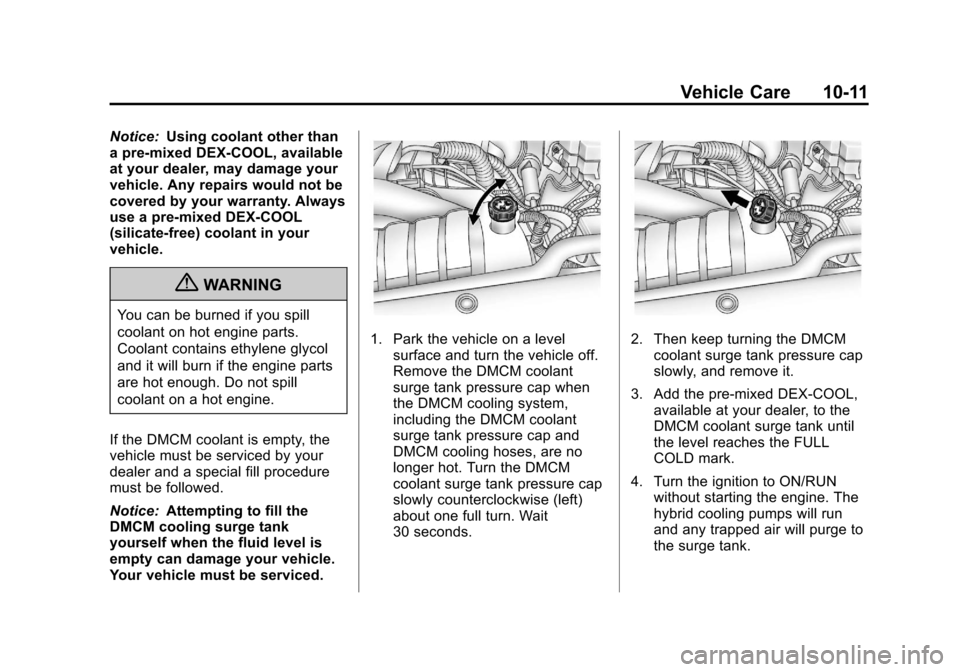
1. Park the vehicle on a level surface and turn the vehicle off.
Remove the DMCM coolant
surge tank pressure cap when
the DMCM cooling system,
including the DMCM coolant
surge tank pressure cap and
DMCM cooling hoses, are no
longer hot. Turn the DMCM
coolant surge tank pressure cap
slowly counterclockwise (left)
about one full turn. Wait
30 seconds.2. Then keep turning the DMCMcoolant surge tank pressure cap
slowly, and remove it.
3. Add the pre‐mixed DEX‐COOL, available at your dealer, to the
DMCM coolant surge tank until
the level reaches the FULL
COLD mark.
4. Turn the ignition to ON/RUN without starting the engine. The
hybrid cooling pumps will run
and any trapped air will purge to
the surge tank.