warning CHEVROLET TAHOE 2011 3.G Owner's Manual
[x] Cancel search | Manufacturer: CHEVROLET, Model Year: 2011, Model line: TAHOE, Model: CHEVROLET TAHOE 2011 3.GPages: 98, PDF Size: 1.55 MB
Page 61 of 98
Black plate (13,1)Chevrolet Tahoe and GMC Yukon/Yukon Denali Hybrid - 2011
Vehicle Care 10-13
Vehicle Storage
{WARNING
Batteries have acid that can burn
you and gas that can explode.
You can be badly hurt if you are
not careful. SeeJump Starting on
page 10‑32 for tips on working
around a battery without
getting hurt.
Infrequent Usage: Remove the
12‐volt battery black, negative (−)
cable from the battery to keep the
battery from running down.
Extended Storage: Remove the
12‐volt battery black, negative (−)
cable from the battery or use a
battery trickle charger.
Remember to reconnect the battery
when ready to drive the vehicle.
Bulb Replacement
For the proper type of replacement
bulbs, see Replacement Bulbs on
page 10‑14.
For any bulb‐changing procedure
not listed in this section, contact
your dealer.
Taillamps, Turn Signal,
Stoplamps, and Back-Up
Lamps
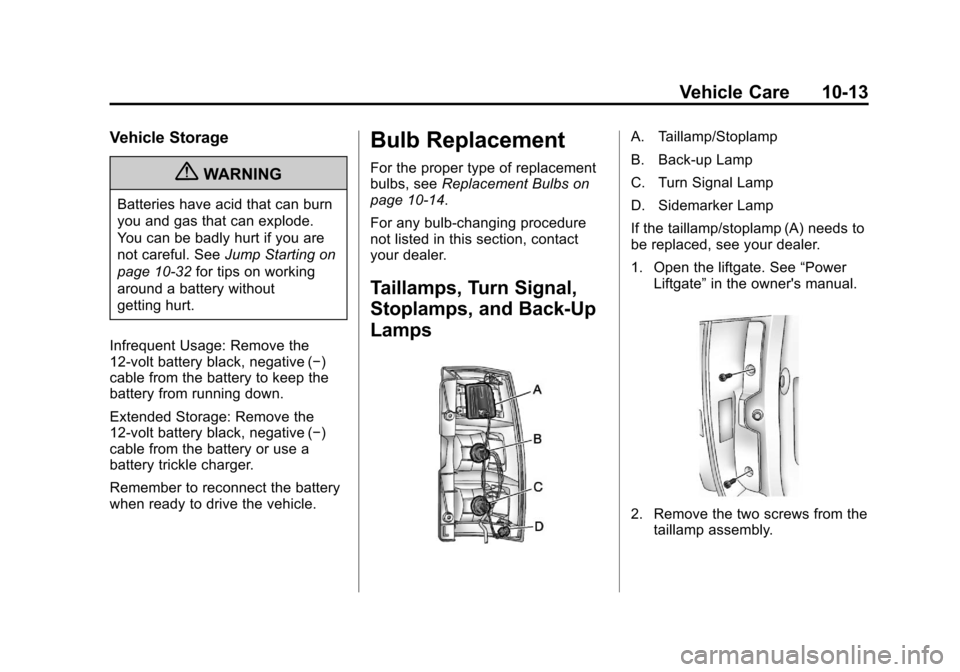
A. Taillamp/Stoplamp
B. Back-up Lamp
C. Turn Signal Lamp
D. Sidemarker Lamp
If the taillamp/stoplamp (A) needs to
be replaced, see your dealer.
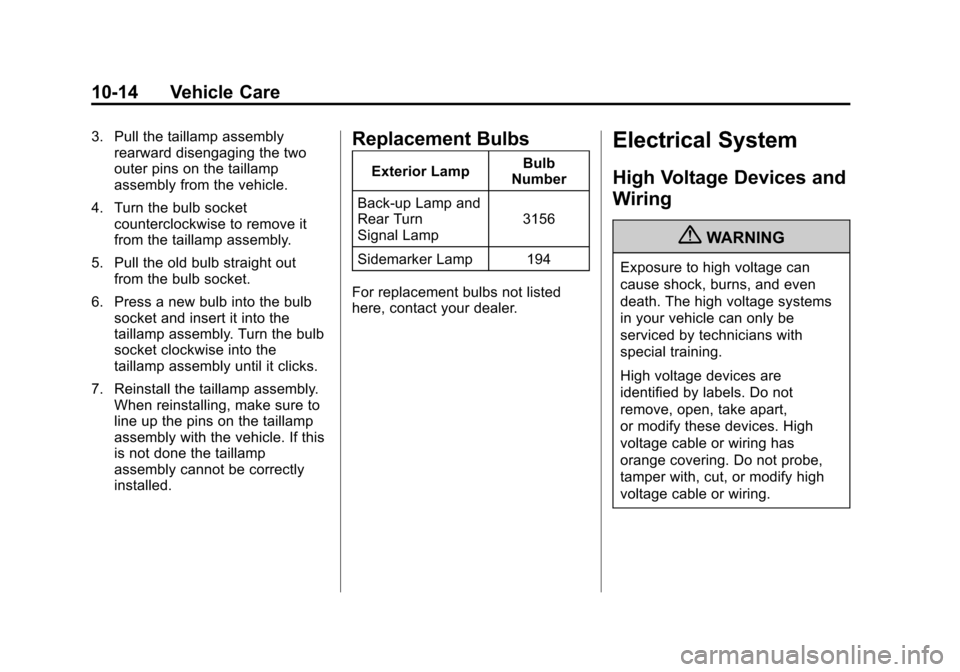
1. Open the liftgate. See “Power
Liftgate” in the owner's manual.
2. Remove the two screws from the
taillamp assembly.
Page 62 of 98
Black plate (14,1)Chevrolet Tahoe and GMC Yukon/Yukon Denali Hybrid - 2011
10-14 Vehicle Care
3. Pull the taillamp assemblyrearward disengaging the two
outer pins on the taillamp
assembly from the vehicle.
4. Turn the bulb socket counterclockwise to remove it
from the taillamp assembly.
5. Pull the old bulb straight out from the bulb socket.
6. Press a new bulb into the bulb socket and insert it into the
taillamp assembly. Turn the bulb
socket clockwise into the
taillamp assembly until it clicks.
7. Reinstall the taillamp assembly. When reinstalling, make sure to
line up the pins on the taillamp
assembly with the vehicle. If this
is not done the taillamp
assembly cannot be correctly
installed.Replacement Bulbs
Exterior Lamp Bulb
Number
Back-up Lamp and
Rear Turn
Signal Lamp 3156
Sidemarker Lamp 194
For replacement bulbs not listed
here, contact your dealer.
Electrical System
High Voltage Devices and
Wiring
{WARNING
Exposure to high voltage can
cause shock, burns, and even
death. The high voltage systems
in your vehicle can only be
serviced by technicians with
special training.
High voltage devices are
identified by labels. Do not
remove, open, take apart,
or modify these devices. High
voltage cable or wiring has
orange covering. Do not probe,
tamper with, cut, or modify high
voltage cable or wiring.
Page 66 of 98
Black plate (18,1)Chevrolet Tahoe and GMC Yukon/Yukon Denali Hybrid - 2011
10-18 Vehicle Care
affects vehicle handling and ride
comfort. Never load your vehicle
with more weight than it was
designed to carry.
When to Check
Check your tires once a month
or more.
How to Check
Use a good quality pocket-type
gauge to check tire pressure. You
cannot tell if your tires are properly
inflated simply by looking at them.
Radial tires may look properly
inflated even when they're
underinflated. Check the tire's
inflation pressure when the tires are
cold. Cold means your vehicle has
been sitting for at least three hours
or driven no more than 1.6 km
(1 mile).
Remove the valve cap from the tire
valve stem. Press the tire gauge
firmly onto the valve to get a
pressure measurement. If the cold
tire inflation pressure matches the
recommended pressure on the tireand loading information label, no
further adjustment is necessary.
If the pressure is low, add air until
you reach the recommended
amount.
If you overfill the tire, release air by
pushing on the metal stem in the
center of the tire valve. Recheck the
tire pressure with the tire gauge.
Be sure to put the valve caps back
on the valve stems. They help
prevent leaks by keeping out dirt
and moisture.
Tire Pressure Monitor
Operation
This vehicle may have a Tire
Pressure Monitor System (TPMS).
The TPMS is designed to warn the
driver when a low tire pressure
condition exists. TPMS sensors are
mounted onto each tire and wheel
assembly. The TPMS sensors
monitor the air pressure in the
vehicle's tires and transmit the tire
pressure readings to a receiver
located in the vehicle.
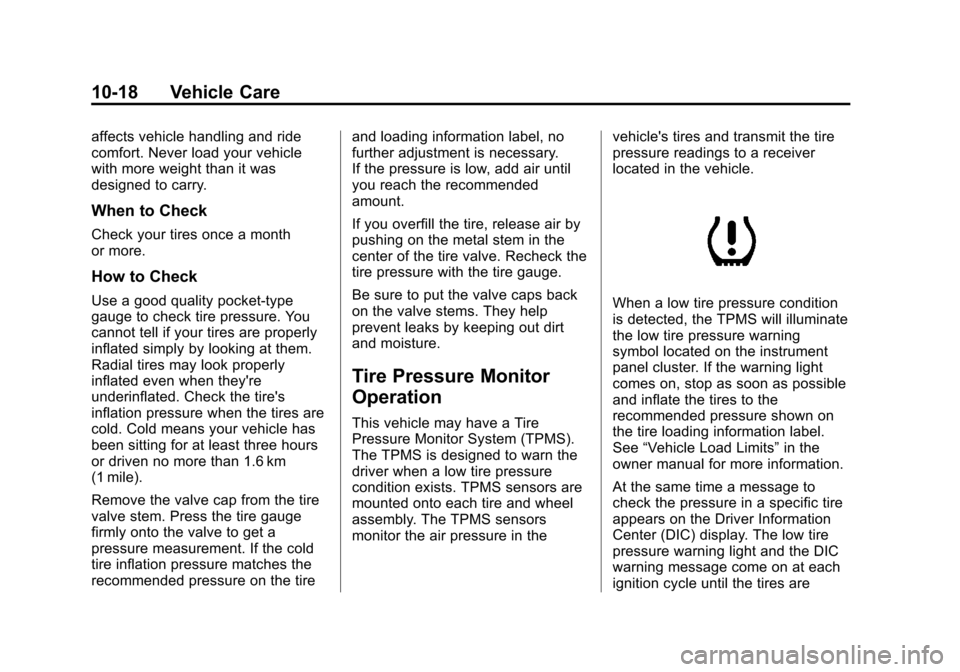
When a low tire pressure condition
is detected, the TPMS will illuminate
the low tire pressure warning
symbol located on the instrument
panel cluster. If the warning light
comes on, stop as soon as possible
and inflate the tires to the
recommended pressure shown on
the tire loading information label.
See
“Vehicle Load Limits” in the
owner manual for more information.
At the same time a message to
check the pressure in a specific tire
appears on the Driver Information
Center (DIC) display. The low tire
pressure warning light and the DIC
warning message come on at each
ignition cycle until the tires are
Page 67 of 98
Black plate (19,1)Chevrolet Tahoe and GMC Yukon/Yukon Denali Hybrid - 2011
Vehicle Care 10-19
inflated to the correct inflation
pressure. Using the DIC, tire
pressure levels can be viewed by
the driver. For additional information
and details about the DIC operation
and displays seeDriver Information
Center (DIC) on page 5‑11.
The low tire pressure warning light
may come on in cool weather when
the vehicle is first started, and then
turn off as you start to drive. This
could be an early indicator that the
air pressure in the tire(s) are getting
low and need to be inflated to the
proper pressure.
A Tire and Loading Information
label, attached to your vehicle,
shows the size of your vehicle's
original equipment tires and the
correct inflation pressure for your
vehicle's tires when they are cold.
See “Vehicle Load Limits” for an
example of the Tire and Loading
Information label and its location on
your vehicle. Also see Tire Pressure
on page 10‑17. Your vehicle's TPMS can warn you
about a low tire pressure condition
but it does not replace normal tire
maintenance. See
“Tire Inspection,”
“Tire Rotation” and“Tires” in the
owner manual for more information.
Notice: Tire sealant materials are
not all the same. A non-approved
tire sealant could damage the Tire
Pressure Monitor System (TPMS)
sensors. TPMS sensor damage
caused by using an incorrect tire
sealant is not covered by the
vehicle warranty. Always use only
the GM approved tire sealant
available through your dealer or
included in the vehicle.
Your vehicle, when new, included a
factory‐installed Tire Sealant and
Compressor Kit. This kit uses a GM
approved liquid tire sealant. See
Tire Sealant and Compressor Kit on
page 10‑24.TPMS Malfunction Light and
Message
The TPMS will not function properly
if one or more of the TPMS sensors
are missing or inoperable. When the
system detects a malfunction, the
low tire warning light flashes for
about one minute and then stays on
for the remainder of the ignition
cycle. A DIC warning message is
also displayed. The low tire warning
light and DIC warning message
come on at each ignition cycle until
the problem is corrected. Some of
the conditions that can cause the
malfunction light and DIC message
to come on are:
.The TPMS sensor matching
process was started but not
completed or not completed
successfully after rotating the
vehicle's tires. The DIC message
and TPMS malfunction light
should go off once the TPMS
sensor matching process is
performed successfully. See
“TPMS Sensor Matching
Process” later in this section.
Page 70 of 98
Black plate (22,1)Chevrolet Tahoe and GMC Yukon/Yukon Denali Hybrid - 2011
10-22 Vehicle Care
After the tires have been
rotated, adjust the front and rear
inflation pressures as shown on
the Tire and Loading Information
label. See“Vehicle Load Limits”
in the owner manual for an
example of the label and its
location on your vehicle.
The Tire Pressure Monitor
System (TPMS) sensors will
need to be reset after a tire
rotation. See “TPMS Sensor
Identification Codes” under“Tire
Pressure Monitor Operation”.
Make certain that all wheel nuts
are properly tightened. See
“Wheel Nut Torque” under
“Capacities and Specifications ”
in the owner manual.
Lightly coat the center of the
wheel hub with wheel bearing
grease after a wheel change or
tire rotation to prevent corrosion
or rust build-up. Do not get grease on the flat wheel
mounting surface or on the
wheel nuts or bolts.
Tire Chains
{WARNING
Do not use tire chains. There is
not enough clearance. Tire chains
used on a vehicle without the
proper amount of clearance can
cause damage to the brakes,
suspension, or other vehicle
parts. The area damaged by the
tire chains could cause you to
lose control of the vehicle and
you or others may be injured in a
crash. Use another type of
traction device only if its
manufacturer recommends it for
use on the vehicle and tire size
combination and road conditions.
Follow that manufacturer's
instructions. To help avoid
(Continued)
WARNING (Continued)
damage to the vehicle, drive
slowly, re‐adjust or remove the
device if it is contacting the
vehicle, and do not spin the
wheels. If you do find traction
devices that will fit, install them on
the rear tires.
If a Tire Goes Flat
Your vehicle has a tire inflator kit.
There is no spare tire, no tire
changing equipment, and no place
to store a tire.
It is unusual for a tire to blow out
while you are driving, especially if
you maintain your tires properly.
If air goes out of a tire, it is much
more likely to leak out slowly. But,
if you should ever have a blow out,
here are a few tips about what to
expect and what to do:
If a front tire fails, the flat tire
creates a drag that pulls the vehicle
toward that side. Take your foot off
Page 71 of 98

Black plate (23,1)Chevrolet Tahoe and GMC Yukon/Yukon Denali Hybrid - 2011
Vehicle Care 10-23
the accelerator pedal and grip the
steering wheel firmly. Steer to
maintain lane position, and then
gently brake to a stop, well off the
road, if possible.
A rear blow out, particularly on a
curve, acts much like a skid and
may require the same correction
you would use in a skid. In any rear
blow out, remove your foot from the
accelerator pedal. Get the vehicle
under control by steering the way
you want the vehicle to go. It may
be very bumpy and noisy, but you
can still steer. Gently brake to a
stop, well off the road, if possible.
{WARNING
Driving on a flat tire will cause
permanent damage to the tire.
Re-inflating a tire after it has
been driven on while severely
under-inflated or flat may cause a
blowout and a serious crash.(Continued)
WARNING (Continued)
Never attempt to re-inflate a tire
that has been driven on while
severely under-inflated or flat.
Have your dealer or an authorized
tire service center repair or
replace the flat tire as soon as
possible.
If a tire goes flat, avoid further tire
and wheel damage by driving slowly
to a level place and stopping, well
off the road, if possible. Then
do this:
1. Turn on the hazard warning flashers.
2. Park your vehicle. Set the parking brake firmly and put the
shift lever in PARK (P).
3. Turn off the engine.
4. Inspect the flat tire. If the tire has been separated from
the wheel or has damaged sidewalls
or large tears that allow rapid air
loss, call a tire repair facility. See
“Roadside Assistance Program”
in
the owner manual.
If the flat tire is due to a slow leak
caused by a nail or other similar
road hazard, the tire inflator kit may
be used to repair the damaged tire
temporarily. The kit uses a liquid tire
sealant to seal small punctures in
the tread area of the tire.
After repairing a tire with the tire
inflator kit, take your vehicle to an
authorized dealer to have the tire
inspected and repaired as soon as
possible. The tire sealant is a
temporary repair only. See Tire
Sealant and Compressor Kit on
page 10‑24.
Page 72 of 98

Black plate (24,1)Chevrolet Tahoe and GMC Yukon/Yukon Denali Hybrid - 2011
10-24 Vehicle Care
Tire Sealant and
Compressor Kit
{WARNING
Idling a vehicle in an enclosed
area with poor ventilation is
dangerous. Engine exhaust may
enter the vehicle. Engine exhaust
contains Carbon Monoxide (CO)
which cannot be seen or smelled.
It can cause unconsciousness
and even death. Never run the
engine in an enclosed area that
has no fresh air ventilation. For
more information, see”Engine
Exhaust” in the owner manual.
{WARNING
Over-inflating a tire could cause
the tire to rupture and you or
others could be injured. Be sure
to read and follow the tire sealant
and compressor kit instructions
and inflate the tire to its
recommended pressure. Do not
exceed the recommended
pressure.
{WARNING
Storing the tire sealant and
compressor kit or other
equipment in the passenger
compartment of the vehicle could
cause injury. In a sudden stop or
collision, loose equipment could
strike someone. Store the tire
sealant and compressor kit in its
original location. If this vehicle has a tire sealant and
compressor kit, there may not be a
spare tire, tire changing equipment,
and on some vehicles there may not
be a place to store a tire.
The tire sealant and compressor
can be used to temporarily seal
punctures up to 6 mm (¼ inch) in
the tread area of the tire. It can also
be used to inflate an under
inflated tire.
If the tire has been separated from
the wheel, has damaged sidewalls,
or has a large puncture, the tire is
too severely damaged for the tire
sealant and compressor kit to be
effective. See
“Roadside Assistance
Program” in the owner manual.
Read and follow all of the tire
sealant and compressor kit
instructions.
Page 74 of 98

Black plate (26,1)Chevrolet Tahoe and GMC Yukon/Yukon Denali Hybrid - 2011
10-26 Vehicle Care
If a tire goes flat, avoid further tire
and wheel damage by driving slowly
to a level place. Turn on the hazard
warning flashers.
SeeIf a Tire Goes Flat on
page 10‑22 for other important
safety warnings.
Do not remove any objects that
have penetrated the tire.
1. Remove the tire sealant and compressor kit from its storage
location. See Storing the Tire
Sealant and Compressor Kit on
page 10‑31.
Make sure the on/off button (D)
is in the off (O) position.
2. Unwrap the sealant/air hose (G) and the power plug (C).
3. Place the kit on the ground. Make sure the tire valve stem is
positioned close to the ground
so the hose will reach it.
4. Remove the valve stem cap from the flat tire by turning it
counterclockwise. 5. Attach the sealant/air hose (G)
onto the tire valve stem. Turn it
clockwise until it is tight.
6. Plug the power plug (C) into the accessory power outlet in the
vehicle. Unplug all items from
other accessory power outlets.
See “Power Outlets” in the
owner manual.
If the vehicle has an accessory
power outlet, do not use the
cigarette lighter.
If the vehicle only has a cigarette
lighter, use the cigarette lighter.
Do not pinch the power plug
cord in the door or window.
7. Start the vehicle. The vehicle must be running while using the
air compressor.
8. Press the on/off (D) button to turn the tire sealant and
compressor kit on.
The compressor will inject
sealant and air into the tire. The pressure gauge (E) will
initially show a high pressure
while the compressor pushes the
sealant into the tire. Once the
sealant is completely dispersed
into the tire, the pressure will
quickly drop and start to rise
again as the tire inflates with
air only.
9. Inflate the tire to the recommended inflation pressure
using the pressure gauge (E).
The recommended inflation
pressure can be found on the
Tire and Loading Information
label. See Tire Pressure on
page 10‑17.
The pressure gauge (E) may
read higher than the actual tire
pressure while the compressor is
on. Turn the compressor off to
get an accurate pressure
reading. The compressor may
be turned on/off until the correct
pressure is reached.
Page 76 of 98

Black plate (28,1)Chevrolet Tahoe and GMC Yukon/Yukon Denali Hybrid - 2011
10-28 Vehicle Care
If the tire pressure has not
dropped more than 68 kPa
(10 psi) from the recommended
inflation pressure, inflate the
tire to the recommended
inflation pressure.
19. Wipe off any sealant from the wheel, tire or vehicle.
20. Dispose of the used sealant canister (B) and sealant/air
hose (G) assembly at a local
dealer or in accordance with
local state codes and practices.
21. Replace it with a new canister available from your dealer.
22. After temporarily sealing a tire using the tire sealant and
compressor kit, take the
vehicle to an authorized dealer
within a 161 km (100 miles) of
driving to have the tire repaired
or replaced.Using the Tire Sealant and
Compressor Kit without
Sealant to Inflate a Tire (Not
Punctured)
To use the air compressor to inflate
a tire with air only and not sealant:
If a tire goes flat, avoid further tire
and wheel damage by driving slowly
to a level place. Turn on the hazard
warning flashers. See
If a Tire Goes Flat on
page 10‑22 for other important
safety warnings.
1. Remove the tire sealant and compressor kit from its storage
location. See Storing the Tire
Sealant and Compressor Kit on
page 10‑31.
2. Unlock the air only hose (F) from the sealant canister (B) by
pulling up on the lever.
3. Pull the air only hose (F) from the sealant canister (B).
4. Remove the power plug (C) from the air compressor (A).
5. Place the kit on the ground. Make sure the tire valve stem is
positioned close to the ground
so the hose will reach it.
6. Remove the tire valve stem cap by turning it counterclockwise.
Page 80 of 98

Black plate (32,1)Chevrolet Tahoe and GMC Yukon/Yukon Denali Hybrid - 2011
10-32 Vehicle Care
Jump Starting
{WARNING
Personal injury, death, or damage
to the vehicle can result if you try
jump starting or using a battery
charger on the high voltage
hybrid battery. Use only the
12-volt battery for jump starting
and charging.
For more information about the
vehicle battery, see Battery on
page 10‑12.
If the vehicle's 12‐volt battery has
run down, you may want to use
another vehicle and some jumper
cables to start your vehicle. Use the
following steps to do it safely.
{WARNING
Batteries can hurt you. They can
be dangerous because:
.They contain acid that can
burn you.
.They contain gas that can
explode or ignite.
.They contain enough
electricity to burn you.
If you do not follow these steps
exactly, some or all of these
things can hurt you. Notice:
Ignoring these steps
could result in costly damage to
the vehicle that would not be
covered by the warranty.
Trying to start the vehicle by
pushing or pulling it will not
work, and it could damage the
vehicle.
1. Check the other vehicle. It must
have a 12‐volt battery with a
negative ground system.
Notice: Only use vehicles with
12-volt systems with negative
grounds to jump start your
vehicle. If the other vehicle's
system is not a 12-volt system
with a negative ground, both
vehicles can be damaged.