key CHEVROLET TRACKER 1993 User Guide
[x] Cancel search | Manufacturer: CHEVROLET, Model Year: 1993, Model line: TRACKER, Model: CHEVROLET TRACKER 1993Pages: 339, PDF Size: 15.75 MB
Page 52 of 339
Features & Controls
... 50
3. If it doesn't start right away, hold
your
key in START for about three
seconds at a time until your engine
starts. Wait about
15 seconds
between each try to help avoid
draining your battery.
Holding your key in
START for
longer than
15 seconds at a time
will cause your battery
to be
drained much sooner. And the
excessive heat
can ~ag~~~ gz <&!Kg::, starter motor. p-,'*'Q,&P'F$+
If your engine still won't start, call your
dealer for help.
IVU I lLt
I Driving through Deep
Standing Water
ProCarManuals.com
Page 64 of 339
Features & Controls
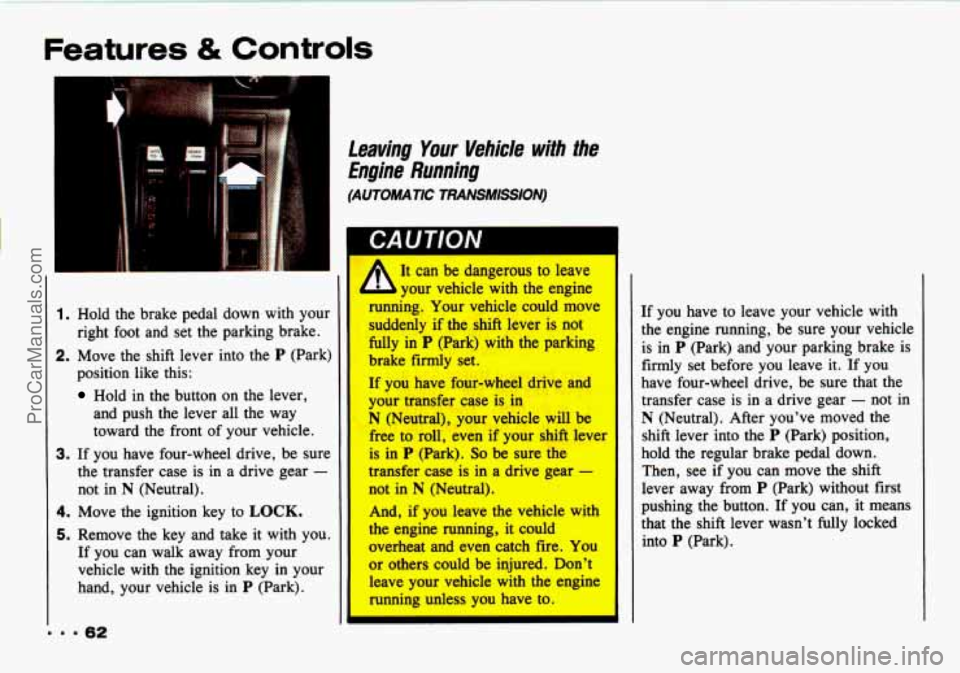
1. Hold the brake pedal down with your
right foot and set the parking brake.
2. Move the shift lever into the P (Park)
position like this:
Hold in the button on the lever,
and push the lever all the way
toward the front of your vehicle.
3. If you have four-wheel drive, be sure
the transfer case is in a drive gear
-
not in N (Neutral).
4. Move the ignition key to LOCK.
5. Remove the key and take it with you.
If you can walk away from your
vehicle with the ignition key in your
hand, your vehicle is
in P (Park).
Leaving Your Vehide with the
Engine Running
(AUTOMATIC TRANSMISSION)
A It can be dangerous to leave
your vehicle with the engine
running. Your vehicle could move
suddenly if the &ifl lever is not
fully in P (Park) with the parking
brake firmly set.
If you have f0.w-wheel drive and
your -fer we is. in
N (Neutral), your vehicle will be
free to roll, even if your shift lever
is in P (Park). So be sure the
transfer case is in a drive gear -
not in N (Neutral).
And, if you leave the vehicle with
the
engine running, it could
overheat and even catch fire. You
or others could be injured. Don't
leave your vehicle with the engine
running unless you have to.
If you have to leave your vehicle with
the engine running, be sure your vehicle
is in
P (Park) and your parking brake is
firmly set before you leave
it. If you
have four-wheel drive, be sure that the
transfer case is in a drive gear
- not in
N (Neutral). After you've moved the
shift lever into the
P (Park) position,
hold the regular brake pedal down.
Then, see if you can move the shift
lever away from
P (Park) without first
pushing the button. If you can, it means
that the shift lever wasn't fully locked
into
P (Park).
ProCarManuals.com
Page 71 of 339
r
Opentiun of Lights
Although your vehicle's lighting system
(headlamps, parking lamps, fog lamps,
side marker lamps and taillamps) meet
all applicable Federal lighting
requirements, certain States and
Provinces may apply their own lighting
regulations that may require special
attention before you operate these
lamps. For example, some jurisdictions may
require that you operate your low
beam lamps with fog lamps at all times,
or that headlamps be turned on
whenever you must use your windshield
wipers. In addition, most jurisdictions
prohibit driving solely with parking
lamps, especially at dawn or dusk.
It is
recommended that you check with your
own State or Provincial highway
authority for applicable lighting
regulations. Turn
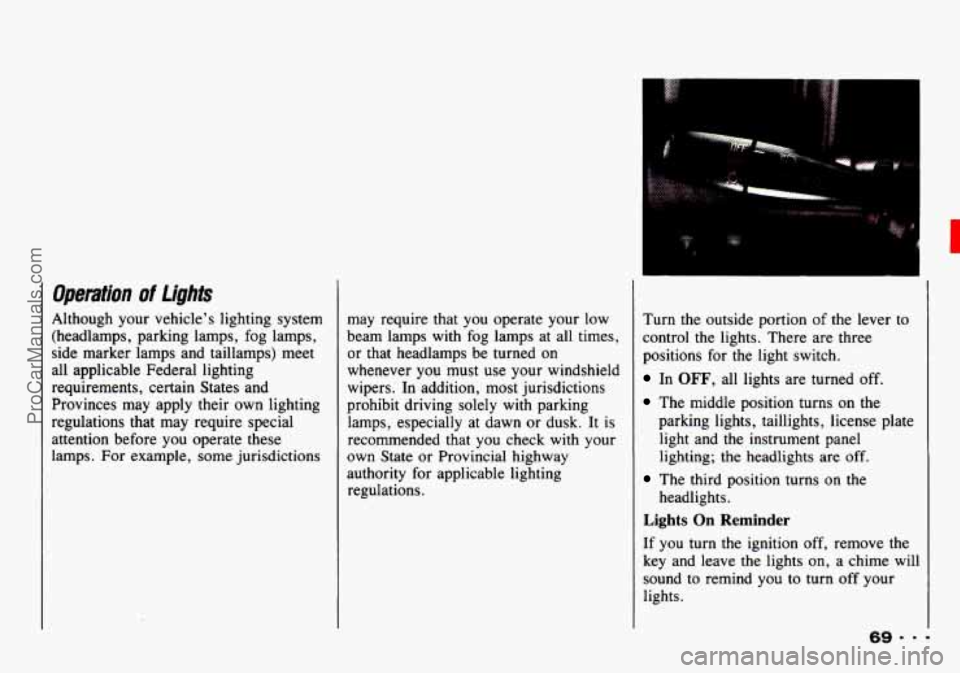
the outside portion of the lever to
control the lights. There are three
positions for the light switch.
In OFF, all lights are turned off.
The middle position turns on the
parking lights, taillights, license plate
light and the instrument panel
lighting; the headlights are
off.
The third position turns on the
headlights.
Lights On Reminder
If you turn the ignition off, remove the
key and leave the lights on, a chime will
sound to remind you to turn off your
lights.
ProCarManuals.com
Page 77 of 339
..
>torage and Compartpnents
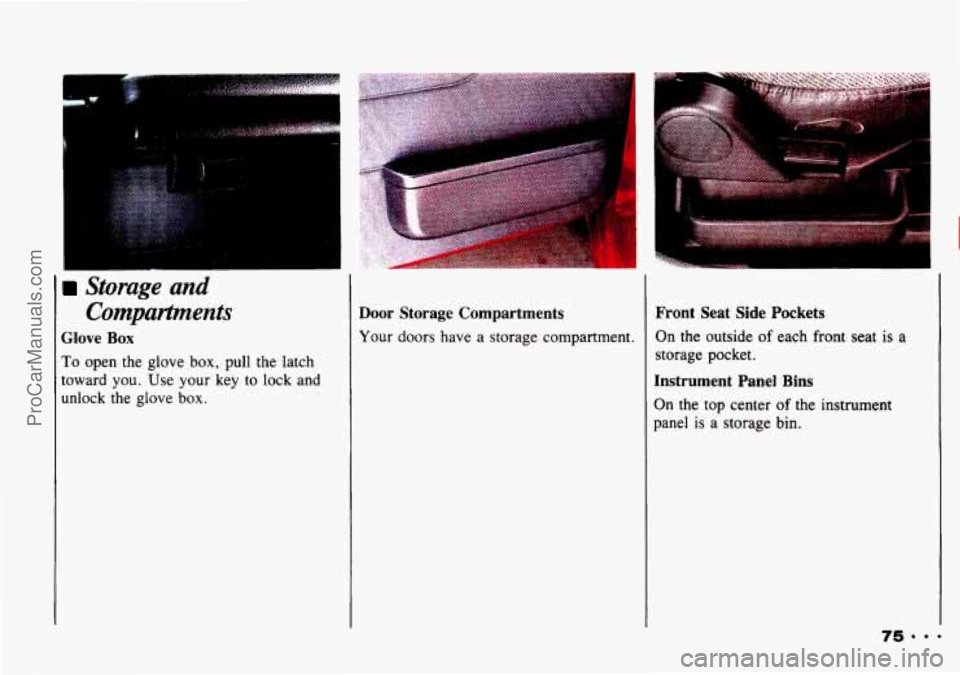
Glove Box
To open the glove box, pull the latch
toward you. Use
your key to lock and
unlock the glove
box.
Door Storage Compartments
Your doors have a storage compartment.
Front Seat Side Pockets
On the outside of each front seat is a
storage pocket.
Instrument Panel Bins
On the top center of the instrument
panel
is a storage bin.
ProCarManuals.com
Page 84 of 339
Features & Conrrols
Tachometer
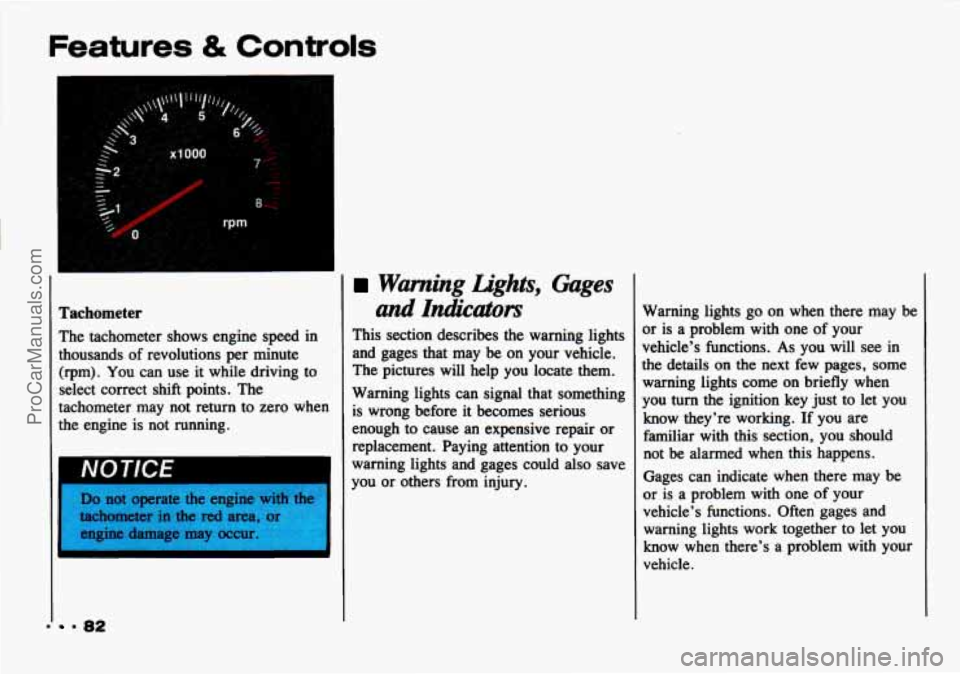
The tachometer shows engine speed in
thousands
of revolutions per minute
(rpm).
You can use it while driving to
select correct shift points. The
tachometer may not return to zero when
the engine is not running.
NOTICE
Do not operate the engine with the
tachometer in the red area
engine damage may occur
9 82
Wanting Lights, Gages
and
Indicators
This section describes the warning lights
and gages that may be on your vehicle.
The pictures will help
you locate them.
Warning lights can signal that something
is wrong before it becomes serious
enough to cause an expensive repair or
replacement. Paying attention to your
warning lights and gages could also save
you or others from injury. Warning
lights go on when there may be
or is a problem with one
of your
vehicle’s functions.
As you will see in
the details on the next few pages, some
warning lights come on briefly when
you turn the ignition key just to let you
know they’re working. If you are
familiar with this section, you should
not be alarmed when this happens.
Gages can indicate when there may be
or is a problem with one of your
vehicle’s functions. Often’ gages
and
warning lights work together to let you
know when there’s a problem with your
vehicle.
ProCarManuals.com
Page 126 of 339
Your Driving and the Road
deaths are the result of someone who
was drinking and driving. Over 25,000
motor vehicle-related deaths occur each
year because
of alcohol, and thousands
of people are injured.
Just how much alcohol is too much if a
person plans to drive? Ideally, no one
should drink alcohol and then drive. But
if one does, then what’s “too much”? It
can be a lot less than many might think.
Although it depends on each person and
situation, here is some general
information on the problem. The Blood Alcohol
Content (BAC) of
someone who is drinking depends upon
four things:
How much alcohol is in the drink.
The drinker’s body weight.
The amount of food that is consumed
before and during drinking.
The length of time it has taken the
drinker to consume the alcohol. According
to
the American Medical
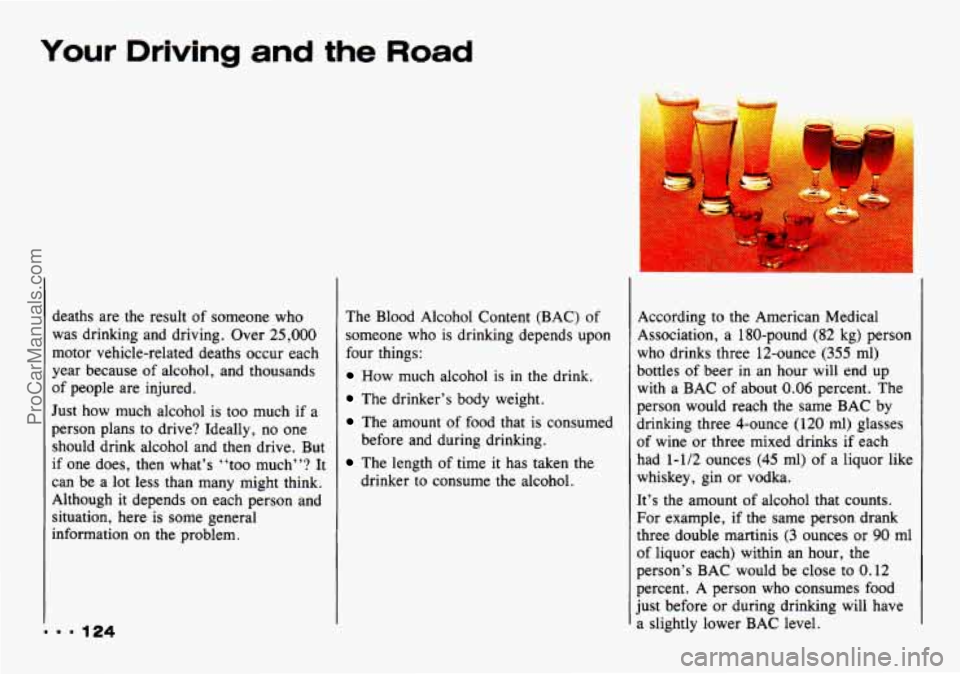
Association, a 180-pound (82 kg) person
who drinks three 12-ounce
(355 ml)
bottles of beer in an hour will end up
with
a BAC of about 0.06 percent. The
person would reach the same BAC by
drinking three 4-ounce (120
ml) glasses
of wine or three mixed drinks if each
had 1- 1/2 ounces (45 ml)
of a liquor like
whiskey, gin or vodka.
It’s the amount
of alcohol that counts.
For example, if the same person drank
three double martinis
(3 ounces or 90 ml
of liquor each) within an hour, the
person’s BAC would be close to 0.12
percent. A person who consumes food
just before or during drinking will have
a slightly lower BAC level.
ProCarManuals.com
Page 145 of 339
Getting Familiar with Off-Road
Driving
It’s a good idea to practice in an area
that’s safe and close
to home before you
go into the wilderness. Off-road driving
does require some new and different
driving skills. Here’s what we mean.
Tune your senses to different kinds of
signals. Your eyes, for example, need to
constantly sweep the terrain for
unexpected obstacles. Your ears need
to
listen for unusual tire or engine sounds.
With your arms, hands, feet, and body
you’ll need to respond to vibrations and
vehicle bounce.
I.
best ways to control your vehicle is to
control your speed. Here are some
things to keep in mind. At higher
speeds:
You approach things faster and you
have less time
to scan the terrain for
obstacles.
You have less time to react.
You have more vehicle bounce when
you drive over obstacles.
You’ll need more distance for
braking, especially since you’re on an
unpaved surface.
CAUTION Controlling your vehicle is the key to
successful off-road driving. One of the When you’re driving
off road,
c L bouncing and quick changes
in direction can easily throw you
out
of position. This could cause
you to lose control and crash.
So,
whether you’re driving on or off
the road, you and your passengers
should wear safety belts.
r
143- -
ProCarManuals.com
Page 188 of 339
Your Driving and the Road
Recreational Towing
There may be times when you want to
tow your Geo behind another vehicle for
use at your destination. Be sure to use
the proper towing equipment designed
for recreational towing. Follow
the
instructions for the towing equipment.
186
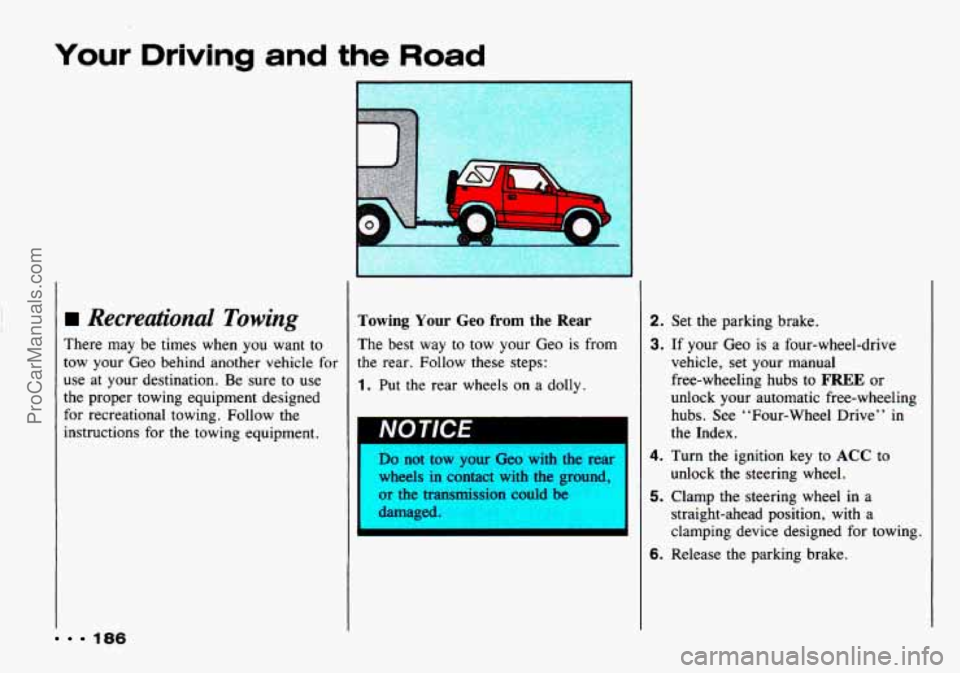
Towing Your Geo from the Rear
The best way to tow your Geo is from
the rear. Follow these steps:
1 . Put the rear wheels on a dolly.
NOTlCE
Do not tow your Geo with the re--
wheels in contact with the grounL,
or
the transmission could be
damaged.
2. Set the parking brake.
3. If your Geo is a four-wheel-drive
vehicle, set your manual
free-wheeling hubs to
FREE or
unlock your automatic free-wheeling
hubs. See “Four-Wheel Drive’’
in
the Index.
4. Turn the ignition key to ACC to
unlock the steering wheel.
5. Clamp the steering wheel in a
straight-ahead position,
with a
clamping device designed for towing.
6. Release the parking brake.
ProCarManuals.com
Page 189 of 339
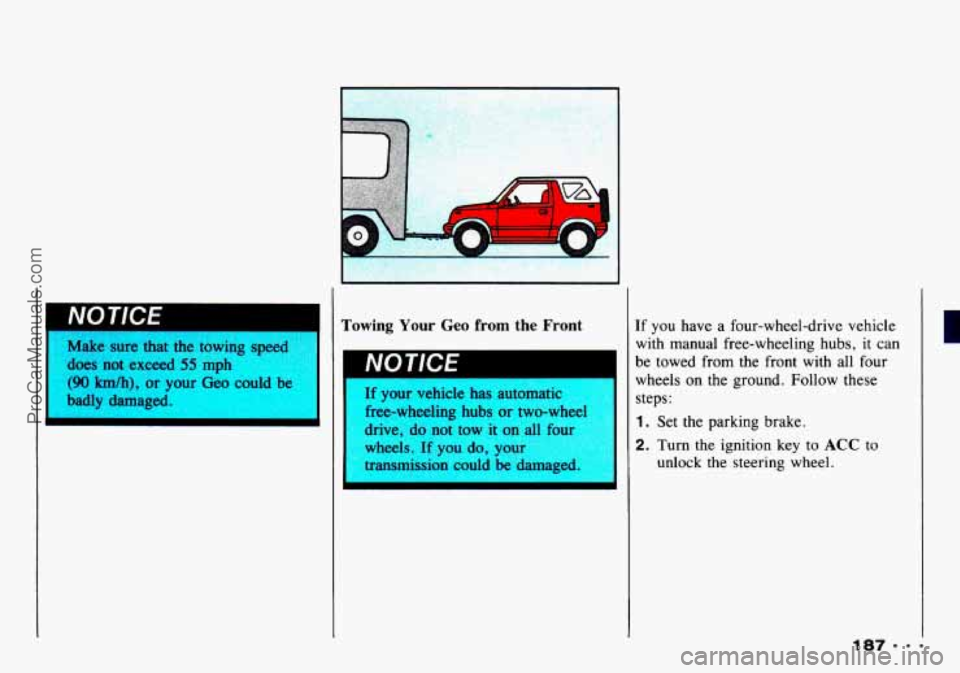
Make sure that the towing speed
dues not exceed 55 mph
(90 km/h), or your Geo could be
badly damaged.
Towing Your Geo from the Front
If your vehicle has automatic
I free-wheeling hubs or two-whet
drive, do not tow it
on all fa
I wheels. If you do, you transmission could be damaged.
I
If you have a four-wheel-drive vehicle
with manual free-wheeling hubs, it can
be towed from the front with all four
wheels on the ground. Follow these
steps:
1. Set the parking brake.
2. Turn the ignition key to ACC to
unlock the steering wheel.
ProCarManuals.com
Page 190 of 339
Your Driving and the Road
= - 9 188
3. Shift your automatic transmission
into
P (Park), or your manual
transmission into
2 (Second).
4. Shift the transfer case to N (Neutral).
5. Set the hubs to FREE. See
“Four-Wheel Drive” in the Index.
6. Release the parking brake. Stop towing every
200 miles (300 km)
and
start the engine. Leave the transfer
case shift lever in
N (Neutral). Shift
your automatic transmission
to
D (Drive); leave a manual transmission
in
2 (Second) and release the clutch.
Run the engine at medium speed for one
minute to circulate
the oil in the transfer
case. Turn
the ignition key to ACC.
Now, you can continue towing your
Geo
.
NU I Kt
Make sure that the towing speed
does not exceed
50 mph
(80 km/h), or your Geo could
badly damaged.
ProCarManuals.com