key CHEVROLET TRACKER 1993 Owner's Manual
[x] Cancel search | Manufacturer: CHEVROLET, Model Year: 1993, Model line: TRACKER, Model: CHEVROLET TRACKER 1993Pages: 339, PDF Size: 15.75 MB
Page 192 of 339
Problems on the Road
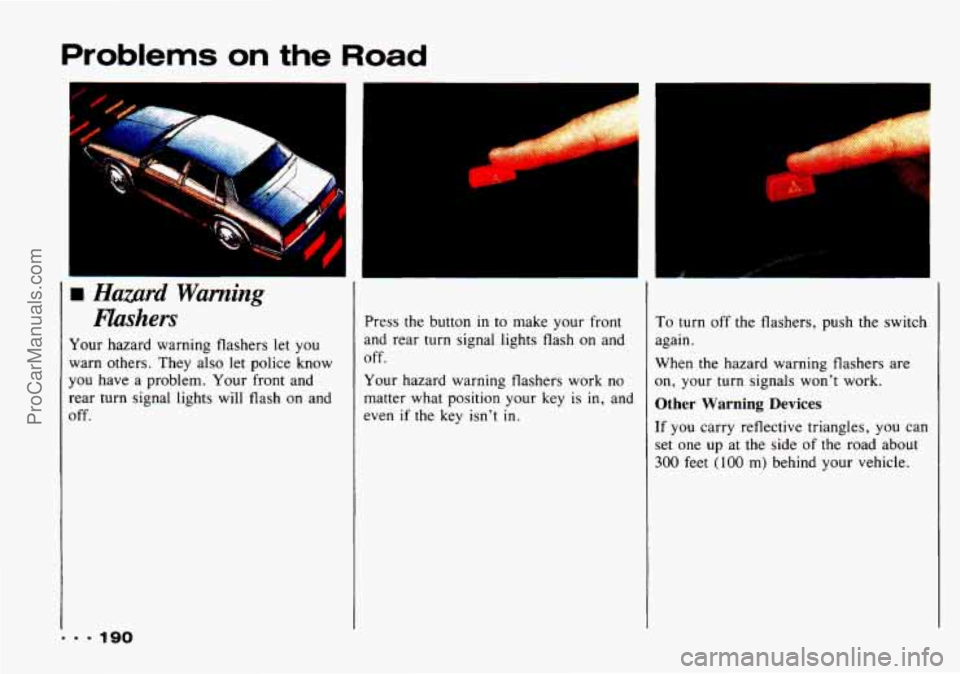
I Hazard Warning fishers
Your hazard warning flashers let you
warn others. They also let police know
you have a problem. Your front and
rear turn signal lights will flash on and
off.
Press th e button in t :o mak 'our fr 'on t
and rear turn signal lights flash on and
off.
Your hazard warning flashers work no
matter what position your key is in, and
even
if the key isn't in. To turn
again.
off the flashers,
push the switch
When the hazard warning flashers are
on, your turn signals won't work.
Other Warning Devices
If you carry reflective triangles, you can
set one up at the side
of the road about
300 feet (100 m) behind your vehicle.
ProCarManuals.com
Page 199 of 339
That your vehicle has rear-wheel
drive, or that
it has the
four-wheel-drive option.
vehicle.
The make, model, and year of your
Whether you can still move the shift
levers for the transmission and
transfer case,
if you have one.
If there was an accident, what was
damaged.
When the towing service arrives, let the
tow operator know that this manual
contains detailed towing instructions and
illustrations. The operator may want to
see them.
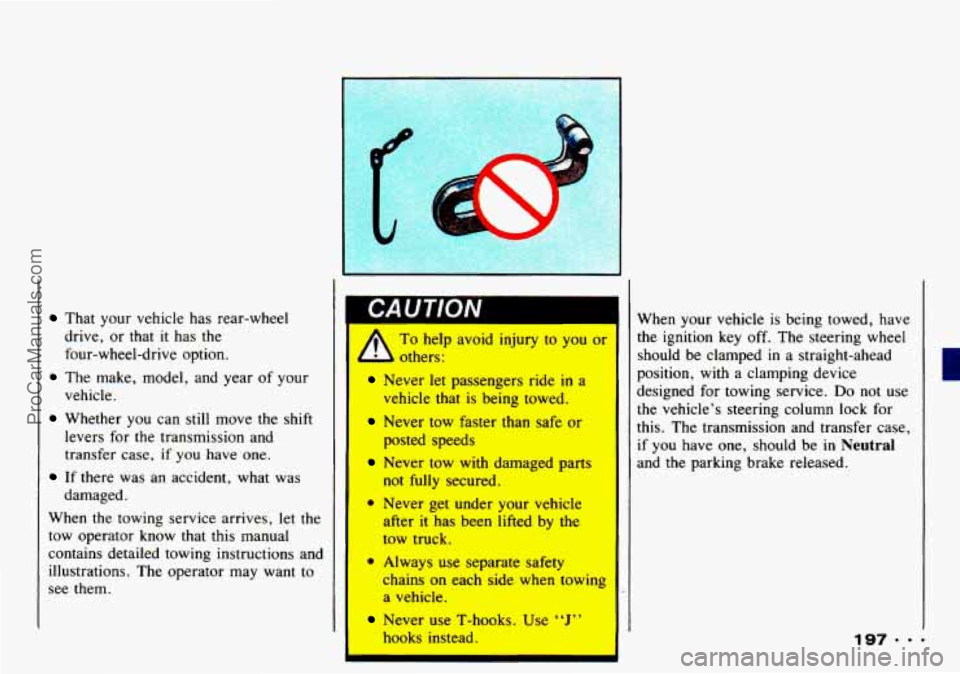
* T- help avoid injury to you or
Never let passengers ride in a
vehicle that is being towed.
Never tow faster than safe or
posted speeds
Never tow with damaged parts
not fully secured.
0 Never get under your vehicle
after it
has been lifted by the
tow truck.
chains on each side when towing
a vehicle.
hooks instead.
* Always use separate safety
Never use T-hooks. Use “J”
When your vehicle is being towed, have
the ignition key off. The steering wheel
should be clamped
in a straight-ahead
position, with
a clamping device
designed for towing service.
Do not use
the vehicle’s steering column lock for
this. The transmission and transfer case,
if you have one, should be in Neutral
and the parking brake released.
ProCarManuals.com
Page 213 of 339
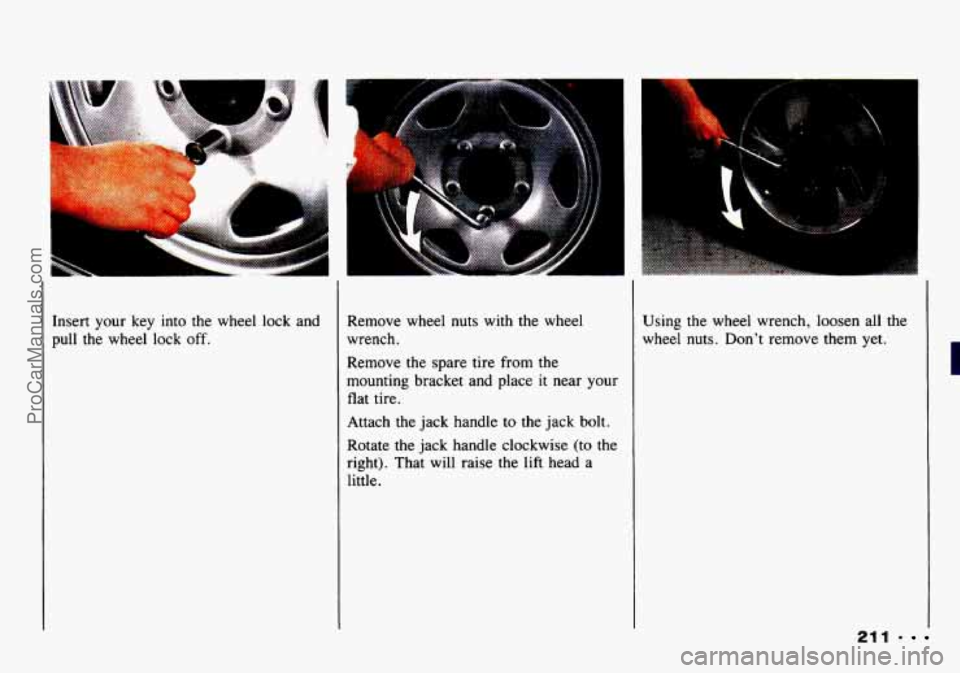
Insert your key into the wheel lock and
pull the wheel lock
off.
Remove wheel nuts with the wheel
wrench.
Remove the spare tire from the
mounting bracket and place it near your
flat tire.
Attach the jack handle to the jack bolt.
Rotate the jack handle clockwise (to the
right). That will raise the lift head a
little. Using
the wheel wrench, loosen all the
wheel nuts. Don’t remove them yet.
211
ProCarManuals.com
Page 302 of 339
Maintenance Schedule
Section B: Owner Checks and Services (Cont.)
.r
Body Lubrication Lubricate all body door hinges including the tailgate. Also lubricate all hinges and latches,
including those for the hood, rear compartment, glove box door, console door and any folding
seat hardware. Section
D tells you what to use.
Starter Switch
At Least Once a Year
?
CHECK
OR SERVICE WHAT TO DO
Kev Lock Cylinders Lubricate the key lock cylinders with the lubricant specified in Section D.
1. Before you start, be sure you have enough room around the vehicle.
2. Firmly apply both the parking brake (see “Parking Brake” in the Index if necessary) and the
NOTE: Do not use the accelerator pedal, and be ready to turn off the engine immediately if it
3. On automatic transmission vehicles, try to start the engine in each gear. The starter should
work only in
P (Park) or N (Neutral). If the starter works in any other position, your vehicle
needs service, On manual transmission vehicles, put the shift lever
in Neutral, push the
clutch down halfway and try to start the engine. The starter should work only when the clutch
is pushed down
all the way to the floor. If the starter works when the clutch isn’t pushed all
the way down, your vehicle needs service.
regular
brake.
starts.
I.. 300
ProCarManuals.com
Page 303 of 339
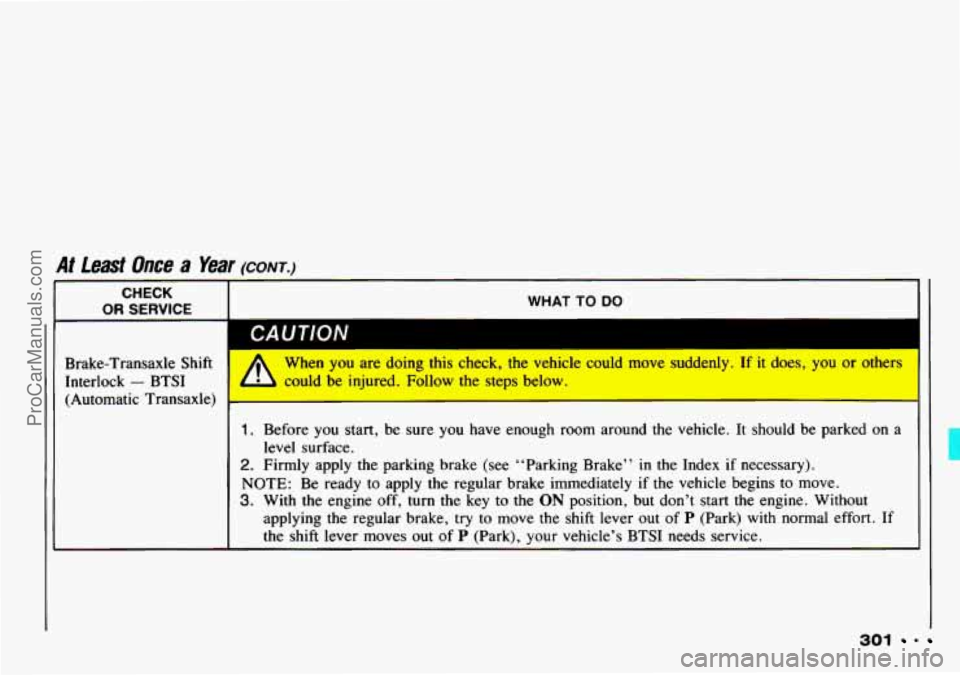
At Least Once a Year (CONT.)
CHECK
OR SERVICE 4- WHAT TO DO
Brake-Transaxle Shift
Interlock
- BTSI
(Automatic Transaxle)
I CAUTION m A When you are doing this check, the vehicle could move suddenly. If it does, you or others I
1. Before you start, be sure you have enough room around the vehicle. It should be parked on a
2. Firmly apply the parking brake (see “Parking Brake” in the Index if necessary).
NOTE: Be ready to apply the regular brake immediately if the vehicle begins to move.
3. With the engine off, turn the key to the ON position, but don’t start the engine. Without
level
surface.
applying the regular brake,
try to move the shift lever out of P (Park) with normal effort. If
the shift lever moves out of
P (Park), your vehicle’s BTSI needs service.
301 9
ProCarManuals.com
Page 304 of 339
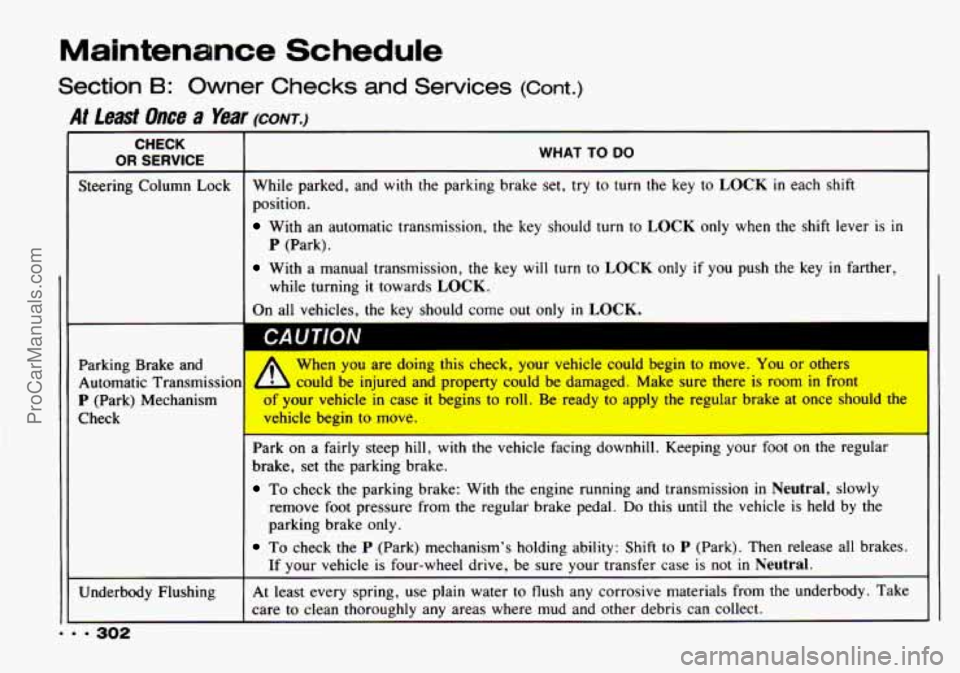
Maintenance Schedule
Section B: Owner Checks and Services (Cont.)
At Least Once a Year (CONT.)
CHECK
OR SERVICE I WHAT TO DO
Steering Column Lock While
parked, and with the parking brake set, try to turn the key to LOCK in each shift
position.
With an automatic transmission, the key should turn to LOCK only when the shift lever is in
With a manual transmission, the key will turn to LOCK only if you push the key in farther,
On all vehicles, the key should come out only
in LOCK.
P (Park).
while turning
it towards LOCK.
Parking Brake and
Automatic Transmission
P (Park) Mechanism
Check
Underbody Flushing When
you are doing this check, your vehicle could begin to move. You or others
could be injured and property could be damaged. Make sure there is room
in front
VI your vehicle in case it begins to roll. Be ready to apply the regular brake at once should the
Park
on a fairly steep hill, with the vehicle facing downhill. Keeping your foot on the regular
brake, set the parking brake.
To check the parking brake: With the engine running and transmission in Neutral, slowly
remove foot pressure from the regular brake pedal.
Do this until the vehicle is held by the
parking brake only.
To check the P (Park) mechanism’s holding ability: Shift to P (Park). Then release all brakes.
If your vehicle is four-wheel drive, be sure your transfer case is not in Neutral.
At least every spring, use plain water to flush any corrosive materials from the underbody. Take
care to clean thoroughly any areas where mud and other debris can collect.
ProCarManuals.com
Page 308 of 339
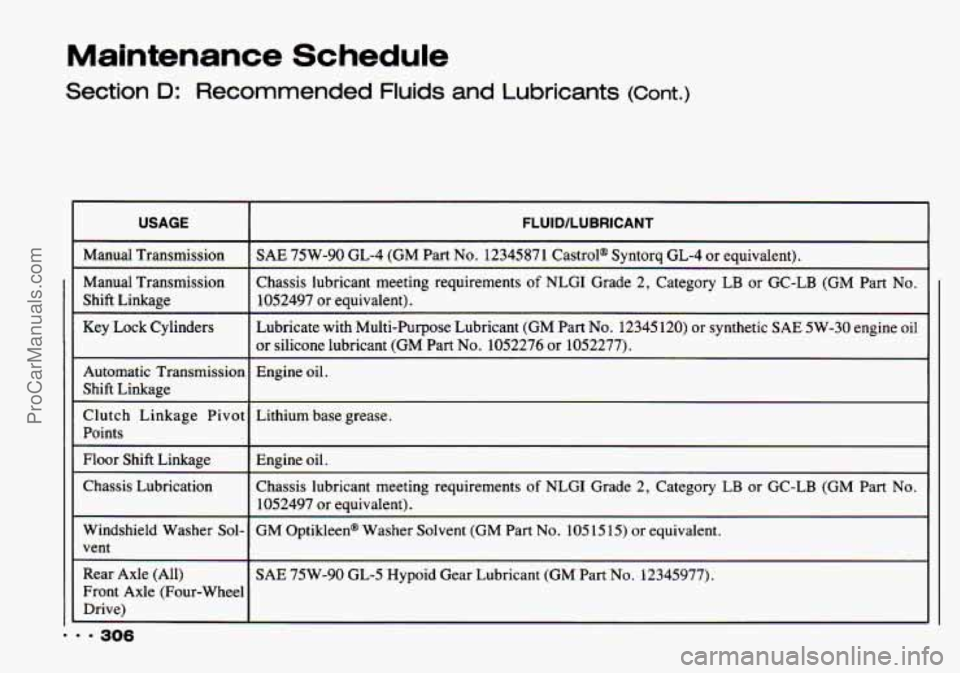
Maintenance Schedule
Section D: Recommended Fluids and Lubricants (Cont.)
USAGE FLUID/LUBRICANT
I Manual Transmission I SAE 75W-90 GL-4 (GM Part No. 12345871 Castrol@ Syntorq GL-4 or equivalent). I
Manual Transmission Chassis lubricant meeting requirements of NLGT Grade 2, Category LB or GC-LB (GM Part No.
Shift Linkage 1052497 or equivalent).
Key Lock Cylinders Lubricate with Multi-Purpose Lubricant (GM Part
No. 12345120) or synthetic SAE 5W-30 engine oil
or silicone lubricant (GM Part No. 1052276 or 1052277).
Automatic Transmission Engine oil.
Shift Linkage
Clutch Linkage Pivot Lithium base grease.
Points
Floor Shift Linkage Engine oil.
~~ ~ ~ ~~~
Chassis Lubrication Chassis lubricant meeting requirements of NLGI Grade 2, Category LB or GC-LB (GM Part No.
Windshield Washer Sol- GM Optikleen@ Washer Solvent (GM Part No. 1051515) or equivalent.
vent
Rear Axle (All)
SAE 75W-90 GL-5 Hypoid Gear Lubricant (GM Part No. 12345977).
Front Axle (Four-wheel
Drive) 1052497
or equivalent).
ProCarManuals.com
Page 330 of 339
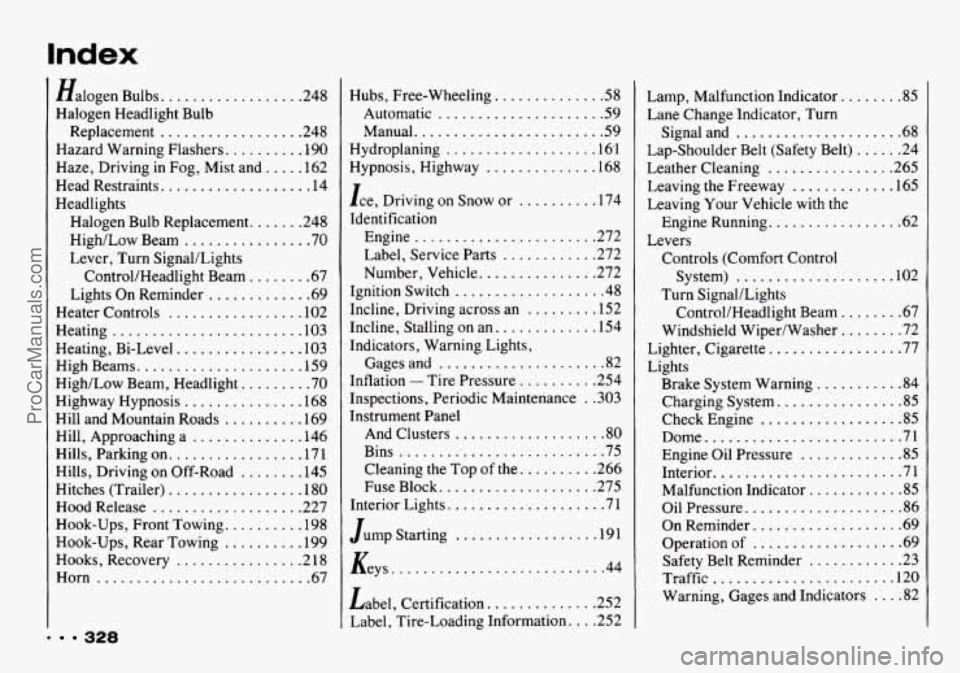
Halogen Bulbs .................. 248
Halogen Headlight Bulb
Replacement
.................. 248
Hazard Warning Flashers
.......... 190
Haze. Driving in Fog. Mist and ..... 162
Head Restraints
................... 14
Headlights Halogen Bulb Replacement
....... 248
High/Low Beam
................ 70
Lever. Turn Signal/Lights
ControVHeadlight Beam
........ 67
Lights On Reminder
............. 69
Heater Controls ................. 102
Heating
........................ 103
Heating. Bi-Level
................ 103
High Beams
..................... 159
High/Low Beam. Headlight
......... 70
Highway Hypnosis
............... 168
Hill and Mountain Roads
.......... 169
Hill. Approaching a
.............. 146
Hills. Parking
on ................. 171
Hills. Driving on Off-Road
........ 145
Hitches (Trailer)
................. 180
Hood Release
................... 227
Hook-Ups. Front Towing
.......... 198
Hook-Ups. Rear Towing .......... 199
Hooks. Recovery
................ 2 18
Horn ........................... 67 Hubs. Free-Wheeling
.............. 58
Automatic
..................... 59
Manual
........................ 59
Hydroplaning
................... 16.1
Hypnosis. Highway .............. 168
Ice. Driving on Snow or .......... 174
Identification
Engine
....................... 272
Label. Service Parts
............ 272
Number. Vehicle
............... 272
Ignition Switch
................... 48
Incline. Driving across an
......... 152
Incline. Stalling on an
............. 154
Indicators. Warning Lights. Gages and
..................... 82
Inflation
- Tire Pressure .......... 254
Inspections. Periodic Maintenance
. . 303
Instrument Panel And Clusters
................... 80
Bins .......................... 75
Cleaning the Top of the
.......... 266
Fuse Block
.................... 275
Interior Lights
.................... 7 1
Jump Starting .................. 19 1
Keys ................ .... 44
Label. Certification
.............. 252
Label. Tire-Loading Information
.... 252 Lamp. Malfunction Indicator
. . ... 85
Lane Change Indicator. Turn
Signal and
..................... 68
Lap-Shoulder Belt (Safety Belt)
...... 24
Leather Cleaning
................ 265
Leaving the Freeway
............. 165
Leaving Your Vehicle with the Engine Running
................. 62
Levers Controls (Comfort Control System)
.................... 102
Turn SignaULights ControUHeadlight Beam
........ 67
Windshield Wiper/Washer
........ 72
Lighter. Cigarette
................. 77
Lights Brake System Warning
........... 84
Charging System
................ 85
Check Engine
.................. 85
Dome ......................... 71
Engine Oil Pressure
............. 85
Interior ........................ 71
Malfunction Indicator
............ 85
Oil Pressure. ................... 86
On Reminder ................... 69
Operation of ................... 69
Safety Belt Reminder ............ 23
Traffic
....................... 120
Warning. Gages and Indicators
.... 82
9 328
ProCarManuals.com