lights CHEVROLET TRACKER 1993 User Guide
[x] Cancel search | Manufacturer: CHEVROLET, Model Year: 1993, Model line: TRACKER, Model: CHEVROLET TRACKER 1993Pages: 339, PDF Size: 15.75 MB
Page 84 of 339
Features & Conrrols
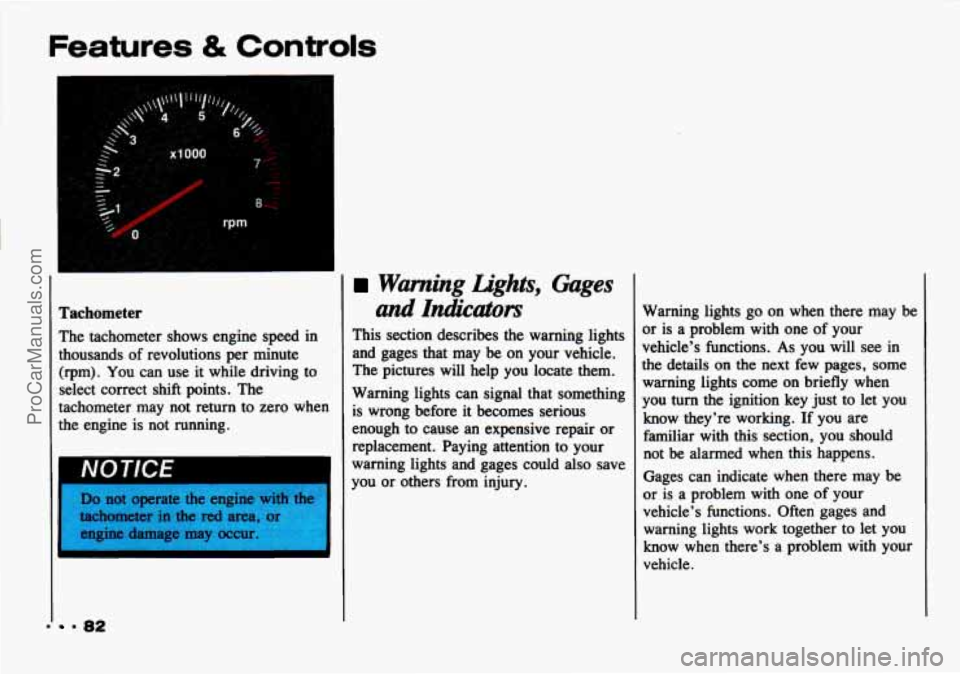
Tachometer
The tachometer shows engine speed in
thousands
of revolutions per minute
(rpm).
You can use it while driving to
select correct shift points. The
tachometer may not return to zero when
the engine is not running.
NOTICE
Do not operate the engine with the
tachometer in the red area
engine damage may occur
9 82
Wanting Lights, Gages
and
Indicators
This section describes the warning lights
and gages that may be on your vehicle.
The pictures will help
you locate them.
Warning lights can signal that something
is wrong before it becomes serious
enough to cause an expensive repair or
replacement. Paying attention to your
warning lights and gages could also save
you or others from injury. Warning
lights go on when there may be
or is a problem with one
of your
vehicle’s functions.
As you will see in
the details on the next few pages, some
warning lights come on briefly when
you turn the ignition key just to let you
know they’re working. If you are
familiar with this section, you should
not be alarmed when this happens.
Gages can indicate when there may be
or is a problem with one of your
vehicle’s functions. Often’ gages
and
warning lights work together to let you
know when there’s a problem with your
vehicle.
ProCarManuals.com
Page 85 of 339
c
When one of the warning lights comes
on and stays on
when you are driving,
or when one of the gages shows there
may be a problem, check the section
that tells you what to do about
it. Please
follow the manual’s advice. Waiting to
do repairs can
be costly - and even
dangerous. So please get to know your
warning lights and gages. They’re a big
help.
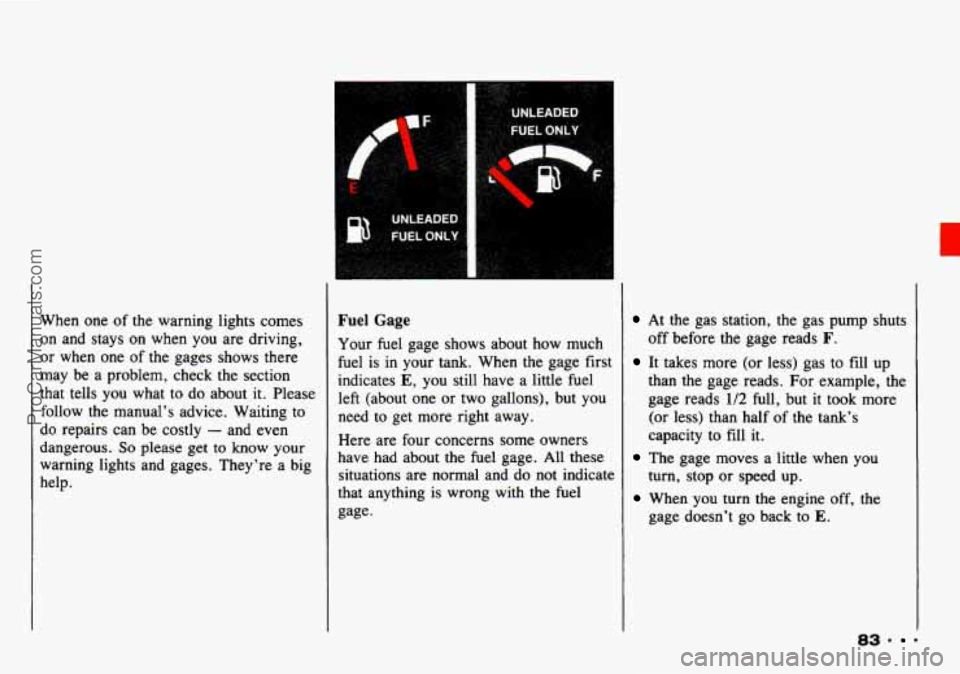
Fuel Gage
Your fuel gage shows about how much
fuel
is in your tank. When the gage first
indicates
E, you still have a little fuel
left (about one
or two gallons), but you
need to get more right away.
Here are four concerns some owners
have had about the fuel gage. All these
situations are normal and do not indicate
that anything is wrong
with the fuel
gage.
At the gas station, the gas pump shuts
It takes more (or less) gas to fill up
off before the
gage reads
F.
than the gage reads. For example, the
gage reads
1/2 full, but it took more
(or less) than half of the tank’s
capacity to fill it.
The gage moves a little when you
turn, stop or speed up.
When you turn the engine off, the
gage doesn’t
go back to E.
83. 9
ProCarManuals.com
Page 122 of 339
Your Driving and
KEEP
RIGHT THROUGH LEFT OR RIGHT TURN
ONLY
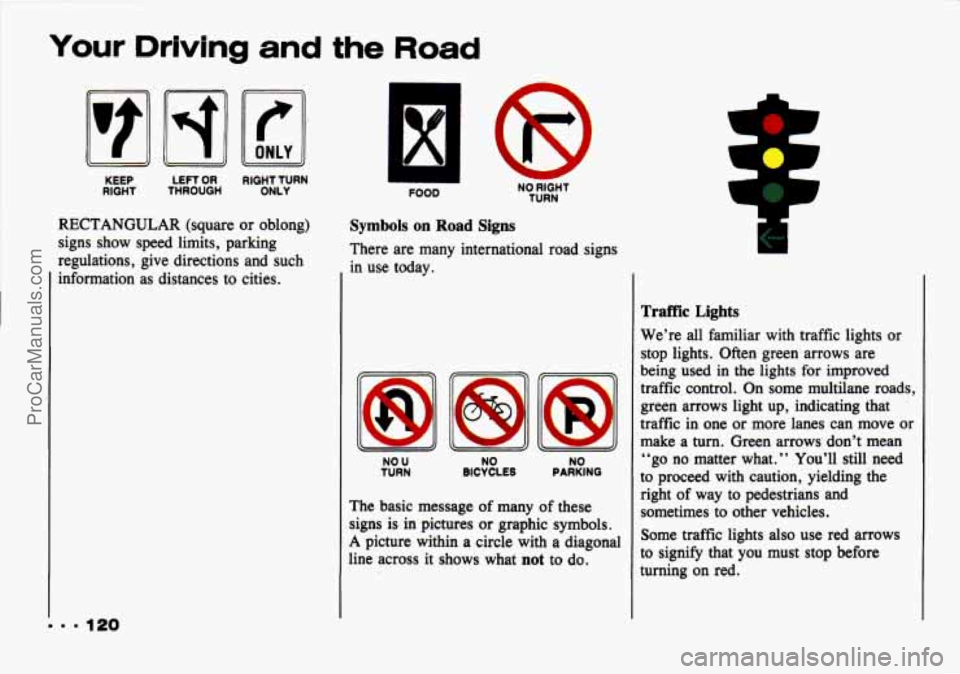
RECTANGULAR (square or oblong)
signs show speed limits, parking
regulations, give directions and such
information as distances to cities.
. 120
FOOD NO RIGHT TURN
Symbols on Road Signs
There are many international road signs
in use today.
NO U NO
TURN BICYCLES PARKING NO
The basic message of many of these
signs is
in pictures or graphic symbols.
A picture within a circle with a diagonal
line across it shows what
not to do.
Traffic Lights
We’re all familiar with traffic lights or
stop lights. Often green arrows are
being used
in the lights for improved
traffic control. On some multilane roads,
green arrows light up, indicating that
traffic in one or more lanes can move
or
make a turn. Green arrows don’t mean
“go no matter what.
” You’ll still need
to proceed with caution, yielding the
right of way to pedestrians and
sometimes to other vehicles.
Some traffic lights
also use red arrows
to signify that you must stop before
turning on red.
ProCarManuals.com
Page 124 of 339
Your Driving and the Road
Slowing down. If time allows, tap the
brake pedal once or twice in advance of
slowing or stopping. This warns the
driver behind
you.
Disabled. Your four-way flashers signal
that your vehicle is disabled or is a
hazard. See “Hazard Warning
Flashers” in the Index.
Trafilc Officer
The traffic police officer is also a source
of important information. The officer’s
signals govern, no matter what the
traffic lights or other signs say.
The next section discusses some
of the
road conditions you may encounter.
.122
Defensive Driving
The best advice anyone can give about
driving
is: Drive defensively.
Please
start with a very important safety
device
in your Geo: Buckle up. (See
“Safety Belts” in
the Index.)
Defensive driving really means “be
ready for anything.” On city streets,
rural roads, or freeways, it means
“always expect the unexpected.
”
Assume that pedestrians or other drivers
are going to be careless and make
mistakes. Anticipate what they might
do.
Be ready for their mistakes. Expect children
to dash out from behind
parked cars, often followed by other
children. Expect occupants in parked cars to open doors into traffic. Watch
for movement in parked cars
-
someone may be about to open a door.
Expect other drivers to run stop signs
when you are on a through street. Be
ready
to brake if necessary as you go
through intersections. You may not have
to use the brake, but if you do, you will
be ready.
[f you’re driving through a shopping
center parking lot where there are
well-marked lanes, directional arrows,
and designated parking areas, expect
ProCarManuals.com
Page 136 of 339
Your Driving and the Road
When you drive into a curve at night,
it’s harder to see the road ahead of you
because it bends away from the straight
beams of your lights. This is one good
reason to drive slower.
134
Steering in Emergencies
There are times when steering can be
more effective than braking. For
example, you come over a hill and
find
a truck stopped in your lane, or a car
suddenly pulls out from nowhere, or a
child darts out from between parked cars
and stops right in front of you.
You can
avoid these problems by braking
- if
you can stop in time. But sometimes you
can’t; there isn’t room. That’s the time
for evasive action
- steering around the
problem.
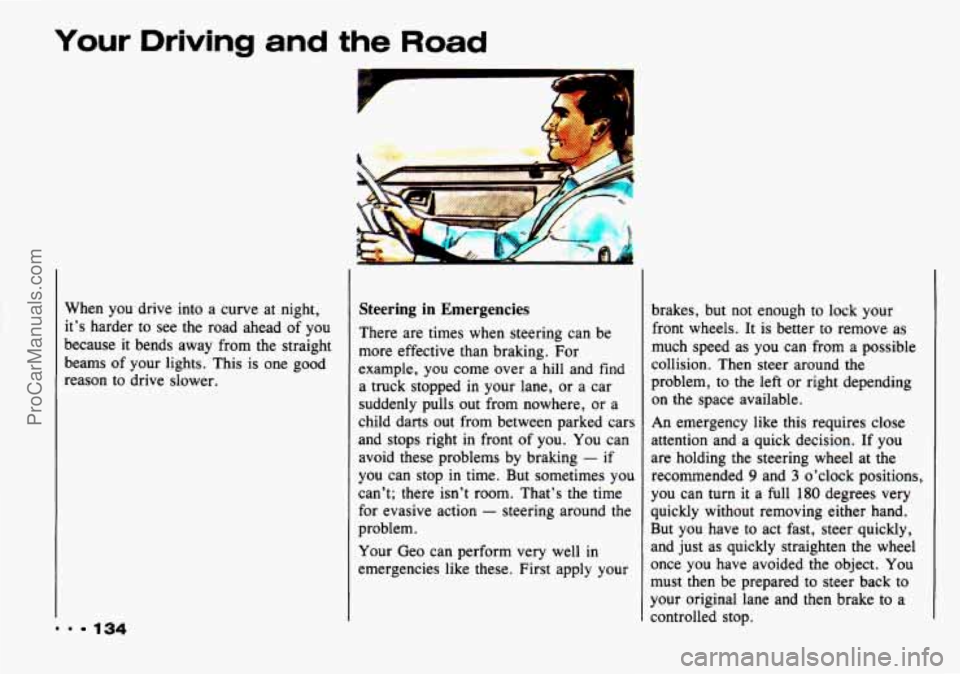
Your Geo can perform very well in
emergencies like these. First apply your brakes,
but not enough to lock your
front wheels. It is better to remove as
much speed as you can from a possible
collision. Then steer around the
problem, to the left or right depending
on the space available.
An emergency like this requires close
attention and a quick decision.
If you
are holding the steering wheel at the
recommended
9 and 3 o’clock positions,
you can turn it a full
180 degrees very
quickly without removing either hand.
But
you have to act fast, steer quickly,
and just as quickly straighten the wheel
once you have avoided the object.
You
must then be prepared to steer back to
your original lane and then brake to a
controlled stop.
ProCarManuals.com
Page 140 of 339
Your Driving and the Road
you just passed may seem to be
further away from
you than it really
is.)
Try not to pass more than one vehicle
at a time on two-lane roads.
Reconsider before passing the next
vehicle.
vehicle too rapidly. Even though the
brake lights are not flashing, it may
be slowing down or starting to turn.
If you’re being passed, make it easy
for the following driver to get ahead
of you. Perhaps you can ease a little
to the right.
Don’t overtake a slowly moving
Loss of Control
Let’s review what driving experts say
about what happens when the three
control systems (brakes, steering and
acceleration) don’t have enough friction
where the tires meet
the road to do what
the driver has asked.
In any emergency, don’t give up. Keep
trying to steer and constantly seek an
escape route or area of less danger.
Skidding
In a skid, a driver can lose control of
the vehicle. Defensive drivers avoid
most skids by taking reasonable care
suited to existing conditions, and by not
“overdriving” those conditions. But
skids are always possible. The three types
of skids correspond
to
your Geo’s three control systems. In the
braking skid your wheels aren’t rolling.
In the steering or cornering skid,
too
much speed or steering in a curve causes
tires to slip and lose cornering force.
And in the acceleration skid too much
throttle causes the driving wheels to
spin.
A cornering skid and an acceleration
skid are best handled by easing your
foot off the accelerator pedal. If your
vehicle starts to slide (as when you turn
a corner on a wet, snow- or ice-covered
road), ease your foot off the accelerator
ProCarManuals.com
Page 147 of 339
Because you will be on an unpaved
I
surface, it’s especially important to
avoid sudden acceleration, sudden turns,
or sudden braking.
In a way, off-road driving requires a
different kind
of alertness from driving
on paved roads and highways. There are
no road signs, posted speed limits or
signal lights. You have to use your own
good judgment about what is safe and
what isn’t.
I CAUTION
’ Drinking and driving can be
- very dangerous on any road.
And this is certainly true for
off-road driving. At the very time
you need special alertness and
driving skills, your reflexes,
perceptions and judgment can be
affected by even a small amount
of
alcohol. You could have a serious
- or even fatal - accident if you
drink and drive or ride with a
driver who has been drinking. (See
“Drunken Driving” in the Index.)
Driving on Off-Road Hills
Off-road driving often takes you up,
down, or across a hill. Driving safely on
hills requires good judgment and an
understanding of what your vehicle can
and can’t do. There are some hills that
simply can’t be driven, no matter how
well built the vehicle.
ProCarManuals.com
Page 150 of 339
Your Driving and the Road
Ease up on your speed as you
approach the top
of the hill.
Attach a flag to the vehicle to make
you more visible to approaching
traffic on trails or hills.
Sound the horn as you approach the
top of the hill to let opposing traffic
know you’re there.
Use your headlights even during the
day. They make you more visible to
oncoming traffic.
CAUTION
A Driving to the top (crest) of a
hill at full speed can cause an
accident. There could be a
drop-off, embankment, cliff, or
even another vehicle. You could
be seriously injured or killed. As
you near the top of a hill, slow
down and stay alert.
I
Q: What should I do if my vehicle
stalls,
or is about to stall, and I
can’t make it up the hill?
A: If this happens, there are some
things you-should do, and there are
some things you must not do. First,
here’s what you
should do:
Push the brake pedal to stop
the
vehicle and keep it from rolling
backwards. Also, apply the parking
brake.
If your engine is still running, shift
the transmission into reverse, release
the parking brake, and slowly back
down the hill in reverse.
ProCarManuals.com
Page 159 of 339
After Off-Road Driving
Remove any brush or debris that has
collected on the underbody, chassis or
under the hood. These accumulations
can be a fire hazard.
After operation in mud or sand, have the
brake linings cleaned and checked.
These substances can cause glazing and
uneven braking. Check the body
structure, steering, suspension, wheels,
tires, and exhaust system for damage.
Also, check the fuel lines and cooling
system for any leakage.
Your vehicle will require more frequent
service due to off-road use. Refer
to the
Maintenance Schedule for additional
information.
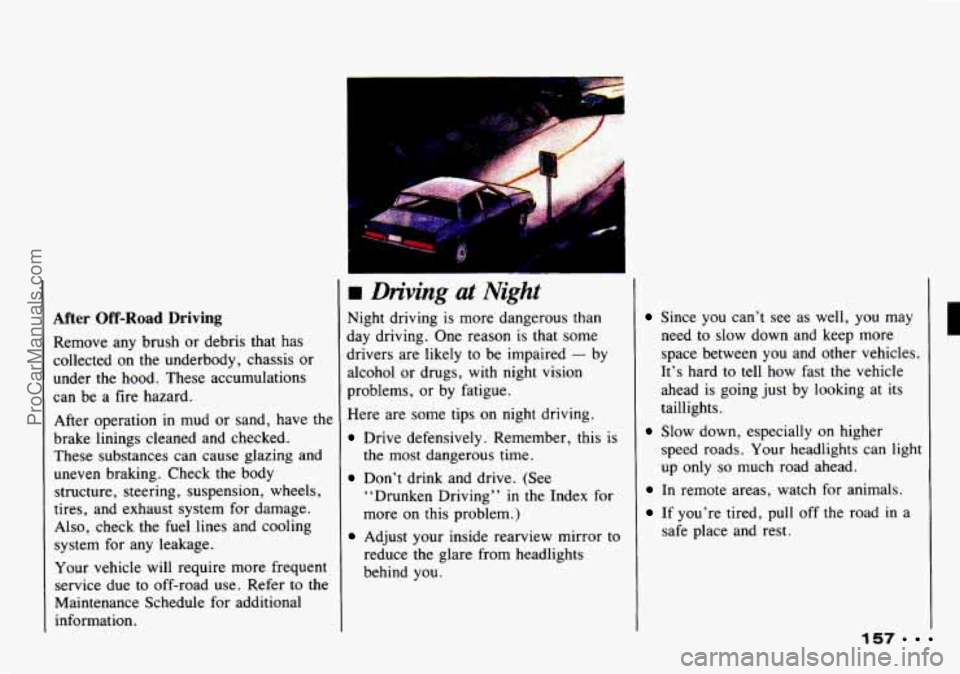
rn Driving at Night
Night driving is more dangerous than
day driving. One reason is that some
drivers are likely to be impaired
- by
alcohol or drugs, with night vision
problems, or by fatigue.
Here are some tips
on night driving.
Drive defensively. Remember, this is
the most dangerous time.
Don’t drink and drive. (See
“Drunken Driving” in the Index for
more on this problem.)
Adjust your inside rearview mirror to
reduce the glare from headlights
behind you.
Since you can’t see as well, you may
need to slow down and keep more
space between you and other vehicles.
It’s hard to tell how fast the vehicle
ahead is going just by looking at its
taillights.
Slow down, especially on higher
speed roads.
Your headlights can light
up only so much road ahead.
In remote areas, watch for animals.
If you’re tired, pull off the road in a
safe place and rest.
157
ProCarManuals.com
Page 160 of 339
Your Driving and the Road
Night Vision
No one can see as well at night as in the
daytime. But as we get older these
differences increase.
A 50-year-old
driver may require at least twice as
much light to see the same thing at night
as a 20-year-old.
What you do in the daytime can also
affect your night vision. For example, if
you spend the day
in bright sunshine
you are wise to wear sunglasses. Your
eyes will have less trouble adjusting to
night.
= = 158
But if you’re driving, don’t wear
sunglasses at night. They may cut down
on glare from headlights, but
they also
make a lot of things invisible
that should
remain visible - such as parked cars,
obstacles, pedestrians, or even trains
blocking railway crossings.
You may
want to put on your sunglasses after you
have pulled into a brightly-lighted
service or refreshment area. Eyes
shielded from that glare may adjust
more quickly to darkness back on
the
road. But be sure to remove your
sunglasses before you leave the service
area.
You can be temporarily blinded by
approaching lights. It can take a second
or two, or even several seconds, for
your eyes to readjust
to the dark. When
you are faced with severe glare (as from
a driver who doesn’t lower the high
beams, or a vehicle with misaimed
headlights), slow down a little. Avoid
staring directly into the approaching
lights. If there is a line of opposing
traffic, make occasional glances over the
line of headlights to make certain that
one of the vehicles isn’t starting to move
into your lane. Once you are past the
bright lights, give your eyes time to
readjust before resuming speed.
ProCarManuals.com