steering wheel CHEVROLET TRACKER 1993 User Guide
[x] Cancel search | Manufacturer: CHEVROLET, Model Year: 1993, Model line: TRACKER, Model: CHEVROLET TRACKER 1993Pages: 339, PDF Size: 15.75 MB
Page 149 of 339
Is the hill simply too rough? Steep
hills often have ruts, gullies, troughs
and exposed rocks because they are
more susceptible to
the effects of
erosion.
Driving Uphill
Once you decide you can safely drive up
the hill, you need to take some special
steps.
Use a low gear and get a firm grip on
the steering wheel.
Get a smooth start up the hill and try
to maintain your speed. Don’t use
more power than you need, because
you don’t want your wheels to start
spinning or sliding.
Try to drive straight up the hill if at
all possible. If the path twists and
turns, you might want to find another
route.
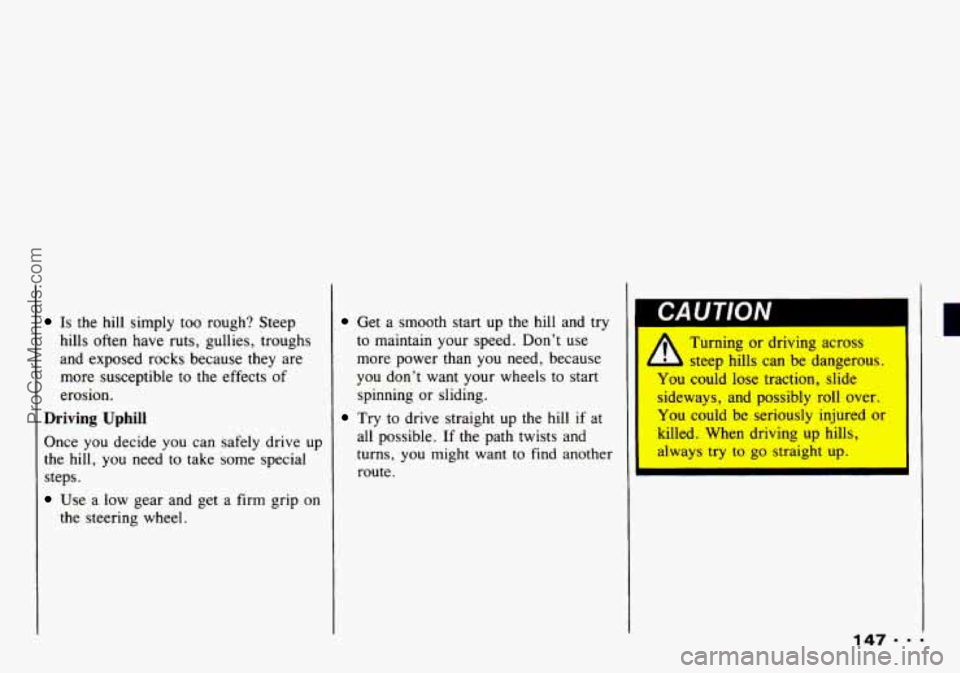
CAUTION
A
Turning or driving across
steep hills can be dangerous.
You could lose traction, slide
sideways, and possibly roll over.
You could be seriously injured or
killed. When driving
up hills,
always
try to go straight up.
ProCarManuals.com
Page 151 of 339
If your engine has stopped running,
you’ll need to restart
it. With the
brake pedal depressed and the
parking brake still applied, shift the
transmission
to P (Park) (or, shift to
Neutral if your vehicle has a
manual transmission) and restart the
engine. Then, shift to reverse,
release the parking brake, and
slowly back down the hill in
reverse.
As you are backing down the hill,
put your
left hand on the steering
wheel at the
12 o’clock position.
This way, you’ll be able
to tell if
your wheels are straight or turned to
the left or right as you back down. Here
are some things you
must not do
if you stall, or are about to stall, when
going up
a hill.
Never attempt to prevent a stall by
shifting into
N (Neutral) (or
depressing the clutch, if you have a
manual transmission)
to “rev-up” the
engine and regain forward
momentum. This won’t work. Your
vehicle will roll backwards very
quickly and you could go out of
control.
Instead, apply the regular brake to stop
the vehicle. Then apply the parking
brake. Shift into reverse, release the
parking brake, and slowly back down.
Never attempt to turn around if you
are about to stall when going up a
hill.
If the hill is steep enough to
stall your vehicle, it’s steep enough
to cause you to roll over if you turn
around. If you can’t make it up the
hill, you must back down the hill.
Q: Suppose, after stalling, I try to
back down the hill and decide
I
just can’t do it. What should I do?
A: Set the parking brake, put your
transmission
in P (Park) (or the
ProCarManuals.com
Page 157 of 339
..
I
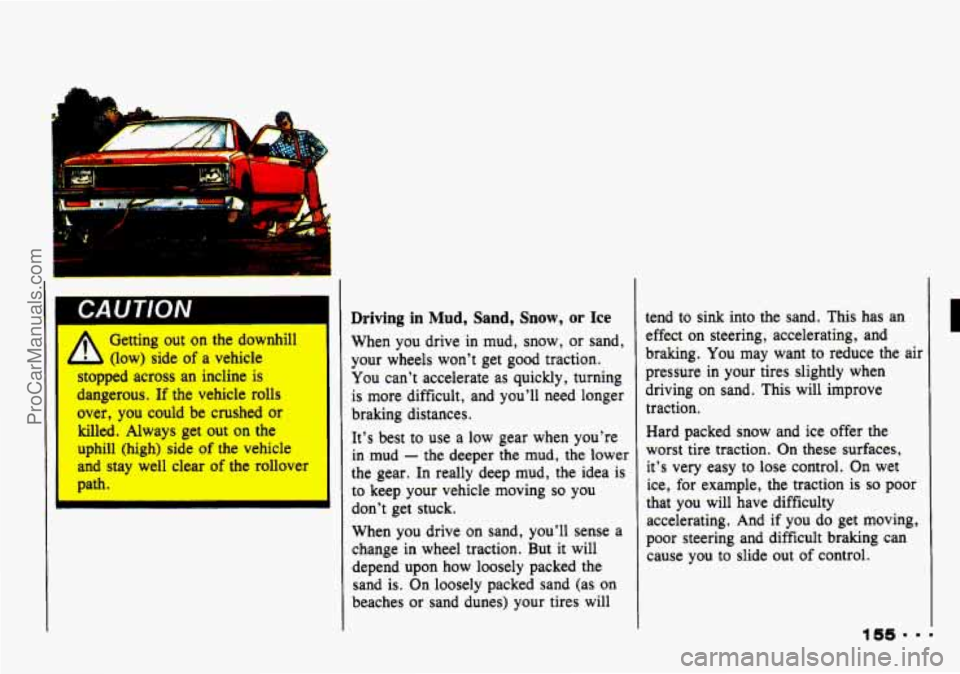
CA UTlON
t
Getting out on the downhill
(low) side of a vehicle
stopped across 811 incline is
dangerous. If the vehicle rolls
over, you could be crushed or
killed. Always get out on the
uphill (high) side of the vehicle
and
stay well clear of the rollover
path.
I
Driving in Mud, Sand, Snow, or Ice
When you drive in mud, snow, or sand,
your wheels won’t get good traction.
You can’t accelerate as quickly, turning
is more difficult, and you’ll need longer
braking distances.
It’s best to use
a low gear when you’re
in mud - the deeper the mud, the lower
the gear. In really deep mud, the idea is
to keep your vehicle moving
so you
don’t get stuck.
When you drive on sand, you’ll sense a
change in wheel traction. But it will
depend upon how loosely packed the
sand is. On loosely packed sand (as
on
beaches or sand dunes) your tires will tend
to sink into the sand. This has an
effect on steering, accelerating, and
braking. You may want to reduce the air
pressure in your tires slightly when
driving on sand. This will improve
traction,
Hard packed snow and ice offer the
worst tire traction. On these surfaces,
it’s very easy to lose control. On wet
ice, for example, the traction is
so poor
that you will have difficulty
accelerating. And if you do get moving,
poor steering and difficult braking can
cause you to slide out of control.
I
ProCarManuals.com
Page 159 of 339
After Off-Road Driving
Remove any brush or debris that has
collected on the underbody, chassis or
under the hood. These accumulations
can be a fire hazard.
After operation in mud or sand, have the
brake linings cleaned and checked.
These substances can cause glazing and
uneven braking. Check the body
structure, steering, suspension, wheels,
tires, and exhaust system for damage.
Also, check the fuel lines and cooling
system for any leakage.
Your vehicle will require more frequent
service due to off-road use. Refer
to the
Maintenance Schedule for additional
information.
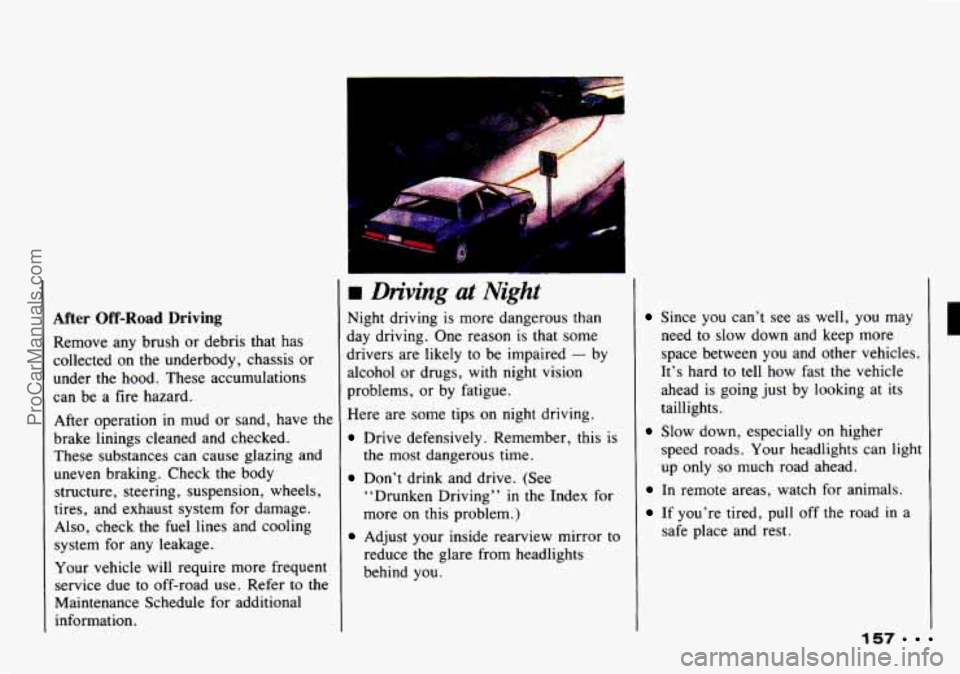
rn Driving at Night
Night driving is more dangerous than
day driving. One reason is that some
drivers are likely to be impaired
- by
alcohol or drugs, with night vision
problems, or by fatigue.
Here are some tips
on night driving.
Drive defensively. Remember, this is
the most dangerous time.
Don’t drink and drive. (See
“Drunken Driving” in the Index for
more on this problem.)
Adjust your inside rearview mirror to
reduce the glare from headlights
behind you.
Since you can’t see as well, you may
need to slow down and keep more
space between you and other vehicles.
It’s hard to tell how fast the vehicle
ahead is going just by looking at its
taillights.
Slow down, especially on higher
speed roads.
Your headlights can light
up only so much road ahead.
In remote areas, watch for animals.
If you’re tired, pull off the road in a
safe place and rest.
157
ProCarManuals.com
Page 185 of 339
Following Distance
Stay at least twice as far behind the
vehicle ahead as you would when
driving your vehicle without a trailer.
This can help you avoid situations that
require heavy braking and sudden turns.
Passing
You’ll need more passing distance up
ahead when you’re towing a trailer.
And, because you’re a good deal longer,
you’ll need to
go much farther beyond
the passed vehicle before you can return
to your lane.
Backing Up
Hold the bottom of the steering wheel
with one hand. Then, to move the trailer
to the left, just move that hand to the
left.
To move the trailer to the right,
move your hand to the right. Always
back up slowly and, if possible, have
someone guide you.
Making Turns
When you’re turning with a trailer,
make wider turns than normal.
Do this
so your trailer won’t strike soft
shoulders, curbs, road signs, trees, or
other objects. Avoid jerky
or sudden
maneuvers. Signal well in advance.
Turn Signals When Towing a Trailer
When you tow a trailer, your vehicle
has to have a different turn signal
flasher and extra wiring. The green
arrows on your instrument panel will
flash whenever you signal
a turn or lane
change. Properly hooked up, the trailer
lights will also flash telling other drivers
you’re about
to turn, change lanes, or
stop.
When towing a trailer, the green arrows
on your instrument panel will flash for
turns even if the bulbs on the trailer are
burned out. Thus, you may think drivers
behind you are seeing your signal when
ProCarManuals.com
Page 188 of 339
Your Driving and the Road
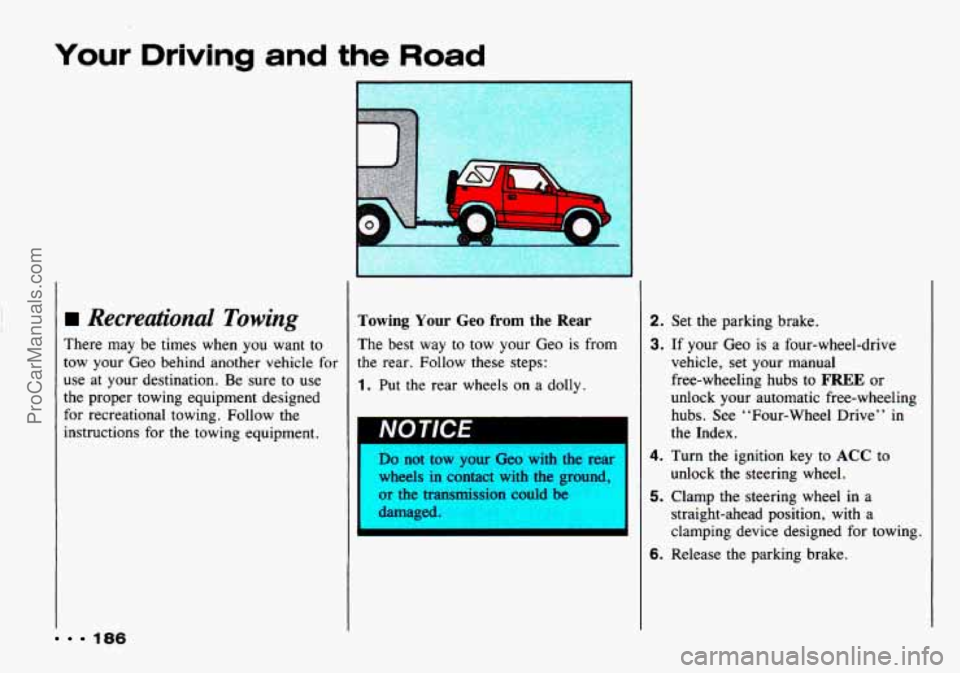
Recreational Towing
There may be times when you want to
tow your Geo behind another vehicle for
use at your destination. Be sure to use
the proper towing equipment designed
for recreational towing. Follow
the
instructions for the towing equipment.
186
Towing Your Geo from the Rear
The best way to tow your Geo is from
the rear. Follow these steps:
1 . Put the rear wheels on a dolly.
NOTlCE
Do not tow your Geo with the re--
wheels in contact with the grounL,
or
the transmission could be
damaged.
2. Set the parking brake.
3. If your Geo is a four-wheel-drive
vehicle, set your manual
free-wheeling hubs to
FREE or
unlock your automatic free-wheeling
hubs. See “Four-Wheel Drive’’
in
the Index.
4. Turn the ignition key to ACC to
unlock the steering wheel.
5. Clamp the steering wheel in a
straight-ahead position,
with a
clamping device designed for towing.
6. Release the parking brake.
ProCarManuals.com
Page 189 of 339
Make sure that the towing speed
dues not exceed 55 mph
(90 km/h), or your Geo could be
badly damaged.
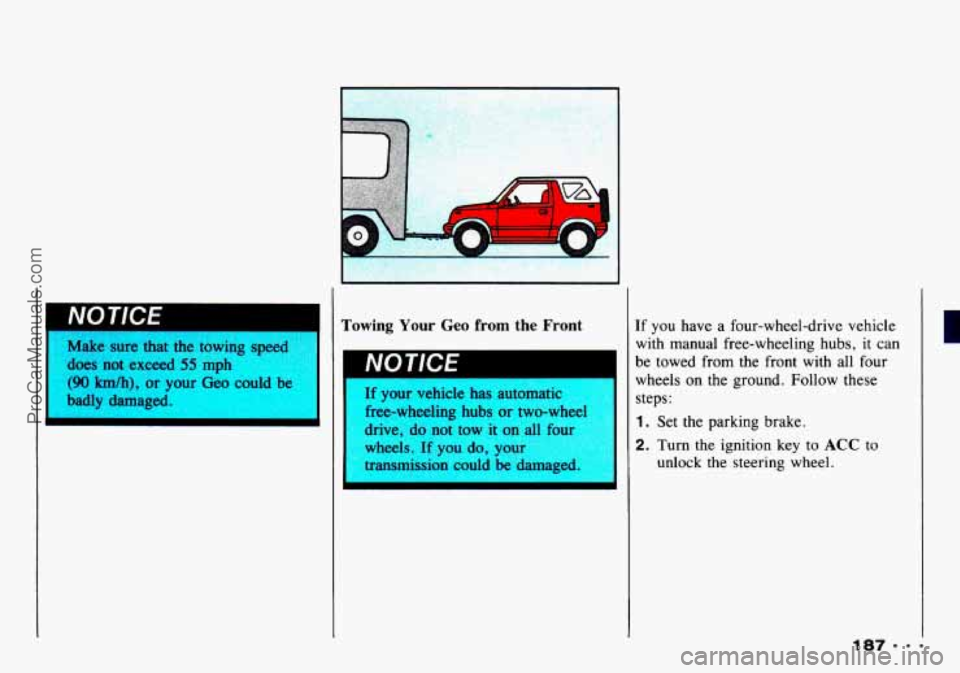
Towing Your Geo from the Front
If your vehicle has automatic
I free-wheeling hubs or two-whet
drive, do not tow it
on all fa
I wheels. If you do, you transmission could be damaged.
I
If you have a four-wheel-drive vehicle
with manual free-wheeling hubs, it can
be towed from the front with all four
wheels on the ground. Follow these
steps:
1. Set the parking brake.
2. Turn the ignition key to ACC to
unlock the steering wheel.
ProCarManuals.com
Page 199 of 339
That your vehicle has rear-wheel
drive, or that
it has the
four-wheel-drive option.
vehicle.
The make, model, and year of your
Whether you can still move the shift
levers for the transmission and
transfer case,
if you have one.
If there was an accident, what was
damaged.
When the towing service arrives, let the
tow operator know that this manual
contains detailed towing instructions and
illustrations. The operator may want to
see them.
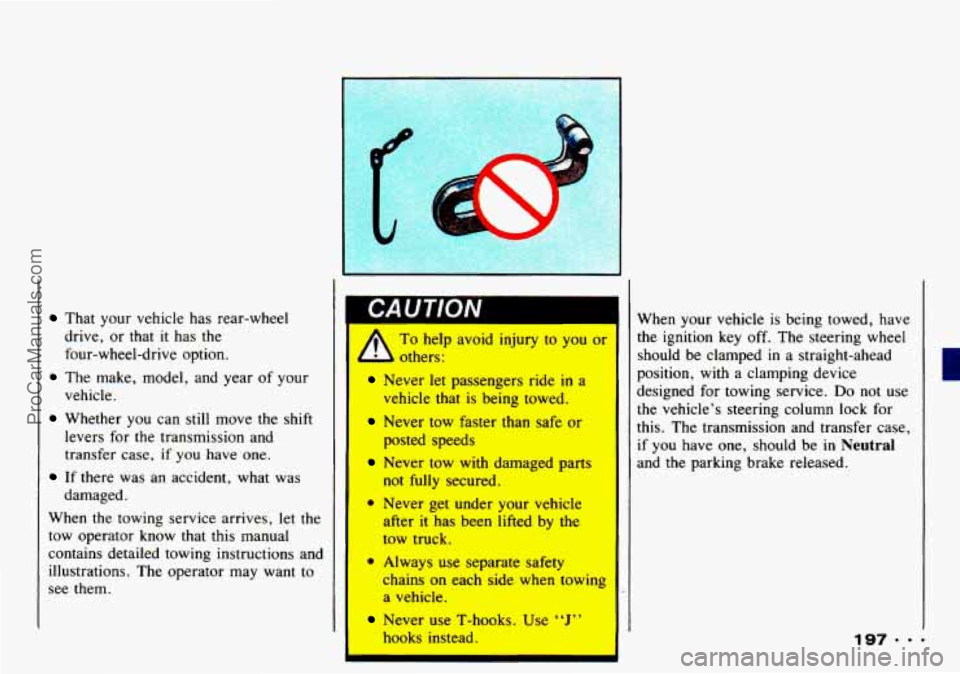
* T- help avoid injury to you or
Never let passengers ride in a
vehicle that is being towed.
Never tow faster than safe or
posted speeds
Never tow with damaged parts
not fully secured.
0 Never get under your vehicle
after it
has been lifted by the
tow truck.
chains on each side when towing
a vehicle.
hooks instead.
* Always use separate safety
Never use T-hooks. Use “J”
When your vehicle is being towed, have
the ignition key off. The steering wheel
should be clamped
in a straight-ahead
position, with
a clamping device
designed for towing service.
Do not use
the vehicle’s steering column lock for
this. The transmission and transfer case,
if you have one, should be in Neutral
and the parking brake released.
ProCarManuals.com
Page 210 of 339
Problems on the Road
Zf a Tire Goes Hut
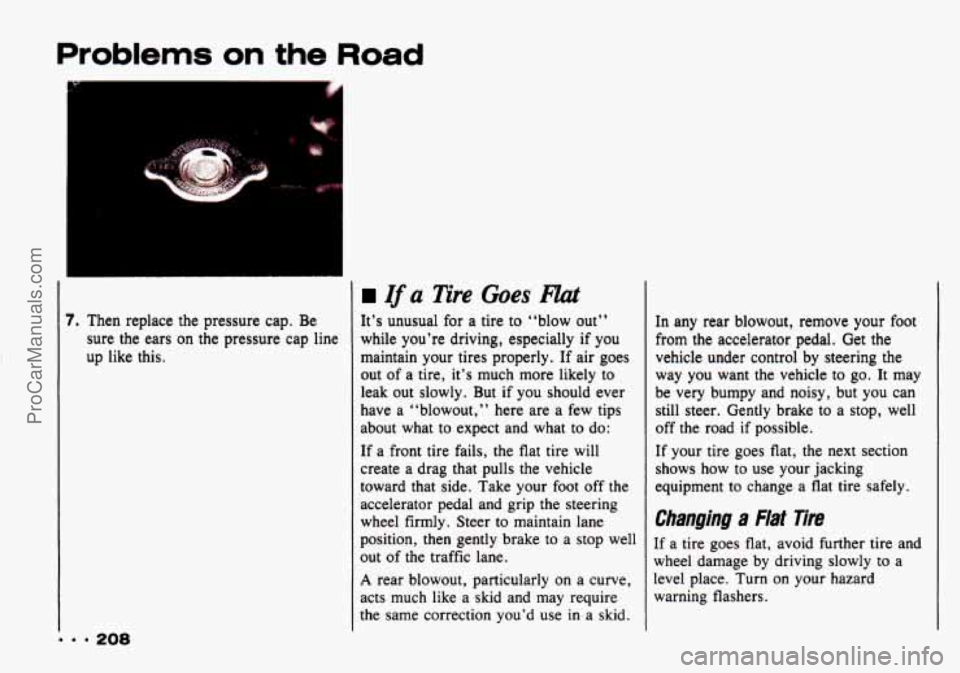
Then replace the pressure cap. Be
sure
the ears on the pressure cap line
up like
this.
9 208
It’s unusual for a tire to “blow out’’
while you’re driving, especially
if you
maintain your tires properly. If air goes
out of a tire, it’s much more likely to
leak out slowly. But if you should ever
have a “blowout,
” here are a few tips
about what to expect and what to do:
If a front tire fails, the flat tire will
create a drag that pulls the vehicle
toward that side. Take your foot off the
accelerator pedal and grip the steering
wheel firmly. Steer to maintain lane
position, then gently brake to a stop well
out of the traffic lane.
A rear blowout, particularly on a curve,
acts much like a skid and may require
the same correction you’d use
in a skid. In any
rear blowout, remove your
foot
from the accelerator pedal. Get the
vehicle under control by steering
the
way you want the vehicle to go. It may
be
very bumpy and noisy, but you can
still steer. Gently brake to a stop, well
off the road
if possible.
If your tire goes flat, the next section
shows how to use your jacking
equipment to change a flat tire safely.
ChanginQ a Flat lire
If a tire goes flat, avoid further tire and
wheel damage by driving slowly to a
level place. Turn
on your hazard
warning flashers.
..
ProCarManuals.com
Page 220 of 339
Problems on the Road
Rocking your vehicle to get it out:
First, turn your steering wheel left and
right. That will clear the area around
your front wheels. Then shift back and
forth between
R (Reverse) and a
forward gear (or with a manual
transmission, between First
or Second
gear and Reverse), spinning the wheels
as little as possible. Release the
accelerator pedal while you shift, and
press lightly
on the accelerator pedal
when the transmission is
in gear. If that doesn’t get you
out after a few tries,
you may need to be towed out. Or, you
can use your recovery hooks. If you do
need to be towed out,
see ‘‘Towing
Your Vehicle” in the Index.
-- --
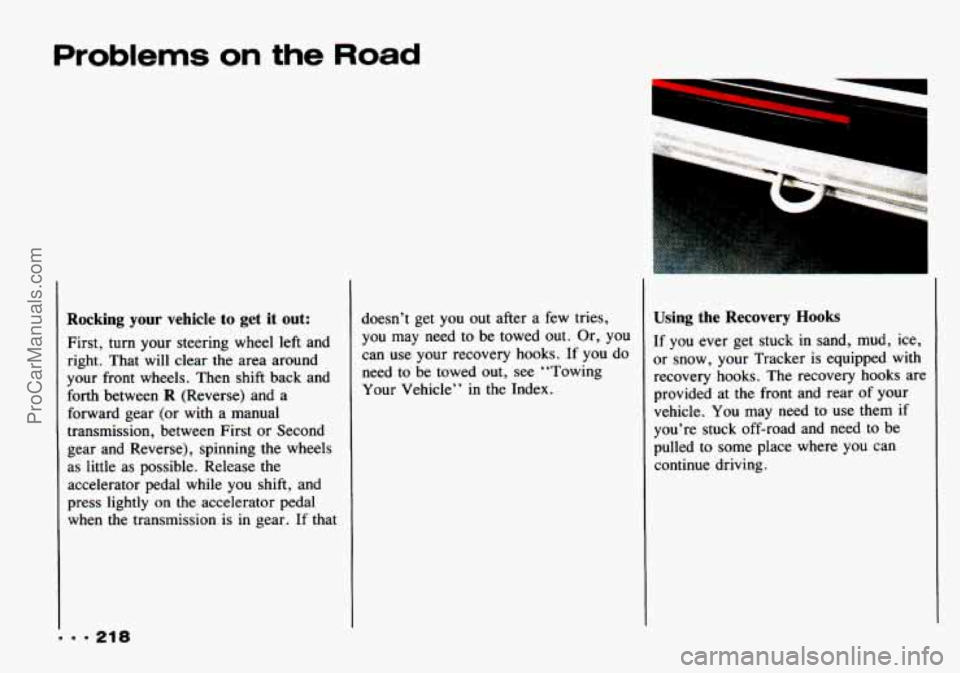
Using the Recovery Hooks
If you ever get stuck in sand, mud, ice,
or snow, your Tracker is equipped with
recovery hooks. The recovery hooks are
provided at the front and rear of your
vehicle. You may need to use them if
you’re stuck off-road and need to be
pulled to some place where you can
continue driving.
ProCarManuals.com