tires CHEVROLET TRACKER 1993 User Guide
[x] Cancel search | Manufacturer: CHEVROLET, Model Year: 1993, Model line: TRACKER, Model: CHEVROLET TRACKER 1993Pages: 339, PDF Size: 15.75 MB
Page 159 of 339
After Off-Road Driving
Remove any brush or debris that has
collected on the underbody, chassis or
under the hood. These accumulations
can be a fire hazard.
After operation in mud or sand, have the
brake linings cleaned and checked.
These substances can cause glazing and
uneven braking. Check the body
structure, steering, suspension, wheels,
tires, and exhaust system for damage.
Also, check the fuel lines and cooling
system for any leakage.
Your vehicle will require more frequent
service due to off-road use. Refer
to the
Maintenance Schedule for additional
information.
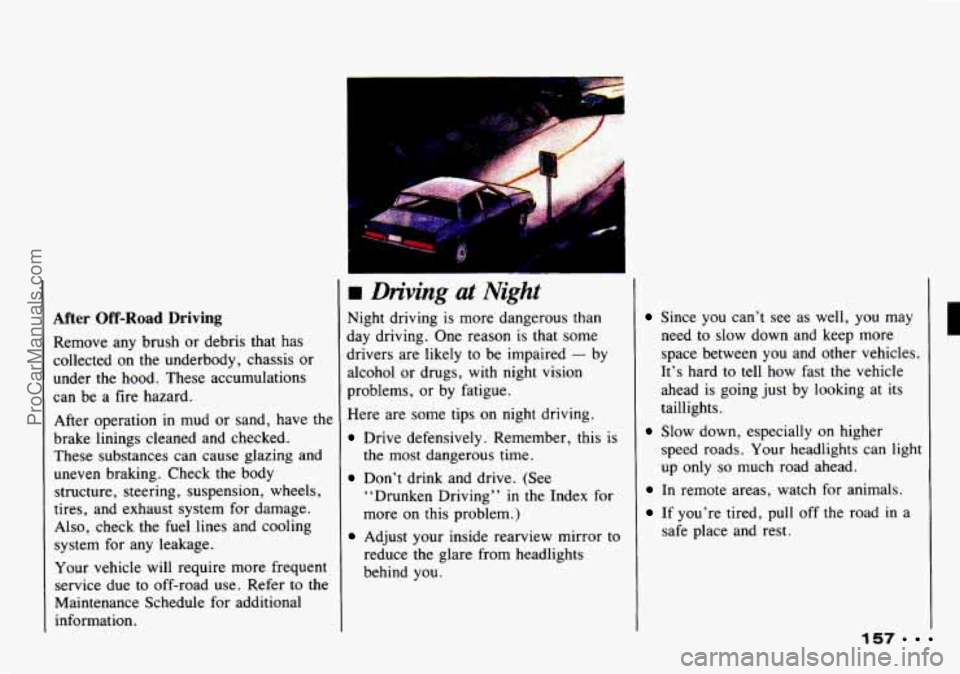
rn Driving at Night
Night driving is more dangerous than
day driving. One reason is that some
drivers are likely to be impaired
- by
alcohol or drugs, with night vision
problems, or by fatigue.
Here are some tips
on night driving.
Drive defensively. Remember, this is
the most dangerous time.
Don’t drink and drive. (See
“Drunken Driving” in the Index for
more on this problem.)
Adjust your inside rearview mirror to
reduce the glare from headlights
behind you.
Since you can’t see as well, you may
need to slow down and keep more
space between you and other vehicles.
It’s hard to tell how fast the vehicle
ahead is going just by looking at its
taillights.
Slow down, especially on higher
speed roads.
Your headlights can light
up only so much road ahead.
In remote areas, watch for animals.
If you’re tired, pull off the road in a
safe place and rest.
157
ProCarManuals.com
Page 162 of 339
Your Driving and the Road
I
*. ’ i
... 160
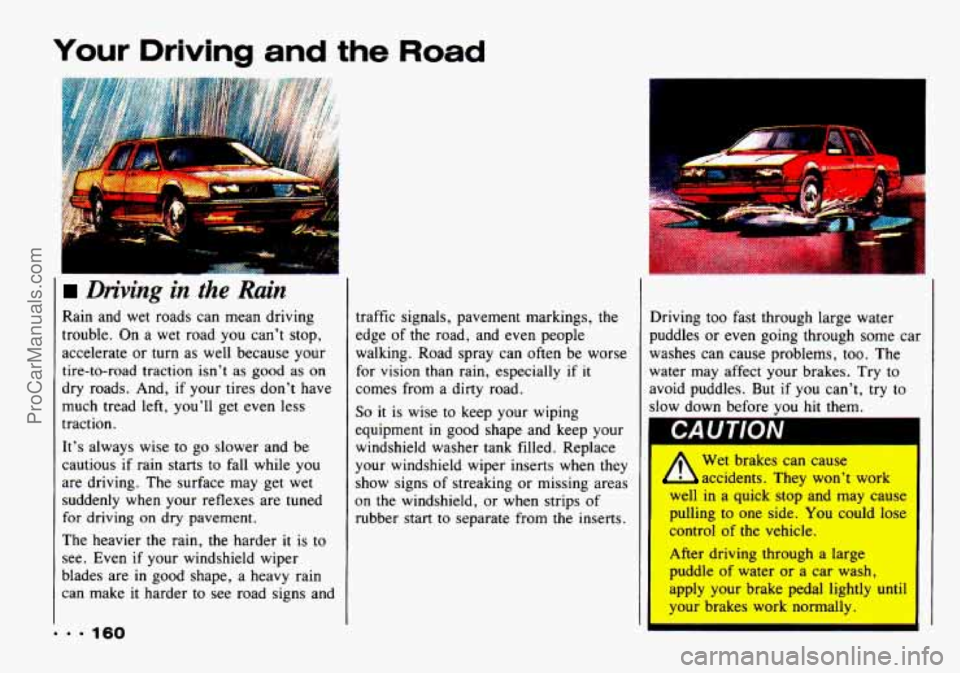
Driving in the Rain
Rain and wet roads can mean driving
trouble. On
a wet road you can’t stop,
accelerate or turn as well because your
tire-to-road traction isn’t as good as on
dry roads. And,
if your tires don’t have
much tread
left, you’ll get even less
traction.
It’s always wise to go slower and be
cautious
if rain starts to fall while you
are driving. The surface may get wet
suddenly when your reflexes are tuned
for driving on dry pavement.
The heavier the rain, the harder
it is to
see. Even if your windshield wiper
blades are
in good shape, a heavy rain
can make it harder to see road signs and traffic signals,
pavement markings, the
edge of the road, and even people
walking. Road spray can often be worse
for vision than rain, especially if
it
comes from a dirty road.
So it is wise to keep your wiping
equipment
in good shape and keep your
windshield washer tank filled. Replace
your windshield wiper inserts when they
show signs of streaking or missing areas
on the windshield, or when strips of
rubber start to separate from the inserts. Driving too
fast through large water
puddles or
even going through some car
washes can cause problems, too. The
water may affect your brakes. Try to
avoid puddles. But if you can’t, try to
slow down before
you hit them.
I A Wet brakes can cause
- accidents. They won’t work
well
in a quick stop and may cause
pulling to one side.
You could lose
control of the vehicle.
After driving through a large
puddle of water or a car wash,
apply your brake pedal lightly until
your brakes work normally.
ProCarManuals.com
Page 163 of 339
Hydroplaning
Hydroplaning is dangerous. So much
water can build up under your tires that
they can actually ride on
the water. This
can happen
if the road is wet enough
and you’re going fast enough. When
your vehicle is hydroplaning, it has little
or no contact with
the road.
You might not be aware of
hydroplaning.
You could drive along for
some time without realizing your tires
aren’t in constant contact with the road.
You could find out the hard way: when
you have to slow, turn, move out to
pass
- or if you get hit by a gust of
wind. You could suddenly find yourself
out of control. Hydroplaning
doesn’t happen often. But
it can if your tires haven’t much tread or
if the pressure in one or more is low. It
can happen if a lot of water is standing
on the road. If you can see reflections
from trees, telephone poles, or other
vehicles, and raindrops “dimple” the
water’s surface, there could be
hydroplaning.
Hydroplaning usually happens at higher
speeds. There just isn’t a hard and fast
rule about hydroplaning. The best advice
is to slow down when it is raining, and
be careful.
Some Other Rainy Weather Tips
Turn on your headlights - not just
your parking lights - to help make
you more visible to others.
Look for hard-to-see vehicles coming
from behind.
You may want to use
your headlights even in daytime
if it’s
raining hard.
Besides slowing down, allow some
extra following distance. And be
especially careful when you pass
another vehicle. Allow yourself more
clear room ahead, and be prepared to
have your view restricted by road
spray.
If the road spray is so heavy
ProCarManuals.com
Page 164 of 339
Your Drlvlng and the Road
you are actually blinded, drop back.
Don’t pass until conditions improve.
having an accident.
~ Going more slowly is better than
Use your defogger if it helps.
Have good tires with proper tread
depth.
(See “Tires” in the Index.)
99. 162
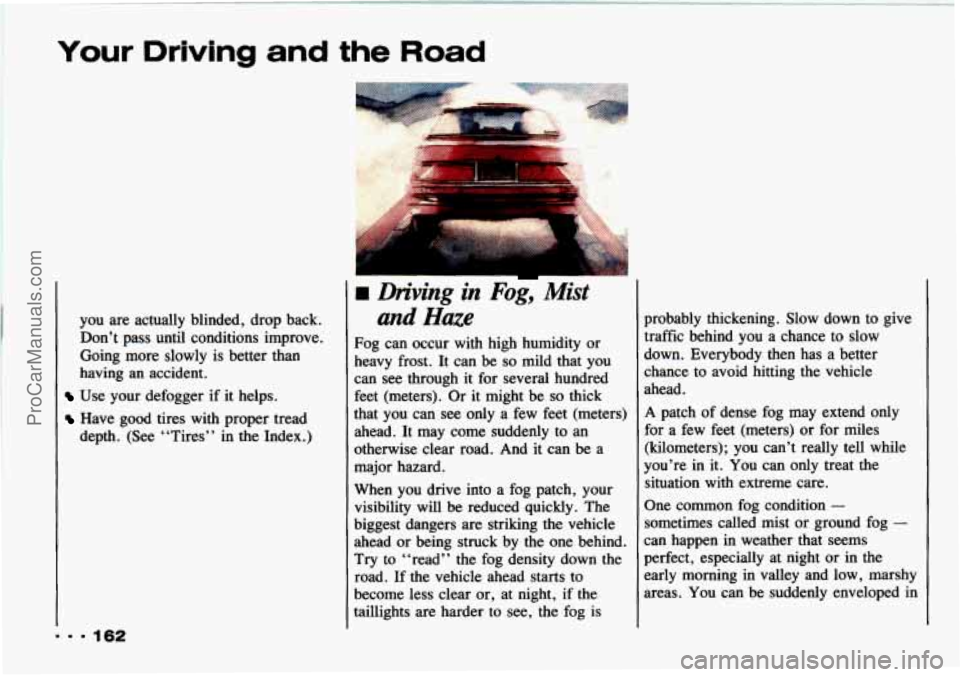
H Driving in Fog, Mist
and Haze
Fog can occur with high humidity or
heavy
fiost. It can be so mild that you
can see through it for several hundred
feet (meters). Or it might be
so thick
that you can see only a few feet (meters)
ahead. It may come suddenly to an
otherwise clear road. And it can be a
major hazard.
When you drive into a fog patch, your
visibility will be reduced quickly. The
biggest dangers are striking the vehicle
ahead or being struck by the one behind.
Try
to “read” the fog density down the
road.
If the vehicle ahead starts to
become less clear or, at night,
if the
taillights are harder to see, the fog is probably thickening. Slow down to give
traffic behind
you a chance to slow
down. Everybody then has a better
chance to avoid hitting the vehicle
ahead.
A patch of dense fog may extend only
for a few feet (meters) or for miles
(kilometers); you can’t really tell while
you’re in it. You can only treat the
situation with extreme care.
One common fog condition
-
sometimes called mist or ground fog -
can happen in weather that seems
perfect, especially at night or in the
early morning in valley and low, marshy
areas.
You can be suddenly enveloped in
ProCarManuals.com
Page 169 of 339
I Driving a Long
Distunce
Although most long trips today are made
on freeways, there are still many made
on regular highways.
Long-distance driving on freeways and
regular highways is the same in some
ways. The trip has
to be planned and the
vehicle prepared, you drive at
higher-than-city speeds, and there are
longer turns behind the wheel. You’ll
l enjoy your trip more if you and your
vehicle are in good shape. Here are
some tips for a successful long trip.
Before Leaving on a Long Trip
Make sure you’re ready. Try to be well
rested. If you must start when you’re
not fresh
- such as after a day’s work
- don’t plan to make too many miles
that first part
of the journey. Wear
comfortable clothing and shoes you can
easily drive in.
Is your vehicle ready for a long trip? If
you keep it serviced and maintained, it’s
ready to go.
If it needs service, have it
done before starting out. Of course,
you’ll find experienced and able service
experts in Geo dealerships all across
North America. They’ll be ready and
willing to help
if you need it. Here
are some things you can check
before a trip:
Windshield Washer Fluid: Is the
reservoir full? Are all windows clean
inside and outside?
Wiper Blades: Are they in good
shape?
Fuel, Engine Oil, Other Fluids:
Have you checked all levels?
Lights: Are they all working? Are the
lenses clean?
Tires: They are vitally important to a
safe, trouble-free trip. Is the tread
good enough
for long-distance
driving? Are the tires all inflated
to
the recommended pressure?
167-9.
ProCarManuals.com
Page 170 of 339
Your Driving and the Road
Weather Forecasts: What’s the
weather outlook along your route?
Should you delay your trip a short
time to avoid a major storm system?
Maps: Do you have up-to-date maps?
On the Road
Unless you are the only driver, it is
good to share the driving task with
others. Limit turns behind the wheel to
about
100 miles (160 km) or two hours
at a sitting. Then, either change drivers
or stop for some refreshment like
coffee, tea or
soft drinks and some
limbering up. But do stop and move
around. Eat lightly along the way. Heavier meals tend
to make some people
sleepy.
On two-lane highways or undivided
multilane highways that do not have
controlled access, you’ll want to watch
for
some situations not usually found on
freeways. Examples are: stop signs and
signals, shopping centers with direct
access to the highway, no passing zones
and school zones, vehicles turning left
and right
off the road, pedestrians,
cyclists, parked vehicles, and even
animals.
Highway Hypnosis
Is there actually such a condition as
“highway hypnosis”?
Or is it just plain
falling asleep at the wheel? Call it
highway hypnosis, lack
of awareness, or
whatever.
There is something about an easy stretch
of road with the same scenery, along
with the hum
of the tires on the road,
the drone of the engine, and the rush
of
the wind against the vehicle that can
make you sleepy. Don’t let
it happen to
you!
If it does, your vehicle can leave
the road in
less than a second, and you
could crash and be injured.
ProCarManuals.com
Page 171 of 339
What can you do about highway
hypnosis? First, be aware that it can
happen.
Then here are some tips:
Make sure your vehicle is well
ventilated, with a comfortably cool
interior.
Keep your eyes moving. Scan the
road ahead and to the sides. Check
your rearview mirrors frequently and
your instruments from time
to time.
This can help you avoid a fixed stare.
Wear good sunglasses in bright light.
Glare can cause drowsiness. But don’t
wear sunglasses at night. They will drastically reduce your overall
vision
at the very time you need all the
seeing power you have.
If you get sleepy, pull off the road
into a rest, service or parking area
and take a nap, get some exercise, or
both. For safety, treat drowsiness on
the highway as an emergency.
As in any driving situation, keep pace
with traffic and allow adequate
following distances.
--
A
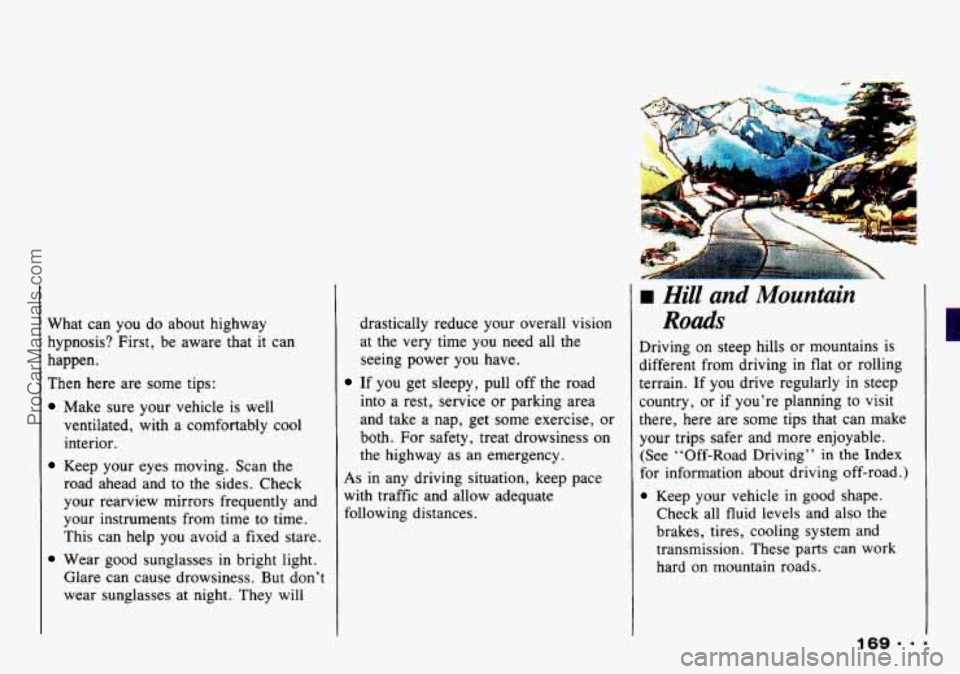
Driving on steep hills or mountains is
different from driving in flat or rolling
terrain. If you drive regularly
in steep
country, or if you’re planning
to visit
there, here are some tips that can make
your trips safer and more enjoyable.
(See “Off-Road Driving’’
in the Index
for information about driving off-road.)
Keep your vehicle in good shape.
Check all fluid levels and also the
brakes, tires, cooling system and
transmission. These ‘parts can work
hard on mountain roads.
ProCarManuals.com
Page 174 of 339
Your Driving and the Road
c
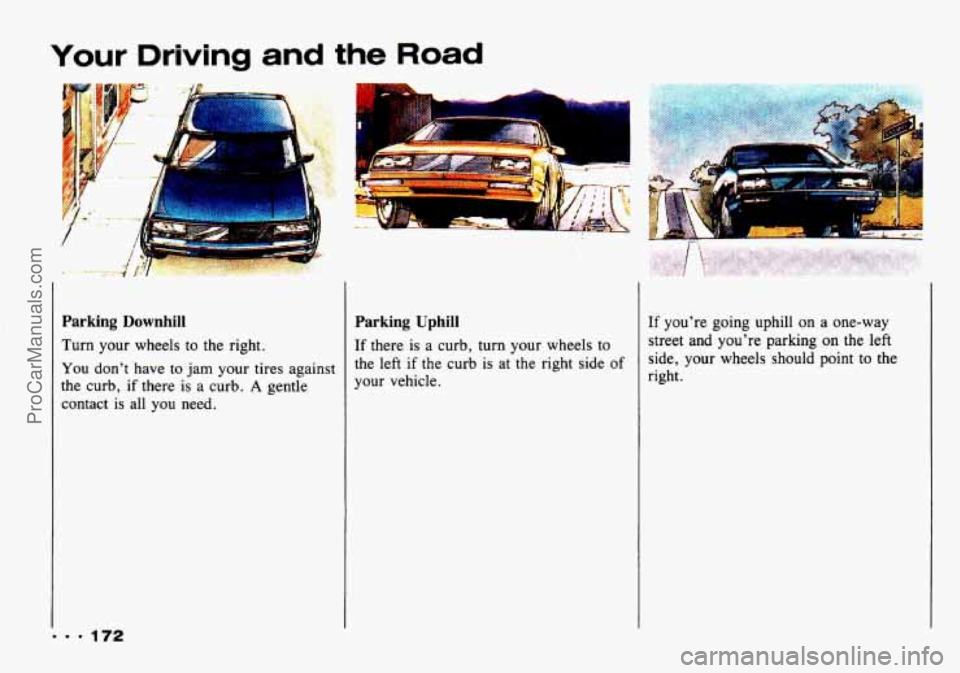
Parking Uphill
If there is a curb, turn your wheels to
the left
if the curb is at the right side of
your vehicle.
Parking Downhill
Turn your wheels to the right.
You don't have to jam your tires against
the curb, if there is
a curb. A gentle
contact is all
you need.
... 172
If you're going uphill on a one-way
street and you're parking on
the left
side, your wheels should point to the
right.
ProCarManuals.com
Page 175 of 339
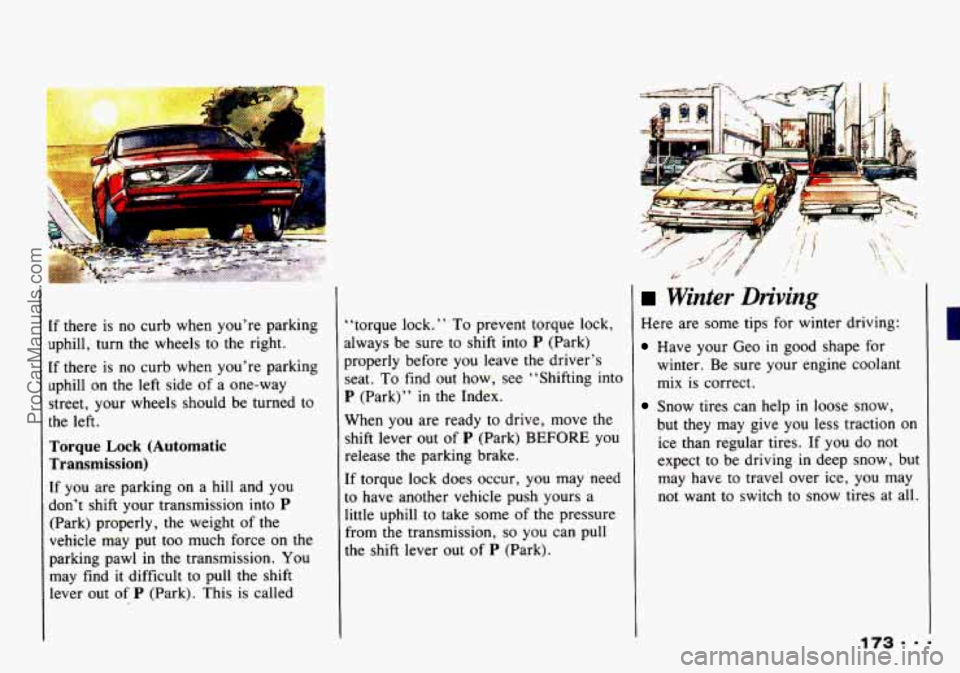
[f there is no curb when you’re parking
uphill, turn the wheels to the right.
[f there is
no curb when you’re parking
uphill on the left side
of a one-way
street, your wheels should be turned
to
the left.
Torque Lock (Automatic
Transmission)
If you are parking on a hill and you
don’t shift your transmission into
P
(Park) properly, the weight of the
vehicle may put too much force on the
parking pawl in the transmission.
You
may find it difficult to pull the shift
lever out of
P (Park). This is called “torque
lock.”
To prevent torque lock,
always be sure to shift into
P (Park)
properly before you leave the driver’s
seat.
To find out how, see ‘‘Shifting into
P (Park)” in the Index.
When you are ready to drive, move the
shift lever out
of P (Park) BEFORE you
release the parking brake.
If torque lock does occur, you may need
to have another vehicle push yours a
little uphill
to take some of the pressure
from the transmission,
so you can pull
the shift lever out
of P (Park).
Winter Driving
Here are some tips for winter driving:
Have your Geo in good shape for
winter. Be sure your engine coolant
mix is correct.
Snow tires can help in loose snow,
but they may give you less traction on
ice than regular tires.
If you do not
expect
to be driving in deep snow, but
may have to travel over ice, you may
not want
to switch to snow tires at all.
I
ProCarManuals.com
Page 176 of 339
Your Driving and the Road
rn
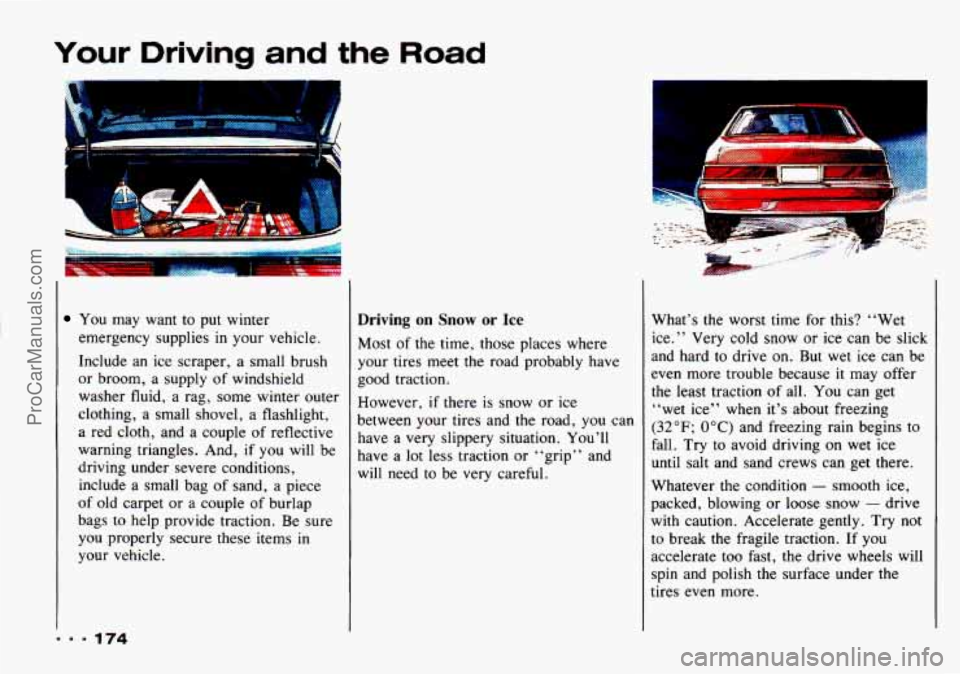
You may want to put winter
emergency supplies in your vehicle.
Include an ice scraper, a small brush
or broom, a supply of windshield
washer fluid, a rag, some winter outer
clothing, a small shovel, a flashlight,
a red cloth, and a couple of reflective
warning triangles. And, if
you will be
driving under severe conditions,
include
a small bag of sand, a piece
of old carpet or
a couple of burlap
bags to help provide traction.
Be sure
you properly secure these items
in
your vehicle.
... 174
Driving on Snow or Ice
Most of the time, those places where
your tires meet the road probably have
good traction.
However,
if there is snow or ice
between your tires and the road, you can
have a very slippery situation. You’ll
have a lot less traction or “grip” and
will need to be very careful.
t
What’s the worst time for this? “Wet
ice.
” Very cold snow or ice can be slick
and hard to drive on. But wet ice can be
even more trouble because it may offer
the least traction
of all. You can get
“wet ice” when it’s about freezing
(32°F; OOC) and freezing rain begins to
fall.
Try to avoid driving on wet ice
until salt and sand crews can get there.
Whatever the condition
- smooth ice,
packed, blowing or loose snow
- drive
with caution. Accelerate gently.
Try not
to break the fragile traction. If you
accelerate too fast, the drive wheels will
spin and polish the surface under the
tires even more.
ProCarManuals.com