tires CHEVROLET TRACKER 1993 Owner's Manual
[x] Cancel search | Manufacturer: CHEVROLET, Model Year: 1993, Model line: TRACKER, Model: CHEVROLET TRACKER 1993Pages: 339, PDF Size: 15.75 MB
Page 180 of 339
Your Driving and the Road
Your Geo can tow a trailer. To identify
what the vehicle trailering capacity is for
your vehicle, you should read the
information
in “Weight of the Trailer”
that appears later in
this section. But
trailering is different than just driving
your vehicle by itself. Trailering means
changes in handling, durability, and fuel
economy. Successful, safe trailering
takes correct equipment, and it has to be
used properly.
That’s the reason for this section.
In it
are many time-tested, important
trailering tips and safety rules. Many of
these are important for your safety and
that of your passengers.
So please read
this section carefully before you pull a
trailer.
9 178
Load-pulling components such as the
engine, transmission, wheel assemblies,
and tires are forced to work harder
against the drag
of the added weight.
The engine is required to operate at
relatively higher speeds and under
greater loads, generating extra heat.
What’s more, the trailer adds
considerably to wind resistance,
increasing the pulling requirements.
All
of that means changes in:
Handling
Durability
Fuel economy
If You Do Decide to Pull a Trailer
If you do, here are some important
points.
There are many different laws having
to do with trailering. Make sure your
rig will be legal, not only where you
live but also where you’ll be driving.
A good source for this information
can be state or provincial police.
Consider using a sway control.
You can ask a hitch dealer about sway
controls.
Don’t tow a trailer at all during the
first
500 miles (800 km) your new
vehicle is driven. Your engine, axle
or other parts could be damaged.
ProCarManuals.com
Page 182 of 339
Your Driving and the Road
L
Weight of the Trailer Tongue
... 180
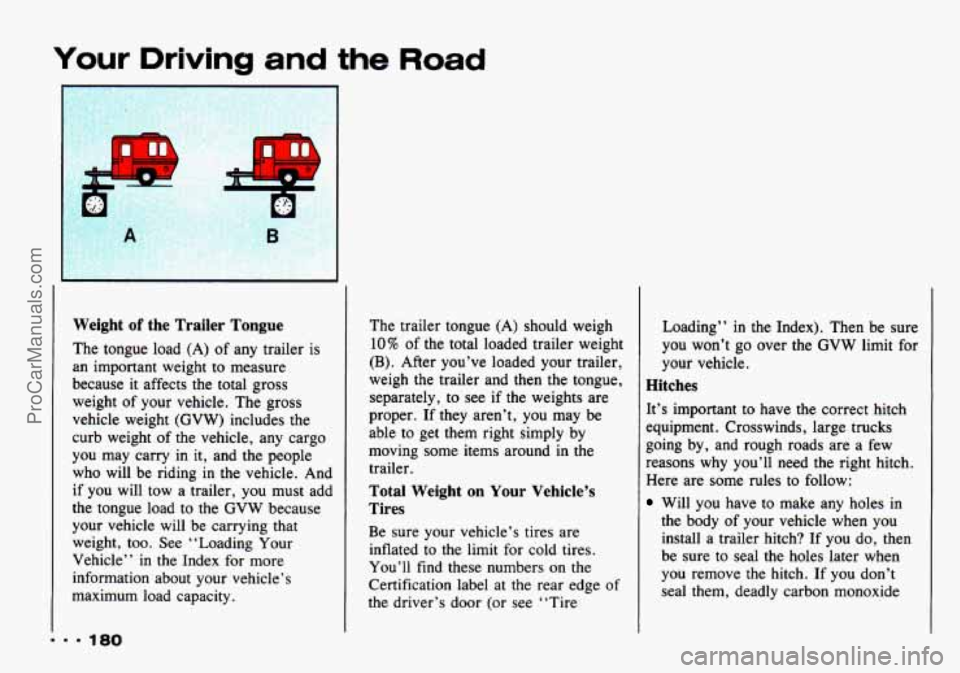
The tongue load (A) of any trailer is
an important weight to measure
because
it affects the total gross
weight of your vehicle. The gross
vehicle weight (GVW) includes the
curb weight of the vehicle, any cargo
you may carry in it, and the people
who will be riding in the vehicle. And
if
you will tow a trailer, you must add
the tongue load to
the GVW because
your vehicle will be carrying that
weight, too. See “Loading Your
Vehicle’’ in the Index for more
information about your vehicle’s
maximum load capacity. The trailer
tongue (A) should weigh
10%
of the total loaded trailer weight
(B). After you’ve loaded your trailer,
weigh the trailer and then the tongue,
separately, to see if the weights are
proper. If they aren’t, you may be
able to get them right simply by
moving some items around in the
trailer.
Total Weight on Your Vehicle’s
Tires
Be sure your vehicle’s tires are
inflated to the limit for cold tires.
You’ll
find these numbers on the
Certification label at the rear edge of
the driver’s door (or see “Tire Loading”
in the Index). Then be sure
you won’t go over the GVW limit for
your vehicle.
Hitches
It’s important to have the correct hitch
equipment. Crosswinds, large trucks
going by, and rough roads are a few
reasons why you’ll need the right hitch.
Here are some rules to follow:
Will you have to make any holes in
the body of your vehicle when
you
install a trailer hitch? If you do, then
be sure to seal
the holes later when
you remove the hitch. If you don’t
seal them, deadly carbon monoxide
ProCarManuals.com
Page 184 of 339
Your Driving and the Road
Will the trailer brake parts take
3,000 psi (20 650 kPa) of pressure? If
not, the trailer brake system must not
be used with your vehicle.
If everything checks out this far, then
make the brake fluid tap at the port
on the master cylinder that sends fluid
to the rear brakes. But don’t use
copper tubing
for this. If you do, it
will bend and finally break off. Use
steel brake tubing.
88. 182
Driving With a Trailer
Towing a trailer requires a certain
amount
of experience. Before setting out
for the open road, you’ll want to get to
know your rig. Acquaint yourself with
the feel of handling and braking with the
added weight
of the trailer. And always
keep in mind that the vehicle you are
driving is now a good deal longer and
not nearly
so responsive as your vehicle
is by itself. Before you
start, check
the trailer hitch
and platform, safety chains, electrical
connector, lights, tires and mirror
adjustment. If the trailer has electric
brakes, start your vehicle and trailer
moving and then apply the trailer brake
controller by hand to be sure the brakes
are working. This lets you check your
electrical connection at the same time.
During your trip, check occasionally to
be sure that the load is secure, and that
the lights and any trailer brakes are still
working.
ProCarManuals.com
Page 198 of 339
Problems on the Road
10. Now start the vehicle with the good
battery and
run the engine for
awhile.
dead battery.
If it won't start after a few tries, it
probably needs service.
11. Try to start the vehicle with the
I
I-
12. Remove the cables in reverse order
to prevent electrical shorting. Take
care that they don't touch each
other or any other metal.
A. Heavy Metal Engine Part
B. Good Battery
C. Dead Battery
r
L
Towing Your Vehicle
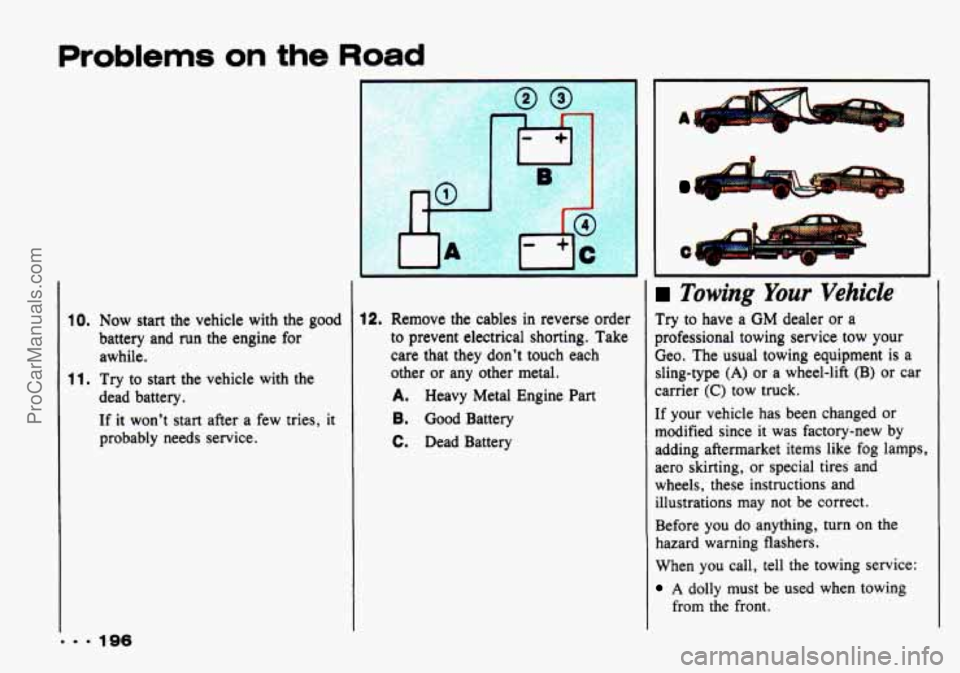
Try to have a GM dealer or a
professional towing service tow your
Geo. The usual towing equipment is
a
sling-type (A) or a wheel-lift (B) or car
carrier
(C) tow truck.
If your vehicle has been changed or
modified since it was factory-new by
adding aftermarket items like fog lamps,
aero skirting, or special tires and
wheels, these instructions and
illustrations may not be correct.
Before you
do anything, turn on the
hazard warning flashers.
When you call, tell the towing service:
A dolly must be used when towing
from the front.
ProCarManuals.com
Page 210 of 339
Problems on the Road
Zf a Tire Goes Hut
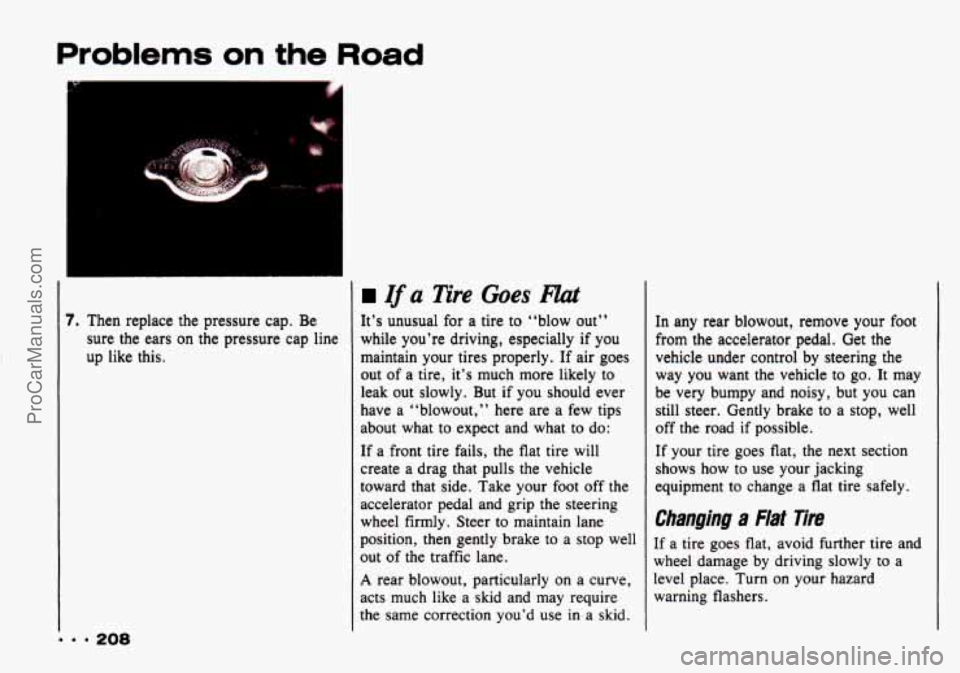
Then replace the pressure cap. Be
sure
the ears on the pressure cap line
up like
this.
9 208
It’s unusual for a tire to “blow out’’
while you’re driving, especially
if you
maintain your tires properly. If air goes
out of a tire, it’s much more likely to
leak out slowly. But if you should ever
have a “blowout,
” here are a few tips
about what to expect and what to do:
If a front tire fails, the flat tire will
create a drag that pulls the vehicle
toward that side. Take your foot off the
accelerator pedal and grip the steering
wheel firmly. Steer to maintain lane
position, then gently brake to a stop well
out of the traffic lane.
A rear blowout, particularly on a curve,
acts much like a skid and may require
the same correction you’d use
in a skid. In any
rear blowout, remove your
foot
from the accelerator pedal. Get the
vehicle under control by steering
the
way you want the vehicle to go. It may
be
very bumpy and noisy, but you can
still steer. Gently brake to a stop, well
off the road
if possible.
If your tire goes flat, the next section
shows how to use your jacking
equipment to change a flat tire safely.
ChanginQ a Flat lire
If a tire goes flat, avoid further tire and
wheel damage by driving slowly to a
level place. Turn
on your hazard
warning flashers.
..
ProCarManuals.com
Page 219 of 339
If You’re Stuck: In
Sand, Mud, Ice or
Snow
What you don’t want to do when your
vehicle is stuck is to spin your wheels.
The method known as “rocking” can
help you get out when you’re stuck, but
you must use caution.
‘ If you let your tires spin at
42 high speed, they can explode
and you or others could be injured.
And, the transmission and other
parts
of the vehicle can overheat.
That could cause
an engine
compartment fire or other damage.
When you’re stuck, spin the
wheels as little
as possible. Don’t
spin the wheels above
35 mph
(55 km/h) as shown on the
speedometer. Spinning
your wheels can destroy
parts of your vehicle as well as th
tires. If you spin the wheels too
fast while shifting your
transmission
back and forth, you
can destroy your transmission.
ProCarManuals.com
Page 223 of 339
Part 6
Here you wit1 find information
about the care of your Geo
. This
part begins with service and fuel
information. and then it shows
how to check important fluid and
lubricant levels
. There is also
technical information about your
vehicle. and
a section devoted to
its appearance care
.
ii iervice & Appearance Care
Service ............................................................. 222
Fuel ............................................................... 223
Checking Things under the Hood ........................................ 227 .
HoodRelease 227
Engineoil ........................................................ 229
Aircleaner ........................................................ 233
Automatic Transmission Fluid ........................................ 234
Manual Transmission Fluid ........................................... 237
Clutch Adjustment .................................................. 238
RearAxle ......................................................... 238
Four-WheelDrive .................................................. 239
Enginecoolant ..................................................... 240
Power Steering Fluid ................................................ 243
Windshield Washer Fluid ............................................ 244
Brake Master Cylinder ............................................... 245
Battery ........................................................... 247
Bulb Replacement .................................................... 248
LoadingYourVehicle ................................................. 252
Tires ............................................................... 253
Appearancecare ..................................................... 261
Appearance Care and Maintenance Materials .............................. 271
Vehicle Identification Number .......................................... 272
Service Parts Identification Label ........................................ 272
Add-on Electrical Equipment ........................................... 272
Fuses and Circuit Breakers ............................................. 273
ReplacementBulbs ................................................... 276
Capacities and Specifications ........................................... 277
221 .
.
......................................................
ProCarManuals.com
Page 254 of 339
Service & Appearance Care
Loading Your Vehicle
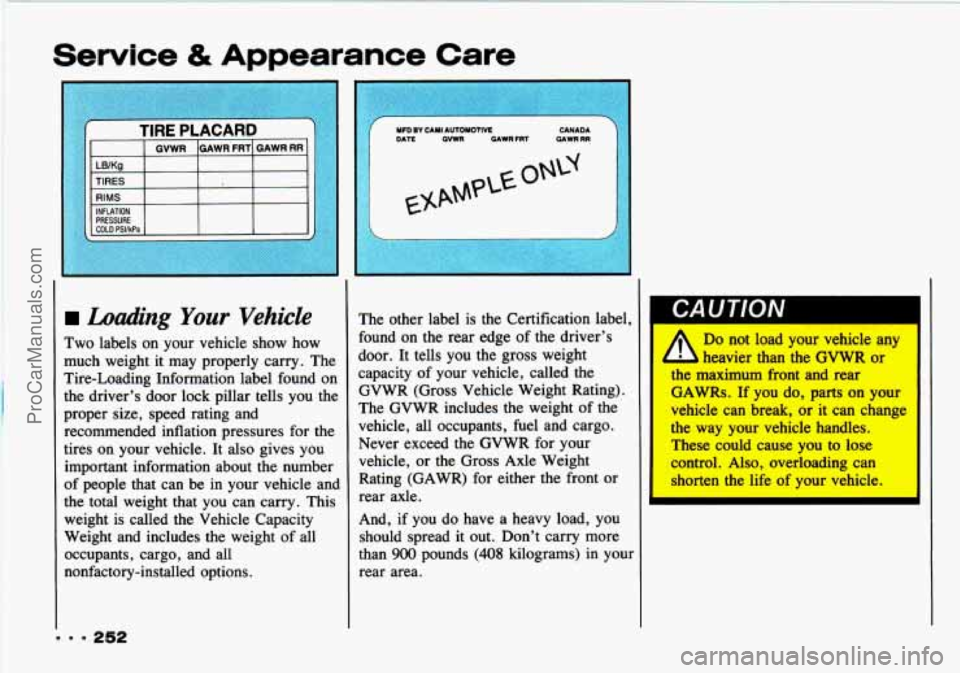
Two labels on your vehicle show how
much weight
it may properly carry. The
Tire-Loading Information label found on
the driver’s door lock pillar tells you the
proper size, speed rating and
recommended inflation pressures for the
tires on your vehicle. It also gives you
important information about the number
of people that can be in your vehicle and
the total weight that you can carry. This
weight is called the Vehicle Capacity
Weight and includes the weight of all
occupants, cargo, and all
nonfactory-installed options. The other
label is the Certification label,
11
found on the rear edge of the driver’s
door. It tells you the gross weight
capacity of your vehicle, called the
GVWR (Gross Vehicle Weight Rating).
The GVWR includes the weight of the
vehicle, all occupants, fuel and cargo.
Never exceed the GVWR for your
vehicle, or the Gross Axle Weight
Rating (GAWR) for either the front or
rear axle.
And, if you do have a heavy load, you
should spread it out. Don’t carry more
than
900 pounds (408 kilograms) in your
rear area.
1
CAUTION
Do not load your vehicle any
heavier than the GVWR or
the
maximum front and rear I
GAWRs. If you do, parts on you]
vehicle can break, or it can chang
the way your vehicle handles.
These could cause you to lose
control. Also, overloading can
shorten the life of your vehicle.
ProCarManuals.com
Page 255 of 339
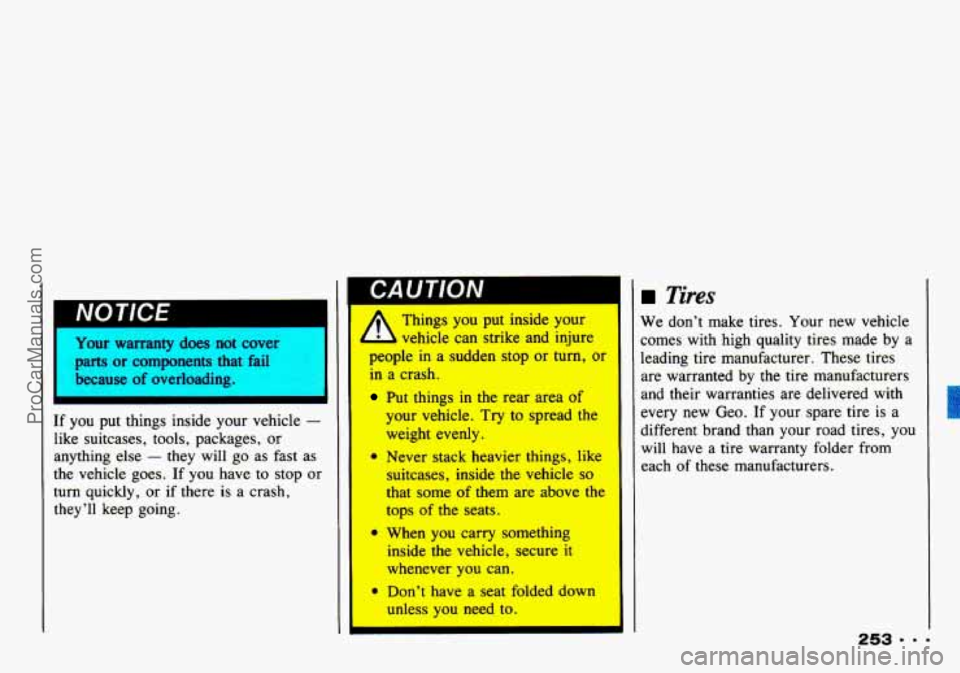
NOTICE I
Your warranty does not cover
parts or components that fail
because of overloading.
If you put things inside your vehicle -
like suitcases, tools, packages, or
anything else - they will go as fast as
the vehicle goes. If you have to stop or
turn quickly, or if there is a crash,
they’ll keep going. Things
you put inside your
vehicle
can strike and injure
people
in a sudden stop or turn, or
in a crash.
Put things in the rear area of
your vehicle. Try to spread the
weight evenly.
* Never stack heavier things, like
suitcases, inside the vehicle so
that some of them are above the
tops
of the seats.
* When you carry something
inside the vehicle, secure it
whenever
you can.
9 Don’t have a seat folded down
unless you need to.
Tires
We don’t make tires. Your new vehicle
comes with high quality tires made by a
leading tire manufacturer. These tires
are warranted by the tire manufacturers
and their warranties are delivered with
every new
Geo. If your spare tire is a
different brand than your road tires, you
will have
a tire warranty folder from
each
of these manufacturers.
253 9 9 .
ProCarManuals.com
Page 256 of 339
Service & Appearance Care
A
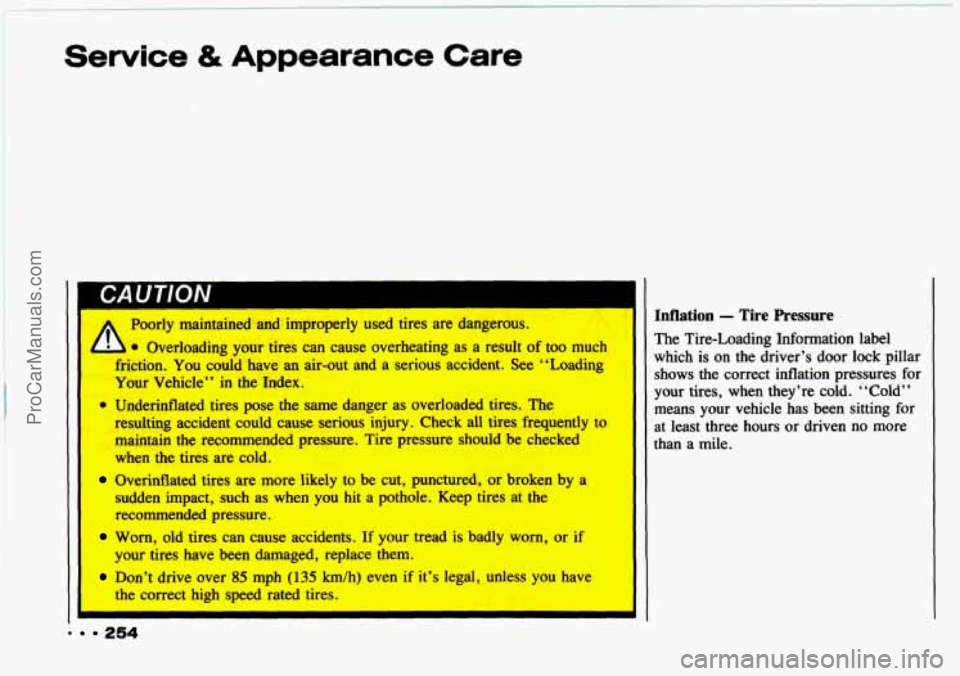
Poorly maintained and improperly used tires are dangerous.
9 Overloading your tires can cause overheating as a result of too much
friction. You could have an air-out and a serious accident. See “Loading
Your Vehicle” in the Index.
resulting accident could cause serious injury. Check all tires frequently to
maintain the recommended pressure. Tire pressure should be checked
when
the tires are cold.
Overinflated tires are more likely to be cut, punctured, or broken by a
sudden impact, such as when you hit a pothole. Keep tires at the
recommended pressure.
your tires have been damaged, replace them.
the correct high speed rated tires.
* Underinflated tires pose the same danger as overloaded tires. The
Worn, old tires can cause accidents. If your tread is badly worn, or if
Don’t drive over 85 mph (135 kmh) even if it’s legal, unless you have
Inflation - Tire Pressure
The Tire-Loading Information label
which
is on the driver’s door lock pillar
shows the correct inflation pressures for
your tires, when they’re cold. “Cold”
means your vehicle has been sitting
for
at least three hours or driven no more
than a mile.
9 254
ProCarManuals.com