transmission CHEVROLET TRACKER 1993 Service Manual
[x] Cancel search | Manufacturer: CHEVROLET, Model Year: 1993, Model line: TRACKER, Model: CHEVROLET TRACKER 1993Pages: 339, PDF Size: 15.75 MB
Page 237 of 339
' /vu I IL-t
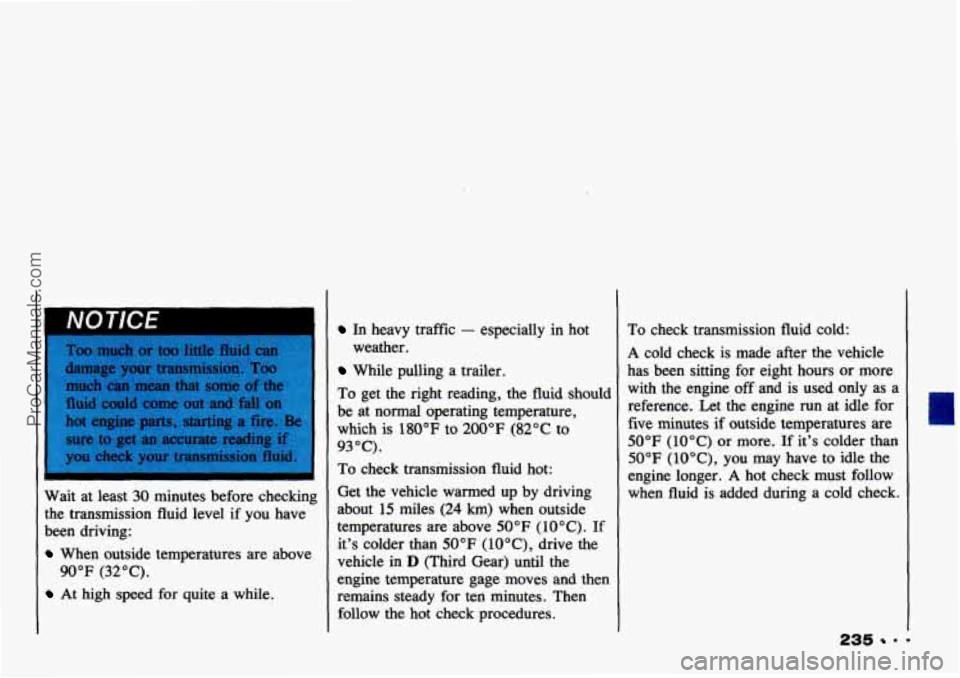
Wait at least 30 minutes before checking
the transmission fluid level if you have
been driving:
When outside temperatures are above
At high speed for quite a while.
90°F (32°C).
In heavy traffic - especially in hot
While pulling a trailer.
To get
the right reading, the fluid should
be at normal operating temperature,
which is
180°F to 200°F (82°C to
93°C).
To check transmission fluid hot:
Get the vehicle warmed up by driving
about
15 miles (24 km) when outside
temperatures are above
50°F (10°C). If
it's colder than 50°F (lO°C), drive the
vehicle in
D (Third Gear) until the
engine temperature gage moves and then
remains steady for ten minutes. Then
follow the hot check procedures.
weather.
To
check transmission fluid cold:
A cold check is made after the vehicle
has been sitting for eight hours or more
with the engine
off and is used only as a
reference. Let the engine run at idle for
five minutes if outside temperatures are
50°F (10°C) or more. If it's colder than
50°F (lO°C), you may have to idle the
engine longer.
A hot check must follow
when fluid
is added during a cold check.
U
235 9
ProCarManuals.com
Page 238 of 339

Service & Appearance Care
... 236
Let the engine run at idle for three
minutes or more.
To check the fluid hot or cold:
Park your vehicle on a level place.
Place the shift lever in P (Park) with
the parking brake applied.
With your foot on the brake pedal,
move the shift lever through each gear
range, pausing for about three seconds
in each range. Then, position the shift
lever in
P (Park).
Then, without shutting off the engine,
follow these steps:
1. Pull out the dipstick and wipe it with
2. Push it back in all the way, wait
a clean rag
or paper towel.
three seconds and then pull
it back
out again.
3. Check both sides of the dipstick, and
read the lower level. The fluid level
must be
in the COLD (A) area for a
cold check or in the
HOT (B) or
cross-hatched area for a hot check.
4. If the fluid level is where it should
be, push the dipstick back
in all the
way.
How to Add Fluid:
Refer to the Maintenance Schedule to
determine what kind of transmission fluid to use.
See “Recommended Fluids
and Lubricants”
in the Index.
If the fluid level is low, add only
enough of the proper fluid to bring the
level up into the COLD area for a cold
check or the
HOT area for a hot check.
It doesn’t take much fluid, generally less
than a pint. Don’t overfill. We
recommend you use only fluid labeled
DEXRON@-11, because fluids with that
label are made especially for our
automatic transmission. Damage caused
by fluid other than DEXRON@-I1 is not
covered by your new vehicle warranty.
ProCarManuals.com
Page 239 of 339
After adding fluid, recheck the fluid
level as described under “How to
Check.
”
obtained, push the dipstick back in all
the way.
When the correct fluid level is
Manual Transmiisioon Fluid
When to Check and Change:
A good time to have it checked is when
the engine oil is changed. Refer to the
Maintenance Schedule to find out
when
to change your transmission fluid. See
‘ ‘Scheduled Maintenance Services’ ’ in
the Index.
How to Check:
Because this operation can be a little
difficult, you may choose to have this
done at a Geo dealership Service
Department.
If you do
it yourself, be sure to follow
all the instructions here, or you could
get
a false reading.
90 much or too little fluid can
...anage your transmission.
Too
much can mean that some of the
fluid could come
out and fall on I
hot engine parts, starting a fire.
I sure to get an accurate reading if
you check your transmission fluid.
I
Check the fluid level only when your
engine is off, the vehicle is parked on a
level place and the transmission
is cool
enough
for you to rest your fingers on
the transmission case.
237 8
ProCarManuals.com
Page 280 of 339
Service & Appearance Care
Capacities (Approximate)
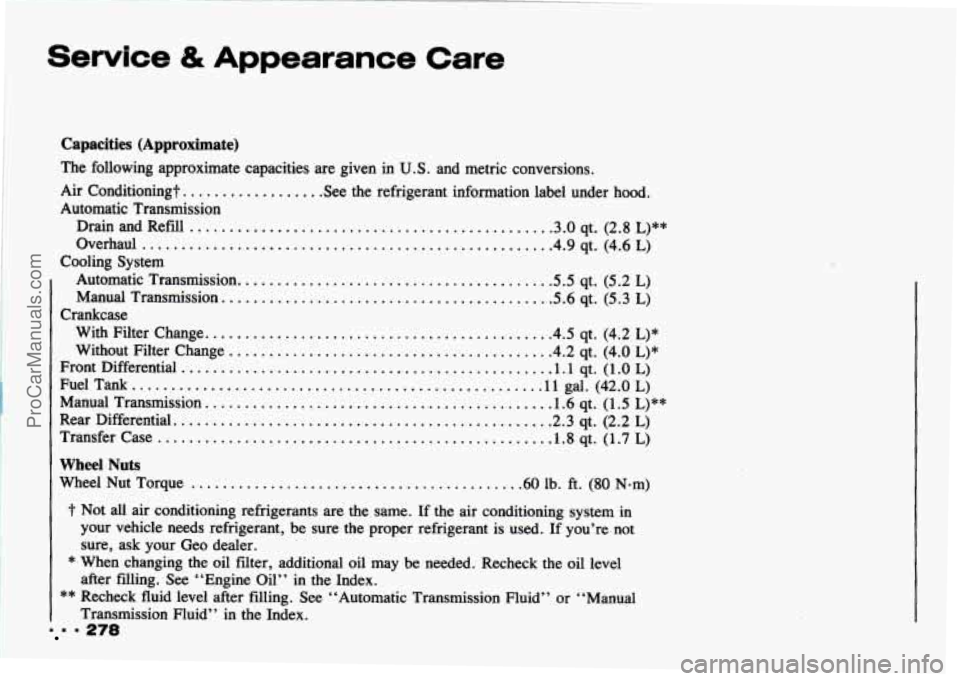
The following approximate capacities are given in U.S. and metric conversions.
Automatic Transmission Air
Conditioning?.
................ .See the refrigerant information label under hood.
.............................................
................................................... Drain and Refill .3.0 qt. (2.8 L)**
Overhaul .4.9 qt. (4.6 L)
Cooling System
Automatic Transmission. ...................................... S.5 qt. (5.2 L)
I Manual Transmission. ........................................ S.6 qt. (5.3 L)
FuelT ank....................................................llgal.(42.0L) .
Crankcase
..........................................
........................................
With Filter Change. .4.5 qt. (4.2 L)*
Without Filter Change .4.2 qt. (4.0 L)*
Front Differential ............................................... 1 1 qt. (1 .O L)
Manual Transmission. .1.6 qt. (1.5 L)**
Rear Differential. .2.3 qt. (2.2 L)
Transfer Case .................................................. 1 .8 qt. (1.7 L)
..........................................
..............................................
Wheel Nuts
Wheel Nut Torque .60 lb. ft. (80 N-m)
? Not all air conditioning refrigerants are the same. If the air conditioning system in
your vehicle needs refrigerant, be sure
the proper refrigerant is used. If you’re not
sure, ask your Geo dealer.
after filling.
See “Engine Oil” in the Index.
Transmission Fluid” in the Index.
.........................................
*.When changing the oil filter, additional oil may be needed. Recheck the oil level
** Recheck fluid level after filling. See “Automatic Transmission Fluid” or “Manual
9 278
ProCarManuals.com
Page 293 of 339
ITEM
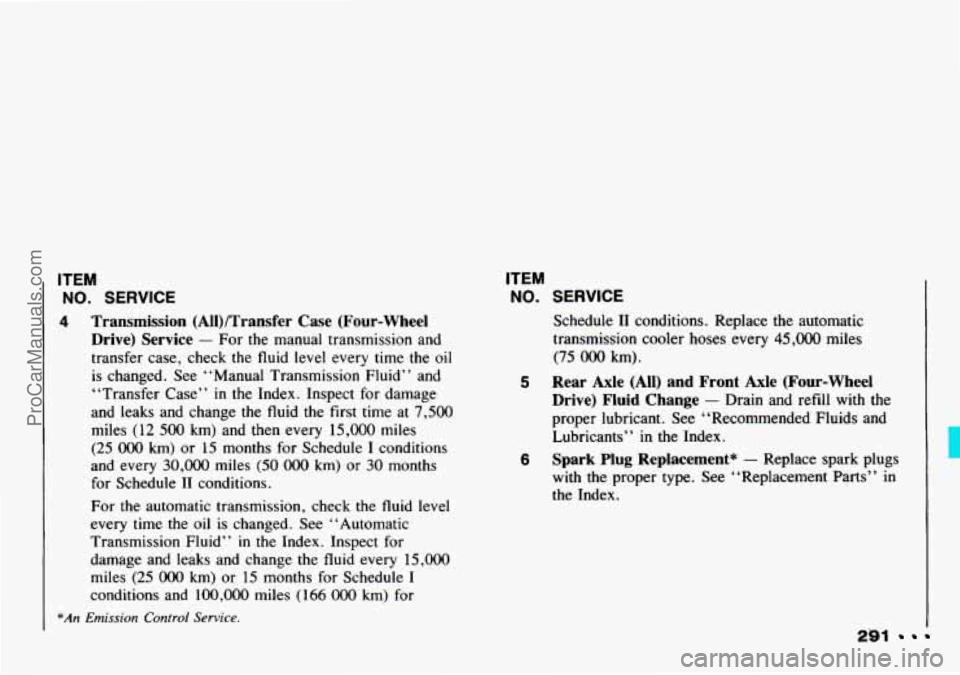
NO. SERVICE
4 Transmission (AlI)/Transfer Case (Four-wheel
Drive) Service
- For the manual transmission and
transfer case, check the fluid level every
time the oil
is changed. See “Manual Transmission Fluid” and
“Transfer Case”
in the Index. Inspect for damage
and leaks and change the fluid the first time at
7,500
miles (12 500 km) and then every 15,000 miles
(25 000 km) or 15 months for Schedule I conditions
and every
30,000 miles (50 OOO km) or 30 months
for Schedule
I1 conditions.
For the automatic transmission, check the fluid level
every time the oil is changed. See “Automatic
Transmission Fluid”
in the Index. Inspect for
damage and leaks and change the
fluid every 15,000
miles (25 OOO km) or 15 months for Schedule I
conditions and
100,OOO miles (166 000 km) for
*An Emission Control Service.
ITEM
NO. SERVICE
Schedule I1 conditions. Replace the automatic
transmission cooler hoses every
45,000 miles
(75 000 km).
5 Rear Axle (All) and Front Axle (Four-wheel
Drive) Fluid Change
- Drain and refill with the
proper lubricant. See “Recommended Fluids and
Lubricants”
in the Index.
6 Spark Plug Replacement* - Replace spark plugs
with the proper type. See “Replacement Parts’’ in
the Index.
291
ProCarManuals.com
Page 298 of 339
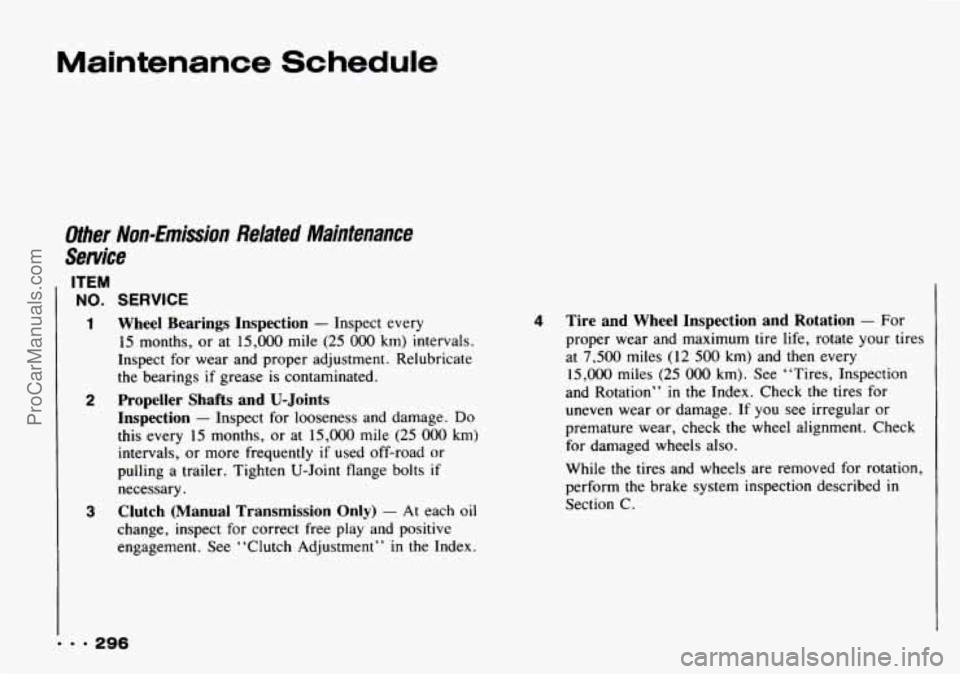
NO.
1
2
3
SERVICE
Wheel Bearings Inspection - Inspect every
15 months, or at 15,000 mile (25 OOO km) intervals.
Inspect for wear and proper adjustment. Relubricate
the bearings
if grease is contaminated.
Propeller Shafts and U-Joints
Inspection
- Inspect for looseness and damage. Do
this every 15 months, or at 15,000 mile (25 000 km)
intervals, or more frequently if used off-road or
pulling a trailer. Tighten U-Joint flange bolts if
necessary.
Clutch (Manual Transmission Only) - At each oil
change, inspect for correct free play and positive
engagement. See “Clutch Adjustment’’
in the Index.
Maintenance Schedule
Uther Nun-Emissun Related Maintenance
Service
ITEM
4 Tire and Wheel Inspection and Rotation - For
proper wear and maximum tire life, rotate your tires
at
7,500 miles (12 500 km) and then every
15 ,OOO miles (25 OOO km). See “Tires, Inspection
and Rotation”
in the Index. Check the tires for
uneven wear or damage. If you see irregular or
premature wear, check the wheel alignment. Check
for damaged wheels also.
While the tires and wheels are removed for rotation,
perform
the brake system inspection described in
Section C.
ProCarManuals.com
Page 301 of 339
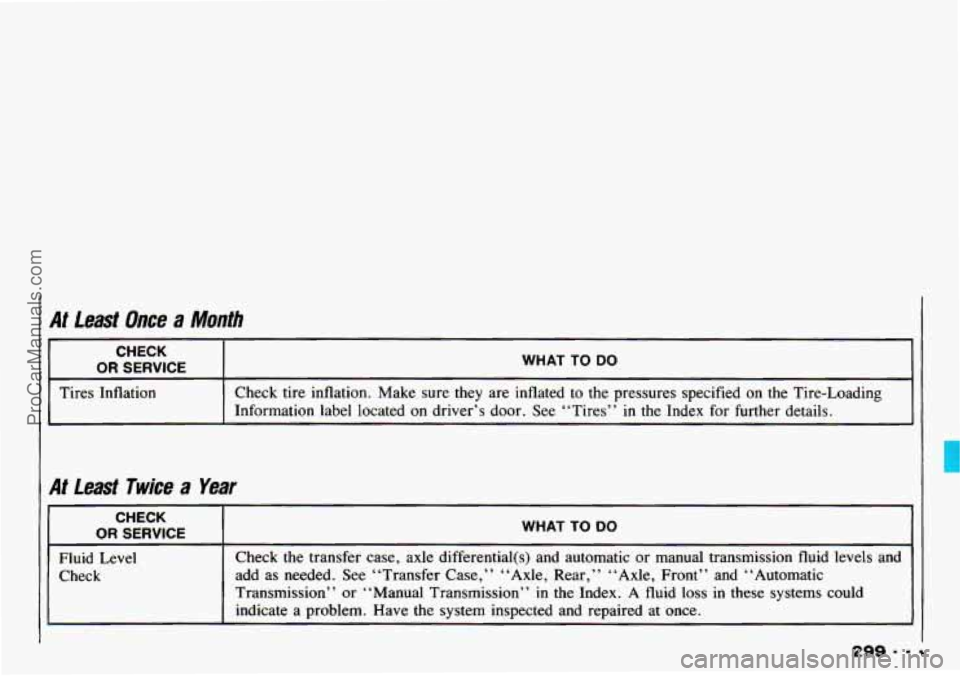
At Least Once a Month
CHECK
OR SERVICE “‘HAT TO DO
Tires
Inflation
Check tire inflation. Make sure they are inflated to the pressures specified on the Tire-Loading
Information label located
on driver’s door. See “Tires” in the Index for further details.
l At least Twice a Year
CHECK
I OR SERVICE I WHAT TO DO
Fluid Level
Check Check
the transfer case, axle differential(s) and automatic or manual transmission fluid levels and
add as needed. See “Transfer Case,
” ‘‘Axle, Rear,” “Axle, Front” and “Automatic
I Transmission” or “Manual Transmission” in the Index. A fluid loss in these systems could I
I indicate a problem. Have the system inspected and repaired at once. I
299 9 =
ProCarManuals.com
Page 302 of 339
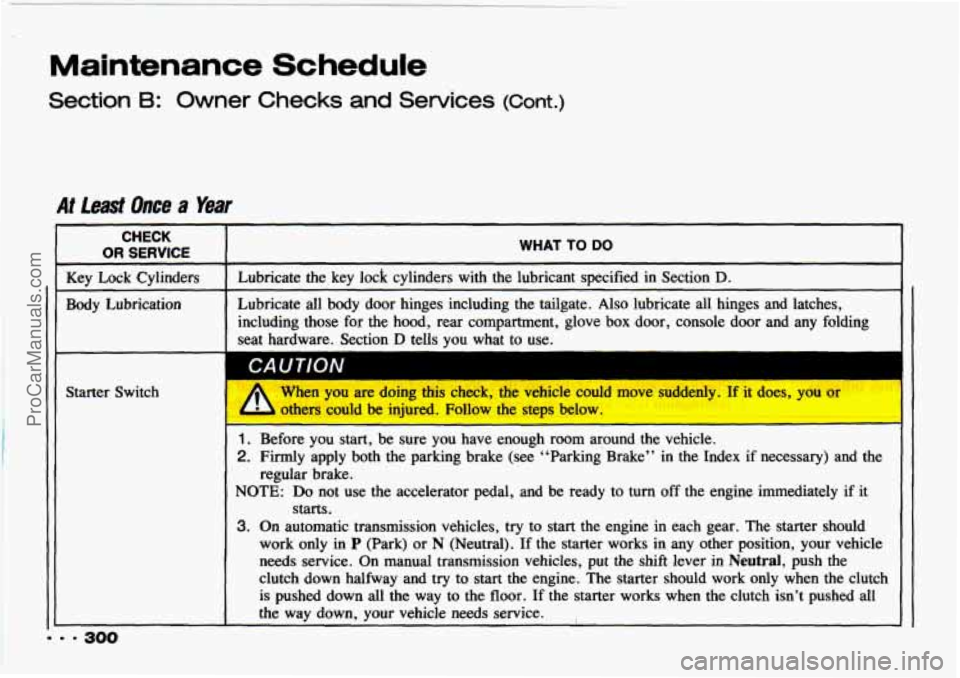
Maintenance Schedule
Section B: Owner Checks and Services (Cont.)
.r
Body Lubrication Lubricate all body door hinges including the tailgate. Also lubricate all hinges and latches,
including those for the hood, rear compartment, glove box door, console door and any folding
seat hardware. Section
D tells you what to use.
Starter Switch
At Least Once a Year
?
CHECK
OR SERVICE WHAT TO DO
Kev Lock Cylinders Lubricate the key lock cylinders with the lubricant specified in Section D.
1. Before you start, be sure you have enough room around the vehicle.
2. Firmly apply both the parking brake (see “Parking Brake” in the Index if necessary) and the
NOTE: Do not use the accelerator pedal, and be ready to turn off the engine immediately if it
3. On automatic transmission vehicles, try to start the engine in each gear. The starter should
work only in
P (Park) or N (Neutral). If the starter works in any other position, your vehicle
needs service, On manual transmission vehicles, put the shift lever
in Neutral, push the
clutch down halfway and try to start the engine. The starter should work only when the clutch
is pushed down
all the way to the floor. If the starter works when the clutch isn’t pushed all
the way down, your vehicle needs service.
regular
brake.
starts.
I.. 300
ProCarManuals.com
Page 304 of 339
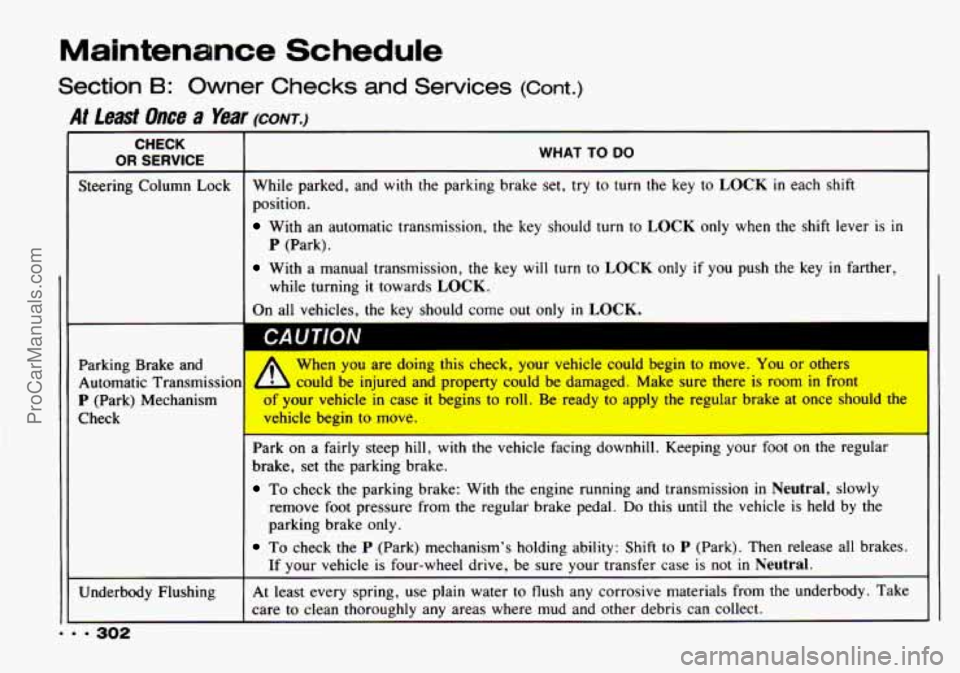
Maintenance Schedule
Section B: Owner Checks and Services (Cont.)
At Least Once a Year (CONT.)
CHECK
OR SERVICE I WHAT TO DO
Steering Column Lock While
parked, and with the parking brake set, try to turn the key to LOCK in each shift
position.
With an automatic transmission, the key should turn to LOCK only when the shift lever is in
With a manual transmission, the key will turn to LOCK only if you push the key in farther,
On all vehicles, the key should come out only
in LOCK.
P (Park).
while turning
it towards LOCK.
Parking Brake and
Automatic Transmission
P (Park) Mechanism
Check
Underbody Flushing When
you are doing this check, your vehicle could begin to move. You or others
could be injured and property could be damaged. Make sure there is room
in front
VI your vehicle in case it begins to roll. Be ready to apply the regular brake at once should the
Park
on a fairly steep hill, with the vehicle facing downhill. Keeping your foot on the regular
brake, set the parking brake.
To check the parking brake: With the engine running and transmission in Neutral, slowly
remove foot pressure from the regular brake pedal.
Do this until the vehicle is held by the
parking brake only.
To check the P (Park) mechanism’s holding ability: Shift to P (Park). Then release all brakes.
If your vehicle is four-wheel drive, be sure your transfer case is not in Neutral.
At least every spring, use plain water to flush any corrosive materials from the underbody. Take
care to clean thoroughly any areas where mud and other debris can collect.
ProCarManuals.com
Page 307 of 339
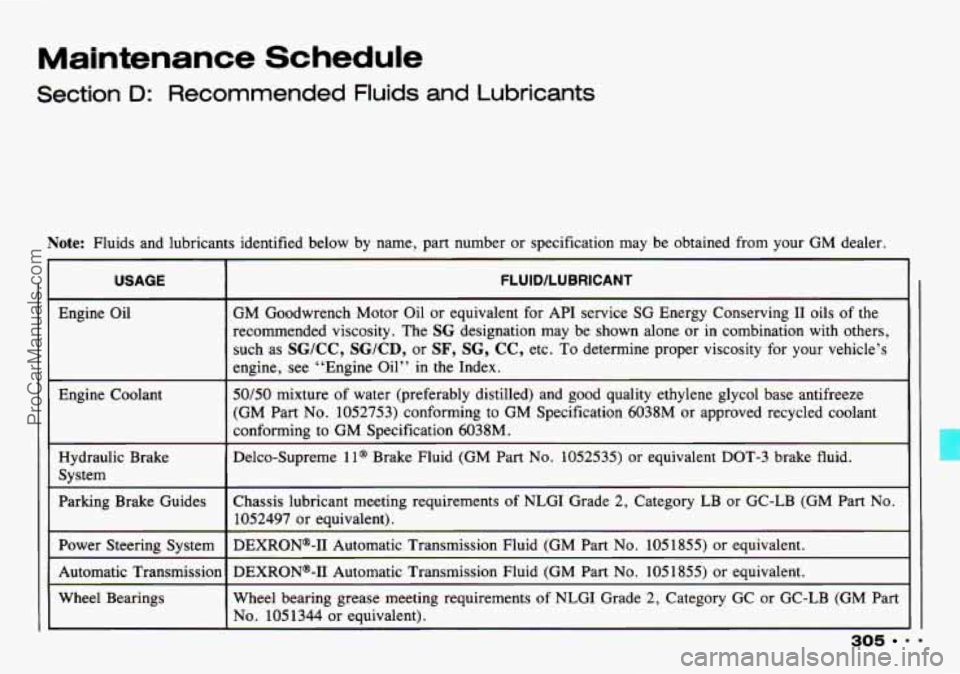
Maintenance Schedule
Section D: Recommended Fluids and Lubricants
Note: Fluids and lubricants identified below by name, part number or specification may be obtained from your GM dealer.
USAGE
Engine Oil
Engine Coolant
Hydraulic Brake
System
Parking Brake Guides
Power Steering System
Automatic Transmission
Wheel Bearings
FLUID/LUBRICANT
GM Goodwrench Motor Oil or equivalent for API service SG Energy Conserving I1 oils of the
recommended viscosity. The SG designation may be shown alone or in combination with others,
such as
SG/CC, SG/CD, or SF, SG, CC, etc. To determine proper viscosity for your vehicle’s
engine, see
‘ ‘Engine Oil” in the Index.
50/50 mixture of water (preferably distilled) and good quality ethylene glycol base antifreeze
(GM Part
No. 1052753) conforming to GM Specification 6038M or approved recycled coolant
conforming to GM Specification 6038M.
Delco-Supreme 1
l@ Brake Fluid (GM Part No. 1052535) or equivalent DOT-3 brake fluid.
~~
Chassis lubricant meeting requirements of NLGI Grade 2, Category LB or GC-LB (GM Part No.
1052497 or equivalent).
DEXRONB-I1 Automatic Transmission Fluid (GM Part
No. 1051855) or equivalent.
DEXRON*-I1 Automatic Transmission Fluid (GM Part
No. 1051855) or equivalent.
3.
-
-
305 9 -
Wheel bearing grease meeting requirements of NLGI Grade 2, Category GC or GC-LB (GM Part
No. 105 1344 or equivalent).
ProCarManuals.com