wheel CHEVROLET TRACKER 1993 Manual PDF
[x] Cancel search | Manufacturer: CHEVROLET, Model Year: 1993, Model line: TRACKER, Model: CHEVROLET TRACKER 1993Pages: 339, PDF Size: 15.75 MB
Page 271 of 339
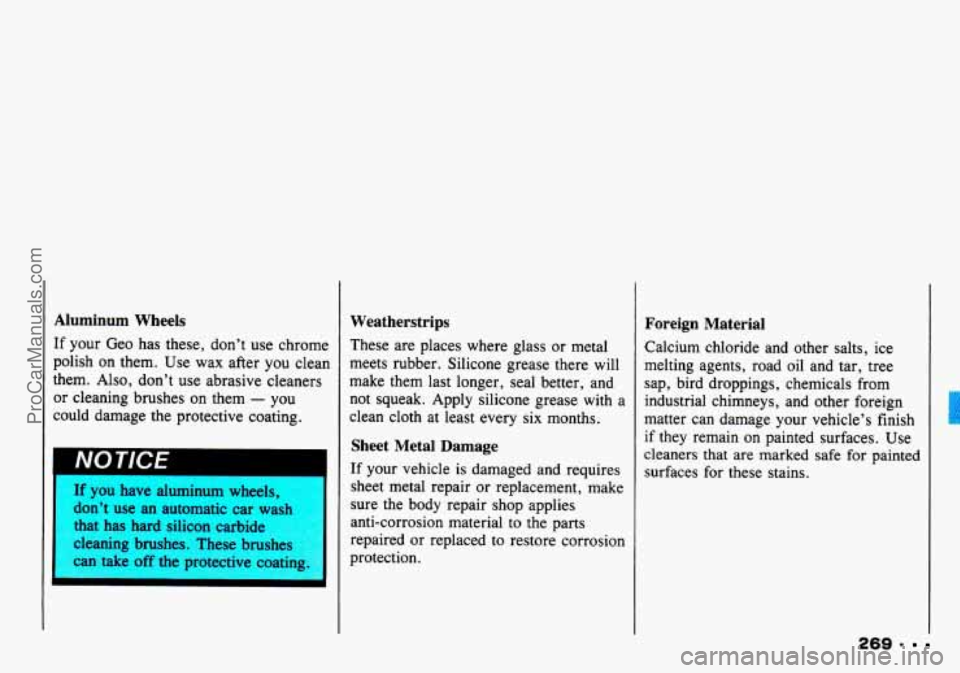
Aluminum Wheels
If your Geo has these, don’t use chrome
polish on them. Use wax after you clean
them. Also, don’t use abrasive cleaners or cleaning brushes on them
- you
could damage the protective coating.
If you have aluminum wheels,
don’t use an automatic car wa:
that has
hard silicon carbide
cleaning brushes. These brushes
can take off the protective coatinl
Weatherstrips
These are places where glass or metal
meets rubber. Silicone grease there will
make them last longer, seal better, and
not squeak. Apply silicone grease with a
clean cloth at least every six months.
Sheet Metal Damage
If your vehicle is damaged and requires
sheet metal repair or replacement, make
sure the body repair shop applies
anti-corrosion material to the parts
repaired or replaced to restore corrosion
protection.
Foreign Material
Calcium chloride and other salts, ice
melting agents, road oil and tar, tree
sap, bird droppings, chemicals from
industrial chimneys, and other foreign
matter can damage your vehicle’s finish
if they remain on painted surfaces. Use
cleaners
that are marked safe for painted
surfaces for these stains.
269
ProCarManuals.com
Page 277 of 339
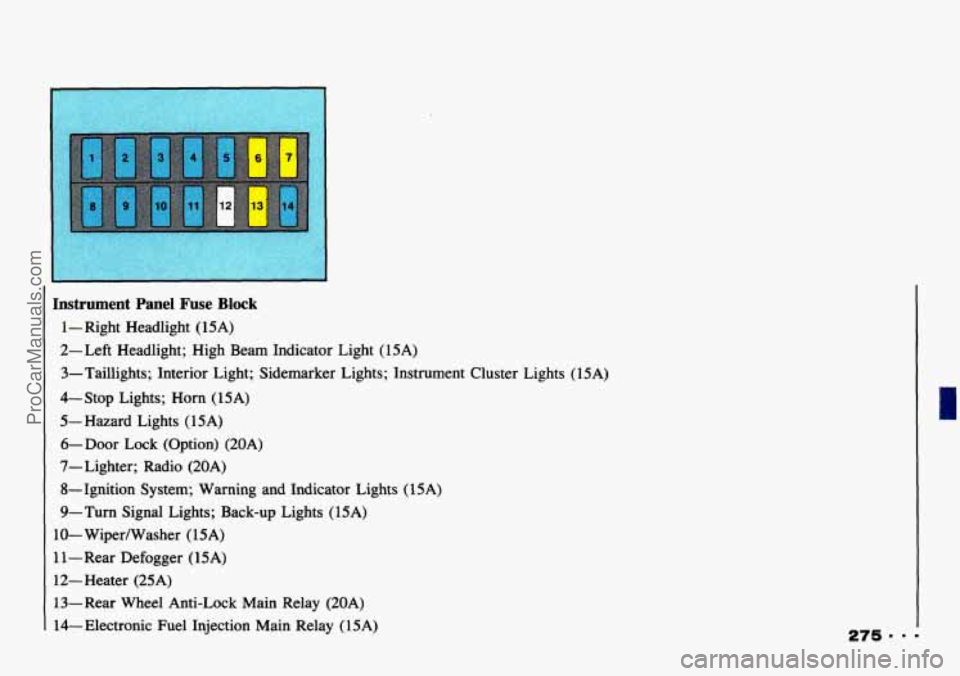
[ Instrument Panel Fuse Block
1 - Right Headlight (15A)
2- Left Headlight; High Beam Indicator Light (1 5A)
3-Taillights; Interior Light; Sidemarker Lights; Instrument Cluster Lights (15A)
4-Stop Lights; Horn (15A)
5- Hazard Lights (15A)
6-Door Lock (Option) (20A)
7- Lighter; Radio (20A)
8-Ignition System; Warning and Indicator Lights (15A)
9-Turn Signal Lights; Back-up Lights (15A)
10- Wiperwasher
(1 SA)
1 1 - Rear Defogger ( 15A)
12-Heater (25A) 13-Rear Wheel Anti-Lock Main Relay (20A)
14-Electronic Fuel Injection Main Relay (15A)
ProCarManuals.com
Page 280 of 339
Service & Appearance Care
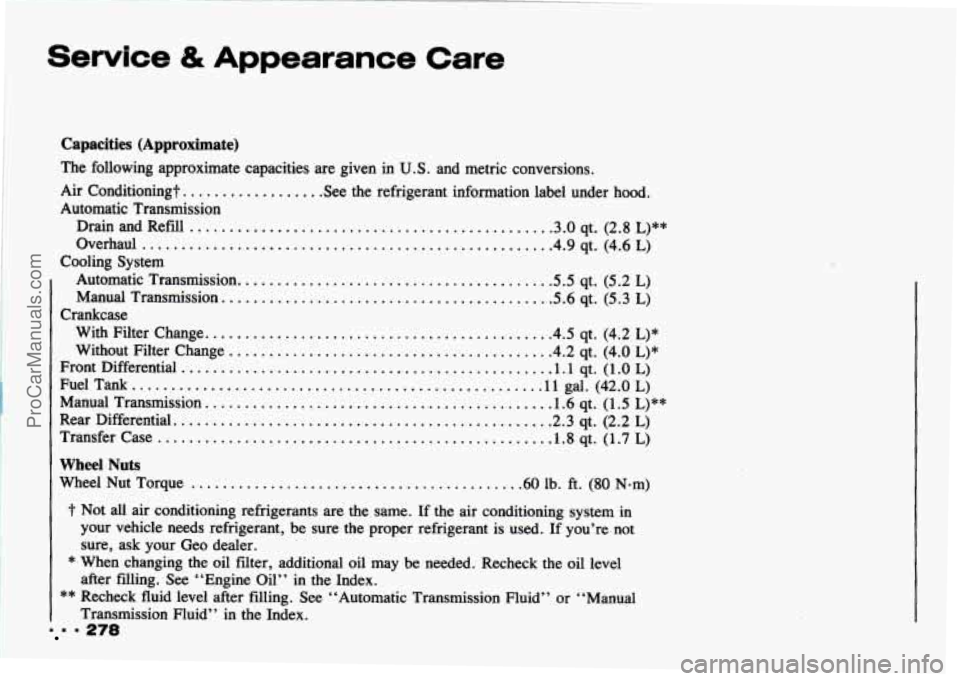
Capacities (Approximate)
The following approximate capacities are given in U.S. and metric conversions.
Automatic Transmission Air
Conditioning?.
................ .See the refrigerant information label under hood.
.............................................
................................................... Drain and Refill .3.0 qt. (2.8 L)**
Overhaul .4.9 qt. (4.6 L)
Cooling System
Automatic Transmission. ...................................... S.5 qt. (5.2 L)
I Manual Transmission. ........................................ S.6 qt. (5.3 L)
FuelT ank....................................................llgal.(42.0L) .
Crankcase
..........................................
........................................
With Filter Change. .4.5 qt. (4.2 L)*
Without Filter Change .4.2 qt. (4.0 L)*
Front Differential ............................................... 1 1 qt. (1 .O L)
Manual Transmission. .1.6 qt. (1.5 L)**
Rear Differential. .2.3 qt. (2.2 L)
Transfer Case .................................................. 1 .8 qt. (1.7 L)
..........................................
..............................................
Wheel Nuts
Wheel Nut Torque .60 lb. ft. (80 N-m)
? Not all air conditioning refrigerants are the same. If the air conditioning system in
your vehicle needs refrigerant, be sure
the proper refrigerant is used. If you’re not
sure, ask your Geo dealer.
after filling.
See “Engine Oil” in the Index.
Transmission Fluid” in the Index.
.........................................
*.When changing the oil filter, additional oil may be needed. Recheck the oil level
** Recheck fluid level after filling. See “Automatic Transmission Fluid” or “Manual
9 278
ProCarManuals.com
Page 281 of 339
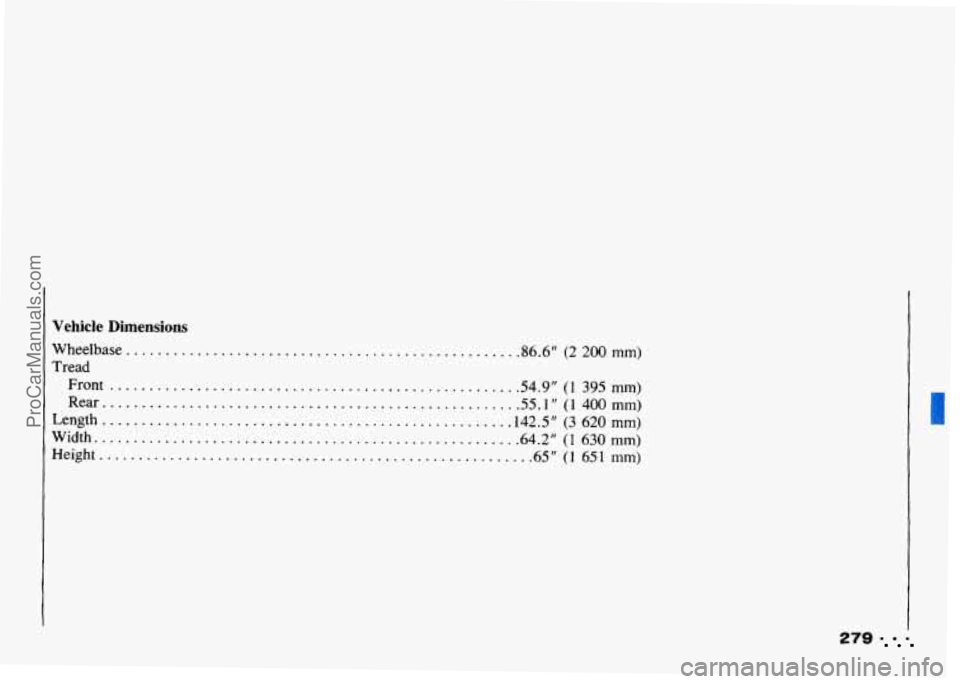
Vehicle Dimensions
Wheelbase. .86.6“ (2 200 mm) ................................................
Tread Front
....................................................54.9” (1 395 mm)
................................................... Rear, .55. I” (1 400 mm)
Length
....................................................14 2.5” (3 620mm)
Width. .64.2“ (1 630 mm)
Height. .65” (1 651 mm)
.................................................... ...................................................
279
ProCarManuals.com
Page 293 of 339
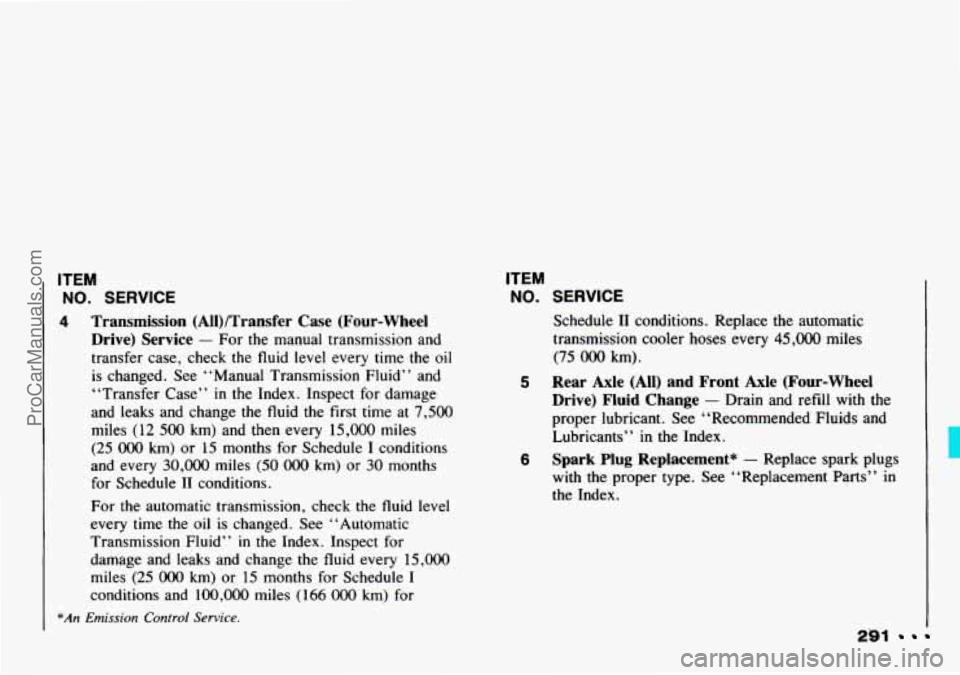
ITEM
NO. SERVICE
4 Transmission (AlI)/Transfer Case (Four-wheel
Drive) Service
- For the manual transmission and
transfer case, check the fluid level every
time the oil
is changed. See “Manual Transmission Fluid” and
“Transfer Case”
in the Index. Inspect for damage
and leaks and change the fluid the first time at
7,500
miles (12 500 km) and then every 15,000 miles
(25 000 km) or 15 months for Schedule I conditions
and every
30,000 miles (50 OOO km) or 30 months
for Schedule
I1 conditions.
For the automatic transmission, check the fluid level
every time the oil is changed. See “Automatic
Transmission Fluid”
in the Index. Inspect for
damage and leaks and change the
fluid every 15,000
miles (25 OOO km) or 15 months for Schedule I
conditions and
100,OOO miles (166 000 km) for
*An Emission Control Service.
ITEM
NO. SERVICE
Schedule I1 conditions. Replace the automatic
transmission cooler hoses every
45,000 miles
(75 000 km).
5 Rear Axle (All) and Front Axle (Four-wheel
Drive) Fluid Change
- Drain and refill with the
proper lubricant. See “Recommended Fluids and
Lubricants”
in the Index.
6 Spark Plug Replacement* - Replace spark plugs
with the proper type. See “Replacement Parts’’ in
the Index.
291
ProCarManuals.com
Page 298 of 339
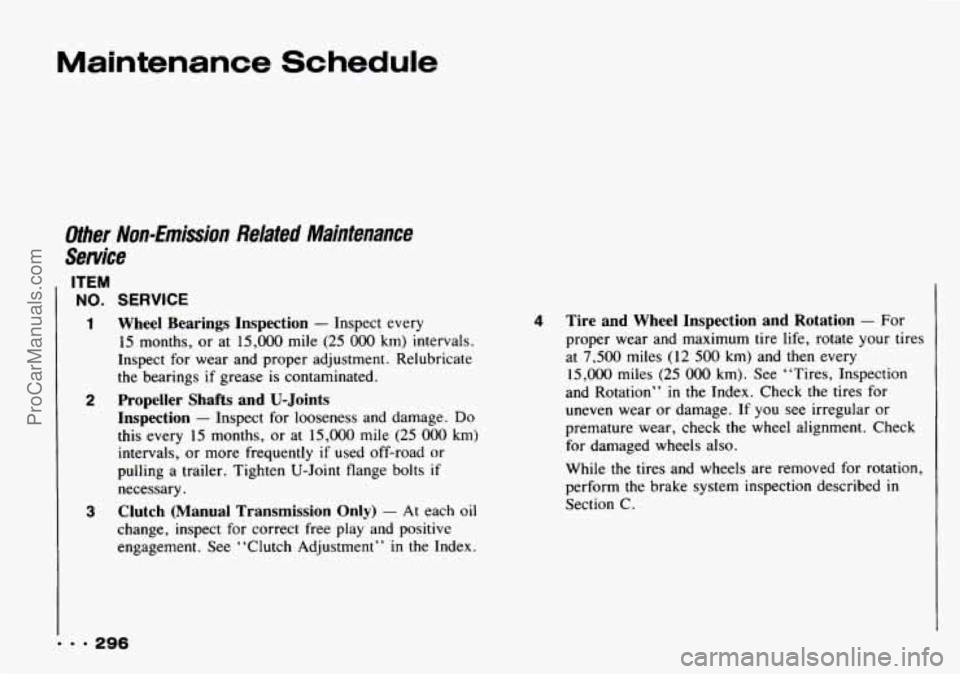
NO.
1
2
3
SERVICE
Wheel Bearings Inspection - Inspect every
15 months, or at 15,000 mile (25 OOO km) intervals.
Inspect for wear and proper adjustment. Relubricate
the bearings
if grease is contaminated.
Propeller Shafts and U-Joints
Inspection
- Inspect for looseness and damage. Do
this every 15 months, or at 15,000 mile (25 000 km)
intervals, or more frequently if used off-road or
pulling a trailer. Tighten U-Joint flange bolts if
necessary.
Clutch (Manual Transmission Only) - At each oil
change, inspect for correct free play and positive
engagement. See “Clutch Adjustment’’
in the Index.
Maintenance Schedule
Uther Nun-Emissun Related Maintenance
Service
ITEM
4 Tire and Wheel Inspection and Rotation - For
proper wear and maximum tire life, rotate your tires
at
7,500 miles (12 500 km) and then every
15 ,OOO miles (25 OOO km). See “Tires, Inspection
and Rotation”
in the Index. Check the tires for
uneven wear or damage. If you see irregular or
premature wear, check the wheel alignment. Check
for damaged wheels also.
While the tires and wheels are removed for rotation,
perform
the brake system inspection described in
Section C.
ProCarManuals.com
Page 299 of 339
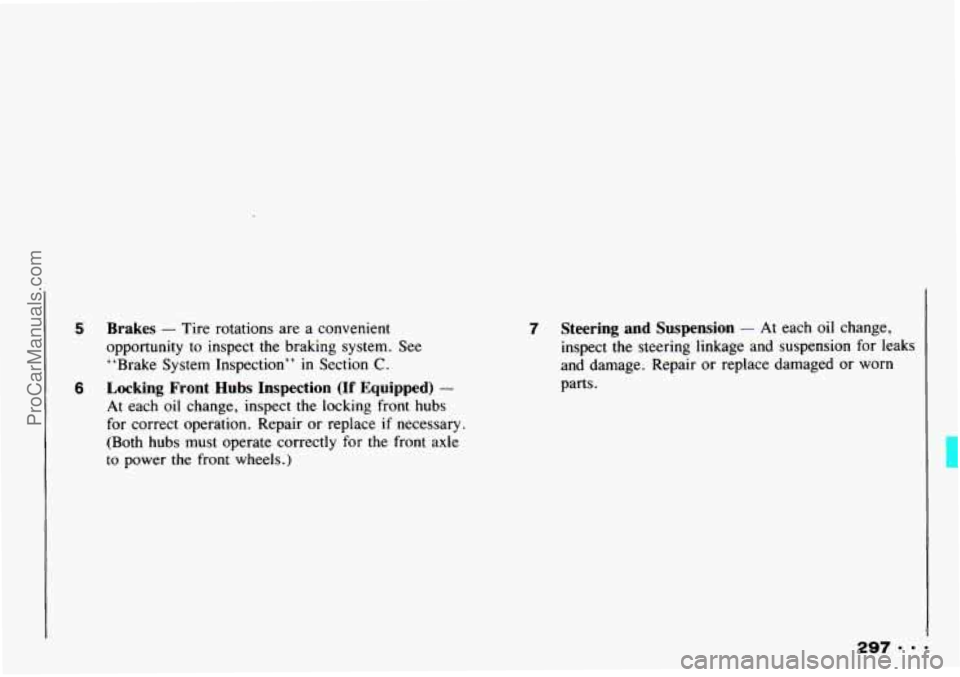
5
6
Brakes - Tire rotations are a convenient
opportunity
to inspect the braking system. See
“Brake System Inspection”
in Section C.
Locking Front Hubs Inspection (If Equipped) -
At each oil change, inspect the locking front hubs
for correct operation. Repair or replace
if necessary.
(Both hubs must operate correctly for the front axle
to power
the front wheels.)
7 Steering and Suspension - At each oil change,
inspect the steering linkage and suspension for leaks
and damage. Repair or replace damaged or worn
parts.
ProCarManuals.com
Page 304 of 339
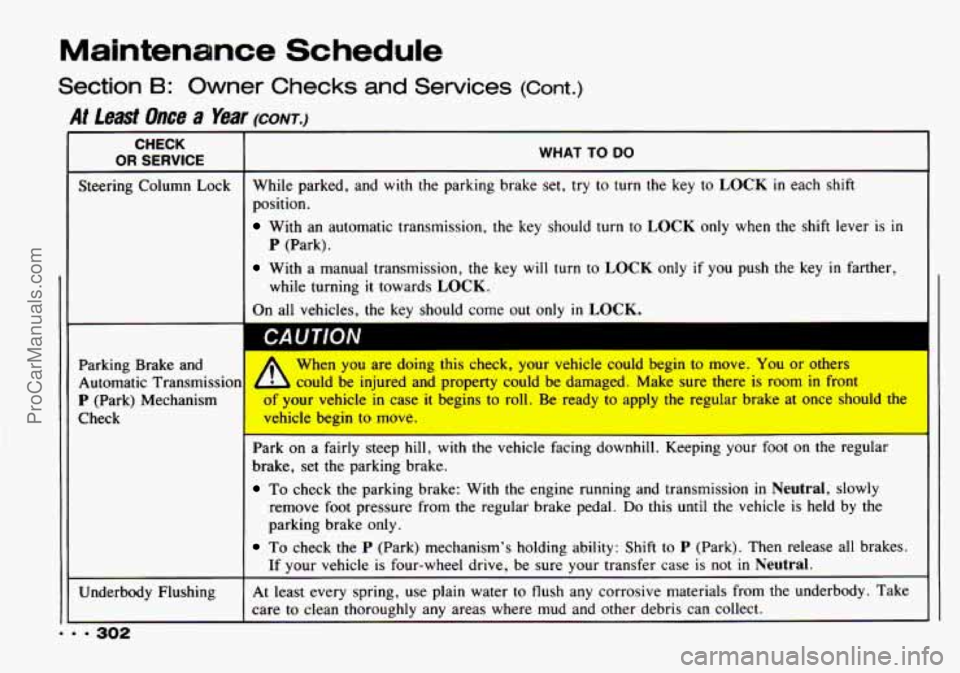
Maintenance Schedule
Section B: Owner Checks and Services (Cont.)
At Least Once a Year (CONT.)
CHECK
OR SERVICE I WHAT TO DO
Steering Column Lock While
parked, and with the parking brake set, try to turn the key to LOCK in each shift
position.
With an automatic transmission, the key should turn to LOCK only when the shift lever is in
With a manual transmission, the key will turn to LOCK only if you push the key in farther,
On all vehicles, the key should come out only
in LOCK.
P (Park).
while turning
it towards LOCK.
Parking Brake and
Automatic Transmission
P (Park) Mechanism
Check
Underbody Flushing When
you are doing this check, your vehicle could begin to move. You or others
could be injured and property could be damaged. Make sure there is room
in front
VI your vehicle in case it begins to roll. Be ready to apply the regular brake at once should the
Park
on a fairly steep hill, with the vehicle facing downhill. Keeping your foot on the regular
brake, set the parking brake.
To check the parking brake: With the engine running and transmission in Neutral, slowly
remove foot pressure from the regular brake pedal.
Do this until the vehicle is held by the
parking brake only.
To check the P (Park) mechanism’s holding ability: Shift to P (Park). Then release all brakes.
If your vehicle is four-wheel drive, be sure your transfer case is not in Neutral.
At least every spring, use plain water to flush any corrosive materials from the underbody. Take
care to clean thoroughly any areas where mud and other debris can collect.
ProCarManuals.com
Page 305 of 339
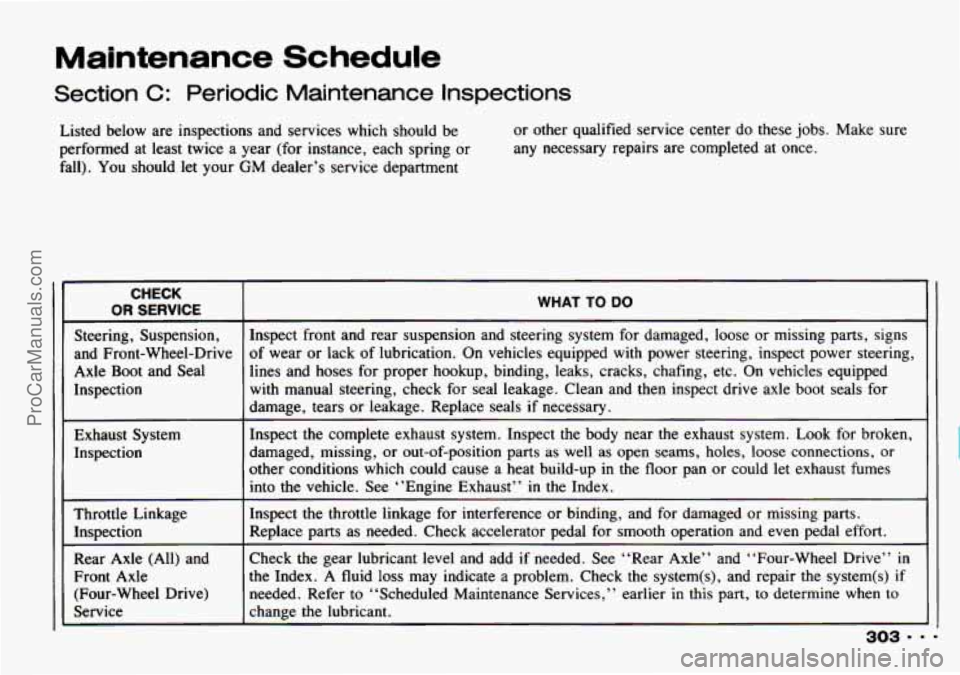
Maintenance Schedule
Section C: Periodic Maintenance Inspections
Listed below are inspections and services which should be
performed at least twice a year (for instance, each spring or
fall). You should let your
GM dealer’s service department or
other qualified service center do these
jobs. Make sure
any necessary repairs are completed at once.
CHECK
I OR SERVICE WHAT TO DO
Steering, Suspension,
and Front-Wheel-Drive
Axle Boot and Seal
Inspection
Exhaust System
Inspection
Throttle Linkage
Inspection
Rear Axle (All) and
Front Axle
(Four-wheel Drive)
Service ~ Inspect front and rear suspension and steering system for damaged, loose or missing parts, signs
of wear or lack of lubrication. On vehicles equipped with power steering, inspect power steering,
lines and hoses for proper hookup, binding, leaks, cracks, chafing, etc. On vehicles equipped
with manual steering, check
for seal leakage. Clean and then inspect drive axle boot seals for
damage, tears or leakage. Replace seals
if necessary.
Inspect the complete exhaust system. Inspect the body near the exhaust system. Look for broken,
damaged, missing,
or out-of-position parts as well as open seams, holes, loose connections, or
other conditions which could cause a heat build-up in the floor pan or could let exhaust fumes
into the vehicle. See “Engine Exhaust’’
in the Index.
Inspect the throttle linkage for interference or binding, and for damaged or missing parts.
Replace parts as needed. Check accelerator pedal for smooth operation and even pedal effort.
Check the gear lubricant level and add if needed. See “Rear Axle’’ and ‘‘Four-wheel Drive’’
in
the Index. A fluid loss may indicate a problem. Check the system(s), and repair the system(s) if
needed. Refer to “Scheduled Maintenance Services,” earlier in this part, to determine when to
change
the lubricant.
ProCarManuals.com
Page 306 of 339
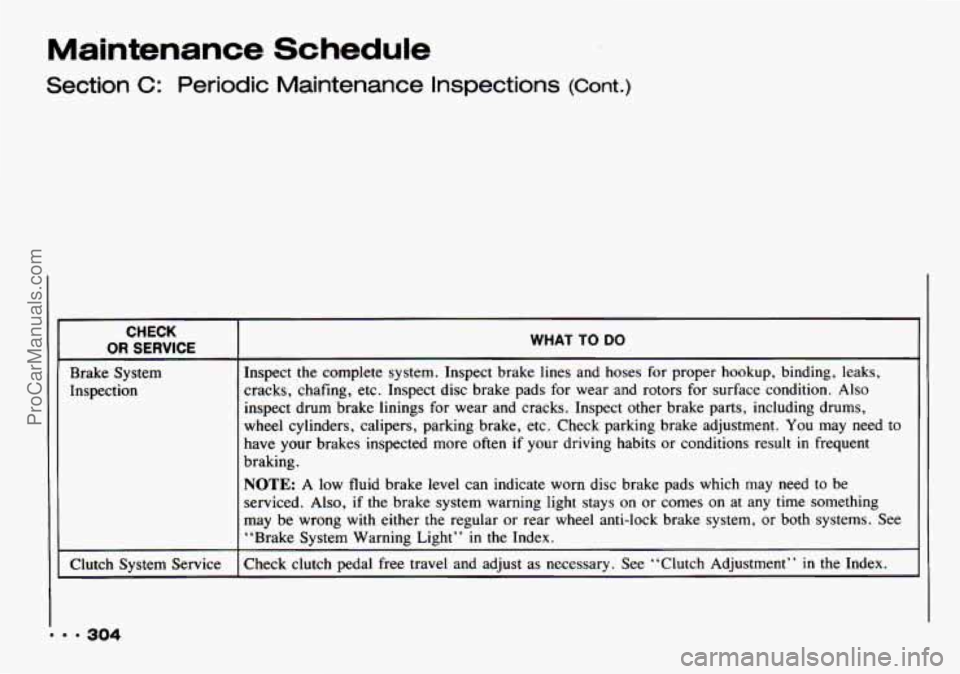
Maintenance Schedule
Section C: Periodic Maintenance Inspections (Cont.)
CHECK
OR SERVICE
Brake System
Inspection
Clutch System Service
~
WHAT TO DO
Inspect the complete system. Inspect brake lines and hoses for proper hookup, binding, leaks,
cracks, chafing, etc. Inspect disc brake pads for wear and rotors for surface condition.
Also
inspect drum brake linings for wear and cracks. Inspect other brake parts, including drums,
wheel cylinders, calipers, parking brake, etc. Check parking brake adjustment.
You may need to
have your brakes inspected more often if your driving habits or conditions result in frequent
braking.
NOTE: A low fluid brake level can indicate worn disc brake pads which may need to be
serviced. Also,
if the brake system warning light stays on or comes on at any time something
may be wrong with either the regular or rear wheel anti-lock brake system, or both systems. See
“Brake Svstem Warning Light” in the Index.
Check clutch pedal free travel and adjust as necessary. See “Clutch Adjustment”
in the Index.
ProCarManuals.com