door lock CHEVROLET TRACKER 1993 Owners Manual
[x] Cancel search | Manufacturer: CHEVROLET, Model Year: 1993, Model line: TRACKER, Model: CHEVROLET TRACKER 1993Pages: 339, PDF Size: 15.75 MB
Page 26 of 339
Seats & Safety Belts
I
9.924
First, you’ll want to know which
restraint systems your vehicle has.
We’ll start
with the driver position.
Driver Position
This section describes the driver’s
restraint system.
1
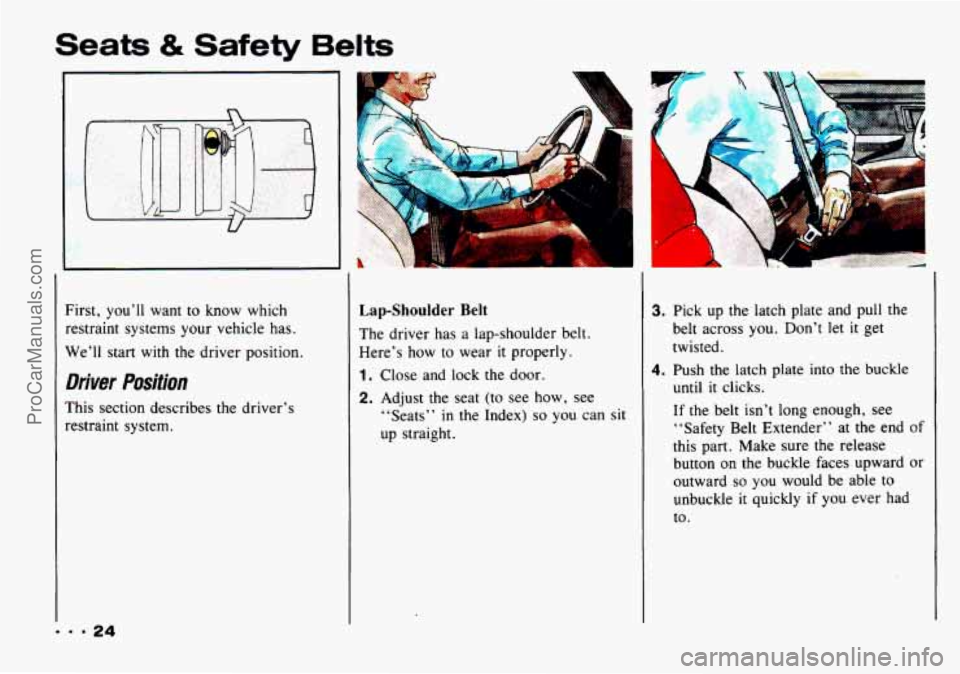
Lap-Shoulder Belt
The driver has a lap-shoulder belt.
Here’s how
to wear it properly.
1. Close and lock the door.
2. Adjust the seat (to see how, see
“Seats” in the Index)
so you can sit
up straight.
Y
3. Pick up the latch plate and pull the
belt across
you. Don’t let it get
twisted.
4. Push the latch plate into the buckle
until it clicks.
If
the belt isn’t long enough, see
“Safety Belt Extender” at the end
of
this part. Make sure the release
button on the buckle faces upward or
outward
so you would be able to
unbuckle
it quickly if you ever had
to.
ProCarManuals.com
Page 45 of 339
Here you can learn about the
many standard and optional
features on your Geo. and
information on starting. shifting
and braking
. Also explained are
the instrument panel and the
warning systems that tell you
if
everything is working properly -
and what to do if you have a
problem
.
Part 2
Features & Controls
Keys ................................................................ 44
Door Locks
.......................................................... 45
Theft
................................................................ 47
New Vehicle “Break-In”
............................................... 48
Ignitionswitch ....................................................... 48
Starting Your Engine .................................................. 49
Driving through Deep Standing Water
.................................... 50
Five-Speed Manual Transmission ........................................ 54
Parking
.............................................................. 60
EngineExhaust ....................................................... 64
Automatic Transmission
................................................ 51
Four-wheel Drive
..................................................... 57
Windows
............................................................ 66
Horn
................................................................ 67
Tiltwheel ........................................................... 67
The Turn Signal/Lights Control/Headlight Beam Lever
...................... 67
Interior Lights
........................................................ 71
Windshield Wiper/Washer Lever
........................................ 72
Rear Window Wiper/Washer ............................................ 73
Mirrors .............................................................. 74
Storage and Compartments ............................................. 75
SunVisors ........................................................... 76
Passenger Assist Grips
................................................. 76
Ashtrays and Lighter .................................................. 77
Instrument Panel and Clusters
........................................... 80
Warning Lights, Gages and Indicators .................................... 82
ConvertibleTop ...................................................... 87
43.-
ProCarManuals.com
Page 46 of 339
Features & Controls
1 I Keys
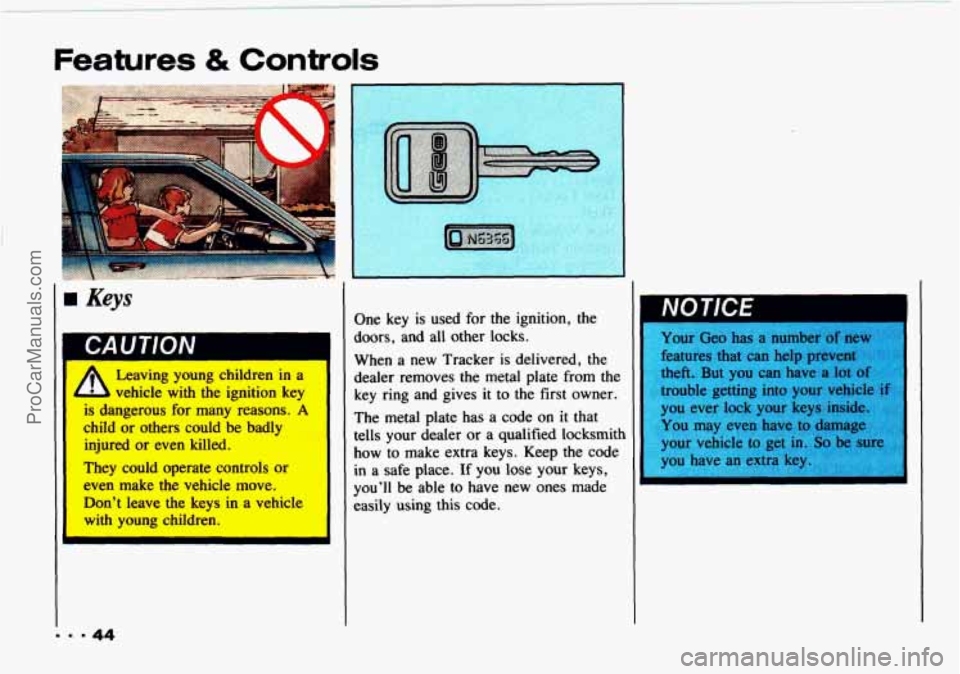
Leaving young children in a
vehicle with the ignition key
I
is dangerous for many reasons. A
child or others could be badly
injured or even killed.
They could operate controls or
even make the vehicle move.
Don’t leave the keys in a vehicle
with young children. One key is used
for the ignition, the
doors, and all other locks.
When a new Tracker is delivered, the
dealer removes the metal plate from the key ring and gives
it to the first owner.
The metal plate has a code
on it that
tells your dealer
or a qualified locksmith
how to make extra keys. Keep the code
in a safe place. If you lose your keys,
you’ll be able to have new ones made easily using this code.
ProCarManuals.com
Page 47 of 339
H Door Locks
Passengers - especially children
- can easily open the doors and
fall out. When a door is Iocked,
the inside handle won’t open it.
Outsiders can easily enter through
an unlocked door when you slow
down or stop your vehicle.
This may not be so obvious: You
increase the! chance of being
thrown out of the vehicle in a
crash if tbe doors aren’t locked.
Wear safety belts properly, lock
your doors, and you will be far
better off whenever yw drive your
vehicle. 1
I
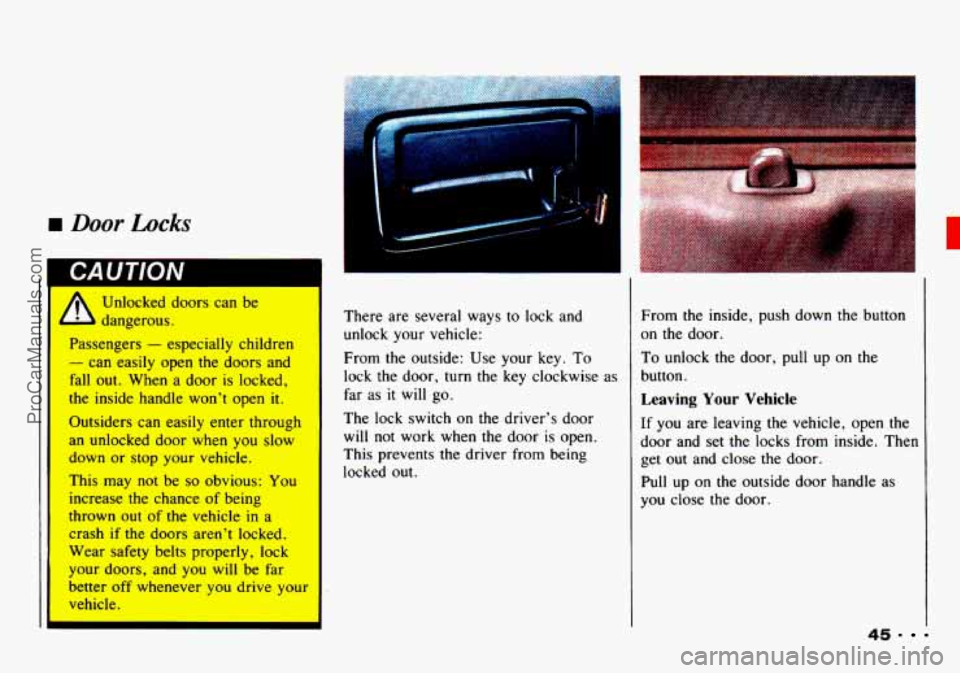
There are several ways to lock and
unlock your vehicle:
From
the outside: Use your key. To
lock the door, turn the key clockwise as
far as
it will go.
The lock switch on the driver’s door
will not work when the door is open.
This prevents the driver from being
locked out.
From the inside, push down the button
on the door.
To unlock the door, pull up on the
button.
Leaving Your Vehicle
If you are leaving the vehicle, open the
door and set the locks from inside. Then
get out and close the door.
Pull
up on the outside door handle as
you close the door.
45. -
ProCarManuals.com
Page 49 of 339
meft
Vehicle theft is big business, especially
in some cities. Although your Geo has a
number of theft-deterrent features, we
know that nothing we put on it can make
it impossible to steal. However, there
are ways you can help. Key in the Ignition: If you walk away
from your vehicle
with the key inside,
it’s
an easy target for joy riders or
professional thieves
- so don’t do it.
When you park your Geo and open the
driver’s door, you’ll hear a chime
reminding
you to remove your key from
the ignition and take it with you. Always
do this. Your steering wheel will be
locked,
and so will your ignition. If you
have an automatic transmission, taking
your key out also locks your
transmission. And remember to lock the
doors.
Parking at Night: Park in a lighted
spot, close all windows and lock your
vehicle. Remember
to keep your
valuables out
of sight. Put them in a
storage area, or take them with you.
47. =
ProCarManuals.com
Page 50 of 339
Features & Controls
New Vehicle
“Break-In ’’
Your modern Geo doesn’t need an
:laborate “break-in.” But it will
perform better in the long
1
1 follow these guideli~
A
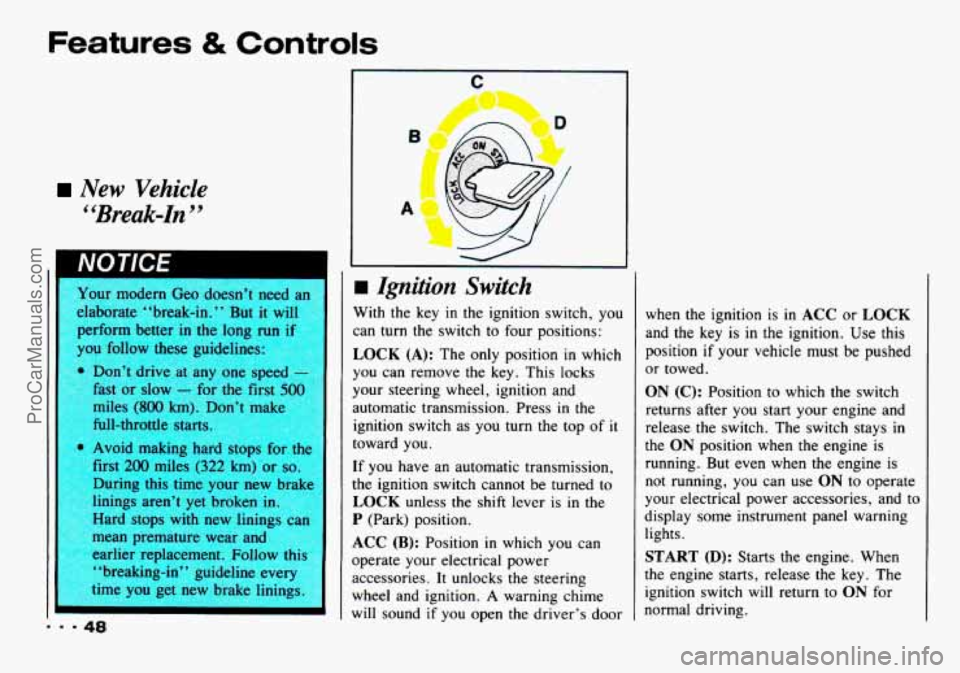
m Ignition Switch
With the key in the ignition switch, you
can turn the switch to four positions:
LOCK (A): The only position in which
you can remove the key. This locks
your steering wheel, ignition and
automatic transmission. Press
in the
ignition switch as you turn the top of it
toward you.
If you have an automatic transmission,
the ignition switch cannot be turned to
LOCK unless the shift lever is in the
P (Park) position.
ACC (B): Position in which you can
operate your electrical power accessories. It unlocks the steering
wheel and ignition.
A warning chime
will sound if you open the driver’s door when the ignition is
in ACC or LOCK
and the key is in the ignition.
Use this
position if your vehicle must be pushed
or towed.
ON (C): Position to which the switch
returns after you start your engine and
release the switch. The switch stays in
the
ON position when the engine is
running. But even when the engine is not running, you can use
ON to operate
your electrical power accessories, and to
display some instrument panel warning
lights.
START (D): Starts the engine. When
the engine starts, release the key. The
ignition switch will return to
ON for
normal driving.
ProCarManuals.com
Page 77 of 339
..
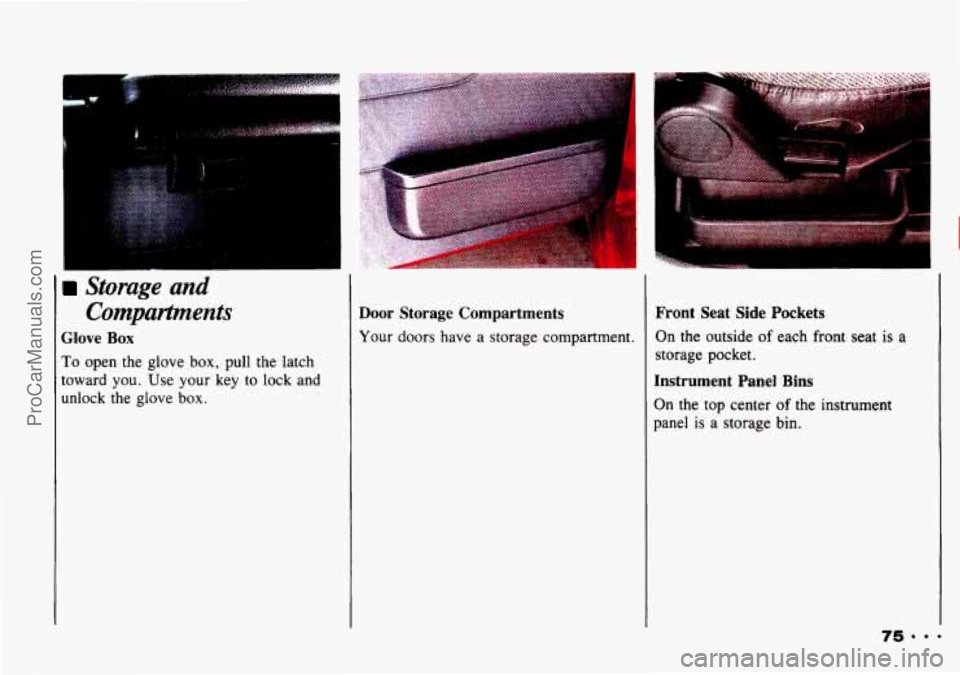
>torage and Compartpnents
Glove Box
To open the glove box, pull the latch
toward you. Use
your key to lock and
unlock the glove
box.
Door Storage Compartments
Your doors have a storage compartment.
Front Seat Side Pockets
On the outside of each front seat is a
storage pocket.
Instrument Panel Bins
On the top center of the instrument
panel
is a storage bin.
ProCarManuals.com
Page 228 of 339
Service & Appearance Care
Filling Your Tank
bA u 1 lU/V
1 Gasoline vapor is highly
and that can cause very bad
injuries. Don’t smoke if you’re
near gasoline
or refueling your
vehicle. Keep sparks,
flames, and
smoking materials away
from
gasoline. flammable.
It bums violently,
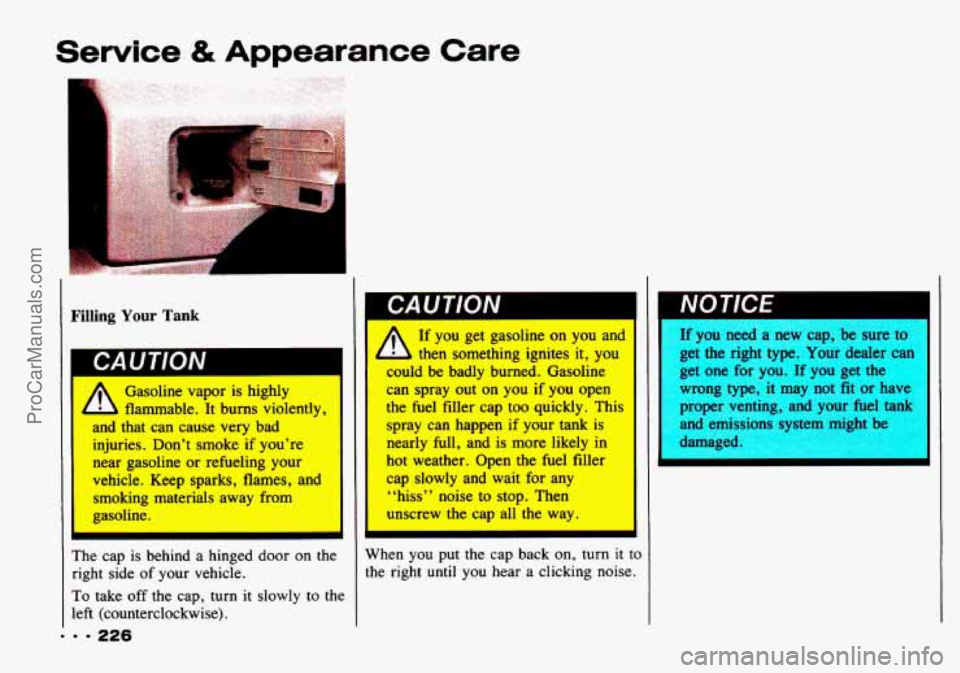
The cap is behind a hinged door on the
right side of your vehicle.
To take off the cap, turn
it slowly to the
left (counterclockwise).
... 226
I
I
If you get gasoline on you and
then something ignites it, you
could be badly burned. Gasoline
can spray out on you if you open
the fuel filler cap too quickly. This
spray can happen if your tank is
nearly full, and is more likely in
hot weather. Open the
fuel filler
cap slowly and wait for any
“hiss” noise to stop. Then
unscrew the cap all the way.
When you put the cap back on, turn it to
the right until you hear a clicking noise.
NU I ILt
If you need a new cap, be sure to
get the right type.
Your dealer can
get one
for you. If you get the
wrong type, it may not fit
or have
proper venting, and your fuel
tank
and emissions system IT ‘It be
damal ‘ ~
‘
ProCarManuals.com
Page 254 of 339
Service & Appearance Care
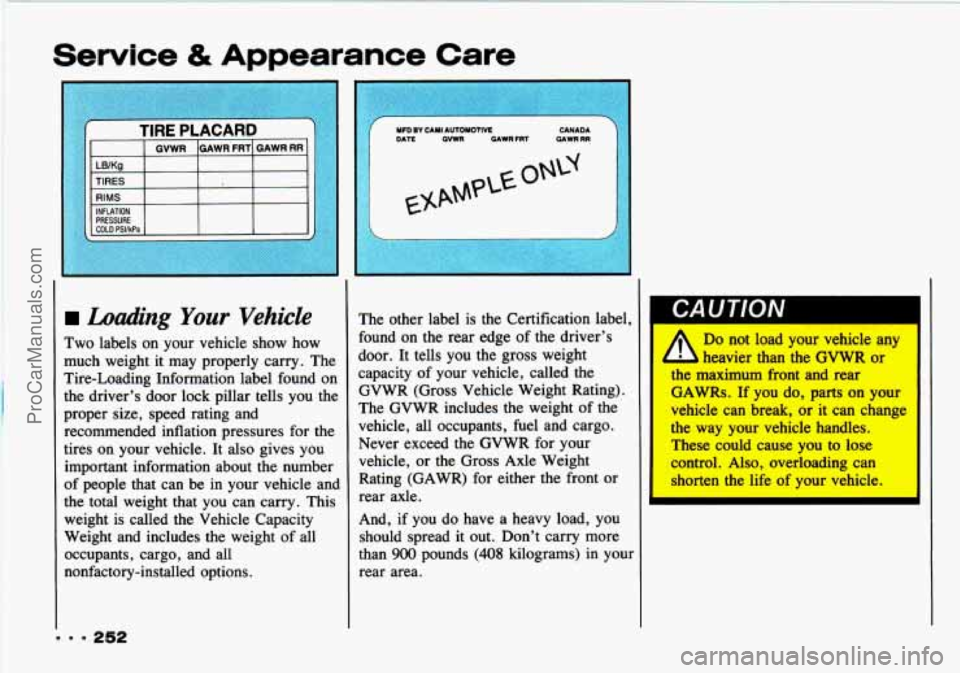
Loading Your Vehicle
Two labels on your vehicle show how
much weight
it may properly carry. The
Tire-Loading Information label found on
the driver’s door lock pillar tells you the
proper size, speed rating and
recommended inflation pressures for the
tires on your vehicle. It also gives you
important information about the number
of people that can be in your vehicle and
the total weight that you can carry. This
weight is called the Vehicle Capacity
Weight and includes the weight of all
occupants, cargo, and all
nonfactory-installed options. The other
label is the Certification label,
11
found on the rear edge of the driver’s
door. It tells you the gross weight
capacity of your vehicle, called the
GVWR (Gross Vehicle Weight Rating).
The GVWR includes the weight of the
vehicle, all occupants, fuel and cargo.
Never exceed the GVWR for your
vehicle, or the Gross Axle Weight
Rating (GAWR) for either the front or
rear axle.
And, if you do have a heavy load, you
should spread it out. Don’t carry more
than
900 pounds (408 kilograms) in your
rear area.
1
CAUTION
Do not load your vehicle any
heavier than the GVWR or
the
maximum front and rear I
GAWRs. If you do, parts on you]
vehicle can break, or it can chang
the way your vehicle handles.
These could cause you to lose
control. Also, overloading can
shorten the life of your vehicle.
ProCarManuals.com
Page 256 of 339
Service & Appearance Care
A
Poorly maintained and improperly used tires are dangerous.
9 Overloading your tires can cause overheating as a result of too much
friction. You could have an air-out and a serious accident. See “Loading
Your Vehicle” in the Index.
resulting accident could cause serious injury. Check all tires frequently to
maintain the recommended pressure. Tire pressure should be checked
when
the tires are cold.
Overinflated tires are more likely to be cut, punctured, or broken by a
sudden impact, such as when you hit a pothole. Keep tires at the
recommended pressure.
your tires have been damaged, replace them.
the correct high speed rated tires.
* Underinflated tires pose the same danger as overloaded tires. The
Worn, old tires can cause accidents. If your tread is badly worn, or if
Don’t drive over 85 mph (135 kmh) even if it’s legal, unless you have
Inflation - Tire Pressure
The Tire-Loading Information label
which
is on the driver’s door lock pillar
shows the correct inflation pressures for
your tires, when they’re cold. “Cold”
means your vehicle has been sitting
for
at least three hours or driven no more
than a mile.
9 254
ProCarManuals.com