turn signal CHEVROLET TRACKER 1993 Owners Manual
[x] Cancel search | Manufacturer: CHEVROLET, Model Year: 1993, Model line: TRACKER, Model: CHEVROLET TRACKER 1993Pages: 339, PDF Size: 15.75 MB
Page 10 of 339
How to Use this Manual
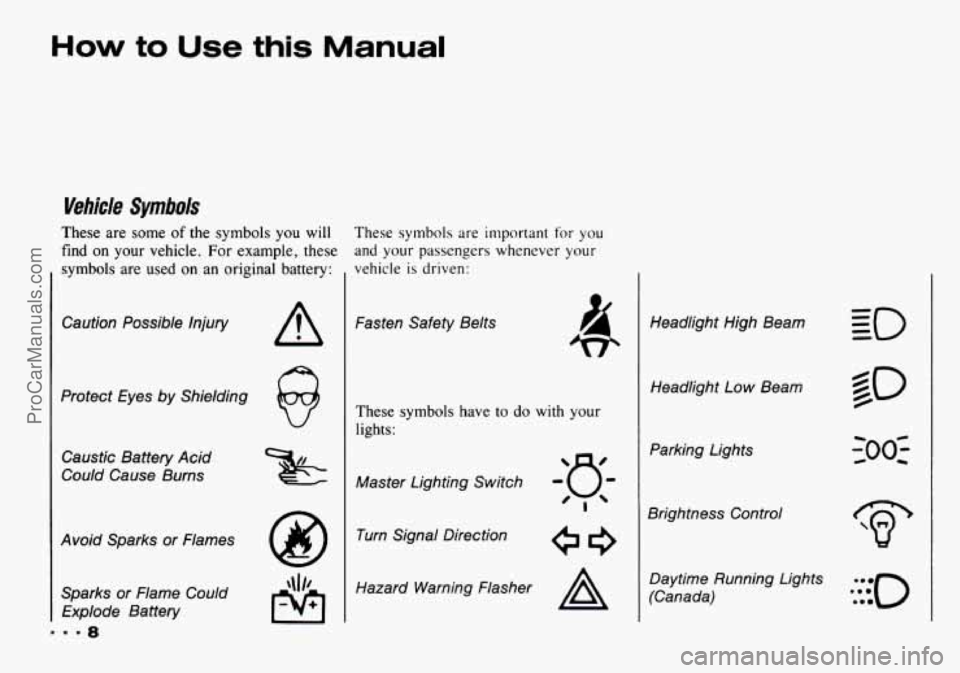
Vehicle Symbols
These are some of the symbols you will
find on your vehicle. For example, these
symbols are used
on an original battery:
Caution Possible injury
Protect Eyes by Shielding
Caustic Battery Acid
Could Cause Burns
Avoid Sparks or Flames
Sparks
or Flame Could
Explode Battery
These symbols are important for you
and your passengers whenever your
vehicle
is driven:
Fasten Safety Belts
i
These symbols have to do with your
lights:
Master Lighting Switch
Turn Signal Direction
Hazard Warning Flasher
A
Headlight High Beam
Headlight
Low Beam
Parking Lights
Brightness Control
5a ytime Running Lights
(Canada)
ProCarManuals.com
Page 45 of 339
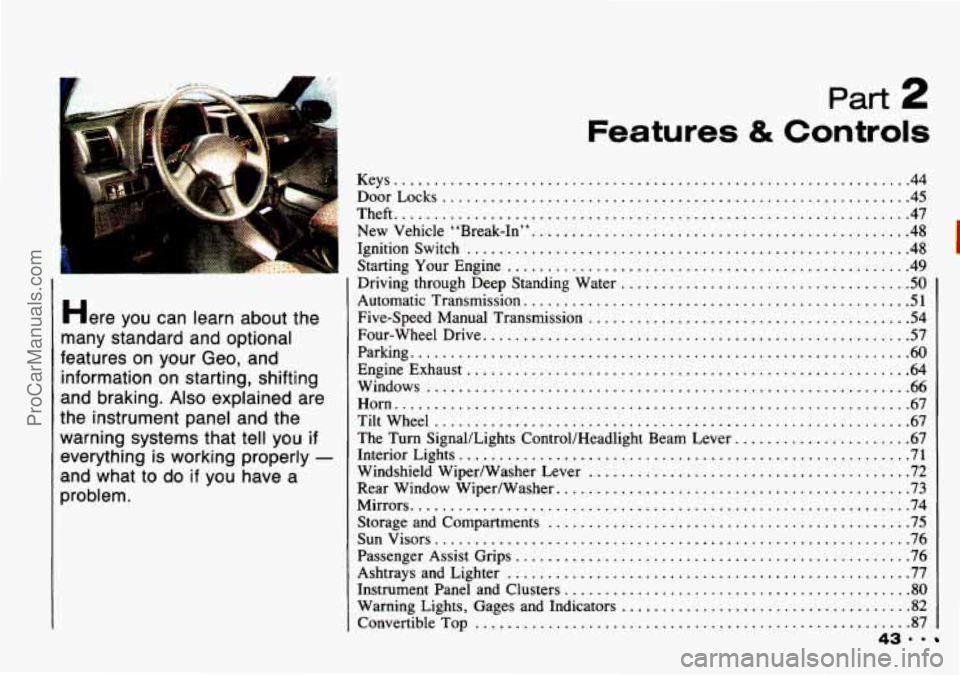
Here you can learn about the
many standard and optional
features on your Geo. and
information on starting. shifting
and braking
. Also explained are
the instrument panel and the
warning systems that tell you
if
everything is working properly -
and what to do if you have a
problem
.
Part 2
Features & Controls
Keys ................................................................ 44
Door Locks
.......................................................... 45
Theft
................................................................ 47
New Vehicle “Break-In”
............................................... 48
Ignitionswitch ....................................................... 48
Starting Your Engine .................................................. 49
Driving through Deep Standing Water
.................................... 50
Five-Speed Manual Transmission ........................................ 54
Parking
.............................................................. 60
EngineExhaust ....................................................... 64
Automatic Transmission
................................................ 51
Four-wheel Drive
..................................................... 57
Windows
............................................................ 66
Horn
................................................................ 67
Tiltwheel ........................................................... 67
The Turn Signal/Lights Control/Headlight Beam Lever
...................... 67
Interior Lights
........................................................ 71
Windshield Wiper/Washer Lever
........................................ 72
Rear Window Wiper/Washer ............................................ 73
Mirrors .............................................................. 74
Storage and Compartments ............................................. 75
SunVisors ........................................................... 76
Passenger Assist Grips
................................................. 76
Ashtrays and Lighter .................................................. 77
Instrument Panel and Clusters
........................................... 80
Warning Lights, Gages and Indicators .................................... 82
ConvertibleTop ...................................................... 87
43.-
ProCarManuals.com
Page 69 of 339

H Horn
To sound the horn, press the horn
symbol on your steering wheel.
I Tilt meel (OPTION)
1 tilt steerng wheel allows you to adjust
he steering wheel before you drive.
lou can also raise it to the highest level
o give your legs more room when you
:xit and enter the vehicle.
?o tilt the wheel, hold the steering
vheel and lower the lever. Move the
teering wheel
to a comfortable level,
hen raise the lever to its highest
losition to lock the wheel in place.
H I;he Turn SignaULights
CoPttrolHeadlight Beam
Lever
The lever on the left side of the steering
column includes your:
Turn Signal and Lane Change
Headlight High/Low Beam and
Indicator
Passing Signal
Lighting Operation
67
c
ProCarManuals.com
Page 70 of 339
Features & Controls
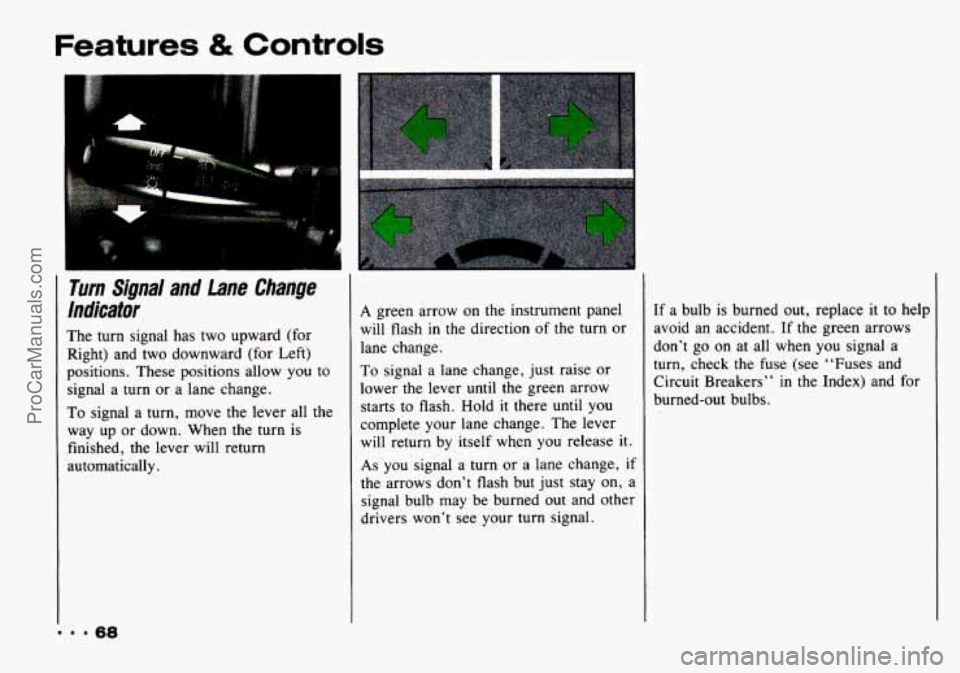
Turn Signal and lane Change
lndicator
The turn signal has two upward (for
Right) and two downward (for Left)
positions. These positions allow you to
signal a turn or a lane change.
To signal a turn, move the lever all the
way
up or down. When the turn is
finished, the lever will return
automatically.
A green arrow on the instrument panel
will flash in the direction of the turn or
lane change.
To signal a lane change, just raise or
lower the lever until the green arrow
starts to flash. Hold
it there until you
complete your lane change. The lever
will return by itself when you release it.
As you signal a turn or a lane change, if
the arrows don’t flash but just stay on, a
signal bulb may be burned out and other
drivers won’t see your turn signal. If
a bulb is burned out, replace it
to help
avoid an accident. If the green arrows
don’t go on at all when you signal a
turn, check the fuse (see “Fuses and
Circuit Breakers’’
in the Index) and for
burned-out bulbs.
ProCarManuals.com
Page 72 of 339
Features & Controls
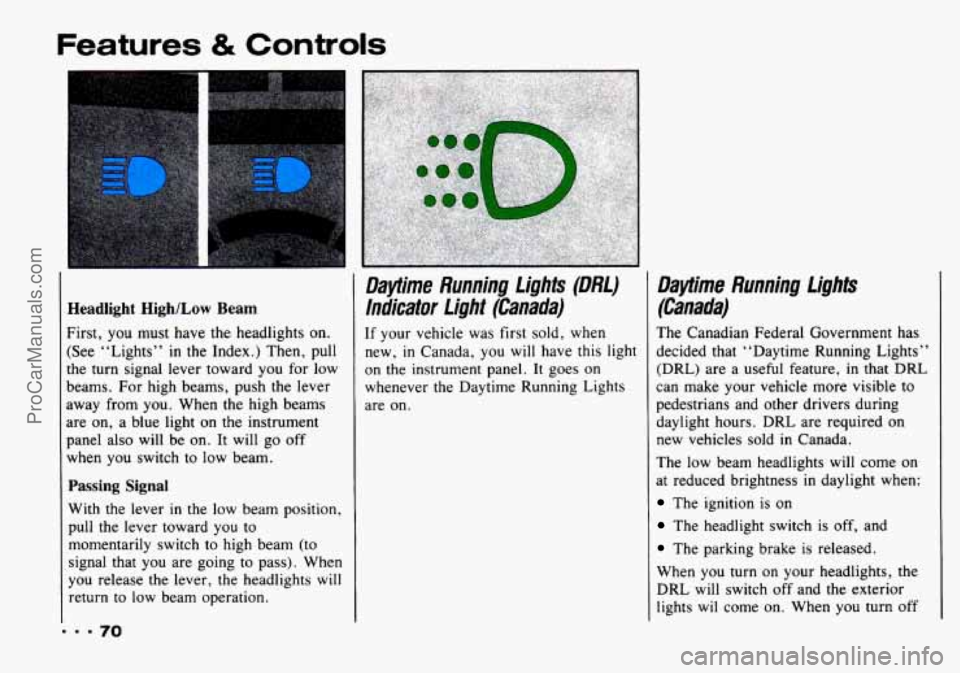
Headlight High/Low Beam
First, you must have the headlights on.
(See “Lights”
in the Index.) Then, pull
the turn signal lever toward you for low
beams. For high beams, push the lever
away from you. When the high beams
are on, a blue light on the instrument
panel also will be on. It will go off
when you switch
to low beam.
Passing Signal
With the lever in the low beam position,
pull the lever toward you to
momentarily switch to high beam (to
signal that you are going to pass). When
you release the lever, the headlights will
return to low beam operation.
Daytime Running fights (DM)
lndicator Light (Canada)
If your vehicle was first sold, when
new,
in Canada, you will have this light
on the instrument panel. It goes on whenever the Daytime Running Lights
are on.
Daytime Running f ights
(Canada)
The Canadian Federal Government has
decided that “Daytime Running Lights”
(DRL) are a useful feature, in that DRL
can make your vehicle more visible to
pedestrians and other drivers during
daylight hours. DRL are required
on
new vehicles sold in Canada.
The low beam headlights will come on
at reduced brightness
in daylight when:
The ignition is on
The headlight switch is off, and
The parking brake is released.
When you turn on your headlights, the
DRL will switch off and the exterior
lights wil come on. When you turn off
ProCarManuals.com
Page 73 of 339
the headlights, the exterior lights will go
out and the low beams will change to
the reduced brightness
of DRL again.
The DRL indicator light on the
instrument panel will
go on whenever
the DRL are on. This light means that
only the DRL are on. When you turn on
your exterior lights, this light will go
out,
Of course, you may still turn on the
headlights or passing signal any time
you need to.
To idle your vehicle with DRL
off, set
the parking brake. The DRL will stay
off until you release the parking brake.
4 Interior Lights
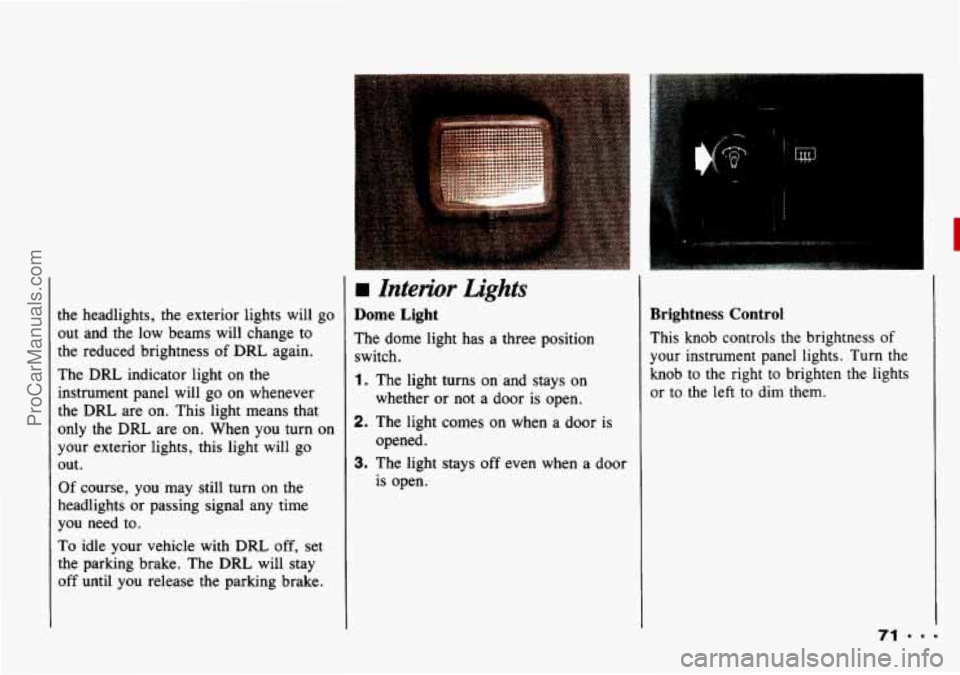
Dome Light
The dome light has a three position
switch.
1. The light turns on and stays on
whether or not a door
is open.
2. The light comes on when a door is
opened.
3. The light stays off even when a door
is open.
Brightness Control
This knob controls the brightness of
your instrument panel lights. Turn the
knob to the right to brighten
the lights
or
to the left to dim them.
ProCarManuals.com
Page 84 of 339
Features & Conrrols
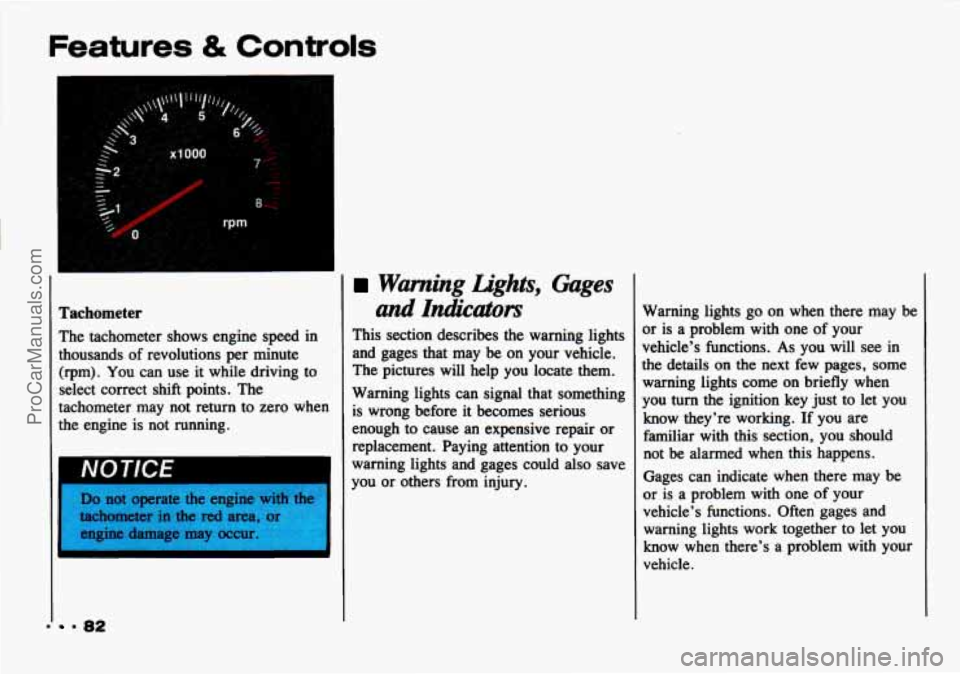
Tachometer
The tachometer shows engine speed in
thousands
of revolutions per minute
(rpm).
You can use it while driving to
select correct shift points. The
tachometer may not return to zero when
the engine is not running.
NOTICE
Do not operate the engine with the
tachometer in the red area
engine damage may occur
9 82
Wanting Lights, Gages
and
Indicators
This section describes the warning lights
and gages that may be on your vehicle.
The pictures will help
you locate them.
Warning lights can signal that something
is wrong before it becomes serious
enough to cause an expensive repair or
replacement. Paying attention to your
warning lights and gages could also save
you or others from injury. Warning
lights go on when there may be
or is a problem with one
of your
vehicle’s functions.
As you will see in
the details on the next few pages, some
warning lights come on briefly when
you turn the ignition key just to let you
know they’re working. If you are
familiar with this section, you should
not be alarmed when this happens.
Gages can indicate when there may be
or is a problem with one of your
vehicle’s functions. Often’ gages
and
warning lights work together to let you
know when there’s a problem with your
vehicle.
ProCarManuals.com
Page 120 of 339
Your Driving and the Road
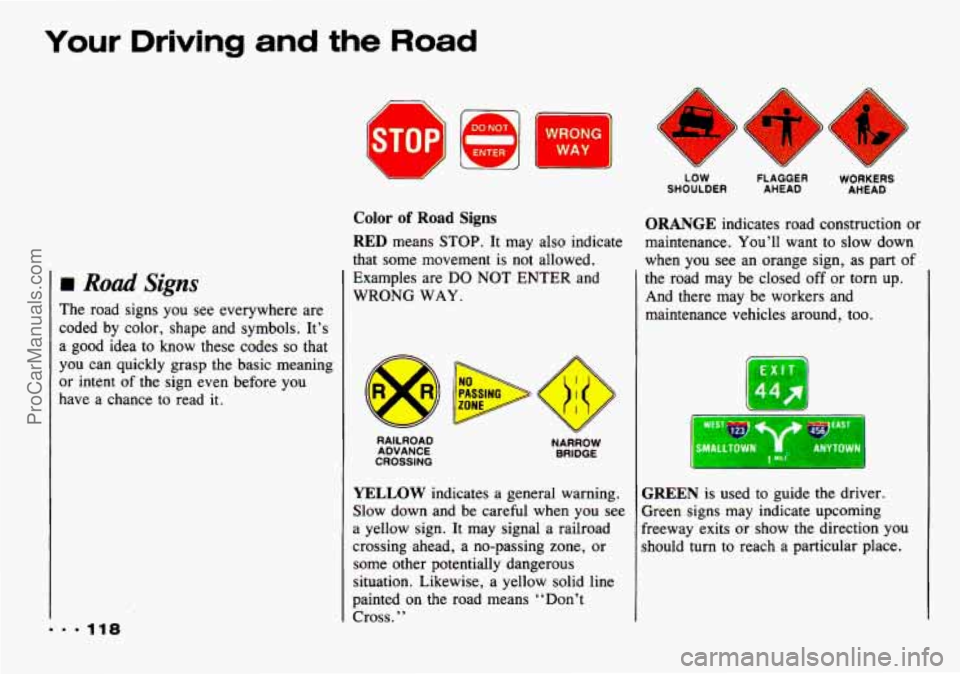
m Road Signs
The road signs you see everywhere are
coded by color, shape and symbols. It’s
a good idea to know these codes
so that
you can quickly grasp the basic meaning
or intent
of the sign even before you
have a chance to read it.
A
WAY I
Color of Road Signs
RED means STOP. It may also indicate
that some movement is not allowed.
Examples are
DO NOT ENTER and
WRONG WAY.
NARROW BRIDGE
YELLOW indicates a general warning.
Slow down and be careful when you see
a yellow sign. It may signal a railroad
crossing ahead, a no-passing zone, or
line
some
other potentially dangerous
situation. Likewise, a yellow solid
painted on
the road means “Don’t
Cross.”
LA w7
LOW
SHOULDER
ORANGE indicates road construction or
maintenance. You’ll want to slow down
when you see an orange sign, as part
of
the road may be closed off or torn up.
And there may be workers and
maintenance vehicles around, too.
GREEN is used to guide the driver.
Green signs may indicate upcoming
freeway exits or
show the direction you
should turn to reach
a particular place.
... 118
ProCarManuals.com
Page 123 of 339
Y
REVERSIBLE
LANE ON ROADWAY
MULTI-LANE
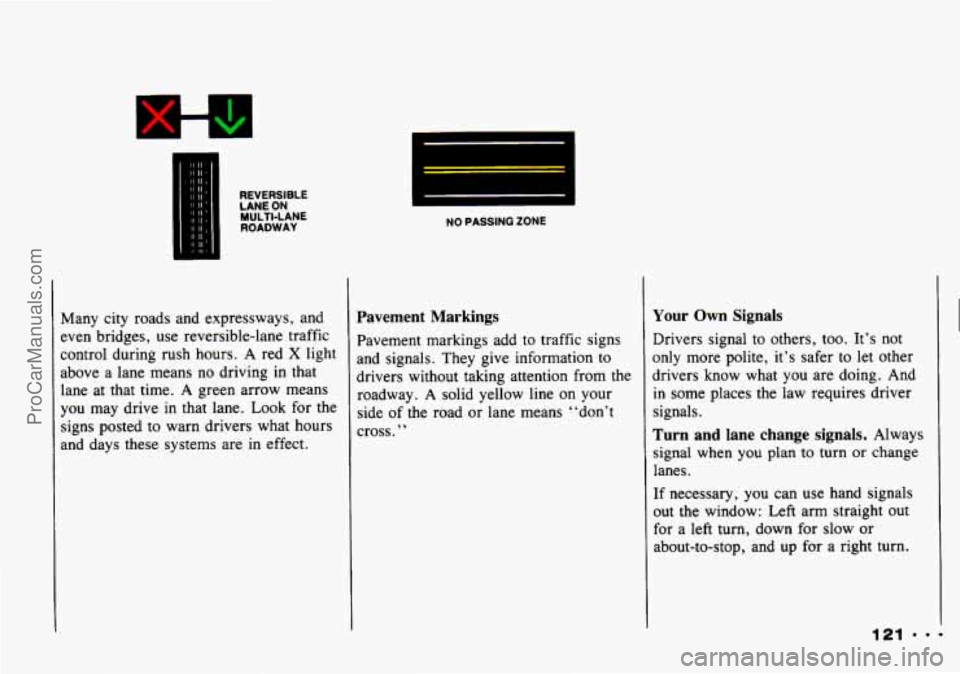
Many
city roads and expressways, and
zven bridges,
use reversible-lane traffic
:ontrol during rush hours. A red
X light
above a lane means no driving in that
lane at that time. A green arrow means
you may drive
in that lane. Look for the
signs posted to warn drivers what hours
and days
these systems are in effect.
NO PASSING ZONE
Pavement Markings
Pavement markings add to traffic signs
and signals. They give information to
drivers without taking attention from
the
roadway. A solid yellow line on your
side of the road or lane means “don’t
xoss. ”
Your Own Signals
Drivers signal to others, too. It’s not
only more polite, it’s safer to let other
drivers know what you are doing. And
in some places the law requires driver
signals.
Turn and lane change signals. Always
signal
when you plan to turn or change
lanes.
If necessary,
you can use hand signals
out the window: Left arm straight out
for a left turn, down for slow or
about-to-stop, and up for a right turn.
ProCarManuals.com
Page 139 of 339
Never cross a solid line on your side
of the lane or a double solid line,
even if the road seems empty of
approaching traffic.
If you suspect that the driver of the
vehicle you want to pass isn’t aware
of your presence, tap the horn a
couple of times before passing. Or, if
your Geo has the Passing Signal
option, you can use that. See
“Passing Signal” in the Index.
Do not get too close to the vehicle
you want to pass while you’re
awaiting
an opportunity. For one
thing, following too closely reduces
your area of vision, especially if
you’re following a larger vehicle.
Also, you won’t have adequate space
if the vehicle ahead suddenly slows or
stops. Keep back a reasonable
distance.
When it looks like a chance to pass is
coming up, start
to accelerate but stay
in the right lane and don’t get too
close. Time your move
so you will be
increasing speed as the time comes
to
move into the other lane. If the way is
clear to pass, you will have a
“running start” that more than makes
up for the distance you would lose by
dropping back. And if something
happens to cause you to cancel your
pass, you need only slow down and
drop back again and wait for another
opportunity.
If other cars are lined up to pass a
slow vehicle, wait your turn. But take
care that someone isn’t trying to pass
you as you pull out to pass the slow
vehicle. Remember to glance over
your shoulder and check the blind
spot.
Check your mirrors, glance over your
shoulder, and start your left lane
change signal before moving out
of
the right lane to pass. When you are
far enough ahead of the passed
vehicle to see its front in your inside
mirror, activate your right lane
change signal and move back into the
right lane. (Remember that your right
outside mirror is convex. The vehicle
ProCarManuals.com