check oil CHEVROLET TRACKER 1994 User Guide
[x] Cancel search | Manufacturer: CHEVROLET, Model Year: 1994, Model line: TRACKER, Model: CHEVROLET TRACKER 1994Pages: 258, PDF Size: 14.43 MB
Page 171 of 258
~~
~~ ~ ~~~~ ~ Service and Appearance Care
Four- Wheel Drive
Most
lubricant checks in this section also
apply to four-wheel-drive vehicles.
However, they have
two additional
systems that need lubricatiog.
Transfer Case
When to Check qnd Change Lubricant
Refer to the Maintenance Schedule to
determine how often to check the
lubricant and when to change
it. See
“Scheduled Maintenance Services”
in the
Index.
How to Check Lubricant
If the level is below the bottom of the
filler plug hole, you’ll need to add some
lubricant. Add enough lubricant to raise
the level to the bottom of the filler plug
hole.
What to Use
Refer to the Maintenance Schedule to
determine what kind of lybricant to use.
See “Recommended Fluids and
Lubricants”
in the Index.
Front Axle
When
to Check and Change Lubricant
Refer to the Maintenance Schedule to a
determine how often to check the
lubricant and when to change it. See
“Periodic Maintenance Inspections” and
“Scheduled Maintenance Services”
in the
Index.
How to Check Lubricant
If the level is below the bottom of the
filler plug hole, you’ll need to add some
lubricant.
If the differential is at operating
temperature (warm), add enough lubricant
to raise the level to the bottom of the filler
plug hole.
If the differential
is cold, add enough
lubricant to raise the level to
1/2 inch (12
mm) below the filler plug hole.
What to Use
Refer to the Maintenance Schedule to
determine
what kind of lubricant to use.
See “Recommended Fluids and
Lubricants”
in the Index.
Engine Coolant
The following explains your cooling
system and how to add coolant when it is
low. If you have a problem with engine
overheating, see “Engine Overheating”
in
the Index.
The proper coolant for your Geo will:
Give freezing protection down to
-20°F (-29”C), or -34°F (-37°C)
in
Canada and for vehicles with the cold
climate option.
Give boiling protection up to 258°F
(125°C).
Protect against rust and corrosion.
Help keep the proper engine
temperature.
Let the warning lights work as they
should.
What to Use:
Use a mixture of one-half clean water
(preferably distilled) and one-half
antifreeze that meets “GM Specification
6038-M,” which won’t damage aluminum
parts.
You can also use a recycled coolant
conforming to
“GM Specification
6038-M”
with a complete coolant flush
. . .I70
ProCarManuals.com
Page 172 of 258
and refill. If you use this mixture. you
don't need to add anything else.
A CAUTION:
Adding only plain water to your
cooling system can
be dangerous.
Plain water, or some other
liquid like
alcohol, can
boil before the proper
coolant mix will. Your vehicle's
cool-
ant warning system is set for the
proper coolant
mix. With plain water
or the wrong mix, your engine could
get too hot but you wouldn't get the
overheat warning. Your engine could
catch fire and you or others could be
burned. Use a 50/50 mix of clean
water and a proper antifreeze.
NOTICE:
If you use an improper coolant mix,
your engine could overheat and be
badly damaged. The repair cost
wouldn't be covered by your war-
ranty.
Too much water in the mix can
freeze and crack the engine, radiator,
heater core and other parts. Some conditions, such
as air
trapped in
the cooling system, can af't'ect the coolant
level
in the radiator. Check the coolant
level when the engine is cold and follow
the steps under "Adding Coolant" for the
proper way
to add coolant.
If you have to add coolant Inore than four
times
a year. have your dealer check your
cooling system.
NOTICE:
If you use the proper coolant. you
don't have to add extra inhibitors
or
additives which claim to improve thc
system. These can
be harmful.
%-Valve Engine
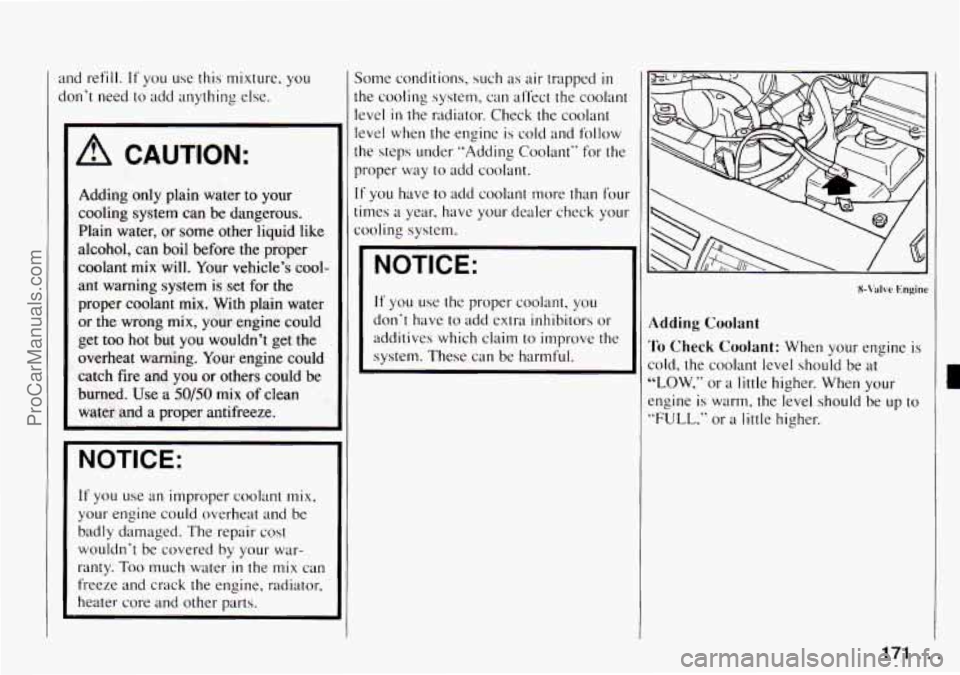
Adding Coolant
To Check Coolant: When your engine is
cold.
the coolant level should be at
"LOW," or a little higher. When your
engine
is warm. the level should be up to
"FULL." or a little higher.
171 ..
ProCarManuals.com
Page 176 of 258
correct a leak. If you add fluid when your
linings are worn, then you’ll have too
much fluid when you get new brake
linings. You should add (or remove)
brake fluid, as necessary, only when work
is done on the brake hydraulic system.
Refer to the Maintenance Schedple to
determine when to check
yoqr drake
fluid. See “Periodic Maintenance
Inspections” in the Index.
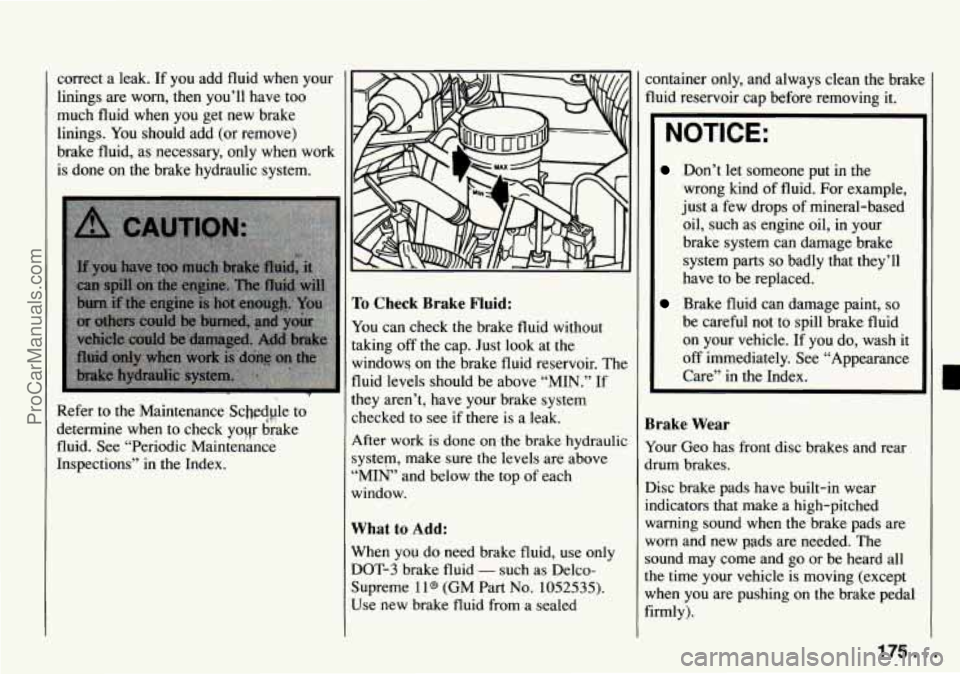
To Check Brake Fluid:
You can check the brake fluid without
taking
off the cap. Just look at the
windows on the brake fluid reservoir. The
fluid levels should be above “MIN.” If
they aren’t, have your brake system
checked to see if there is a leak.
After work is done
on the brake hydraulic
system, make sure the levels are above
“MIN’ and below the top
of each
window.
What to Add:
When you do need brake fluid, use only
DOT-3 brake fluid
- such as Delco-
Supreme 11s (GM Part
No. 1052535).
Use new brake fluid from a sealed container
only, and always clean the brakl
fluid reservoir cap before removing it.
NOTICE:
Don’t let someone put in the
wrong kind of fluid. For example,
just a few drops of mineral-based
oil, such as engine oil, in your
brake system can damage brake system parts
so badly that they’ll
have to be replaced.
Brake fluid can damage paint, so
be careful not to spill brake fluid
on your vehicle. If
you do, wash it
off immediately. See “Appearance
Care” in the Index.
Brake Wear
Your Geo has front disc brakes and rear
drum brakes.
Disc brake pads have built-in wear
indicators that make a high-pitched
warning sound when the brake pads are
worn and new pads are needed. The
sound may come and
go or be heard all
the time your vehicle is moving (except
when you are pushing on the brake pedal
firmly).
175 ...
ProCarManuals.com
Page 200 of 258

Replacement Bulbs
Back-up ........................................................ 1156
Dome
...................................................... 96051559
Center High-Mounted Stop
........................................... 921
Front Parking and
Turn Signal .................................... 1157 NA
Headlight (Halogen) ............................................... 9004
Heater
or Air Conditioning Control ............................... 96052599
Charging System
............................................ 9433 184
Engine Oil Pressure
.......................................... 9433 184
4WD
...................................................... 9433184
Headlight High Beam
......................................... 9433 184
Instrument Cluster
............................................. 9605 156
Rear Defogger Switch ......................................... 9606 1736
Rear Hazard and
Turn Signal ........................................ 1156
Rear Wipermasher Switch
..................................... 9606 1736
Indicator and Warning
Brake
..................................................... 9433184
CheckEngine
............................................... 9433184
SafetyBelt
................................................. 9433184
Turnsignal
................................................. 9433184
Licenseplate
..................................................... 194
Lighter
...................................................... 9433184
Rearparkingandstop
............................................. 1157
Sidemarker ......................................... ............ 194
199 ...
ProCarManuals.com
Page 202 of 258
Capacities (Approximate)
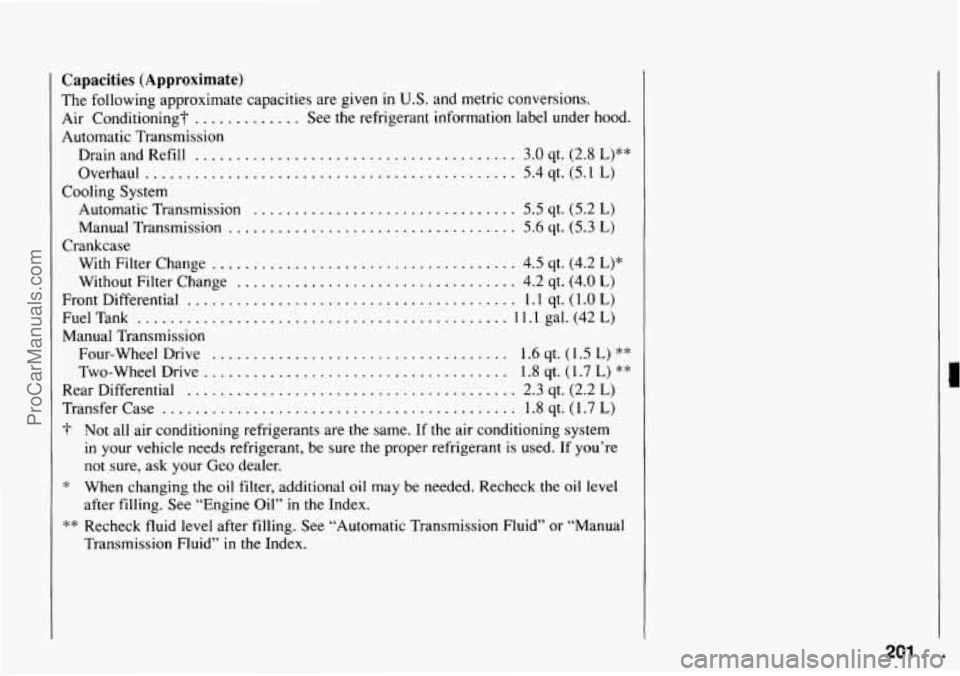
The following approximate capacities are given in U.S. and metric conversions.
Air Conditioning”
............. See the refrigerant information label under hood.
Automatic Transmission Drain and Refill
....................................... 3.0 qt. (2.8 L)**
Overhaul ............................................. 5.4 qt. (5.1 L)
Automatic Transmission ................................ 5.5 qt. (5.2 L)
Manual Transmission ................................... 5.6 qt. (5.3 L)
With Filter Change ..................................... 4.5 qt. (4.2 L)*
Without Filter Change .................................. 4.2 qt. (4.0 L)
Front Differential ........................................ 1.1 qt. (1 .O L)
Fuel Tank ............................................. 11.1 gal. (42 L)
Manual Transmission
Cooling System
Crankcase
Four-wheel Drive
.................................... 1.6 qt. ( 1.5 L) **
Two-Wheel Drive ..................................... 1.8 qt. (1.7 L) **
Rear Differential ........................................ 2.3 qt. (2.2 L)
Transfer Case ........................................... 1.8 qt. ( 1.7 L)
T Not all air conditioning refrigerants are the same. If the air conditioning system
in your vehicle needs refrigerant, be sure the proper refrigerant is used. If you’re
not sure, ask your Geo dealer.
* When changing the oil filter, additional oil may be needed. Recheck the oil level
after filling. See “Engine Oil”
in the Index.
** Recheck fluid level after filling. See “Automatic Transmission Fluid” or “Manual
Transmission Fluid”
in the Index.
201 ...
ProCarManuals.com
Page 204 of 258

.
IMPORTANT:
KEEP THE ENGINE OIL
AT THE PROPER
LEVEL AND CHANGE AS
RECOMMENDED
This part covers the
maintenance required
for your
Geo . Your vehicle needs these
services to retain its safety.
dependability and emission
control performance
.
Maintenance Schec
Section
Introduction: A Word about Maintenance ........................
A .
B .
C .
D .
E .
Your Vehicle and the Environment .........................
How This Part Is Organized ............................
Scheduled Maintenance Services ........................
Using Your Maintenance Schedule .......................
Selecting the Right Schedule ............................
Schedule1 .......
Schedule11 ............................................
Owner Checks and Services .........
At Each Fuel Fill .......
At Least Once a Month .................. .......
At Least Twice a Year .........
AtLeastOnceaYear ..................................
Periodic Maintenance Inspections ...........................
Recommended Fluids and Lubricants ........................
MaintenanceRecord ......................................
................................
Explanation of Scheduled Maintenance Services ..............
....................
.........................
...................
ule
Protection
Plan
Have you purchased the GM Protection Plan? The Plan
supplements
your new car warranties .
See your GM dealer for details .
204
204
204
205
205
205
206
210
214
218
218 219
219 220
223
225
228
203 ...
ProCarManuals.com
Page 215 of 258
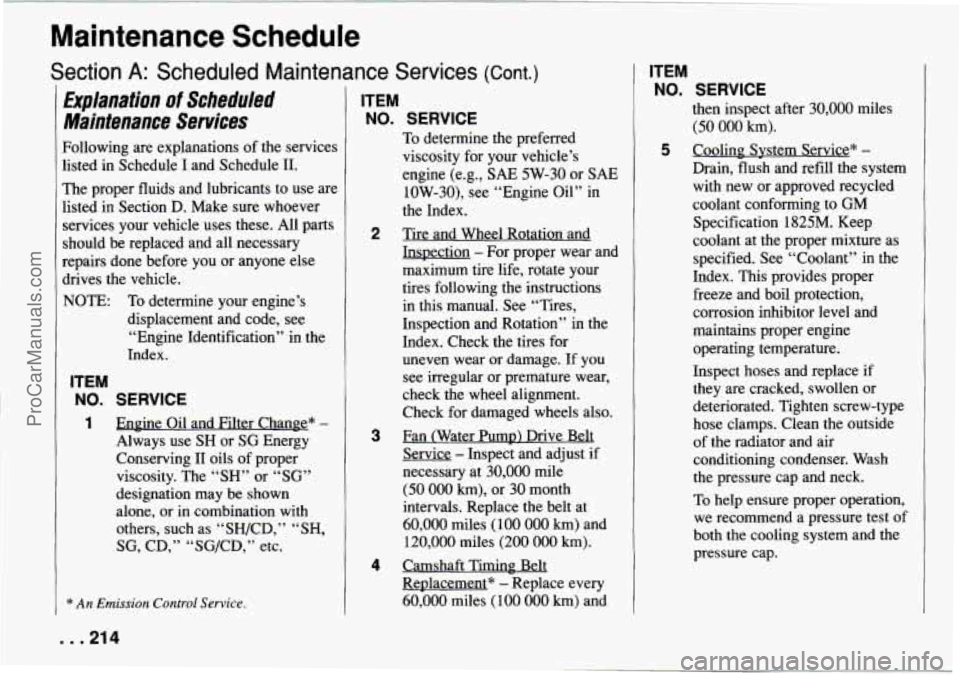
Maintenance Schedule
Section A: Scheduled Maintenance Services (Cont.)
&planation of Scheduled
Maintenance Services
?allowing are explanations of the services
isted in Schedule
I and Schedule II.
he proper fluids and lubricants to use are
.isted
in Section D. Make sure whoever
rervices your vehicle uses these. All parts
should be replaced and all necessary
repairs done before you or anyone else
~ives the vehicle.
NOTE: To determine your engine’s
displacement and code, see
“Engine Identification” in the
Index.
ITEM
NO. SERVICE
1 -e Oil and Filter Change* -
Always use SH or SG Energy
Conserving
II oils of proper
viscosity. The
“SH” or “SG”
designation may be shown
alone, or in combination with
others, such as “SHKD,”
“SH,
SG, CD,” “SG/CD,” etc.
* An Emission Control Service.
ITEM
NO. SERVICE
2
3
4
To determine the preferred
viscosity for your vehicle’s
engine (e.g.,
SAE 5W-30 or SAE
10W-30), see “Engine Oil” in
the Index.
Tire Wheel Rotation and
Jnspectioq
- For proper wear and
maximum tire life, rotate your
tires following the instructions
in this manual. See
“Ties,
Inspection and Rotation’’ in the
Index. Check the tires for
uneven wear or damage.
If you
see irregular or premature wear,
check the wheel alignment.
Check for damaged wheels also.
Fan (Water Pump) Drive Belt
Servk
- Inspect and adjust if
necessary at
30,000 mile
(50 000 km), or 30 month
intervals. Replace the belt at
60,000 miles (100 000 km) and
120,000 miles (200 000 km).
-shaft Timin? Belt
Replacemeat”
- Replace every
60,000 miles (100 000 km) and
ITEM NO.
SERVICE
then inspect after 30,000 miles
(50 000 km).
Drain, flush and refill the system
with new or approved recycled
coolant conforming to
GM
Specification 182SM. Keep
coolant at the proper mixture
as
specified. See “Coolant” in the
Index. This provides proper
freeze and boil protection,
corrosion inhibitor level and
maintains proper engine
operating temperature.
Inspect hoses and replace
if
they are cracked, swollen or
deteriorated. Tighten screw-type
hose clamps. Clean the outside
of the radiator and air
conditioning condenser. Wash
the pressure cap and neck.
To help ensure proper operation,
we recommend a pressure test
of
both the cooling system and the
nressure cap.
5 Coolin? Sys&nSemice* -
. . ,214
ProCarManuals.com
Page 216 of 258
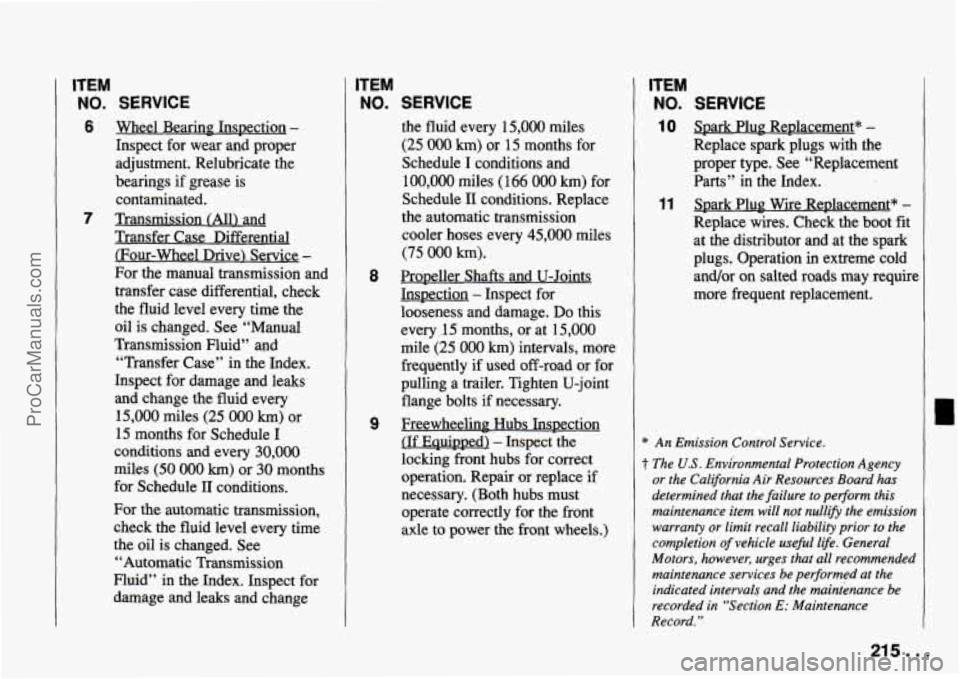
ITEM
NO. SERVICE
6 Wheel Bearin? InsDection -
Inspect for wear and proper
adjustment. Relubricate the
bearings if grease is
contaminated.
7 Transmission (All) and
Transfer Case Differential
(Four-wheel Drive) Service
-
For the manual transmission and
transfer case differential, check
the fluid level every time the
oil is changed. See “Manual
Transmission Fluid” and
“Transfer Case” in the Index.
Inspect for damage and leaks
and change the fluid every
15,000 miles
(25 000 km) or
15 months for Schedule
I
conditions and every 30,000
miles (50 000 km) or 30 months
for Schedule
II conditions.
For the automatic transmission,
check the fluid level every time
the oil is changed. See
“Automatic Transmission
Fluid” in the Index. Inspect for
damage and leaks and change
ITEM
NO. SERVICE
8
9
the fluid every 15,000 miles
(25 0o0 km) or 15 months for
Schedule
I conditions and
100,000 miles ( 166 000 km) for
Schedule
I1 conditions. Replace
the automatic transmission cooler hoses every
45,000 miles
(75 000 km).
Propeller Shafts and U-Joints
Inspection
- Inspect for
looseness and damage.
Do this
every,.l5 months, or at 15,000
mile
(25 000 km) intervals, more
frequently if used off-road
or for
pulling a trailer. Tighten U-joint
flange bolts if necessary.
Freewheeling Hubs InsDection
/If Equipped) - Inspect the
locking front hubs for correct
operation. Repair or replace if
necessary. (Both hubs must
operate correctly for the front
axle to power the front wheels.)
ITEM
NO. SERVICE
10
11
Spark Plug Replacement” -
Replace spark plugs with the
proper type. See “Replacement Pans” in the Index.
Spark Plup Wire Replacement”
-
Replace wires. Check the boot fit
at the distributor and
at the spark
plugs. Operation in extreme cold
and/or on salted roads may require
more frequent replacement.
* An Emission Control Service.
t The U.S. Environmental Protection Agency
or the California Air Resources Board has
determined that the failure to perform this
maintenance item will not null@ the emission
warranty
or limit recall liability prior to the
completion
of vehicle useful life. General
Motors, however, urges that all recommended
maintenance services be pegormed at the
indicated intervals and the maintenance be
recorded
in “Section E: Maintenance
Record.
’’
215 ...
ProCarManuals.com
Page 219 of 258
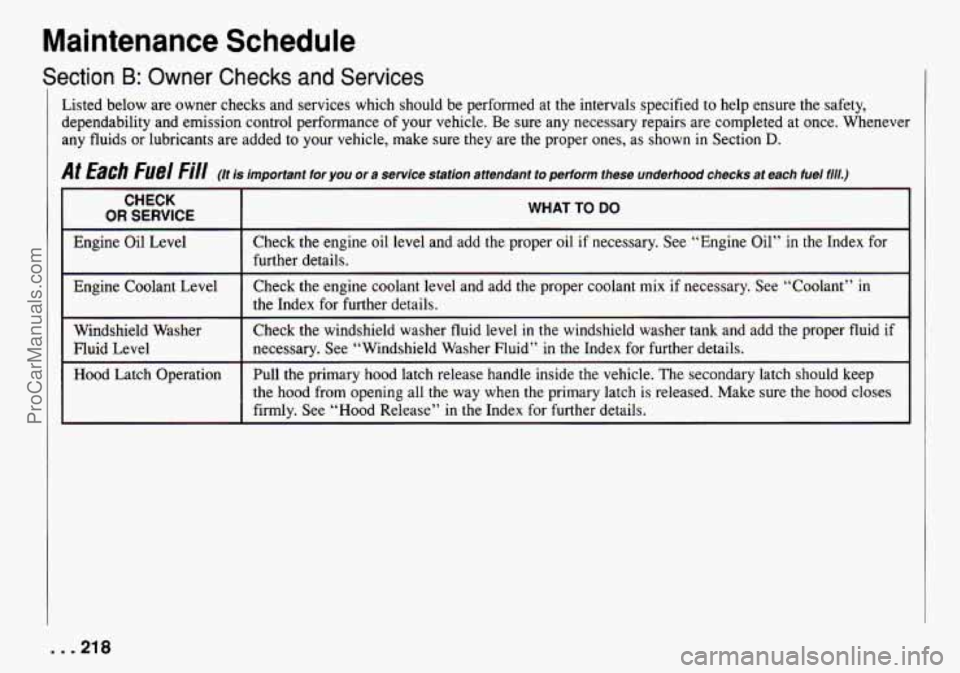
Maintenance Schedule
iection B: Owner Checks and Services
Listed below are owner checks and services which should be performed at the intervals specified to help ensure the safety,
dependability and emission control performance of your vehicle. Be sure any necessary repairs are completed at once. Whenever
any fluids or lubricants are added to your vehicle, make sure they are the proper ones, as shown in Section
D.
At Each Fuel Fill (It is important for you or a service station attendant to perform these underhood checks at each fuel fill.)
CHECK
OR SERVICE I WHAT TO DO
Engine Oil Level
Check the engine coolant level and add the proper coolant mix
if necessary. See “Coolant” in Engine Coolant Level Check the engine
oil level and add the proper oil if necessary. See “Engine Oil” in the Index for
further details.
the Index for further details.
Windshield Washer
Pull
the primary hood latch release handle inside the vehicle. The secondary latch should keep
Hood Latch Operation necessary. See “Windshield Washer
Fluid”
in the Index for further details.
Fluid Level Check
the windshield washer fluid level in
the windshield washer tank and add the proper fluid if
the hood from opening all the way when the primary latch is released. Make sure the hood closes
firmly. See “Hood Release” in the Index for further details.
. . .218
ProCarManuals.com
Page 248 of 258

1 Keys ....................... 36
Label. Certification/Tire
........ 18 1
Label. Service Parts Identification . . 196
Lamp. Malfunction Indicator
...... 7 1
Lane Change Indicator.
Turn Signal and
.............. 54
Lap-Shoulder Belt (Safety Belts)
... 20
Larger Children (Safety Belts)
..... 32
Leaving Your Vehicle
............ 37
Leaving Your Vehicle with the
Engine Running
.............. 49
Lighter. Ashtrays and
............ 62
Lights Brake System Warning
......... 69
Bulb Replacement
............ 177
Charging System
............. 70
Check Engine
................ 71
Daytime Running ............. 56
Daytime Running Lights
Indicator
.................. 72
Dome
...................... 57
Engine Oil Pressure
........... 71
Gages and Indicators. Warning
. . 68
Interior ..................... 57
Malfunction Indicator Lamp
.... 71
Operation
of ................. 55
Safety Belt Reminder .......... 19
Lights On Reminder
............. 55
Loading Your Vehicle .... . 181 Locks.
Door ................... 37
Loss of Control
................ 107
Lubricant Front Axle
.................. 170
Rear Axle
................... 169
Recommended
............... 225
Transfer Case
................ 170
Main Fuse Block
............. 198
Maintenance Inspections. Periodic
.......... 223
Record
..................... 228
Schedule
.................... 203
Services. Scheduled
........... 206
Underbody
.................. 194
When Trailer Towing
.......... 129
Malfunction Indicator Lamp
...... 71
Manual
Adjust Mirrors. Outside
........ 60
Freewheeling Hubs ........... 46
Transmission Fluid
............ 168
Windows
................... 52
Master Cylinder. Brake
.......... 174
Mirrors Convex Outside
.............. 59
Inside Daymight Rearview
..... 59
Inside Rearview
.............. 59
Outside Manual Adjust
........ 60
Mountain Roads. Hill and ........ 121
Transmission. Five-Speed
...... 44 New
Vehicle “Break-In”
....... 39
Night Driving
.................. 116
Night Vision
................... 117
Nuts. Wheel
................... 202
Odometer. Speedometer and
..... 66
Odometer. Trip
................. 67
Off-Road Driving After
....................... 116
Before You Go
............... 108
Getting Familiar With
......... 109
Loading Your Vehicle for
....... 108
On Hills
.................... 110
With Your Geo Four-Wheel-Drive
Vehicle
................... 108
Off-Road Recovery
............. 105
Oil. Engine .................... 162
Opening and Closing Your Rear
Window
.................... 75
Opening and Closing Your
sunroof ..................... 74
Operation
of Lights ............. 55
Outside Manual Adjust Mirrors .... 60
Overheating. Engine
............ 140
Owner Checks and Services
....... 218
P (Park) Shifting into ...
P (Park). Shifting out of ...
.... 48
.... 49
247 ... ProCarManuals.com