headlights CHEVROLET TRACKER 1994 Owners Manual
[x] Cancel search | Manufacturer: CHEVROLET, Model Year: 1994, Model line: TRACKER, Model: CHEVROLET TRACKER 1994Pages: 258, PDF Size: 14.43 MB
Page 56 of 258

A green arrow on the instrument panel
will flash in the direction of the turn or
lane change.
To signal a lane change, just raise or
lower the lever
until the green arrow starts
to flash. Hold
it there until you complete
your lane change. The lever
will return by
itself
when you release it.
As you signal a turn or a lane change, if
the arrows don’t flash but just stay on, a
signal bulb may be burned out and other
drivers
won’t see your turn signal.
If a bulb is burned out, replace
it to help
avoid an accident. If the green arrows
don’t go on at all when you signal a turn,
check the fuse (see “Fuses and Circuit
Breakers” in the Index) and for
burned-out bulbs.
Operation of Lights
Although your vehicle’s lighting system
(headlights, parking lights, fog lamps,
sidemarker lights and taillights) meets all
applicable federal lighting requirements,
certain states and provinces may apply
their own lighting regulations that may
require special attention before you
operate these lights.
For example, some jurisdictions may
require that you operate your fog lamps
only when your lower beam headlights
are also
on, or that headlights be turned
on whenever you must use your
windshield wipers. In addition, most
jurisdictions prohibit driving solely
with
parking lights, especially at dawn or dusk.
It is recommended that you check with
your own state or provincial highway
authority for applicable lighting
regulations. Turn the
outside part
of the lever to
control the lights. There are three
positions
for the light switch.
OFF: All lights are off.
-300:: The parking lights, taillights,
license plate light and the instrument
panel lighting come on. The
headlights are
off.
/, , :The headlights and all other
operating lights come on. . ‘8’’-
Lights On Reminder
If you turn the ignition off, remove the
key, open the door and leave
the lights on,
a chime will remind you to turn off your
lights.
55 ... ProCarManuals.com
Page 57 of 258
Features and Controls
-- I
-- a1
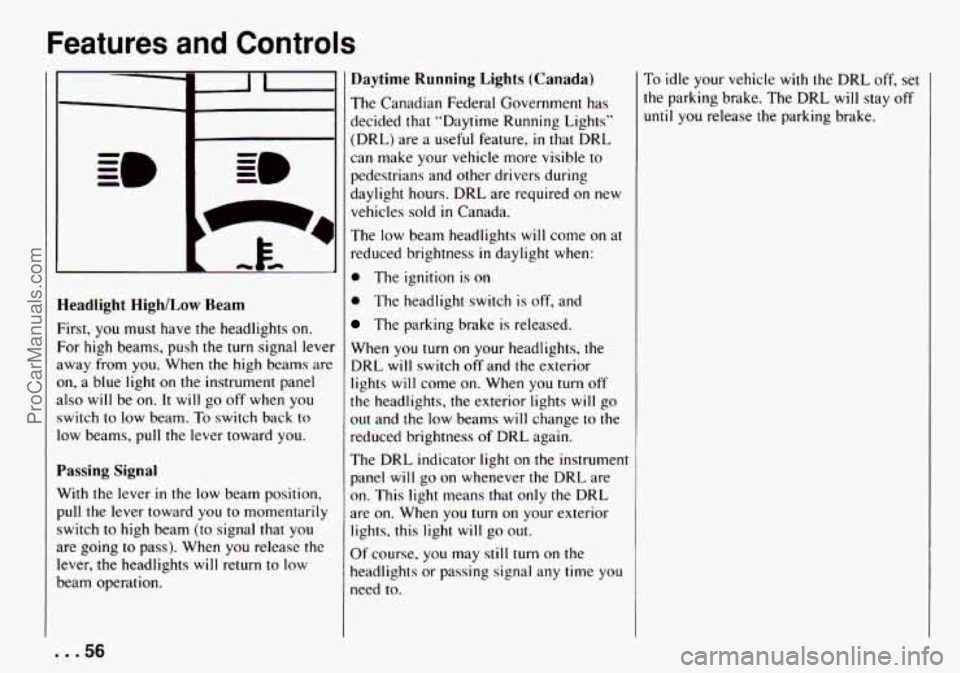
Headlight HighlLow Ream
First, you must have the headlights on.
For high beams, push the turn signal lever
away from you. When
the high beams are
on, a blue light on the instrument panel
also will be
on. It will go off when you
switch to low beam. To switch back
to
low beams, pull the lever toward you.
Passing Signal
With the lever in the low beam position,
pull the lever toward you
to momentarily
switch to high beam (to signal that
you
are going to pass). When you release the
lever, the headlights will return
to low
beam operation.
Daytime Running Lights (Canada)
The Canadian Federal Government has
decided that “Daytime Running Lighls”
(DRL) are
a useful feature, in that DRL
can make your vehicle more visible to
pedestrians and other drivers during
daylight hours. DRL are required
on new
vehicles sold
in Canada.
The low beam headlights will come on at
reduced brightness in daylight when:
0 The ignition is on
0 The headlight switch is off, and
The parking brake is released.
When
you turn on your headlights, the
DRL will switch
off and the exterior
lights will come on. When
you turn off
the headlights, the exterior lights will go
out and the low beams will change
to the
reduced brightness of DRL again.
The DRL indicator light on the instrument
panel will go on whenever the DRL are
on. This light means that only the DRL
are on. When you turn on your exterior
lights, this light will go
out.
Of course, you may still turn on the
headlights
or passing signal any time you
need to.
To idle your vehicle with the DRL off, set
the parking brake. The DRL will stay off
until you release the parking brake.
... 56
ProCarManuals.com
Page 112 of 258
0 Is the hill simply too rough‘? Steep hills
often have ruts, gullies, troughs and
exposed rocks because
they are more
susceptible
to the effects of erosion.
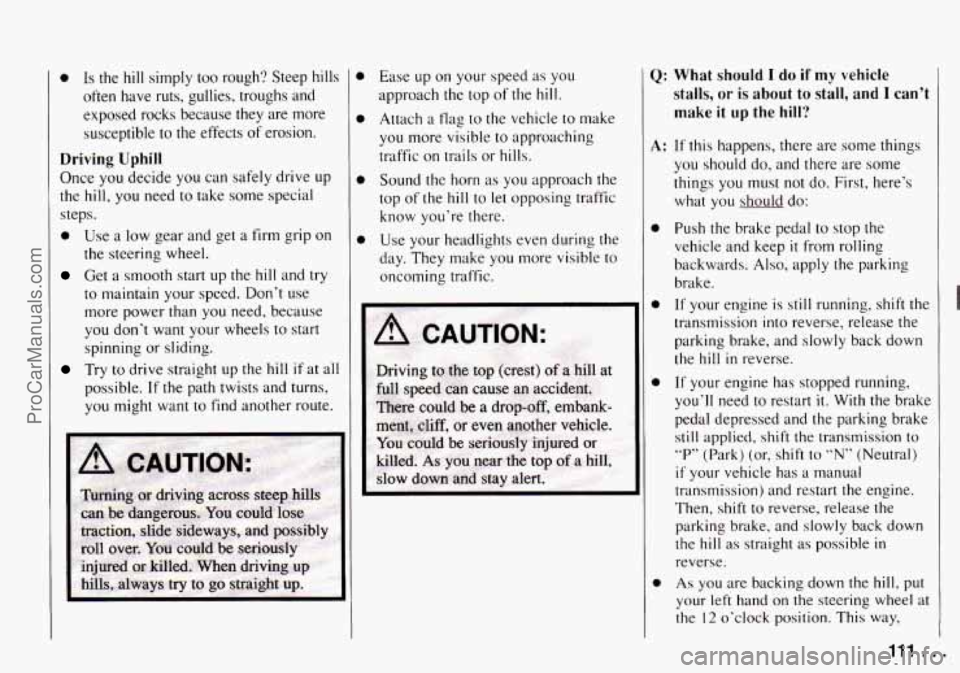
Driving Uphill
Once you decide you can safely drive up
the hill,
you need to take some special
steps.
0 Use a low gear and get a firm grip on
the steering wheel.
Get a smooth start up the hill and try
to maintain your speed. Don’t use
more power than
you need, because
you don’t want your wheels
to start
spinning or sliding.
Try to drive straight up the hill if at a1
possible.
If the path twists and turns,
you might want to find another route.
0
0
0
0
Ease up on your speed as you
approach the top
of the hill.
Attach a flag to the vehicle to tnake
you more visible to approaching
traffic on trails
or hills.
Sound the
horn as you approach the
top
of the hill to let opposing traffic
know you’re there.
Use your headlights even during the
day. They make you more visible
to
oncoming traffic.
Q: What should I do if my vehicle
A:
0
0
0
0
stalls, or is about to stall, and I can’t
make
it up the hill?
If this happens, there are some things
you should do, and there are some
things you must not do. First, here’s
what you should do:
Push the brake pedal
to stop the
vehicle and keep
it from rolling
backwards. Also, apply
the parking
brake.
If your engine is still running, shift the
transmission into reverse, release the
parking brake, and slowly back down
the
hill in reverse.
If your engine has stopped running,
you’ll need to restart it. With the brake
pedal depressed and
the parking brake
still applied,
shift the transmission to
“P” (Park) (or, shift to “N” (Neutral)
if your vehicle has a manual
transmission) and restart
the engine.
Then, shift
to reverse, release the
parking brake, and slowly back down
the
hill as straight as possible in
reverse.
As you are backing down the hill, put
your left hand
on the steering wheel at
the
12 o’clock position. This way,
111 . . .
ProCarManuals.com
Page 117 of 258
Your Driving and the Road
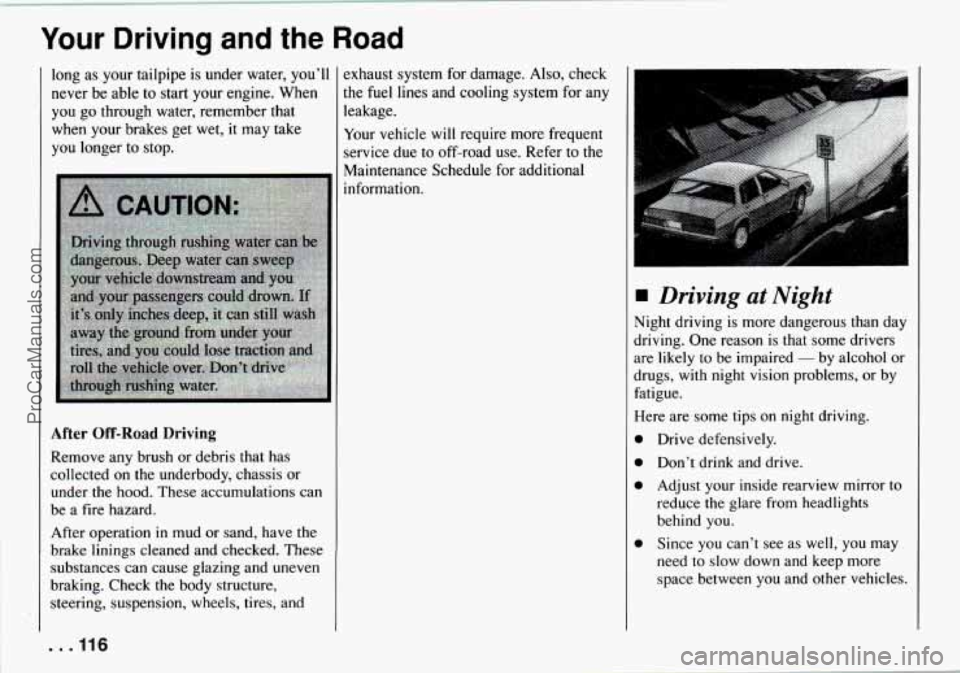
long as your tailpipe is under water, you'll
never be able to
start your engine. When
you go through water, remember that
when your brakes get wet, it may take
you longer to stop.
After Off-Road Driving
Remove any brush or debris that has
collected
on the underbody, chassis or
under the hood. These accumulations can
be a fire hazard.
After operation in mud or sand, have the
brake linings cleaned and checked. These
substances can cause glazing and uneven
braking. Check the body structure,
steering, suspension, wheels, tires, and exhaust system
for damage.
Also, check
the fuel lines and cooling system for any
leakage.
Your vehicle will require more frequent
service due to off-road
use. Refer to the
Maintenance Schedule for additional
information.
4 Driving at Night
Night driving is more dangerous than day
driving. One reason is that some drivers
are likely
to be impaired - by alcohol or
drugs, with night vision problems, or by
fatigue.
Here are some tips on night driving.
Drive defensively.
Don't drink and drive.
Adjust your inside rearview mirror to
reduce the glare from headlights
behind you.
Since you can't see as well,
you may
need to slow down and keep more space between
you and other vehicles.
. . .116
ProCarManuals.com
Page 118 of 258

Slow down, especially on higher
speed roads. Your headlights can light
up
only so much road ahead.
0 In remote areas. watch for animals.
0 If you're tired, pull off the road in a
safe place md rest.
Night Vision
No one can see 11s well at night as in the
daytime.
But as we get older these
differences increase. A SO-year-old driver
may require at least twice as much
light to
see the same thing
a( night :is a
20-year-old.
What you do
in the daytime can also
affect your night vision. For example.
if
you spend the day in bright sunshine you
are wise
to wear sunglasses. Your eyes
will have less trouble adjusting
to night.
But
if you're driving, don't wear
sunglasses at night. They may cut down
on glare from headlights. but they also
make
a lot of things invisible.
You can be temporarily blinded by
approaching lights. It c;tn take a second or
two,
or even several seconds, for your
eyes
to readjust to the dark. When you are
ked with severe glare
(as from a driver
who doesn't lower the high beams. or a vehicle with Inisaimed headlights), slow.
down
a little. Avoid staring directly into
the approaching lights.
Keep your windshield and
all the glass on
your vehicle clean - inside and out.
Glare
at night is nladc much worse by dirt
on the glass. Even the inside of the glass
can build up a film caused by dust. Dirty
glass makes lights dazzle and flash more
than clean
glass would. making the pupils
of
your eyes contract repeatedly.
Remember that your hcacilights light
up
far less of' LI roadway when you are in a
turn or curve.
Kecp your eycs moving: that way,
it's
casier to pick out dimly lighted objects.
Just
as your headlights should be checked
regularly for proper aim.
so should your
eyes be examined regulurly.
Some drivers
suffer from night blindness
- the
inability to see
in dim light - and aren't
even aware
of it.
Driving in the Rain
Rain and wet roads can mean driving
trouble. On
a wet road you can't stop,
accelerate
or turn as well because your
tire-to-road traction isn't as good as on
dry roads. And,
if your tires don't have
much tread left, you'll get even less
traction.
It's always wise to go slower and
be cautious if
rain starts to fall while you
are driving. The surface may get wet
suddenly when your reflexes are tuned for
driving
on dry pavement.
The heavier the rain. the harder
it is to
see. Even if your windshield wiper blades
are
in good shape. a heavy rain can make
it harder to see road signs and traffic
signals, pavement markings,
the edge of
the road, and even people walking.
117 ...
ProCarManuals.com
Page 119 of 258
Your Driving and the Road
It’s wise to keep your wiping equipment
in good shape and keep your windshield
washer tank filled. Replace your
windshield wiper inserts when they show
signs of streaking or missing areas on the
windshield, or when strips of rubber start
to separate from the inserts.
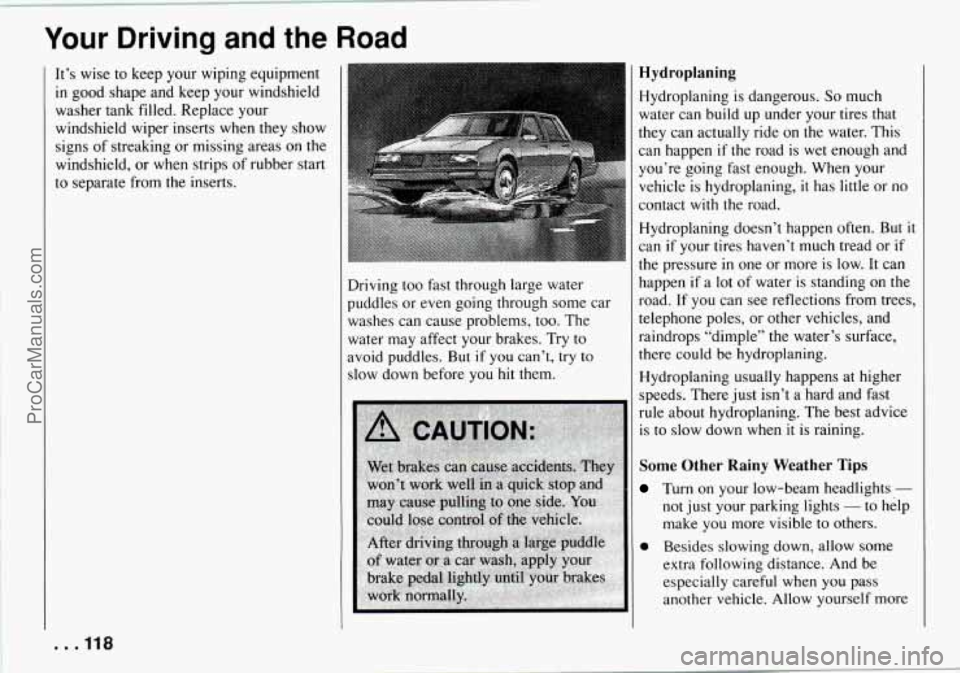
Driving too fast through large water
puddles or even going through some car
washes can cause problems, too. The
water may affect your brakes. Try to
avoid puddles. But
if you can’t, try to
slow down before you hit them.
Hydroplaning
Hydroplaning is dangerous. So much
water can build
up under your tires that
they can actually ride on the water. This
can happen if the road is
wet enough and
you’re going fast enough. When your
vehicle is hydroplaning,
it has little or no
contact
with the road.
Hydroplaning doesn’t happen often.
But it
can if your tires haven’t much tread or
if
the pressure in one or more is low. It can
happen
if a lot of water is standing on the
road.
If you can see reflections from trees,
telephone poles, or other vehicles, and
raindrops “dimple” the water’s surface,
there could be hydroplaning.
Hydroplaning usually happens at higher speeds. There just isn’t a hard and fast
rule about hydroplaning. The best advice
is to slow down when it is raining.
Some Other Rainy Weather Tips
Turn on your low-beam headlights -
not just your parking lights - to help
make you more visible to others.
0 Besides slowing down, allow some
extra following distance. And be
especially careful when you pass
another vehicle. Allow yourself more
. . .I18
ProCarManuals.com
Page 125 of 258
Your Driving and the Road
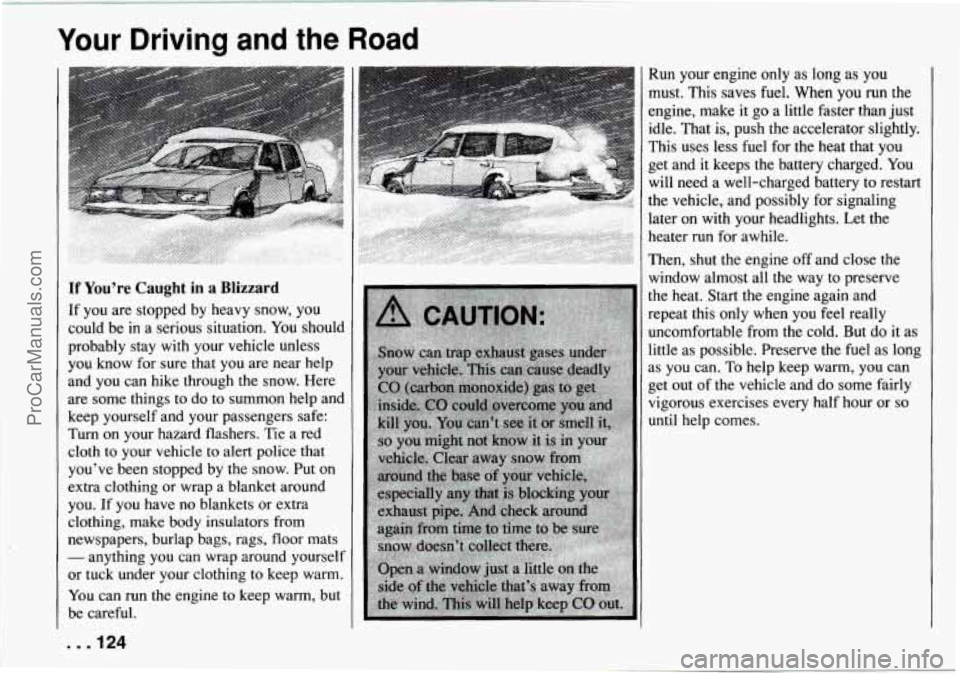
If You’re Caught in a Blizzard
If you are stopped by heavy snow, you
could be in a serious situation. You should
probably stay with your vehicle unless
you know
for sure that you are near help
and you can hike through the snow. Here
are some things to do to summon help and
keep yourself and your passengers safe:
Turn on your hazard flashers. Tie a red
cloth to your vehicle to alert police that
you’ve been stopped by the snow. Put on
extra clothing or wrap
a blanket around
you. If you have no blankets or extra
clothing, make body insulators from
newspapers, burlap bags, rags, floor mats
- anything you can wrap around yourself
or tuck under your clothing to keep warm.
You can
run the engine to keep warm, but
be careful. Run your engine
only as long as
you
must. This saves fuel. When you run the
engine, make it go a little faster than just
idle. That is, push the accelerator slightly.
This uses less fuel for the heat that you
get and it keeps the battery charged. You
will need a well-charged battery to restart
the vehicle, and possibly for signaling
later on with your headlights. Let the
heater run for awhile.
Then, shut the engine off and close the
window almost all the way to preserve
the heat. Start the engine again and
repeat this only when you feel really
uncomfortable from the cold. But
do it as
little as possible. Preserve the fuel as long
3s you can. To help keep warm, you can
get out of the vehicle and do some fairly
vigorous exercises every half hour or
so
until help comes.
. . ,124
ProCarManuals.com
Page 178 of 258
will help keep your battery from running
down.
Contact your dealer to learn how to
prepare your vehicle for longer storage
periods. Bulb Replacement
See “Replacement Bulbs” in the Index to
check the size and type of bulb you need
to use.
Halogen Bulbs
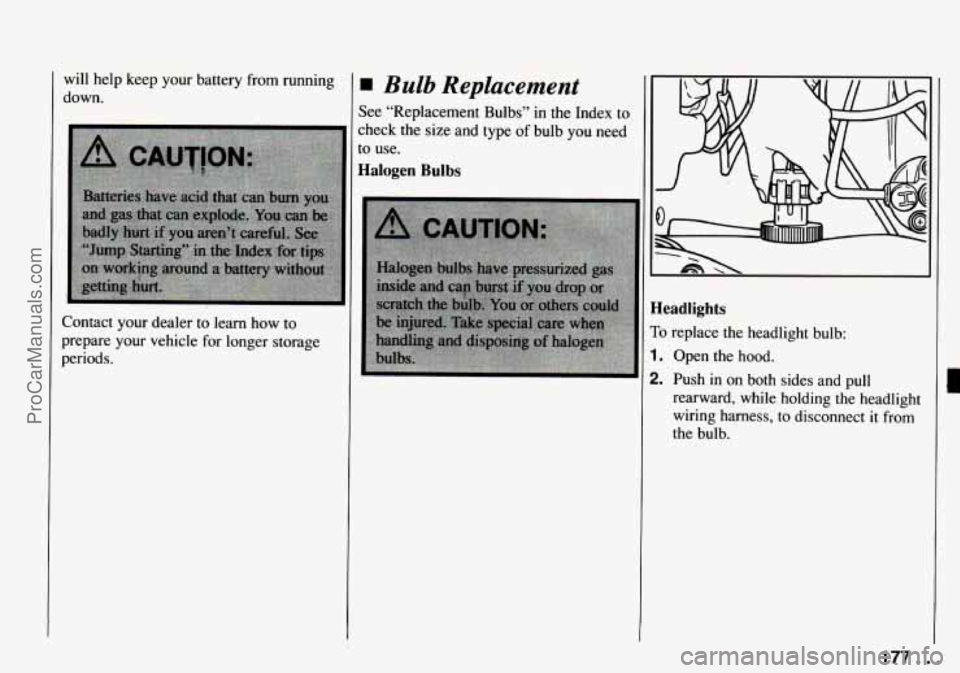
Headlights
To replace the headlight bulb:
1. Open the hood.
2. Push in on both sides and pull
rearward, while holding the headlight
wiring harness, to disconnect it from
the bulb.
177 ... ProCarManuals.com
Page 244 of 258
A bout Driving Your Tracker ..... 3
ABS ......................... 103
Adding Coolant ................ 171
Additives. Engine
Oil ............ 165
Adjustment. Clutch
............. 169
Air Cleaner .................... 165
Air Conditioner Controls
......... 85
Air Filter Replacement
........... 166
Air Intake Lever ................ 84
Airflow Lever
.................. 84
Alignment and Tire Balance
.
Wheel ...................... 187
Aluminum Wheels
.............. 193
AM/FM Stereo
................ 88
With Cassette Tape and Compact
Disc Player
................ 93
With Cassette Tape Player ...... 89
Antenna
...................... 98
Anti-Lock Brakes
.............. 103
To Use ..................... 103
Appearance Care ............... I89
Appearance Care and Materials
.... 195
Appearance Care. Service and
..... 155
Approaching
a Hill .............. 1 10
Ashtrays and Lighter ............ 62
Ashtray. Front
................. 63
Ashtray. Rear .................. 63
Assist Grips. Passenger .......... 62
Add-on
Electrical Equipment
..... 196
Adjustable Steering Column
...... 53
Audio Systems ................. 87
Audio Systems. Comfort
Controls and
................. 83
Automatic
Freewheeling Hubs
........... 47
Transmission
................ 42
Transmission Fluid ............ 167
Axle. Front
.................... 170
Axle
. Rear .................... 169
Babies. Smaller Children
and (Safety Belts)
............. 26
Balance. Wheel Alignment
and Tire
.................... 187
Battery
....................... 176
BBB Auto Line
- Alternative Dispute
Resolution Program. GM
Participation
in ............. 235
Before Leaving
on a Long Trip .... 120
Belt. Lap-Shoulder .............. 20
Bi-Level ...................... 84
Bin. Coinholder and ............. 61
Bins. Instrument Panel ........... 61
Blizzard. If You’re Caught in a ... 124
Box. Glove
.................... 60
Brakes
Adjustment
.................. 176
Anti-Lock (ABS)
............. 103
Fluid ....................... 1 74
Master Cylinder
.......... 174
Parking
......... 48 Brakes
Pedal Travel
................. i76
System Parts. Replacing ........ 176
System Warning Light
......... 69
Trailer ...................... i27
Wear ...................... 175
Braking (Control of
a Vehicle) ..... 102
Braking
in Emergencies .......... 104
“Break.In. .. New Vehicle ........ 39
Bright Metal Parts. Protecting
Exterior
.................... 192
Brightness Control
.............. 57
Bulb Replacement .............. 177
Stoplight .................. 181
Headlights .................. 177
Rear Combination
............ 180
Rear Sidemarker
.............. 179
Sidemarker ......... . .179
Bulbs. Halogen
............... 177
Bulbs. Replacement
............. 199
Canadian Roadside Assistance ... 237
Canvas Top
Preparing for Storage
.......... 80
Special Care for
.............. 193
Capacities and Specifications
...... 200
Carbon Monoxide .............. 51
Center High-Mounted
Front Parking and Turn Signal
... 178
Removing and Installing Your
... 76
243 ...
ProCarManuals.com
Page 247 of 258

Index
Fluid Automatic Transmission
....... 167
Brake
...................... 174
Manual Transmission
.......... 168
Power Steering ............... 173
Recommended
............... 225
Windshield Washer
........... 174
Foreign Countries. Fuels
in ....... 1.57
Foreign Material Paint Damage
.... 194
Four-wheel Drive
.............. 46
Four-wheel Drive (Service) ....... 170
Four-Wheel-Drive Vehicle. Off-Road
Driving With Your Geo
........ 108
Freeway Driving ............... 120
Freewheeling Hubs
Automatic
................. 47
Manual
..................... 46
Ashtray
..................... 63
Axle
....................... 170
Seat ........................ 10
Seat Side Pockets ............. 61
Seatbacks. Reclining .......... IO
Towing Hook-ups ............. 138
Fuel ......................... 156
FuelGage
..................... 69
Fuels in Foreign Countries ........ 157
Fuse Block, Instrument Panel ..... 198
Fuse Block, Main ............... 198
Fuses and Circuit Breakers ....... 196
Folding Rear
Seat
............... 13
Front Gages
Engine Coolant Temperature
.... 70
Fuel
....................... 69
Warning Lights and Indicators ... 68
Gasolines for Cleaner Air ........ 157
Glass
......................... 19 1
Glove Box .................... 60
GM Participation
in RBB Auto Line .
Alrernative Dispute Resolution
Program
.................. 235
Grips . Passenger Assist .......... 62
Guidelines. Driving ............. 107
Halogen Bulbs
............... 177
Hazard Warning Flashers
......... 132
Head Restraints
................ I1
Headlights .................... 177
Heater Controls
................ 84
Heater. Engine Coolant
(Block) .... 41
Heating ....................... 84
Highway Hypnosis
.............. 12 1
Hill and Mountain Roads ......... 121
Hill. Approaching a ............. 1 IO
Hitches ....................... 126
Hood Release .................. IS9
Hood . Checking Things under the . . 159
Hook.Ups . Front Towing ......... 138
Hook.Ups. Rear Towing
......... I39
Horn ......................... 53
Headlight High/Low Beam ....... 56
How to Add Coolant to the
How
to Add Coolant to the
Hubs. Freewheeling
Coolant
Recovery Tank
........ 142
Radiator
............... . .144
Automatic
................... 47
Manual
..................... 46
Hydroplaning .................. 118
Hypnosis. Highway
............. 121
Identification Number. Vehicle .... 196
Identification. Engine ............ 196
If a Tire Goes Flat .............. 146
If You’re Stuck: In Sand. Mud. Ice
or Snow .................... 153
Ignition Switch
................. 39
Incline
. Driving Across an ........ 113
Incline. Stalling on
an ........... 114
Intlation - Tire Pressure .......... 184
Inside Day/Night Rearview Mirror
...................... 59
Inside Rearview Mirror
.......... 59
Instrument Cluster .............. 66
Instrument Panel ............... 64
Instrument Panel Bins
........... 61
Instrument Panel Fuse Block ...... 198
Instrument Panel
. Cleaning the
Topof
..................... 191
Interior Lights ................. 57
Jump Starting
................. 133
... 246
ProCarManuals.com