ignition CHEVROLET TRACKER 1994 Owner's Manual
[x] Cancel search | Manufacturer: CHEVROLET, Model Year: 1994, Model line: TRACKER, Model: CHEVROLET TRACKER 1994Pages: 258, PDF Size: 14.43 MB
Page 98 of 258

If the code is correct. the radio will
operate. If the code
is wrong, “Err” will
appear
in the display.
To Unlock the System After a Power
Loss
If power is disrupted to the radio while in
the ”SEC” mode, the unit will not work
and
”LOC” will show on the display
whenever the ignition is on. To unlock the
unit:
1.
2.
3.
4.
5.
6.
Press “4 SEEK b“ and/or
‘‘4 TUNE b” and “0000” will appear
on the display.
Press the
“SEEK 4“ button and hold it
until the first digit of your code
appears.
Press the
“SEEK b‘* button and hold it
until the second digit of your code
appears.
Press the
“TUNE 4’‘ button and hold
it until the third digit of your code
appears.
Press the
“TUNE b” button and hold
it until the fourth digit of your code
appears.
Press “AM-FM” after you have
checked that the code matches
the one
you wrote down. Now “SEC” will
appear on
the display.
Understanding Radio Reception
FM Stereo
FM stereo will give you rhe best sound.
But
FM signals will reach only about IO
to 40 miles ( 16 to 65 ktn). And, tall
buildings or hills can interfere with
FM
signals, causing the sound to come and
go-
A 1LI
The range for most AM stations is greater
than for
FM, especially at night. The
longer range, however, can cause stations
to interfere with each other. AM can pick
up noise from things like storms and
power lines.
Try reducing the treble to
reduce this noise if you ever get it.
Care of Your Cassette Tape
Player
A tape player that is not cleaned regularly
can cause reduced sound quality, ruined
cassettes, or a damaged mechanism.
Cassette tapes should be stored
in their
cases away from contaminants, direct
sunlight.
and extreme heat. If they aren’t.
they may not operate properly or cause
failure of the tape player.
Your tape player should
be cleaned
regularly each month or after every
I5
hours of use. If you notice a reduction in
sound quality. try a known good cassette
lo see if‘ the tape or the tape player is at
f‘ault. If this other cassette has no
improvement
in sound quality. clean the
tape player.
97 . .
ProCarManuals.com
Page 116 of 258
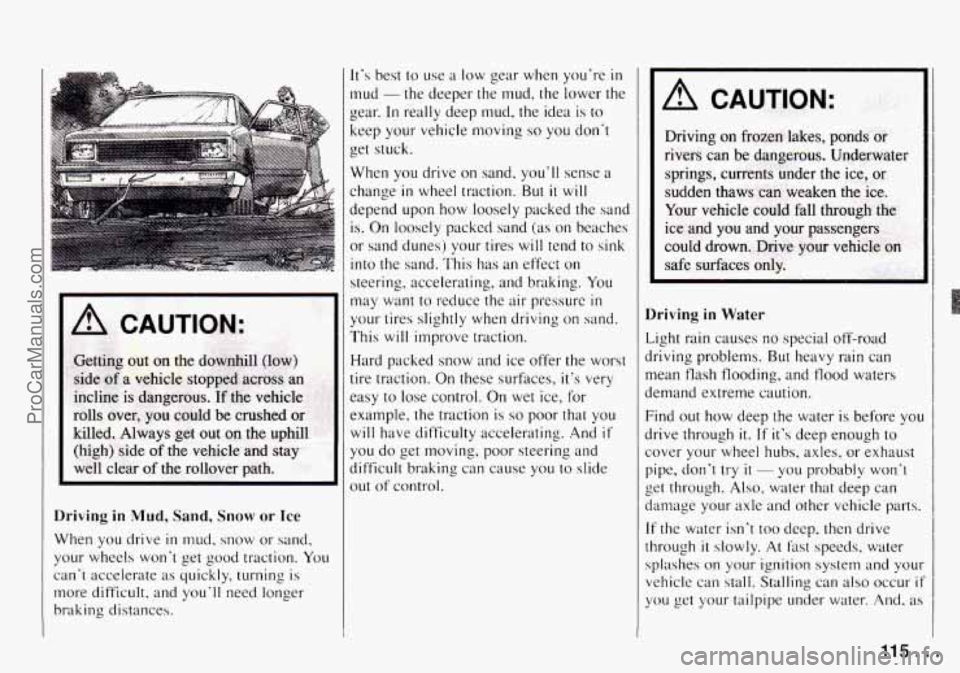
A CAUTION:
Driving in Mud, Sand, Snow or Ice
When you drive in mud, snow or sand,
your wheels won't get good traction. You
can't accelerate as quickly, turning is
more difficult, and you'll need longer
braking distances.
It's best to use a low gear when you're in
mud -the deeper the mud, the lower the
gear.
In really deep mud, the idea is to
keep your vehicle moving so you don't
get stuck.
When
you drive on sand, you'll sense a
change
in wheel traction. But it will
depend upon how loosely packed the sand
is. On loosely packed sand (as on beaches
or sand dunes) your tires will tend
to sink
into the sand. This has an effect on
steering. accelerating, and braking. You
may want to reduce the air pressure
in
your tires slightly when driving on sand.
This will improve traction.
Hard packed snow and ice offer the worst
tire traction. On these surfaces, it's very
easy
to lose control. On wet ice, for
example, the traction is
so poor that you
will have difficulty accelerating. .4nd
if
you do get moving, poor steering and
difficult braking can cause
you to slide
out of control.
A CAUTION:
Driving in Water
Light rain causes no special off-road
driving problems. But heavy rain can
mean tlash flooding, and tlood
waters
demand extreme caution.
Find out how deep the water is before you
drive through it.
If it's deep enough to
cover your wheel hubs, axles, or exhaust
pipe, don't
try il - you probably won't
get through.
Also, water that deep can
damage your axle and other vehicle parts.
If the water
isn't too deep, then drive
through
it slowly. At fast speeds. water
splashes on your ignition system and
your
vehicle can stall. Stalling can also occur if
you get your tailpipe under water. ,4nd, as
115 ...
ProCarManuals.com
Page 123 of 258

Your Driving and the Road
0 Know how to go down hills. The mosl
important thing
to know is this: let
your engine do some of the slowing
down. Shift
to a lower gear when you
go down a steep or long hill.
If you don’t shift down, your brakes
could get so hot that they wouldn’t
work well.
You would then have poor
braking
or even none going down a
hill. You could crash. Shift down to
let your engine assist your brakes on
a steep downhill slope.
A CAUTION:
t 0
1
0
0
0
Coasting downhill in “N” (Neutral)
or with the ignition off is dangerous.
Your brakes will have to do all the
work of slowing down. They could
get
so hot that they wouldn’t work
well.
You could crash. Always have
your engine running and your vehicle
in gear when you go downhill. Know how to
go
uphill. You may
want to shift down
to a lower gear.
The lower gears help cool your engine
and transmission. and you can climb the
hill better.
Stay
in yo~~r own lane when driving
on two-lane roads
in hills or
mountains.
Don’t swing wide or cut
~tcross
[he center of the road. Drive at
speeds
that let you stay in your own
lane.
As you go over the top of a hill. be
alert. There could be something
in
your lane. like a stalled car or an
accident.
You n~ay see highway signs
on
mountains that warn of special
problems. Examples are long grades,
passing or no-passing zones,
a falling
rocks area, or winding roads.
Be alert
to these and take appropriate action.
Winter Driving
Here are some tips for winter driving:
Have your Geo
in good shape for
winter.
Be sure your engine coolant
mix is correct.
You may want
to put winter
emergency supplies
in your vehicle.
. . .122
ProCarManuals.com
Page 131 of 258

Your Driving and the Road
2. Set the parking brake.
3. If your Geo is a four-wheel-drive
vehicle, set your manual freewheeling
hubs
to ”FREE” or unlock your
automatic I‘reewheeling hubs. See “Four-wheel Drive”
in the Index.
4. Turn the ignilion key to ”ACC’‘ to
unlock the steering wheel.
5. Clamp the steering wheel in a
straight-ahead position, with a
clamping device designed for towing.
6. Release the parking brake.
I NOTICE:
I
Make sure that the towing speed does
not exceed
55 mph (90 km/h), or
your Geo could be badly damaged.
~~
Towing Your Geo from the Front
NOTICE:
If your vehicle has automatic free-
wheeling hubs
or two-wheel drive,
do not tow
it on all four wheels. If
you do, your transmission could be
damaged.
If you have a four-wheel-drive vehicle
with manual freewheeling hubs, it can be
towed from the front with
all four wheels
on the ground. Follow these steps:
1. Set the parking brake.
2. Turn the ignition key to “ACC” to
unlock the steering wheel.
3. Shift your automatic transmission into
“P” (Park), or your manual
transmission into “2” (Second).
4. Shift the transfer case to “N”
(Neutral).
“Four-wheel Drive”
in the Index.
5. Set the hubs to “FREE.” See
6. Reledse the parking brake,
Stop towing every 200 miles
(300 km)
and start the engine. Leave the transfer
case shift lever
in ”N” (Neutral). Shift
your automatic transmission
to “D”
(Drive); leave a manual transmission
in
“2” (Second) and release the clutch. Run
the engine
at medium speed for one
minute to circulate the oil in the transfer
case. Turn the ignition key to
“ACC.”
Now, you can continue towing your Geo.
I
NOTICE:
I
Make sure the towing speed does not
exceed
SO mph (80 km/h), or your
Geo could be badly damaged.
I
. . .130
ProCarManuals.com
Page 134 of 258

I Jump Starting
If your battery has run down, you may
want to use another vehicle and some
jumper cables to start your Geo. But
please follow
the steps below to do it
safely.
NOTICE:
Ignoring these steps could result in
costly damage to your vehicle that
wouldn’t be covered by your war-
ranty.
Trying to start your Geo by pushing
or pulling it could damage your
vehicle, even if you have
a manual
transmission. And if you have an
automatic transmission,
it won’t start
that way.
To Jump Start Your Geo:
1. Check the other vehicle. It must have
a 12-volt battery with a negative
ground system.
NOTICE:
If the other system isn’t a 12-volt
system with
a negative ground, both
vehicles can be damaged.
2. Get the vehicles close enough so the
jumper cables can reach, but be sure
the vehicles aren’t touching each
other.
If they are, it could cause a
ground connection you don’t want.
You wouldn’t be able to start your
Geo, and
the bad grounding could
damage the electrical systems.
3. Turn off the ignition on both vehicles.
Turn off all lights that aren’t needed,
and radios. This will avoid sparks and
help save both batteries. And it could
save your radio!
I NOTICE:
I
I
If you leave your radio on, it could be
badly damaged. The repairs wouldn’t
be covered by your warranty.
I
133 ...
ProCarManuals.com
Page 138 of 258

G
A CAUTION:
To help avoid injury to you or others:
0
i.
0
0
0
0
Never let passengers ride in a
vehicle that
is being towed.
Never
tow faster than safe or
Never tow with damaged parts
not fully secured.
Never get under
your vehicle
after
it has been lifted by the tow
truck.
Always use seperate safety
chains
on each side when towing
a vehicle.
Never use
T-hooks. Use “J”
hooks instead.
posted speeds.
When your vehicle is being towed, have
the ignition key
off. The steering wheel
should
be clamped in a straight-ahead
position, with a clamping device designed
for towing service.
Do not use the
vehicle’s steering column
lock for this.
The transmi.ssion and transfer case,
if you
have one, should be in “Neutral” and the
parking brake released.
Don’t have
your vehicle towed with the
rear wheels
in contact with the ground. If
a vehicle must be towed from the front
with sling-type or wheel lift equipment,
the rear wheels
must be supported on a
If your vehicle has four-wheel drive,
don’t have
it towed on the front wheels
unless
you must. If a vehicle with
four-wheel drive
must be towed on the
front wheels,
set your tnanual,
freewheeling hubs
to “FREE” or unlock
your automatic freewheeling hubs, and set
your transfer case to two-wheel drive. If
your vehicle must be towed on the front
wheels, don‘t
go more than 55 rnph (90
km/h).
dolly.
131 . . . ProCarManuals.com
Page 199 of 258

Service and Appearance Care
Main Fuse Block
1 - Generator to Battery Circuit (60A)
2
- Circuits Only Active When
Ignition Switch is
in “ACC,” “ON”
or “START” (50A)
3
- Circuits Always Active (40A)
4 - Circuits Always Active (30A)
. . .198
nstrument Panel Fuse Block
- Right Headlight (15A)
~ - Left Headlight; High Beam Indicatol
Light
( 1 SA)
I- Taillights; Interior Light; Sidemarker Lights; Instrument Cluster Lights
( 1 SA)
. - Stop Lights; Horn (15A)
~ - Hazard Lights (15A)
I - Door Lock (Option) (20A)
’ - Lighter; Radio (20A)
1 - Ignition System; Warning and
1 - Turn Signal Lights; Back-up Lights
Indicator Lights
( 1 SA)
( 1 SA)
10 - Wiper/Washer ( 15A)
1 1 - Rear Defogger (1 5A)
12 - Heater
(25A)
13
- Rear Wheel Anti-Lock Main Relay
(20A)
14 - Electronic Fuel Injection Main
Relay
( 15A)
ProCarManuals.com
Page 247 of 258

Index
Fluid Automatic Transmission
....... 167
Brake
...................... 174
Manual Transmission
.......... 168
Power Steering ............... 173
Recommended
............... 225
Windshield Washer
........... 174
Foreign Countries. Fuels
in ....... 1.57
Foreign Material Paint Damage
.... 194
Four-wheel Drive
.............. 46
Four-wheel Drive (Service) ....... 170
Four-Wheel-Drive Vehicle. Off-Road
Driving With Your Geo
........ 108
Freeway Driving ............... 120
Freewheeling Hubs
Automatic
................. 47
Manual
..................... 46
Ashtray
..................... 63
Axle
....................... 170
Seat ........................ 10
Seat Side Pockets ............. 61
Seatbacks. Reclining .......... IO
Towing Hook-ups ............. 138
Fuel ......................... 156
FuelGage
..................... 69
Fuels in Foreign Countries ........ 157
Fuse Block, Instrument Panel ..... 198
Fuse Block, Main ............... 198
Fuses and Circuit Breakers ....... 196
Folding Rear
Seat
............... 13
Front Gages
Engine Coolant Temperature
.... 70
Fuel
....................... 69
Warning Lights and Indicators ... 68
Gasolines for Cleaner Air ........ 157
Glass
......................... 19 1
Glove Box .................... 60
GM Participation
in RBB Auto Line .
Alrernative Dispute Resolution
Program
.................. 235
Grips . Passenger Assist .......... 62
Guidelines. Driving ............. 107
Halogen Bulbs
............... 177
Hazard Warning Flashers
......... 132
Head Restraints
................ I1
Headlights .................... 177
Heater Controls
................ 84
Heater. Engine Coolant
(Block) .... 41
Heating ....................... 84
Highway Hypnosis
.............. 12 1
Hill and Mountain Roads ......... 121
Hill. Approaching a ............. 1 IO
Hitches ....................... 126
Hood Release .................. IS9
Hood . Checking Things under the . . 159
Hook.Ups . Front Towing ......... 138
Hook.Ups. Rear Towing
......... I39
Horn ......................... 53
Headlight High/Low Beam ....... 56
How to Add Coolant to the
How
to Add Coolant to the
Hubs. Freewheeling
Coolant
Recovery Tank
........ 142
Radiator
............... . .144
Automatic
................... 47
Manual
..................... 46
Hydroplaning .................. 118
Hypnosis. Highway
............. 121
Identification Number. Vehicle .... 196
Identification. Engine ............ 196
If a Tire Goes Flat .............. 146
If You’re Stuck: In Sand. Mud. Ice
or Snow .................... 153
Ignition Switch
................. 39
Incline
. Driving Across an ........ 113
Incline. Stalling on
an ........... 114
Intlation - Tire Pressure .......... 184
Inside Day/Night Rearview Mirror
...................... 59
Inside Rearview Mirror
.......... 59
Instrument Cluster .............. 66
Instrument Panel ............... 64
Instrument Panel Bins
........... 61
Instrument Panel Fuse Block ...... 198
Instrument Panel
. Cleaning the
Topof
..................... 191
Interior Lights ................. 57
Jump Starting
................. 133
... 246
ProCarManuals.com
Page 251 of 258
Index
Steam Corning from Your Engine . . 140
Column. Adjustable
........... 53
Fluid. Power ................. 173
Power
...................... 104
Steering
...................... 104
In Emergencies ............... 105
Tips
........................ 104
Compartments. Door
.......... 60
Storage
Preparing Your Canvas Top for
. . 80
Vehicle
..................... 176
Stuck: In Sand. Mud. Ice or Snow
. . 153
Sun Visors
.................... 61
Sunroof. Opening and Closing
Your
....................... 74
Switch. Ignition
................ 39
Symbols. Vehicle
............... 7
Symbols. Safety Warnings and .... 5
Tachometer .................. 68
Tailgate
....................... 38
Tank. Filling Your .............. 158
Temperature Control Lever ....... 84
Terrain. Scanning
the ............ 109
Theft ......................... 39
Theft Deterrent Feature AM/FM Stereo
with Cassette Tape
AM/FM Stereo
with Cassette Tape
and Compact Disc Player
..... 96
Player
.................... 91
Thermostat .................... 172
... 250
Tips. Steering ................ 104
Tips. Ventilation
................ 87
Tires
......................... 183
Balance. Wheel Alignment and
. . 187
Buying New ................. 186
Chains
..................... 188
Inflation Pressure
............. 184
Inspection and Rotation
........ 185
Temperature Grades
........... 187
Traction Grades
.............. 187
Treadwear
................... 186
Uniform Quality Grading
....... 186
When It’s Time for New
....... 186
AM/FM Stereo
............... 89
and Compact Disc Player
..... 93
Player
.................... 90
Top Strap (Child Restraints)
....... 28
Top. Convertible
................ 72
Torque
Lock .................. 49
Towing
A Trailer .................... 125
Rear Hook-Ups
.............. 139
Recreational Vehicle
.......... 129
Your Vehicle
................. 136
Trailer Brakes
.................. 127
Changing a Flat .............. 146
Loading
.................... 18 I
Tone. Setting the
AM/FM Stereo
with Cassette Tape
AM/FM Stereo
with Cassette Tape
Front Hook-Ups
.............. 138 Trailer. Towing
a
............... 125
Transfer Case
.................. 47
Transfer Case (Service)
.......... 170
Transmission Automatic
................... 42
Fluid. Automatic
............. 167
Fluid. Manual
................ 168
Manual
..................... 44
Transportation. Courtesy
......... 237
Traveling to Remote Areas
....... 109
Trip Odometer
................. 67
Trip. Before Leaving on a Long
.... 120
Turn Signal and Lane Change
Indicator
.................... 54
Turn SignalLights Control/Headlight
Beam Lever
................. 54
Underbody Maintenance ....... 194
Understanding Radio Reception ... 97
Uniform Tire Quality Grading
..... 186
Uphill. Driving ................. 111
Used Oil. What to Do With ....... 165
Used Replacement Wheels
........ 189
Using the Recovery Hooks ....... 154
Vehicle Control of a
................. 102
Damage Warnings ............ 6
Dimensions ................. 202
Environment and Your
......... 204
Identification Number
(VIN) .... 196
ProCarManuals.com