lights CHEVROLET TRACKER 1994 Owner's Manual
[x] Cancel search | Manufacturer: CHEVROLET, Model Year: 1994, Model line: TRACKER, Model: CHEVROLET TRACKER 1994Pages: 258, PDF Size: 14.43 MB
Page 129 of 258

Your Driving and the Road
passed vehicle before vou can return to
your lane.
Backing Up
Hold the bottom of the steering wheel
with one hand. Then, to move the trailer
to the left, just move that hand to the left.
To move
the trailer to the right, move
your hand to the right. Always back up
slowly and,
if possible, have someone
guide you.
Making Turns
When you’re turning with a trailer, make
wider turns than normal.
Do this so your
trailer won’t strike soft shoulders, curbs,
road signs, trees, or other objects. Avoid
jerky or sudden maneuvers. Signal well
in
advance.
Turn Signals When Towing a Trailer
When you tow a trailer, your vehicle has
to have a different turn signal flasher and
extra wiring. The green arrows on your
instrument panel will flash whenever you
signal a turn or lane change. Properly
hooked up, the trailer lights will also
flash, telling other drivers you’re about to
turn, change lanes or stop. When towing
a trailer, the green arrows
on your instrument panel will flash for
turns even
if the bulbs on the trailer are
burned out. Thus, you may think drivers
behind you are seeing your signal when
they are not. It’s important to check
occasionally to be sure the trailer bulbs
are still working.
Driving on Grades
Reduce speed and shift to a lower gear
before you start down a long or steep
downgrade. If you don’t shift down, you
might have to use your brakes
so much
that they would get hot and no longer
work well.
On a long uphill grade, shift down and
reduce your speed to around
45 mph
(70 km/h) to reduce the possibility of
engine and transmission overheating.
If
you are towing a trailer and you have
a manual transmission with fifth gear,
you may prefer not
to use fifth gear. Just
drive in fourth gear (or, as
you need to,
.a lower gear).
Parking on Hills
You really should not park your vehicle,
with a trailer attached, on a hill. If
something goes wrong, your
rig could start
to move. People can be injured, and
both your vehicle and the trailer can be
damaged.
But if you ever have to park
your rig on a
hill, here’s how to do it:
1. Apply your regular brakes, but don’t
shift into
“F’” (Park) yet, or into gear
for a manual transmission.
2. Have someone place chocks under the
3. When the wheel chocks are in place,
release the regular brakes until the
chocks absorb the load.
trailer wheels.
4. Reapply the regular brakes.
Then
apply your parking brake, and then
shift to
‘T” (Park), or “R” (Reverse)
for a manual transmission.
5. If you have a four-wheel-drive
vehicle, be sure the transfer case is
in
a drive gear - not in “N” (Neutral).
6. Release the regular brakes.
. .-’ . 1 28
ProCarManuals.com
Page 133 of 258
Problems on the Road
j
Hazard Warning
Flashers
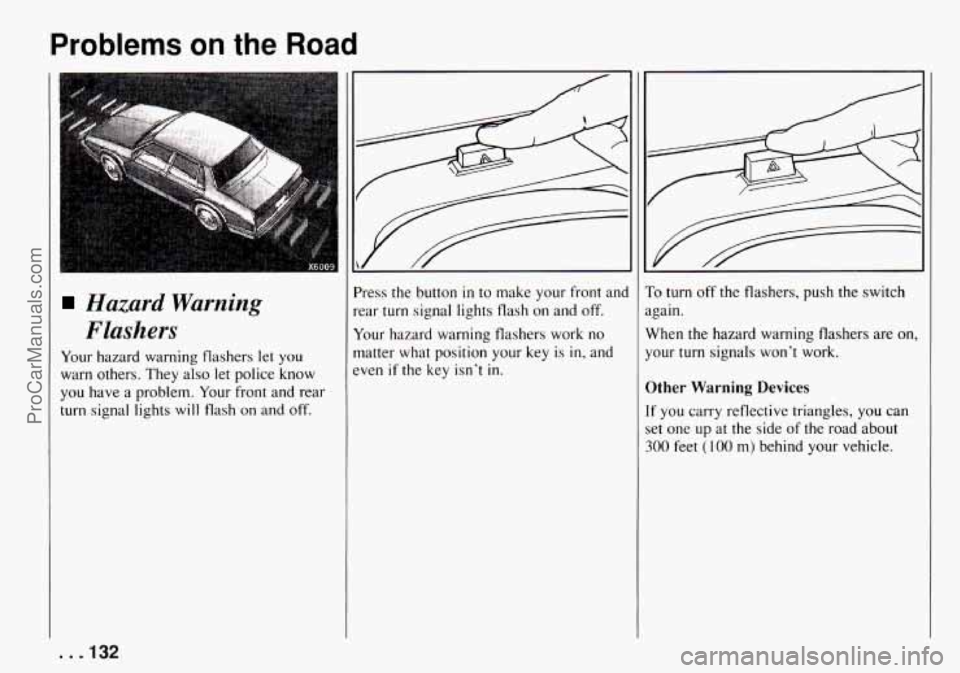
Your hazard warning flashers let you
warn others. They also let police know
you have a problem. Your front and rear
turn signal lights
will tlash on and off. Press the button
in to make your front and
rear
turn signal lights flash on and off.
Your hazard warning flashers work no
matter what position your key
is in, and
even
if the key isn't in.
To turn off the flashers, push the switch
again.
When the hazard warning flashers are on,
your turn signals won't work.
Other Warning Devices
If you carry reflective triangles, you can
set one up at the side
of the road about
300 feet (100 m> behind your vehicle.
. . .I32
ProCarManuals.com
Page 134 of 258

I Jump Starting
If your battery has run down, you may
want to use another vehicle and some
jumper cables to start your Geo. But
please follow
the steps below to do it
safely.
NOTICE:
Ignoring these steps could result in
costly damage to your vehicle that
wouldn’t be covered by your war-
ranty.
Trying to start your Geo by pushing
or pulling it could damage your
vehicle, even if you have
a manual
transmission. And if you have an
automatic transmission,
it won’t start
that way.
To Jump Start Your Geo:
1. Check the other vehicle. It must have
a 12-volt battery with a negative
ground system.
NOTICE:
If the other system isn’t a 12-volt
system with
a negative ground, both
vehicles can be damaged.
2. Get the vehicles close enough so the
jumper cables can reach, but be sure
the vehicles aren’t touching each
other.
If they are, it could cause a
ground connection you don’t want.
You wouldn’t be able to start your
Geo, and
the bad grounding could
damage the electrical systems.
3. Turn off the ignition on both vehicles.
Turn off all lights that aren’t needed,
and radios. This will avoid sparks and
help save both batteries. And it could
save your radio!
I NOTICE:
I
I
If you leave your radio on, it could be
badly damaged. The repairs wouldn’t
be covered by your warranty.
I
133 ...
ProCarManuals.com
Page 171 of 258
~~
~~ ~ ~~~~ ~ Service and Appearance Care
Four- Wheel Drive
Most
lubricant checks in this section also
apply to four-wheel-drive vehicles.
However, they have
two additional
systems that need lubricatiog.
Transfer Case
When to Check qnd Change Lubricant
Refer to the Maintenance Schedule to
determine how often to check the
lubricant and when to change
it. See
“Scheduled Maintenance Services”
in the
Index.
How to Check Lubricant
If the level is below the bottom of the
filler plug hole, you’ll need to add some
lubricant. Add enough lubricant to raise
the level to the bottom of the filler plug
hole.
What to Use
Refer to the Maintenance Schedule to
determine what kind of lybricant to use.
See “Recommended Fluids and
Lubricants”
in the Index.
Front Axle
When
to Check and Change Lubricant
Refer to the Maintenance Schedule to a
determine how often to check the
lubricant and when to change it. See
“Periodic Maintenance Inspections” and
“Scheduled Maintenance Services”
in the
Index.
How to Check Lubricant
If the level is below the bottom of the
filler plug hole, you’ll need to add some
lubricant.
If the differential is at operating
temperature (warm), add enough lubricant
to raise the level to the bottom of the filler
plug hole.
If the differential
is cold, add enough
lubricant to raise the level to
1/2 inch (12
mm) below the filler plug hole.
What to Use
Refer to the Maintenance Schedule to
determine
what kind of lubricant to use.
See “Recommended Fluids and
Lubricants”
in the Index.
Engine Coolant
The following explains your cooling
system and how to add coolant when it is
low. If you have a problem with engine
overheating, see “Engine Overheating”
in
the Index.
The proper coolant for your Geo will:
Give freezing protection down to
-20°F (-29”C), or -34°F (-37°C)
in
Canada and for vehicles with the cold
climate option.
Give boiling protection up to 258°F
(125°C).
Protect against rust and corrosion.
Help keep the proper engine
temperature.
Let the warning lights work as they
should.
What to Use:
Use a mixture of one-half clean water
(preferably distilled) and one-half
antifreeze that meets “GM Specification
6038-M,” which won’t damage aluminum
parts.
You can also use a recycled coolant
conforming to
“GM Specification
6038-M”
with a complete coolant flush
. . .I70
ProCarManuals.com
Page 178 of 258
will help keep your battery from running
down.
Contact your dealer to learn how to
prepare your vehicle for longer storage
periods. Bulb Replacement
See “Replacement Bulbs” in the Index to
check the size and type of bulb you need
to use.
Halogen Bulbs
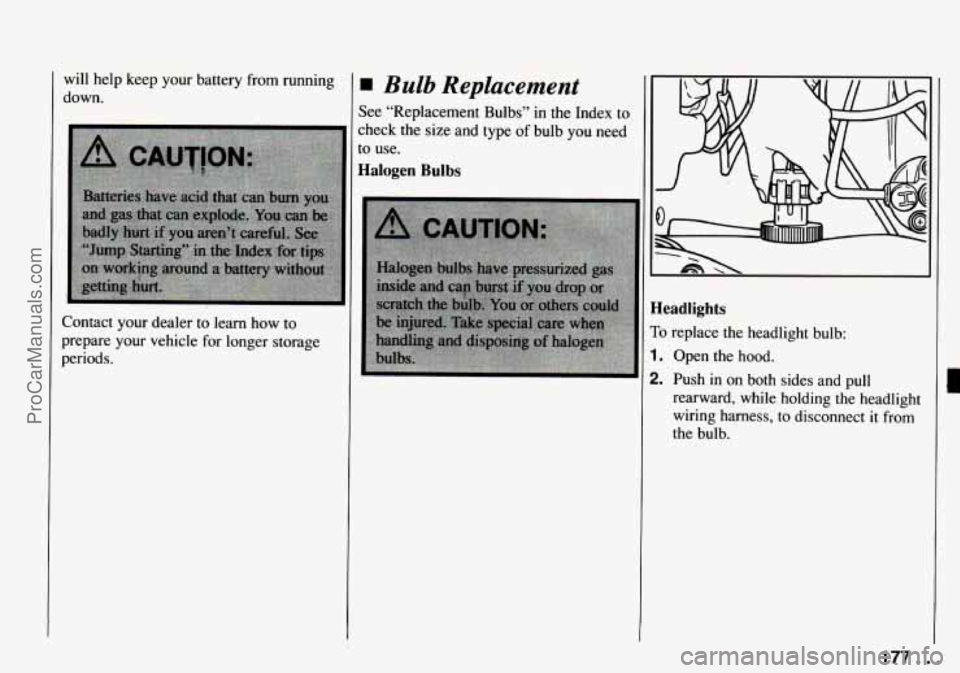
Headlights
To replace the headlight bulb:
1. Open the hood.
2. Push in on both sides and pull
rearward, while holding the headlight
wiring harness, to disconnect it from
the bulb.
177 ... ProCarManuals.com
Page 179 of 258
Service and Appearance Care
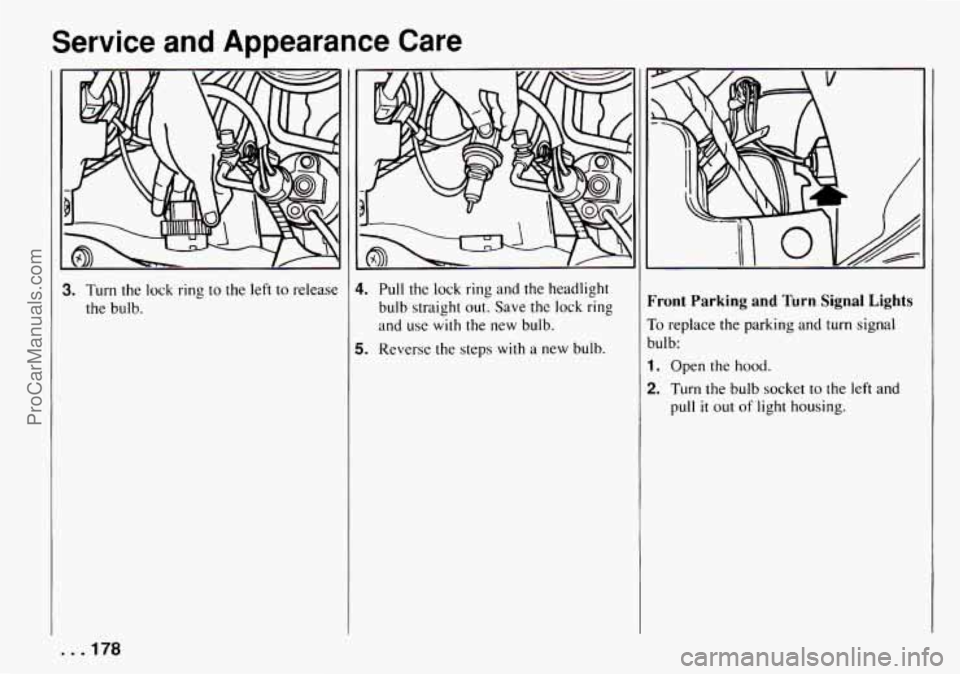
3. Turn the lock ring to the left to release
the bulb. 4. Pull the lock ring and the headlight
bulb straight out. Save the lock ring
and use with
the new bulb.
5. Reverse the steps with a new bulb.
Front Parking and Turn Signal Lights
ro replace the parking and turn signal
mlb:
I. Open the hood.
2. Turn the bulb socket to the left and
pull
it out of light housing.
. . .178
ProCarManuals.com
Page 180 of 258
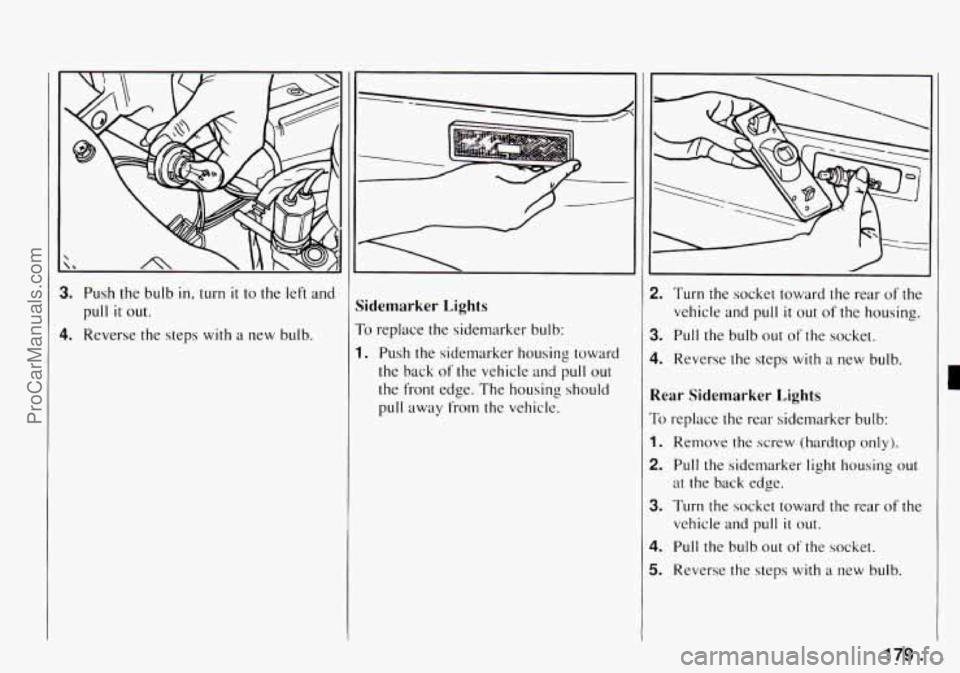
3. Push the bulb in, turn it to the left and
4. Reverse the steps with a new bulb.
pull it out. Sidemarker Lights
ro replace the sidemarker bulb:
I. Push the sidemarker housing toward
the back
of the vehicle and pull out
the front edge. The housing should
pull away from the vehicle.
2. Turn the socket toward the rear of the
vehicle and pull
it out of the housing.
3. Pull the bulb out of the socket.
4. Reverse the steps with a new bulb.
Rear Sidemarker Lights
To replace the rear sidemarker bulb:
1. Remove the screw (hardtop only).
2. Pull the sidemarker light housing out
3. Turn the socket toward the rear of the
at the back edge.
vehicle and pull
it out.
4. Pull the bulb out ofthe socket.
5. Reverse the steps with a new bulb.
179 ... ProCarManuals.com
Page 181 of 258
Service and Appearance Care
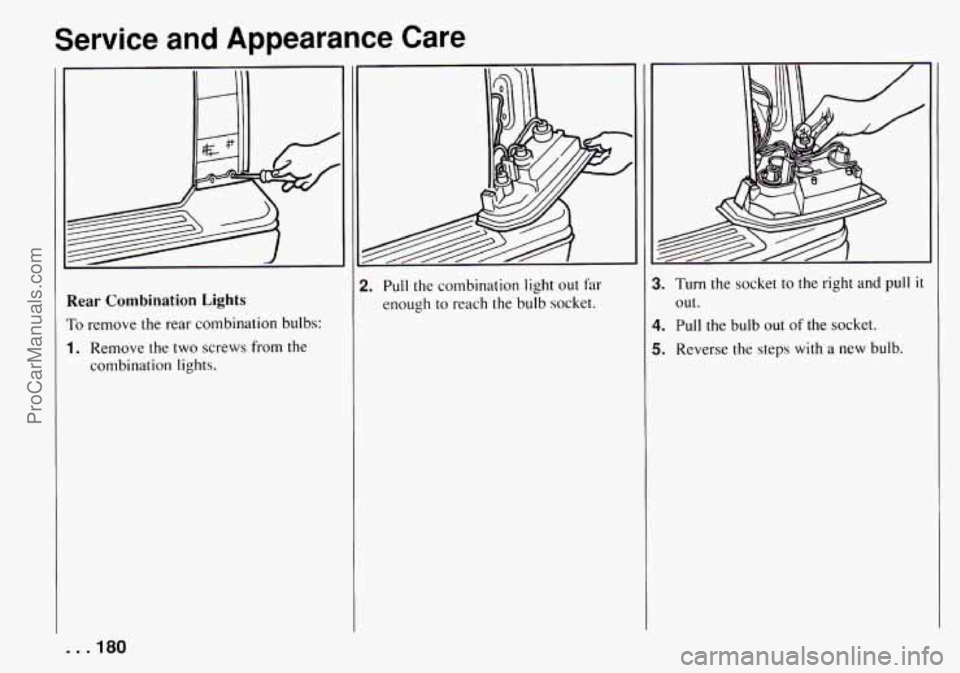
Rear Combination Lights
To remove the rear combination bulbs:
1. Remove the two screws from the
combination lights.
2. Pull the combination light out Fdr
enough to reach the bulb socket. 1. Turn the socket to the right and pull it
1. Pull the bulb out of the socket.
i. Reverse the steps with a new bulb.
out.
. . .I80
ProCarManuals.com
Page 198 of 258

For access to the main fuses, pull off the
cover.
A spare fuse is also inside the fuse
box.
bother fuse box is under the left side of
he instrument panel. The fuses here
Jrotect each separate circuit including
leadlights.
If you have electrical failure,
:heck here first. Look at the
silver-colored band inside the
fuse.
If the band is broken or melted,
replace the fuse. Be sure you replace a
bad fuse
with a new one of the correct
size.
If you ever have a problem on the road
and don’t have a spare fuse, you can
borrow one. Just pick some feature of
your vehicle that you can get along
without
- like the radio or cigarette
lighter
- and use its fuse, if it is the size
you need. Replace
it as soon as you can.
Before replacing a fuse,
turn every
vehicle electrical \witch off.
197. I ProCarManuals.com
Page 199 of 258

Service and Appearance Care
Main Fuse Block
1 - Generator to Battery Circuit (60A)
2
- Circuits Only Active When
Ignition Switch is
in “ACC,” “ON”
or “START” (50A)
3
- Circuits Always Active (40A)
4 - Circuits Always Active (30A)
. . .198
nstrument Panel Fuse Block
- Right Headlight (15A)
~ - Left Headlight; High Beam Indicatol
Light
( 1 SA)
I- Taillights; Interior Light; Sidemarker Lights; Instrument Cluster Lights
( 1 SA)
. - Stop Lights; Horn (15A)
~ - Hazard Lights (15A)
I - Door Lock (Option) (20A)
’ - Lighter; Radio (20A)
1 - Ignition System; Warning and
1 - Turn Signal Lights; Back-up Lights
Indicator Lights
( 1 SA)
( 1 SA)
10 - Wiper/Washer ( 15A)
1 1 - Rear Defogger (1 5A)
12 - Heater
(25A)
13
- Rear Wheel Anti-Lock Main Relay
(20A)
14 - Electronic Fuel Injection Main
Relay
( 15A)
ProCarManuals.com