washer fluid CHEVROLET TRACKER 1994 Owners Manual
[x] Cancel search | Manufacturer: CHEVROLET, Model Year: 1994, Model line: TRACKER, Model: CHEVROLET TRACKER 1994Pages: 258, PDF Size: 14.43 MB
Page 59 of 258

Features and Controls
For a single wiping cycle, push the lever
to “MIST.” Hold it there until the wipers
start, hen let
go. The wipers will stop
after one cycle. If you want more cycles,
hold the lever
on “MIST.” longer.
Washers
Pull the wiper/washer lever toward you to
spray washer fluid’on
the windshield. The
spray will continue
until you release the
lever. This will also turn on the low speed
wipers.
Heavy snow or ice can overload your
wipers.
A circuit breaker will stop them
until the motor cools. Clear away snow or
ice to prevent an overload.
NOTICE:
0
0
0
0
When using concentrated washer
fluid, follow the manufacturer’s
instructions for adding water.
Don’t
mjx water with
ready-to-use washer fluid. Water
can cause the solution
to freeze
and damqge your washer fluid
tank and other parts of the
washer system. Also, water
doesn’t clean as well as washer
fluid.
Fill your washer fluid
tank only
3/4 full when it’s very cold. This
allows
for expansion, which
could damage the tank
if it is
compldtel) full.
Don’t use radiator antifreeze in
your wipdshield washer. It can
damage your paint.
... 58
ProCarManuals.com
Page 60 of 258
n
I
i
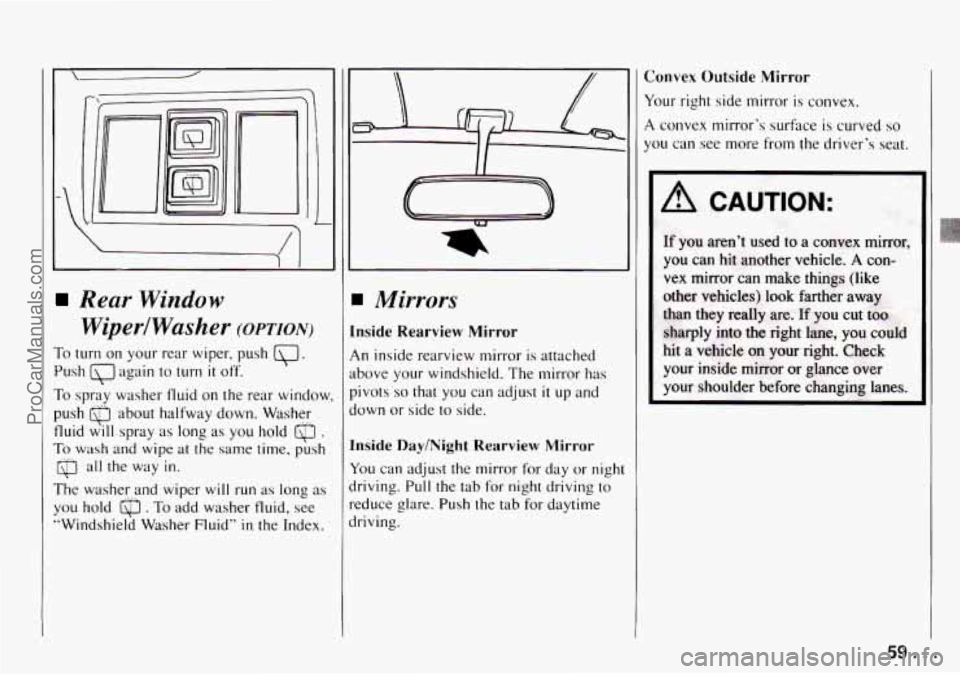
Rear Window WiperlWasher
(OPTION)
To turn on your rear wiper, push Q.
Push Q again to turn it off.
To spray washer fluid on the rear window,
push
Q about halfway down. Washer
fluid will spray as long
as you hold IQ .
To wash and wipe at the same time, push
IQ all the way in.
The washer and wiper will run as long as
you hold
Q . To add washer fluid, see
“Windshield Washer Fluid”
in the Index.
Mirrors
Inside Rearview Mirror
An inside rearview mirror is attached
above your windshield. The mirror has
pivots
so that you can adjust it up and
down or side
to side.
Inside Day/Night Rearview Mirror
You can adjust the mirror for day or night
driving. Pull the tab for night driving
to
reduce glare. Push the tab for daytime
driving.
Convex Outside Mirror
Your right side mirror is convex.
A convex mirror‘s surface is curved so
you can see more from the driver’s seat.
59 ...
ProCarManuals.com
Page 121 of 258
Your Driving and the Road
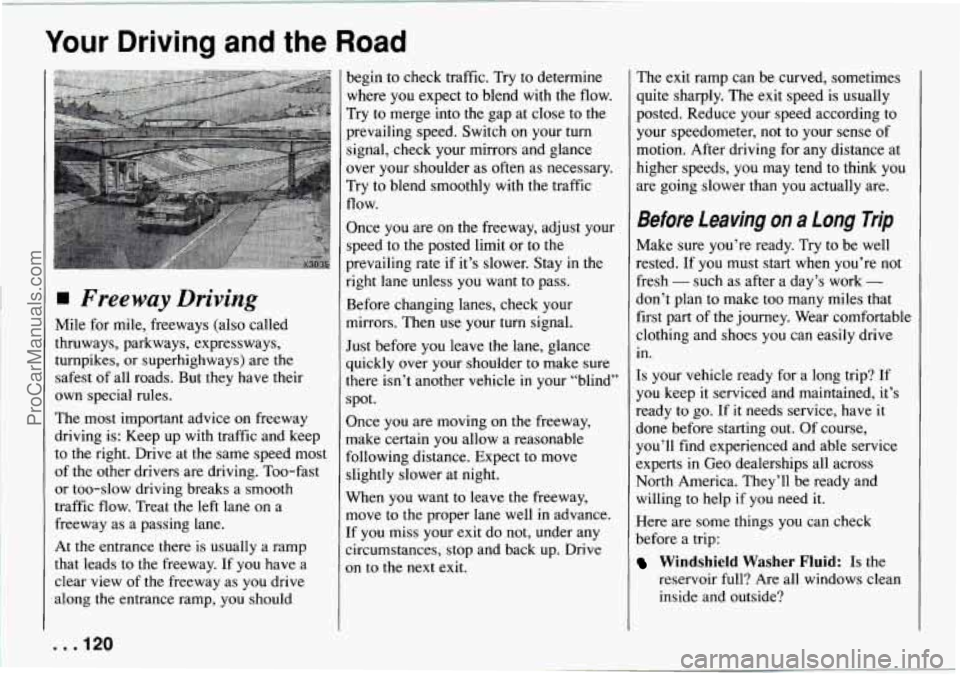
Freeway Driving
Mile for mile, freeways (also called
thruways, parkways, expressways,
turnpikes, or superhighways) are
the
safest of all roads. But they have their
own special rules.
The most important advice on freeway
driving is: Keep up with traffic and keep
to the right. Drive at the same speed most
of the other drivers are driving. Too-fast
or too-slow driving breaks
a smooth
traffic flow. Treat the left lane on a
freeway as a passing lane.
At
the entrance there is usually a ramp
that leads to the freeway. If
you have a
clear view of the freeway as you drive
along the entrance ramp, you should
1
1
1
f
t
1
!
1
I
1
I
I
I
3egin to check traffic. Try to determine
where you expect to blend with the flow.
Try to merge into the gap at close to the
prevailing speed. Switch on your turn
signal, check your mirrors and glance
wer your shoulder as often as necessary.
Try to blend smoothly with the traffic
flow.
Once you are on the freeway, adjust your
speed to the posted limit or to the
prevailing rate if it’s slower. Stay in the
right lane unless
you want to pass.
Before changing lanes, check your
mirrors. Then use your turn signal.
Just before you leave the lane, glance
quickly over your shoulder to make sure
there isn’t another vehicle in your “blind”
spot.
Once you are moving on the freeway,
make certain
you allow a reasonable
following distance. Expect to move
slightly slower at night.
When you want to leave
the freeway,
move to the proper lane well in advance.
If you miss your exit do not, under any
circumstances, stop and back up. Drive
on to the next exit. I’he
exit ramp can be curved, sometimes
pite sharply. The exit speed
is usually
3osted. Reduce your speed according to
your speedometer, not to your sense of
motion, After driving for any distance at
higher speeds, you may tend to think you
are going slower than you actually are.
Before Leaving on a Long Trip
Make sure you’re ready. Try to be well
rested,
If you must start when you’re not
Fresh
- such as after a day’s work -
don’t plan to make too many miles that
Fist part of the journey. Wear comfortable
clothing and shoes
you can easily drive
in.
[s your vehicle ready for a long trip? If
you keep it serviced and maintained, it’s
ready to
go. If it needs service, have it
done before starting out. Of course,
you’ll find experienced and able service
experts in Geo dealerships all across
North America. They’ll be ready and
willing to help if
you need it.
Here are some things you can check
before a trip:
Windshield Washer Fluid: Is the
reservoir full? Are all windows clean
inside and outside?
. . .I20
ProCarManuals.com
Page 124 of 258
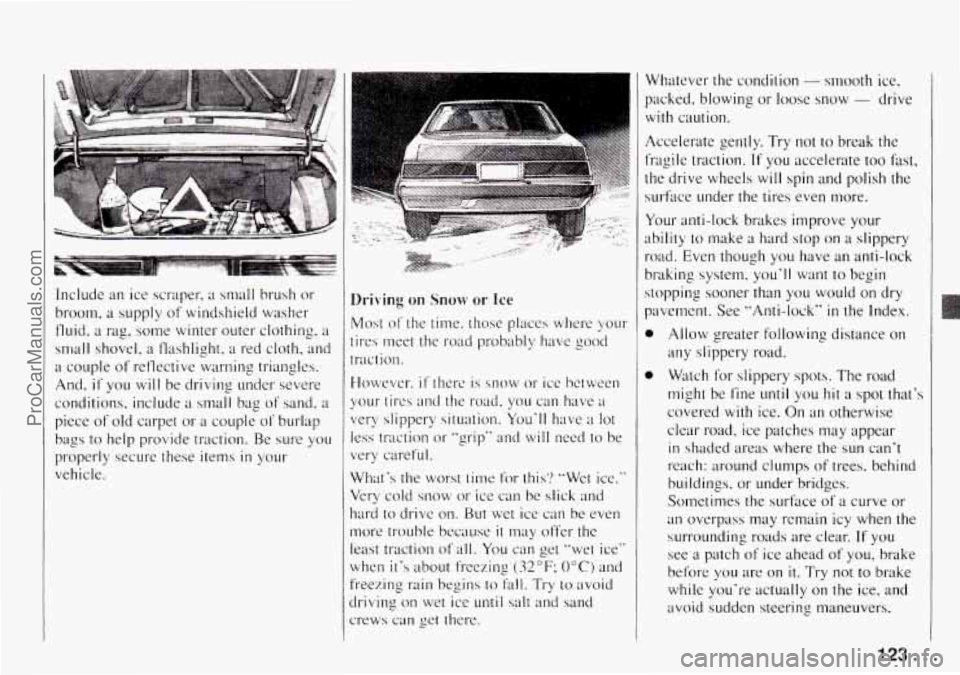
Include an ice scraper7 a small brush or
broom. a supply of windshield washer
fluid,
a rag, some winter outer clothing, a
small shovel, a flashlight, a red cloth, and
a couple of reflective warning triangles.
And,
if you will be driving under severe
conditions, include
:I small bag of sand, ;I
piece of old carpet or a couple of burlap
bags to
help provide traction. Be sure yo11
properl}, secure these item in your
vehicle.
Driving on Snow or Ice
Most of the time. those placcs where your
tires meet the road probably have good
traction.
Howe\w-.
it’ thcrc is snow or ice between
your tires antl the road, you can Iwve ;I
very slippery situation. You‘ll have ;t lot
less traction or “grip“ and will need to be
very careful.
What‘s the worst time
for this’? “Wet ice.”
Very cold snow
or ice can be slick and
hurd to drive on. Rut wet ice can be even
more trouble because
it nlay offer the
least traction
of all. You can get ”wet ice”
when it’s about freezing
(32°F; 0°C) and
freezing rain begins to fall. Try to avoid
hiving on wet ice
until salt and sand
:rews
can get there. Whatever the condition
- smooth ice.
packed. blowing or loose snow
- drive
with caution.
Accelerate gently. Try not
to break the
fragile traction. If you accelerate too fast,
the drive wheels will spin and polish the
surface under the tires even more.
Your anti-lock brakes improve your
ability
to make a hard stop on a slippery
road. Even though you have
an anti-lock
braking system.
you’ll want to begin
stopping sooner than
you would on dry
pavement.
See “Anti-lock” in the Index.
0
0
Allow greater following distance on
any slippery road.
Watch for slippery spots. The road
might be fine
until you hit H spot that’s
covered with ice.
On an otherwise
clear road. ice patches may appear
in shaded areas where the sun can’t
reach: around clumps
of trees. behind
buildings, or under bridges.
Sometimes the surftlce
of a curve or
an overpass may remain icy when the
surrounding roads are clear.
If you
see a patch of ice ahead of you, brake
before you are on
it. Try not to brake
while
you’re actually on the ice, and
avoid sudden steerins maneuvers.
123 ...
ProCarManuals.com
Page 156 of 258
Here you will find information
about the care of your Geo
. This
part begins with service and fuel
information. and then it shows
how to check important fluid and
lubricant levels
. There is also
technical information about your
vehicle. and a section devoted
to its appearance care
.
Service & Appearance Care
Service ........................................................
Fuel ..........................................................
Checking Things under the Hood ...................................
HoodRelease .................................................
Engineoil ...................................................
Aircleaner ...................................................
Automatic Transmission Fluid ....................................
Manual Transmission Fluid ......................................
Clutch Adjustment .............................................
RearAxle ....................................................
Four-WheelDrive .............................................
Enginecoolant ................................................
Power Steering Fluid ...........................................
Windshield Washer Fluid ........................................
Brake Master Cylinder ..........................................
Bulb Replacement ...............................................
Loading Your Vehicle ..........................................
Tires ........................................................
Appearance Care Materials Chart ...................................
Vehicle Identification Number (VIN) ................................
Service Parts Identification Label ...................................
Add-on Electrical Equipment ......................................
Fuses and Circuit Breakers ........................................
Capacities and Specifications .......................................
Battery ......................................................
Appearancecare ................................................
ReplacementBulbs ..............................................
156
156
159
159
162
165
167
168
169 169
170 170
173
174
174
176 177
181
183
189 195 196
196
196
196
199
200
155 ...
ProCarManuals.com
Page 161 of 258
Service and Appearance Care
6% CAUTION:
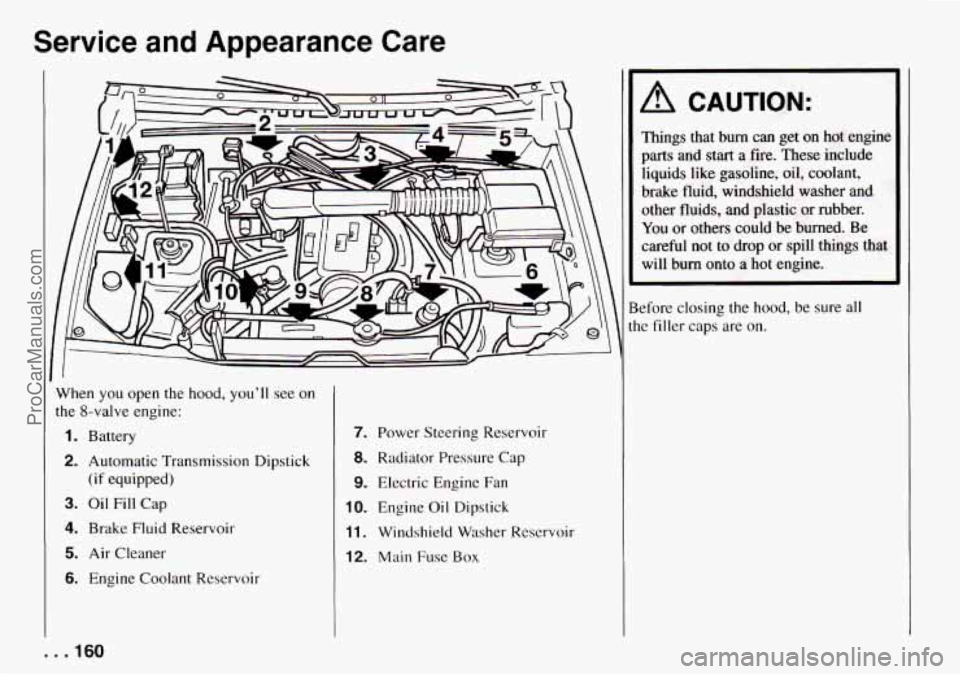
When you open the hood, you’ll see on
the 8-valve engine:
1. Battery
2. Automatic Transmission Dipstick
3. Oil Fill Cap
4. Brake Fluid Reservoir
5. Air Cleaner
6. Engine Coolant Reservoir
(if equipped)
7. Power Steering Reservoir
8. Radiator Pressure Cap
9. Electric Engine Fan
IO. Engine Oi I Dipstick
11. Windshield Washer Rescrvoir
12. Main Fuse Box
Things that burn can get on hot engine
parts and start a fire. These include
liquids like gasoline, oil, coolant,
brake fluid, windshield washer and
other fluids, and pXastic OT rubber.
You or others could be burned. Be
careful not to drop or spill things that
will burn onto a hot engine.
Before closing the hood, be sure all
the filler caps are on.
. . .160
ProCarManuals.com
Page 162 of 258
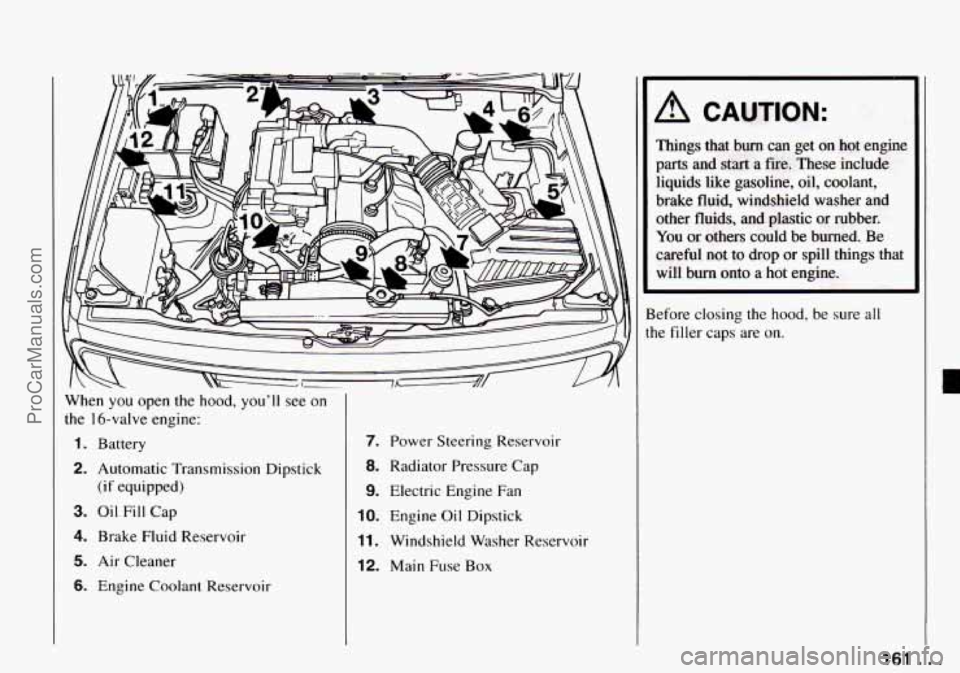
When you open the hood, you’ll see on
the 16-valve engine:
1. Battery
2. Automatic Transmission Dipstick
3. Oil Fill Cap
4. Brake Fluid Reservoir
5. Air Cleaner
6. Engine Coolant Reservoir (if equipped)
7. Power Steering Reservoir
8. Radiator Pressure Cap
9. Electric Engine Fan
IO. Engine Oil Dipstick
11. Windshield Washer Reservoir
12. Main Fuse Box
A CAUTION:
Things that bm can get on hot engiae
parts and start a fxe. These include
liquids like gasoline, oil, coolant,
brake fluid, windshield
washer and
other fluids, and plastic or rubber.
You
or others could be burned. Be
careful not to drop or spill things that
will bum onto a hot engine.
Before closing the hood, be sure all
the filler caps are on.
161 ... ProCarManuals.com
Page 175 of 258
Service and Appearance Care
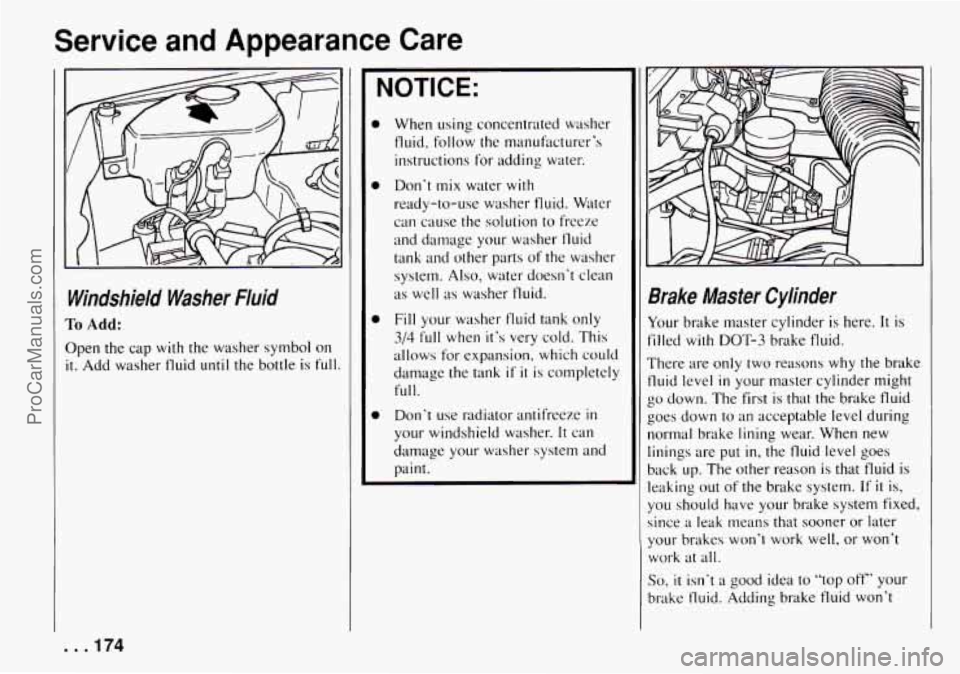
Windshield Washer Fluid
To Add:
Open the cap with the washer symbol on
it. Add washer fluid until the bottle is full.
NOTICE:
When using concentrated washer
tluid, follow the manuficturer’s
instructions for adding water.
Don’t mix water with
ready-to-use washer fluid. Water
can cause the solution to freeze
and damage
your washer fluid
tank and other parts
of the washer
system. Also, water doesn’t clean
as well
as washer tluid.
Fill your washer tluid tank only
3/4 full when it’s very cold. This
allows for expansion, which could
damage the
tank if it is completely
full.
Don’t use radiator antifreeze in
your windshield washer. It can
damage your washer system and
paint.
Brake Master Cylinder
Your brake master cylinder is here. It is
‘illed with
DOT-3 brake fluid.
I‘here are
only two reasons why the brake
fluid level
in your master cylinder might
go down. The first is that the brake fluid
goes down
to an acceptable level during
lormal brake lining wear. When new
iinings are put
in, the fluid level goes
mck
up. The other reason is that tluid is
leaking out of the brake system.
If it is,
you should have your brake system fixed,
;ince a leak means that sooner or later
your brakes won’t work well,
or won’t
work
at all.
So, it isn‘t a good idea to “top off’ your
brake fluid. Adding brake tluid won’t
. . .I74
ProCarManuals.com
Page 219 of 258
Maintenance Schedule
iection B: Owner Checks and Services
Listed below are owner checks and services which should be performed at the intervals specified to help ensure the safety,
dependability and emission control performance of your vehicle. Be sure any necessary repairs are completed at once. Whenever
any fluids or lubricants are added to your vehicle, make sure they are the proper ones, as shown in Section
D.
At Each Fuel Fill (It is important for you or a service station attendant to perform these underhood checks at each fuel fill.)
CHECK
OR SERVICE I WHAT TO DO
Engine Oil Level
Check the engine coolant level and add the proper coolant mix
if necessary. See “Coolant” in Engine Coolant Level Check the engine
oil level and add the proper oil if necessary. See “Engine Oil” in the Index for
further details.
the Index for further details.
Windshield Washer
Pull
the primary hood latch release handle inside the vehicle. The secondary latch should keep
Hood Latch Operation necessary. See “Windshield Washer
Fluid”
in the Index for further details.
Fluid Level Check
the windshield washer fluid level in
the windshield washer tank and add the proper fluid if
the hood from opening all the way when the primary latch is released. Make sure the hood closes
firmly. See “Hood Release” in the Index for further details.
. . .218
ProCarManuals.com
Page 228 of 258

USAGE
Rear Axle (All) and
Front Axle (Four-
Wheel Drive)
Windshield Washer Solvent
Transfer Case (Four-
Wheel Drive)
Hood Latch Assembly
a. Pivots and Spring
b. Release Pawl
Anchor
Hood, Door and Lift-
gate Hinges, Rear
Folding Seat, Fuel
Door Hinge, Rear
Compartment Lid
Hinges
Weatherstrips
FLUID/LUBRICANT
SAE 7SW-90 GL-5 Hypoid Gear Lubricant.
GM Optikleen@ Washer Solvent (GM Part No. 105 15 15) or equivalent.
SAE 75W-90 GL-4 Gear Lubricant.
a. Engine oil.
b. Chassis lubricant
(GM Part No. 1052497 or equivalent) or lubricant meeting requirements
of
NLGI Grade 2, Category LB or GC-LB.
Engine oil or Lubriplate Lubricant (GM Part
No. lOSOlO9).
Dielectric Silicone Grease (GM Part No. 12345579 or equivalent).
See “Replacement Parts”
in the Index for recommended replacement filters, valves and spark plugs.
J
227. . . ProCarManuals.com