window CHEVROLET TRACKER 1994 Owner's Manual
[x] Cancel search | Manufacturer: CHEVROLET, Model Year: 1994, Model line: TRACKER, Model: CHEVROLET TRACKER 1994Pages: 258, PDF Size: 14.43 MB
Page 88 of 258

Ventilation Tips
0
0
0
Keep the hood and front air inlet free
of ice, snow, or any other obstruction
(such as leaves). The heater and
defroster will work far better, reducing
the chance of fogging the inside of
your windows.
When you enter a vehicle in cold
weather, move the fan lever towards
for a few moments before driving off.
This helps clear the intake ducts of
snow and moisture, and reduces the
chance of fogging the inside of your
windows.
Keep the air path under the front seats
clear of objects. This helps air to
circulate throughout your vehicle.
Audio Systems
Your Delco@ audio system has been
designed to operate easily and give years
of listening pleasure. But you will get the
most enjoyment out of
it if you acquaint
yourself with it first. Find out what your
Delco@ system can do and how to operate
all its controls, to be sure you’re getting
the most out of the advanced engineering
that went into
it.
NOTICE:
Before you add any sound equipment
to your vehicle - like a tape player,
CB radio, mobile telephone or
two-way radio
- be sure you can
add what you want.
If you can, it’s
very important to do it properly.
Added sound equipment may inter-
fere
with the operation of your
vehicle’s engine, Delco8 radio or
other systems, and even damage
them. And, your vehicle’s systems
may interfere with the operation of
sound equipment that has been added
improperly.
So, before adding sound equipment,
check with your dealer and be sure
to
check Federal rules covering mobile
radio and telephone units.
87 ...
ProCarManuals.com
Page 121 of 258
Your Driving and the Road
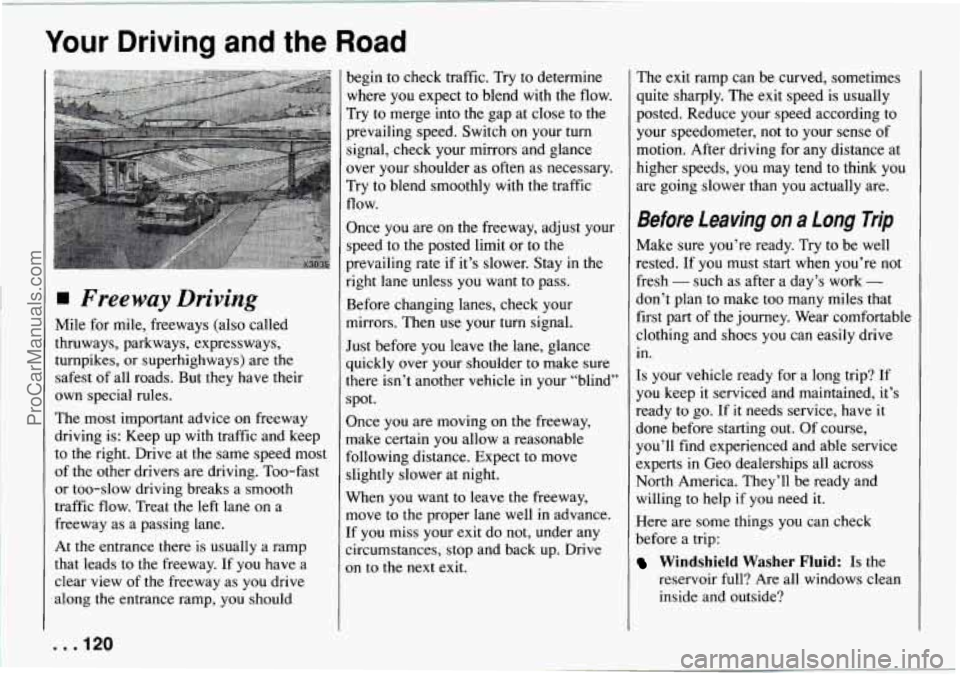
Freeway Driving
Mile for mile, freeways (also called
thruways, parkways, expressways,
turnpikes, or superhighways) are
the
safest of all roads. But they have their
own special rules.
The most important advice on freeway
driving is: Keep up with traffic and keep
to the right. Drive at the same speed most
of the other drivers are driving. Too-fast
or too-slow driving breaks
a smooth
traffic flow. Treat the left lane on a
freeway as a passing lane.
At
the entrance there is usually a ramp
that leads to the freeway. If
you have a
clear view of the freeway as you drive
along the entrance ramp, you should
1
1
1
f
t
1
!
1
I
1
I
I
I
3egin to check traffic. Try to determine
where you expect to blend with the flow.
Try to merge into the gap at close to the
prevailing speed. Switch on your turn
signal, check your mirrors and glance
wer your shoulder as often as necessary.
Try to blend smoothly with the traffic
flow.
Once you are on the freeway, adjust your
speed to the posted limit or to the
prevailing rate if it’s slower. Stay in the
right lane unless
you want to pass.
Before changing lanes, check your
mirrors. Then use your turn signal.
Just before you leave the lane, glance
quickly over your shoulder to make sure
there isn’t another vehicle in your “blind”
spot.
Once you are moving on the freeway,
make certain
you allow a reasonable
following distance. Expect to move
slightly slower at night.
When you want to leave
the freeway,
move to the proper lane well in advance.
If you miss your exit do not, under any
circumstances, stop and back up. Drive
on to the next exit. I’he
exit ramp can be curved, sometimes
pite sharply. The exit speed
is usually
3osted. Reduce your speed according to
your speedometer, not to your sense of
motion, After driving for any distance at
higher speeds, you may tend to think you
are going slower than you actually are.
Before Leaving on a Long Trip
Make sure you’re ready. Try to be well
rested,
If you must start when you’re not
Fresh
- such as after a day’s work -
don’t plan to make too many miles that
Fist part of the journey. Wear comfortable
clothing and shoes
you can easily drive
in.
[s your vehicle ready for a long trip? If
you keep it serviced and maintained, it’s
ready to
go. If it needs service, have it
done before starting out. Of course,
you’ll find experienced and able service
experts in Geo dealerships all across
North America. They’ll be ready and
willing to help if
you need it.
Here are some things you can check
before a trip:
Windshield Washer Fluid: Is the
reservoir full? Are all windows clean
inside and outside?
. . .I20
ProCarManuals.com
Page 125 of 258
Your Driving and the Road
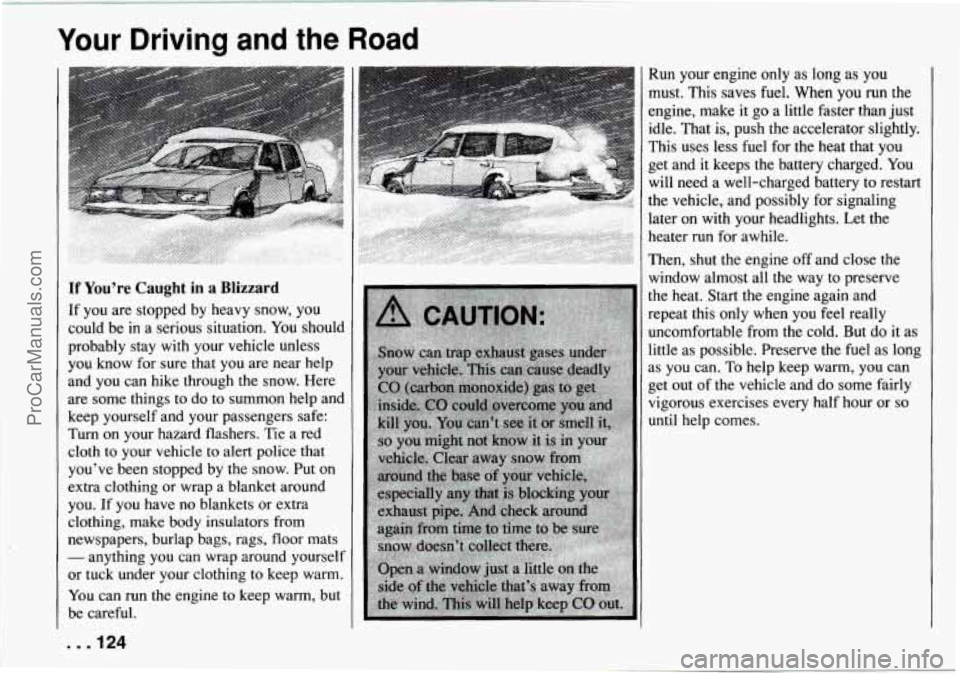
If You’re Caught in a Blizzard
If you are stopped by heavy snow, you
could be in a serious situation. You should
probably stay with your vehicle unless
you know
for sure that you are near help
and you can hike through the snow. Here
are some things to do to summon help and
keep yourself and your passengers safe:
Turn on your hazard flashers. Tie a red
cloth to your vehicle to alert police that
you’ve been stopped by the snow. Put on
extra clothing or wrap
a blanket around
you. If you have no blankets or extra
clothing, make body insulators from
newspapers, burlap bags, rags, floor mats
- anything you can wrap around yourself
or tuck under your clothing to keep warm.
You can
run the engine to keep warm, but
be careful. Run your engine
only as long as
you
must. This saves fuel. When you run the
engine, make it go a little faster than just
idle. That is, push the accelerator slightly.
This uses less fuel for the heat that you
get and it keeps the battery charged. You
will need a well-charged battery to restart
the vehicle, and possibly for signaling
later on with your headlights. Let the
heater run for awhile.
Then, shut the engine off and close the
window almost all the way to preserve
the heat. Start the engine again and
repeat this only when you feel really
uncomfortable from the cold. But
do it as
little as possible. Preserve the fuel as long
3s you can. To help keep warm, you can
get out of the vehicle and do some fairly
vigorous exercises every half hour or
so
until help comes.
. . ,124
ProCarManuals.com
Page 141 of 258

Problems on the Road
Engine Overheating
You will find a coolant temperature gage
on your Geo instrument panel.
If Steam Is Coming from Your Engine:
NOTICE:
If your engine catches fire because
you keep driving with no coolant,
your vehicle can be badly damaged.
The costly repairs would not be cov-
ered by your warranty.
If No Steam Is Coming from Your
Engine:
If you get the overheat warning but see or
hear no steam, the problem may not be
too serious. Sometimes the engine can get
a little too hot when you:
0 Climb a long hill on a hot day.
0 Stop after high speed driving.
Idle for long periods in traffic.
Tow a trailer.
If you get the overheat warning with no
sign of steam, try this
for a minute or so:
1.
If you have an air conditioner, turn it
off.
2. Turn on your heater to full hot at the
highest fan speed and open the
window as necessary.
(Neutral).
3. If you’re in a traffic jam, shift to “N”
. . .140
ProCarManuals.com
Page 176 of 258
correct a leak. If you add fluid when your
linings are worn, then you’ll have too
much fluid when you get new brake
linings. You should add (or remove)
brake fluid, as necessary, only when work
is done on the brake hydraulic system.
Refer to the Maintenance Schedple to
determine when to check
yoqr drake
fluid. See “Periodic Maintenance
Inspections” in the Index.
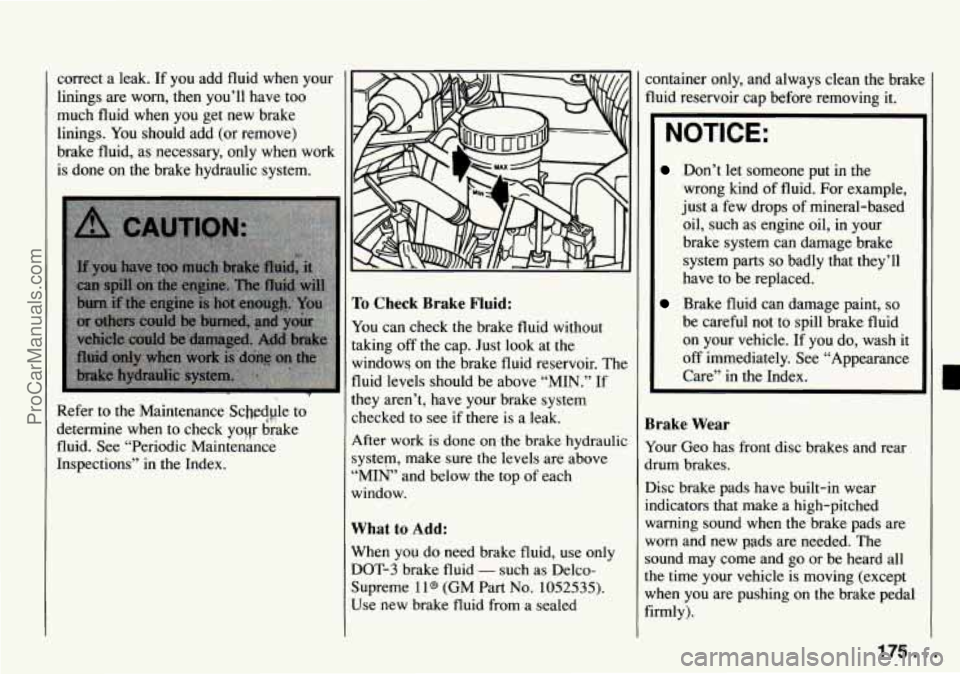
To Check Brake Fluid:
You can check the brake fluid without
taking
off the cap. Just look at the
windows on the brake fluid reservoir. The
fluid levels should be above “MIN.” If
they aren’t, have your brake system
checked to see if there is a leak.
After work is done
on the brake hydraulic
system, make sure the levels are above
“MIN’ and below the top
of each
window.
What to Add:
When you do need brake fluid, use only
DOT-3 brake fluid
- such as Delco-
Supreme 11s (GM Part
No. 1052535).
Use new brake fluid from a sealed container
only, and always clean the brakl
fluid reservoir cap before removing it.
NOTICE:
Don’t let someone put in the
wrong kind of fluid. For example,
just a few drops of mineral-based
oil, such as engine oil, in your
brake system can damage brake system parts
so badly that they’ll
have to be replaced.
Brake fluid can damage paint, so
be careful not to spill brake fluid
on your vehicle. If
you do, wash it
off immediately. See “Appearance
Care” in the Index.
Brake Wear
Your Geo has front disc brakes and rear
drum brakes.
Disc brake pads have built-in wear
indicators that make a high-pitched
warning sound when the brake pads are
worn and new pads are needed. The
sound may come and
go or be heard all
the time your vehicle is moving (except
when you are pushing on the brake pedal
firmly).
175 ...
ProCarManuals.com
Page 190 of 258
Appearance Care
Remember, cleaning products can be
hazardous. Some are toxic. Others can
burst into flame
if you strike a match
or get them
on a hot part of the vehicle.
Some are dangerous
if you breathe
their fumes
in a closed space. When
you use anything from a container to
clean your Geo, be sure to follow
the manufacturer’s warnings and
instructions. And always open your
doors or windows when you’re
cleaning the inside. Never use
these to clean your vehicle:
Gasoline
0 Benzene
Naphtha
Carbon Tetrachloride
0 Acetone
0 Paint Thinner
Turpentine
Lacquer Thinner
Nail Polish Remover
They can
all be hazardous some more -
thanothers - and they can all damage
your vehicle, too. Don‘t use any of
these unless this
manual says you can.
In many uses,
these
will damage your vehicle:
0 Alcohol
Laundry Soap
Bleach
Reducing Agents
Cleaning the lnside of Your
Geo
Use a vacuum cleaner often to get rid of
dust and loose dirt. Wipe vinyl or
leather with a clean, damp cloth.
Your Geo dealer has two
GM cleaners,
a solvent-type spot lifter and a
foam-type powdered cleaner. They will
clean normal spots and stains very well.
Do not use them on vinyl or leather.
Here are some cleaning tips:
Always read the instructions on the
Clean up stains as soon as you can
cleaner
label.
- before they set.
189 ... ProCarManuals.com
Page 193 of 258
Service and Appearance Care
Don’t use abrasive cleaners on glass,
because they may cause scratches. Avoid
placing decals on the inside rear window,
since they
may have to be scraped off
later.
If abrasive cleaners are used on the
inside
of the rear window, an electric
defogger element may be damaged.
Any
temporary license should not be attached
across
the defogger grid.
Cleaning the Outside of the Windshield
and Wiper Blades
If the windshield is not clear after using
the windshield washer, or
if the wiper
blade chatters when running, wax or other
material may be on the blade
or
windshield.
Clean
the outside of the windshield with
GM Windshield Cleaner, Bon-Ami
Powder@
(GM Part No. 105001 1). The
windshield is clean
if beads do not form
when you rinse
it with water.
Clean the blade by wiping vigorously
with a cloth soaked in full strength
windshield washer solvent. Then rinse
the
blade with water.
Wiper blades should be checked on a
regular basis and replaced when worn.
Cleaning the Outside of Your
Geo
The paint finish on your vehicle provides
beauty, depth
of color, gloss retention and
durability.
Washing Your Vehicle
The best way to preserve your vehicle’s
finish is to keep
it clean by washing it
often with lukewarm or cold water.
Don’t wash your vehicle
in the direct rays
of the sun. Don’t use strong soaps or
chemical detergents. Use liquid hand,
dish or car washing (mild detergent)
soaps. Don’t use cleaning agents
that
are petroleum based, or contain acid or
abrasives. All cleaning agents should be
flushed promptly and not allowed to dry
on the surface, or they could stain. Dry
the finish
with a soft, clean chamois or a
100% cotton towel to avoid surface
scratches and water spotting.
High pressure car washes may cause
water to enter your vehicle.
Finish Care
Occasional waxing or mild polishing of
your Geo may be necessary to remove
residue from the paint finish. You can get
GM approved cleaning products from your dealer.
(See “Appearance Care and
Materials”
in the Index.)
Your Geo has a “basecoat/clearcoat” pain
finish. The clearcoat gives more depth
and gloss to the colored basecoat. Always
use waxes and polishes that are
non-abrasive and made for a
basecoatfclearcoat paint
finish.
NOTICE:
Machine compounding or aggressive
polishing on a basecoatfclearcoat
paint finish may dull the finish or
leave swirl marks.
Protecting Exterior Bright Metal Parts
Bright metal parts should be cleaned
regularly to keep their luster. Washing
with water is all that is usually needed.
However, you may use GM Chrome
Polish
on chrome or stainless steel trim,
if necessary.
Use special care
with aluminum trim. To
avoid damaging protective
trim, never
use auto or chrome polish, steam or
caustic soap to clean
aluminum. A
coating of wax, rubbed to high polish, is
recommended for
all. bright metal parts.
. . .I92
ProCarManuals.com
Page 194 of 258
Special Care for Canvas Top
To protect the canvas top:
0 After you wash the vehicle, make sure
the top is completely dry before you
open or remove it.
vehicle’s painted finish; it could leave
streaks.
Don’t go through automatic car
washes; the canvas top could be
damaged.
The plastic windows are pliable and can
be scratched if you don’t take these
precautions when you clean them:
0 Don’t get any vinyl cleaner on the
0
0
0
Wipe off dust with a soft cotton cloth
moistened with clean, cool or
lukewarm water. Don’t use a “dry”
cloth. Wipe in one direction only, not
back and forth.
To remove frost, snow or ice, use
lukewarm water. Don’t use a scraper
or any de-icing fluids.
Wash the windows with a soft cloth
and clean, cool or lukewarm water.
Never use a dry cloth, hot water,
strong soap or detergent, solvents or
harsh cleaning agents. Rinse
thoroughly and wipe with a slightly
moist soft, clean cloth.
1
Don’t put any labels, stickers or tape
on windows. It’s hard to remove
adhesives left on the window when
such items are removed.
If a sticker or
label must be removed, remove any
adhesive left on the window while the
adhesive is still soft and sticky. Press
on a new sticker or piece of tape and
then lift it off again; keep doing this
until all the adhesive lifts off with
the sticker or tape.
Aluminum Wheels (If So Equipped)
Your aluminum wheels have a protective
zoating similar to the painted surface
3f your vehicle. Don’t use strong soaps,
:hemicals, chrome polish, abrasive
cleaners or abrasive cleaning brushes
on them because you could damage this
coating. After rinsing thoroughly, a wax
mi ay be applied.
NOTICE:
If you have aluminum wheels, don’t
use an automatic car wash that has
hard silicon carbide cleaning brushes.
These brushes can take
off the
protective coating.
Tires
Your Geo dealer has a GM White Sidewall
Tire Cleaner. You can use a stiff brush
with the cleaner.
When applying a tire dressing, always
take care to wipe
off any overspray
or splash from painted surfaces.
Petroleum-based products may damage
the paint finish.
Weatherstrips
Silicone grease on weatherstrips will
make them last longer, seal better, and
not stick or squeak. Apply silicone
grease with a clean cloth at least every
six months. During very cold, damp
weather more frequent application may
be required. (See “Recommended Fluids
and Lubricants” in the Index.)
Sheet Metal Damage
If your vehicle is damaged and requires
sheet metal repair or replacement,
make sure the body repair shop applies
anti-corrosion material
to the parts
repaired or replaced to restore corrosion
protection.
193 ... ProCarManuals.com
Page 246 of 258

Customer Assistance for the Hearing
Customer Assistance Information
. . 233
Customer Satisfaction Procedure
... 234
or Speech Impaired (TDD)
..... 234
Damage. Finish
............... 194
Damage. Sheet Metal
............ 193
Daytime Running Lights
......... 56
Daytime Running Lights Indicator Light
....................... 72
Deep Standing Water.
Driving through
.............. 41
Defects. Safety
Reporting to General Motors
.... 236
Reporting to the Canadian
Reporting to the United States
Government
............... 236
Government
............... 236
Defensive Driving
.............. 100
Defogger. Rear Window ......... 86
Defogging and Defrosting
Windows
................... 85
Dehumidifying ................. 85
Dimensions. Vehicle ............ 202
Doing Your Own Service Work
.... 156
Dome Light ................... 57
Door Locks
.................... 37
Door Storage Compartments
...... 60
Downhill. Driving
.............. 1 12
Drive. Four-wheel
.............. 46
Drive. Four-wheel (Service)
...... 170 Driver Position
(Safety Belts)
... 20
Driving
Across an Incline
............. 11 3
At Night .................... 1 16
City
........................ 119
Defensive
................... 100
Downhill
................... 1 12
Drunken
.................... 100
Freeway
.................... 120
Guidelines
.................. 107
In Mud. Sand. Ice or Snow ..... 1 15
In the Rain .................. 117
In Water .................... 115
0ff.Road. With Your Geo Four-
Wheel-Drive Vehicle
........ 108
On Curves .................. 104
On Off-Road Hills
............ I10
On Snow or Ice
.............. 123
Through Deep Standing Water
... 41
Uphill
...................... 111
Winter
...................... 122
With a Trailer
................ 127
Your Tracker. About ........... 3
Drunken Driving
............... 100
Easy Entry Seats
.............. 12
Electrical Equipment. Add-on
..... 196
Emergencies. Braking in
......... 104
Emergencies. Steering in
......... 105 Engine
Coolant
..................... 170
Coolant (Block) Heater
........ 41
Coolant Temperature Gage
..... 70
Exhaust
..................... 51
Identification
................ 196
Oil
........................ 162
Oil Pressure Light
............ 71
Overheating
................. 140
Specifications
................ 200
Starting Your
................ 40
Environment. Your Vehicle
and the
..................... 204
Exhaust. Engine
................ 51
Extender. Safety Belt
....... 1 .... 33
Exterior Bright Metal Parts.
Protecting
................... 192
Fabric Protection
.............. 190
Fan Control Lever
.............. 84
Features and
Controls ........... 35
Filling Your Tank ............... 158
Filter. Air. Replacement
.......... 166
Finish Care (Paint)
.............. 192
Finish Damage (Paint)
........... 194
Flashers. Hazard Warning
........ 132
Flat Tire. Changing a
............ 146
Flat.
If a Tire Goes .............. 146
Flow-Through Ventilation System . . 86
245 ..
ProCarManuals.com
Page 248 of 258

1 Keys ....................... 36
Label. Certification/Tire
........ 18 1
Label. Service Parts Identification . . 196
Lamp. Malfunction Indicator
...... 7 1
Lane Change Indicator.
Turn Signal and
.............. 54
Lap-Shoulder Belt (Safety Belts)
... 20
Larger Children (Safety Belts)
..... 32
Leaving Your Vehicle
............ 37
Leaving Your Vehicle with the
Engine Running
.............. 49
Lighter. Ashtrays and
............ 62
Lights Brake System Warning
......... 69
Bulb Replacement
............ 177
Charging System
............. 70
Check Engine
................ 71
Daytime Running ............. 56
Daytime Running Lights
Indicator
.................. 72
Dome
...................... 57
Engine Oil Pressure
........... 71
Gages and Indicators. Warning
. . 68
Interior ..................... 57
Malfunction Indicator Lamp
.... 71
Operation
of ................. 55
Safety Belt Reminder .......... 19
Lights On Reminder
............. 55
Loading Your Vehicle .... . 181 Locks.
Door ................... 37
Loss of Control
................ 107
Lubricant Front Axle
.................. 170
Rear Axle
................... 169
Recommended
............... 225
Transfer Case
................ 170
Main Fuse Block
............. 198
Maintenance Inspections. Periodic
.......... 223
Record
..................... 228
Schedule
.................... 203
Services. Scheduled
........... 206
Underbody
.................. 194
When Trailer Towing
.......... 129
Malfunction Indicator Lamp
...... 71
Manual
Adjust Mirrors. Outside
........ 60
Freewheeling Hubs ........... 46
Transmission Fluid
............ 168
Windows
................... 52
Master Cylinder. Brake
.......... 174
Mirrors Convex Outside
.............. 59
Inside Daymight Rearview
..... 59
Inside Rearview
.............. 59
Outside Manual Adjust
........ 60
Mountain Roads. Hill and ........ 121
Transmission. Five-Speed
...... 44 New
Vehicle “Break-In”
....... 39
Night Driving
.................. 116
Night Vision
................... 117
Nuts. Wheel
................... 202
Odometer. Speedometer and
..... 66
Odometer. Trip
................. 67
Off-Road Driving After
....................... 116
Before You Go
............... 108
Getting Familiar With
......... 109
Loading Your Vehicle for
....... 108
On Hills
.................... 110
With Your Geo Four-Wheel-Drive
Vehicle
................... 108
Off-Road Recovery
............. 105
Oil. Engine .................... 162
Opening and Closing Your Rear
Window
.................... 75
Opening and Closing Your
sunroof ..................... 74
Operation
of Lights ............. 55
Outside Manual Adjust Mirrors .... 60
Overheating. Engine
............ 140
Owner Checks and Services
....... 218
P (Park) Shifting into ...
P (Park). Shifting out of ...
.... 48
.... 49
247 ... ProCarManuals.com