door lock CHEVROLET TRACKER 1994 Owners Manual
[x] Cancel search | Manufacturer: CHEVROLET, Model Year: 1994, Model line: TRACKER, Model: CHEVROLET TRACKER 1994Pages: 258, PDF Size: 14.43 MB
Page 21 of 258
Seats and Restraint Systems
First, you’ll want to know which restraint
systems
your vehicle has.
We’ll start with the driver position.
Driver Position
This section describes the driver’s
restraint system.
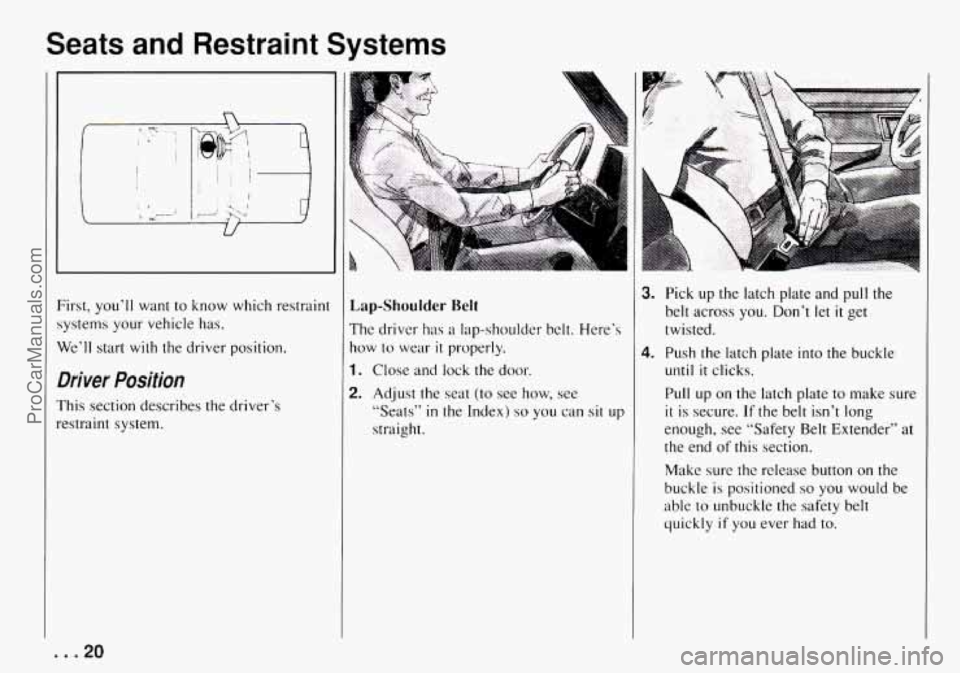
Lap-Shoulder Belt
The driver has a lap-shouldcr bclt. Here‘s
how 10 wear il properly.
1. Close and lock the door.
2. Adjust the seat (to see how, see
“Seats”
in the Index) so you can sit up
straight.
3. Pick up the latch plate and pull the
belt across you. Don’t
let it get
twisted.
4. Push the latch plate into the buckle
until it clicks.
Pull up
on the latch plate to make sure
it is secure. If the belt isn’t long
enough, see “Safety Belt Extender” at
the end of
this section.
Make sure the release button on the
buckle is positioned
so you would be
able
to unbuckle the safety belt
quickly
if you ever had to.
... 20
ProCarManuals.com
Page 24 of 258

To unlatch the belt, just push the button
on the buckle. The belt should go back
out of the way.
Before you close
the door, be sure the belt
is out of the way. If you slam the door on
it, you can damage both the belt and your
vehicle.
Safety Belt Use during Pregnancy
Safety belts work for everyone, including
pregnant women. Like all occupants, they
are more likely to be seriously injured if
they don’t wear safety belts.
A pregnant woman should wear a
lap-shoulder belt, and
the lap portion
should be worn as low as possible
throughout the pregnancy.
The best way to protect the fetus is to
protect the mother. When a safety belt
is
worn properly, it’s more likely that the
fetus won’t be hurt in a crash. For
pregnant women, as for anyone, the key
to making safety belts effective is wearing
them properly.
L
1
Passenger Positions
Right Front Passenger Position
The right front passenger’s safety belt
works the same way as
the driver’s safety
belt. See “Driver Position,’’ earlier in this
part.
When the shoulder belt is pulled out all
the way, it will lock.
If it does, let it go
back all the way and start again.
23. ..
ProCarManuals.com
Page 36 of 258
Here you can learn about the
many standard and optional
features on your Geo. and
information on starting. shifting
and braking
. Also explained are
the instrument panel and the
warning systems that tell you
if
everything is working properly -
and what to do if you have a
problem
.
Part 2
Features & Controls
Keys ........................................................... 36
DoorLocks ...................................................... 37
Theft
........................................................... 39
New Vehicle “Break-In” ........................................... 39
Ignitionswitch ................................................... 39
Starting
Your Engine .............................................. 40
Automatic Transmission ................. ...................... 42
Manual Transmission
............... ...................... 44
Four-wheel Drive ................................................ 46
Parking ......................................................... 48
EngineExhaust
.................................................. 51
Windows ....................................................... 52
Horn
........................................................... 53
Adjustable Steering Column ........................................ 53
Interior Lights
................................................... 57
Windshield WiperjWasher Lever
..................................... 57
Rear Window Wiperwasher
........................................ 59
Mirrors ......................................................... 59
Storage and Compartments
....................................... 60
Sun Visors
................................... .. ..... 61
Passenger Assist Grips
............................................. 62
Ashtray and Lighter
............................................... 62
Instrument Panel and Cluster
........................................ 66
The Turn Signalbights Control/Headlight Beam Lever ................... 54
ConvertibleTop
.................................................. 72
35 I ..
ProCarManuals.com
Page 38 of 258

Door Locks
There are several ways to lock and unlock
your vehicle:
From the outside, use your key. To lock
the door,
turn the key toward the front of
the vehicle.
To unlock the door, turn the
key toward the rear.
/
To lock the door from the inside, push
down the button on the door.
To unlock it,
pull up on the button.
Leaving Your Vehicle
If you are leaving the vehicle, take your
key, open your door and set the
locks
from inside. Then get out and close the
door.
37 ...
ProCarManuals.com
Page 40 of 258
Theft
Vehicle theft is big business, especially in
some cities. Although your Geo has a
number of theft deterrent features, we
know that nothing we
put on it can make
it impossible to steal. However, there are
ways you can help.
Key in the Ignition
If you walk away from your vehicle with
the keys inside, it’s an easy target for joy
riders or professional thieves
- so don’t
do
it.
When you park your Geo and open the
driver’s door, you’ll hear a chime
reminding you to remove your key from
the ignition and take
it with you. Always
do this. Your steering wheel will be
locked, and
so will your ignition. If you
have
an automatic transmission, taking
your key out
also locks your transmission.
And remember to lock the doors.
Parking at Night
Park in a lighted spot, close all windows
and lock your vehicle. Remember
to keep
your valuables out
of sight. Put them in a
storage area, or take them with you.
New Vehicle
"Break-in"
NOTICE:
Your modern Geo doesn‘t need an
elaborate “break-in.” But
it will per-
form better
in the long run if you fol-
low these guidelines:
0 Keep your speed at 55 mph
(88 km/h) or less for the first
500 miles (804 km).
0 Don’t drive at any one speed
- fast or slow - for the first
500 miles (804 km). Don’t
make full-throttle starts.
0 Avoid making hard stops for
the first
200 miles (322 km) or
so. During this time your new
brake linings aren’t yet broken
in. Hard stops
with new linings
can mean premature wear and
earlier replacement. Follow this
“breaking-in“ guideline every
time you get new brake linings.
C
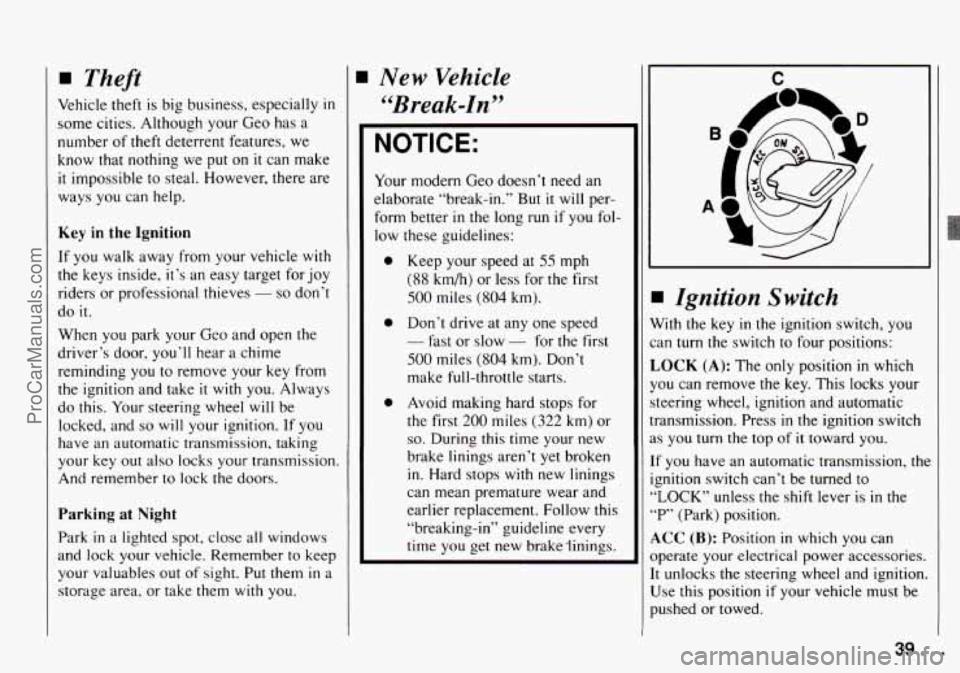
I Ignition Switch
Vith the key in the ignition switch, you
an
turn the switch to four positions:
,OCK (A): The only position in which
‘ou can remove the key. This locks your
teering wheel, ignition and automatic
ransmission. Press
in the ignition switch
s you turn the top of it toward you.
f you have an automatic transmission, the
gnition switch can’t be turned
to
,LOCK” unless the shift lever is in the
‘P’ (Park) position.
LCC (B): Position in which you can
bperate your electrical power accessories.
t unlocks the steering wheel and ignition.
Jse this position
if your vehicle must be
mhed or towed.
39. .
ProCarManuals.com
Page 41 of 258
Features and Controls
ON (C): Position to which the switch
returns after
you start your engine and
release the switch. The switch stays in the
“ON’ position when the engine is
running. But even when the engine is not
running, you can use
“ON’ to operate
your electrical power accessories and to
display some instrument panel warning
and indicator lights.
START (D): Starts the engine. When the
engine starts, release the key. The ignition
switch will return to
“ON’ for normal
driving.
When the engine is not running, “ACC”
and
“ON’ allow you to operate your
electrical accessories, such as the radio
and ventilation fan.
A warning chime will sound if you open
the driver’s door when the ignition is in
“ACC” or “LOCK” and the key is in the
ignition.
NOTICE:
If your key seems stuck in “LOCK”
and you can’t
turn it, be sure it is all
the way in. If it is, then turn the steer-
ing wheel left and right while you
turn the key hard. But turn the key
only with your hand. Using a tool to
force it could break the key or the
ignition switch. If none of this works,
then your vehicle needs service.
Starting Your Engine
Automatic transmission: Move your
shift lever to
“P” (Park) or “N’ (Neutral).
Your engine won’t start in any other
position
- that’s a safety feature. To
restart when you’re already moving, use
“N’ (Neutral) only.
NOTICE:
Don’t try to shift to “P’ (Park) if your
Geo is moving.
If you do, you could
damage the transmission. Shift to
“P”
(Park) only when your vehicle is
stopped.
Manual transmission: The gear selector
should be in neutral. Hold the clutch
pedal to the floor and start the engine.
Your vehicle won’t start if the clutch
pedal is
not all the way down - that’s
a safety feature.
To start your engine:
1. Without pushing the accelerator pedal,
turn your ignition key
to “START.”
When the engine starts, let
go of the
key.
... 40
ProCarManuals.com
Page 61 of 258

Features and Controls
3utside Manual Adjust Mirrors
The mirrors should be adjusted by hand
io that you can just see the side of your
Iehicle, when you are sitting in a
:omfortable position.
Storage and
Compartments
Glove Box
To open the glove box, pull the latch
toward you. Use
your key to lock and
unlock the glove
box.
loor Storage Compartments
lach door has a storage compartment.
... 60
ProCarManuals.com
Page 159 of 258
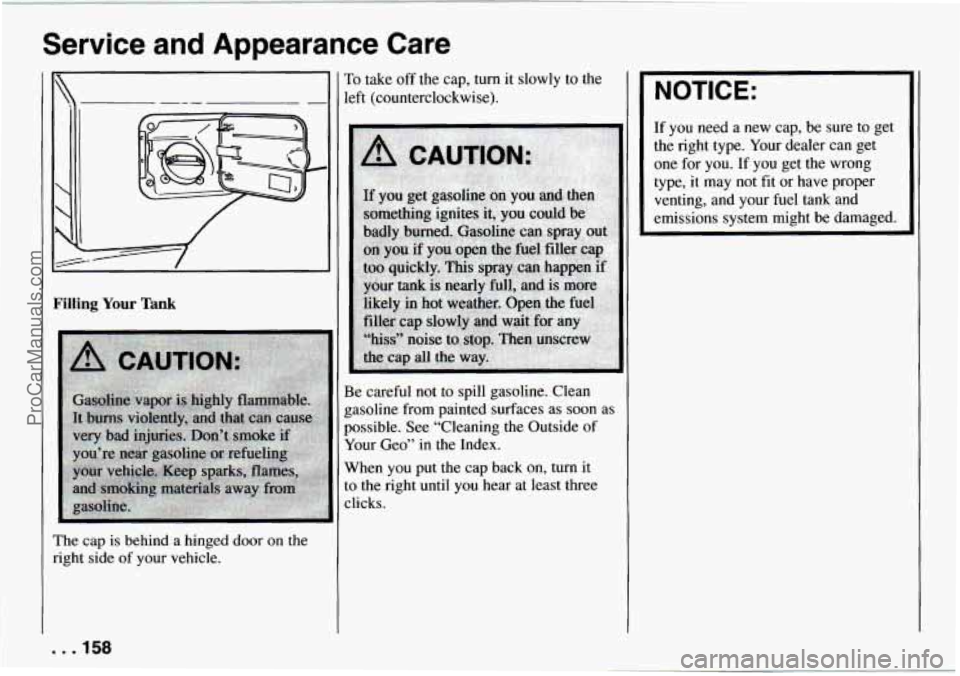
Service and Appearance Care
Filling Your Tank
The cap is behind a hinged door on the
right side of your vehicle.
I’o take off the cap, turn it slowly to the
left (counterclockwise).
Be careful not to spill gasoline. Clean
gasoline from painted surfaces as soon as
possible. See “Cleaning
the Outside of
Your Geo” in the Index.
When you put the cap back on,
turn it
to the right until you hear at least three
:licks.
NOTICE:
If you need a new cap, be sure to get
the right type.
Your dealer can get
one for you. If you get the wrong
type, it
may not fit or have proper
venting, and your fuel tank and
emissions system might be damaged.
. . .158
ProCarManuals.com
Page 166 of 258

Engine Oil Additives
Don’t add anything to your oil. Your Geo
dealer is ready to advise
if you think
something should be added.
When to Change Engine Oil
See if any one of these is true for you:
Most trips are less than 4 miles (6 km).
It’s below freezing outside and most
trips are less than 10 miles (1 6 km).
The engine is at low speed most of the
time (as
in door-to-door delivery, or
stop-and-go traffic).
You tow a trailer often.
Most trips are through dusty places.
The vehicle is frequently operated
If any one of these is true for your
vehicle, then you need to change your
and filter every
3,000 miles (5 000 km) or
3 months - whichever comes first.
If none of them is true, change oil and
filter every
7,500 miles (1 2 500 km) or
7.5 months - whichever comes first.
off-road.
Engine
Coolant Heater (Engine Block
Heater)
An engine coolant heater can be a big
help
if you have to park outside in very
cold weather,
0°F (-I 8°C) or colder. If
your vehicle has this option, see “Engine
Coolant Heater”
in the Index.
What to Do with Used Oil
Did you know that used engine oil
contains elements that may be unhealthy
for your skin and could even cause
cancer? Don’t let used oil stay on your
skin for very long. Clean your skin and
nails
with soap and water, or a good hand
cleaner. Wash or properly throw away
clothing or rags containing used engine
oil. (See the manufacturer’s warnings
about
the use and disposal of oil products.)
Used oil can
be a real threat to the
environment.
If you change your own oil,
be sure
to drain all free-tlowing oil from
the filter before disposal. Don’t ever
dispose of oil by putting
it in the trash,
pouring
it on the ground, into sewers, or
into streams or bodies
of water. Instead.
recycle
it by taking it to a place that
collects used
oil. If you have a problem
properly disposing.
of your used oil, ask
your dealer,
a service station or a local
recycling center for help.
Air Cleaner
Refer to the Maintenance Schedule to
detertnine when to replace the
air filter.
See “Scheduled Maintenance Services“
ir
the Index.
A CAUTION:
Operating the engine with the air
cleaner off can cause you or others to
be burned. The air cleaner not only.
cleans the air,
it stops flame if the
engine backfires.
If it isn’t there, and
the engine backfires, you could be
burned. Don’t drive with it
off, and
be careful working
on the engine
with the
air cleaner off.
165.
ProCarManuals.com
Page 182 of 258

:enter High-Mounted Stoplight
Hardtop)
i, remove the bulb:
. Remove the side pins.
!. Pull the housing forward.
1. Turn the socket counterclockwise and
pull
it out.
I. Pull the bulb out of the socket.
i. Reverse the steps with a new bulb.
ll
GVWR ~GAWR FRT GAWR RR
I TIRES I
I PRESSURE COLD PSl!kPa I
IJ
Center High-Mounted Stoplight
(Convertible)
To remove the bulb:
1, Remove the two screws and the lens
housing.
pull
it out.
2. Turn the socket counterclockwise and
3. Pull the bulb out of the socket.
4. Reverse the steps with a new bulb.
Loading Your Vehicle
Two labels on your vehicle show how
much weight
it may properly carry. The
Tire-Loading Information label found
on
the driver’s door lock pillar tells you the
proper size, speed rating and
recommended inflation pressures for the
tires on your vehicle.
It also gives you
important information about the number
of people that can be
in your vehicle and
the total weight that
you can carry. This
weight is called the Vehicle Capacity
Weight and includes the weight
of all
occupants, cargo, and all
nonfactory-installed options.
181 . . .
ProCarManuals.com