engine oil CHEVROLET TRACKER 1994 Owners Manual
[x] Cancel search | Manufacturer: CHEVROLET, Model Year: 1994, Model line: TRACKER, Model: CHEVROLET TRACKER 1994Pages: 258, PDF Size: 14.43 MB
Page 8 of 258
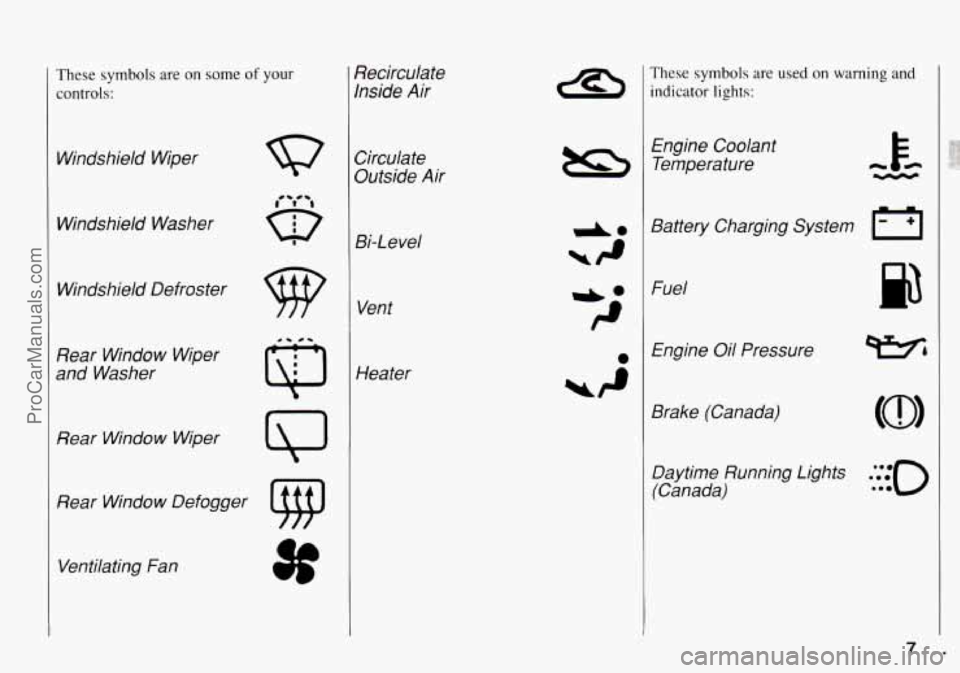
These symbols are on some of your
controls:
Windshield Wiper
Windshield Washer
Windshield Defroster
Rear Window Wiper
and Washer
Rear Window Wiper
Rear Window Defogger Ventilating Fan Recirculate
Inside
Air
Circulate
Outside Air
Bi-Level
Vent
Heater
These symbols are used on warning and
indicator
lights:
Engine Coolant Temperature
Battery Charging System
Fl
Fuel
Engine Oil Pressure
Brake (Canada) Daytime Running Lights
.***to
(Canada) **e
f ...
ProCarManuals.com
Page 43 of 258
Features and Controls
NOTICE:
After you’ve used the coolant heater,
be sure to store the cord as
it was
before to keep
it away from moving
engine parts. If you don’t, it could be
damaged.
How long should you keep the coolant
heater plugged
in? The answer depends
on the weather, the kind
of oil you have,
and some other things. Instead of trying
to list everything here, we ask that you
contact a Geo dealer in the area where
you’ll be parking your vehicle. The dealer
can give
you the best advice for that
particular area.
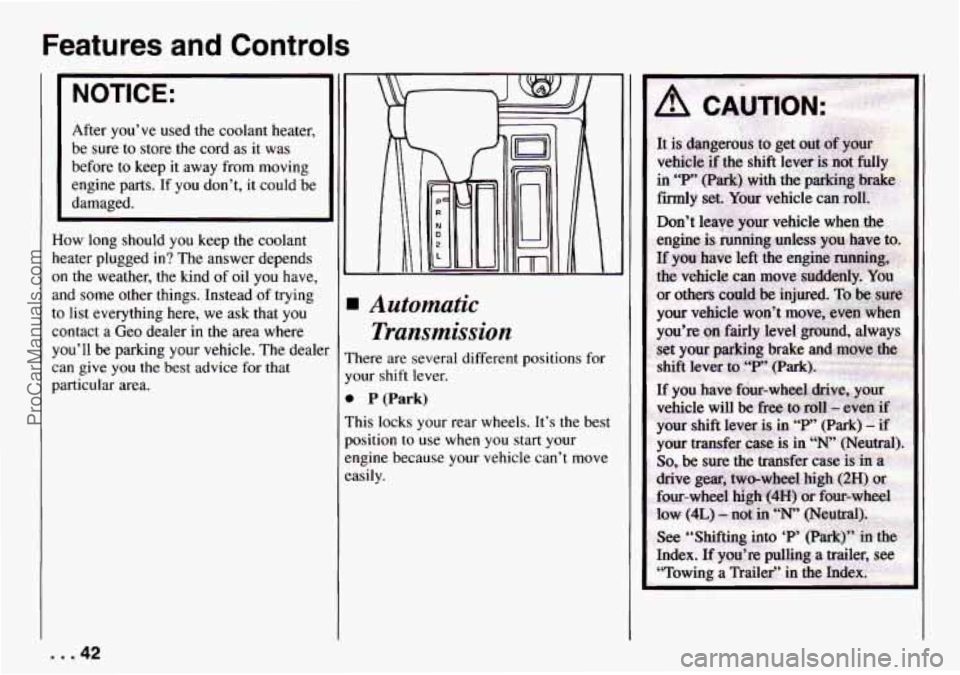
Automatic
Transmission
There are several different positions for
your
shift lever.
0 P (Park)
This locks your rear wheels. It’s the best
position to use when you start your
engine because your vehicle can’t move
easily.
1
-..42
ProCarManuals.com
Page 72 of 258
I1 1
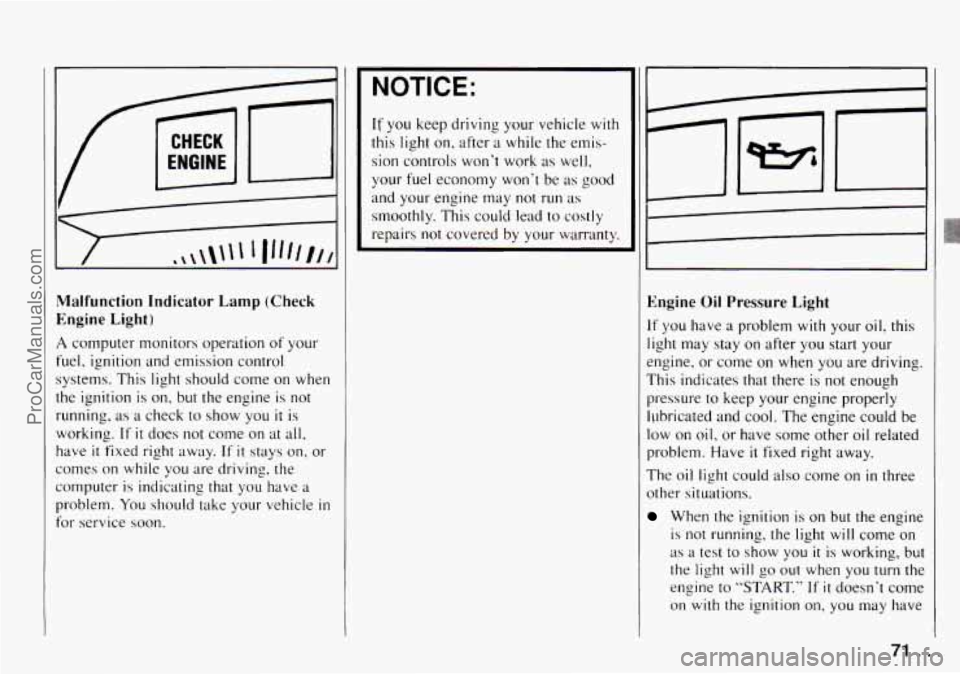
Malfunction Indicator Lamp (Check
Engine Light)
A computer monitors operation of your
fuel, ignition and emission control
1 systems. This light should come on when
the ignition is
on, but the engine is not
running, as a check to show you it is
working.
If it does not come on at all,
have it fixed right away. If it stays on. or
comes on while
you are driving, the
computer
is indicating that you have a
problem.
You should take your vehicle in
for service soon.
NOTICE:
If you keep driving your vehicle with
this light on. after
a while the ernis-
sion controls won't work as well,
your
fuel economy won't be as good
and your engine may
not run as
smoothly. This could lead to costly
repairs
not covered by your warranty.
Engine Oil Pressure Light
If you have a problem with your oil? this
light may stay
on after you start your
engine, or come
on when you are driving.
This indicates that there is not enough
pressure
to keep your engine properly
ILJbricated and
cool. The engine could be
low on oil, or have some other oil related
problem. Have
it fixed right away.
The oil light could also come
on in three
other situations.
When the ignition is on but the engine
is not running, the light will come on
as a test to show you it is working, but
the light will
go out when you turn the
engine to
"START." If it doesn't come
on with the ignition
on, you may have
71
ProCarManuals.com
Page 73 of 258
Features and Controls
a problem with the fuse or bulb. Have
it fixed right away.
Sometimes when the engine is idling
at a stop, the light may blink on and
off. This is normal.
If you make a hard stop, the light may
come on for a moment. This is
normal.
A CAUTION:
Don't keep driving if the oil pressure
is low, If' you do, your engine can
be~ome so hot that it catches fae.
You UT ol;krers could be burned.
Check your oil as SQOD as possible
and have yaw vehicle serviced.
NOTICE:
Damage to your engine from
neglected oil problems can be costly
and is not covered by your warranty.
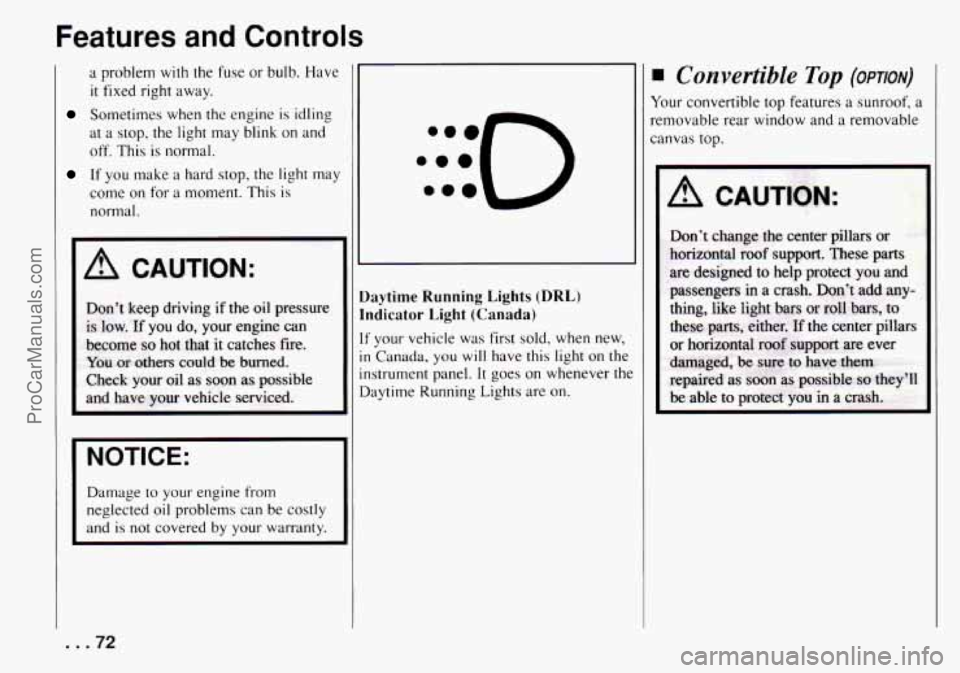
laytime Running Lights (DRL)
ndicator Light (Canada)
F your vehicle was first sold, when new,
I Canada, you will have this light on the
xtrument panel.
It goes on whenever the
laytime Running Lights are on.
Convertible Top (OPTION)
Your convertible top features a sunroof, a
removable rear window and a removable
canvas top.
A CAlJTtON:
... 72
ProCarManuals.com
Page 122 of 258
0
0
Wiper Blades: Are they in good
shape?
Fuel, Engine Oil, Other Fluids:
Have you checked all levels?
Lights: Are they all working? Are the
lenses clean?
Tires: They are vitally important to a
safe, trouble-free trip. Is the tread
good enough for long-distance
driving? Are the tires all inflated to
the recommended pressure?
Weather Forecasts: What’s the
weather outlook along your route?
Should you delay your trip a short
time to avoid a major storm system?
Maps: Do you have up-to-date
maps?
Highway Hypnosis
Is there actually such a condition as
“highway hypnosis”? Or is it just plain
falling asleep at the wheel? Call
it
highway hypnosis, lack of awareness, or
whatever.
There is something about an easy stretch
of road with
the same scenery, along with
the hum of the tires
on the road, the drone
of the engine, and the rush of the wind
against the vehicle that can make you sleepy. Don’t let it happen
to you! If it
does, your vehicle can leave the road in
less than a second, and
you could crash
and be injured.
What can you do about highway
hypnosis? First, be aware that
it can
happen.
Then here are some tips:
0 Make sure your vehicle is well
ventilated, with a comfortably cool
interior.
0 Keep your eyes moving. Scan the
road ahead and to
the sides. Check
your mirrors and your instruments
frequently.
0 If you get sleepy, pull off the road into
a rest, service, or parking area and
take a nap, get some exercise,
or both.
For safety, treat drowsiness on the
highway as an emergency.
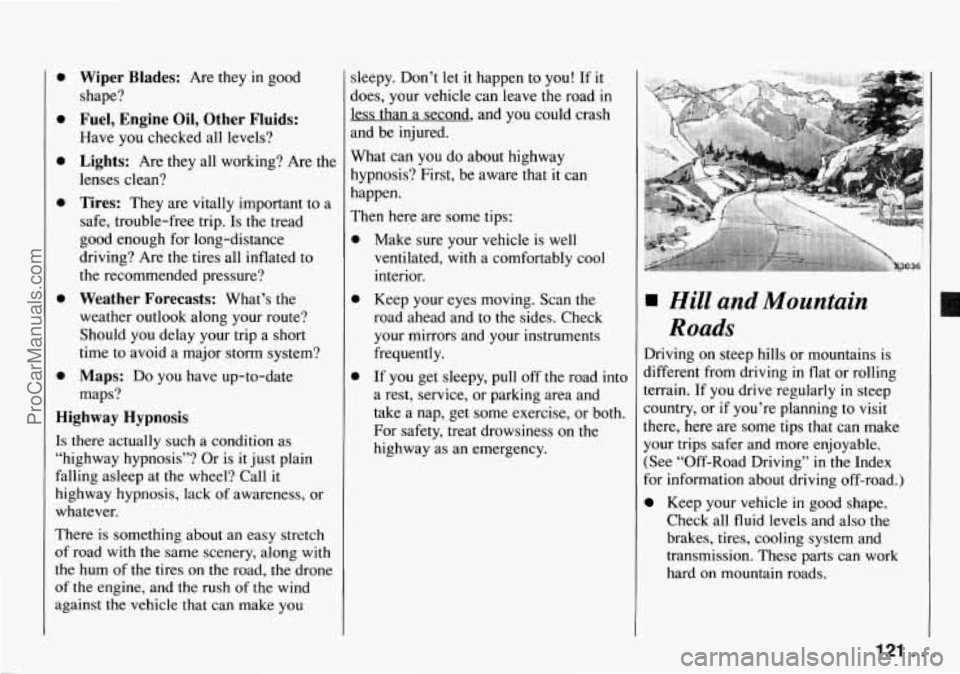
Hill and Mountain
Roads
Driving on steep hills or mountains is
different from driving
in flat or rolling
terrain. If you drive regularly in steep
country, or
if you’re planning to visit
there, here are some tips that can make
your trips safer and more enjoyable.
(See “Off-Road Driving” in the Index
for information about driving off-road.)
Keep your vehicle in good shape.
Check all fluid levels and also the
brakes, tires, cooling system and
transmission. These parts can work
hard
on mountain roads.
ILI . . .
ProCarManuals.com
Page 130 of 258
When You Are Ready to Leave after
Parking
on a Hill
1. Apply your regular brakes and hold
the pedal down while you:
Start your engine;
Shift into a gear; and
0 Release the parking brake.
2. Let up on the brake pedal.
3. Drive slowly until the trailer is clear
4. Stop and have someone pick up and
of the chocks.
store the chocks.
Maintenance When Trailer Towing
Your vehicle will need service more often
when you're pulling
a trailer. See the
Maintenance Schedule for more
on this.
rhings that are especially important in
:railer operation are automatic
.ransmission lluid (don't overfill), engine
oil? axle lubricant, belts, cooling system,
and brake adjustment. Each of these
is
covered in this manual, and the Index will
help you find them quickly. If you're
trailering, it's a good idea to review these
sections before you start
your trip.
Check periodically
to see that all hitch
nuts and bolts are tight.
I
I
Recreational Vehicle
To wing
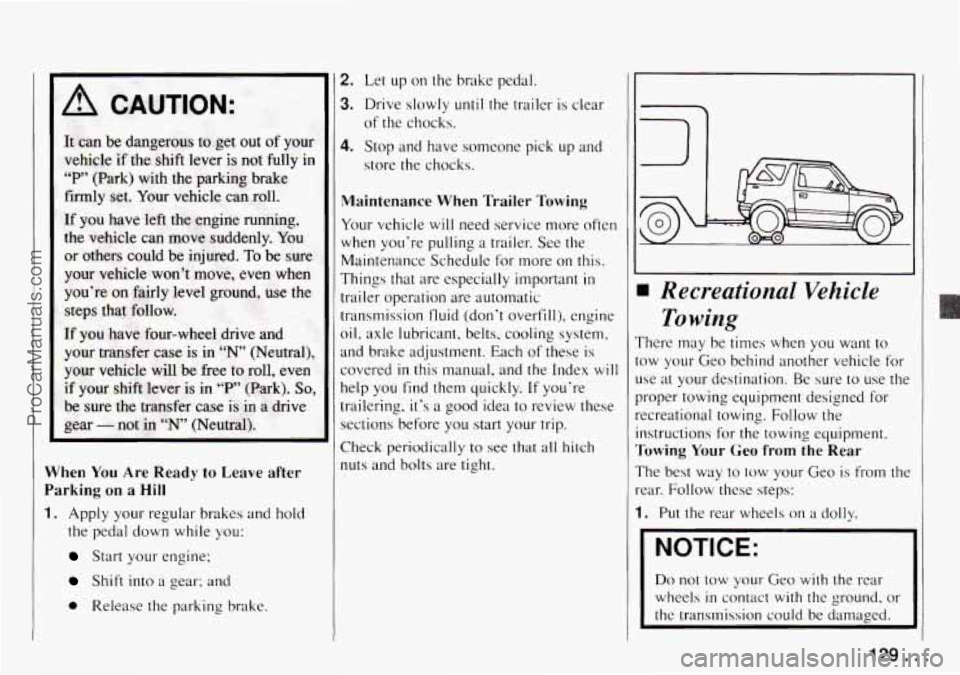
There may be times when you want to
:ow your Geo behind another vehicle for
Jse at your destination. Be sure to use the
proper towing equipment designed for
-ecreational towing. Follow the Instructions for the towing equipment.
rowing Your Geo from the Rear
rhe best way to tow your Geo is from the
-ear. Follow these steps:
1. Put the rear wheels on a dolly.
I NOTICE:
I
Do not tow your Geo with the rear
wheels
in contact with the ground. or
the transmission could be damaged. 1
.. 129. ProCarManuals.com
Page 131 of 258

Your Driving and the Road
2. Set the parking brake.
3. If your Geo is a four-wheel-drive
vehicle, set your manual freewheeling
hubs
to ”FREE” or unlock your
automatic I‘reewheeling hubs. See “Four-wheel Drive”
in the Index.
4. Turn the ignilion key to ”ACC’‘ to
unlock the steering wheel.
5. Clamp the steering wheel in a
straight-ahead position, with a
clamping device designed for towing.
6. Release the parking brake.
I NOTICE:
I
Make sure that the towing speed does
not exceed
55 mph (90 km/h), or
your Geo could be badly damaged.
~~
Towing Your Geo from the Front
NOTICE:
If your vehicle has automatic free-
wheeling hubs
or two-wheel drive,
do not tow
it on all four wheels. If
you do, your transmission could be
damaged.
If you have a four-wheel-drive vehicle
with manual freewheeling hubs, it can be
towed from the front with
all four wheels
on the ground. Follow these steps:
1. Set the parking brake.
2. Turn the ignition key to “ACC” to
unlock the steering wheel.
3. Shift your automatic transmission into
“P” (Park), or your manual
transmission into “2” (Second).
4. Shift the transfer case to “N”
(Neutral).
“Four-wheel Drive”
in the Index.
5. Set the hubs to “FREE.” See
6. Reledse the parking brake,
Stop towing every 200 miles
(300 km)
and start the engine. Leave the transfer
case shift lever
in ”N” (Neutral). Shift
your automatic transmission
to “D”
(Drive); leave a manual transmission
in
“2” (Second) and release the clutch. Run
the engine
at medium speed for one
minute to circulate the oil in the transfer
case. Turn the ignition key to
“ACC.”
Now, you can continue towing your Geo.
I
NOTICE:
I
Make sure the towing speed does not
exceed
SO mph (80 km/h), or your
Geo could be badly damaged.
I
. . .130
ProCarManuals.com
Page 143 of 258
Problems on the Road
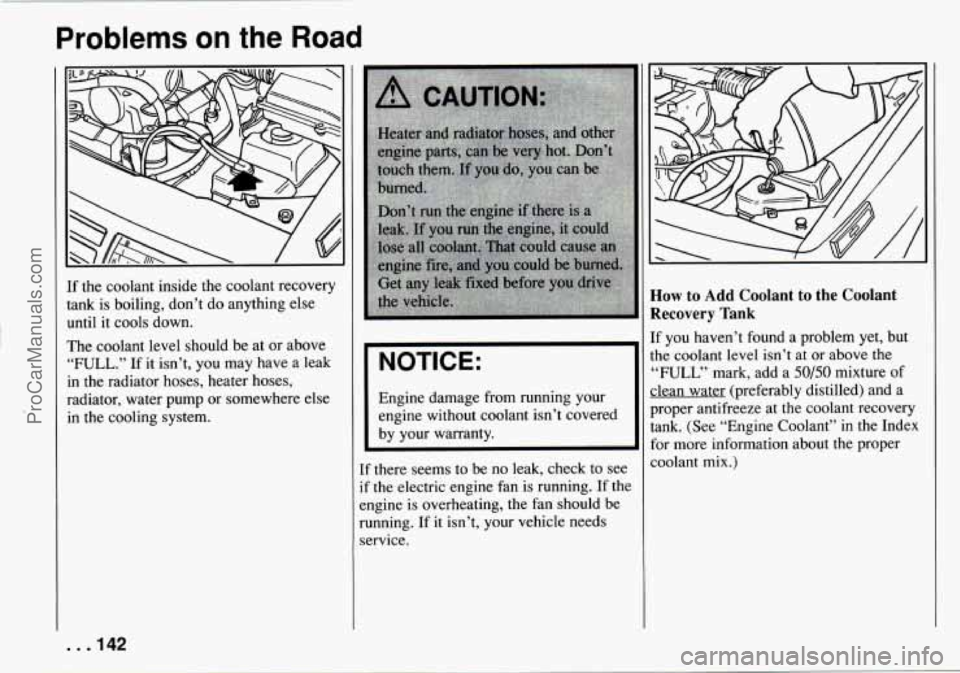
If the coolant inside the coolant recovery
tank
is boiling, don’t do anything else
until it cools down.
The coolant level should be at or above
“FULL.” If it isn’t, you may have a leak
in the radiator hoses, heater hoses,
radiator, water pump or somewhere else
in the cooling system. I NOTICE:
I
Engine damage from running your
engine without coolant isn’t covered
by your warranty.
[f there seems to be no leak, check to see
if the electric engine fan is running.
If the
mgine is overheating, the fan should be
running. If it isn’t, your vehicle needs
service.
How to Add Coolant to the Coolant
Recovery
Tank
[f you haven’t found a problem yet, but
:he coolant level isn’t at or above the
“FULL” mark, add a 50/50 mixture of
:lean water (preferably distilled) and a
xoper antifreeze at
the coolant recovery
:a&. (See “Engine Coolant” in the Index
for more information about the proper
:oolant mix.)
. . .I42
ProCarManuals.com
Page 156 of 258
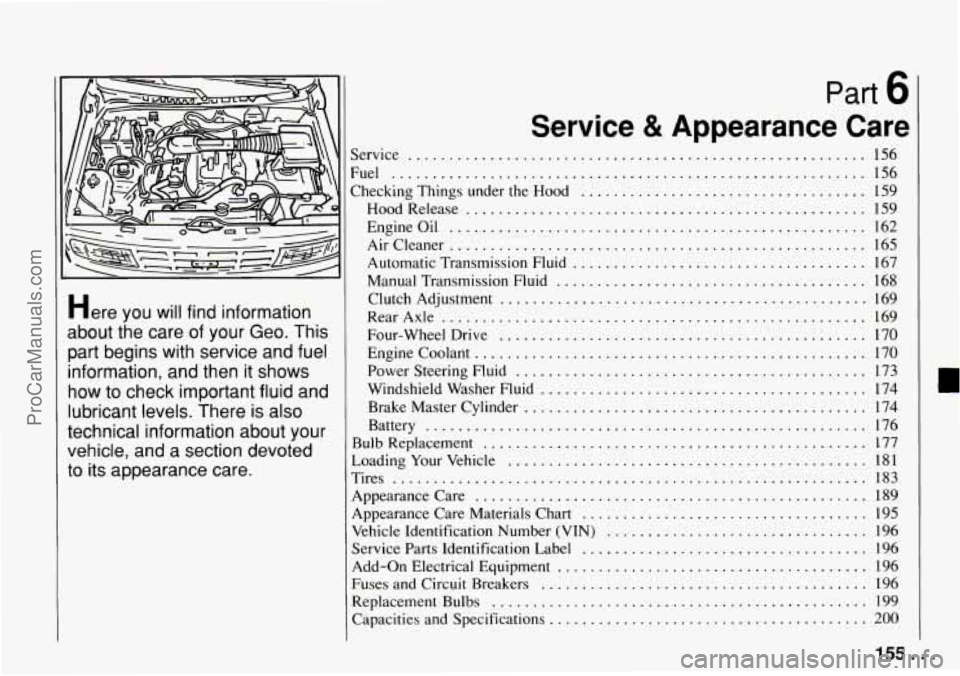
Here you will find information
about the care of your Geo
. This
part begins with service and fuel
information. and then it shows
how to check important fluid and
lubricant levels
. There is also
technical information about your
vehicle. and a section devoted
to its appearance care
.
Service & Appearance Care
Service ........................................................
Fuel ..........................................................
Checking Things under the Hood ...................................
HoodRelease .................................................
Engineoil ...................................................
Aircleaner ...................................................
Automatic Transmission Fluid ....................................
Manual Transmission Fluid ......................................
Clutch Adjustment .............................................
RearAxle ....................................................
Four-WheelDrive .............................................
Enginecoolant ................................................
Power Steering Fluid ...........................................
Windshield Washer Fluid ........................................
Brake Master Cylinder ..........................................
Bulb Replacement ...............................................
Loading Your Vehicle ..........................................
Tires ........................................................
Appearance Care Materials Chart ...................................
Vehicle Identification Number (VIN) ................................
Service Parts Identification Label ...................................
Add-on Electrical Equipment ......................................
Fuses and Circuit Breakers ........................................
Capacities and Specifications .......................................
Battery ......................................................
Appearancecare ................................................
ReplacementBulbs ..............................................
156
156
159
159
162
165
167
168
169 169
170 170
173
174
174
176 177
181
183
189 195 196
196
196
196
199
200
155 ...
ProCarManuals.com
Page 158 of 258
worry if you hear a little pinging noise
when you’re accelerating or driving up a
hill. That’s normal and you don’t have to
buy a higher octane fuel to get rid of
pinging. It’s the heavy, constant knock
that means you have a problem.
What about gasoline
with blending
materials that contain oxygen
(oxygenates), such as MTBE or alcohol?
MTBE
is “methyl tertiary-butyl ether.”
Fuel that is no more than
15% MTBE is
fine for your vehicle.
Ethanol
is ethyl or grain alcohol.
Properly-blended fuel that
is no more
than
10% ethanol is fine for your vehicle.
Methanol is methyl or wood alcohol.
NOTICE:
Fuel that is more than S% methanol
is bad for your vehicle. Don’t use it.
It can corrode metal parts
in your fuel
system and also damage plastic and
rubber parts. That damage wouldn’t
be covered under your warranty. And
even
at 5% or less, there must be
“cosolvents” and corrosion prevent-
ers
in this fuel to help avoid these
problems.
Gasolines for Cleaner Air
Your use of gasoline with deposit control
additives
will help prevent deposits from
forming
in your engine and fuel system.
That helps keep your engine
in tune and
your emission control system working
properly. It’s good for your vehicle, and
you’ll be doing your part
for cleaner air.
Many gasolines are now blended with
oxygenates. General Motors recommends
that you use gasolines
with these blending
materials, such as MTBE and ethanol. By
doing
so, you can help clean the air,
especially
in those parts of the country
that have high carbon monoxide levels.
In addition, some gasoline suppliers are
now producing reformulated gasolines.
These gasolines are specially designed to
reduce vehicle emissions. General Motors
recommends that you use reformulated
gasoline.
By doing so, you can help clean
the air, especially
in those parts of the
country that have high ozone levels.
You should ask your service station
operators
if their gasolines contain deposit
control additives and oxygenates, and
if
they have been reformulated to reduce
vehicle emissions.
Fuels in Foreign Countries
If you plan on driving in another country
outside the
U.S. or Canada, unleaded fuel
may be hard to find.
Do not use leaded
gasoline. If you use even one tankful,
your emission controls won’t work well
or at all. With continuous use, spark plugs
can get fouled, the exhaust system can
corrode, and your engine oil can
deteriorate quickly. Your vehicle’s oxygen
sensor
will be damaged. All of that means
costly repairs that wouldn’t be covered by
your warranty.
To check on fuel availability, ask an auto
club, or contact a major oil company
that
does business in the country where you’ll
be driving.
You can also write us
at the following
address for advice. Just tell us where
you’re going and give your Vehicle
Identification Number
(VIN).
General Motors Overseas Distribution
North American Export Sales (NAES)
1908 Colonel Sam Drive
Oshawa, Ontario
LlH 8P7
Corporation
157.. ProCarManuals.com