fuel cap CHEVROLET TRACKER 1994 Owners Manual
[x] Cancel search | Manufacturer: CHEVROLET, Model Year: 1994, Model line: TRACKER, Model: CHEVROLET TRACKER 1994Pages: 258, PDF Size: 14.43 MB
Page 70 of 258

1s I FUELONLY UNLEADED [I
UNLEADED-
J
FUEL ONLY
Fuel Gage
Your fuel gage shows about how much
fuel is in your tank. When the gage first
indicates “E,” you still have a little fuel
left (about one or two gallons), but you
need to get more right away.
Here are four concerns some owners have
had about the fuel gage. All these
situations are normal and do not indicate
that anything is wrong with the
fuel gage,
At the gas station, the fuel pump shuts
off before the gage reads
“F.”
It takes more (or less) fuel to fill up
than
the gage reads. For example, the
gage reads half full, but it took more
(or less) than half
of the tank’s
capacity to fill it.
J
0
0
The gage moves a little when you
turn, stop
or speed up.
When you turn the engine
off, the
gage doesn’t go back to “E.”
~~
Brake System Warning Light
four Geo’s hydraulic brake system is
livided into two parts. If one part isn’t
vorking, the other part can still work and
;top you. For good braking, though, you
leed both parts working well.
four vehicle also has rear-wheel anti-lock
)rakes. If the warning light comes on,
here could be a brake problem with eithel
[our regular or rear-wheel anti-lock
)rakes, or both. Have your brake system
nspected right away.
rhis light should come on as you start the
lehicle.
If it doesn’t come on then, have ii
ixed
so it will be ready to warn you if
here’s a problem.
r
69 ...
ProCarManuals.com
Page 126 of 258

Towing a Trailer
NOTICE:
Pulling a trailer improperly can dam-
age your vehicle and result in costly
repairs not covered by your warranty,
To pull a trailer correctly, follow the
advice in this section, and see your
Geo dealer for important information
about towing a trailer with your
vehicle. Your
vehicle can tow a trailer. To identify
what the vehicle trailering capacity
is for
your vehicle,
you should read the
information in “Weight
of the Trailer” that
appears later in this section.
But trailering
is different than just driving your vehicle
by itself. Trailering means changes in
handling, durability, and fuel economy.
Successful, safe trailering takes correct
equipment, and it has to be used properly.
That’s the reason for this section.
In it are
many time-tested, important trailering
tips and safety rules. Many of these are
important for your safety and that of your
passengers.
So please read this section
carefully before you pull a trailer.
Load-pulling components such as the
engine, transmission, wheel assemblies,
and tires are forced to work harder against
the drag of the added weight. The engine
is required to operate at relatively higher
speeds and under greater loads,
generating extra heat. What’s more, the
trailer adds considerably to wind
resistance, increasing the pulling
requirements.
If You Do Decide to Pull a Trailer
If you do, here are some important points.
There are many different laws having
to do with trailering. Make sure your
rig will be legal, not only where you
live but also where you’ll be driving.
A good source for this information
can be state or provincial police.
Consider using a sway control. You
can ask a hitch dealer about sway
controls.
Don’t tow a trailer at all during the
first
500 miles (800 km) your new
vehicle is driven. Your engine, axle or
other parts could be damaged.
Then, during the first
500 miles (800
km) that you tow a trailer, don’t drive
over
50 mph (80 km/h) and don’t
make starts at
full throttle. This helps
your engine and other parts
of your
vehicle wear in at the heavier loads.
125 ...
ProCarManuals.com
Page 156 of 258
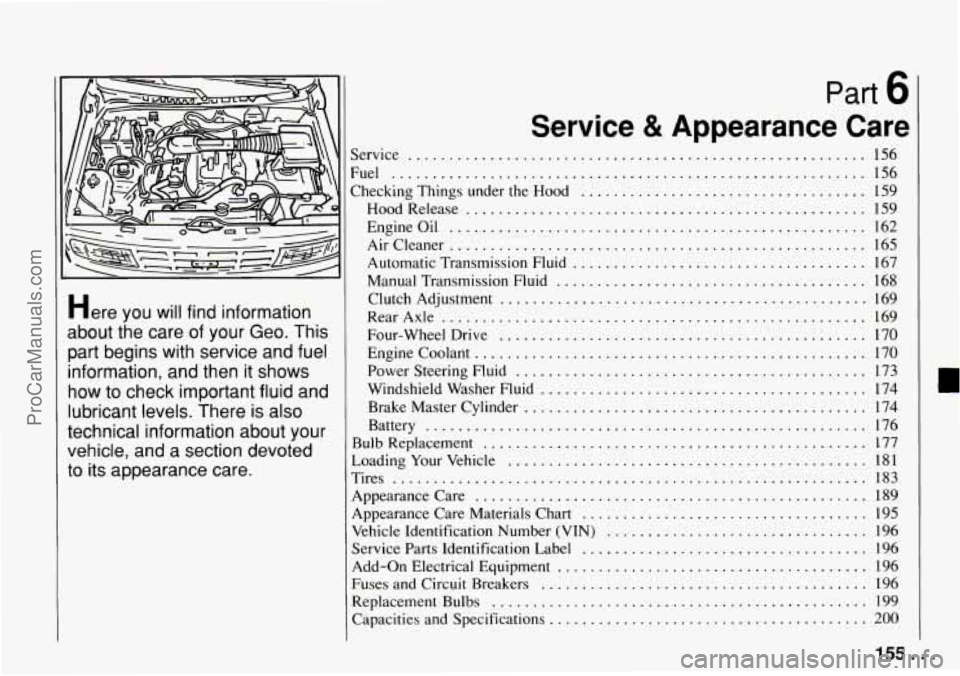
Here you will find information
about the care of your Geo
. This
part begins with service and fuel
information. and then it shows
how to check important fluid and
lubricant levels
. There is also
technical information about your
vehicle. and a section devoted
to its appearance care
.
Service & Appearance Care
Service ........................................................
Fuel ..........................................................
Checking Things under the Hood ...................................
HoodRelease .................................................
Engineoil ...................................................
Aircleaner ...................................................
Automatic Transmission Fluid ....................................
Manual Transmission Fluid ......................................
Clutch Adjustment .............................................
RearAxle ....................................................
Four-WheelDrive .............................................
Enginecoolant ................................................
Power Steering Fluid ...........................................
Windshield Washer Fluid ........................................
Brake Master Cylinder ..........................................
Bulb Replacement ...............................................
Loading Your Vehicle ..........................................
Tires ........................................................
Appearance Care Materials Chart ...................................
Vehicle Identification Number (VIN) ................................
Service Parts Identification Label ...................................
Add-on Electrical Equipment ......................................
Fuses and Circuit Breakers ........................................
Capacities and Specifications .......................................
Battery ......................................................
Appearancecare ................................................
ReplacementBulbs ..............................................
156
156
159
159
162
165
167
168
169 169
170 170
173
174
174
176 177
181
183
189 195 196
196
196
196
199
200
155 ...
ProCarManuals.com
Page 159 of 258
Service and Appearance Care
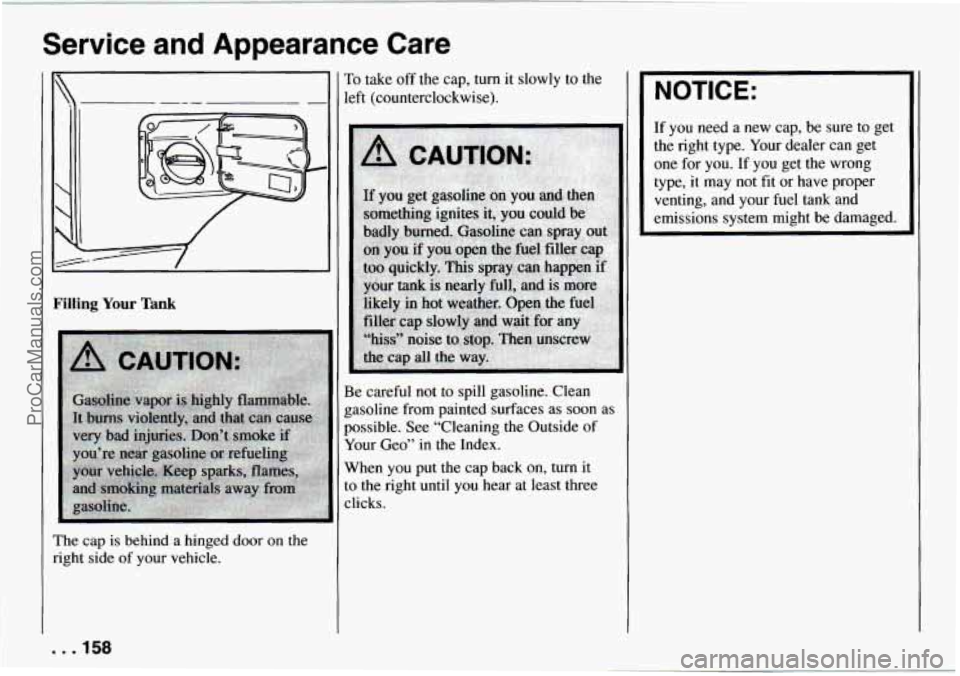
Filling Your Tank
The cap is behind a hinged door on the
right side of your vehicle.
I’o take off the cap, turn it slowly to the
left (counterclockwise).
Be careful not to spill gasoline. Clean
gasoline from painted surfaces as soon as
possible. See “Cleaning
the Outside of
Your Geo” in the Index.
When you put the cap back on,
turn it
to the right until you hear at least three
:licks.
NOTICE:
If you need a new cap, be sure to get
the right type.
Your dealer can get
one for you. If you get the wrong
type, it
may not fit or have proper
venting, and your fuel tank and
emissions system might be damaged.
. . .158
ProCarManuals.com
Page 183 of 258

Service and Appearance Care
1
1
a
I
> 7
i
tl
B
tl
F
tl
0
S
T
t
f
r
1
1)
:he other label is the Certification label,
dso found
on the driver’s door lock pillal
t tells you the gross weight capacity of
Tour vehicle, called the
GVWR (Gross
Jehicle Weight Rating). The
GVWR
dudes the weight of the vehicle, all
ccupants, fuel and cargo. Never exceed
ne GVWR for your vehicle, or the Gross
Ytle Weight Rating (GAWR) for either
he front or rear axle.
ind, if you
do have a heavy load, you
hould spread it out. Don’t carry more
han
400 pounds (1 8 1 kilograms) in your
ear area when four people are in your
wo-wheel drive vehicle.
If you have a
our-wheel drive vehicle, don’t carry
nore than
200 pounds (91 kilograms) in
{our rear area when four people are
in
Tour vehicle.
NOTICE:
I
Your warranty does not cover parts or
components that fail because
of over-
loading.
I ~
[f you put things inside your vehicle -
like suitcases, tools, packages, or
anything else
- they will go as fast as the
vehicle goes. If you have to stop or turn
quickly, or if there is a crash, they’ll keep
going.
. .I82
ProCarManuals.com
Page 185 of 258
Service and Appearance Care
Inflation - Tire Pressure
The Certificatioflire label which is on the driver’s door shows the correct inflation
pressures for your tires, when they’re cold. ‘Told” means your vehicle has been
sitting for at least three hours or driven no more than
a mile.
NOTICE:
Don’t let anyone tell you that underinflation PI: overinflation is all right. It’s not.
If your tires don’t have enough air (underinflation) you can get:
i Too much flexing
0 Too much heat
0 Tire overloading
0 Bad wear
0 Bad handling
0 Bad fuel economy.
If your tires have too much air (overinflation), you can get:
0 Unusual wear
0 Bad handling
0 Rough ride
0 Needless damage from road hazards.
When to Check: Check your tires
once a month or more. Also, check the
tire pressure
of the spare tire.
How to Check: Use a good quality
pocket-type gage to check tire
I
1
t
7
xessure. Simply looking at the tires
will not tell
you the pressure,
:specially if you have radial tires
-
which may look properly inflated even
.f they’re underinflated.
[f your tires have valve caps, be sure to
Jut them back on. They help prevent
leaks by keeping out dirt and moisture.
. . .I84
ProCarManuals.com
Page 201 of 258
Service and Appearance Care
..........
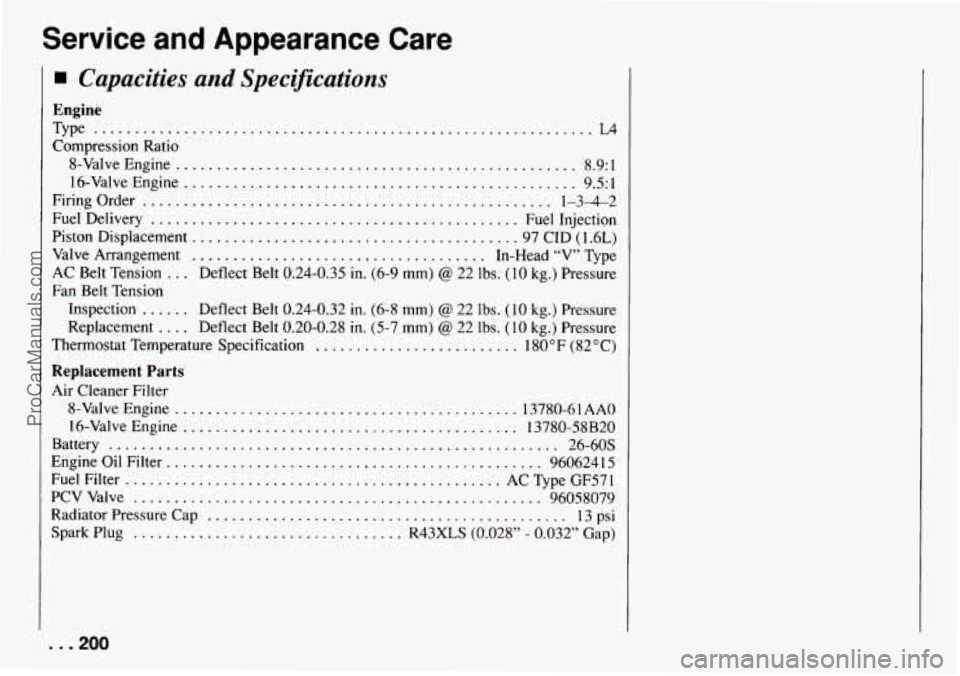
Capacities and Specifications
Engine
Type .......................................... . * L4
Compression Ratio 8-Valve Engine
................................................. 8.9: 1
16-Valve Engine ................................................ 9.5: 1
Fuel Delivery
............................................. Fuel Injection
Piston Displacement
........................................ 97 CID (1.6L)
Valve Arrangement
.................................... In-Head “V” Type
Firingorder
.................................................. 1-342
AC Belt Tension ... Deflect
Belt 0.24-0.35 in. (6-9 mm) @I 22 lbs. (10 kg.) Pressure
Fan Belt Tension
Inspection
...... Deflect Belt 0.24-0.32 in. (6-8 mm) @ 22 lbs. (10 kg.) Pressure
Replacement
.... Deflect Belt 0.20-0.28 in. (5-7 mm) @ 22 lbs. (10 kg.) Pressure
Thermostat Temperature Specification
......................... 180°F (82°C)
Replacement Parts
Air Cleaner Filter
8-Valve Engine
.......................................... 13780-6 1 AAO
16-Valve Engine ......................................... 13780-58B20
Engine
Oil Filter .............................................. 9606241 5
Radiator Pressure Cap ............................................ 13 psi
Spark Plug ................................. R43XLS (0.028” - 0.032” Gap)
Battery
....................................................... 26-60s
Fuel Filter
.............................................. AC Type GF571
PCVValve
.................................................. 96058079
.. .200
ProCarManuals.com
Page 202 of 258
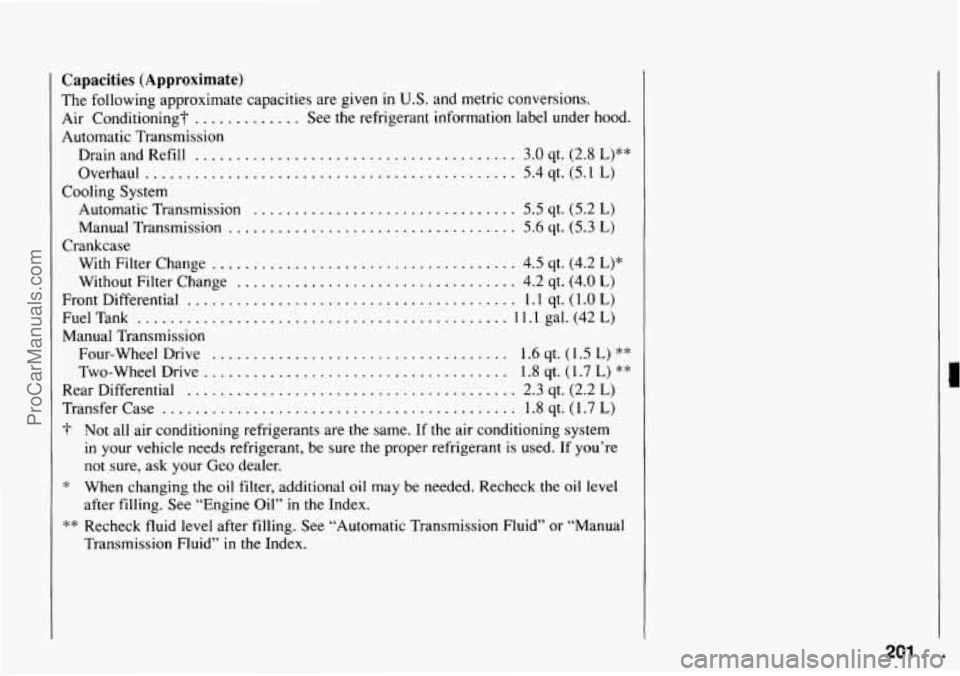
Capacities (Approximate)
The following approximate capacities are given in U.S. and metric conversions.
Air Conditioning”
............. See the refrigerant information label under hood.
Automatic Transmission Drain and Refill
....................................... 3.0 qt. (2.8 L)**
Overhaul ............................................. 5.4 qt. (5.1 L)
Automatic Transmission ................................ 5.5 qt. (5.2 L)
Manual Transmission ................................... 5.6 qt. (5.3 L)
With Filter Change ..................................... 4.5 qt. (4.2 L)*
Without Filter Change .................................. 4.2 qt. (4.0 L)
Front Differential ........................................ 1.1 qt. (1 .O L)
Fuel Tank ............................................. 11.1 gal. (42 L)
Manual Transmission
Cooling System
Crankcase
Four-wheel Drive
.................................... 1.6 qt. ( 1.5 L) **
Two-Wheel Drive ..................................... 1.8 qt. (1.7 L) **
Rear Differential ........................................ 2.3 qt. (2.2 L)
Transfer Case ........................................... 1.8 qt. ( 1.7 L)
T Not all air conditioning refrigerants are the same. If the air conditioning system
in your vehicle needs refrigerant, be sure the proper refrigerant is used. If you’re
not sure, ask your Geo dealer.
* When changing the oil filter, additional oil may be needed. Recheck the oil level
after filling. See “Engine Oil”
in the Index.
** Recheck fluid level after filling. See “Automatic Transmission Fluid” or “Manual
Transmission Fluid”
in the Index.
201 ...
ProCarManuals.com
Page 209 of 258

Maintenance Schedule
Section A: Scheduled Maintenance Services (cont.)
Schedule / (Cont.)
* An Emission Control Service.
t The US. Environmental Protection Agency
or the California Air Resources Board has
determined that the failure to perform this
maintenance item will
not nullify the emission
warranty or limit recall liability prior to the
completion
of vehicle useful life. General
Motors, however, urges that all recommended
maintenance services be performed at the
indicated intervals and the maintenance be
recorded in “Section E: Maintenance Record.”
WHAT TO SERVICE
See “Explanation of Scheduled
Schedules
I and 11.
ITEM NO. Maintenance Services” following
WHEN TO PERFORM
Miles (kilometers) or Months
(whichever occurs first).
14
Air Cleaner Filter Replacement* See “Explanation of Scheduled
Maintenance
Services” following Schedules
I and 11.
15 I Fuel Tank, Cap and Lines Inspection*t I
See “Explanation of Scheduled Maintenance
Services” following Schedules
I and 11.
16
Every
80,000 miles (133 000 km). Heated
Oxygen Sensor Replacement*
18 Every
100,000 miles
(166 000 km).
Fuel Injector Inspection”
17 Every
30,000 miles (50 000 km)
or 30 months. Fuel Filter Replacement*
l9 I
Evaporative Emissions Canister
Replacement* I Every 100,000 miles (166 000 km).
Engine Control Module (ECM) and 2o Associated Sensors Inspection* Every 100,000 miles (1 66 000 km).
21 Every
100,000 miles (166 000 kml
Three Wav Catalvtic Converter Inspection* 22
Every 60,000 miles (100 000 km). Emission
System Hoses Inspection*
~~ I - \--- ~~
23 I Engine Timing and Distributor Check* I Every 60,000 miles (100 000 km).
24
Every 60,000 miles (100 000 km). Brake Fluid
Service 28
Every 60,000 miles (100 000 km) or 60 months.
Wiring Harness and Connectors Inspection* 27
Every 7,500 miles (12 500 km) or 7.5 months.
Power Steering System Inspection 26
Every 15,000 miles (25 000 km).
Valve Lash (Clearance) Inspection* 25
Every 15,000 miles (25 000 km).
Engine Idle Speed Check*?
. . ,208
ProCarManuals.com
Page 213 of 258

Maintenance Schedule
Section A: Scheduled Maintenance
Schedule /I (Cont.)
* An Emission Control Service.
t The US. Environmental Protection Agency
or the California Air Resources Board has
determined that the failure to perform this
maintenance item will not nullify the emission
warranty or limit recall liability prior to the
completion
of vehicle useful life. General
Motors, however, urges that all recommended
maintenance services be performed at the
indicated intervals and the maintenance be
recorded in “Section E: Maintenance Record.”
-
ITEM NO.
20
21
-
Services (Cont.)
WHAT TO SERVICE
See “Explanation of Scheduled
Maintenance Services” following
Schedules
I and 11.
Air Cleaner Filter Replacement*
Fuel Tank, Cap and Lines Inspection*?
Fuel Filter Replacement*
Fuel Injector Inspection* Heated Oxygen Sensor Replacement*
Evaporative Emissions Canister
Replacement*
Engine Control Module (ECM) and
Associated Sensors Inspection”
Emission System Hoses Inspection*
Three Way Catalytic Converter Inspection*
Engine Timing and Distributor Check*
Engine Idle Speed Check*?
Valve Lash (Clearance) Inspection*
Power Steering System Inspection
Wiring Harness and Connectors Inspection*
Brake Fluid Service
WHEN TO PERFORM
Miles (kilometers) or Months
(whichever occurs first).
See “Explanation of Scheduled Maintenance
Services” following Schedules
I and 11.
See “Explanation
of Scheduled Maintenance
Services” following Schedules I and
11.
Every 30,000 miles (50 000 km) or 30 months.
Every
100,000 miis (166 000 km).
Everv 80.000 miles (1 33 000 km).
Every
100,000 miles (166 000 km).
Every
100,000 miles (166 000 km).
Everv
60.000 miles (100 000 km). ~~
Every 100,000 miles (166 000 km).
Every
60,000 miles (100 000 km).
Every
15,000 miles (25 000 km).
Every
15,000 miles (25 000 km).
Every
7,500 miles (12 500 km) or 7.5 months.
Every
60,000 miles (100 000 km) or 60 months.
Every
60,000 miles (100 000 km).
. . .212
ProCarManuals.com