radiator CHEVROLET TRACKER 1994 Owners Manual
[x] Cancel search | Manufacturer: CHEVROLET, Model Year: 1994, Model line: TRACKER, Model: CHEVROLET TRACKER 1994Pages: 258, PDF Size: 14.43 MB
Page 59 of 258

Features and Controls
For a single wiping cycle, push the lever
to “MIST.” Hold it there until the wipers
start, hen let
go. The wipers will stop
after one cycle. If you want more cycles,
hold the lever
on “MIST.” longer.
Washers
Pull the wiper/washer lever toward you to
spray washer fluid’on
the windshield. The
spray will continue
until you release the
lever. This will also turn on the low speed
wipers.
Heavy snow or ice can overload your
wipers.
A circuit breaker will stop them
until the motor cools. Clear away snow or
ice to prevent an overload.
NOTICE:
0
0
0
0
When using concentrated washer
fluid, follow the manufacturer’s
instructions for adding water.
Don’t
mjx water with
ready-to-use washer fluid. Water
can cause the solution
to freeze
and damqge your washer fluid
tank and other parts of the
washer system. Also, water
doesn’t clean as well as washer
fluid.
Fill your washer fluid
tank only
3/4 full when it’s very cold. This
allows
for expansion, which
could damage the tank
if it is
compldtel) full.
Don’t use radiator antifreeze in
your wipdshield washer. It can
damage your paint.
... 58
ProCarManuals.com
Page 142 of 258

If you no longer have the overheat
warning, you can drive. Just to be safe,
drive slower for about
ten minutes. If the
warning doesn’t come back on,
you can
drive normally.
If the warning continues, pull over, stop,
and park your vehicle right away.
If there’s still no sign
of steam, you can
idle the engine for two or three minutes
while you’re parked, to see if the warning
stops. But then, if you still have the
warning, TURN
OFF THE ENGINE
AND GET EVERYONE OUT OF THE
VEHICLE until it cools down.
You may decide not to lift the hood but to
get service help right away.
2ooling System
Vhen you decide it’s safe to lift the hood,
lere’s what you’ll see on the 8-valve
mgine:
I. Coolant Recovery Tank
!. Radiator Pressure Cap
1. Electric Engine Fan lere’s
what you’ll see on the 16-valve
:ngine:
I. Coolant Recovery Tank
!. Radiator Pressure Cap
I. Electric Engine Fan
141 . . .
ProCarManuals.com
Page 143 of 258
Problems on the Road
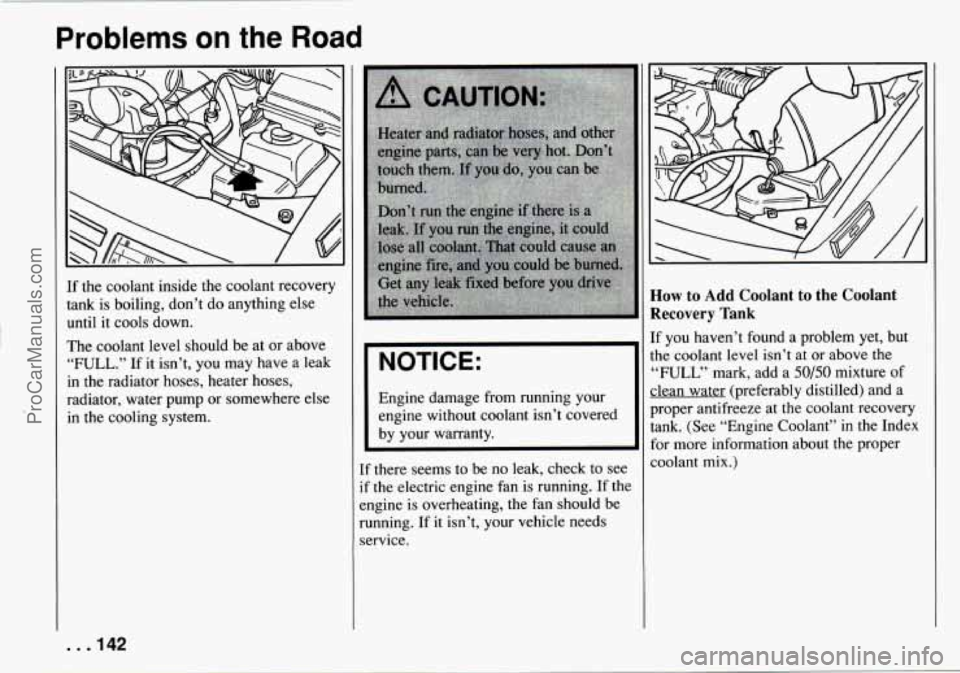
If the coolant inside the coolant recovery
tank
is boiling, don’t do anything else
until it cools down.
The coolant level should be at or above
“FULL.” If it isn’t, you may have a leak
in the radiator hoses, heater hoses,
radiator, water pump or somewhere else
in the cooling system. I NOTICE:
I
Engine damage from running your
engine without coolant isn’t covered
by your warranty.
[f there seems to be no leak, check to see
if the electric engine fan is running.
If the
mgine is overheating, the fan should be
running. If it isn’t, your vehicle needs
service.
How to Add Coolant to the Coolant
Recovery
Tank
[f you haven’t found a problem yet, but
:he coolant level isn’t at or above the
“FULL” mark, add a 50/50 mixture of
:lean water (preferably distilled) and a
xoper antifreeze at
the coolant recovery
:a&. (See “Engine Coolant” in the Index
for more information about the proper
:oolant mix.)
. . .I42
ProCarManuals.com
Page 144 of 258

~~ NOTICE:
~~~
In cold weather, water
can freeze and
crack the engine, radiator, heater core
and other parts.
Use the recom-
mended coolant. When
the coolant in the
coolant recovery
tank is at or above the
"FULL" mark.
start your vehicle.
If the overheat warning continues, there's
ope more thing you can try. You can add
the proper coolant mix directly to the
radiator, but be sure the coolink 7 . 4: y. stem
is cool before you
do it.
A CAUTION:
Steam and scalding liquids from a
hot cooling system can blow out and
burn you badly. They
are under pres-
sure, and
if you turn the radiator
pressure cap
- even a little - they can
come out
at high speed. Never turn
the cap when the
cooling system,
including the radiator pressure cap, is
hot. Wait for the cooling system and
radiator pressure
cap to cool if you
ever have to turn the pressure cap.
I
143.. ProCarManuals.com
Page 145 of 258
Problems on the Road
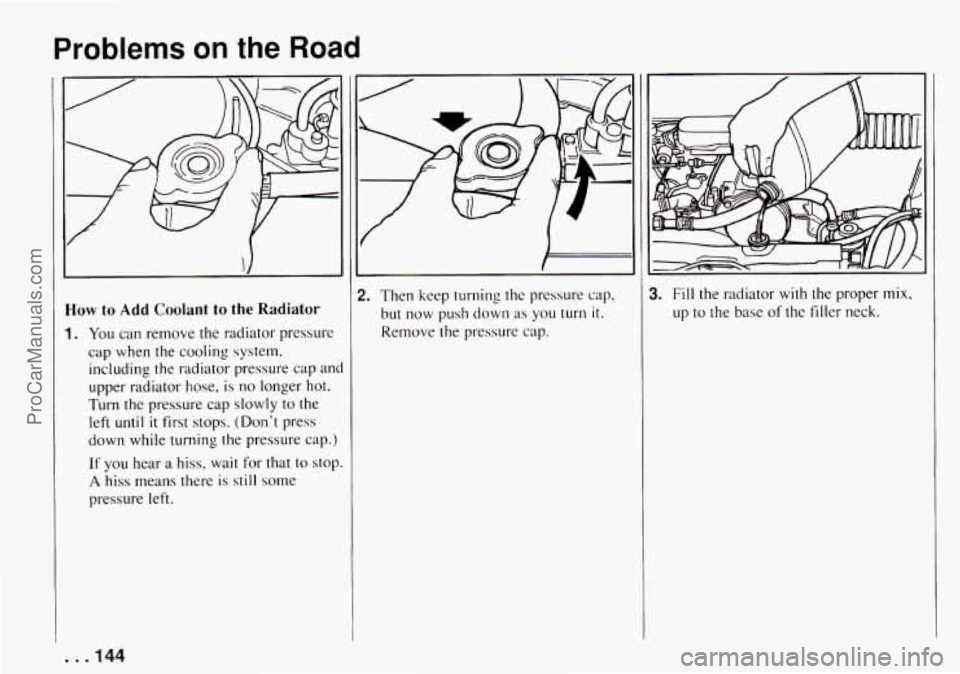
How to Add Coolant to the Radiator
1. You can remove the radiator pressure
cap when the cooling system,
including the radiator pressure cap an(
upper radiator hose, is
no longer hot.
Turn the pressure cap slowly
to the
left
until it first stops. (Don’t press
down while turning the pressure cap.)
If you hear a hiss, wait for that to stop
A hiss means there is still some
pressure left.
. . .I44
2. Then keep turning the pressure cap,
but now push down
as you turn it.
Remove the pressure cap.
3. Fill the radiator with the proper mix,
up to the base of the filler neck.
ProCarManuals.com
Page 146 of 258
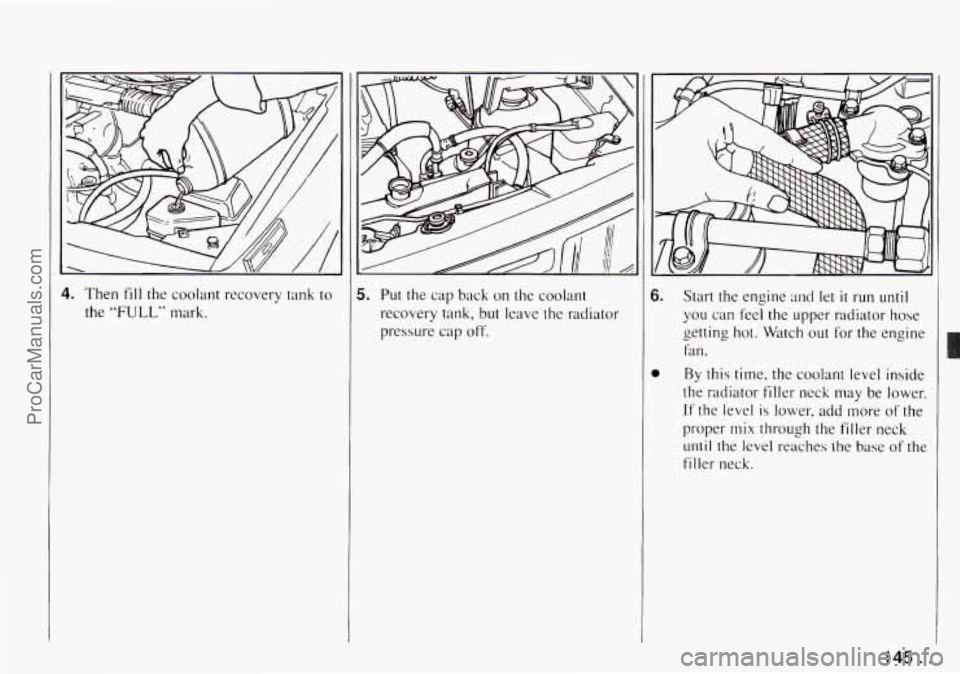
4. Then fill the coolant recovery tank to
the
"FULL" murk. Put the
cap back
on the coolant
recovery tank,
but leave the radiator
pressure cap
off.
6.
0
Start the engine and let it run until
you can feel the upper radiator hose
getting hot. Watch out for the engine
fan.
By this time, the coolant level inside
the radiator filler neck may be lower.
If the level is lower, add more of the
proper
mix through the filler neck
until the level reaches the base of the
filler neck.
145 ... ProCarManuals.com
Page 161 of 258
Service and Appearance Care
6% CAUTION:
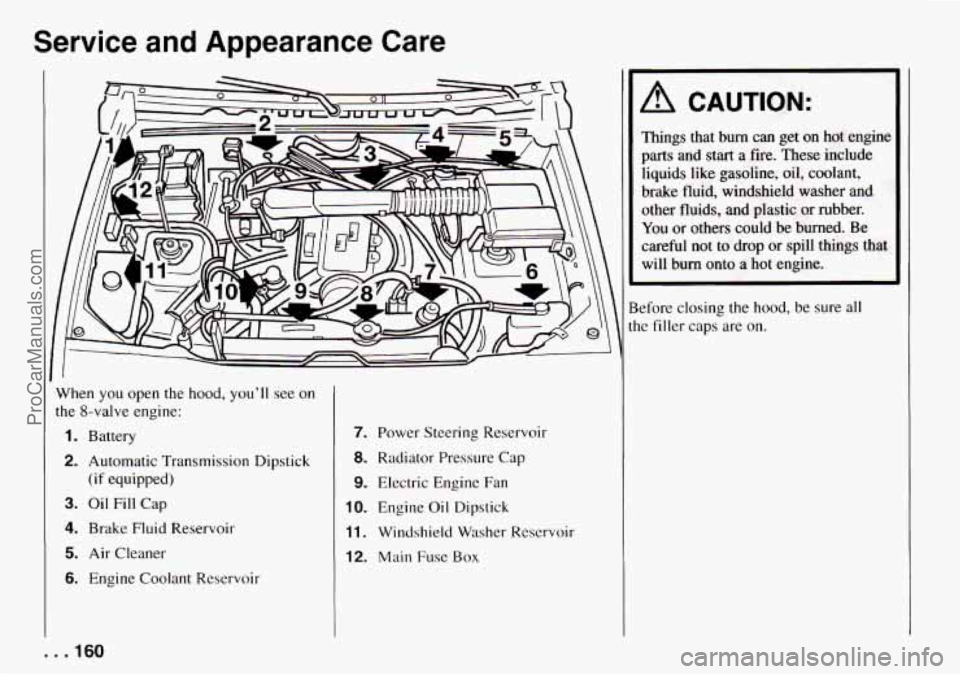
When you open the hood, you’ll see on
the 8-valve engine:
1. Battery
2. Automatic Transmission Dipstick
3. Oil Fill Cap
4. Brake Fluid Reservoir
5. Air Cleaner
6. Engine Coolant Reservoir
(if equipped)
7. Power Steering Reservoir
8. Radiator Pressure Cap
9. Electric Engine Fan
IO. Engine Oi I Dipstick
11. Windshield Washer Rescrvoir
12. Main Fuse Box
Things that burn can get on hot engine
parts and start a fire. These include
liquids like gasoline, oil, coolant,
brake fluid, windshield washer and
other fluids, and pXastic OT rubber.
You or others could be burned. Be
careful not to drop or spill things that
will burn onto a hot engine.
Before closing the hood, be sure all
the filler caps are on.
. . .160
ProCarManuals.com
Page 162 of 258
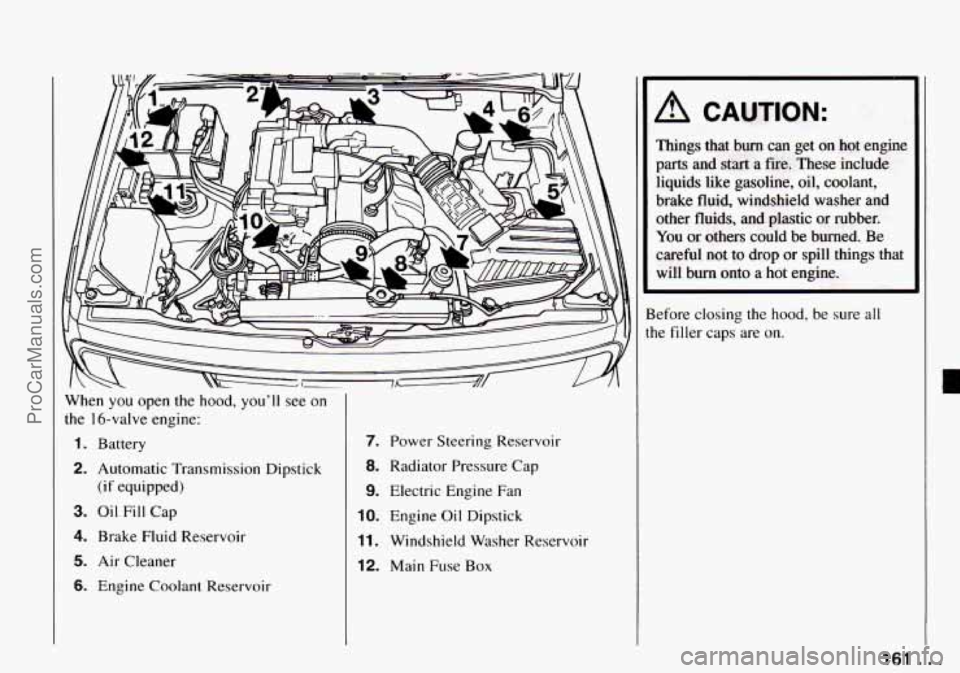
When you open the hood, you’ll see on
the 16-valve engine:
1. Battery
2. Automatic Transmission Dipstick
3. Oil Fill Cap
4. Brake Fluid Reservoir
5. Air Cleaner
6. Engine Coolant Reservoir (if equipped)
7. Power Steering Reservoir
8. Radiator Pressure Cap
9. Electric Engine Fan
IO. Engine Oil Dipstick
11. Windshield Washer Reservoir
12. Main Fuse Box
A CAUTION:
Things that bm can get on hot engiae
parts and start a fxe. These include
liquids like gasoline, oil, coolant,
brake fluid, windshield
washer and
other fluids, and plastic or rubber.
You
or others could be burned. Be
careful not to drop or spill things that
will bum onto a hot engine.
Before closing the hood, be sure all
the filler caps are on.
161 ... ProCarManuals.com
Page 172 of 258
and refill. If you use this mixture. you
don't need to add anything else.
A CAUTION:
Adding only plain water to your
cooling system can
be dangerous.
Plain water, or some other
liquid like
alcohol, can
boil before the proper
coolant mix will. Your vehicle's
cool-
ant warning system is set for the
proper coolant
mix. With plain water
or the wrong mix, your engine could
get too hot but you wouldn't get the
overheat warning. Your engine could
catch fire and you or others could be
burned. Use a 50/50 mix of clean
water and a proper antifreeze.
NOTICE:
If you use an improper coolant mix,
your engine could overheat and be
badly damaged. The repair cost
wouldn't be covered by your war-
ranty.
Too much water in the mix can
freeze and crack the engine, radiator,
heater core and other parts. Some conditions, such
as air
trapped in
the cooling system, can af't'ect the coolant
level
in the radiator. Check the coolant
level when the engine is cold and follow
the steps under "Adding Coolant" for the
proper way
to add coolant.
If you have to add coolant Inore than four
times
a year. have your dealer check your
cooling system.
NOTICE:
If you use the proper coolant. you
don't have to add extra inhibitors
or
additives which claim to improve thc
system. These can
be harmful.
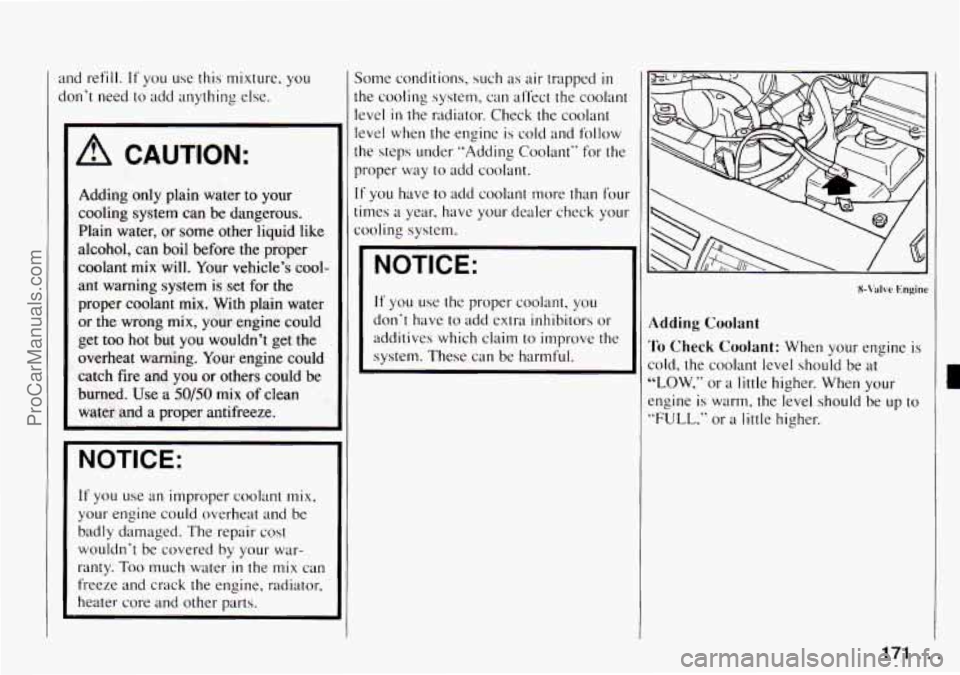
%-Valve Engine
Adding Coolant
To Check Coolant: When your engine is
cold.
the coolant level should be at
"LOW," or a little higher. When your
engine
is warm. the level should be up to
"FULL." or a little higher.
171 ..
ProCarManuals.com
Page 173 of 258

Service and Appearance Care
Radiator Pressure Cap
16-Valve Engine
To Add Coo1ant:If you need to add more
coolant, add the proper mix
qt the coolant
recovery tank. Add
coolant
mix at the recovery tank, but
be careful not to spill it.
NOTICE:
Your radiator cap is a 13 psi (90 kPa)
pressure-type cap and must be tightly
installed to prevent coolant loss and
possible engine damage
from over-
heating.
Be sure the amows on the
cap line up with the overflow tube
on the radiator filler neck.
When you replace
your radiator pressure
zap, an
AC@ cap is recommended.
Thermostat
Engine coolant temperature is controlled
by a thermostat in the engine coolant
system. The thermostat stops the
flow of
coolant through the radiator until the
coolant reaches a preset temperature.
When you replace your thermostat,
an
Ace' thermostat is recommended.
. . .172
ProCarManuals.com