fuel CHEVROLET TRACKER 1995 User Guide
[x] Cancel search | Manufacturer: CHEVROLET, Model Year: 1995, Model line: TRACKER, Model: CHEVROLET TRACKER 1995Pages: 354, PDF Size: 18.24 MB
Page 151 of 354
Driving In Water
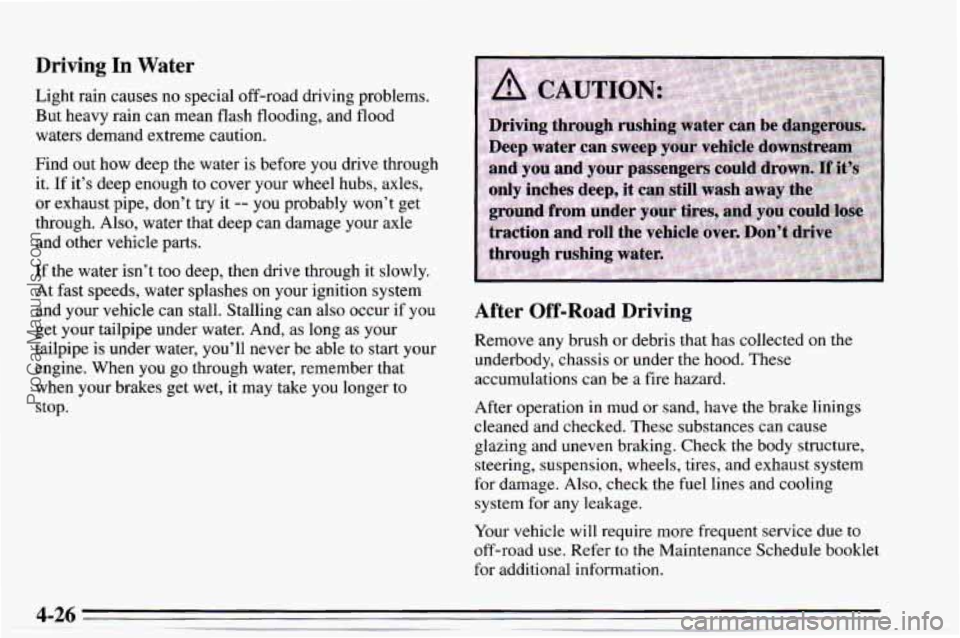
Light rain causes no special off-road driving problems.
But heavy rain can mean flash flooding, and flood
waters demand extreme caution.
Find out how deep the water is before you drive through
it. If it’s deep enough
to cover your wheel hubs, axles,
or exhaust pipe, don’t try it
-- you probably won’t get
through. Also, water that deep can damage your axle
and other vehicle parts.
If the water isn’t too deep, then drive through it slowly.
At fast speeds, water splashes on your ignition system
and your vehicle can stall. Stalling can also occur if
you
get your tailpipe under water. And, as long as your
tailpipe is under water, you’ll never
be able to start your
engine. When you go through water, remember that
when your brakes get wet, it may take you longer
to
stop.
After Off-Road Driving
Remove any brush or debris that has collected on the
underbody, chassis or under the hood. These
accumulations can be
a fire hazard.
After operation in mud or sand, have the brake linings
cleaned and checked. These substances can cause
glazing and uneven braking. Check the body structure,
steering, suspension, wheels, tires, and exhaust system
for damage. Also, check the fuel lines and cooling
svstem for any leakage.
rour vehicle
will require more frequent service due to
off-road use. Refer to the Maintenance Schedule booklet
for additional information.
ProCarManuals.com
Page 158 of 354
The exit ramp can be curved, sometimes quite sharply.
The
exit speed is usually posted.
Reduce your speed according to your speedometer, not
to your sense of motion. After driving for any distance
at higher speeds, you may tend to think
you are going
slower than
you actually are.
Before Leaving on a Long Trip
Make sure you’re ready. Try to be well rested. If you
must start when you’re not fresh
-- such as after a day’s
work
-- don’t plan to make too many miles that first part
of the journey. Wear comfortable clothing and shoes you
can easily drive in.
Is your vehicle ready for a long trip? If you keep it
serviced and maintained, it’s ready to go. If
it needs
service, have it done before starting out. Of course,
you’ll find experienced and able service experts
in
ChevroletlGeo dealerships all across North America.
They’ll be ready and willing to help if
you need it.
Here are some things you can check before a trip:
0 Windshield Washer Fluid: Is the reservoir full? Are
all windows clean inside and outside?
0 Wiper Blades: Are they in good shape?
0
0
0
0
0
Fuel, Engine Oil, Other Fluids: Have you checked
all levels?
Lamps: Are they all working? Are the lenses clean?
Tires: They are vitally important to a safe,
trouble-free trip.
Is the tread good enough for
long-distance driving? Are the tires all inflated to the
recommended pressure?
Weather Forecasts: What’s the weather outlook
along your route? Should you delay your trip a short
time to avoid a major storm system?
Maps: Do you have up-to-date maps?
Highway Hypnosis
Is there actually such a condition as “highway
hypnosis”? Or is it just plain falling asleep at the wheel?
Call
it highway hypnosis, lack of awareness, or
whatever.
There is something about an easy stretch of road with
the same scenery, along with the hum of the tires on the
road, the drone of the engine, and the rush of the wind
against the vehicle that can make you sleepy. Don’t let
it
happen to you! If it does, your vehicle can leave the
road in
less than a second, and you could crash and be
injured.
ProCarManuals.com
Page 164 of 354
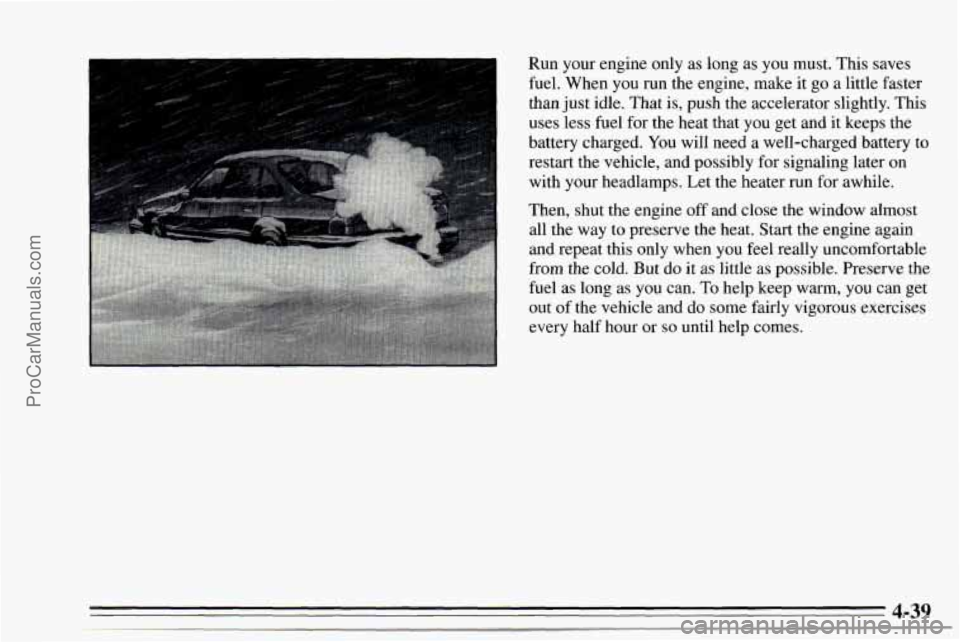
Run your engine only as long as you must. This saves
fuel. When you run the engine, make it go a little faster
than just idle. That
is, push the accelerator slightly. This
uses less fuel for the heat that you get and it keeps the
battery charged. You will need
a well-charged battery to
restart the vehicle, and possibly for signaling later
on
with your headlamps. Let the heater run for awhile.
Then, shut the engine
off and close the window almost
all the way to preserve the heat. Start the engine again
and repeat this only when you feel really uncomfortable
from the cold. But do it
as little as possible. Preserve the
fuel as long as you can.
To help keep warm, you can get
out of the vehicle and do some fairly vigorous exercises
every half hour or
so until help comes.
4-39
ProCarManuals.com
Page 168 of 354
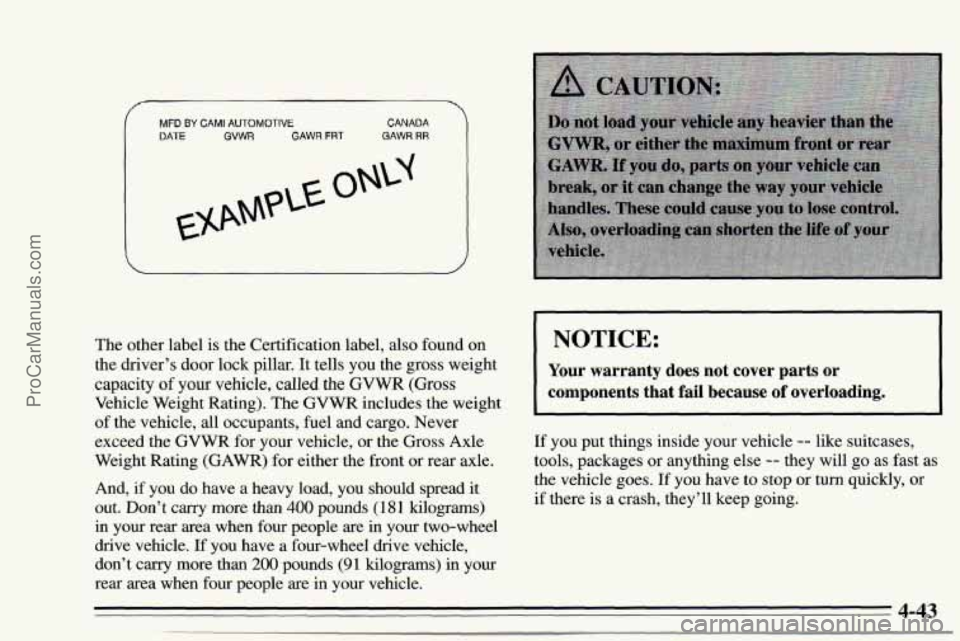
f :[:BY CAM1 AUTOMOTIVE CANADA GVWR GAWR FRT GAWR RR
The
other label is the Certification label, also found on
the driver’s door lock pillar. It tells you the gross weight
capacity of your vehicle, called
the GVWR (Gross
Vehicle Weight Rating). The GVWR includes the weight
of the vehicle,
all occupants, fuel and cargo. Never
exceed the GVWR for your vehicle, or the Gross Axle
Weight Rating
(GAWR) for either the front or rear axle.
And,
if you do have a heavy load, you should spread it
out. Don’t
carry more than 400 pounds (181 kilograms)
in your rear area when four people are in your two-wheel
drive vehicle.
If you have a four-wheel drive vehicle,
don’t carry more than
200 pounds (9 1 kilograms) in your
rear area when four people are in your vehicle.
NOTICE:
Your warranty does not cover parts or
components that fail because
of overloading.
If you put things inside your vehicle -- like suitcases,
tools, packages or anything else
-- they will go as fast as
the vehicle goes. If
you have to stop or turn quickly, or
if there is a crash, they’ll keep going.
4-43
ProCarManuals.com
Page 170 of 354
Your vehicle can tow a trailer. To identify what the
vehicle trailering capacity
is for your vehicle, you
should read the information in “Weight of the Trailer”
that
appears later in this section. But trailering is
different than just driving your vehicle by itself.
Trailering means changes in handling, durability, and
fuel economy. Successful, safe trailering takes correct
equipment, and it has to be used properly.
That’s the reason for this section. In it are many
time-tested, important trailering tips and safety rules.
Many
of these are important for your safety and that of
your passengers.
So please read this section carefully
before you pull a trailer.
Load-pulling components such as the engine,
transmission, wheel assemblies, and tires are forced
to
work harder against the drag of the added weight. The
engine
is required to operate at relatively higher speeds
and under greater loads, generating extra heat. What’s
more, the trailer adds considerably
to wind resistance,
increasing the pulling requirements.
If You Do Decide To Pull A Trailer
If you do, here are some important points.
0
0
0
0
There are many different laws, including speed limit
restrictions, having
to do with trailering. Make sure
your rig will
be legal, not only where you live but
also where
you’ll be driving. A good source for this
information can be state or provincial police.
Consider using a sway control. You
can ask a hitch
dealer about sway controls.
Don’t tow a trailer at all during the first
500 miles
(800 km) your new vehicle is driven. Your engine,
axle or other parts could be damaged.
Then, during the first
500 miles (800 km) that you
tow a trailer, don’t drive over
50 mph (80 km/h) and
don’t make starts at full throttle. This helps your
engine and other parts of your vehicle wear
in at the
heavier loads.
If
you have an automatic transmission, you should use
DRIVE (D) (or, as
you need to, a lower gear) when
towing
a trailer. Operating your vehicle in DRIVE (D)
when towing a trailer will minimize heat build-up and
extend the
life of your transmission. If you have a
manual transmission and
you are towing a trailer, it’s
better
not to use FIFTH (5) gear. Just drive in
FOURTH (4) gear (or, as you need to, a lower gear).
ProCarManuals.com
Page 212 of 354
Gem Section 6 Service and Appearance Care
Here you will find information about the care of your Geo.
This section begins with service and fuel information, and
then it shows how to check important fluid and lubricant
levels. There is also technical information about your
vehicle, and a part devoted
to its amearance care.
Service
Your Chevrolet/Geo dealer knows your vehicle best and
wants
you to be happy with it. We hope you’ll go to your
dealer for all your service needs. You’ll get genuine
GM
parts and GM-trained and supported service people.
We hope you’ll want
to keep your GM vehicle all GM.
Genuine GM parts have one of these marks:
n
Delco
Doing Your Own Service Work
If you want to do some of your own service work, you’ll
want to get the proper Geo Service Manual. It tells you
much more about how to service your Geo than this
manual can.
To order the proper service manual, see
“Service Publications”
in the Index.
You should keep a record with all parts receipts and list
the mileage and the date of any service work
you
perform. See “Maintenance Record” in the Index.
ProCarManuals.com
Page 213 of 354
Fuel
NOTICE:
If you try to do your own service work without
knowing enough about it, your vehicle could be
damaged.
Use regular unleaded gasoline rated at 87 octane or
higher. It should meet specifications ASTM D4814 in
the United States and CGSB
3.5-92 in Canada. These
fuels should have the proper additives,
so you should not
have
to add anything to the fuel.
In the United States and Canada, it’s easy to be sure you
get the right kind of gasoline (unleaded). You’ll
see
UNLEADED right on the pump. And only unleaded
nozzles will fit into your vehicle’s filler neck.
Be sure the posted octane is at least
87. If the octane is
less than 87, you may get a heavy knocking noise when
you drive. If it’s bad enough,
it can damage your engine.
If you’re using fuel rated at 87 octane or higher and you
still hear heavy knocking, your engine needs service.
But don’t worry if
you hear a little pinging noise when
you’re accelerating or driving up a hill. That’s normal,
and you don’t have
to buy a higher octane fuel to get rid
of pinging. It’s the heavy, constant knock that means
you have a problem.
ProCarManuals.com
Page 214 of 354

What about gasoline with blending materials that
contain oxygen (oxygenates), such as MTBE or alcohol?
MTBE is “methyl tertiary-butyl ether.” Fuel that is no
more than
15% MTBE is fine for your vehicle.
Ethanol is ethyl or grain alcohol. Properly-blended fuel
that
is no more than 10% ethanol is fine for your
vehicle.
Methanol is methyl or wood alcohol.
NOTICE:
Fuel that is more than 5% methanol is bad for
your vehicle. Don’t use it. It can corrode metal parts in your fuel system and also damage plastic
and rubber parts. That damage wouldn’t be
covered under your warranty. And even at
5% or
less, there must be “cosolvents” and corrosion
preventers in this fuel to help avoid these
problems.
Gasolines for Cleaner Air
Your use of gasoline with deposit control additives will
help prevent deposits from forming in your engine and
fuel system. That helps keep your engine in tune and
your emission control system working properly. It’s
good for your vehicle, and you’ll be doing your part for
cleaner air.
Many gasolines are now blended with oxygenates.
General Motors recommends that you use gasolines with
these blending materials, such as MTBE and ethanol. By
doing
so, you can help clean the air, especially in those
parts of the country that have high carbon monoxide
levels.
In addition, some gasoline suppliers are
now producing
reformulated gasolines. These gasolines are specially
designed
to reduce vehicle emissions. General Motors
recommends that
you use reformulated gasoline. By
doing
so, you can help clean the air, especially in those
parts
of the country that have high ozone levels.
You should ask your service station operators if their
gasolines contain deposit control additives and
oxygenates, and if they have been reformulated to
reduce vehicle emissions.
ProCarManuals.com
Page 215 of 354
Fuels in Foreign Countries
If you plan on driving in another country outside the
U.S. or Canada, unleaded fuel may be hard to find. Do
not use leaded gasoline. If you use even one tankful,
your emission controls won’t work well or at all. With
continuous use, spark plugs can get fouled, the exhaust
system
can corrode, and your engine oil can deteriorate
quickly. Your vehicle’s oxygen sensor will be damaged.
All
of that means costly repairs that wouldn’t be covered
by your warranty.
To check on fuel availability, ask an auto club, or
contact
a major oil company that does business in the
country where you’ll be driving.
You can also write
us at the following address for
advice. Just tell us where you’re going and give your
Vehicle Identification Number (VIN).
Filling Your Tank
- ~~~
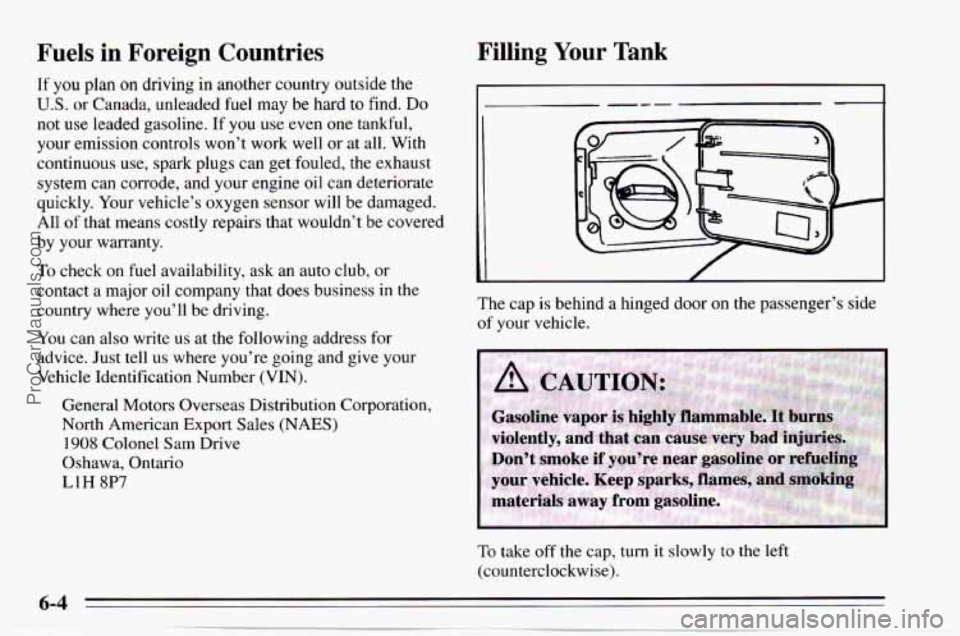
The cap is behind a hinged door on the passenger’s side
of your vehicle.
General Motors Overseas Distribution Corporation,
North American
Export Sales (NAES)
1908 Colonel Sam Drive
Oshawa, Ontario
L1H 8P7
To take off the cap, turn it slowly to the left
(counterclockwise).
ProCarManuals.com
Page 223 of 354
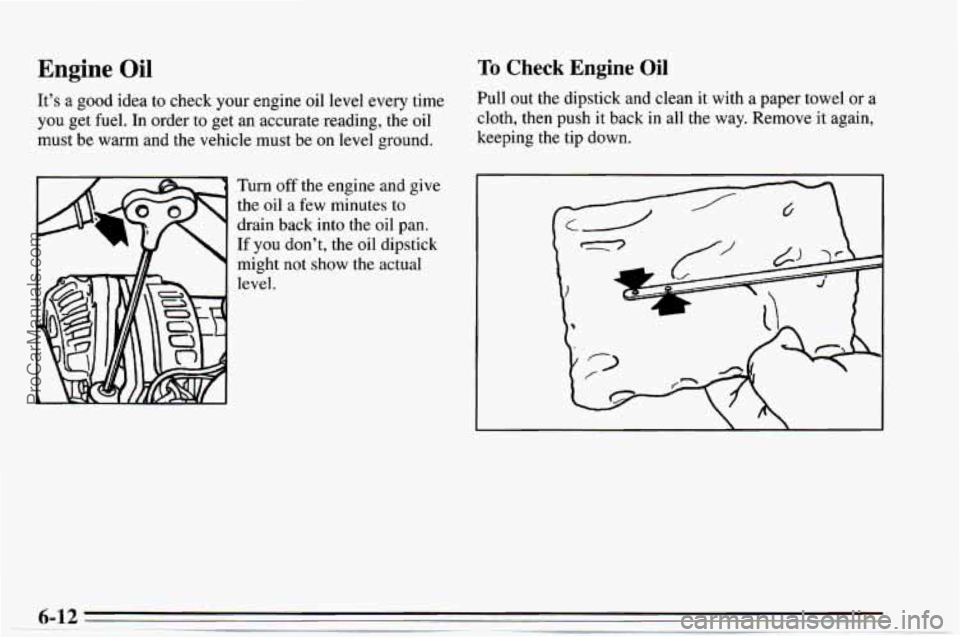
Engine Oil
It’s a good idea to check your engine oil level every time
you get fuel. In order to get an accurate reading, the oil
must be warm and the vehicle must be
on level ground.
Turn
off the engine and give
the oil a few minutes to
drain back into the oil pan.
If
you don’t, the oil dipstick
might not
show the actual
level.
To Check Engine Oil
Pull out the dipstick and clean it with a paper towel or a
cloth, then push it back in all the way. Remove it again,
keeping the tip down.
t
ProCarManuals.com