brakes CHEVROLET TRACKER 1995 Owner's Manual
[x] Cancel search | Manufacturer: CHEVROLET, Model Year: 1995, Model line: TRACKER, Model: CHEVROLET TRACKER 1995Pages: 354, PDF Size: 18.24 MB
Page 173 of 354
nailer Brakes
If your trailer weighs more than 1,000 pounds (450 kg)
loaded, then it needs its own brakes -- and they must be
adequate. Be sure to read and follow the instructions for
the trailer brakes
so you’ll be able to install, adjust and
maintain them properly.
Driving with a Trailer
0
0
0
Don’t tap into your vehicle’s brake system if the
trailer’s brake system will use more than
0.02 cubic
inch
(0.3 cc) of fluid from your vehicle’s master
cylinder.
If it does, both systems won’t work well.
You could even lose your brakes.
Will the trailer brake parts take
3,000 psi
(20 650 kPa) of pressure? If not, the trailer brake
system must not be used with your vehicle.
If everything checks out this far, then make the brake
fluid tap at the port on the master cylinder that sends
fluid to the rear brakes. But don’t use copper tubing
for this.
If you do, it will bend and finally break off.
Use steel brake tubing. Towing
a trailer requires a certain amount of experience.
Before setting out for the open road, you’ll
want to get
to know your rig. Acquaint yourself with the feel of
handling and braking with the added weight
of the
trailer. And always keep in mind that the vehicle you
are
driving is now a good deal longer and not nearly as
responsive as your vehicle
is by itself.
Before you start, check the trailer hitch and platform
(and attachments), safety chains, electrical connector,
lamps, tires and mirror adjustment.
If the trailer has
electric brakes, start your vehicle and trailer moving and
then apply the trailer brake controller by hand to be sure
the brakes are working. This lets
you check your
electrical connection at the same time.
During your trip, check occasionally to be sure that the
load is secure, and that the lamps and any trailer brakes
are still working.
ProCarManuals.com
Page 175 of 354
When towing a trailer, the green arrows on your
instrument panel will flash for turns even if the bulbs on
the trailer are burned out. Thus, you may think drivers
behind you are seeing your signal when
they are not. It’s
important to check occasionally to be sure the trailer
bulbs are still working.
Driving On Grades
Reduce speed and shift to a lower gear before you start
down a long or steep downgrade.
If you don’t shift
down, you might have to
use your brakes so much that
they would get hot and no longer work well.
On a long uphill grade, shift down and reduce your
speed
to around 45 mph (70 km/h) to reduce the
possibility of engine and transmission overheating.
If you are towing a trailer and you have a manual
transmission with fifth gear, you may prefer not to use
fifth gear. Just drive in fourth gear (or,
as you need to, a
lower gear).
Parking on Hills
You really should not park your vehicle, with a trailer
attached,
on a hill. If something goes wrong, your rig
could start
to move. People can be injured, and both
your vehicle and the trailer can be damaged.
But if you ever have to park your rig on a hill, here’s
how to do it:
1. Apply your regular brakes, but don’t shift into
PARK
(P) yet, or into gear for a manual
transmission.
2. Have someone place chocks under the trailer wheels.
3. When the wheel chocks are in place, release the
regular brakes until the chocks absorb the load.
4. Reapply the regular brakes. Then apply your parking
brake, and then shift to PARK
(P), or REVERSE (R)
for a manual transmission.
5. If you have a four-wheel drive vehicle, be sure
the transfer case is
in a drive gear -- not in
NEUTRAL
(N).
6. Release the regular brakes.
ProCarManuals.com
Page 176 of 354
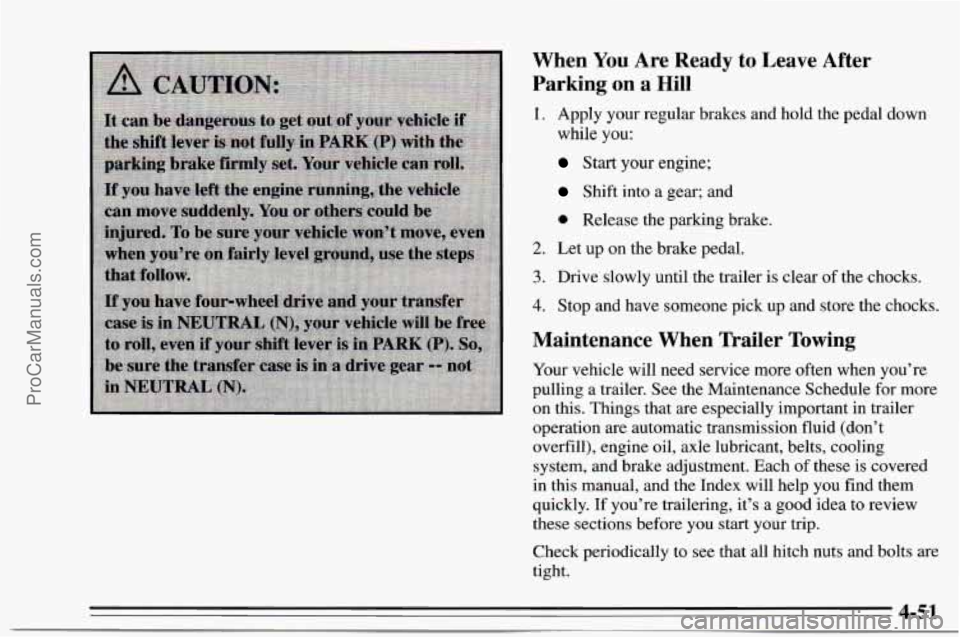
When You Are Ready to Leave After
Parking on a Hill
1. Apply your regular brakes and hold the pedal down
while you:
Start your engine;
Shift into a gear; and
0 Release the parking brake.
2. Let up on the brake pedal.
3. Drive slowly until the trailer is clear of the chocks.
4. Stop and have someone pick up and store the chocks.
Maintenance When Trailer Towing
Your vehicle will need service more often when you’re
pulling a trailer. See the Maintenance Schedule for more
on this. Things that
are especially important in trailer
operation are automatic transmission fluid (don’t
overfill), engine oil, axle lubricant, belts, cooling
system, and brake adjustment. Each of these is covered
in this manual, and the Index will help you find them
quickly. If you’re trailering, it’s a good idea to review
these sections before you start your trip.
Check periodically to see that all hitch nuts and bolts are
tight.
4-51
ProCarManuals.com
Page 242 of 354
Brakes
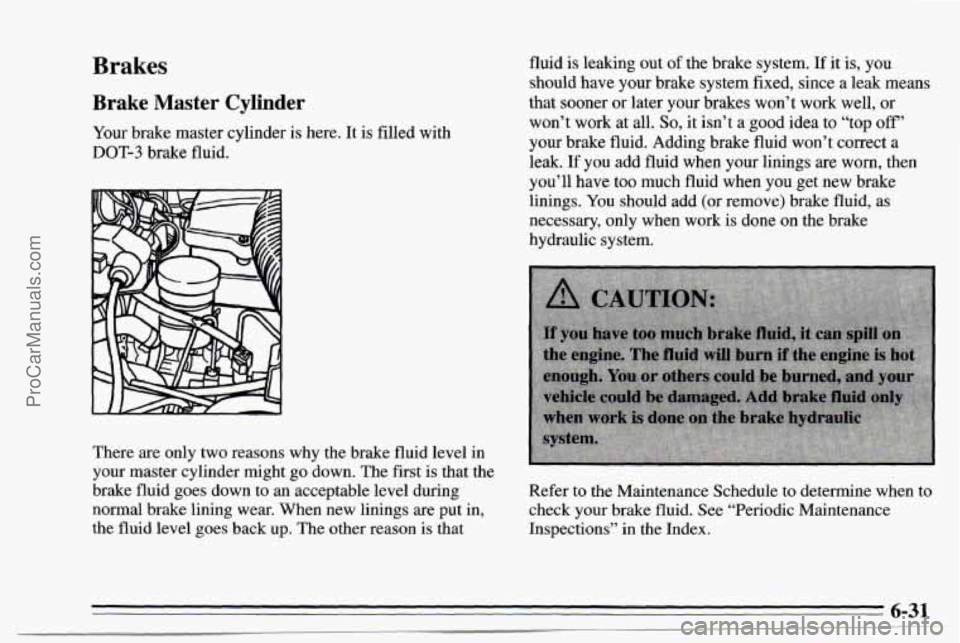
Brake Master Cylinder
YOLK brake master cylinder is here. It is filled with
DOT-3 brake fluid.
There are only two reasons why the brake fluid level in
your master cylinder might go down. The first is that the
brake fluid goes down to an acceptable level during
normal brake lining wear. When new linings are put in,
the fluid level goes back up. The other reason is that fluid
is leaking out
of the brake system. If it is, you
should have your brake system fixed, since
a leak means
that sooner or later your brakes won’t work well, or
won’t work at
all. So, it isn’t a good idea to “top off”
your brake fluid. Adding brake fluid won’t correct a
leak. If you add fluid when your linings are worn, then
you’ll have too much fluid when you get new brake
linings. You should add (or remove) brake fluid, as
necessary, only when work is done on the brake
hydraulic system.
Refer to the Maintenance Schedule to determine when to
check your brake fluid. See “Periodic Maintenance
Inspections” in the Index.
6-31
ProCarManuals.com
Page 244 of 354
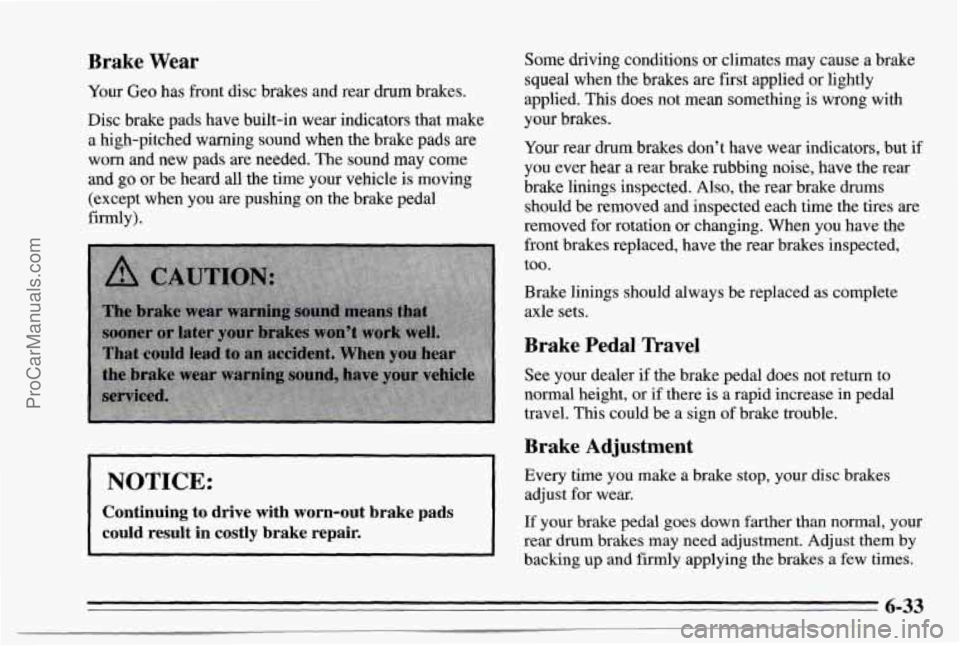
Brake Wear
Your Geo has front disc brakes and rear drum brakes.
Disc brake pads have built-in wear indicators that make
a high-pitched warning sound when the brake pads
are
worn and new pads are needed. The sound may come
and go or be heard all the time your velvcle is moving
(except when you are pushing on the brake pedal
firmly).
NOTICE:
Continuing to drive with worn-out brake pads
could result in costly brake repair.
Some driving conditions or climates rSray C2iQSg si brake
squeal when the brakes are first applied or lightly
applied. This does not mean something is wrong with
your brakes.
Your rear drum brakes don’t have wear indicators, but if
you ever hear a rear brake rubbing noise, have the rear
brake linings inspected. Also, the rear brake drums
should be removed and inspected each time the tires are
removed for rotation or changing. When you have the
front brakes replaced, have the rear brakes inspected,
too.
Brake linings should always be replaced as complete
axle sets.
Brake Pedal Travel
See your dealer if the brake pedal does not return to
normal height, or
if there is a rapid increase in pedal
travel. This could be a sign
of brake trouble.
Brake Adjustment
Every time you make a brake stop, your disc brakes
adjust for wear.
If your brake pedal goes down farther than normal, your
rear drum brakes
may need adjustment. Adjust them by
backing up and firmly applying the brakes a few times.
ProCarManuals.com
Page 245 of 354
Replacing Brake System Parts
The braking system on a modern vehicle is complex. Its
many parts have to be
of top quality and work well
together if the vehicle is to have really good braking.
Vehicles we design and test have top-quality GM brake
parts in them, as your Geo does when it is new. When
you replace parts of your braking system
-- for example,
when your brake linings wear down and you have to
have new ones put in
-- be sure you get new genuine
GM replacement parts. If you don’t, your brakes may
no longer work properly. For example, if someone puts
in brake linings that are wrong for your vehicle,
the balance between your front and rear brakes can
change
-- for the worse. The braking performance
you’ve come to expect can change in many other ways
if someone puts in the wrong replacement brake parts.
Battery
Every new Geo has a Delco Freedom@ battery. You
never have to add water to one
of these. When it’s time
for
a new battery, we recommend a Delco Freedom@
battery. Get one that has the replacement number shown
on the original battery’s label.
Vehicle Storage
If you’re not going to drive your vehicle for 25 days or
more, take
off the black, negative (-) cable from the
battery. This will help keep your battery from running
down.
Contact your dealer to learn how to prepare your vehicle
for longer storage periods.
ProCarManuals.com
Page 328 of 354
 Mechanism Check At least every spring, use plain water to flush any
corrosive materials from
the underbody. Take")
Parking Brake and Automatic Ikansmission PARK Underbody Flushing \
(P) Mechanism Check At least every spring, use plain water to flush any
corrosive materials from
the underbody. Take care to
clean thoroughly any areas where mud and other debris
can collect.
.-
Park on a fairly steep hill, with the vehicle facing
downhill. Keeping your foot
on the regular brake, set the
parking brake.
0 To check the parking brake: With the engine running
and transmission
in NEUTRAL (N), slowly remove
foot pressure from the regular brake pedal.
Do this
until the vehicle is held by the parking brake only.
0 To check the PARK (P) mechanism's holding ability:
Shift to
PARK (P). Then release all brakes. If your
vehicle is four-wheel drive, be sure the transfer case
is not in NEUTRAL (N).
ProCarManuals.com
Page 330 of 354
Throttle Linkage Inspection
Inspect the throttle linkage for interference or binding,
and for damaged or missing parts. Replace parts as
needed. Accelerator and cruise control cables should
not
be lubricated.
Rear Axle (All) and Front Axle
(Four-Wheel Drive) Service
Check the gear lubricant level and add if needed. See
“Rear Axle” and “Four-Wheel Drive”
in the Index. A
fluid loss may indicate a problem. Check the system(s),
and repair the system(s) if needed. Refer
to “Scheduled
Maintenance Services,” earlier
in this section, to
determine when to change the lubricant.
Brake System Inspection
Inspect the complete system. Inspect brake lines and
hoses for proper hookup, binding, leaks, cracks, chafing,
etc. Inspect disc brake pads for wear and rotors for
surface condition. Also inspect drum brake linings for
wear and cracks. Inspect other brake parts, including
drums, wheel cylinders, calipers, parking brake, etc.
Check parking brake adjustment.
You may need to have
your brakes inspected more often if your driving habits
or conditions result in frequent braking.
Clutch System Service
Check clutch pedal free travel and adjust as necessary.
See “Clutch Adjustment’’ in
the Index.
7-53
ProCarManuals.com
Page 344 of 354
Gee Section 9 Index
Adding Automatic Transmission Fluid
.................. 6-22
Brake Fluid
................................. 6-32
Electrical Equipment
.................... 2- 10. 6.59
Engine Coolant .............................. 6-26
Engineoil
.................................. 6-13
Manual Transmission Fluid
.................... 6-23
Power Steering Fluid
......................... 6-29
SoundEquipment
............................ 3-18
Windshield Washer Fluid
................. 2-3 1, 6-30
Adjustable Steering Column ...................... 2-27
Aircleaner
.................................... 6-16
Air Cleaner Filter Replacement
.................... 6- 18
Air Conditioning ................................ 3-3
Air Conditioning Controls ......................... 3-3
AirIntakeLever
................................. 3-2
Airflow Lever 3-
I
Alignment and Balance, Tires ..................... 6-46
Aluminum Wheels, Cleaning
...................... 6-56
Antifreeze
..................................... 6-25
Anti-Lock ..................................... 4-6
Anti-Lock Brakes
............................... 4-6
Appearance Care ............................... 6-49
Appearance Care and Materials
.................... 6-58
Ashtrays Front
...................................... 2-36
...................................
Antenna ...................................... 3-19 Rear
....................................... 2-37
Audio Systems
.................................. 3-5
Automatic Transmission
......................... 2-11
Drive
(D) Position ............................ 2-13
Low(L)Position
............................. 2-14
Neutral
(N) Position .......................... 2-13
Park (P) Position
............................. 2-11
Reverse (R) Position
.......................... 2-12
Second (2) Position
........................... 2-13
Starting Your Engine
........................... 2-9
Automatic Transmission Fluid
..................... 6-19
Adding .................................... 6-22
Checking
................................... 6-22
Axle, Front
.................................... 6-25
Axle, Rear
.................................... 6-24
Battery
...................................... 6-34
BBB Auto Line
................................. 8-3
Bi-Level
....................................... 3-2
Brake Warnings
.................................... 5-2
Blizzard
...................................... 4-38
Adjustment
................................. 6-33
Fluid, Adding
............................... 6-31
Master Cylinder
............................. 6-31
Parking
.................................... 2-20
PedalTravel
................................ 6-33
9-1
--.. p-.. ........ ... _-i-.-_'.-.-- ..... .=_ ___.~~~~-~_.i_i~.---~ ~~~ ..__________I ProCarManuals.com
Page 345 of 354
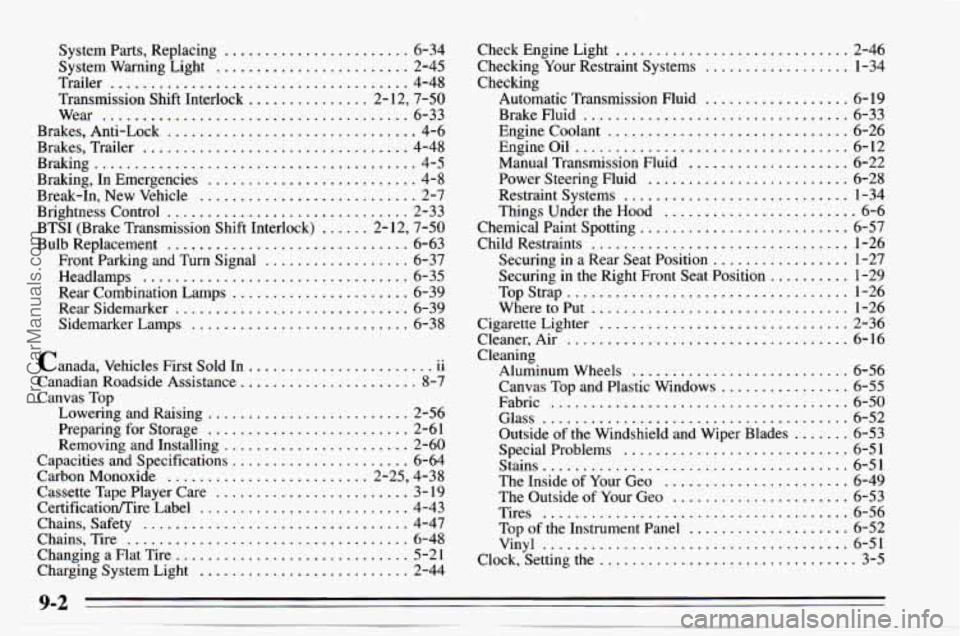
System Parts. Replacing ....................... 6-34
Trailer
..................................... 4-48
Transmission Shift Interlock
............... 2- 12. 7.50
Wear
...................................... 6-33
Brakes. Anti-Lock
............................... 4-6
Brakes. Trailer
................................. 4-48
Braking
........................................ 4-5
Braking. In Emergencies
.......................... 4-8
Break-In. New Vehicle
........................... 2-7
Brightness Control
.............................. 2-33
BTSI (Brake Transmission Shift Interlock)
...... 2- 12. 7-50
Bulb Replacement .............................. 6-63
Front Parking and Turn Signal
.................. 6-37
Headlamps
................................. 6-35
Rear Combination Lamps
...................... 6-39
Rear Sidemarker
............................. 6-39
Sidemarker Lamps
........................... 6-38
System Warning Light
........................ 2-45
Canada. Vehicles First Sold In
-11
Canadian Roadside Assistance ...................... 8-7
Canvas Top Lowering and Raising
......................... 2-56
Preparing for Storage
......................... 2-61
Removing and Installing
....................... 2-60
Capacities and Specifications
...................... 6-64
CarbonMonoxide
......................... 2.25. 4.38
Cassette Tape Player Care
........................ 3-19
Certificatioflire Label
.......................... 4-43
Chains. Safety
................................. 4-47
Chains. Tire
................................... 6-48
Changing a Flat Tire ............................. 5-2 1
Charging System Light .......................... 2-44
.. ......................
Check Engine Light ............................. 2-46
Checking Your Restraint Systems
.................. 1-34
Checking Automatic Transmission Fluid
.................. 6-19
BrakeFluid
................................. 6-33
Engine Coolant
.............................. 6-26
Engineoil
.................................. 6-12
Manual Transmission Fluid
.................... 6-22
Power Steering Fluid
......................... 6-28
Restraint Systems
............................ 1-34
Things Under the
Hood ........................ 6-6
Chemical Paint Spotting
.......................... 6-57
Child Restraints
................................ 1-26
Securing in a Rear Seat Position
................. 1-27
Securing in the Right Front Seat Position
.......... 1-29
WheretoPut
................................ 1-26
Cleaner. Air
................................... 6-16
Cleaning Aluminum Wheels
........................... 6-56
Canvas Top and Plastic Windows
................ 6-55
Fabric
..................................... 6-50
Glass
...................................... 6-52
Outside of the Windshield and Wiper Blades
....... 6-53
Stains
...................................... 6-51
The Inside of Your Geo
....................... 6-49
The Outside
of Your Geo ...................... 6-53
Tires
...................................... 6-56
Top
of the Instrument Panel .................... 6-52
Vinyl
...................................... 6-51
TopStrap
................................... 1-26
Cigarette Lighter
............................... 2-36
Special Problems
............................ 6-51
Clock. Setting the
................................ 3-5
9-2
. ProCarManuals.com