brakes CHEVROLET TRACKER 1995 User Guide
[x] Cancel search | Manufacturer: CHEVROLET, Model Year: 1995, Model line: TRACKER, Model: CHEVROLET TRACKER 1995Pages: 354, PDF Size: 18.24 MB
Page 134 of 354
Suppose you’re steering through a sharp curve.
Then you suddenly apply the brakes. Both control
systems
-- steering and braking -- have to do their
work where the tires meet the road. Adding the hard
bralung can demand too much at those places. You can
lose control.
The same thing can happen if you’re steering through
a
sharp curve and you suddenly accelerate. Those two
control systems
-- steering and acceleration -- can
overwhelm those places where the tires meet the road
and make
you lose control.
What should
you do if this ever happens? Ease up on the
brake or accelerator pedal, steer the vehicle
the way you
want it to go, and slow down.
Speed limit signs near curves warn that
you should
adjust your speed.
Of course, the posted speeds are
based on good weather and road conditions. Under less
favorable conditions you’ll want to go slower.
Steering in Emergencies
There are times when steering can be more effective
than braking. For example,
you come over a hill and
find a truck stopped in your lane,
or a car suddenly pulls
out from nowhere,
or a child darts out from between
parked cars and stops right in front
of you. You can
avoid these problems by braking
-- if you can stop in
time. But sometimes
you can’t; there isn’t room. That’s
the time for evasive action
-- steering around the
problem.
Your Geo can perform very well in emergencies like
these. First apply your brakes, but not enough to lock
your front wheels. (See “Braking in Emergencies’’
earlier in this section.) It is better to remove
as much
speed as you can from a possible collision. Then steer
around the problem,
to the left or right depending on the
space available.
If you need to reduce your speed as you approach
a
curve, do it before you enter the curve, while your front
wheels are straight ahead.
Try
to adjust your speed so you can “drive” through the
curve. Maintain
a reasonable, steady speed. Wait to
accelerate until you are out
of the curve, and then
accelerate gently into the straightaway.
4-9
ProCarManuals.com
Page 137 of 354

Check your mirrors, glance over your shoulder, and
start your left lane change signal before moving out
of the right lane to pass. When you are far enough
ahead
of the passed vehicle to see its front in your
inside mirror, activate your right lane change signal
and move back into the right lane. (Remember that
your right outside mirror is convex. The vehicle
you
just passed may seem to be farther away from you
than it really is.)
Try not to pass more than one vehicle at a time on
two-lane roads. Reconsider before passing the
next
vehicle.
0 Don’t overtake a slowly moving vehicle too rapidly.
Even though the brake lamps are not flashing, it may
be slowing down
or starting to turn.
following driver to get ahead
of you. Perhaps you
can ease a little to the right.
If you’re being passed, make it easy for the
Loss of Control
Let’s review what driving experts say about what
happens when the three control systems (brakes, steering
and acceleration) don’t have enough friction where the
tires meet the road to do what the driver has asked.
In any emergency, don’t give up. Keep trying to steer
and constantly seek an escape route or area
of less
danger.
Skidding
In a skid, a driver can lose control of the vehicle.
Defensive drivers avoid most skids by taking reasonable
care suited to existing conditions, and by not
“overdriving” those conditions. But skids are always
possible.
The three types
of skids correspond to your Geo’s three
control systems. In the braking skid your wheels aren’t
rolling. In the steering or cornering skid, too much speed
or steering in a curve causes tires to slip
and lose
cornering force. And in the acceleration skid too much
throttle causes the driving wheels to spin.
A cornering skid and an acceleration skid are best
handled by easing your foot off the accelerator pedal.
ProCarManuals.com
Page 138 of 354
If your vehicle starts to slide, ease your foot off the
accelerator pedal and quickly steer the way you want the
vehicle to go. If you start steering quickly enough, your
vehicle may straighten
out. Always be ready for a
second skid if it occurs.
Of course, traction is reduced when water, snow, ice,
gravel, or other material is on the road. For safety,
you’ll
want to slow down and adjust your driving to these
conditions. It is important to slow down on slippery
surfaces because stopping distance will be longer and
vehicle control more limited.
While driving
on a surface with reduced traction, try
your best to avoid sudden steering, acceleration, or
braking (including engine braking by shifting to a lower
gear). Any sudden changes could cause the tires to slide.
You may not realize the surface
is slippery until your
vehicle is skidding. Learn
to recognize warning
clues
-- such as enough water, ice or packed snow on
the road to make a “mirrored surface” -- and slow
down when you have any doubt.
Remember: The rear-wheel anti-lock braking system
(RWAL) helps avoid only a rear braking skid.
In a
braking skid (where the front wheels are no longer
rolling), release enough pressure
on the brakes to get the front
wheels rolling again. This restores steering control.
Push the brake pedal down steadily when you have to
stop suddenly. As long as the front wheels are rolling,
you will have steering control.
Driving Guidelines
This multipurpose passenger vehicle is defined as a
utility vehicle
in Consumer Information Regulations
issued by the National Highway Traffic Safety
Administration (NHTSA) of the United States
Department of Transportation, Utility vehicles have
higher ground clearance and a narrower track to make
them capable of performing in a wide variety
of off-road
applications. Specific design characteristics give them
a
higher center of gravity than ordinary cars. An
advantage
of the higher ground clearance is a better
view
of the road allowing you to anticipate problems.
They are
not designed for cornering at the same speeds
as conventional 2-wheel drive vehicles any more than
low-slung sports cars are designed
to perform
satisfactorily under off-road conditions. If at all
possible, avoid sharp turns or abrupt maneuvers.
As with
other vehicles of this type, failure
to operate this vehicle
correctly may result in loss of control or vehicle
rollover.
ProCarManuals.com
Page 139 of 354
Off-Road Driving with Your Geo
Four-wheel Drive Vehicle
This off-road guide is for vehicles that have four-wheel
drive.
Also, see “Anti-Lock Brakes” in the Index.
If your vehicle doesn’t have four-wheel drive, you
shouldn’t drive off-road unless you’re on a level, solid
surface.
Off-road driving can be great fun. But it does have some
definite hazards. The greatest of these is the terrain
itself.
“Off-roading” means you’ve
left the great North
American road system behind. Traffic lanes aren’t
marked. Curves aren’t banked. There are no road signs.
Surfaces can be slippery, rough, uphill or downhill. In
short, you’ve gone right back to nature.
Off-road driving involves some new skills. And that’s
why it’s very important that you read this guide. You’ll
find many driving tips and suggestions. These will help
make your off-road driving safer and more enjoyable.
Before You Go Off-Roading
There are some things to do before you go out. For
example, be sure to have all necessary maintenance and
service work done. Check to make sure all underbody
shields (if
so equipped) are properly attached. Be sure
you read all the information about your four-wheel drive
vehicle
in this manual. Is there enough fuel? Is the spare
tire fully inflated? Are the fluid levels up where they
should be? What are the local laws that apply
to
off-roading where you’ll be driving? If you don’t know,
you should check with law enforcement people
in the
area. Will you be on someone’s private land? If
so, be
sure to get the.necessary permission.
Loading Your Vehicle for Off-Road Driving
There are some important things to remember about
how to load your vehicle.
0 The heaviest things should be on the load floor and
forward
of your rear axle. Put heavier items as far
forward as you can.
0 Be sure the load is secured properly, so driving on
the off-road terrain doesn’t toss things around.
4-14
ProCarManuals.com
Page 146 of 354
Driving Downhill
When off-roading takes you downhill, you’ll want to
consider a number
of things:
How steep is the downhill? Will I be able to maintain
vehicle control?
0 What’s the surface like? Smooth? Rough? Slippery?
Hard-packed dirt? Gravel?
0 Are there hidden surface obstacles? Ruts? Logs?
Boulders?
What’s at the bottom of the hill? Is there a hidden
creek bank
or even a river bottom with large rocks?
If
you decide you can go down a hill safely, then try to
keep your vehicle headed straight down, and use a low
gear. This way, engine drag can help your brakes and
they won’t have to do all the work. Descend slowly,
keeping your vehicle under control at all times.
ProCarManuals.com
Page 147 of 354
&: Are there some things I should not do when
A: Yes! These are important because if you ignore
driving down a bill?
0
them you could lose control and have a serious
accident.
When dr.iving downhill, avoid
turns that take you
across the incline of the hill. A hill that’s not too
steep to drive down may be too steep to drive across.
You could roll over if you don’t drive straight down.
Never go downhill with
the transmission in
NEUTRAL, (N), or with the clutch pedal depressed
in a manual shift. This is called “free-wheeling.‘‘
Your brakes
wjll have to do all the work and c&ld
overheat and fade.
Avoid braking
so hard that you lock the front wheels
when going downhill.
Tf your front wheels are
locked,
you can’t steer your vehicle. If your wheels
lock up during downhill braking, you may feel the
vehicle starting
to slide sideways. To regain your
direction, just ease off the
brakes and steer to keep
the front
of the vehicle pointing straight downhill.
@ Am I likely to stall when going downhill?
A: It’s much more likely to happen going uphill. But if
it happens going downhill, here’s what to do.
Stop your vehicle by applying the regular brakes.
Apply the parking brake.
Shift to PARK (P) (or to NEUTRAL (N) with the
manual transmission) and, while still braking, restart
the engine.
Shift back to a low gear, release the parking brake,
and drive straight down.
If the engine won’t start, get out and get help.
ProCarManuals.com
Page 151 of 354
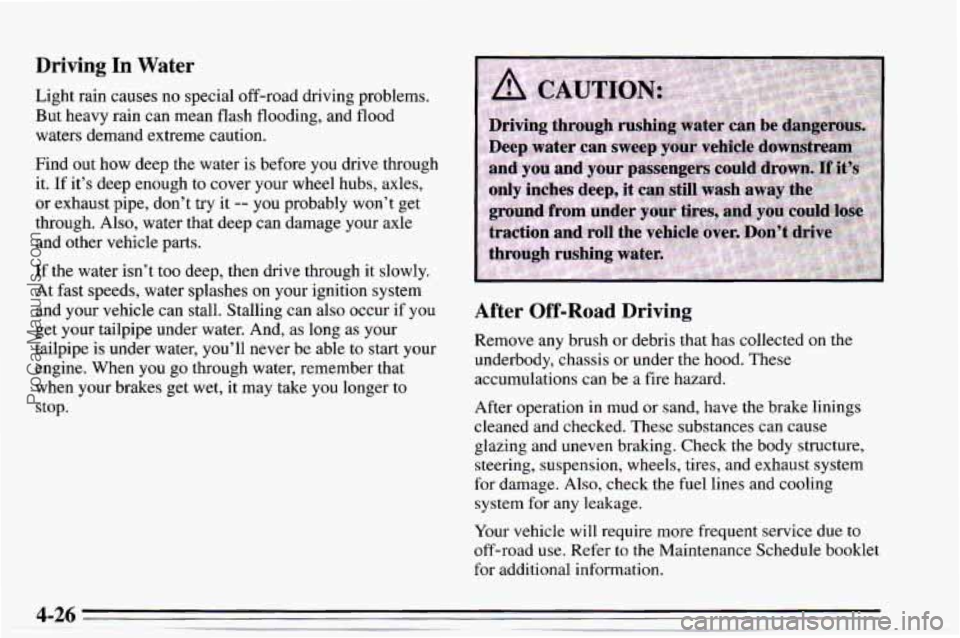
Driving In Water
Light rain causes no special off-road driving problems.
But heavy rain can mean flash flooding, and flood
waters demand extreme caution.
Find out how deep the water is before you drive through
it. If it’s deep enough
to cover your wheel hubs, axles,
or exhaust pipe, don’t try it
-- you probably won’t get
through. Also, water that deep can damage your axle
and other vehicle parts.
If the water isn’t too deep, then drive through it slowly.
At fast speeds, water splashes on your ignition system
and your vehicle can stall. Stalling can also occur if
you
get your tailpipe under water. And, as long as your
tailpipe is under water, you’ll never
be able to start your
engine. When you go through water, remember that
when your brakes get wet, it may take you longer
to
stop.
After Off-Road Driving
Remove any brush or debris that has collected on the
underbody, chassis or under the hood. These
accumulations can be
a fire hazard.
After operation in mud or sand, have the brake linings
cleaned and checked. These substances can cause
glazing and uneven braking. Check the body structure,
steering, suspension, wheels, tires, and exhaust system
for damage. Also, check the fuel lines and cooling
svstem for any leakage.
rour vehicle
will require more frequent service due to
off-road use. Refer to the Maintenance Schedule booklet
for additional information.
ProCarManuals.com
Page 154 of 354
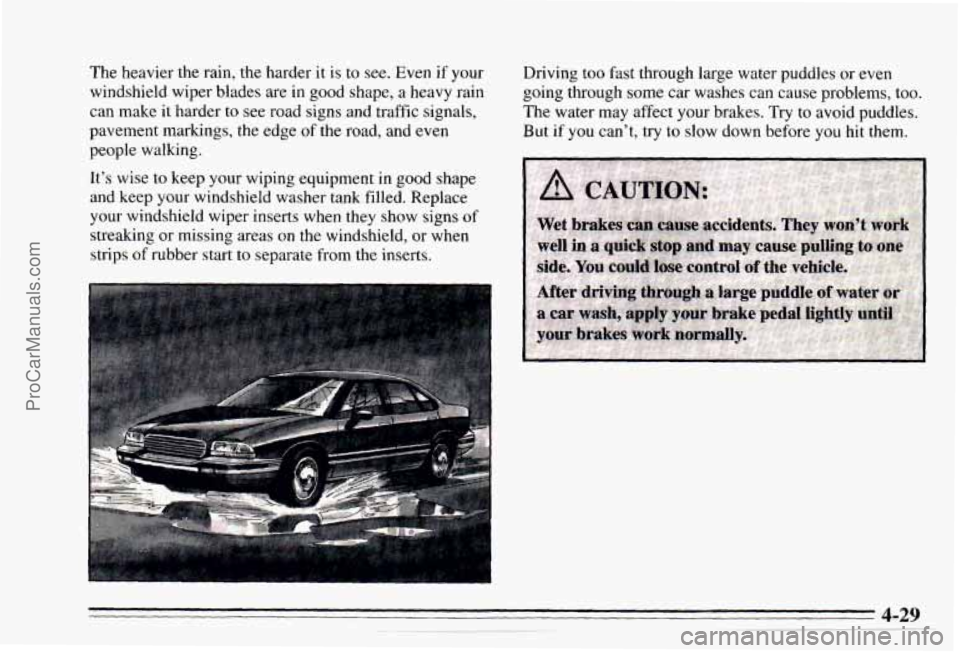
The heavier the rain, the harder it is to see. Even if your
windshield wiper blades are
in good shape, a heavy rain
can
make it harder to see road signs and traffic signals,
pavement markings, the edge
of the road, and even
people walking.
It’s wise to keep your wiping equipment in good shape
and keep your windshield washer tank filled. Replace
your windshield wiper inserts when they
show signs of
streaking or missing areas on the windshield, or when
strips of rubber start to separate from the inserts. Driving too fast through large water puddles
or even
going through some car washes
can cause problems, too.
The water may affect your brakes.
Try to avoid puddles.
But if you can’t, try to slow down before you hit them.
ProCarManuals.com
Page 160 of 354
0 Keep your vehicle in good shape. Check all fluid
levels and also the brakes, tires, cooling system and
transmission. These parts can work hard
on
mountain roads.
Know how to go down hills. The most important
thing
to know is this: let your engine do some of the.
slowing down. Shift
to a lower gear when you go
down a steep or long hill.
0
0
0
0
Know how to go uphill. You may want to shift down
to
a lower gear. The lower gears help cool your
engine and transmission, and you can climb the hill
better.
Stay
in your own lane when driving on two-lane
roads
in hills or mountains. Don’t swing wide or cut
across the center
of the road. Drive at speeds that let
you stay in your own lane.
As you go over the top of a hill, be alert. There could
be something in your lane, like a stalled car or an
accident.
You may
see highway signs on mountains that warn of
special problems. Examples are long grades, passing or
no-passing zones, a falling rocks area, or winding
roads. Be
alert to these and take appropriate action.
ProCarManuals.com
Page 162 of 354
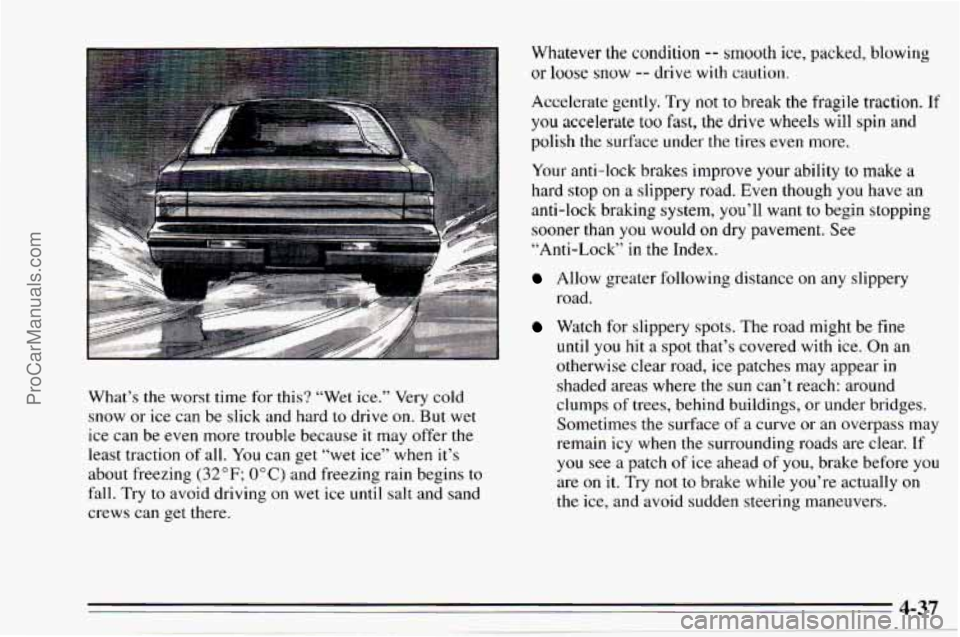
What’s the worst time for this? “Wet ice.” Very cold
snow or ice can be slick and hard
to drive on. But wet
ice can be even more trouble because it may offer
the
least traction of all. You can get “wet ice” when it’s
about freezing (32” F; 0°C) and freezing rain begins to
fall. Try
to avoid driving on wet ice until salt and sand
crews can get there. Whatever
the condition
-- smooth ice, packed, blowing
or loose snow
-- drive with caution.
Accelerate gently. Try not
to break the fragile traction. If
you accelerate too fast, the drive wheels will spin and
polish the surface under the tires even more.
Your anti-lock brakes improve
your ability to make a
hard stop on a slippery road. Even though you have an
anti-lock braking system, you’ll want
to begin stopping
sooner than you would on dry pavement. See
“Anti-Lock”
in the Index.
Allow greater following distance on any slippery
road.
Watch for slippery spots. The road might be fine
until
you hit a spot that’s covered with ice. On an
otherwise clear road, ice patches may appear in
shaded areas where the sun can’t reach: around
clumps of trees, behind buildings,
or under bridges.
Sometimes the surface
of a curve or an overpass may
remain icy when
the surrounding roads are clear. If
you see a patch of ice ahead of you, brake before you
are
on it. Try not to brake while you’re actually on
the ice, and avoid sudden steering maneuvers,
ProCarManuals.com