lock CHEVROLET TRACKER 1995 Workshop Manual
[x] Cancel search | Manufacturer: CHEVROLET, Model Year: 1995, Model line: TRACKER, Model: CHEVROLET TRACKER 1995Pages: 354, PDF Size: 18.24 MB
Page 166 of 354
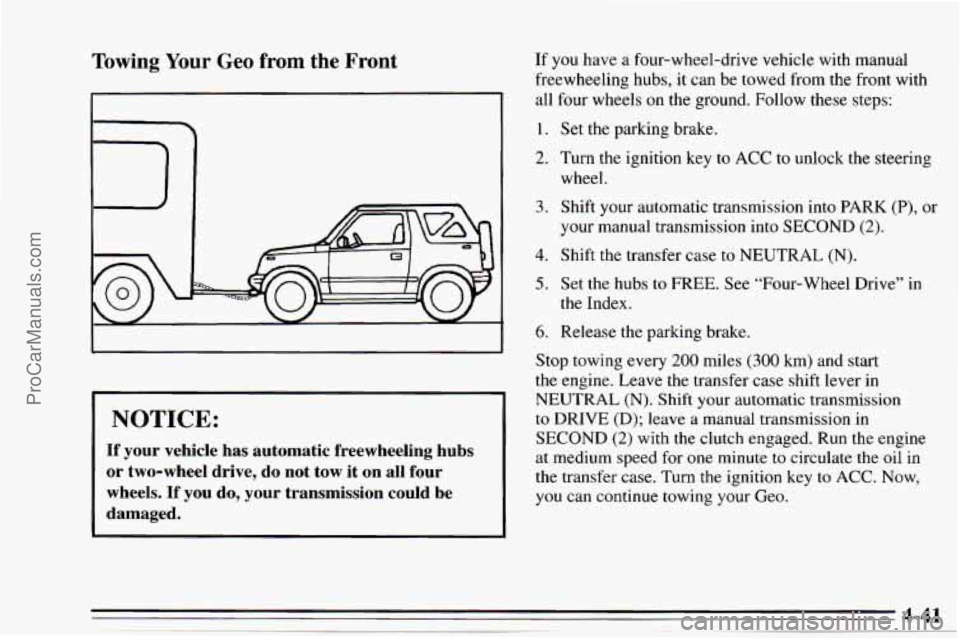
Towing Your Geo from the Front
I NOTICE:
If your vehicle has automatic freewheeling hubs
or two-wheel drive, do not tow it on all four
wheels. If you do, your transmission could be
damaged.
If you have a four-wheel-drive vehicle with manual
freewheeling hubs, it can be towed from the front with
all four wheels on the ground. Follow these steps:
1. Set the parking brake.
2. Turn the ignition key to ACC to unlock the steering
wheel.
3. Shift your automatic transmission into PARK (P), or
your manual transmission into SECOND
(2).
4. Shift the transfer case to NEUTRAL (N).
5. Set the hubs to FREE. See “Four-wheel Drive” in
the Index.
6. Release the parking brake.
Stop towing every
200 miles (300 km) and start
the engine. Leave the transfer
case shift lever in
NEUTRAL (N). Shift your automatic transmission
to
DRIVE (D); leave a manual transmission in
SECOND
(2) with the clutch engaged. Run the engine
at medium speed for
one minute to circulate the oil in
the transfer case. Turn the ignition key to ACC. Now,
you can continue towing your Geo.
ProCarManuals.com
Page 167 of 354
I
NOTICE:
The front wheels transmit shocks during towing.
The steering column may not be strong enough to
withstand the shocks. Always unlock the steering
wheel before towing.
Loading Your Vehicle
I NOTICE:
Make sure that the towing speed does not exceed
damaged.
I 50 mph (SO kmh), or your Geo could be badly
f
TIRE PLACARD
GhR GWVR FRT GAWR RR
WKg
TIRES
RIMS
INFLATION PRESSURE COLD PSVkPa
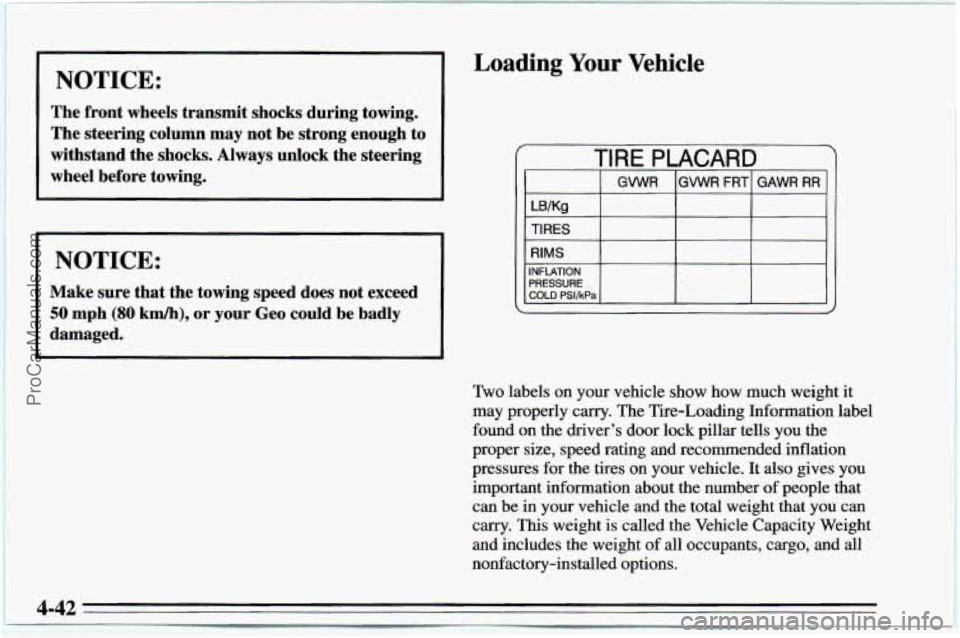
Two labels on your vehicle show how much weight it
may properly carry. The Tire-Loading Information label
found on the driver’s door lock pillar tells you the
proper size, speed rating and recommended inflation
pressures for the tires on your vehicle. It also gives you
important information about the number of people that
can be in your vehicle and the total weight that
you can
carry.
This weight is called the Vehicle Capacity Weight
and includes the weight of all occupants, cargo, and all
nonfactory-installed options.
4-42
ProCarManuals.com
Page 168 of 354
f :[:BY CAM1 AUTOMOTIVE CANADA GVWR GAWR FRT GAWR RR
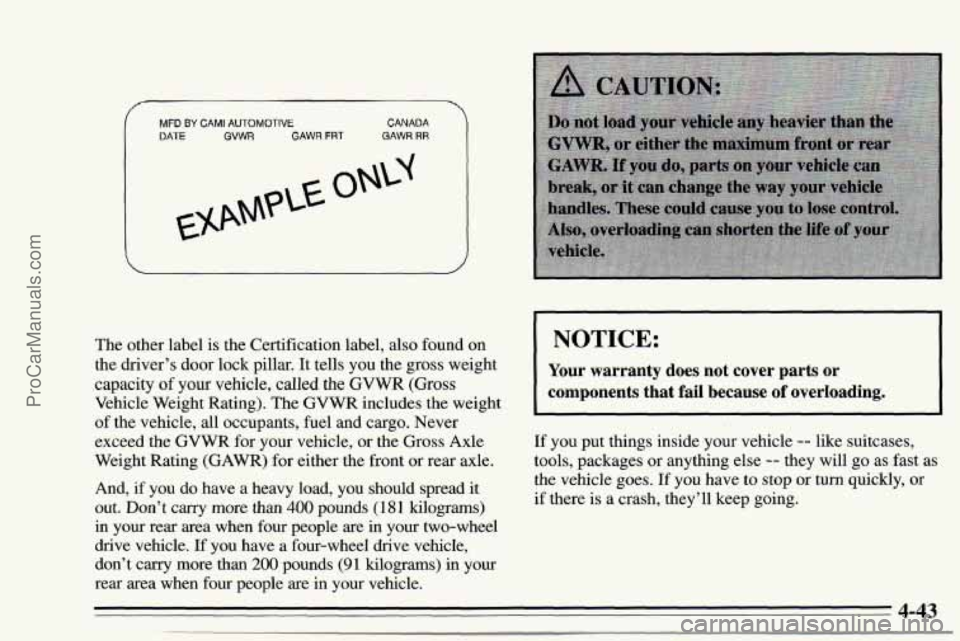
The
other label is the Certification label, also found on
the driver’s door lock pillar. It tells you the gross weight
capacity of your vehicle, called
the GVWR (Gross
Vehicle Weight Rating). The GVWR includes the weight
of the vehicle,
all occupants, fuel and cargo. Never
exceed the GVWR for your vehicle, or the Gross Axle
Weight Rating
(GAWR) for either the front or rear axle.
And,
if you do have a heavy load, you should spread it
out. Don’t
carry more than 400 pounds (181 kilograms)
in your rear area when four people are in your two-wheel
drive vehicle.
If you have a four-wheel drive vehicle,
don’t carry more than
200 pounds (9 1 kilograms) in your
rear area when four people are in your vehicle.
NOTICE:
Your warranty does not cover parts or
components that fail because
of overloading.
If you put things inside your vehicle -- like suitcases,
tools, packages or anything else
-- they will go as fast as
the vehicle goes. If
you have to stop or turn quickly, or
if there is a crash, they’ll keep going.
4-43
ProCarManuals.com
Page 184 of 354
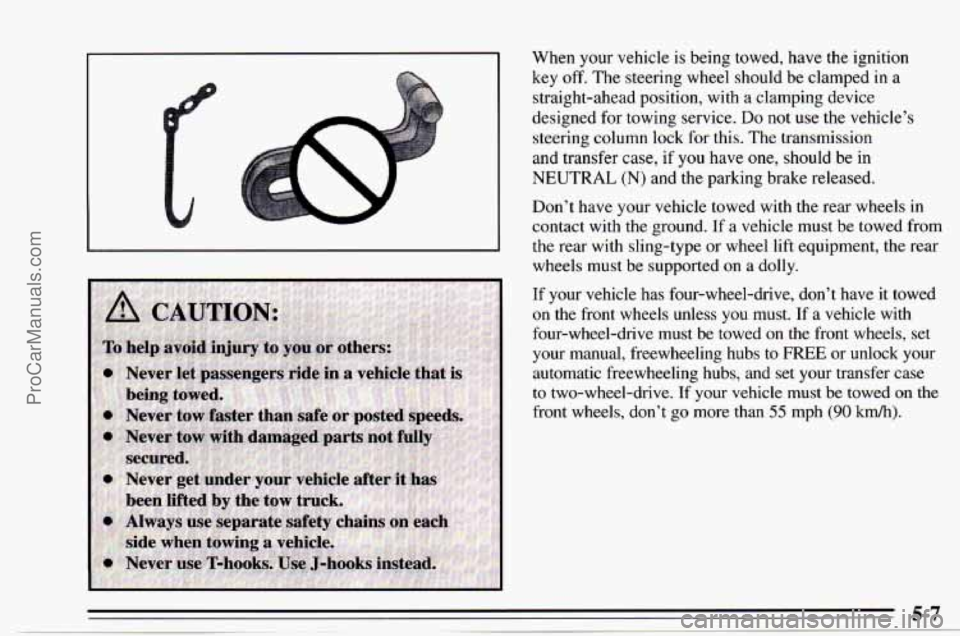
When your vehicle is being towed, have the ignition
key
off. The steering wheel should be clamped in a
straight-ahead position, with a clamping device
designed for towing service.
Do not use the vehicle’s
steering column lock
for this. The transmission
and transfer
case, if you have one, should be in
NEUTRAL (N) and the parking brake released.
Don’t have your vehicle towed with the rear wheels in
contact with the ground. If a vehicle must be towed from
the rear with sling-type or wheel lift equipment, the rear
wheels must be supported on a dolly.
If your vehicle has four-wheel-drive, don’t have it towed on
the front wheels unless you must. If a vehicle with
four-wheel-drive must be towed
on the front wheels, set
your manual, freewheeling hubs to FREE or unlock your
automatic freewheeling hubs, and set your transfer case
to two-wheel-drive. If
your vehicle must be towed on the
front wheels, don’t
go more than 55 mph (90 km/h).
5-7
ProCarManuals.com
Page 201 of 354
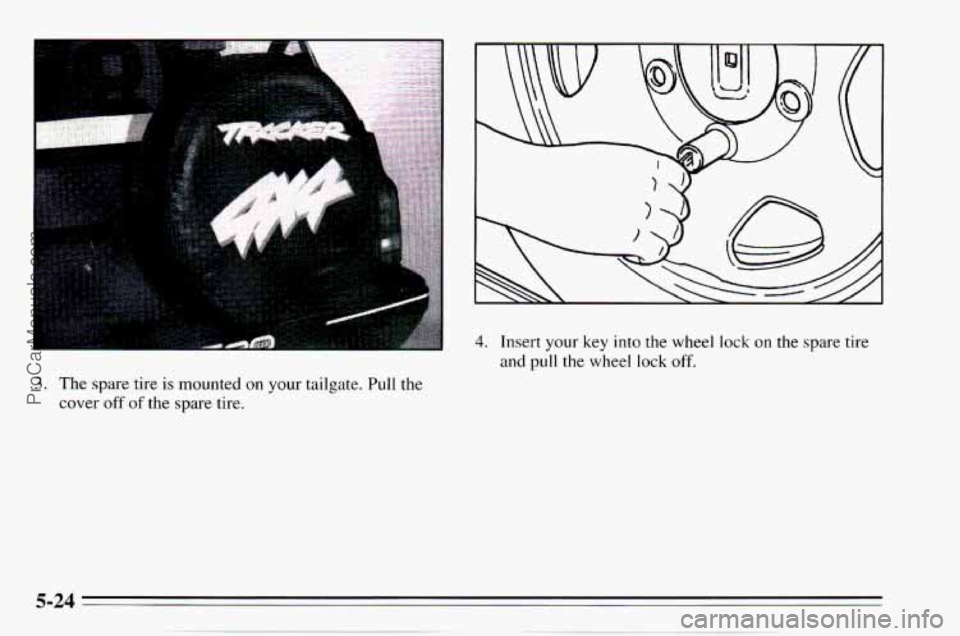
3. The spare tire is mounted on your tailgate. Pull the
cover off of the spare tire.
4. Insert your key into the wheel lock on the spare tire
and pull
the wheel lock off.
ProCarManuals.com
Page 202 of 354
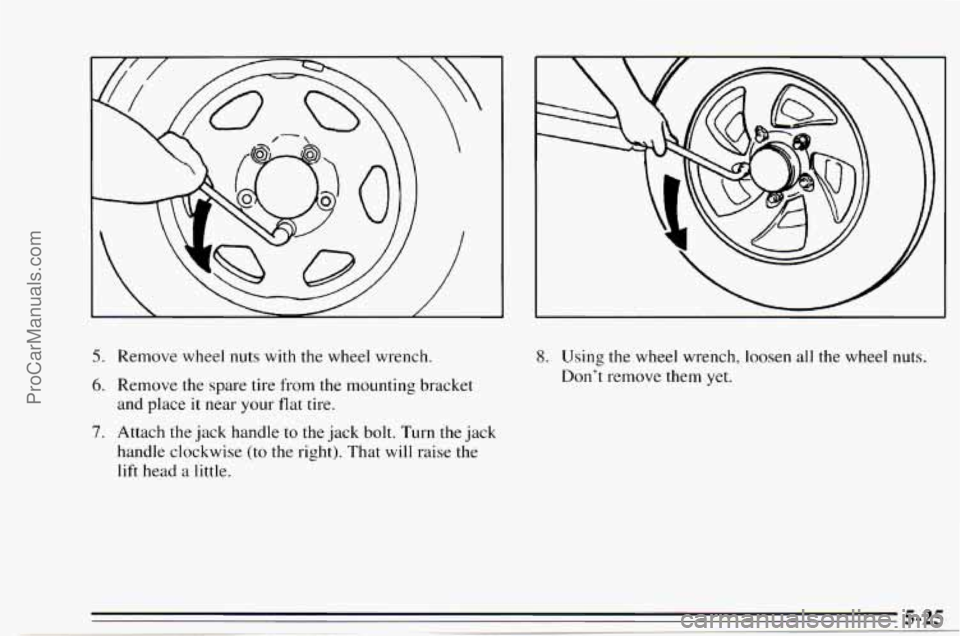
5. Remove wheel nuts with the wheel wrench.
6. Remove the spare tire from the mounting bracket
and place
it near your flat tire.
7. Attach the jack handle to the jack bolt. Turn the jack
handle clockwise
(to the right). That will raise the
lift head a little.
8. Using the wheel wrench, loosen all the wheel nuts.
Don’t remove them
yet.
5-25 - ProCarManuals.com
Page 203 of 354
I
I
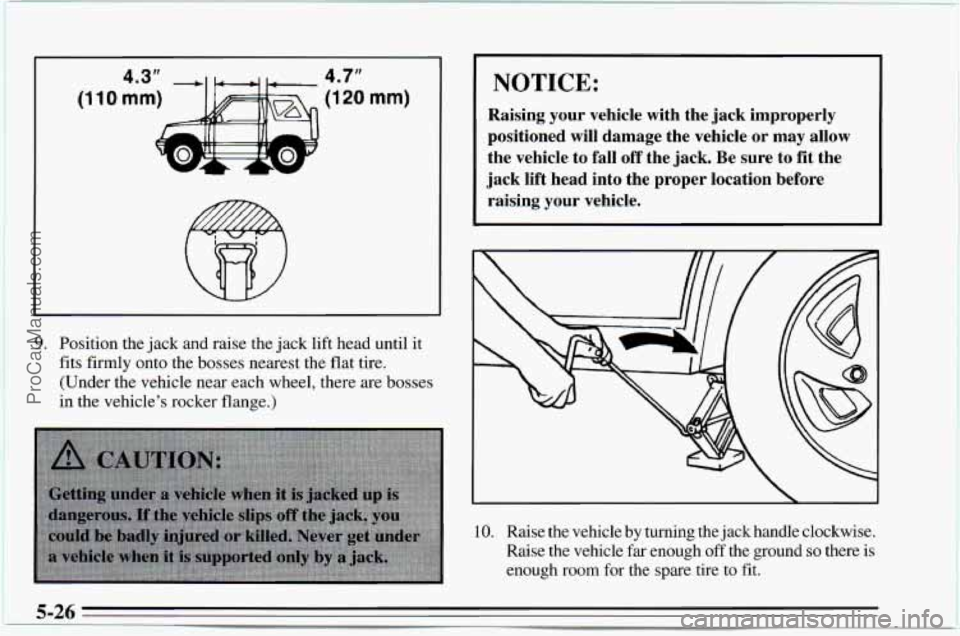
9. Position the jack and raise the jack lift head until it
fits firmly onto the bosses nearest the flat tire.
(Under the vehicle near each wheel, there are bosses
in the vehicle’s rocker flange.)
NOTICE:
Raising your vehicle with the jack improperly
positioned will damage the vehicle or may allow
the vehicle to fall
off the jack. Be sure to fit the
jack lift head into the proper location before raising your vehicle.
10. Raise the vehicle by turning the jack handle clockwise.
Raise the vehicle far enough
off the ground so there is
enough room for the spare tire to fit.
5-26
ProCarManuals.com
Page 205 of 354
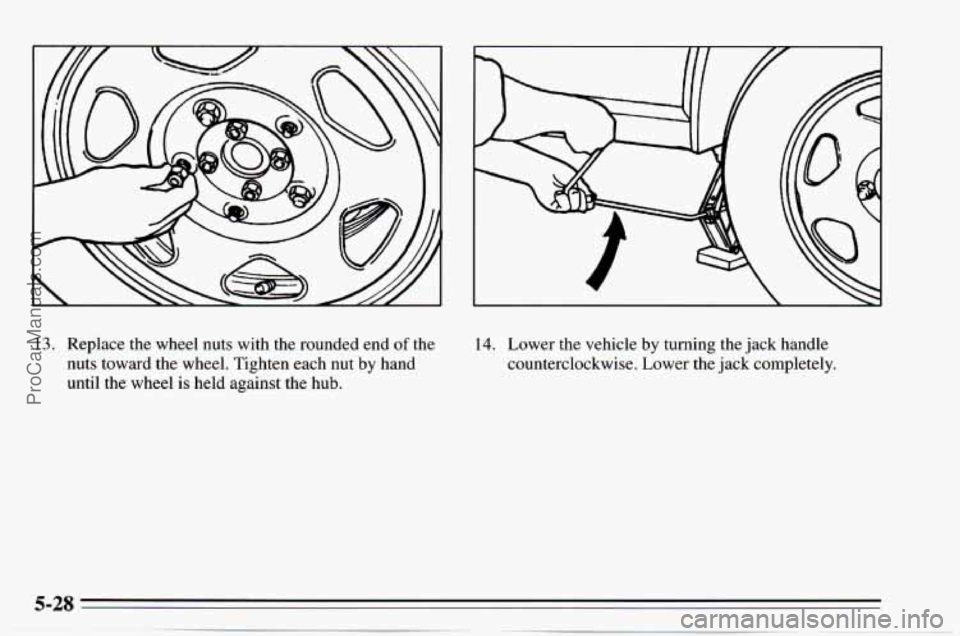
13. Replace the wheel nuts with the rounded end of the
nuts toward the wheel. Tighten each nut
by hand
until the wheel
is held against the hub.
14. Lower the vehicle by turning the jack handle
counterclockwise. Lower the jack completely.
ProCarManuals.com
Page 215 of 354
Fuels in Foreign Countries
If you plan on driving in another country outside the
U.S. or Canada, unleaded fuel may be hard to find. Do
not use leaded gasoline. If you use even one tankful,
your emission controls won’t work well or at all. With
continuous use, spark plugs can get fouled, the exhaust
system
can corrode, and your engine oil can deteriorate
quickly. Your vehicle’s oxygen sensor will be damaged.
All
of that means costly repairs that wouldn’t be covered
by your warranty.
To check on fuel availability, ask an auto club, or
contact
a major oil company that does business in the
country where you’ll be driving.
You can also write
us at the following address for
advice. Just tell us where you’re going and give your
Vehicle Identification Number (VIN).
Filling Your Tank
- ~~~
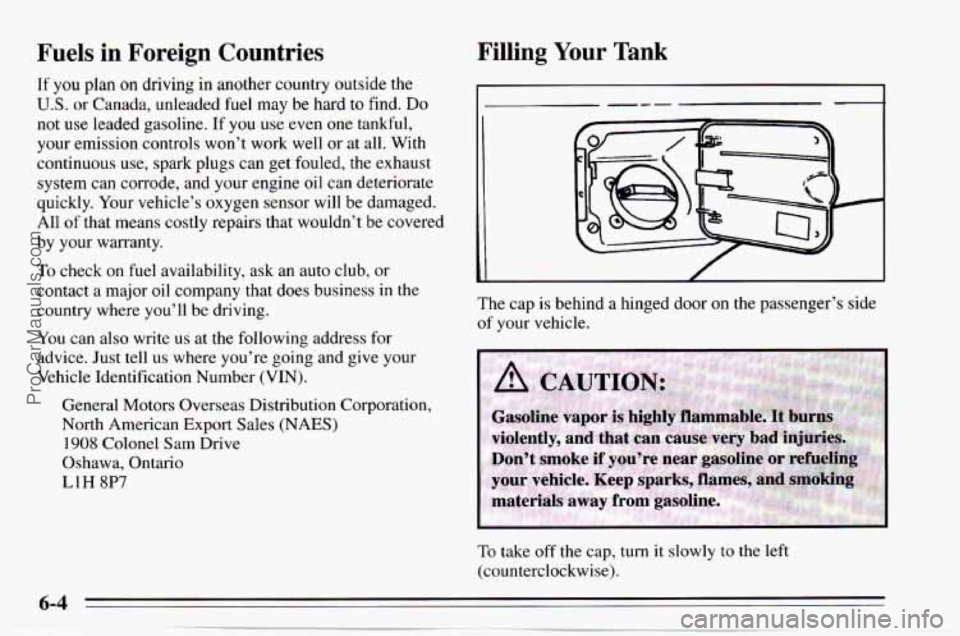
The cap is behind a hinged door on the passenger’s side
of your vehicle.
General Motors Overseas Distribution Corporation,
North American
Export Sales (NAES)
1908 Colonel Sam Drive
Oshawa, Ontario
L1H 8P7
To take off the cap, turn it slowly to the left
(counterclockwise).
ProCarManuals.com
Page 247 of 354
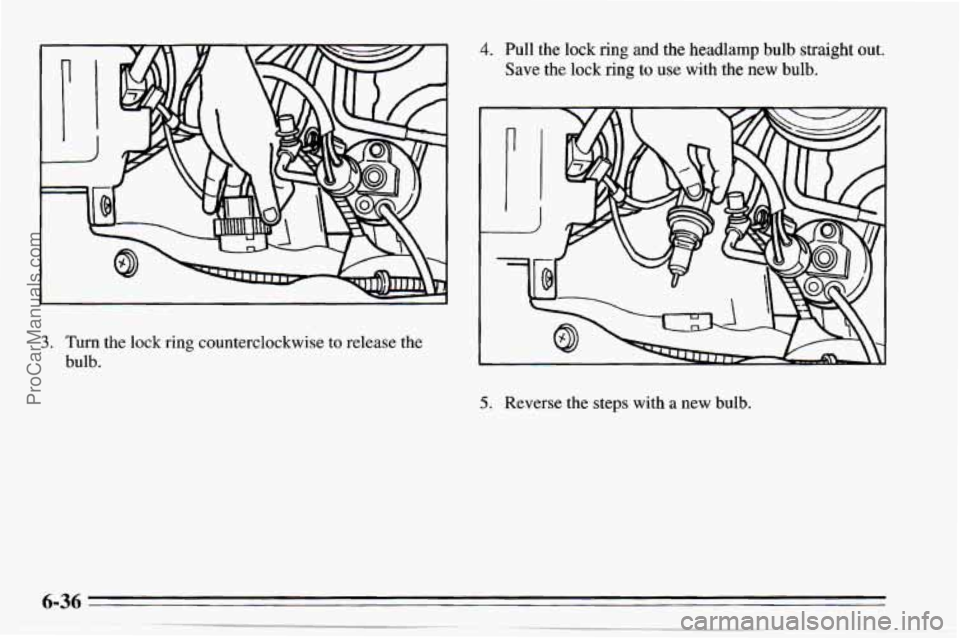
4. Pull the lock ring and the headlamp bulb straight out.
Save the lock
ring to use with the new bulb.
3. Turn the lock ring counterclockwise to release the
bulb.
5. Reverse the steps with a new bulb.
ProCarManuals.com