cooling CHEVROLET TRACKER 1996 User Guide
[x] Cancel search | Manufacturer: CHEVROLET, Model Year: 1996, Model line: TRACKER, Model: CHEVROLET TRACKER 1996Pages: 387, PDF Size: 18.54 MB
Page 220 of 387
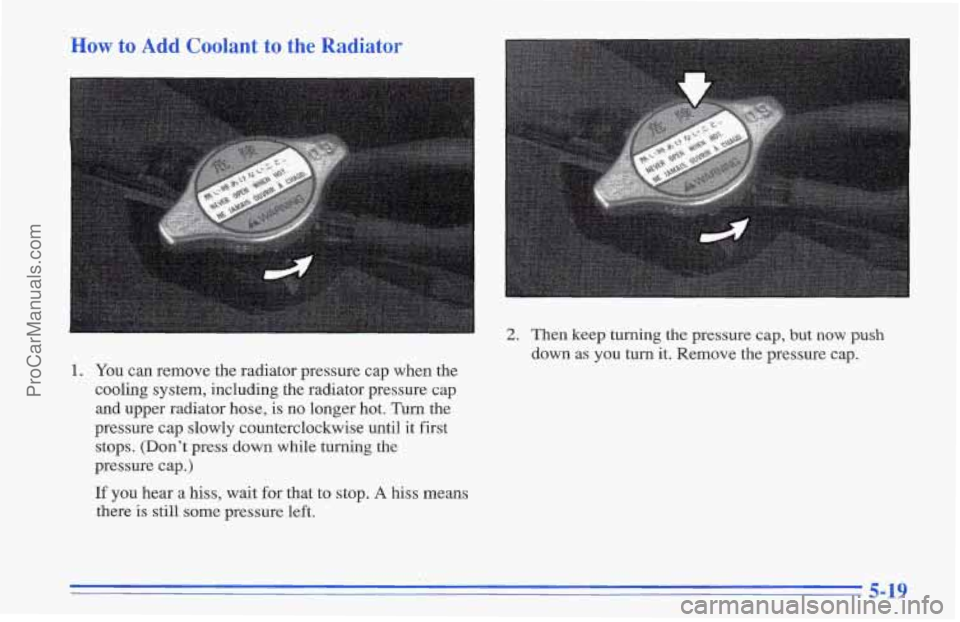
How to Add Coolant to the Rac
2. Then keep turning the pressure cap, but now push
down
as you turn it. Remove the pressure cap.
’ . You can remove the radiator pressure cap when the
cooling system, including the radiator pressure cap
and upper radiator hose, is
no longer hot. Turn the
pressure cap slowly counterclockwise until it first
stops. (Don’t press down while turning the
pressure cap.)
If you hear a hiss, wait for that to stop. A hiss means
there
is still some pressure left.
- 5-19
ProCarManuals.com
Page 261 of 387
What to Use
Refer to the Maintenance Schedule to determine what
W of lubricant to use. See “Recommended Fluids and
Lubricants”
in the Index.
Engine Coolant
The following explains your cooling system and how
to add coolant when
it is low. If you have a problem
with engine overheating, see “Engine Overheating” in
the Index.
A 50/50 mixture of water and the proper coolant for
your Geo will:
Give freezing protection down to -33 “F (-36°C).
0 Give boiling protection up to 258°F (125°C).
Protect against rust and corrosion.
Help keep the proper engine temperature,
Let the warning lights and gages work as
they should.
What to Use
Use a mixture of one-half clean water (preferably
distilled) and one-half antifreeze that meets
GM
Specification 1825-M, which won’t damage aluminum
parts. You can also use a recycled coolant conforming
to
GM Specification 1825-M with a complete coolant flush
and refill. If you use this mixture, you don’t need to add
anything else.
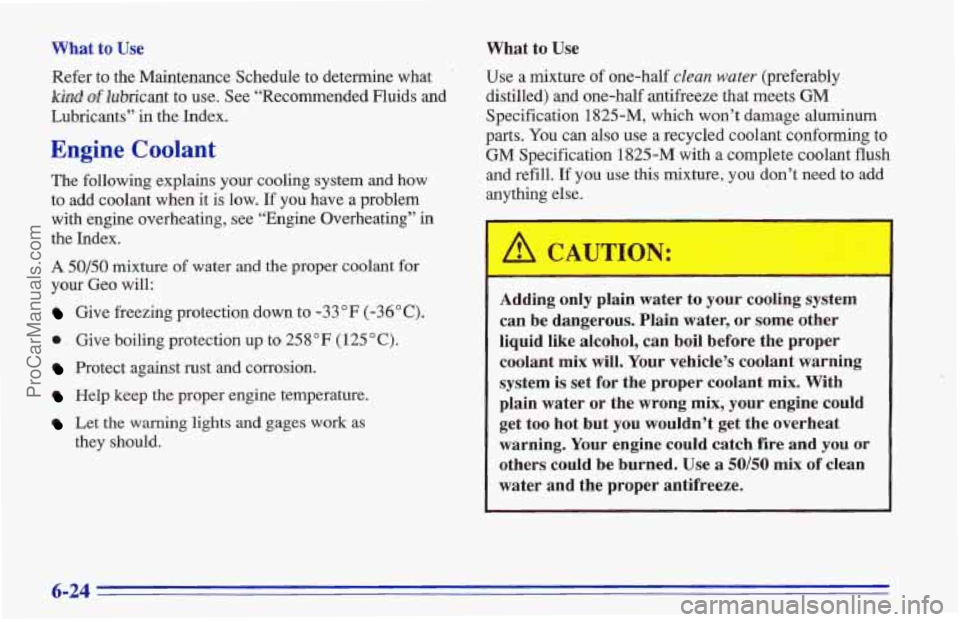
/i CAUTTON:
Adding only plain water to your cooling system
can be dangerous. Plain water, or some other
liquid like alcohol, can boil before the proper
coolant mix
will. Your vehicle’s coolant warning
system is set for the proper coolant
mix. With
plain water
or the wrong mix, your engine could
get too hot
but you wouldn’t get the overheat
warning. Your engine could catch
fire and you or
others could be burned. Use a 50/50 mix of clean
water and the proper antifreeze.
6-24
ProCarManuals.com
Page 262 of 387
NOTICE:
If you use an improper coolant mix, your engine
could overheat and be badly damaged. The
repair cost wouldn’t be covered by
your
warranty. Too much water in the mix can freeze
and crack the engine, radiator, heater core and
other parts.
If you have to add coolant more than four times a year,
have your dealer check your cooling system.
NOTICE:
r
If you use the proper coolant, you don’t have to
add extra inhibitors or additives which claim to
improve the system. These can be harmful.
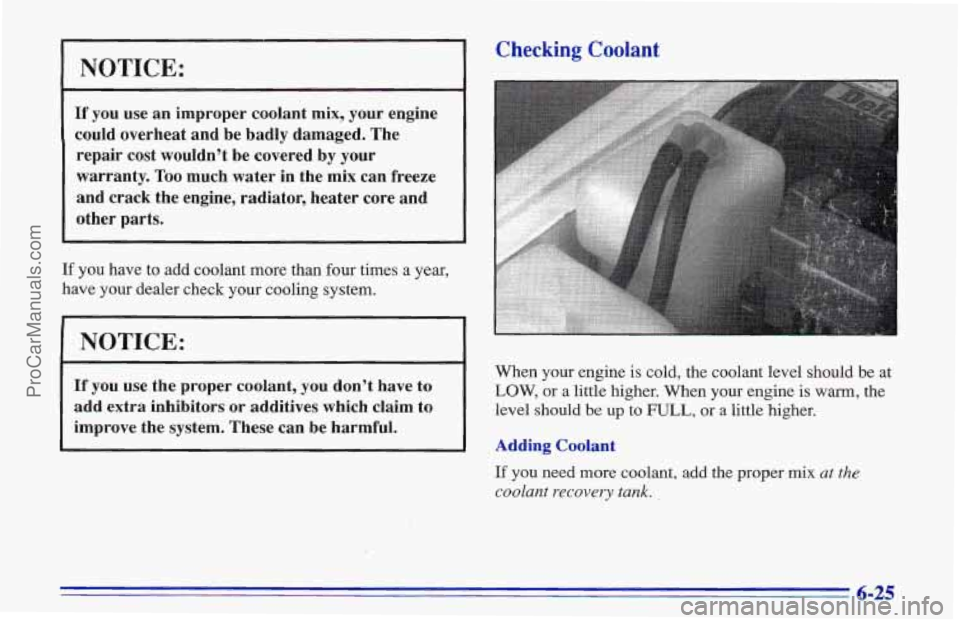
Checking Coolant
When your engine is cold, the coolant level should be at
LOW, or
a little higher. When your engine is warm, the
level should be
up to FULL, or a little higher.
Adding Coolant
If you need more coolant, add the proper mix at the
coolant recovery tank.
6-25
ProCarManuals.com
Page 283 of 387
Wheel Alignment and Tire Balance
The wheels on your vehicle were aligned and balanced
carefully at the factory
to give you the longest tire life
and best overall performance.
In most cases, you will not need to have your wheels
aligned again. However, if you notice unusual tire wear
or your vehicle pulling one way or the other, the
alignment may need
to be reset. If you notice your
vehicle vibrating when driving
on a smooth road, your
wheels may need
to be rebalanced.
Wheel Replacement
Replace any wheel that is bent, cracked, or badly rusted
or corroded.
If wheel nuts keep corning loose, the wheel,
wheel bolts
and wheel nuts should be replaced. If the
wheel leaks
air, replace it (except some aluminum
wheels, which
can sometimes be repaired). See your
Geo dealer if any of these conditions exist.
Your dealer will know the kind
of wheel you need.
Each new wheel
should have the same load-carrying
capacity, diameter, width, offset
and be mounted the
same way as
the one it replaces.
If you need to replace any of your wheels, wheel bolts
or wheel nuts, replace them only with new
GM original
equipment parts. This way, you will be sure to have the
right wheel, wheel bolts and wheel nuts for your
Geo model.
Using the wrong replacement wheels, wheel bolts
or wheel nuts on your vehicle can be dangerous. It
could affect the braking and handling of your
vehicle, make your tires lose air and make
you lose
control.
You could have a collision in which you or
others could be injured. Always use the correct
wheel, wheel bolts and wheel nuts for replacement.
NOTICE:
The wrong wheel can also cause problems with
bearing life, brake cooling, speedometer or
odometer calibration, headlamp aim, bumper
height, vehicle
ground clearance and tire or tire
chain clearance to the body and
chassis.
~~
See “Changing a Flat Tire” in the Index for more
information.
6-46
ProCarManuals.com
Page 300 of 387
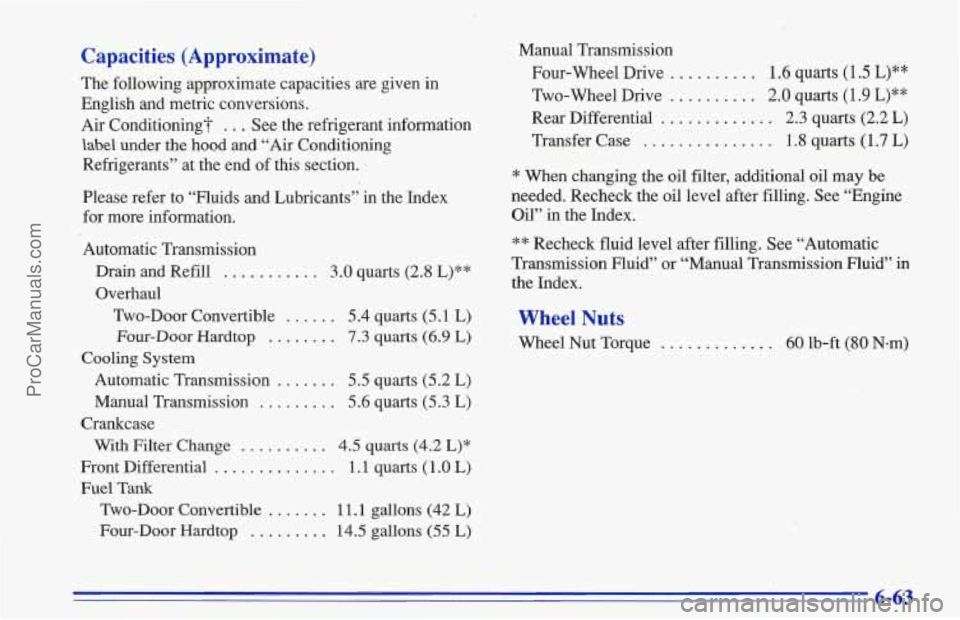
Capacities (Approximate)
The following approximate capacities are given in
English and metric conversions.
label under the hood and “Air Conditioning
Refrigerants” at the end of this section.
Air Conditioning?
... See the refrigerant information
Please refer to “Fluids and Lubricants” in the Index
for more information.
Automatic Transmission Drain and Refill
...... . 3.0 quarts (2.8 L)**
Overhaul
Two-Door Convertible
...... 5.4 quarts (5.1 L)
Four-Door Hardtop
........ 7.3 quarts (6.9 L)
Automatic Transmission ....... 5.5 quarts (5.2 L)
Manual Transmission
....... 5.6 quarts (5.3 L)
With Filter Change ........ 4.5 quarts (4.2 L)*
Front Differential ............ 1.1 quarts (1.0 L)
Fuel Tank
Two-Door Convertible
....... 11.1 gallons (42 L)
Four-Door Hardtop ......... 14.5 gallons (55 L)
Cooling System
Crankcase Manual Transmission
Four-wheel Drive
........ 1.6 quarts (1.5 L)**
Two-Wheel Drive .......... 2.0 quarts (1.9 L)**
Rear Differential ............. 2.3 quarts (2.2 L)
Transfer Case ............... 1.8 quarts (1.7 L)
* When changing the oil filter, additional oil may be
needed. Recheck the oil level after filling. See “Engine
Oil” in the Index.
** Recheck fluid level after filling. See “Automatic
Transmission Fluid” or “Manual Transmission Fluid” in
the Index.
Wheel Nuts
Wheel Nut Torque ............. 60 lb-ft (80 N-m)
6-63
ProCarManuals.com
Page 309 of 387
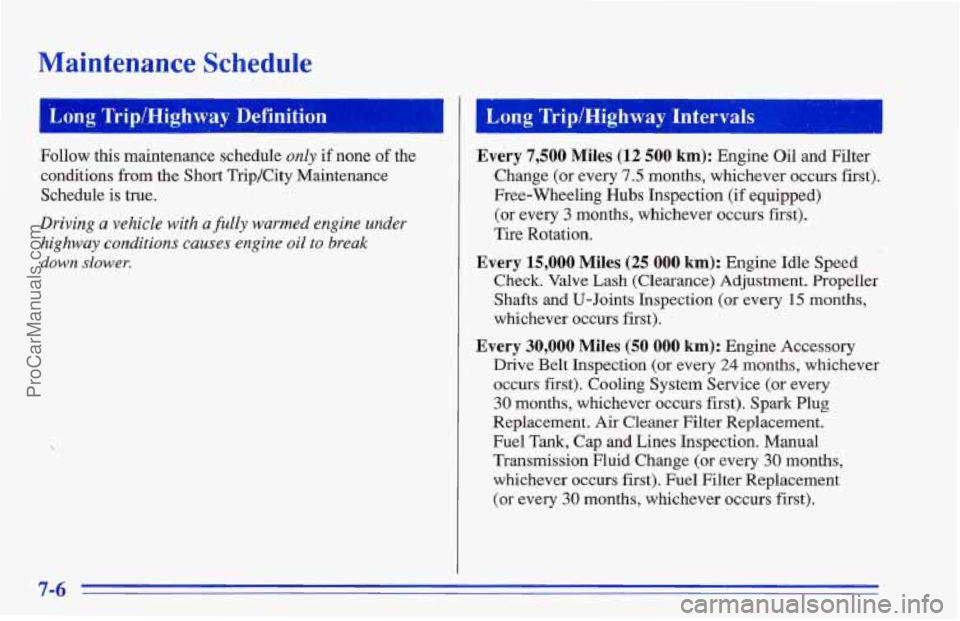
Maintenance Schedule
Lo'ng Trip/Highway Definition I
Follow this maintenance schedule only if none of the
conditions from the
Short TripjCity Maintenance
Schedule
is true.
Driving a vehicle with a fully warmed engine under
highway conditions causes engine oil to break
down slower.
Long Trip/Highway Intervals
Every 7,500 Miles (12 500 km): Engine Oil and Filter
Change (or every
7.5 months, whichever occurs first).
Free-Wheeling Hubs Inspection
(if equipped)
(or every 3 months, whichever occurs first).
Tire Rotation.
Every 15,000 Miles (25 000 km): Engine Idle Speed
Check. Valve Lash (Clearance) Adjustment. Propeller
Shafts
and U-Joints Inspection (or every 15 months,
whichever occurs first).
Every 30,000 Miles (50 000 km): Engine Accessory
Drive Belt Inspection
(or every 24 months, whichever
occurs first). Cooling System Service (or every
30 months, whichever occurs first). Spark Plug
Replacement. Air Cleaner Filter Replacement.
Fuel
Tank, Cap and Lines Inspection. Manual
Transmission Fluid Change
(or every 30 months,
whichever occurs first). Fuel
Filter Replacement
(or every
30 months, whichever occurs first).
7-6
ProCarManuals.com
Page 316 of 387
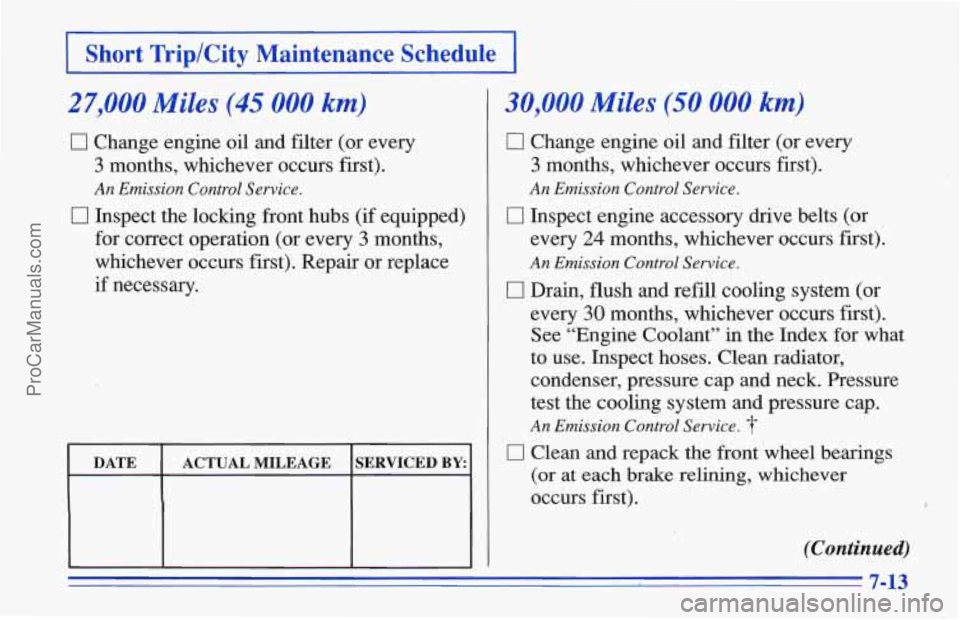
)p/City Maintenance Schedule I
27,000 Miles (45 000 km)
0 Change engine oil and filter (or every
3 months, whichever occurs first).
An Emission Control Service.
0 Inspect the locking front hubs (if equipped)
for correct operation (or every
3 months,
whichever occurs first). Repair or replace
if necessary.
DATE
SERVICED BY: ACTUAL MILEAGE
30,000 Miles (50 000 km)
0 Change engine oil and filter (or every
3 months, whichever occurs first).
An Emission Control Service.
I7 Inspect engine accessory drive belts (or
every
24 months, whichever occurs first).
An Emission Control Service.
I7 Drain, flush and refill cooling system (or
every 30 months, whichever occurs first).
See “Engine Coolant”
in the Index for what
to use. Inspect hoses. Clean radiator, condenser, pressure cap and neck. Pressure
test the cooling system
and pressure cap.
An Emission Control Service.
0 Clean and repack the front wheel bearings
(or at each brake relining, whichever
occurs first).
(Continued)
7-13
ProCarManuals.com
Page 323 of 387
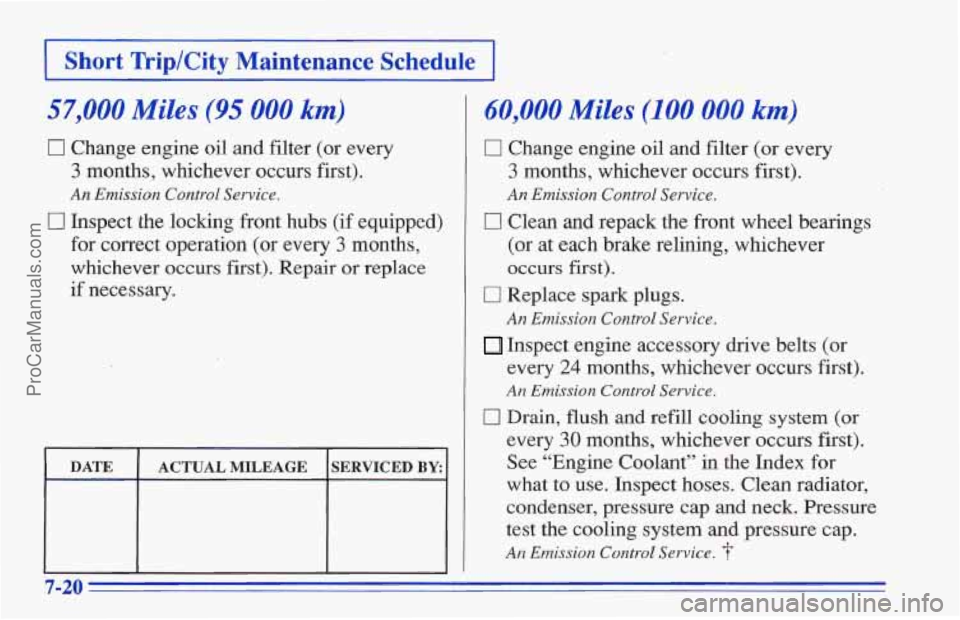
1 Short Trip/City Maintenance Schedule ~-1
57,000 Miles (95 000 km)
0 Change engine oil and filter (or every
3 months, whichever occurs first).
An Emission Control Service.
0 Inspect ,the locking front hubs (if equipped)
for correct operation (or every
3 months,
whichever occurs first). Repair or replace
if necessary.
60,000 Miles (100 000 km)
c] Change engine oil and filter (or every
3 months, whichever occurs first).
An Emission Control Service.
0 Clean and repack the front wheel bearings
(or
at each brake relining, whichever
occurs first).
0 Replace spark plugs.
Inspect engine accessory drive belts (or
An Emission Control Service.
every 24 months, whichever occurs first).
0 Drain, flush and refill. cooling system (or
every 30 months, whichever occurs first).
See “Engine Coolant” in the Index for
what
to use. Inspect hoses. Clean radiator,
condenser, pressure cap and neck. Pressure
test the cooling system and pressure
cap.
An Emission Control Service.
An Emission Control Service.
7-20
ProCarManuals.com
Page 331 of 387
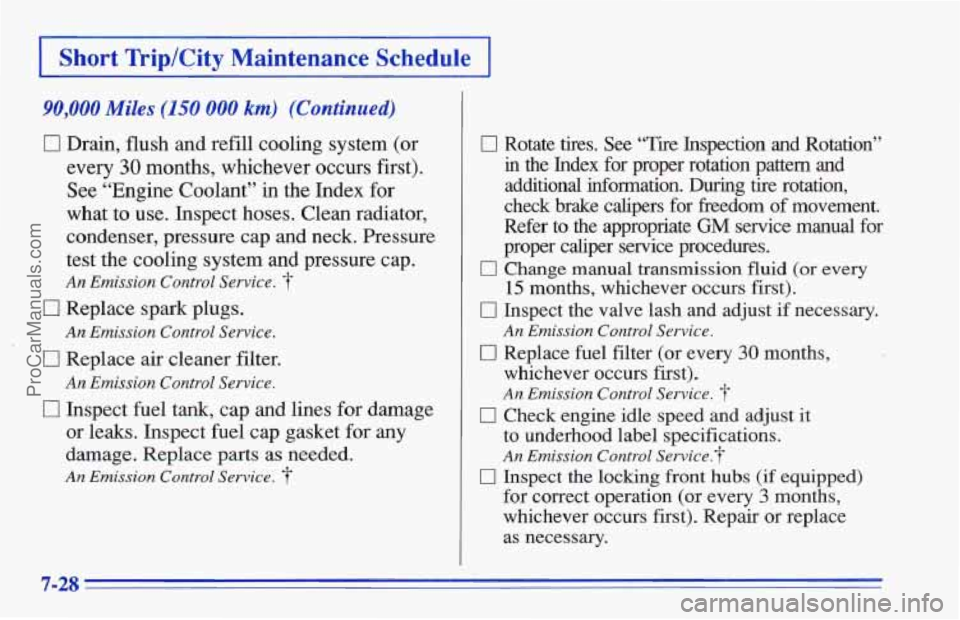
I Short Trip/City Maintenance Schedule I
90,000 Miles (150 000 km) (Continued)
0 Drain, flush and refill cooling system (or
every 30 months, whichever occurs first).
See “Engine Coolant” in the Index for
what to use. Inspect
hoses. Clean radiator,
condenser, pressure cap and neck. Pressure
test the cooling system and pressure cap.
An Emission Control Service.
0 Replace spark plugs.
An Emission Control Service.
0 Replace air cleaner filter.
An Emission Control Service.
0 Inspect fuel tank, cap and lines for damage
or leaks. Inspect fuel cap gasket for
any
damage. Replace parts as needed.
An Emission Control Service.
otate tires. See “Tire Inspection and Rotatio
in the Index for proper rotation pattern and
additional information.
During tire rotation,
check brake calipers for heedom of movement.
Refer to the appropriate
GM service manual for
proper caliper service procedures.
15 months, whichever occurs first).
An Emission Control Service.
whichever occurs first).
An Emission Control Service.
0 Check engine idle speed and adjust it
to underhood label specifications.
An Emission Control Service.?
0 Inspect the locking front hubs (if equipped)
for correct operation (or every 3 months,
whichever occurs first). Repair or replace
as necessary.
0 Change manual transmission fluid (or every
0 Inspect the valve lash and adjust if necessary.
0 Replace fuel filter (or every 30 months,
7-28
ProCarManuals.com
Page 338 of 387
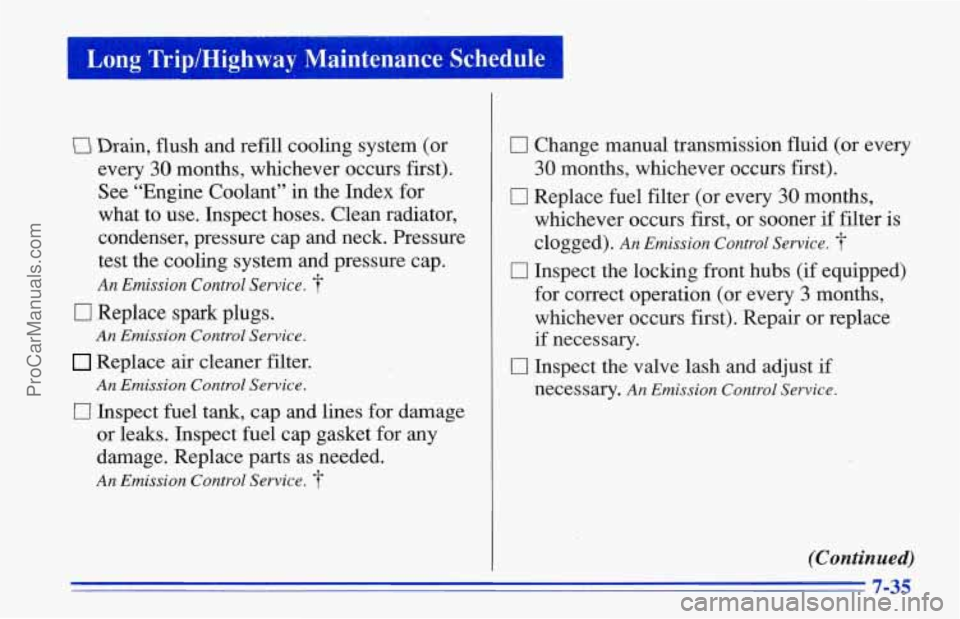
I Long TriplHighway Maintenance Schedule I
Q Drain, flush and refill cooling system (or
every
30 months, whichever occurs first).
See “Engine Coolant” in the Index for
what to use. Inspect hoses. Clean radiator,
condenser, pressure cap and neck. Pressure
test the cooling system and pressure cap.
An Emission Control Service. 7
0 Replace spark plugs.
An Emission Control Service.
Replace air cleaner filter.
An Emission Control Service.
0 Inspect fuel tank, cap and lines for damage
or leaks. Inspect fuel cap gasket for any
damage. Replace parts as needed.
An Emission Control Service.
0 Change manual transmission fluid (or every
30 months, whxhever occurs first).
I7 Replace fuel filter (or every 30 months,
whichever occurs first, or sooner
if filter is
clogged).
An Emission Control Service.
17 Inspect the locking front hubs (if equipped)
for correct operation (or every
3 months,
whichever occurs first). Repair or replace
if necessary.
0 Inspect the valve lash and adjust if
necessary.
An Emission Control Service.
(Continued)
7-35
ProCarManuals.com