automatic transmission CHEVROLET TRACKER 1996 Owner's Manual
[x] Cancel search | Manufacturer: CHEVROLET, Model Year: 1996, Model line: TRACKER, Model: CHEVROLET TRACKER 1996Pages: 387, PDF Size: 18.54 MB
Page 255 of 387
L
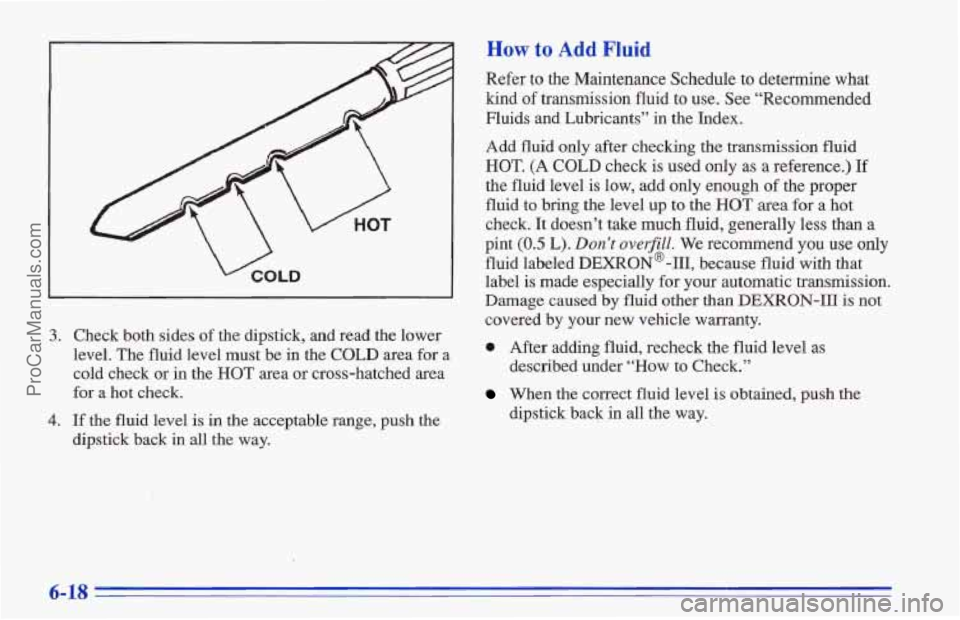
3. Check both sides of the dipstick, and read the lower
level. The fluid level must be in the
COLD area for a
cold check or in the HOT area or cross-hatched area
for
a hot check.
4. If the fluid level is in the acceptable range, push the
dipstick back in all the way.
How to Add Fluid
Refer to the Maintenance Schedule to determine what
kind
of transmission fluid to use. See “Recommended
Huids and Lubricants”
in the Index.
Add fluid only after checking the transmission fluid
HOT. (A COLD check is used only as a reference.) If
the fluid level is low, add only enough of the proper
fluid to bring the level up to the
HOT area for a hot
check. It doesn’t take much fluid, generally less than a
pint
(0.5 L). Don’t overfill. We recommend you use only
fluid labeled
DEXRON@-111, because fluid with that
label is made especially for your automatic transmission.
Damage caused by fluid other than
DEXRON-111 is not
covered by your new vehicle warranty.
0 After adding fluid, recheck the fluid level as
When the correct fluid level is obtained, push the
described under
“How to Check.”
dipstick back
in all the way.
6-18
ProCarManuals.com
Page 300 of 387
Capacities (Approximate)
The following approximate capacities are given in
English and metric conversions.
label under the hood and “Air Conditioning
Refrigerants” at the end of this section.
Air Conditioning?
... See the refrigerant information
Please refer to “Fluids and Lubricants” in the Index
for more information.
Automatic Transmission Drain and Refill
...... . 3.0 quarts (2.8 L)**
Overhaul
Two-Door Convertible
...... 5.4 quarts (5.1 L)
Four-Door Hardtop
........ 7.3 quarts (6.9 L)
Automatic Transmission ....... 5.5 quarts (5.2 L)
Manual Transmission
....... 5.6 quarts (5.3 L)
With Filter Change ........ 4.5 quarts (4.2 L)*
Front Differential ............ 1.1 quarts (1.0 L)
Fuel Tank
Two-Door Convertible
....... 11.1 gallons (42 L)
Four-Door Hardtop ......... 14.5 gallons (55 L)
Cooling System
Crankcase Manual Transmission
Four-wheel Drive
........ 1.6 quarts (1.5 L)**
Two-Wheel Drive .......... 2.0 quarts (1.9 L)**
Rear Differential ............. 2.3 quarts (2.2 L)
Transfer Case ............... 1.8 quarts (1.7 L)
* When changing the oil filter, additional oil may be
needed. Recheck the oil level after filling. See “Engine
Oil” in the Index.
** Recheck fluid level after filling. See “Automatic
Transmission Fluid” or “Manual Transmission Fluid” in
the Index.
Wheel Nuts
Wheel Nut Torque ............. 60 lb-ft (80 N-m)
6-63
ProCarManuals.com
Page 308 of 387
Maintenance Schedule
I Short Trip/City Intervals I
Every 50,000 Miles (83 000 km): Automatic
Transmission Service (severe conditions only). Positive Crankcase Ventilation (PCV) Valve Replacement.
Every 60,000 Miles (100 000 km): Engine Timing
and Distributor Check. Fuel Tank Cap Gasket
Replacement. Emission System Hoses Inspection. Camshaft Timing Belt Replacement. Brake Fluid
Service. Spark Plug Wire Replacement (or every
60 months, whichever occurs first). Wiring Harness
and Connectors Inspection (or every 60 months,
whichever occurs
first).
Short Trip/City Intervals
At 90,000 Miles (150 000 km): Camshaft Timing
Every 100,000 Miles (166 000 km): Fuel Injector
Belt Inspection.
Inspection. Evaporative Emissions Canister
Replacement.
These intervals only summarize maintenance services.
Be sure to
follow the complete maintenance schedule
on the following pages.
7-5
ProCarManuals.com
Page 310 of 387
Maintenance Schedule
.I
Long TriplHighway Intervals Long Trip/Highway Intervals
Every 50,000 Miles (83 000 km): Automatic
Transmission Service (severe conditions only).
Positive Crankcase Ventilation
(PCV)
Valve Replacement.
Every 60,000 Miles (100 000 km): Engine Timing
and Distributor Check. Fuel Tank Cap Gasket
Replacement. Emission System Hoses Inspection.
Camshaft Timing Belt Replacement. Spark
Plug Wire
Replacement (or every 60 months, whichever occurs
first). Wiring Harness and Connectors Inspection
(or every 60 months, whichever occurs first). Brake
Fluid Service.
At 90,000 Miles (150 000 km): Camshaft Timing
Belt Inspection.
Every 100,000 Miles (166 000 km): Fuel Injector
Inspection. Evaporative Emissions Canister
Replacement.
These intervals only summarize maintenance services.
Be
sure to follow the complete maintenance schedule
on the following pages.
r
7-7
ProCarManuals.com
Page 334 of 387
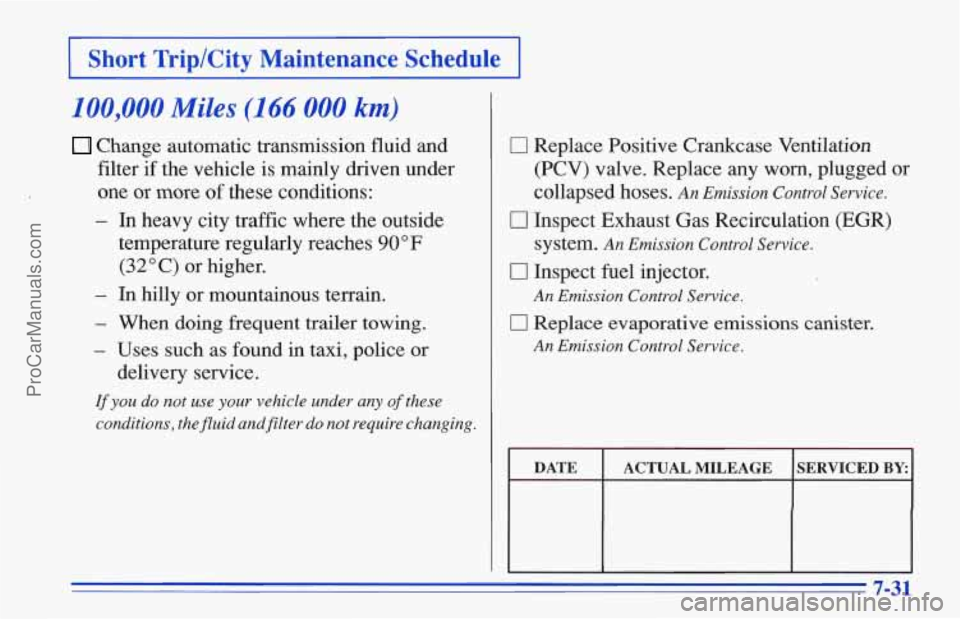
I Short Trip/City Maintenance Schedule I
100,000 Miles (166 000 km)
Change automatic transmission fluid and
filter
if the vehicle is mainly driven under
one
or more of these conditions:
- In heavy city traffic where the outside
temperature regularly reaches
90 OF
(32" C) or higher.
- In hilly or mountainous terrain.
- When doing frequent trailer towing.
- Uses such as found in taxi, police or
If you do not use your vehicle under any of these
conditions, the fluid andfilter do not require changing.
delivery service.
0 Replace Po sitive Cranl ltcase Ventilation
(PCV) valve.
Replace any worn, plugged or
collapsed hoses.
An Emission Control Service.
0 Inspect Exhaust Gas Recirculation (EGR)
system.
An Emission Control Service.
0 Inspect fuel injector.
An Emission Control Service.
0 Replace evaporative emissions canister.
An Emission Control Service.
I DATE ACTUAL MILEAGE SERVICED BY:
7-31
ProCarManuals.com
Page 341 of 387
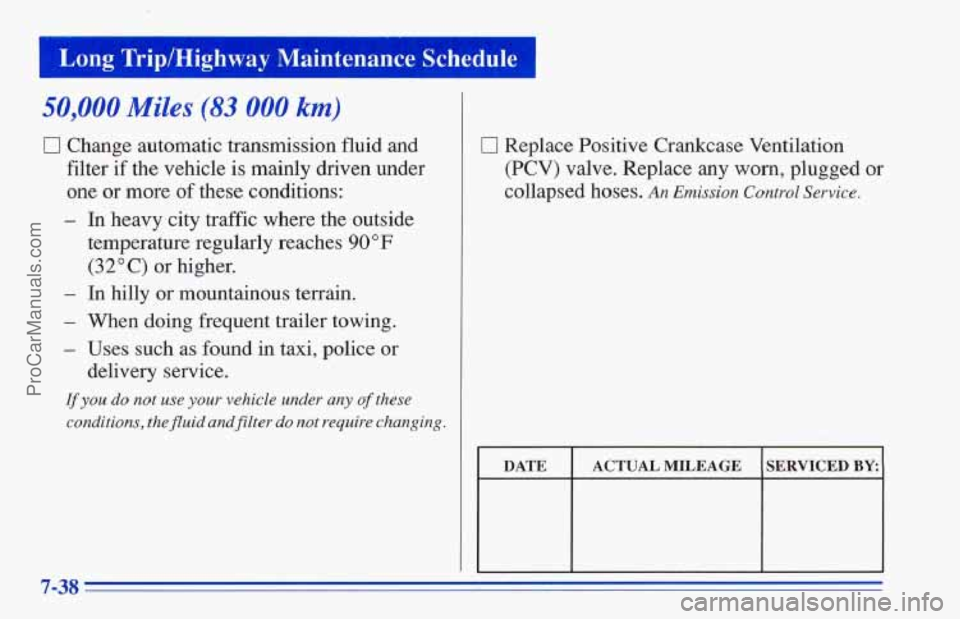
i Long TriplHighway Maintenance Schedule
50,000 Miles (83 000 km)
0 Change automatic transmission fluid and
filter
if the vehicle is mainly driven under
one or more
of these conditions:
- In heavy city traffic where the outside
temperature regularly reaches
90 OF
(32°C) or higher.
- In hilly or mountainous terrain.
- When doing frequent trailer towing.
- Uses such as found in taxi, police or
delivery service.
If you do not use your vehicle under any of these
conditions, thefluid
andfilter do not require changing.
0 Replace Positive Crankcase Ventilation
(PCV) valve. Replace any worn, plugged or
collapsed hoses. An Emission Control Service.
7-38
ProCarManuals.com
Page 349 of 387
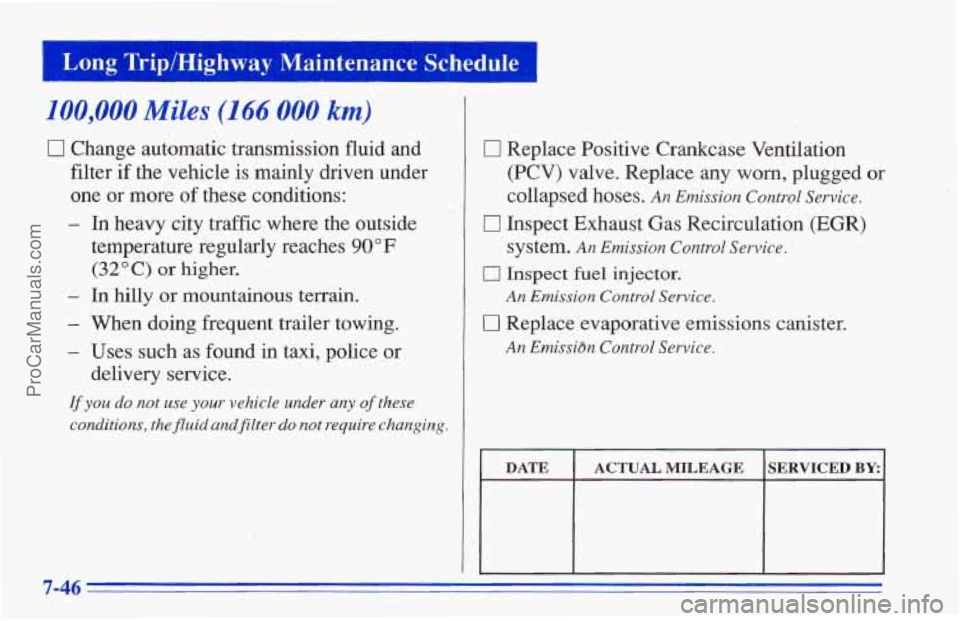
r Long Trip/Highway Maintenance Schedule
100,000 Miles (1 66 000 km)
0 Change automatic, transmission fluid and
filter if the vehicle is mainly driven under
one or more of these conditions:
- In heavy city traffic where the outside
temperature regularly reaches
90 OF
(32 O C) or higher.
- In hilly or mountainous terrain.
- When doing frequent trailer towing.
- Uses such as found in taxi, police or
delivery service.
If you do not use your vehicle under any of these
conditions,
the fluid andfilter do not require changing.
0 Replace Positive Crankcase Ventilation
(PCV) valve. Replace any worn, plugged or
collapsed hoses.
An Emission Control Service.
0 Inspect Exhaust Gas Recirculation (EGR)
17 Inspect fuel injector.
system. An Emission Control Service.
An Emission Control Service.
0 Replace evaporative emissions canister.
An Emissitin Control Service.
DATE SERVICED BY: ACTUAL MILEAGE
7-46
ProCarManuals.com
Page 351 of 387
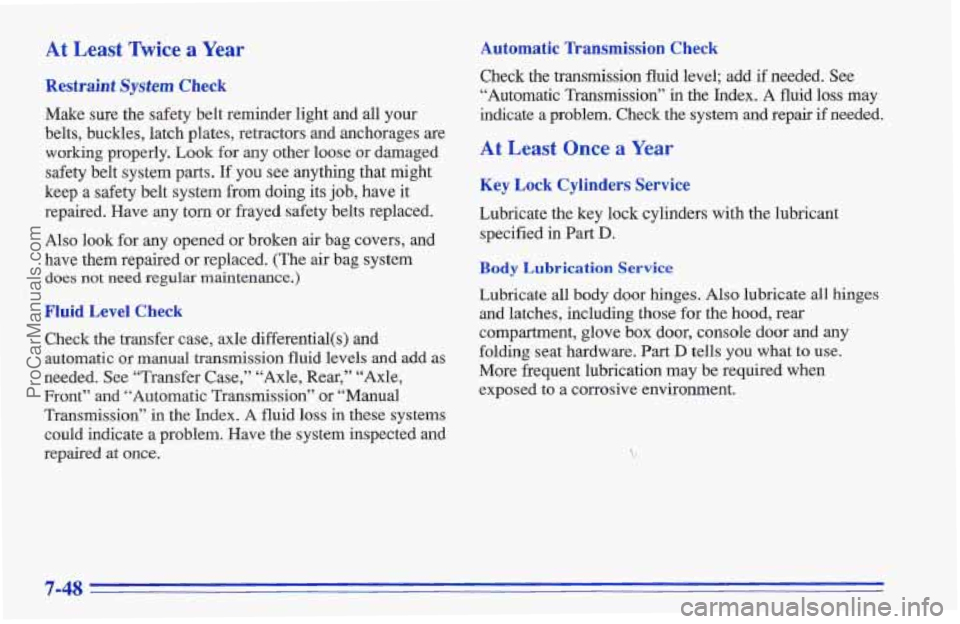
At Least Twice a Year Automatic Transmission Check
Restraint System Check
Make sure the safety belt reminder light and all your
belts, buckles, latch plates, retractors and anchorages are
working properly.
Look for any other loose or damaged
safety belt system parts.
If you see anything that might
keep a safety belt system from doing its job, have it
repaired. Have
any torn or frayed safety belts replaced.
Also look for any opened or broken air bag covers, and
have them repaired or replaced.
(The air bag system
does not need regular maintenance.)
Fluid Level Check
Check the transfer case, axle differential(s) and
automatic
or manual transmission fluid levels and add as
needed. See “Transfer Case,” “Axle, Rear,” “Axle,
Front” and “Automatic Transmission” or “Manual
Transmission”
in the Index. A fluid loss in these systems
could indicate a problem. Have the system inspected and
repaired
at once.
Check the transmission fluid level; add if needed. See
“Automatic Transmission”
in the Index. A fluid IOSS may
indicate
a problem. Check the system and repair if needed.
At Least Once a Year
Key Lock Cylinders Service
Lubricate the key lock cylinders with the lubricant
specified
in Part D.
Body Lubrication Service
Lubricate all body door hinges. Also lubricate all hinges
and latches, including those for the hood, rear
compartment, glove box door, console door and any
folding seat hardware.
Part D tells you what to use.
More frequent lubrication may be required when
exposed
to a corrosive environment.
7-48
ProCarManuals.com
Page 352 of 387
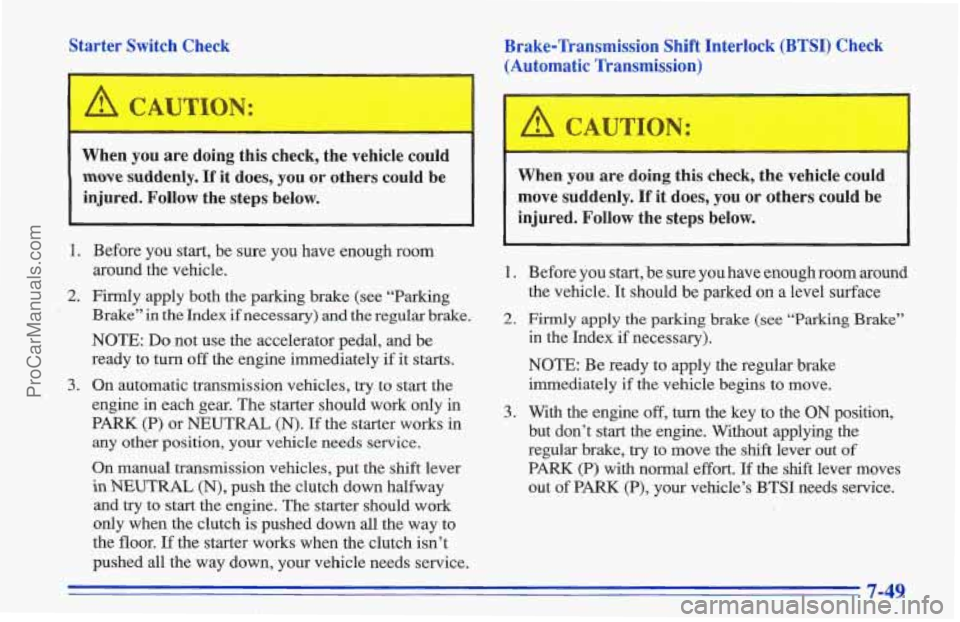
Starter Switch Check Brake-Transmission Shift Interlock (BTSI) Check
(Automatic Transmission)
When
you are doing this check, the vehicle could
move suddenly. If it does, you or others could be
injured. Follow the steps below.
1. Before you start, be sure you have enough room
2. Firmly apply both the parking brake (see “Parking
Brake” in
the Index if necessary) and the regular brake.
NOTE:
Do not use the accelerator pedal, and be
ready to turn off the engine immediately
if it starts.
3. On automatic transmission vehicles, try to start the
engine in each gear. The starter should work only in
PARK
(P) or NEUTRAL (N). If the starter works in
any other position, your vehicle needs service.
On manual transmission vehicles, put the shift lever
in NEUTRAL (N), push the clutch down halfway
and try to
start the engine. The starter should work
only when the clutch
is pushed down all the way to
the floor.
If the starter works when the clutch isn’t
pushed all the way down, your vehicle needs service.
around the vehicle.
When you are doing this check,
the vehicle could
move suddenly.
If it does, you or others could be
injured. Follow the steps below.
I. Before you start, be sure you have enough room around
the vehicle. It should
be parked on a level surface
2. Firmly apply the parking brake (see “Parking Brake”
in the Index
if necessary).
NOTE: Be ready to apply the regular brake
immediately if the vehicle begins to move.
3. With the engine off, turn the key to the ON position,
but don’t start the engine. Without applying the
regular brake,
try to move the shift lever out of
PARK (P) with normal effort. If the shift lever moves
out of
PARK (P), your vehicle’s BTSI needs service.
7-49
ProCarManuals.com
Page 353 of 387
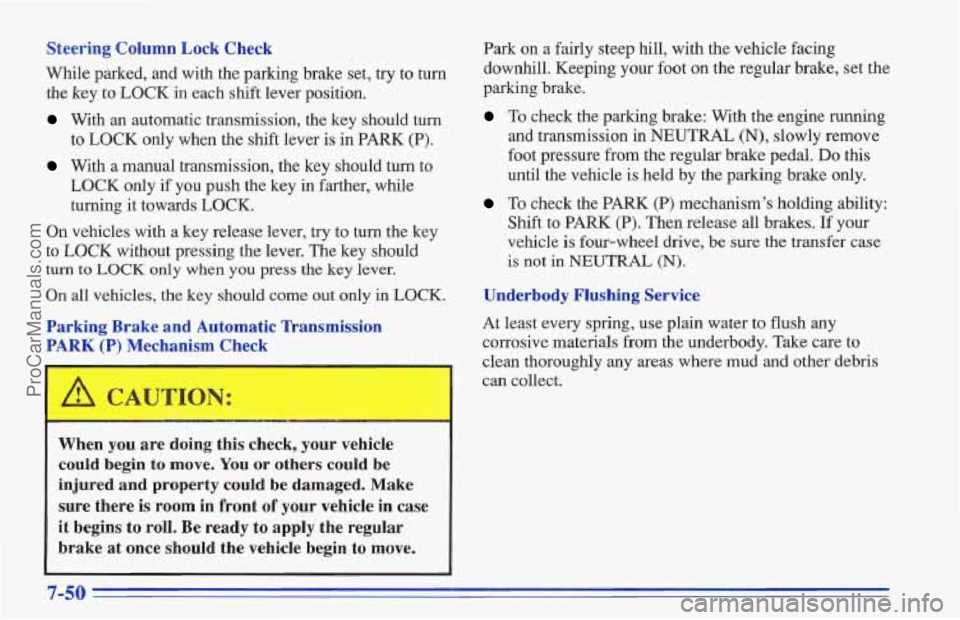
Steering Column Lock Check
While parked, and with the parking brake set, try to turn
the
key to LOCK in each shift lever position.
With an automatic transmission, the key should turn
to LOCK only when the shift lever is in PARK (P).
With a manual transmission, the key should turn to
LOCK only if you push the key in farther, while
turning it towards
LOCK.
On vehicles with a key release lever, try to turn the key
to LOCK without pressing the lever. The key should
turn to LOCK only when you press the key lever.
On all vehicles, the key should come out only in LOCK.
Parking Brake and Automatic Transmission
PARK (P) Mechanism Check
/d CAUTION:
When you are doing this check, your vehicle
could begin to
move. You or others could be
injured and property
could be damaged. Make
sure there
is room in front of your vehicle in case
it begins
to roll. Be ready to apply the regular
brake at once should the vehicle begin to move.
Park on a fairly steep hill, with the vehicle facing
downhill. Keeping your foot on the regular brake, set the
parking brake.
To check the parking brake: With the engine running
and transmission in NEUTRAL (N), slowly remove
foot pressure from the regular brake pedal.
Do this
until the vehicle is held by the parking brake only.
To check the PARK (P) mechanism’s holding ability:
Shift to
PARK (P). Then release all brakes. If your
vehicle is four-wheel
drive, be sure the transfer case
is not in NEUTRAL (N).
Underbody Flushing Service
At least every spring, use plain water to flush any
corrosive materials from the underbody. Take care to
clean thoroughly any areas where mud and other debris
can collect.
7-50
ProCarManuals.com