steering wheel CHEVROLET TRACKER 1996 Owner's Manual
[x] Cancel search | Manufacturer: CHEVROLET, Model Year: 1996, Model line: TRACKER, Model: CHEVROLET TRACKER 1996Pages: 387, PDF Size: 18.54 MB
Page 189 of 387
2.
3.
4.
5,
Set the parking brake.
If your Geo is a four-wheel-drive vehicle, set your
manual free-wheeling hubs
to FliEE or unlock your
automatic freewheeling hubs.
See “Four-wheel
Drive” in the Index.
Turn the ignition key to ACC to unlock the
steering wheel.
Clamp the steering wheel in a straight-ahead
position, with
a clamping device designed
for towing.
Release the parking brake.
NOTICE:
Make sure that the towing speed does not
exceed 55 mph (90 km/h), or your Geo could be
badly damaged.
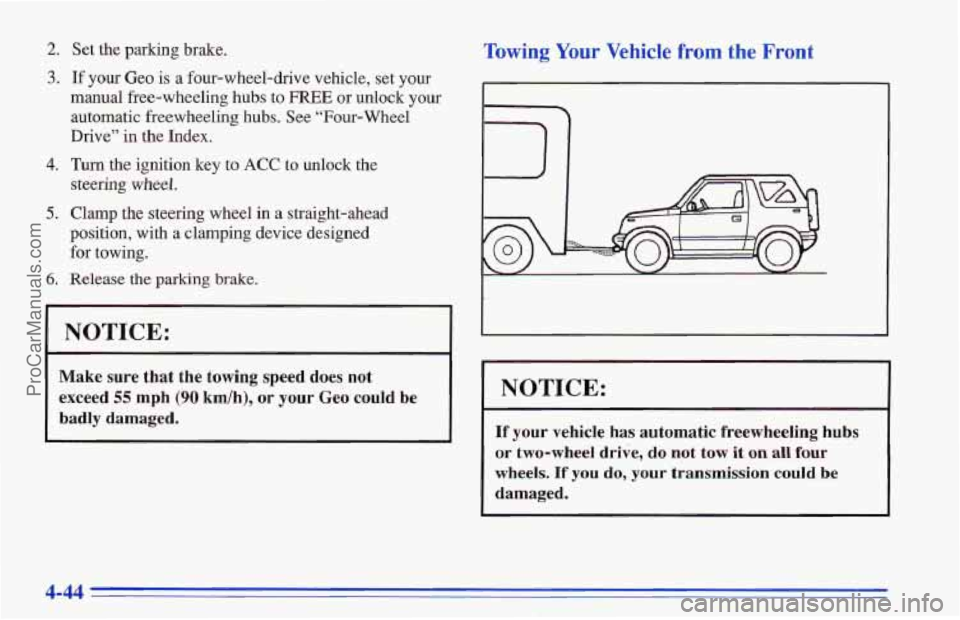
Towing Your Ve- ‘cle from the Front
NOTICE:
If your vehicle has automatic freewheeling hubs
or two-wheel drive, do not tow it on all four
wheels. If you do, your transmission could be
damaged.
4-44
ProCarManuals.com
Page 190 of 387
If you have a four-wheel-drive vehicle with manual
freewheeling
hubs, it can be towed from the front with
all four wheels on the ground. Follow these steps:
1.
2.
3.
4.
5.
6.
Set the parking brake.
Turn the ignition key to ACC to unlock the
steering wheel.
Shift your automatic transmission into
PARK (P), or
your manual transmission into SECOND
(2).
Shift the transfer case to NEUTRAL (N).
Set the hubs to FREE. See “Four-wheel Drive” in
the Index.
Release
the parking brake.
Stop towing every
200 miles (300 km) and start
the engine. Leave the transfer case shift lever
in
NEUTRAL (N). Shift your automatic transmission
to DRIVE (D); leave a manual transmission in
SECOND (2) with the clutch engaged. Run the engine
at medium speed for one minute to circulate the oil in
the transfer case. Turn the ignition key to ACC. Now
you can continue towing your Geo.
NOTICE:
The front wheels transmit shocks during towing.
The steering column may not be strong enough to
withstand the shocks. Always unlock the steering
wheel before towing.
I NOTICE:
Make sure that the towing speed does not exceed
50 mph (80 kdh), or your Geo could be badly
damaged.
4-45
ProCarManuals.com
Page 197 of 387
Driving with a Trailer Following Distance
Towing a trailer requires a certain amount of experience.
Before setting out for the open road, you’ll want to get
to
know your rig. Acquaint yourself with the feel of
handling and braking with the added weight of the
trailer., And always keep in mind that the vehicle you are
driving is now a good deal longer and not nearly as
responsive as your vehicle is by itself.
Before you start, check the trailer hitch and platform
(and attachments), safety chains, electrical connector,
lamps, tires and mirror adjustment. If the trailer has
electric brakes, start your vehicle and trailer moving and
then apply the trailer brake controller by hand to be sure
the brakes are working. This lets you check your
electrical connection at
the same time.
During your trip, check occasionally to be sure that the
load is secure, and that the lamps and
any trailer brakes
are still working. Stay
at least twice as
far behind the vehicle ahead as you
would when
driving your vehicle without a trailer. This
can help you avoid situations that require heavy braking
and sudden turns.
Passing
You’ll need more passing distance up ahead when
you’re towing a trailer. And, because you’re a
good deal
longer, you’ll need to
go much farther beyond the
passed vehicle before you can return to your lane.
Backing Up
Hold the bottom of the steering wheel with one hand.
Then,
to move the trailer to the left, just move that hand
to the left. To move the trailer to the right, move your
hand to the right. Always back up slowly and, if
possible, have someone guide you.
4-52
ProCarManuals.com
Page 209 of 387
U‘l’lOR’
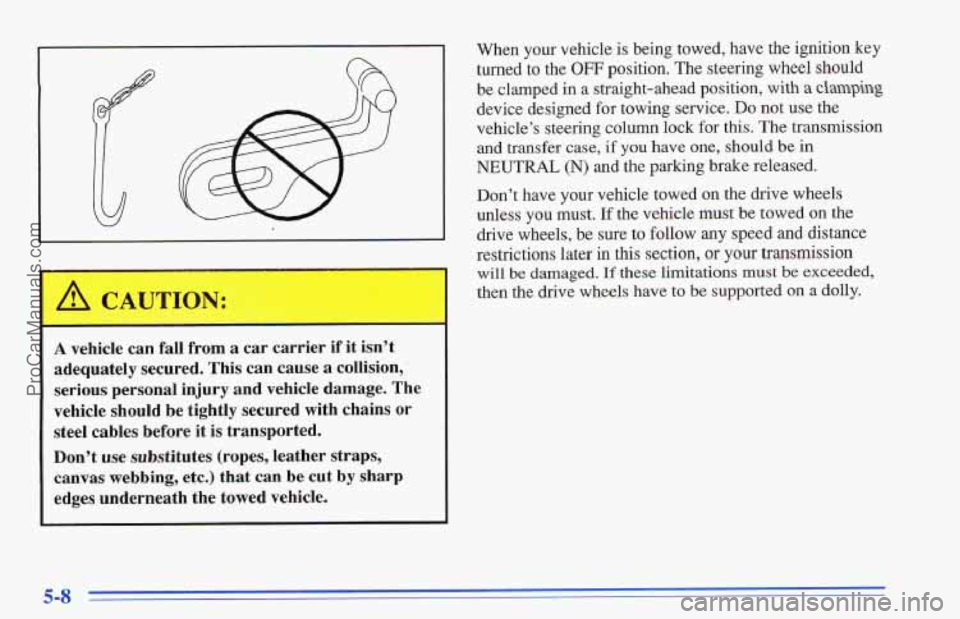
A vehicle can fall from a car carrier if it isn’t
adequately secured. This can cause
a collision, ‘
serious personal injury and vehicle damage. The
vehicle should be tightly secured with chains or
steel cables before
it is transported.
Don’t
use substitutes (ropes, leather straps,
canvas webbing,
etc.) that can be cut by sharp
edges underneath the towed vehicle.
When your vehicle is being towed, have the ignition key
turned to the OFF position. The steering wheel should
be clamped in a straight-ahead position, with a clamping
device designed for towing service. Do not use the
vehicle’s steering column lock for this.
The transmission
and
transfer case, if you have one, should be in
NEUTRAL (N) and the parking brake released.
Don’t have your vehicle towed
on the drive wheels
unless
you must. If the vehicle &ust be towed on the
drive wheels, be sure to follow any speed and distance
restrictions later
in this section, or your transmission
will be damaged. If these limitations must be exceeded,
then the drive wheels have to be supported on a dolly.
5-8
ProCarManuals.com
Page 223 of 387
If a Tire Goes Plat
It’s unusual for a tire to “blow out” while you’re driving,
especiaIIy
if you maintain your tires properly. If air goes
out
of a tire, it’s much more likely to leak put slowly.
But if you should ever have a “blowout,” here are a few
tips about
what to expect and what to do:
If a front tire fails, the flat tire will create a drag that
pulls the vehicle toward that side. Take your foot
off the
accelerator pedal
and grip the steering wheel firmly.
Steer to maintain lane position, and then gently brake to
a stop well out
of the traffic lane.
A rear blowout, particularly on a curve, acts much like a
skid and may require the same correction you’d use in a
skid. In any rear blowout, remove your foot from the
accelerator pedal. Get the vehicle under control by
steering the way you want the vehicle to go.
It may be
very
bumpy and noisy, but you can still steer. Gently
brake to a stop
-- well off the road if possible.
If a tire goes flat, the next part shows how to use your
jacking equipment to change a flat tire safely.
Changing a Flat Tire
If a tire goes flat, avoid further tire and wheel damage
by driving slowly
to a level place. Turn on your hazard
warning flashers.
I
’ A CAUTION:
Changing a tire can cause an injury. The vehicle
can slip
off the jack and roll over you or other
people.
You and they could be badly injured.
Find
a level place to change your tire. To help
prevent the vehicle
from moving:
1. Set the parking brake firmly.
2. Put an automatic transmission shift
lever in PARK (P) or shift a manual
transmission to FIRST (1) or
REVERSE
(R).
3. If you have a four-wheel-drive vehicle,
be sure the transfer case is in
a drive
gear
-- not in NEUTRAL (N).
4. Turn off the engine.
To be even more certain the vehicle won’t move,
you can put blocks at the front and rear of the
tire farthest away from the one being changed.
That would be the tire on the other side of the
vehicle,
at the opposite end.
~~
5-22
ProCarManuals.com
Page 235 of 387
Rocking your vehicle to.get it out: Using the Recovery Hooks
First,
turn your steering wheel left and right. That will
clear
the area around your front wheels. Then shift back
and forth between
REVERSE (R) and a forward gear
(or with a manual transmission, b’etween FIRST (1) or
SECOND (2) and REVERSE(R)), spinning the wheels
as little as possible. Release the accelerator pedal while
you shift, and press lightly on the accelerator pedal
when the transmission is in gear.
If that doesn’t get you
out after a few tries, you may need to be towed out. Or,
you can use your recovery
hooks if your vehicle has
them. If you do need to be towed out, see “Towing Your
Vehicle” in the Index.
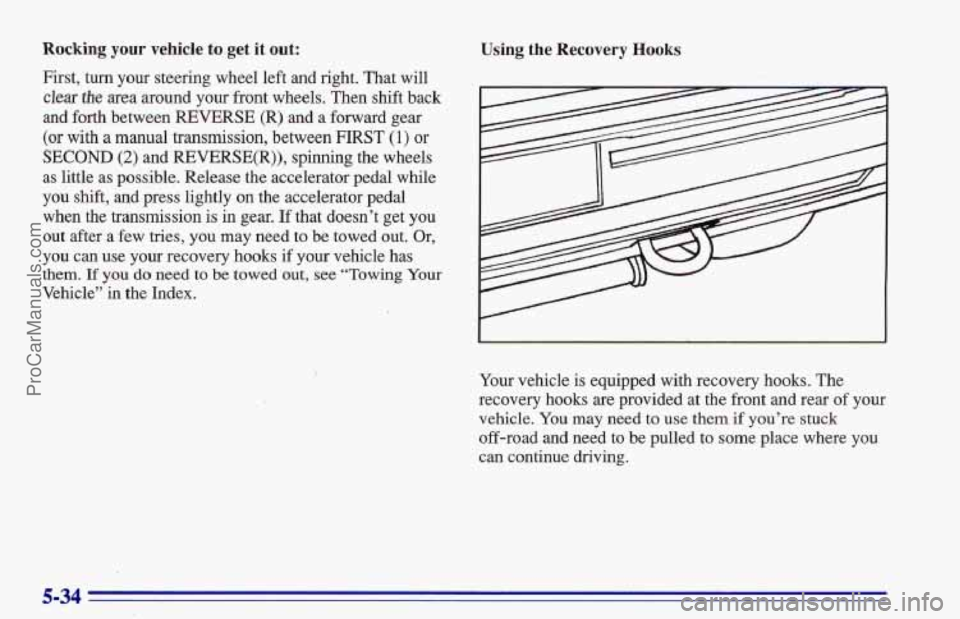
Your vehicle
is equipped with recovery hooks. The
recovery hooks
are provided at the front and rear of your
vehicle. You may need to use them if you’re stuck
off-road and need to be pulled to some place where you
can continue driving.
5-34
ProCarManuals.com
Page 353 of 387
Steering Column Lock Check
While parked, and with the parking brake set, try to turn
the
key to LOCK in each shift lever position.
With an automatic transmission, the key should turn
to LOCK only when the shift lever is in PARK (P).
With a manual transmission, the key should turn to
LOCK only if you push the key in farther, while
turning it towards
LOCK.
On vehicles with a key release lever, try to turn the key
to LOCK without pressing the lever. The key should
turn to LOCK only when you press the key lever.
On all vehicles, the key should come out only in LOCK.
Parking Brake and Automatic Transmission
PARK (P) Mechanism Check
/d CAUTION:
When you are doing this check, your vehicle
could begin to
move. You or others could be
injured and property
could be damaged. Make
sure there
is room in front of your vehicle in case
it begins
to roll. Be ready to apply the regular
brake at once should the vehicle begin to move.
Park on a fairly steep hill, with the vehicle facing
downhill. Keeping your foot on the regular brake, set the
parking brake.
To check the parking brake: With the engine running
and transmission in NEUTRAL (N), slowly remove
foot pressure from the regular brake pedal.
Do this
until the vehicle is held by the parking brake only.
To check the PARK (P) mechanism’s holding ability:
Shift to
PARK (P). Then release all brakes. If your
vehicle is four-wheel
drive, be sure the transfer case
is not in NEUTRAL (N).
Underbody Flushing Service
At least every spring, use plain water to flush any
corrosive materials from the underbody. Take care to
clean thoroughly any areas where mud and other debris
can collect.
7-50
ProCarManuals.com
Page 354 of 387
Part C: Periodic Maintenance
Inspections
Listed below are inspections and services which should
be performed at least twice a year (for instance, each
spring and fall). You should let your
GM dealer’s
service department or other qualified service center do
these jobs. Make sure any necessary repairs are
completed at once.
Proper procedures to perform these services may be
found
in a Geo service manual. See “Service and Owner
Publications” in the Index.
Steering, Suspension and Front- Wheel-Drive
Axle
Boot and Seal Inspection
Inspect the front and rear suspension and steering
system for damaged, loose or missing
parts, signs of
wear, or lack of lubrication. Inspect the power steering
lines and hoses for proper hook-up, binding, leaks,
cracks, chafing, etc. Clean and then inspect the drive
axle boot seals for damage, tears or leakage. Replace
seals if necessary.
Exhaust System Inspection
Inspect the complete exhaust system. Inspect the body
near the exhaust system.
Look for broken, damaged,
missing or out-of-position parts as well as open seams,
holes, loose connections, or other conditions which
could cause a heat build-up in the floor pan or could let
exhaust fumes into the vehicle. See “Engine Exhaust”
in
the Index.
Radiator and Heater Hose Inspection
Inspect the hoses and have them replaced if they are
cracked, swollen or deteriorated. Inspect all pipes,
fittings and clamps; replace as needed.
7-51
ProCarManuals.com
Page 356 of 387
Part D: Recommended Fluids and
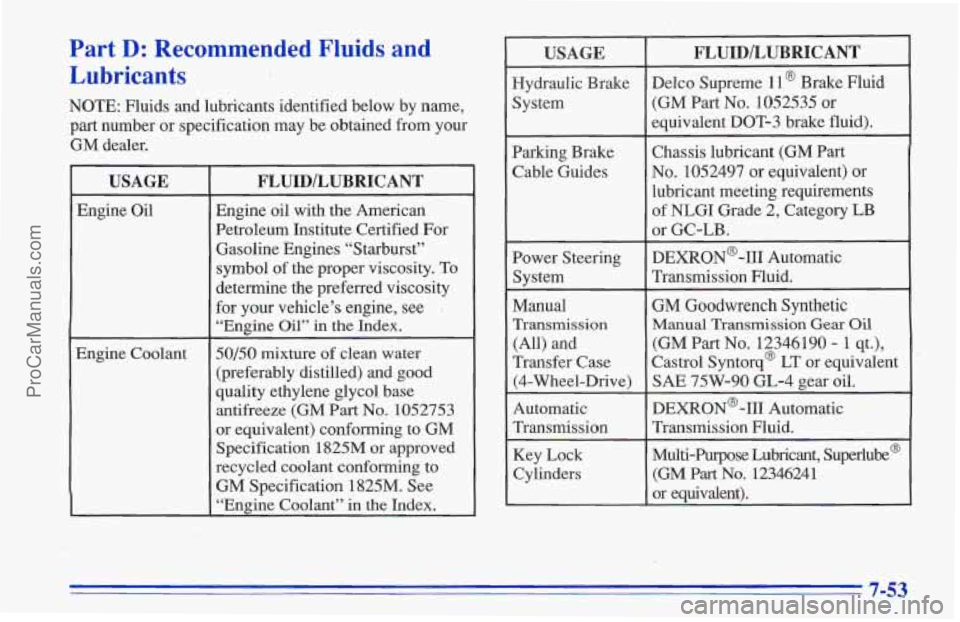
Lubricants
NOTE: Fluids and lubricants identified below by name,
part number or specification may be obtained from your
GM dealer.
USAGE
Engine Oil
Engine Coolant
FLUIDlLUBRICANT
Engine oil with the American
Petroleum Institute Certified For
Gasoline Engines “Starburst”
symbol
of the proper viscosity. To
determine the preferred viscosity
for your vehicle’s engine, see
“Engine Oil” in the Index.
50/50 mixture of clean water
(preferably distilled) and good
quality ethylene glycol base
antifreeze
(GM Part No. 1052753
or equivalent) conforming to GM
Specification 1825M
or approved
recycled coolant conforming
to
GM Specification 1825M. See
“Engine Coolant” in
the Index.
USAGE
Hydraulic Brake
System
Parking Brake
Cable Guides
Power Steering
System
Manual
Transmission
(All) and
Transfer Case
(4-Wheel-Drive)
~
Automatic
Transmission
Key Lock
Cylinders
FLUIDlLUBRICANT
Delco Supreme 11 @ Brake Fluid
(GM Part
No. 1052535 or
equivalent DOT-3 brake fluid).
Chassis lubricant (GM Part
No. 1052497 or equivalent) or
lubricant meeting requirements
of NLGI Grade 2, Category’ LB
or GC-LB.
DEXR0N’-I11 Automatic
Transmission Fluid.
GM Goodwrench Synthetic
Manual Transmission Gear Oil
(GM Part No. 12346190 - 1 qt.),
Castrol Syntorq@
LT or equivalent
SAE 75W-90 GL-4 gear oil.
DEXRON@-I11 Automatic
Transmission Fluid.
Multi-F‘urpose Lubricant, Superlube@
(GM Part No. 12346241
or equivalent).
7-53
ProCarManuals.com
Page 379 of 387
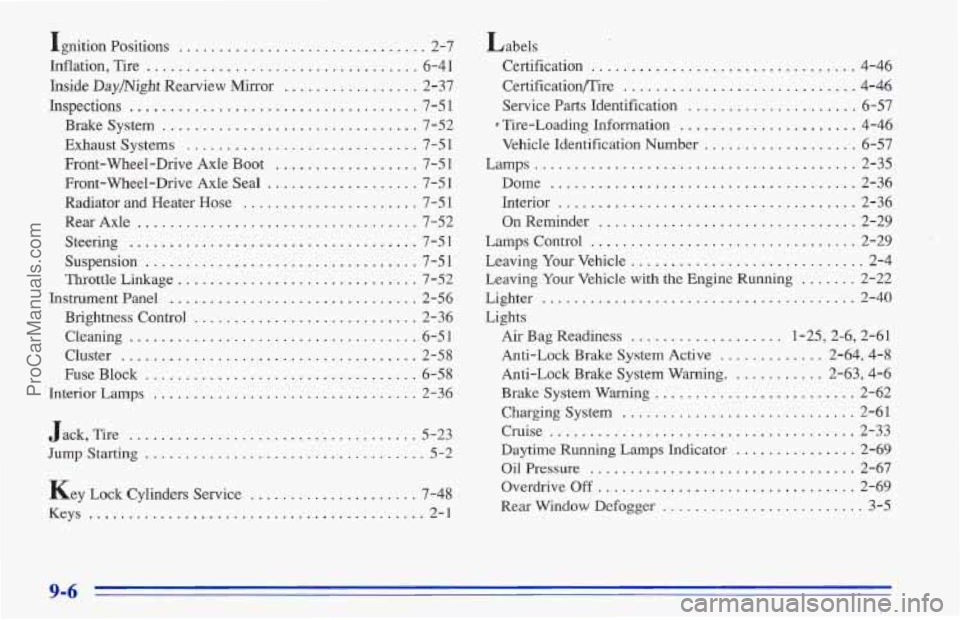
Ignition Positions ....... ............ 2-4
Inflation, Tire
................................ 6-41
Inside Daymight Rearview Mirror ................. 2-37
Inspections
.................................... 7-51
Exhaust Systems
............................. 7-5 1
Front-Wheel-Drive Axle Boot .................. 7-5 1
Front-Wheel-Drive Axle Seal ................... 7-5 1
Radiator and Heater Hose ...................... 7-51
RearAxle
................................... 7-52
Steering
.................................... 7-51
Suspension
................... ........... 7-51
Throttle Linkage
.............................. 7-52
Instrument Panel
............................... 2-56
Brightness Control
............................ 2-36
Cleaning
.................................... 6-51
Cluster ..................................... 2-58
Fuse Block .................................. 6-58
Interior
Lamps .................... ... 2-36
Brake
System
.... ....................... 7-52
Jack. Tire
....
Jump Starting . .
.................... 5-23
................... 5-2
Key Lock Cylinders Service ..................... 7-48 .
Keys .......................................... 2-1
Labels
Certification
................................. 4-46
Certification/Tire
............................. 4-46
Service Parts Identification ..................... 6-57
8 Tire-Loading Information ...................... 4-46
Vehicle Identification Number ................... 6-57
Lamps
...................................... 2-35
Dome ................. ........... 2-36
Interior
............ ......... 2-36
On Reminder ......... , ... ....... 2-29
Lamps Control
........................ . . 2-29
Leaving
Your Vehicle ............................. 2-4
Leaving Your Vehicle with the Engine Running
....... 2-22
Lighter
....................................... 2-40
Lights
Air Bag Readiness
................... 1-25.2.6. 2-61
Anti-Lock
Brake System Active ............. 2-64. 4-8
Anti-Lock Brake System Warning
....... . . 2.63, 4.6
Brake System Warning
........... .... 2-62
Charging System
........................... 2-61
Cruise ...................................... 2-33
Daytime Running Lamps Indicator ............... 2-69
Oil Pressure ................................. 2-67
Overdrive0
fi ................................ 2-69
Rear Window Defogger
......................... 3-5
9-6
ProCarManuals.com