four wheel drive CHEVROLET TRACKER 1997 User Guide
[x] Cancel search | Manufacturer: CHEVROLET, Model Year: 1997, Model line: TRACKER, Model: CHEVROLET TRACKER 1997Pages: 388, PDF Size: 20.12 MB
Page 77 of 388
Shifting Into PARK (P) (Automatic
Tran ~ nission Models Only)
It can be dangerous to get out of your vehicle if
the shift lever is not fully in PARK (P) with the
parking brake firmly set. Your vehicle can roll.
If you have left the engine running, the vehicle
can move suddenly. You or others could be
injured.
To be sure your vehicle won’t move, even
when you’re on fairly level ground, use the steps
that follow.
If you have four-wheel drive and
your transfer case is in
NEUTRAL (N), your
vehicle will be free to roll, even
if your shift lever
is in
PARK (P). So, be sure the transfer case is in
a drive gear -- not in NEUTRAL (N). If you’re
pulling a trailer, see “Towing a Trailer” in
the Index.
1. Hold the brake pedal down with your right foot and
2. Move the shift lever into PARK (P) by holding in the
button
on the lever and pushing the lever all the way
toward the front
of your vehicle.
set
the parking brake.
3. If you have four-wheel drive, be sure the transfer
case
is in a drive gear -- not in NEUTRAL (N).
4. Move the key to LOCK.
5. Remove the key and take it with you. If you can
leave your vehicle with the key
in your hand, your
vehicle is in
PARK (P).
2-23
ProCarManuals.com
Page 78 of 388
Leaving Your Vehicle With the Engine
Running (Automatic Transmission
Models Only)
I
It can be dangerous to leave your vehicle with the
engine running. Your vehicle could move
suddenly if the shift lever is not fully in
PARK (P)
with the parking brake firmly set. If you have
four-wheel drive and your transfer case is in
NEUTRAL (N), your vehicle will be free to roll,
even if your shift lever is in
PARK (P). So be sure
the transfer case is
in a drive gear -- not in
NEUTRAL (N). And, if you leave the vehicle with
the engine running, it could overheat and even
catch fire. You or others could be injured. Don’t
leave your vehicle with the engine running unless
you have to.
Torque Lock (Automatic Transmission)
If you are parking on a hill and you don’t shift your
transmission into PARK (P) properly, the weight
of the
vehicle may put too much force
on the parking pawl in
the transmission. You may find it difficult to pull the
shift lever out
of PARK (P). This is called “torque lock.”
To prevent torque lock, set the parking brake and then
shift into PARK
(P) properly before you leave the
driver’s seat. To find out how, see “Shifting Into
PARK (P)” in the Index.
When you are ready to drive, move the shift lever out of
PARK
(P) before you release the parking brake.
If torque lock does occur, you may need to have another
vehicle push yours a little uphill to take some of the
pressure from the parking pawl in the transmission,
so
you can pull the shift lever out of PARK (P).
2-24
ProCarManuals.com
Page 80 of 388
5. Inside you'll see the return plate (C). Using your
finger, move the return plate toward the rear
of the
vehicle until it stops.
6. Move the shift lever into the gear you want.
7. Have the vehicle fixed as soon as possible.
Parking Your Vehicle
(Manual Transmission)
Before you get out of your vehicle, put your manual
transmission in
REVERSE (R) and firmly apply the
parking brake.
If you have four-wheel drive, be sure your transfer case
is in a drive gear. Your vehicle could roll if it isn't.
If you are towing
a trailer, see "Towing a Trailer" in
the Index.
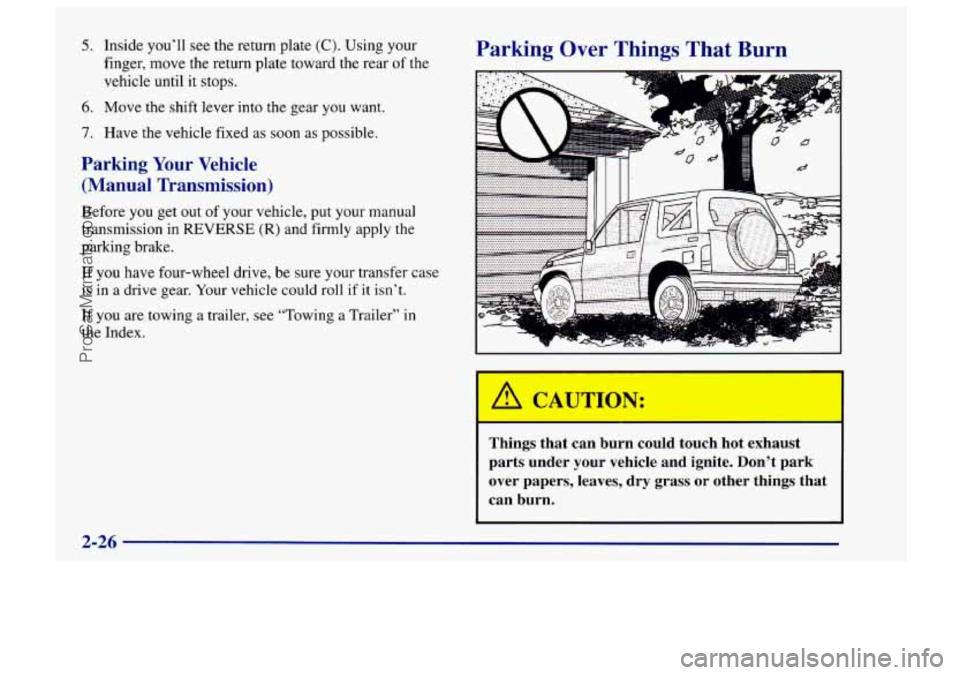
Parking Over Things That Burn
I -w---- I .. . . . . . . . . . u --
A
I
Things that can burn could touch hot exhaust
parts under your vehicle and ignite. Don't park
over papers, leaves, dry grass or other things that
can burn.
2-26
ProCarManuals.com
Page 82 of 388
Windows
Manual Windows
7-
It can be dangerous to get out of your vehicle if
the shift lever is not fully in PARK (P) with the
parking brake firmly set. Your vehicle can roll.
Don’t leave your vehicle when the engine is
running unless you have to. If you’ve left the
engine running, the vehicle can move suddenly.
You or others could be injured.
To be sure your
vehicle won’t move, even when you’re on fairly
level ground, always set your parking brake and
move the shift lever
to PARK (P).
If you have four-wheel drive and your transfer case is in
NEUTRAL (N), your vehicle will be free to roll, even if
your shift lever is in PARK (P). So, be sure the transfer
case is
in a drive gear -- not in NEUTRAL (N). Always
set your parking brake. Follow the proper steps to be
sure your vehicle won’t move. See “Shifting Into
PARK
(P)” in the Index.
If you’re pulling a trailer, see “Towing
a Trailer” in
the Index. Use the
window crank
to open and close each
door window.
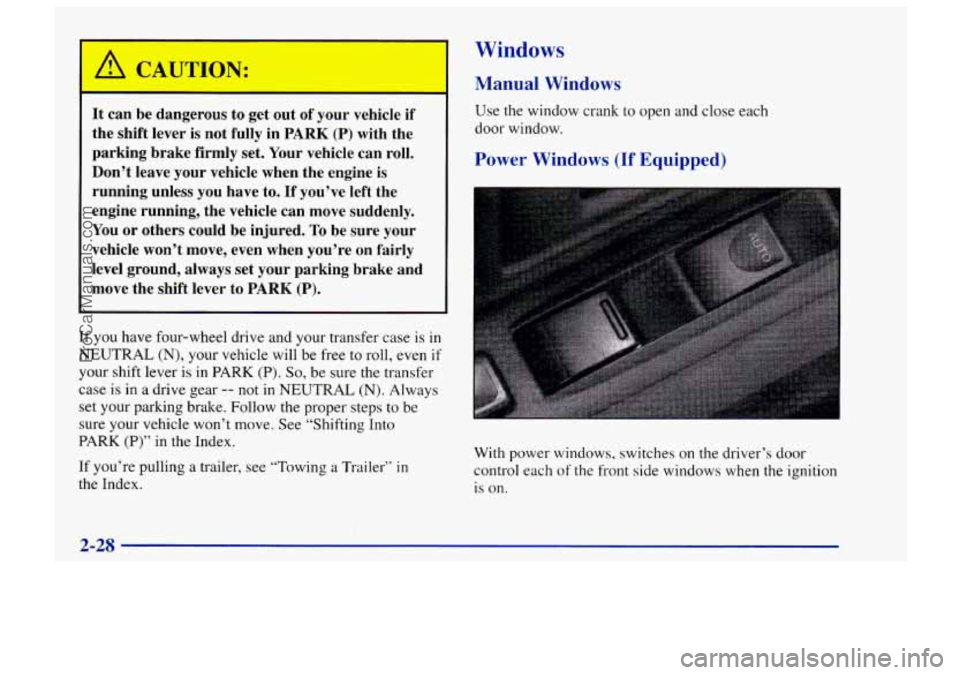
Power Windows (If Equipped)
With power windows, switches on the driver’s door
control each
of the front side windows when the ignition
is on.
2-28
ProCarManuals.com
Page 156 of 388
Steering
Power Steering
If you lose power steering assist because the engine
stops or the system is not functioning, you can steer but
it will take much more effort.
Steering Tips
Driving on Curves
It’s important to take curves at a reasonable speed.
A lot of the “driver lost control” accidents mentioned on
the news happen on curves. Here’s why:
Experienced driver or beginner, each of us is subject to
the same laws
of physics when driving on curves. The
traction
of the tires against the road surface makes it
possible for the vehicle to change its path when you turn
the front wheels. If there’s no traction, inertia will keep
the vehicle going
in the same direction. If you’ve ever
tried to steer a vehicle on wet ice, you’ll understand this.
The traction you can get in a curve depends on the
condition of your tires and the road surface, the angle at
which the curve
is banked, and your speed. While you‘re
in a curve, speed is the one factor you can control. Suppose you’re steering through
a sharp curve. Then you
suddenly apply the brakes. Both control systems
-- steering
and braking
-- have to do their work where the tires meet
the road. Unless you have four-wheel anti-lock brakes,
adding the hard braking can demand too much of those
places. You can lose control.
The same thing can happen
if you’re steering through a
sharp curve and you suddenly accelerate. Those two
control systems
-- steering and acceleration -- can
overwhelm those places where the tires meet the road
and make you lose control.
What should
you do if this ever happens? Ease up on the
brake or accelerator pedal, steer the vehicle the way
you
want it to go, and slow down.
Speed limit signs near curves warn that you should
adjust your speed. Of course, the posted speeds are
based
on good weather and road conditions. Under less
favorable conditions you’ll want to go slower.
If you need to reduce your speed as you approach a
curve, do
it before you enter the curve, while your front
wheels are straight ahead.
Try to adjust your speed
so you can “drive” through the
curve. Maintain
a reasonable, steady speed. Wait to
accelerate
until you are out of the curve, and then
accelerate gently into the straightaway.
4-10
ProCarManuals.com
Page 161 of 388
Driving Guidelines
This multipurpose passenger vehicle is defined as a
utility vehicle in Consumer Information Regulations
issued by the National Highway Traffic Safety
Administration (NHTSA) of the United States
Department of Transportation. Utility vehicles have
higher ground clearance and a narrower track to make
them capable of performing in a wide variety
of off-road
applications. Specific design characteristics give them a
higher center
of gravity than ordinary cars. An
advantage of the higher ground clearance is a better
view of the road allowing you
to anticipate problems.
They are not designed for cornering at the same speeds
as conventional two-wheel-drive vehicles any more than
low-slung sports cars are designed to perform
satisfactorily under off-road conditions. If at all
possible, avoid sharp turns or abrupt maneuvers.
As with other vehicles of this type, failure to operate
this vehicle correctly may result in loss of control or
vehicle rollover.
Off-Road Driving with Your Geo
Four- Wheel-Drive Vehicle
This off-road guide is for vehicles that have
four-wheel drive.
Also, see “Anti-Lock Brakes’’
in the Index.
If your vehicle doesn’t have four-wheel drive, you
shouldn’t drive off-road unless you’re
on a level,
solid surface.
Off-road driving can be great fun. But it does have
some definite hazards. The greatest of these
is the
terrain itself.
“Off-roading” means you’ve left the great North
American road system behind. Traffic lanes aren’t
marked. Curves aren’t banked. There
are no road signs.
Surfaces can be slippery, rough, uphill or downhill. In
short, you’ve gone right back to nature.
Off-road driving involves some new skills. And that’s
why it’s very important that you read this guide. You’ll
find many driving tips and suggestions. These will help
make your off-road driving safer and more enjoyable.
ProCarManuals.com
Page 162 of 388
Before You Go Off-Roading
There are some things to do before you go out.
For example, be sure to have all necessary maintenance
and service work done. Check to make sure all
underbody shields (if
so equipped) are properly
attached. Be sure you read all the information about
your four-wheel-drive vehicle in this manual.
Is there
enough fuel?
Is the spare tire fully inflated? Are the
fluid levels up where they should be? What are the local
laws that apply to off-roading where you’ll be driving?
If you don’t know, you should check with law
enforcement people in the area. Will you be on
someone’s private land?
If so, be sure to get the
necessary permission.
Loading Your Vehicle for Off-Road Driving
There are some important things to remember about
how to load your vehicle.
0 The heaviest things should be on the load floor and
forward of your rear axle. Put heavier items as far
forward as you can.
Be sure the load is secured properly, so driving on
the off-road terrain doesn’t toss things around.
/r CAUTIOI .:
0 Cargo on the load floor piled higher than
the seatbacks can be thrown forward
during
a sudden stop. You or your
passengers could be injured. Keep cargo
below the top of the seatbacks.
0 Unsecured cargo on the load floor can be
tossed about when driving over rough
terrain. You or your passengers can be
struck by flying objects. Secure the
cargo properly.
Heavy loads on the roof raise the vehicle’s
center of gravity, making
it more likely to
roll over. You can be seriously or fatally
injured
if the vehicle rolls over. Put heavy
loads inside the cargo area, not on the roof.
Keep cargo in the cargo area as far forward
and low as possible.
You’ll find other important information in this manual.
See ‘Vehicle Loading,” “Luggage Carrier” and “Tires”
in the Index.
ProCarManuals.com
Page 191 of 388
I NOTICE:
Do not tow your Geo with the rear wheels in
contact with the ground, or the transmission
could be damaged.
2.
3.
4.
Set the parking brake.
If your Geo is a four-wheel-drive vehicle, set your
manual free-wheeling hubs to
FREE or unlock your
automatic freewheeling hubs. See “Four-wheel
Drive” in the Index.
Turn the ignition key to ACC to unlock the
steering wheel.
I NOTICE:
Make sure that the towing speed does not
exceed
55 mph (90 km/h), or your Geo could be
badly damaged.
Towing from the Front
h
I1 I
I NOTICE: I
If your vehicle has automatic freewheeling hubs
or two-wheel drive,
do not tow it on all four
wheels.
If you do, your transmission could
be damaged.
4-45
I
ProCarManuals.com
Page 192 of 388
If you have a four-wheel-drive vehicle with manual
freewheeling hubs, it can be towed from the front with
all four wheels on the ground. Follow these steps:
1. Set the parking brake.
2. Turn the ignition key to ACC to unlock the
steering wheel.
3. Shift your automatic transmission into PARK (P), or
your manual transmission to SECOND (2).
4. Shift the transfer case to NEUTRAL (N).
5. Set the hubs to FREE. See “Four-Wheel-Drive” in
the Index.
6. Release the parking brake.
Stop towing every
200 miles (300 km) and start
the engine. Leave the transfer case shift lever
in
NEUTRAL (N). Shift your automatic transmission
to
DRIVE (D); leave a manual transmission in
SECOND (2) with the clutch engaged. Run the engine at
medium speed for one minute to circulate oil in the
transfer case.
Turn the ignition key to ACC. Now you
can continue towing your Geo.
I NOTICE:
The front wheels transmit shocks during towing.
The steering column may not be strong enough to
withstand the shocks. Always unlock the steering
wheel before towing.
NOTICE:
Make sure that the towing speed does not
exceed
50 mph (80 kmh), or your Geo could be
badly damaged.
4-46
ProCarManuals.com
Page 193 of 388
Loading Your Vehicle
TIRE PLACARD
I GWVR IGWR FRT~ GAWR RR 1
LB/Kg
TI RES
I RIMS
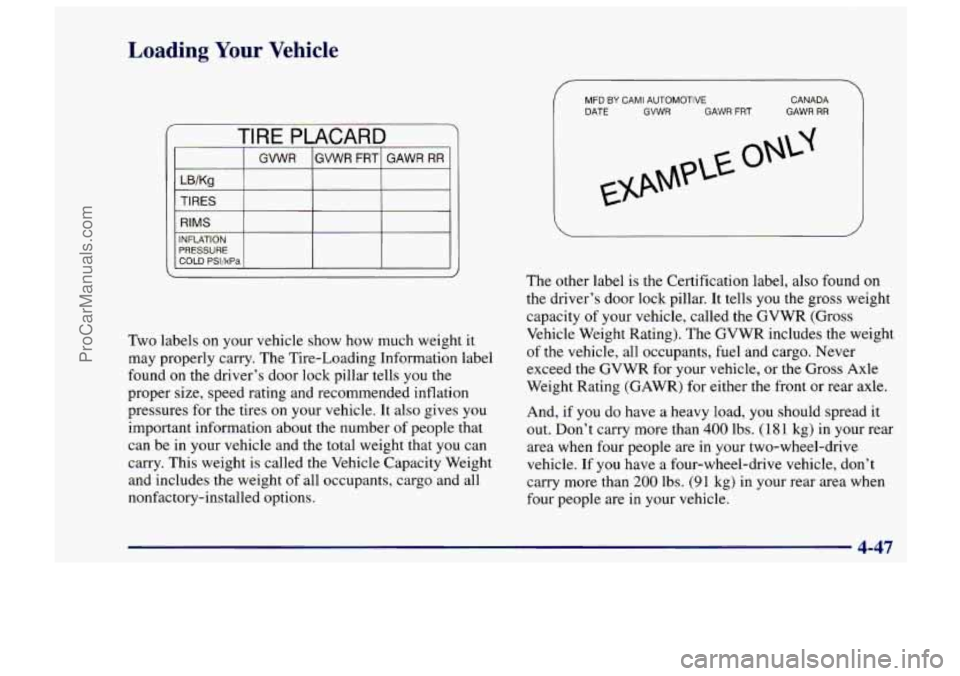
Two labels on your vehicle show how much weight it
may properly carry. The Tire-Loading Information label
found
on the driver’s door lock pillar tells you the
proper size, speed rating and recommended inflation
pressures for the tires on your vehicle. It also gives
you
important information about the number of people that
can be in your vehicle and the total weight that you can
carry. This weight is called the Vehicle Capacity Weight
and includes the weight of all occupants, cargo and all
nonfactory-installed options.
MFD BY CAM1 AUTOMOTIVE
DATE
GVWR GAWR FRT
CANADA
GAWR RR
The other label is the Certification label, also found on
the driver’s door lock pillar. It tells
you the gross weight
capacity
of your vehicle, called the GVWR (Gross
Vehicle Weight Rating). The GVWR includes the weight
of the vehicle, all occupants, fuel and cargo. Never
exceed the GVWR for your vehicle, or the
Gross Axle
Weight Rating (GAWR) for either the front or rear axle.
And,
if you do have a heavy load, you should spread it
out. Don’t carry more than
400 lbs. (181 kg) in your rear
area when four people are in your two-wheel-drive
vehicle. If you have a four-wheel-drive vehicle, don’t
carry more than
200 Ibs. (91 kg) in your rear area when
four people are in your vehicle.
4-47
I
ProCarManuals.com